MCQ
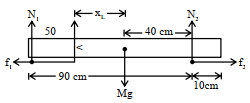
Put a uniform meter scale horizontally on your extended index fingers with the left one at $0.00 cm$ and the right one at $90.00 cm$. When you attempt to move both the fingers slowly towards the center, initially only the left finger slips with respect to the scale and the right finger does not. After some distance, the left finger stops and the right one starts slipping. Then the right finger stops at a distance $x_R$ from the center ( $50.00 cm$ ) of the scale and the left one starts slipping again. This happens because of the difference in the frictional forces on the two fingers. If the coefficients of static and dynamic friction between the fingers and the scale are $0.40$ and $0.32$ , respectively, the value of $x_R($ in $cm )$ is. . . . . . . 
  • $25.60$
  • B
    $25.65$
  • C
    $25.70$
  • D
    $25.75$

Answer

Correct option: A.
$25.60$
a
Initially

$N _1+ N _2= Mg  N _1=\frac{4 Mg }{9}$

$\left(\tau_{ N }=0\right) N _1(50)= N _2(40)  N _2=\frac{5 Mg }{9}$

$5 N _1=4 N _2$

$f_{l_k}=\mu_k N_1 \quad f_{l_L}=\mu_S N_1$

$f_{i_k}=0.32 N _1 \quad f_{l_1}=0.4 N _1$

$\overline{f_{2 k}=0.32 N _2} \quad \overline{f_{2 L }=0.4 N _2}$

Suppose $x _{ L }=$ distance of left finger from centre when right finger starts moring

$\left(\tau_{ n }=0\right)_{\text {about cratre }} \Rightarrow N _1 x _{ L }= N _2(40)$

$f_{ K _1}= f _{ L _2} \quad \Rightarrow 0.32 N _1=0.40 N _2$

$4 N _1=5 N _2$

$N _{ I } x _{ L }=\frac{4 N _1}{5}(40)$

$x _{ L }=32$

Now $x _{ R }=$ distance when right finger stops and left finger starts moring

$\left(\tau_{ n }=0\right)_{\text {atout centre }} \Rightarrow N _1 x _{ L }= N _2\left( x _{ R }\right)$

$f _{ L _1}= f _{ K _2} \Rightarrow 0.4 N _1=0.32 N _2$

$5 N _1=4 N _2$

$\frac{4 N _2}{5}(32)= N _2 x _{ R }$

$x _{ R }=\frac{128}{5}=25.6 cm$

Need a full question paper?

Generate a complete, print-ready paper with questions like this in minutes — across 16+ boards, with answer keys.

Start Generating Free

Similar questions

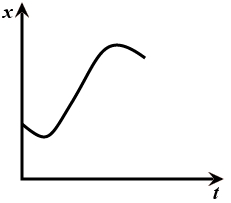
The accompanying graph of position $x$ versus time $t$ represents the motion of a particle. If $p$ and $q$ are both positive constants, the expression that best describes the acceleration $a$ of the particle is
Two bodies $A$ and $B$ of mass $m$ and $2\, m$ respectively are placed on a smooth floor. They are connected by a spring of negligible mass. $A$ third body $C$ of mass $m$ is placed on the floor. The body $C$ moves with a velocity $v_0$ along the line joining $A$ and $B$ and collides elastically with $A$. At a certain time after the collision it is found that the instantaneous velocities of $A$ and $B$ are same and the compression of the spring is $x_0$. The spring constant $k$ will be
A smooth wedge A is fitted in a chamber hanging from a fixed ceiling near the earth's surface. A block B placed at the top of the wedge takes a time T to slide down the length of the wedge. If the block is placed at the top of the wedge and the cable supporting the chamber is broken at the same instant, the block will:
  1. Take a time longer than T to slide down the wedge.
  2. Take a time shorter than T to slide down the wedge.
  3. Remain at the top of the wedge.
  4. Jump off the wedge.
Velocity of a particle is in negative direction with constant acceleration in positive direction. Then, match the following columns.
Colum $I$ Colum $II$
$(A)$ Velocity-time graph $(p)$ Slope $\rightarrow$ negative
$(B)$ Acceleration-time graph $(q)$ Slope $\rightarrow$ positive
$(C)$ Displacement-time graph $(r)$ Slope $\rightarrow$ zero
  $(s)$ $\mid$ Slope $\mid \rightarrow$ increasing
  $(t)$ $\mid$ Slope $\mid$ $\rightarrow$ decreasing
  $(u)$ |Slope| $\rightarrow$ constant
A bullet of $'4\,g'$ mass is fired from a gun of mass $4 \,{kg}$. If the bullet moves with the muzzle speed of $50\, {ms}^{-1}$, the impulse imparted to the gun and velocity of recoil of gun are :
A lead bullet at $27°C$ just melts when stopped by an obstacle. Assuming that $25\%$ of heat is absorbed by the obstacle, then the velocity of the bullet at the time of striking........ $m/sec$  ($M.P.$ of lead $= 327°C,$ specific heat of lead $= 0.03\, cal/gm°C,$ latent heat of fusion of lead $= 6\, cal/gm$ and $J = 4.2\, joule/cal)$
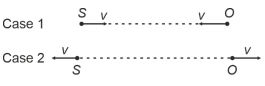
A source $(S)$ of sound has frequency $240 \ Hz$. When the observer $(O)$ and the source move towards each other at a speed $v$ with respect to the ground (as shown in Case $1$ in the figure), the observer measures the frequency of the sound to be $288 \ Hz$. However, when the observer and the source move away from each other at the same speed $v$ with respect to the ground (as shown in Case $2$ in the figure), the observer measures the frequency of sound to be $n Hz$. The value of $n$ is. . . . . .
Two rectangular blocks $A$ and $B$ of different metals have same length and same area of cross-section. They are kept in such a way that their cross-sectional area touch each other. The temperature at one end of $A$ is $100°C$ and that of $B$ at the other end is $0°C$ . If the ratio of their thermal conductivity is $1 : 3$ , then under steady state, the temperature of the junction in contact will be ........ $^oC$
Two non-mixing liquids of densities $\rho $ and $n \rho \,(n > 1)$ are put in a container. The height of each liquid is $h.$ A solid cylinder of length $L$ and density $d$ is put in this container. The cylinder floats with its axis vertical and length $\rho L (\rho < 1)$ in the denser liquid. The density $d$ is equal to
Modulus of rigidity of ideal liquids is
  1. Infinity.
  2. Zero.
  3. Unity.
  4. Some finite small non - zero constant value.