Question
Quantitative analysis of an organic compound (X) shows following % composition.
C : 14.5 %
$\mathrm{Cl}: 64.46 %$
H: 1.8 %
(Empirical formula mass of the compound $(\mathrm{X})$ is
\______________ $\times 10^{-1}$
$\overline{\text { (Given }}$ molar mass in $\mathrm{g} \mathrm{mol}^{-1}$ of $\mathrm{C}: 12, \mathrm{H}: 1$, $\mathrm{O}: 16, \mathrm{Cl}: 35.5$ )
Answer

1655
Sol. $\quad \mathrm{C}: \mathrm{Cl}: \mathrm{H}: \mathrm{O}$
$\begin{array}{lllll}\text { %mass } & 14.5 & 64.46 & 1.8 & 19.24\end{array}$
Molar ratio $\frac{14.5}{12} \quad \frac{64.46}{35.5} \quad \frac{1.8}{1} \quad \frac{19.24}{16}$
$
\begin{array}{llll}
1.2 & 1.8 & 1.8 & 1.2
\end{array}
$
$\begin{array}{lllll}\text { Minimum } & 2 & 3 & 3 & 2\end{array}$
integral ratio
Empiricial formula $=\mathrm{C}_{2} \mathrm{H}_{3} \mathrm{Cl}_{3} \mathrm{O}_{2}$
Mass $=165.5$
Mass $=1655 \times 10^{-1}$

Need a full question paper?

Generate a complete, print-ready paper with questions like this in minutes — across 16+ boards, with answer keys.

Start Generating Free

Similar questions

$2.5\, g$ of protein containing only glycine $\left( C _{2} H _{5} NO _{2}\right)$ is dissolved in water to make $500 \,mL$ of solution. The osmotic pressure of this solution at $300\, K$ is found to be $5.03 \times 10^{-3}$ $bar.$ The total number of glycine units present in the protein is $....$

(Given : $R =0.083\, L\, bar \,K ^{-1} \,mol ^{-1}$ )

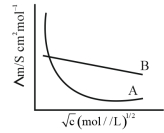
Following figure shows dependence of molar conductance of two electrolytes on concentration. $\Lambda \stackrel{0}{ m }$ is the limiting molar conductivity.The number of Incorrect statement(s) from the following is $...........$

$(A)$ $\Lambda \stackrel{0}{ m }$ for electrolyte $A$ is obtained by extrapolation

$(B)$ For electrolyte B, vx $\Lambda m$ vs $\sqrt{ c }$ graph is a straight line with intercept equal to $\Lambda \stackrel{0}{ m }$

$(C)$ At infinite dilution, the value of degree of dissociation approach zero for electrolyte $B$.

$(D)$ $\Lambda \stackrel{0}{ m }$ for any electrolyte $A$ or $B$ can be calculated using $\lambda^{\circ}$ for individual ions.

How many electrons are involved in the following redox reaction?

$C{r_2}O_7^{2 - } + F{e^{2 + }} + {C_2}O_4^{2 - } \to C{r^{3 + }} + F{e^{3 + }} + C{O_2}$ (Unbalanced)

The number of peptide bonds in the compound
How many compounds among the following
compounds show inductive, mesomeric as well as
hyperconjugation effects? 
 Image
Among $CrO, Cr_2O_3$ and $CrO_3,$ the sum of spin$-$only magnetic moment values of basic and amphoteric oxides is ______ $10^{–2} BM ($nearest integer$). ($Given atomic number of $Cr$ is $24)$
How many $EDTA$ molecules are required to make an octahedral complex with a $Ca^{2+}$ ion?
For a reaction, the rate constant is expressed as, $K = A.e^{-40000/T}$ . The energy of the activation is ....... $cal$
The number of correct statements from the following is :

$A.$ $E _{\text {cell }}$ is an intensive parameter.

$B.$ A negative $E^{\Theta}$ means that the redox couple is a stronger reducing agent than the $H ^{+} / H _2$ couple.

$C.$ The amount of electricity required for oxidation or reduction depends on the stoichiometry of the electrode reaction.

$D.$ The amount of chemical reaction which occurs at any electrode during electrolysis by a current is proportional to the quantity of electricity passed through the electrolyte.

At $25\,^oC$, the vapour pressure of pure liquid $A$ (mol. $wt. = 40$) is $100\, torr$, while that of pure liquid $B$ (mol.$wt. = 80$) is $40\,torr$. The vapour pressure at $25\,^oC$ of a solution containing $20\,gm$ of each $A$ and $B$ is .......... $torr$.