Questions

SECTION - B [CHEMISTY - NUMERIC]

Take a timed test

5 questions · self-marked practice — reveal the answer and mark yourself.

Question 14 Marks
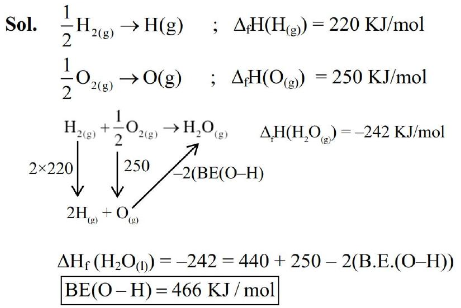
The formation enthalpies, $\Delta \mathrm{H}_{\mathrm{f}}^{\ominus}$ for $\mathrm{H}_{(\mathrm{g})}$ and $\mathrm{O}_{(\mathrm{g})}$ are 220.0 and $250.0 \mathrm{~kJ} \mathrm{~mol}^{-1}$, respectively, at 298.15 K , and $\Delta \mathrm{H}_{\mathrm{f}}^{-}$for $\mathrm{H}_{2} \mathrm{O}_{(\mathrm{g})}$ is $-242.0 \mathrm{~kJ} \mathrm{~mol}^{-1}$ at the same temperature. The average bond enthalpy of the $\mathrm{O}-\mathrm{H}$ bond in water at 298.15 K is __________ $\mathrm{kJ} \mathrm{mol}^{-1}$ (nearest integer).
Answer
466
Image
View full question & answer
Question 24 Marks
The molarity of a $70 \%$ (mass/mass) aqueous solution of a monobasic acid ( X ) is ___________________ M(Nearest integer) [Given : Density of aqueous solution of (X) is $1.25 \mathrm{~g} \mathrm{~mL}^{-1}$ Molar mass of the acid is $70 \mathrm{~g} \mathrm{~mol}^{-1}$ ]
Answer
125
Sol. Assuming 100 gm solution contain 70 gm solute.
Volume of 100 gm solution will be $\frac{100}{1.25} \mathrm{ml}$.
Molarity $=\frac{70 / 70}{100 / 1.25} \times 1000=12.5$ or $125 \times 10^{-1}$
View full question & answer
Question 34 Marks
Quantitative analysis of an organic compound (X) shows following % composition.
C : 14.5 %
$\mathrm{Cl}: 64.46 %$
H: 1.8 %
(Empirical formula mass of the compound $(\mathrm{X})$ is
\______________ $\times 10^{-1}$
$\overline{\text { (Given }}$ molar mass in $\mathrm{g} \mathrm{mol}^{-1}$ of $\mathrm{C}: 12, \mathrm{H}: 1$, $\mathrm{O}: 16, \mathrm{Cl}: 35.5$ )
Answer
1655
Sol. $\quad \mathrm{C}: \mathrm{Cl}: \mathrm{H}: \mathrm{O}$
$\begin{array}{lllll}\text { %mass } & 14.5 & 64.46 & 1.8 & 19.24\end{array}$
Molar ratio $\frac{14.5}{12} \quad \frac{64.46}{35.5} \quad \frac{1.8}{1} \quad \frac{19.24}{16}$
$
\begin{array}{llll}
1.2 & 1.8 & 1.8 & 1.2
\end{array}
$
$\begin{array}{lllll}\text { Minimum } & 2 & 3 & 3 & 2\end{array}$
integral ratio
Empiricial formula $=\mathrm{C}_{2} \mathrm{H}_{3} \mathrm{Cl}_{3} \mathrm{O}_{2}$
Mass $=165.5$
Mass $=1655 \times 10^{-1}$
View full question & answer
Question 44 Marks
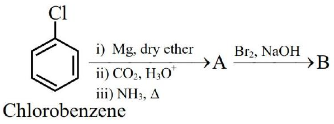
Consider the following sequence of reactions :
Image
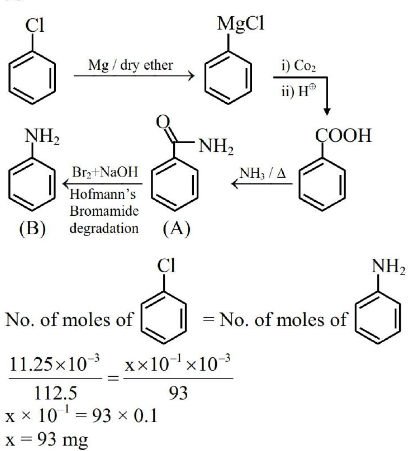
11.25 mg of chlorobenzene will produce_________ $\times 10^{-1} \mathrm{mg}$ of product B .
(Consider the reactions result in complete conversion.)
[Given molar mass of $\mathrm{C}, \mathrm{H}, \mathrm{O}, \mathrm{N}$ and Cl as 12,1 , 16,14 and $35.5 \mathrm{~g} \mathrm{~mol}^{-1}$ respectively]
Answer
93
Image
View full question & answer
Question 54 Marks
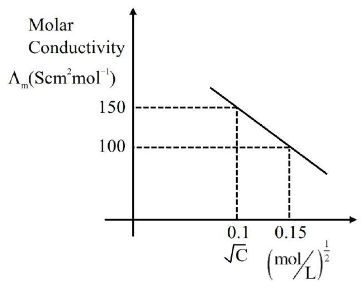
Given below is the plot of the molar conductivity vs $\sqrt{\text { concentration }}$ for KCl in aqueous solution.
Image
If, for the higher concentration of KCl solution, the resistance of the conductivity cell is $100 \Omega$, then the resistance of the same cell with the dilute solution is ' $x$ ' $\Omega$.
The value of $x$ is ___________ (Nearest integer)
Answer
150
$\mathrm{R}=\rho \frac{\ell}{\mathrm{A}}$
$
\begin{gathered}
\kappa=\mathrm{G}_{\mathrm{l}} \mathrm{G}^{*} \mathrm{G}=\frac{1}{\mathrm{R}} ; \kappa=\frac{1}{\rho} \\
\mathrm{G}^{*}=\frac{\ell}{\mathrm{A}} \\
\mathrm{R}=\text { Resistance } \\
\rho=\text { Resistivity } \\
\frac{\ell}{\mathrm{A}}=\text { cell constant }\left(\mathrm{G}^{*}\right) \\
\frac{\kappa_{\mathrm{c}}}{\kappa_{\mathrm{d}}}=\frac{\mathrm{R}_{\mathrm{d}}}{\mathrm{R}_{\mathrm{c}}} ; \lambda_{\mathrm{m}}=\frac{\kappa \times 1000}{\mathrm{C}} \\
\frac{\kappa_{\mathrm{c}}}{\kappa_{\mathrm{d}}}=\frac{\left(\lambda_{\mathrm{m}} \cdot \mathrm{C}\right)}{\left(\lambda_{\mathrm{m}} \cdot \mathrm{C}\right)_{\mathrm{d}}}=\frac{\mathrm{R}_{\mathrm{d}}}{\mathrm{R}_{\mathrm{c}}} \quad \begin{array}{l}
\mathrm{c}=\text { concentrated sol. } \\
\mathrm{d}=\text { diluted solution }
\end{array} \\
\frac{100 .(0.15)^{2}}{150 .(0.1)^{2}}=\frac{\mathrm{R}_{\mathrm{d}}}{100} \quad \\
\mathrm{R}_{\mathrm{d}}=150 \Omega
\end{gathered}
$
View full question & answer