Question
Quote some instances where human intervention saved the forest from destruction.

Answer

There have been enough instances of local people working traditionally for conservation of forests, For example:
  1. Bishnoi community in Rajasthan for whom conservation of forest and wildlife has been a religious tenet.
  2. The Chipko Andolan (‘Hug the Trees Movement’) which started in Reni village in Garhwal and, spreaded quickly among communities. In this movement, woman used to clasp the trees trunk to prevent their felling. These communities traditionally lop the branches and pluck the leaves, allowing the resources to replenish overtime.
  3. The sal forests of Arabari (in West Bengal) were saved from degradation with the active and willing participation of the local community. The villagers were given employment in both silviculture and harvesting operations (25% of the final harvest) and allowed for the collection of forest produce on payment of a nominal fee.

Need a full question paper?

Generate a complete, print-ready paper with questions like this in minutes — across 16+ boards, with answer keys.

Start Generating Free

Similar questions

If a concave mirror has a focal length of 10cm, find the two positions where an object can be placed to give, in each case, an image twice the height of the object.
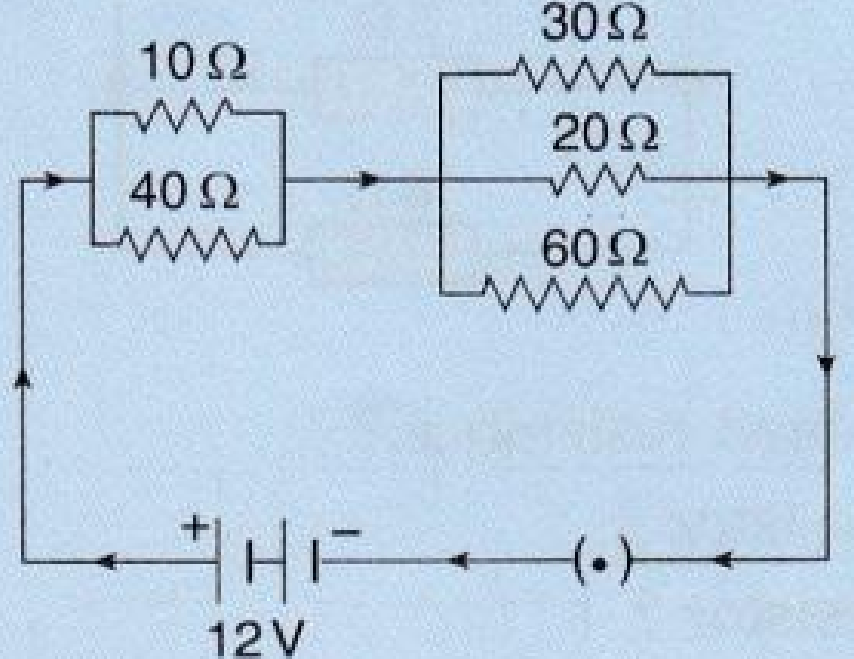
In the circuit diagram given below five resistances of $10 Ω, 40 Ω, 30 Ω, 20 Ω\ \text{and}\ 60 Ω$ are connected as shown to a 12V battery.
Calculate:
  1. Total resistance in the circuit.
  2. Total current flowing in the circuit.
  1. What is an electromagnet? List any two uses.
  2. Draw a labelled diagram to show how an electromagnet is made.
  3. State the purpose of soft iron core used in making an electromagnet.
  4. List two ways of increasing the strength of an electromagnet if the material of the electromagnet is fixed.
What are the limitations in obtaining energy from wind?
Make a list of conventional and non-conventional sources of energy. Give a brief description of harnessing one nonconventional source of energy.
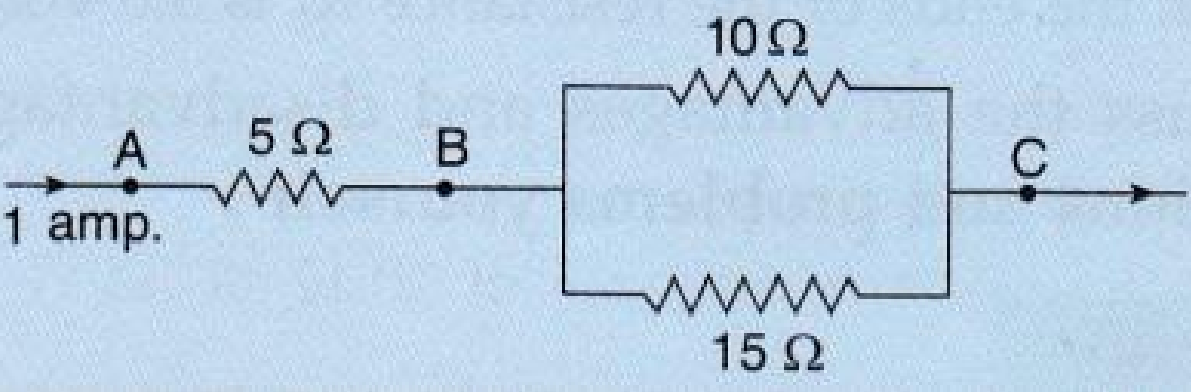
Three resistors are connected as shown in the diagram.

Through the resistor 5 ohm, a current of 1 ampere is flowing,
  1. What is the current through the other two resistors?
  2. What is the p.d. across AB and across AC?
  3. What is the total resistance?
Describe the various steps involved in the sexual reproduction in animals. Draw labelled diagrams to show the fertilisation of an ovum (or egg) by a sperm to form a zygote.
  1. Define focal length of a spherical lens.
  2. A divergent lens has a focal length of 30 cm. At what distance should an object of height 5 cm from the optical centre of the lens be placed so that its image is formed 15 cm away from the lens? Find the size of the image also.
  3. Draw a ray diagram to show the formation of image in the above situation.
The human body has an organ A which acts as a double pump. The oxygenated blood coming from the lungs through a blood vessel B enters the upper left chamber C of the double pump. When chamber C contracts, then blood goes into lower left chamber D. The contraction of chamber D forces the blood to go into a blood vessel E which supplies oxygenated blood to all the organs of the body (except the lungs). The deoxygenated blood coming out of the body organs is taken by a blood vessel F to the right upper chamber G of pumping organ. Contraction of chamber G forces the deoxygenated blood into right lower chamber H. And finally the contraction of chamber H sends the deoxygenated blood into lungs through a blood vessel I.
  1. What is organ A?
  2. Name the blood vessel (i) B (ii) E (iii) F, and (iv) I.
  3. What are chambers (i) C, and (ii) D?
  4. What are chambers (i) G and (ii) H?
Given below is a diagram of the human endocrine system.
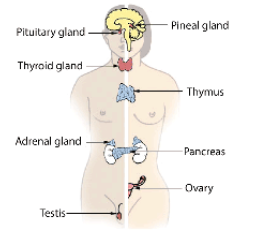
Image
Using the given diagram, answer the following questions:
i. How pituitary gland regulates the growth of the body?
ii. Which hormone is responsible for the carbohydrate, protein, and fat metabolism in the body?
iii. Which pair of glands prepare the body to deal with emergency situations?
iv. Which gland secretes insulin and what does it do in the body?
v. What is the function of endocrine glands?