MCQ
Radio waves and visible light in vacuum have
  • Same velocity but different wavelength
  • B
    Continuous emission spectrum
  • C
    Band absorption spectrum
  • D
    Line emission spectrum

Answer

Correct option: A.
Same velocity but different wavelength
a
(a)In vacuum velocity of all $EM$ waves are same but their wavelengths are different.

Need a full question paper?

Generate a complete, print-ready paper with questions like this in minutes — across 16+ boards, with answer keys.

Start Generating Free

Similar questions

A hydrogen atom in its ground state absorbs $10.2\ eV$ of energy. The orbital angular momentum is increased by

(Given Planck constant $h = 6.6 \times {10^{ - 34}}J -  sec$)
A bomb of mass $3.0\, Kg$ explodes in air into two pieces of masses $2.0 \,kg$ and $1.0\, kg$. The smaller mass goes at a speed of $80 m/s$.The total energy imparted to the two fragments is ............. $kJ$
At temperatures close to $0\ K$ , the heat capacity $C$ of a certain solid is related to its temperature $T$ by the equation $C = aT^3$ , where a is a constant characteristic of the solid. Heat is supplied to the solid at a steady rate. Which graph best represents the variation of its temperature $T$ with time $t$ ?
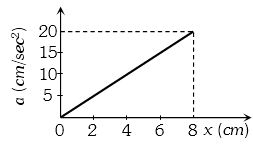
A 10kg mass moves along $x-$axis. Its acceleration as a function of its position is shown in the figure. What is the total work done on the mass by the force as the mass moves from $x = 0$ to $x = 8\,cm$
Sand is being dropped on a conveyer belt at the rate of $M \ kg/s.$ The force necessary to keep the belt moving with a constant velocity of $v\ m/s$ will be
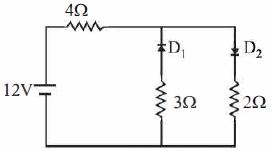
The circuit has two oppositively connected ideal diodes in parallel. What is the current flowing in the circuit?......$A$
Two wires of equal lengths are made of the same material. Wire $A$ has a diameter that is twice as that of wire $B$. If identical weights are suspended from the ends of these wires, the increase in length is
Modern treatment method $P.E.T.$ is based on $!$
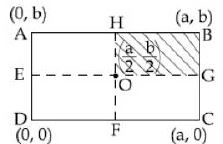
A uniform rectangular thin sheet $ABCD$ of mass $M$ has length $a$ and breadth $b$, as shown in the figure. If the shaded portion $HBGO$ is cut off, the coordinates of the centre of mass of the remaining portion will be
Two particles $A$ and $B$ having equal charges $+6\,C$, after being accelerated through the same potential difference, enter in a region of uniform magnetic field and describe circular paths of radii $2\,cm$ and $3\,cm$ respectively. The ratio of mass of $A$ to that of $B$ is