Question
Radioactive isotopes are produced in a nuclear physics experiment at a constant rate $\frac{\text{dN}}{\text{dt}}=\text{R}.$ An inductor of inductance 100mH, a resistor of resistance $100\Omega$ and a battery are connected to form a series circuit. The circuit is switched on at the instant the production of radioactive isotope starts. It is found that $\frac{\text{i}}{\text{N}}$ remains constant in time where i is the current in the circuit at time t and N is the number of active nuclei at time t. Find the half-life of the isotope.
Answer

$\text{R}=100\Omega;\text{ L}=100\text{mH}$
After time t, $\text{i = i}_0\Big(1-\text{e}^{\frac{-\text{t}}{\text{Lr}}}\Big)\text{ N = N}_0\big(\text{e}^{-\lambda\text{t}}\big)$
$\frac{\text{i}}{\text{N}}=\frac{\text{i}_0\big(1-\text{e}^{-\frac{\text{tR}}{\text{L}}}\big)}{\text{N}_0\text{e}^{-\lambda\text{t}}}\frac{\text{i}}{\text{N}}$ is constant i.e. independent of time.
Coefficients of t are equal $-\frac{\text{R}}{\text{L}}=-\lambda\Rightarrow\frac{\text{R}}{\text{L}}=\frac{0.693}{\text{t}_{\frac{1}{2}}}$
$=\text{t}_{\frac{1}{2}}=0.693\times10^{-3}=6.93\times10^{-4}\text{sec}.$

Need a full question paper?

Generate a complete, print-ready paper with questions like this in minutes — across 16+ boards, with answer keys.

Start Generating Free

Similar questions

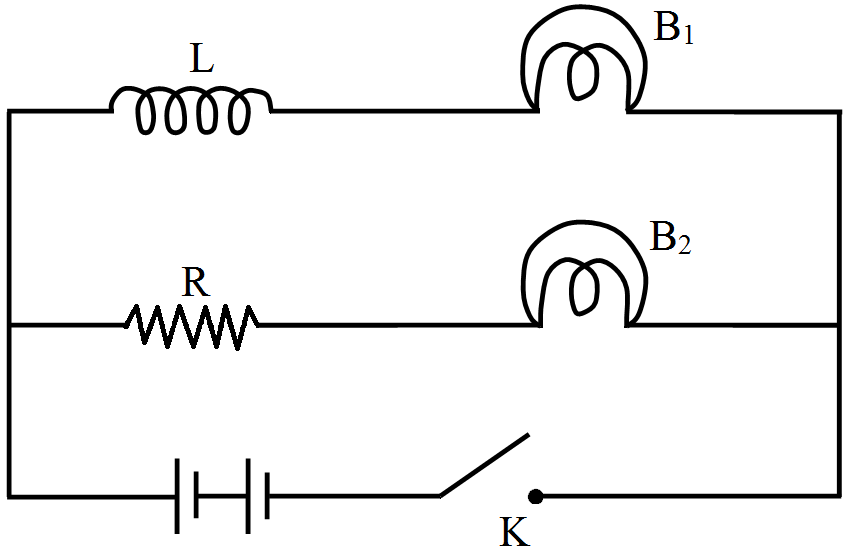
In the given circuit, the value of resistance effect of the coil L is exactly equal to the resistance R. Bulbs $B_1$ and $B_2$ are exactly identical. Answer the following questions based on above information:
  1. Which one of the two bulbs lights up earlier, when key K is closed and why?
  2. What will be the comparative brightness of the two bulbs after sometime if the key K is kept closed and why?
A long straight wire carries a current of 35 A. What is the magnitude of the field B at a point 20 cm from the wire?
  1. Write symbolically the $\beta^–$ decay process of$\frac{15}{32}$P.
  2. Derive an expression for the average life of a radionuclide. Give its relationship with the half-life.
The band gap for silicon is 1.1eV.
  1. Find the ratio of the band gap to kT for silicon at room temperature 300K.
  2. At what temperature does this ratio become one tenth of the value at 300K?
(Silicon will not retain its structure at these high temperatures.)
Two wires of different densities but same area of crosssection are soldered together at one end and are stretched to a tension T. The velocity of a transverse wave in the first wire is double of that in the second wire. Find the ratio of the density of the first wire to that of the second wire.
$a.$ Write the relationship between mobility and drift velocity in a current carrying conductor.
$b.$ Two aluminium wires have their lengths in the ratio $2 : 3$ and radii in the ratio $1 : 3.$ These are connected in parallel across a battery of emf $E$ and of negligible internal resistance. Find the ratio of drift velocities of the electrons in the two wires.
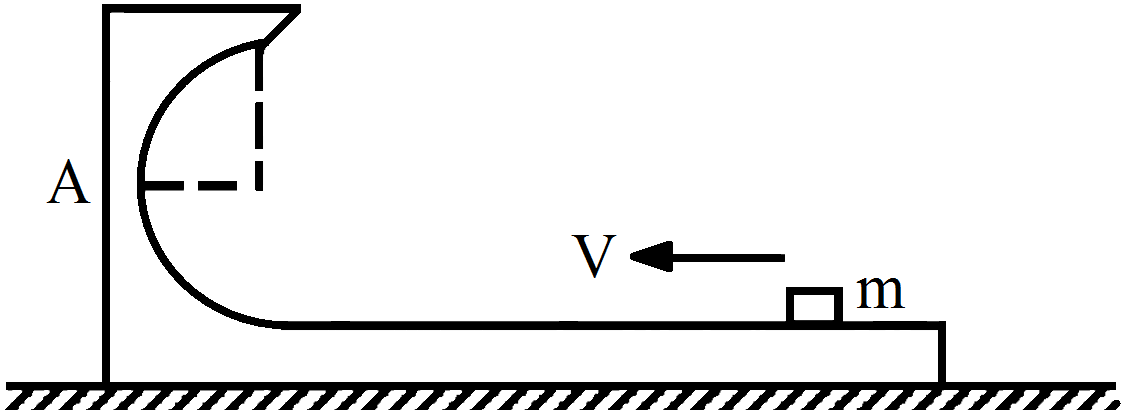
Figure shows a small block of mass m which is started with a speed v on the horizontal part of the bigger block of mass M placed on a horizontal floor. The curved part of the surface shown is semicircular. All the surfaces are frictionless. Find the speed of the bigger block when the smaller block reaches the point A of the surface.
You are given n resistors each of resistance r. They are first connected to get the minimum possible resistance. In the second case, these are again connected differently to get the maximum possible resistance. Calculate the ratio between minimum and maximum values of resistance so obtained.
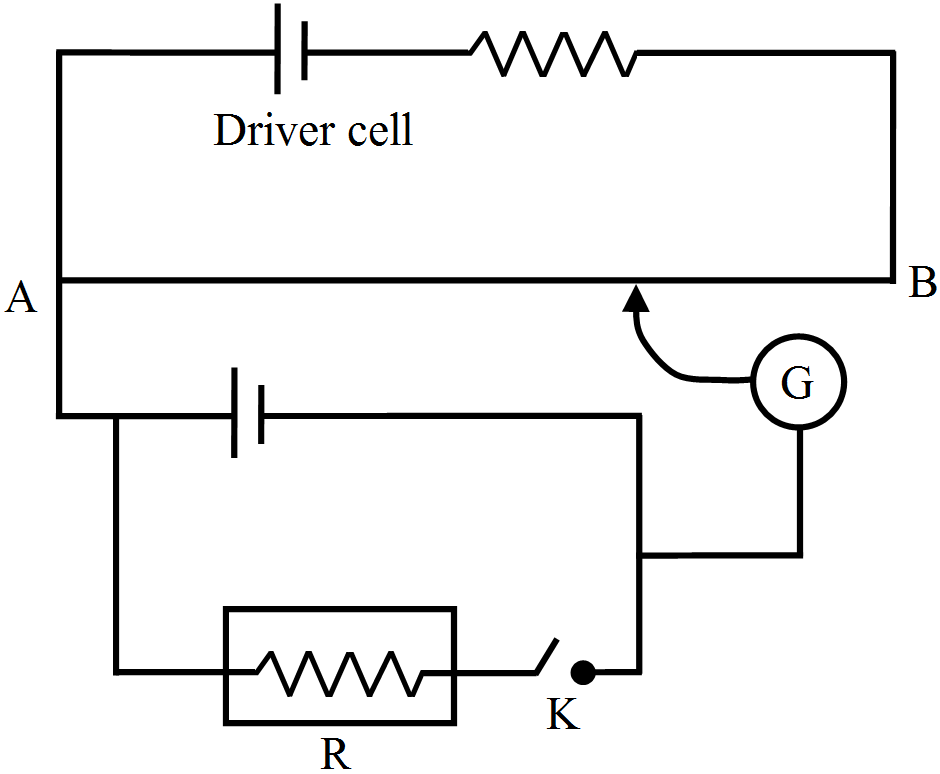
The following circuit shows the use of potentiometer to measure the internal resistance of a cell:
  1. When the key is open, how does the balance point change, if the current from the driver cell decreases?
  2. When the key K is closed, how does the balance point change if R is increased keeping current from the driver cell constant?
Write the truth table for a NAND gate connected as given in Fig. 14.45.

Hence identify the exact logic operation carried out by this circuit.