Question
Radioactivity is
|
(a) Irreversible process |
(b) Self disintegration process |
|
(c) Spontaneous process |
(d) All of the above |
Radioactivity is
|
(a) Irreversible process |
(b) Self disintegration process |
|
(c) Spontaneous process |
(d) All of the above |
(d) All of the above
Generate a complete, print-ready paper with questions like this in minutes — across 16+ boards, with answer keys.
The conductivity of a superconductor is
|
(a) Infinite |
(b) Very large |
(c) Very small |
(d) Zero |
Specific rotation of sugar solution is 0.01 SI units. 200  of impure sugar solution is taken in a polarimeter tube of length 0.25m and an optical rotation of 0.4rad is observed. The percentage of purity of sugar is the sample is
|
(a) 80% |
(b) 89% |
(c) 11% |
(d) 20% |
Nuclear fusion is common to the pair
|
(a) Thermonuclear reactor, uranium based nuclear reactor |
|
(b) Energy production in sun, uranium based nuclear reactor |
|
(c) Energy production in sun, hydrogen bomb |
|
(d) Disintegration of heavy nuclei, hydrogen bomb |
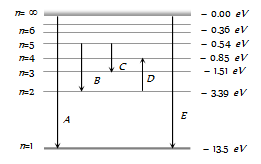
The energy levels of the hydrogen spectrum is shown in figure. There are some transitions A, B, C, D and E. Transition A, B and C respectively represent
|
(a) First member of Lyman series, third spectral line of Balmer series and the second spectral line of Paschen series |
|
(b) Ionization potential of hydrogen, second spectral line of Balmer series and third spectral line of Paschen series |
|
(c) Series limit of Lyman series, third spectral line of Balmer series and second spectral line of Paschen series |
|
(d) Series limit of Lyman series, second spectral line of Balmer series and third spectral line of Paschen series |
The particles emitted by radioactive decay are deflected by magnetic field. The particles will be
|
(a) Protons and α - particles |
(b) Electrons, protons and α -particles |
|
(c) Electrons, protons and neutrons |
(d) Electrons and α -particles |
Assertion : When the speed of an electron increases its specific charge decreases.
Reason : Specific charge is the ratio of the charge to mass.
|
(a) If both assertion and reason are true and the reason is the correct explanation of the assertion. |
|
(b) If both assertion and reason are true but reason is not the correct explanation of the assertion. |
|
(c) If assertion is true but reason is false. |
|
(d) If the assertion and reason both are false. |
Two point charges 3 × 10⁻⁶ C and 8 × 10⁻⁶ C repel each other by a force of 6 × 10⁻³ N. If each of them is given an additional charge – 6 × 10⁶ C, the force between them will be
|
(a) 2.4 × 10⁻³ N (attractive) |
(b) 2.4 × 10⁻⁹ N (attractive) |
|
(c) 1.5 × 10⁻³ N (repulsive) |
(d) 1.5 × 10⁻³ N (attractive) |