MCQ
Radioactivity is
  • A
    Irreversible process
  • B
    Self disintegration process
  • C
    Spontaneous process
  • All of the above

Answer

Correct option: D.
All of the above
d
(d)

Need a full question paper?

Generate a complete, print-ready paper with questions like this in minutes — across 16+ boards, with answer keys.
Start Generating Free

Similar questions

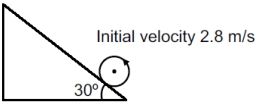
A sphere pure rolls on a rough inclined plane with initial velocity $2.8 \,m / s$. Find the maximum distance on the inclined plane. (in $m$)
A force of $200\, N$ is applied at one end of a wire of length $2\, m$ and having area of cross-section ${10^{ - 2}}\,c{m^2}$. The other end of the wire is rigidly fixed. If coefficient of linear expansion of the wire $\alpha = 8 \times 10{^{-6}}°C^{-1}$ and Young's modulus $Y = 2.2 \times {10^{11}}\,N/{m^2}$ and its temperature is increased by $5°C$, then the increase in the tension of the wire will be ........ $N$
A cylinder of height $ 20\; m$  is completely filled with water. The velocity of efflux of water (in $ m/s$) through a small hole on the side wall of the cylinder near its bottom is ....... $m/s$
A roller coaster is designed such that riders experience "weightlessness" as they go round the top of a hill whose radius of curvature is $20\, m.$ The speed of the car at the top of the hill is between
Dimensions of pair are same. Identify the pair
A particle of mass $m$ is moving with a uniform velocity $v_1$. It is given an impulse such that its velocity becomes $v_2$. The impulse is equal to
The displacement current of $4.425 \,\mu A$ is developed in the space between the plates of parallel plate capacitor when voltage is changing at a rate of $10^{6} \,Vs ^{-1}$. The area of each plate of the capacitor is $40 \,cm ^{2}$. The distance between each plate of the capacitor is $x \times 10^{-3} \,m$. The value of $x$ is ................

(Permittivity of free space, $\varepsilon _{0}=8.85 \times 10^{-12} \,C ^{2} N ^{-1} m ^{-2}$ )

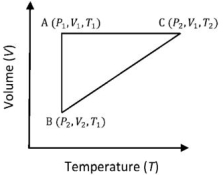
A reversible cyclic process for an ideal gas is shown below. Here, $P, V$, and $T$ are pressure, volume and temperature, respectively. The thermodynamic parameters $q, w, H$ and $U$ are heat, work, enthalpy and internal energy, respectively.

(image)

The correct option ($s$) is (are)

$(A)$ $q_{A C}=\Delta U_{B C}$ and $W_{A B}=P_2\left(V_2-V_1\right)$

$(B)$ $\mathrm{W}_{\mathrm{BC}}=\mathrm{P}_2\left(\mathrm{~V}_2-\mathrm{V}_1\right)$ and $\mathrm{q}_{\mathrm{BC}}=\mathrm{H}_{\mathrm{AC}}$

$(C)$ $\Delta \mathrm{H}_{\mathrm{CA}}<\Delta \mathrm{U}_{\mathrm{CA}}$ and $\mathrm{q}_{\mathrm{AC}}=\Delta \mathrm{U}_{\mathrm{BC}}$

$(D)$ $\mathrm{q}_{\mathrm{BC}}=\Delta \mathrm{H}_{\mathrm{AC}}$ and $\Delta \mathrm{H}_{\mathrm{CA}}>\Delta \mathrm{U}_{\mathrm{CA}}$
A steel wire of length $3.2 m \left( Y _{ S }=2.0 \times 10^{11}\,Nm ^{-2}\right)$ and a copper wire of length $4.4\,M$ $\left( Y _{ C }=1.1 \times 10^{11}\,Nm ^{-2}\right)$, both of radius $1.4\,mm$ are connected end to end. When stretched by a load, the net elongation is found to be $1.4\,mm$. The load applied, in Newton, will be. (Given $\pi=\frac{22}{7}$)
Two objects of masses $200\ gm$ and $500\ gm$ possess velocities $10\hat i m/s$ and $3\hat i + 5\hat j m/s$ respectively.  The velocity of their centre of mass in $m/s$ is