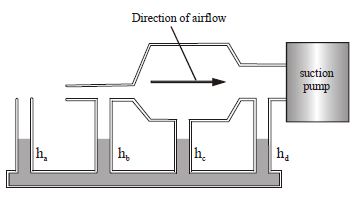
Rank in order, from highest to lowest, the liquid heights $h_a$ to $h_d$ .The air flow is from left to right. The liquid columns are not drawn to scale
Medium
Download our app for free and get started
$h_b > h_d > h_c > h_a$ . The liquid level is higher where the pressure is lower. The pressure is lower where the flow speed is higher. The flow speed is highest in the narrowest tube, zero in the open air.

Download our appand get started for free
Experience the future of education. Simply download our apps or reach out to us for more information. Let's shape the future of learning together!No signup needed.*
Similar Questions
- 1A wooden cube first floats inside water when a $200\,g$ mass is placed on it. When the mass is removed the cube is $2\,cm$ above water level. The side of cube is ........ $cm$View Solution
- 2Eight spherical rain drops of the same mass and radius are falling down with a terminal speed of $6\, cm -s^{-1}$ . If they coalesce to form one big drop, what will be the terminal speed of the bigger drop ? (Neglect the buoyancy of the air) ....... $cm -s^{-1}$View Solution
- 3The reading of spring balance when a block is suspended from it in air, is $60\,N$. This reading is changed to $40\, N$ when the block is immersed in water. The specific density of the block isView Solution
- 4A tank with a square base of area $1.0\; m ^{2}$ is divided by a vertical partition in the middle. The bottom of the partition has a small-hinged door of area $20\; cm ^{2} .$ The tank is filled with water in one compartment, and an acid (of relative density $1.7$) in the other, both to a height of $4.0 \;m$. compute the force (in $N$) necessary to keep the doorView Solution
- 5In a cylindrical container open to the atmosphere from the top a liquid is filled upto $10\,\, m$ depth. Density of the liquid varies with depth from the surface as $\rho (h) = 100 + 6h^2$ where $h$ is in meter and $\rho$ is in $kg/m^3.$ The pressure at the bottom of the container will be : $($ atmosphere pressure $= 10^5\,\, Pa, \,g = 10\, m/sec^2)$View Solution
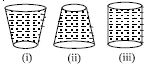
- 6View SolutionThe three water filled tanks shown have the same volume and height. If small identical holes are punched near this bottom, which one will be the first to get empty.
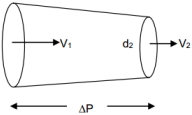
- 7Determine the pressure difference in tube of non$-$uniform cross sectional area as shown in figure. $\Delta P =?$ (in $pa$)View Solution
$d_{1}=5\, cm , V_{1}=4\, cm , d_{2}=2\, cm , V_{2}=?$
- 8An object falling through a fluid is observed to have acceleration given by $a = g -bv$ where $g =$ gravitational acceleration and $b$ is constant. After a long time of release, it is observed to fall with constant speed. The value of constant speed isView Solution
- 9If water is flowing in a pipe with speed $2 \,m / s$ then its kinetic energy per unit volume is ........... $J ^2 m ^3$View Solution
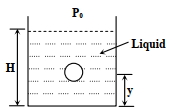
- 10A small spherical monoatomic ideal gas bubble $\left(\gamma=\frac{5}{3}\right)$ is trapped inside a liquid of density $\rho_{\ell}$ (see figure). Assume that the bubble does not exchange any heat with the liquid. The bubble contains n moles of gas. The temperature of the gas when the bubble is at the bottom is $\mathrm{T}_0$, the height of the liquid is $\mathrm{H}$ and the atmospheric pressure is $\mathrm{P}_0$ (Neglect surface tension).View Solution
Figure: $Image$
$1.$ As the bubble moves upwards, besides the buoyancy force the following forces are acting on it
$(A)$ Only the force of gravity
$(B)$ The force due to gravity and the force due to the pressure of the liquid
$(C)$ The force due to gravity, the force due to the pressure of the liquid and the force due to viscosity of the liquid
$(D)$ The force due to gravity and the force due to viscosity of the liquid
$2.$ When the gas bubble is at a height $\mathrm{y}$ from the bottom, its temperature is
$(A)$ $\mathrm{T}_0\left(\frac{\mathrm{P}_0+\rho_0 \mathrm{gH}}{\mathrm{P}_0+\rho_t \mathrm{gy}}\right)^{2 / 5}$
$(B)$ $T_0\left(\frac{P_0+\rho_t g(H-y)}{P_0+\rho_t g H}\right)^{2 / 5}$
$(C)$ $\mathrm{T}_0\left(\frac{\mathrm{P}_0+\rho_t \mathrm{gH}}{\mathrm{P}_0+\rho_t \mathrm{gy}}\right)^{3 / 5}$
$(D)$ $T_0\left(\frac{P_0+\rho_t g(H-y)}{P_0+\rho_t g H}\right)^{3 / 5}$
$3.$ The buoyancy force acting on the gas bubble is (Assume $R$ is the universal gas constant)
$(A)$ $\rho_t \mathrm{nRgT}_0 \frac{\left(\mathrm{P}_0+\rho_t \mathrm{gH}\right)^{2 / 5}}{\left(\mathrm{P}_0+\rho_t \mathrm{gy}\right)^{7 / 5}}$
$(B)$ $\frac{\rho_{\ell} \mathrm{nRgT}_0}{\left(\mathrm{P}_0+\rho_{\ell} \mathrm{gH}\right)^{2 / 5}\left[\mathrm{P}_0+\rho_{\ell} \mathrm{g}(\mathrm{H}-\mathrm{y})\right]^{3 / 5}}$
$(C)$ $\rho_t \mathrm{nRgT} \frac{\left(\mathrm{P}_0+\rho_t g \mathrm{H}\right)^{3 / 5}}{\left(\mathrm{P}_0+\rho_t g \mathrm{~g}\right)^{8 / 5}}$
$(D)$ $\frac{\rho_{\ell} \mathrm{nRgT}_0}{\left(\mathrm{P}_0+\rho_{\ell} \mathrm{gH}\right)^{3 / 5}\left[\mathrm{P}_0+\rho_t \mathrm{~g}(\mathrm{H}-\mathrm{y})\right]^{2 / 5}}$
Give the answer question $1,2,$ and $3.$