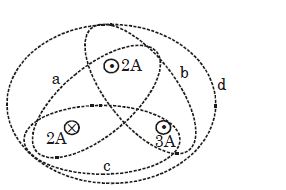
Rank the value of $\oint {\vec B.\overrightarrow {dl} } $ for the closed paths shown in figure from the smallest to largest
Medium
Download our app for free and get started
use $\oint \overrightarrow{\mathrm{B}} \cdot \overrightarrow{\mathrm{d} 1}=\mu_{0} \mathrm{I}_{\mathrm{enclosed}}$
Net current enclosed by path $a$ is zero
Net current enclosed by path $c$ is $A$
Net current enclosed by path $d$ is $3\, \mathrm{A}$
Net current enclosed by path $b$ is $5\, \mathrm{A}$

Download our appand get started for free
Experience the future of education. Simply download our apps or reach out to us for more information. Let's shape the future of learning together!No signup needed.*
Similar Questions
- 1A large current carrying plate is kept along $y-z$ plane with $k$ $amp$ current per unit length in the $+ve$ $y$ direction. Find the net force on the semi cricular current carrying looplying in the $x-y$ plane. Radius of loop is $R$, current is $i$ and centre is at $(d,0, 0)$ where $(d > R)$View Solution
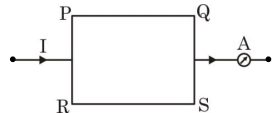
- 2A current carrying rectangular loop PQRS is made of uniform wire. The length $PR = QS =5\,cm$ and $PQ = RS =100\,cm$. If ammeter current reading changes from I to $2 I$, the ratio of magnetic forces per unit length on the wire $P Q$ due to wire RS in the two cases respectively $f_{ PQ }^{ I }: f_{ PQ }^{2 I }$ is :View Solution
- 3A proton and an $\alpha -$ particle (with their masses in the ratio of $1 : 4$ and charges in the ratio of $1:2$ are accelerated from rest through a potential difference $V$. If a uniform magnetic field $(B)$ is set up perpendicular to their velocities, the ratio of the radii $r_p : r_{\alpha }$ of the circular paths described by them will beView Solution
- 4A long straight wire with a circular crosssection having radius $R$, is carrying a steady current $I$. The current I is uniformly distributed across this cross-section. Then the variation of magnetic field due to current I with distance $r\;( r < R )$ from its centre will beView Solution
- 5A parallel plate capacitor of area $60\, cm^2$ and separation $3\, mm$ is charged initially to $90\, \mu C$. If the medium between the plate gets slightly conducting and the plate loses the charge initially at the rate of $2.5\times10^{-8}\, C/s$, then what is the magnetic field between the plates ?View Solution
- 6A one metre long wire is lying at right angles to the magnetic field. A force of $1\, kg$ wt. is acting on it in a magnetic field of $0.98\, Tesla$. The current flowing in it will be....$A$View Solution
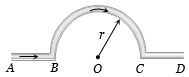
- 7the magnetic induction at $O$ due to the whole length of the conductor isView Solution
- 8A square loop is carrying a steady current $I$ and the magnitude of its magnetic dipole moment is $m$. If this square loop is changed to a circular loop and it carries the same current, the magnitude of the magnetic dipole moment of circular loop will beView Solution
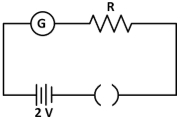
- 9A galvanometer has a $50$ $division$ scale. Battery has no internal resistance. It is found that there is deflection of $40$ $divisions$ when $R = 2400\,\Omega $. Deflection becomes $20$ $divisions$ when resistance taken from resistance box is $4900\,\Omega $ . Then we can concludeView Solution
- 10$A$ galvanometer may be converted into ammeter or voltmeter. In which of the following cases the resistance of the device will be the largest ? (Asssume maximum range of galvanometer $= 1\, mA$)View Solution