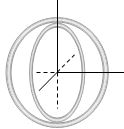
A large current carrying plate is kept along $y-z$ plane with $k$ $amp$ current per unit length in the $+ve$ $y$ direction. Find the net force on the semi cricular current carrying looplying in the $x-y$ plane. Radius of loop is $R$, current is $i$ and centre is at $(d,0, 0)$ where $(d > R)$
Medium


Download our appand get started for free
Experience the future of education. Simply download our apps or reach out to us for more information. Let's shape the future of learning together!No signup needed.*
Similar Questions
- 1A ring of radius $R$, made of an insulating material carries a charge $Q$ uniformly distributed on it. If the ring rotates about the axis passing through its centre and normal to plane of the ring with constant angular speed $\omega $, then the magnitude of the magnetic moment of the ring isView Solution
- 2Two particles of charges $+Q$ and $-Q$ are projected from the same point with a velocity $v$ in a region of uniform magnetic field $B$ such that the velocity vector makes an angle $q$ with the magnetic field. Their masses are $M$ and $2M,$ respectively. Then, they will meet again for the first time at a point whose distance from the point of projection isView Solution
- 3A particle is projected with a velocity ( $10\ m/s$ ) along $y-$ axis from point $(2, 3)$ . Magnetic field of $\left( {3\hat i + 4\hat j} \right)$ Tesla exist uniformly in the space. Its speed when particle passes through $y-$ axis for the third time is : (neglect gravity)View Solution
- 4A proton moving with a velocity, $2.5 \times {10^7}\,m/s$, enters a magnetic field of intensity $2.5\,T$ making an angle ${30^o}$ with the magnetic field. The force on the proton isView Solution
- 5$3\, A$ of current is flowing in a linear conductor having a length of $40\, cm$. The conductor is placed in a magnetic field of strength $500$ $gauss$ and makes an angle of $30^\circ $ with the direction of the field. It experiences a force of magnitudeView Solution
- 6A moving coil galvanometer has $N$ number of turns in a coil of effective area $A$, it carries a current $I$. The magnetic field $B$ is radial. The torque acting on the coil isView Solution
- 7A long thin walled pipe of radius $R$ carries a current $I$ along its length. The current density is uniform over the circumference of the pipe. The magnetic field at the center of the pipe due to quarter portion of the pipe shown, isView Solution
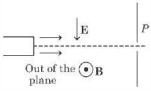
- 8A collimated beam of charged and uncharged particles is directed towards a hole marked $P$ on a screen as shown below. If the electric and magnetic fields as indicated below are turned $ON$View Solution
- 9A electron experiences a force $\left( {4.0\,\hat i + 3.0\,\hat j} \right)\times 10^{-13} N$ in a uniform magnetic field when its velocity is $2.5\,\hat k \times \,{10^7} ms^{-1}$. When the velocity is redirected and becomes $\left( {1.5\,\hat i - 2.0\,\hat j} \right) \times {10^7}$, the magnetic force of the electron is zero. The magnetic field $\vec B$ is :View Solution
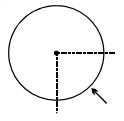
- 10View SolutionTwo insulated rings, one of slightly smaller diameter than the other are suspended along their common diameter as shown. Initially the planes of the rings are mutually perpendicular. When a steady current is set up in each of them