Question
Ray PQ and ray PR are perpendicular to each other. Points B and A are in the interior and exterior of ∠QPR respectively. Ray PB and ray PA are perpendicular to each other.
Draw a figure showing all these rays and write –
i. A pair of complementary angles
ii. A pair of supplementary angles
iii. A pair of congruent angles.

Answer


i. Complementary angles:
∠RPQ = 90° [Ray PQ ⊥ ray PR]
∴ ∠RPB + ∠BPQ = 90° [Angle addition property]
∠RPB and ∠BPQ are pair of complementary angles
∠APB = 90° [Ray PA ⊥ ray PB]
∴ ∠APR + ∠RPB = 90°
∠APR and ∠RPB are pair of complementary angles.

ii. Supplementary angles:
∠APB + ∠RPQ = 90° + 90° = 180°
∴ ∠APB and ∠RPQ are a pair of supplementary angles.

iii. Congruent angles:
a. ∠APB = ∠RPQ [Each is of 90°]
b. ∠APB = ∠RPQ
∴ ∠APR + ∠RPB = ∠RPB + ∠BPQ [Angle addition property]
∴ ∠APR = ∠BPQ
∴ ∠APR ≅ ∠BPQ

Need a full question paper?

Generate a complete, print-ready paper with questions like this in minutes — across 16+ boards, with answer keys.

Start Generating Free

Similar questions

Prove that 3 + √5 is an irrational number.
ABCD is a parallelogram. G is a point on AB such that AG = 2GB and E is point on DC such that CE = 2DE and F is the point of BC such that BF = 2FC. Prove that:
  1. $\text{ar}(\text{ADEG})=\text{ar}(\text{GBCE})$
  2. $\text{ar}{(\triangle\text{EGB}})=\frac{1}{6}\text{ar}(\text{ABCD})$
  3. $\text{ar}(\triangle\text{EFC})=\frac{1}{2}\text{ar}(\triangle\text{EBF})$
  4. $\text{ar}(\triangle\text{EBG})=\text{ar}(\triangle\text{EFC})$
  5. Find what portion of the parallelogram is the area of $\triangle\text{EFG}.$
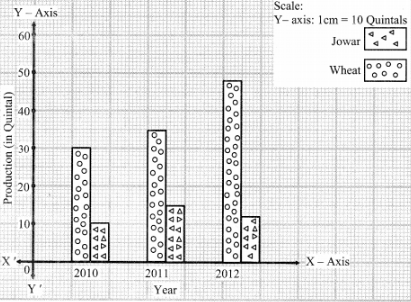
A farmer has produced Wheat and Jowar in his field. The following joint bar diagram shows the production of Wheat and Jowar. From the gken diagram answer the following questions:
i. Which crop production has increased consistently in 3 years?
ii. By how many quintals the production ofjowar has reduced in 2012 as compared to 2011?
iii. What is the difference between the production of wheat in 2010 and 2012 ?
iv. Complete the following table using this diagram.

Image

Image

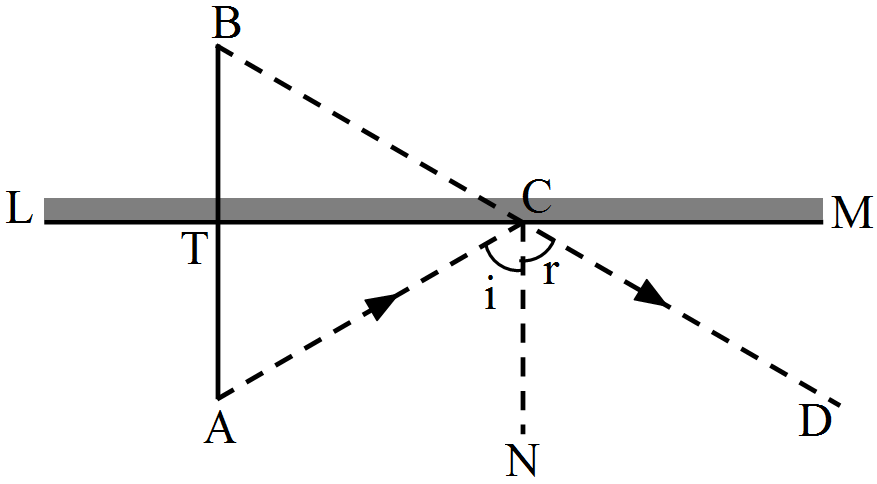
The image of an object placed at a point A before a plane mirror LM is seen at the point B by an observer at D, as shown in the figure. Prove that the image is as far behind the mirror as the object is in front of the mirror.
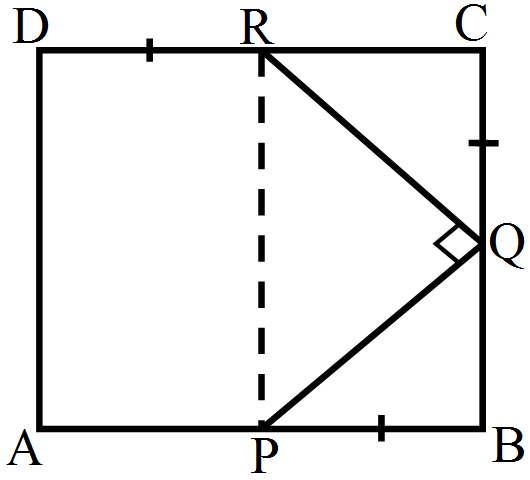
In the given figure, ABCD is a square and $\angle\text{PQR}=90^{\circ}.$ If PB = QC = DR, prove that:
  1. QB = RC,
  2. PQ = QR,
  3. $\angle\text{QPR}=45^{\circ}$
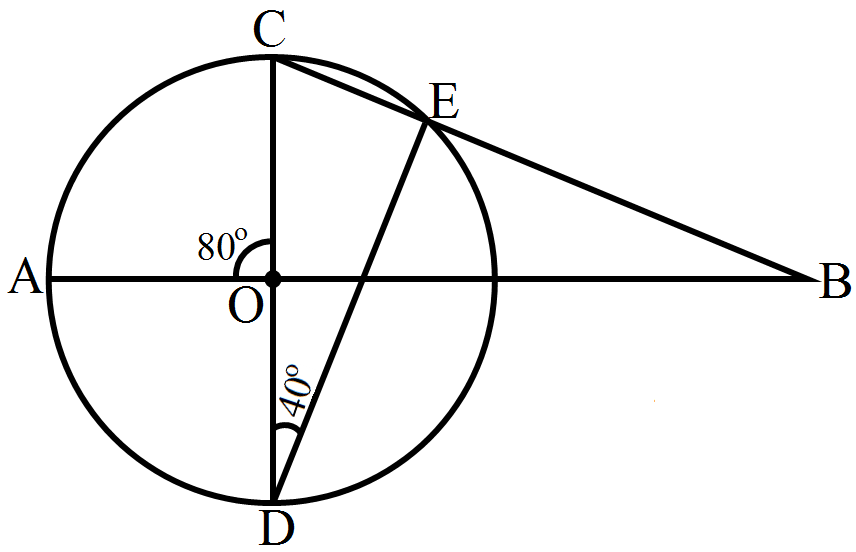
In the given figure, AB and CD are straight lines through the centre O of a circle. If $\angle\text{AOC}=80^\circ$ and $\angle\text{CDE}=40^\circ,$ find
  1. $\angle\text{DCE}$
  2. $\angle\text{ABC}$
Two circles of radii $10\ cm$ and $8\cm$ intersect each other, and the length of the common chord is $12\ cm$.
Find the distance between their centres.
Construct ∆XYZ, in which YZ = 6 cm, XY + XZ = 9 cm, ∠XYZ = 50°.
The mean of 35 observations is 20, out of which mean of first 18 observations is 15 and mean of last 18 observations is 25. Find the 18th observation.
ABCD is a trapezium in which AB || CD, AB = 16cm and DC = 24cm. If E and F are respectively the midpoints of AD and BC, prove that $\text{ar(ABFE)}=\frac{9}{11}\text{ar(EFCD)}.$