Question
Reaction time : When a situation demands our immediate action, it takes some time before we really respond. Reaction time is the time a person takes to observe, think and act. For example, if a person is driving and suddenly a boy appears on the road, then the time elapsed before he slams the brakes of the car is the reaction time. Reaction time depends on complexity of the situation and on an individual.
You can measure your reaction time by a simple experiment. Take a ruler and ask your friend to drop it vertically through the gap between your thumb and forefinger (Fig. 2.8). After you catch it, find the distance $d$ travelled by the ruler. In a particular case, $d$ was found to be $21.0 cm$. Estimate reaction time.
Answer

The ruler drops under free fall. Therefore, $v_o=0$, and $a=-g=-9.8 m s ^{-2}$. The distance travelled $d$ and the reaction time $t_r$ are related by
$
\begin{array}{l}
d=-\frac{1}{2} g t_r^2 \\
t_r=\sqrt{\frac{2 d}{g}} s
\end{array}
$
Given $d=21.0 cm$ and $g=9.8 m s ^{-2}$ the reaction time is
$
t_r=\sqrt{\frac{2 \times 0.21}{9.8}} s \equiv 0.2 s .
$

Need a full question paper?

Generate a complete, print-ready paper with questions like this in minutes — across 16+ boards, with answer keys.

Start Generating Free

Similar questions

Define one dimensional motion.
A labourer standing near the top of an old wooden step ladder feels unstable. Why?
Can the peak voltage across the inductor be greater than the peak voltage of the source in an LCR circuit?
Does specific heat of water remain constant throughout?
Find the thickness of a plate which will produce a change in optical path equal to half the wavelength $\lambda$ of the light passing through it normally. The refractive index of the plate is $\mu$.
Rubber tyres are preferred over steel tyres. Why?
On what does the pressure of a liquid depend?
Four 2cm × 2cm × 2cm cubes of ice are taken out from a refrigerator and are put in 200ml of a drink at 10°C.
  1. Find the temperature of the drink when thermal equilibrium is attained in it.
  2. If the ice cubes do not melt completely, find the amount melted. Assume that no heat is lost to the outside of the drink and that the container has negligible heat capacity. Density of ice = 900kg-m-3, density of the drink = 1000kg-m-3, specific heat capacity of the drink = 4200Jkg-1-K-1, latent heat of fusion of ice = 3.4 × 10⁵J-kg-1.
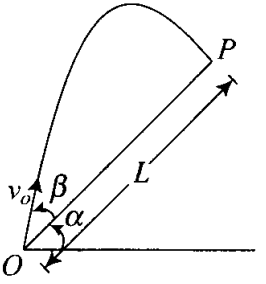
A particle is projected in air at an angle $\beta$ to a surface which itself is inclined at an angle $\alpha$ to the horizontal (Fig.).

  1. Find an expression of range on the plane surface (distance on the plane from the point of projection at which particle will hit the surface).
(Hint: This problem can be solved in two different ways:

  1. Point P at which particle hits the plane can be seen as intersection of its trajectory (parobola) and straight line. Remember particle is projected at an angle $(\alpha+\beta)$ w.r.t. horizontal.
  2. We can take x-direction along the plane and y-direction perpendicular to the plane. In that case resolve g (acceleration due to gravity) in two differrent components, gx along the plane and gy perpendicular to the plane. Now the problem can be solved as two independent motions in x and y directions respectively with time as a common parameter.)
Assume that the law of gravitation changes from inverse square to inverse cube. Does the angular momentum of a planet about the sun will remain constant?