Question
Read the following and answer any four questions from (i) to (v) given below:
In angiosperms, the pollen grains are being transferred from the anther to the stigma and is termed pollination. This phenomenon was first discovered by Camerarius (1694) in the end of seventeenth century. Pollen grains are immobile. They cannot reach the stigma by themselves. An external agent is required for this. The pollination is mainly of two types-self pollination and cross pollination. The diagram given below shows two plants of the same species showing different types of pollination.
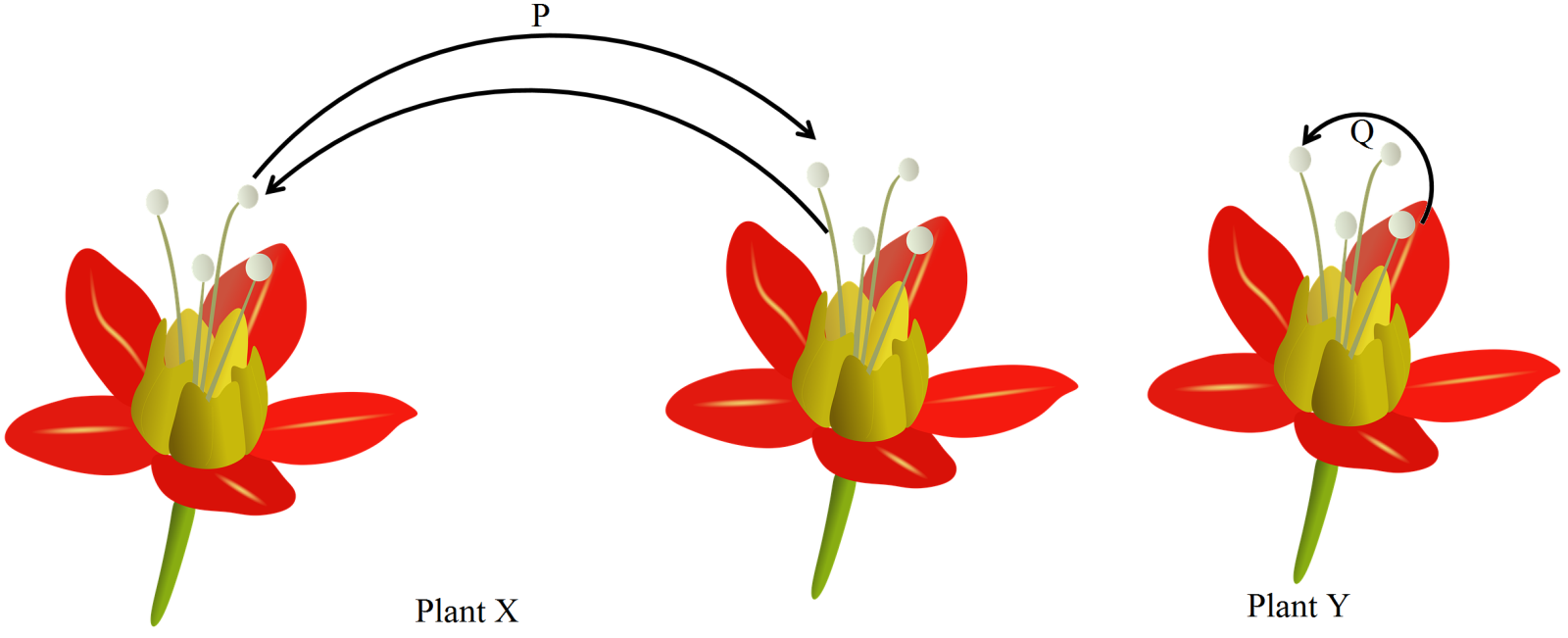
  1. What is transferred between the plants in the process indicated by arrow P?
  1. Ova.
  2. Pollen.
  3. Nutrients.
  4. Seeds.
  1. Which of the following statements is correct regarding processes P, Q and R?
  1. Processes P, Q and R introduce genetic variability in the offspring of sexually reproducing plants X and Y.
  2. Wind serves as agent for process Q if plants X and Y belong to Genus Salvia.
  3. Flowers of plants X and Y need to produce odour and nectar for completion of processes P and Q if they are entomophilous.
  4. If plants X and Y belong to Genus Cannabis, then their flowers need to produce sticky and heavy pollens in very small amount for accomplishment of process Q.
  1. Identify the processes P, Q and R.
S. No
P
Q
R
(a)
Geitonogamy
Xenogamy
Autogamy
(b)
Allogamy
Chasmogamy
Cleistogamy
(c)
Autogamy
Geitonogamy
Xenogamy
(d)
Geitonogamy
Allogamy
Autogamy
  1. In Catliarantl1us, the growth of style brings the stigma in contact of ripe anthers present on the mouth of corolla tube. This is an example of:
  1. Homogamy.
  2. Cleistogamy.
  3. Geitonogamy.
  4. Xenogamy.
  1. Which of the given processes represents a type of pollination that would result in greater adaptability of the particular species to potential environmental changes?
  1. P.
  2. Q.
  3. R.
  4. All of these.

Answer

  1. (b) Pollen.
  2. (c) Flowers of plants X and Y need to produce odour and nectar for completion of processes P and Q if they are entomophilous.
​​​​​​​​​​​​​​​​​​​​​Explanation:

In the given figure, processes P, Q and R represent geitonogamy (self-pollination), xenogamy (cross pollination) and autogamy (self-pollination), respectively. Pollinating agents are required for accomplishment of processes P and Q, but no agent is required for process R. Out of P, Q and R, only Q is responsible for introducing genetic variability as it is cross pollination between different plants of same species. Salvia is insect pollinated, whereas Cannabis is a wind pollinated plant.
  1. (a)
    S. No
    P
    Q
    R
    (a)
    Geitonogamy
    Xenogamy
    Autogamy
​​​​​​​​​​​​​​​​​​​​​​​​​​​​​​​​​​​​​​​​​​Explanation:

In the given figure, processes P, Q and R represent geitonogamy (self-pollination), xenogamy (cross pollination) and autogamy (self-pollination), respectively. Pollinating agents are required for accomplishment of processes P and Q, but no agent is required for process R. Out of P, Q and R, only Q is responsible for introducing genetic variability as it is cross pollination between different plants of same species. Salvia is insect pollinated, whereas Cannabis is a wind pollinated plant.
  1. (a) Homogamy.
​​​​​​​​​​​​​​​​​​​​​​​​​​​​​​​​​​​​​​​​​​​​​​​​​Explanation:

Homogamy occur in chasmogamous or open flowers where anthers and stigmas are brought together by growth, bending or folding.
  1. (b) Q.

Need a full question paper?

Generate a complete, print-ready paper with questions like this in minutes — across 16+ boards, with answer keys.

Start Generating Free

Similar questions

Highlight five areas where biotechnology has influenced our lives.
Distinguish between: Blastula and Gastrula ### Give two differences between blastula and gastrula.
Read the following and answer any four questions from (i) to (v) given below:
While studying inheritance of characters, a teacher gave the example of inheritance of attached earlobe and hypertrichosis of the ear to her students. A man with attached earlobes and extensive hair on pinna married a woman having free earlobes. The couple had four children, one son with attached earlobes and hairy pinna, one son with a free earlobes and hairy pinna and two daughters with attached earlobes. One of the daughters married a man with free earlobes and sparse hair on pinna. Teacher said if this couple would have sons there would be equal chances for both having free or attached earlobes and sparse hair on pinnae.
  1. Attached and free earlobe are respective example of?
  1. Dominant and recessive traits.
  2. Recessive and recessive traits.
  3. Recessive and dominant traits.
  4. Dominant and dominant traits.
  1. Hypertrichosis of the ear is.
  1. X linked trait
  2. Y linked trait
  3. Autosomal dominant trait
  4. Autosomal recessive trait.
  1. If a female with attached earlobe married a male homozygous for free earlobe sparse hair on pinna then what would be the chances of daughter to have attached earlobe?
  1. 0%
  2. 100%
  3. 25%
  4. 75%
  1. If a man with attached earlobe and hairy pinna married a woman with attached earlobe then what would be the chances of son to have hairy pinna?
  1. 50%
  2. 100%
  3. 75%
  4. 0%
  1. A male with attached earlobe, sparse hair on pinna married a female with attached earlobe. Which of the following is correct regarding their progenies?
  1. All sons have a free earlobe with hairy pinna.
  2. All daughters have an attached earlobe.
  3. 50% daughters have an attached earlobe whereas 50% daughters have a free earlobe.
  4. 50% sons have attached earlobe with hairy pinna and 50% sons have a free earlobe
Read the following and answer any four questions from (i) to (v) given below:
A 23 year old Sahil has been diagnosed with an infection of reproductive tract caused by bacteria. He complains about burning sensation during urination, pus-containing discharge and pain around genitalia. This infection has incubation period of 2-5 days but can be cured.
  1. From which disease is Sahil suffering?
  1. Chlamydiasis.
  2. Herpes.
  3. Gonorrhoea.
  4. Syphilis.
  1. Which among the following reproductive tract infections is transmitted by bacteria?
  1. Trichomoniasis.
  2. Chancroid.
  3. Genital warts.
  4. Both (a) and (b).
  1. Which mode of treatment would be useful for Sahil?
  1. Cryosurgery.
  2. Use of Podophyllum preparation.
  3. Use of antibiotic ampicillin.
  4. It cannot be treated.
  1. What technique was used to diagnose Sahil's disease?
  1. Gram staining of discharge and culture.
  2. ELISA Test.
  3. Antibody detection.
  4. Antigen test.
  1. Find the odd one out.
  1. Treponema pallidum.
  2. Neisseria gonorrhoeae.
  3. Haernophilus ducreyi.
  4. Trichomonas vaginalis.
Column I (Phenomena)Column II (Effect)
(1) Eutrophication(a) Soil erosion
(2) Biomagnification(b) Prevention of extinction
(3) Conservation(c) Accumulation of non-biodegradable substance
(4) Deforestation(d) Death of aquatic ecosystem
Read the following and answer any four questions from (i) to (v) given below:
During teaching about various environmental factors, a teacher draw a figure that depicts like history strategies for three plant species (X, Y and Z) along 3 axes - strength of competition with other organisms, level of disturbance in the habitat and level of environmental stress in the habitat. Species X grows in habitats where competition among species is high but disturbance and stress are low. Species Y grows in habitats with high environmental stress but with low intraspecies competition. Species Z grows in highly disturbed habitats with low environmental stress.
  1. Which of the following is correct regarding plant type X?
  1. It has slow growth rate.
  2. It lives in area with high probability of severe environmental changes.
  3. It has good competitive ability at low population densities near the carrying capacity.
  4. None of these.
  1. Environmental stress occurs through.
  1. Very low temperature.
  2. Drought.
  3. Nutrient deficiency.
  4. All of these.
  1. Select the correct option regarding plant type X, Y and Z.
  1. X type of plants are likely to be trees.
  2. Y type of plants could be desert plants.
  3. Z type of plants could be herbaceous plant.
  4. All of these.
  1. Y type of plants grow under high stress and:
  1. Produce large number of seeds in a short time after rains.
  2. Have rapid growth.
  3. Produce less number of seed in a long time after rain.
  4. Both (a) and (b).
  1. Assertion: Plant growth rate is high in area of high stress and high disturbance.
Reason: High stress and high disturbance promote breeding capacity in plants.
  1. Both assertion and reason are true and reason is the correct explanation of assertion.
  2. Both assertion and reason are true but reason is not the correct explanation of assertion.
  3. Assertion is true but reason is false.
  4. Both assertion and reason are false.
Read the following and answer any four questions from (i) to (v) given below:
In recombinant DNA technology, the fragments of DNA generated after cutting the DNA by restriction enzymes are separated according to their size or length by gel electrophoresis. Gel electrophoresis is performed in a gel matrix so that molecules of similar electric charges can be separated on the basis of size. Most commonly used matrix in gel electrophoresis is agarose. The fragments are separated under the influence of electric field. The separated DNA fragments can be seen only after staining the DNA with compound known as ethidium bromide (EtBr) followed by exposure to UV radiation as bright orange band.
  1. Gel electrophoresis is used for the separation of
  1. DNA only.
  2. DNA and RNA only.
  3. DNA and proteins only.
  4. DNA, RNA and proteins.
  1. Most commonly used matrix is _____ which is a ______ extracted from _______.
  1. (i) agarose (ii) polysaccharide (iii) sea weed
  2. (i) agarose (ii) protein (iii) sea weed
  3. (i) EtBr (ii) polysaccharide (iii) sea weed
  4. (i) EtBr (ii) protein (iii) bacteria
  1. A DNA molecule was treated with a restriction endonuclease and three fragments of size (i) 426kb, (ii) 129kb and (iii) 46kb were obtained. Identify the order in which these bands will arrange themselves in the gel plate after gel electrophoresis is completed. (Assuming that negative part of electrode is towards the well)
  1. (iii) → (ii) → (i)
  2. (i) → (ii) → (iii)
  3. (i) → (iii) → (ii)
  4. (iii) → (i) → (ii)
  1. Which of the following statements regarding gel electrophoresis is incorrect?
  1. Separated DNA fragments can be seen only after staining DNA with EtBr.
  2. DNA fragments are separated according to their size.
  3. Under the influence of electric field, positively charged molecules move towards the anode and negatively charged molecules move towards the cathode.
  4. None of these.
  1. The factor that will not affect the rate of DNA migration in gel electrophoresis is:
  1. Size of DNA molecule.
  2. Concentration of DNA.
  3. Voltage supplied.
  4. Concentration of the gel.
Match the terms in Column I with those in Column II.
S. No Column I S. No Column II
(i) Gene therapy 1. Human insulin.
(ii) Cotton bollworm 2. Biopiracy.
(iii) Eli Lilly 3. Emphysema.
(iv) Basmati Rice 4. ADA deficiency.
(v) $\alpha-1\text{ antitrypsin}$ 5. Lepidopteran.
Blood vesselFunctions
(1) Pulmonary aorta(a) Carries oxygenated blood to left atrium
(2) Superior vena cava(b) Carries oxygenated blood to all body parts
(3) Pulmonary vein(c) Carries deoxygenated blood from upper parts of body to right atrium
(4) Aorta(d) Carries deoxygenated blood to lungs
Column AColumn B
(1) Nutritive tissue of embryo(a) Perisperm
(2) Remnants of nucellus in seed(b) Cotyledon
(3) Nutritive tissue of developing microspores(c) Endosperm
(4) First photosynthetic organ of embryo(d) Tapetum