Question
Read the following and answer any four questions from (i) to (v) given below: The given graphs show fluctuations in blood sugar of person X and Y during a 24 hour time period. 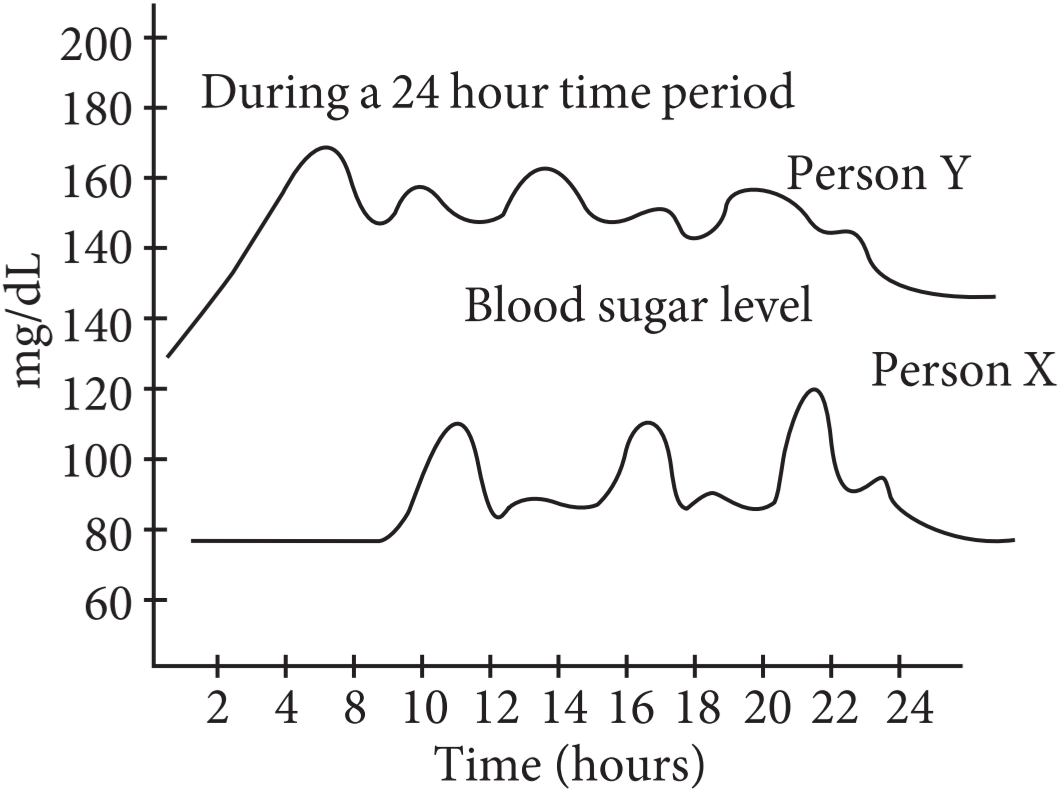 Based on the above information, answer the following questions.
Based on the above information, answer the following questions. - Which of the following holds true for person X?
- Person X is suffering from type I diabetes.
- Person X shows severe insulin deficiency and beta cell depletion.
- Person X is normal and shows good control of blood sugar level.
- Person X is subjected to excessive urination and abnormal thrust.
- The given graph indicates that person Y is suffering from.
- Diabetes
- Hypertension
- Atherosclerosis
- Rheumatic heart disease.
- Which of the following conditions are common in person Y?
- Excretion of glucose in urine and excessive urination.
- Polydipsia and mild beta cell depletion.
- Progressive erosion of articular cartilage at synovial joint.
- Both (a) and (b).
- A person suffering from diabetes mellitus becomes weak because.
- The cells are unable to utilise glucose and other carbohydrates for energy production.
- Degradation of fat increases production of toxic ketone bodies.
- Cells utilise proteins for obtaining energy
- All of these.
- Assertion: Type I diabetes involves failure of insulin to facilitate the movement of glucose into cells.
Reason: Type II diabetes is caused by failure of beta cells to produce adequate amount of insulin due to beta cell depletion.
- Both assertion and reason are true, and reason is the correct explanation of assertion.
- Both assertion and reason are true, but reason is not the correct explanation of assertion.
- Assertion is true, but reason is false.
- Both assertion and reason are false.