MCQ
Read the given statements and decide which is/are correct on the basis of kinetic theory of gases

$(I)$ Energy of one molecule at absolute temperature is zero

$(II)$ $r .m.s.$ speeds of different gases are same at same temperature

$(III)$ For one gram of all ideal gas kinetic energy is same at same temperature

$(IV)$ For one mole of all ideal gases mean kinetic energy is same at same temperature

  • A
    All are correct
  • B
    $I$ and $IV$ are correct
  • C
    $IV$ is correct
  • None of these

Answer

Correct option: D.
None of these
d
on the basis of kinetic theory of gases: Energy of one molecule is never zero, the $rms$ speed depends on the tempreture as well as the weight of the gases, for one gram of ideal gas the kinetic energy also depends on the degree of freedom and also the mean kinetic energy of one mole of a gas is $\frac{f R T}{2}$. So, none of the statement are correct.

Need a full question paper?

Generate a complete, print-ready paper with questions like this in minutes — across 16+ boards, with answer keys.

Start Generating Free

Similar questions

A string of length $1\, m$ and mass $5\, g$ is fixed at both ends. The tension in the string is $8.0\, N$. The string is set into vibration using an external vibrator of frequency $100\, Hz$. The separation between successive nodes on the string is close to .... $cm$
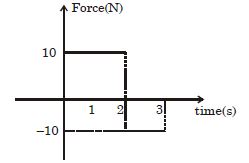
A $2\ kg$ object is floating at rest, acted upon by only force as indicated in figure. Find the total work done by the force in $3\ sec$ ..................... $\mathrm{J}$
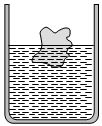
A body floats in a liquid contained in a beaker. If the whole system as shown in figure falls freely under gravity, then the upthrust on the body due to liquid is
A whistle revolves in a circle with an angular speed of $20\; rad/sec$ using a string of length $50 \;cm.$ If the frequency of sound from the whistle is $385\; Hz,$ then what is the minimum frequency heard by an observer, which is far away from the centre in the same plane ... $Hz$ ? ($v = 340 \;m/s$)
$2\, kg$ of a monoatomic gas is at a pressure of $4\times10^4\, N/m^2$. The density of the gas is $8\, kg/m^3$. What is the order of energy of the gas due to its thermal motion ?
An object thrown vertically upwards with a velocity of $25\ m/ s$ takes $4\ sec$ to reach the thrower. What is displacement of the object?
A planet of mass $M$, has two natural satellites with masses $m _1$ and $m _2$. The radii of their circular orbits are $R_1$ and $R_2$ respectively. Ignore the gravitational force between the satellites. Define $v _1, L _1, K _1$ and $T _1$ to be, respectively, the orbital speed, angular momentum, kinetic energy and time period of revolution of satellite $1$ ; and $v_2, L_2, K _2$ and $T _2$ to be the corresponding quantities of satellite $2$ . Given $m _1 / m _2=2$ and $R _1 / R _2=1 / 4$, match the ratios in List-$I$ to the numbers in List-$II$.
List-$I$ List-$II$
$P$ $\frac{ v _1}{ v _2}$ $1$ $\frac{1}{8}$
$Q$ $\frac{ L _1}{ L _2}$ $2$ $1$
$R$ $\frac{ K _1}{ K _2}$ $3$ $2$
$S$ $\frac{ T _1}{ T _2}$ $4$ $8$
A brick of mass $2\, kg$ begins to slide down on a plane inclined at an angle of $45^° $ with the horizontal. The force of friction will be
Young's modulus of a wire depends on:
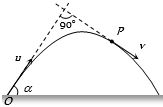
A body is projected with velocity $u$ making an angle $\alpha$ with the horizontal. Its velocity when it is perpendicular to the initial velocity vector $u$ is