Question
Read the passage given below and answer the following questions:
A chlorocompound (A) on reduction with Zn-Cu and ethanol gives the hydrocarbon (B) with five carbon atoms. When (A) is dissolved in dry ether and treated with sodium metal it gave 2, 2, 5, 5 - tetramethylhexane. The treatment of (A) with alcoholic KCN gives compound ( C).
The following questions are multiple choice questions. Choose the most appropriate answer:
  1. The compound (A) is:
  1. 1-chloro-2, 2-dimethylpropane.
  2. 1-chloro-2, 2-dimethyl butane.
  3. 1-chloro-2-methyl butane.
  4. 2-chloro-2-methyl butane.
  1. The reaction of (C) with Na, C2H5OH gives:
  1. (CH3)3C CH2CONH2
  2. (CH3)3C NH2
  3. (CH3)3C CH2CH2NH2
  4. (CH3)2CHCH2NH2
  1. The reaction of (C) with Na, C2H5OH is called:
  1. Gilman reaction.
  2. Mendius reaction.
  3. Grooves process.
  4. Swart's reaction.
  1. The reaction of (A) with aq. KOH will preferably favour:
  1. SN1 mechanism.
  2. SN2 mechanism.
  3. E1 mechanism.
  4. E2 mechanism.
  1. Compound (B) is:
  1. N-pentane.
  2. 2, 2-dimethylpropane.
  3. 2-methylbutane.
  4. None of these.

Answer

  1. (a) 1-chloro-2, 2-dimethylpropane.

Explanation:

$\ \ \ \ \ \ \ \ \ \ \ \ \text{CH}_3\\\ \ \ \ \ \ \ \ \ \ \ \ \ \ |\\\text{CH}_3-\text{C}-\text{CH}_2 -\text{Cl}\xrightarrow{\text{Ether/ Na}}\\\ \ \ \ \ \ \ \ \ \ \ \ \ \ |\\\ \ \ \ \ \ \ \ \ \ \ \ \ \text{CH}_3\ \ \ \ \\\text{I -Chloro-2, 2-di methylpropane }$

$\ \ \ \ \ \ \ \ \ \ \ \ \text{CH}_3\ \ \ \ \ \ \ \ \ \ \ \ \ \ \ \ \ \ \ \ \ \ \ \ \ \ \text{CH}_2\\\ \ \ \ \ \ \ \ \ \ \ \ \ |\ \ \ \ \ \ \ \ \ \ \ \ \ \ \ \ \ \ \ \ \ \ \ \ \ \ \ \ \ \ \ \ |\\\text{CH}_3-\text{C}-\text{CH}_2 -\text{CH}_2-\text{C}-\text{CH}_3\\\ \ \ \ \ \ \ \ \ \ \ \ \ |\ \ \ \ \ \ \ \ \ \ \ \ \ \ \ \ \ \ \ \ \ \ \ \ \ \ \ \ \ \ \ \ |\\\ \ \ \ \ \ \ \ \ \ \ \ \text{CH}_3\ \ \ \ \ \ \ \ \ \ \ \ \ \ \ \ \ \ \ \ \ \ \ \ \ \text{CH}_3\ \ \ \ \\\text{2, 2, 5, 5-Tetramethylhexane}$

  1. (c) (CH3)3C CH2CH2NH2

Explanation:

$\ \ \ \ \ \ \ \ \ \ \ \ \text{CH}_3\\\ \ \ \ \ \ \ \ \ \ \ \ \ \ |\\\text{CH}_3-\text{C}-\text{CH}_2 \text{Cl}\xrightarrow{\text{alc.KCN}}\\\ \ \ \ \ \ \ \ \ \ \ \ \ \ |\\\ \ \ \ \ \ \ \ \ \ \ \ \ \text{CH}_3$

$\ \ \ \ \ \ \ \ \ \ \ \ \text{CH}_3\\\ \ \ \ \ \ \ \ \ \ \ \ \ \ |\\\text{CH}_3-\text{C}-\text{CH}_2 \text{CN}\xrightarrow{\text{Na/C}_2\text{H}_5\text{OH}}\\\ \ \ \ \ \ \ \ \ \ \ \ \ \ |\\\ \ \ \ \ \ \ \ \ \ \ \ \ \text{CH}_3$

$\ \ \ \ \ \ \ \ \ \ \ \ \text{CH}_3\\\ \ \ \ \ \ \ \ \ \ \ \ \ \ |\\\text{CH}_3-\text{C}-\text{CH}_2 \text{CH}_2\text{NH}_2\\\ \ \ \ \ \ \ \ \ \ \ \ \ \ |\\\ \ \ \ \ \ \ \ \ \ \ \ \ \text{CH}_3$

  1. (b) Mendius reaction.
  2. (a) SN1 mechanism.
  3. (b) 2, 2-dimethylpropane.

Explanation:

$\ \ \ \ \ \ \ \ \ \ \ \ \text{CH}_3\\\ \ \ \ \ \ \ \ \ \ \ \ \ \ |\\\text{CH}_3-\text{C}-\text{CH}_2 \text{Cl}\xrightarrow{\text{Zn-Cu/C}_2\text{H}_5\text{OH}}\\\ \ \ \ \ \ \ \ \ \ \ \ \ \ |\\\ \ \ \ \ \ \ \ \ \ \ \ \ \text{CH}_3$

$\ \ \ \ \ \ \ \ \ \ \ \ \text{CH}_3\\\ \ \ \ \ \ \ \ \ \ \ \ \ \ |\\\text{CH}_3-\text{C}-\text{CH}_3\\\ \ \ \ \ \ \ \ \ \ \ \ \ \ |\\\ \ \ \ \ \ \ \ \ \ \ \ \ \text{CH}_3$

Need a full question paper?

Generate a complete, print-ready paper with questions like this in minutes — across 16+ boards, with answer keys.

Start Generating Free

Similar questions

Read the passage given below and answer the following questions:
Amines are alkyl or aryl derivatives of ammonia formed by replacement of one or more hydrogen atoms. Alkyl derivatives are called aliphatic amines and aryl derivatives are known as aromatic amines. The presence of aromatic amines can be identified by performing dye test. Aniline is the simplest example of aromatic amine. It undergoeselectrophilic substitution reactions in which -NH2 group strongly activates the aromatic ring through delocalisation of lone pair of electrons of N-atom. Aniline undergoes electrophilic substitution reactions. Ortho and para positions to the -NH2 group become centres of high electrons density. Thus, -NH2 group is ortho and para-directing and powerful activating group.
The following questions are multiple choice questions. Choose the most appropriate answer:
  1. Cyclohexylamine and aniline can be distinguished by:
  1. Hinsberg test.
  2. carbylamine test.
  3. Lassaigne test.
  4. azo dye test.
  1. Which of the following compounds gives dye test?
  1. Aniline.
  2. Methyl amine.
  3. Diphenyl amine.
  4. Ethyl amine.
  1. Aniline when acetylated, the major product on nitration followed by alkaline hydrolysis gives:
  1.  Acetanilide.
  2. o-nitroacetanitide.
  3. p-nitroaniline.
  4. m-nitroanitine.
  1. Oxidation of aniline with manganese dioxide and sulphuric acid produces:
  1. Phenylhydroxylamine.
  2. Nitrobenzene.
  3. p-benzoquinone.
  4. Phenol.
  1. Aniline when treated with cone. HNO3 and H2S04 gives:
  1.  p-phenylenediamine.
  2. m-nitroaniline.
  3. p-benzoquinone.
  4. Nitrobenzene.
Read the passage given below and answer the following questions:
The f-block elements are those in which the differentiating electron enters the (n -2)f orbital. There are two series of F-block elements corresponding to filling of 4f and 5f-orbitals. The series of 4f-orbitals is called lanthanides. Lanthanides show different oxidation states depending upon stability of f0, f7 and F14 configurations, though the most conunon oxidation states is +3. There is a regular decrease in size oflanthanides ions with increase in atomic number which is known as lanthanide contraction.
The following questions are multiple choice questions. Choose the most appropriate answer:
  1. The atomic numbers of three lanthanide elements X, Y and Z are 65, 68 and 70 respectively, their Ln3+ electronic configuration is:
  1. 4f8, 4f11, 4f13
  2. 4f11, 4f8, 4f13
  3. 4f0, 4f2, 4f11
  4. 4f3, 4f7, 4f9
  1. Lanthanide contraction is observed in:
  1. Gd
  2. At
  3. Xe
  4. Te
  1. Which of the following is not the configuration oflanthanoid?
  1. [Xe]4f106s2
  2. [Xe]4f15d16s2
  3. [Xe]4d145d106s2
  4. [Xe]4f75d16s2
  1. Name a member of the lanthanoid series which is well known to exhibit +4 oxidation state.
  1. Cerium (Z = 58)
  2. Europium (Z = 63)
  3. Lanthanum (Z = 57)
  4. Gadolinium (Z = 64
  1. Identify the incorrect statement among the following.
  1. Lanthanoid contraction is the accumulation of successive shrinkages.
  2. The different radii of Zr and Hf due to consequence of the lanthanoid contraction.
  3. Shielding power of 4f electrons is quite weak.
  4. There is a decrease in the radii of the atoms or ions as one proceeds from La to Lu.
Read the passage given below and answer the following questions:

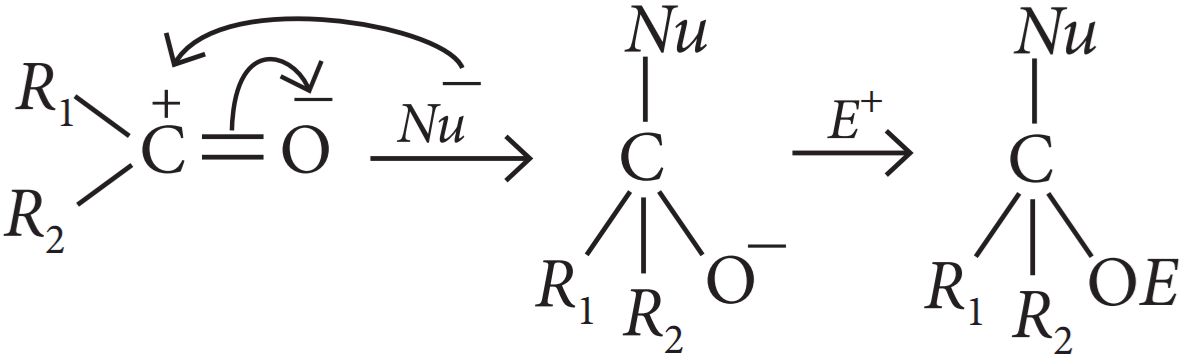
Aldehydes and ketones undergo nucleophilic addition reactions.

Carbonyl carbon is electron deficient hence acts as an electrophi le. Nucleophile attacks on the electrophili c carbon atom of the carbonyl group from a direction perpendicular to the plane of the molecule.
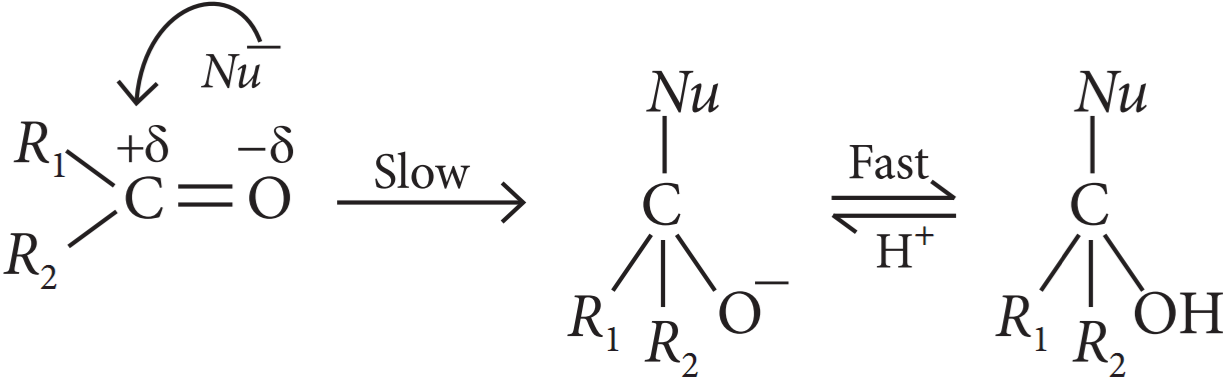
ln this process, hybridisation of carbon atom changes from sp2 to sp3 and a tetrahedral alkoxide ion is formed as intermediate. This intermediate captures proton from the reaction medium to give the neutral product. Aldehydes are generally more reactive than ketones in nucleophilic addition reactions.

In these questions (Q. No. l-iv), a statement of assertion followed by a statement ofreason is given. Choose the correct answer out of the following choices.

  1. Assertion and reason both are correct statements and reason is correct explanation for assertion.
  2. Assertion and reason both are correct statements but reason is not correct explanation for assertion.
  3. Assertion is correct statement but reason is wrong statement.
  4. Assertion is wrong statement but reason is correct statement.
  1. Assertion: Benzaldehyde is more reactive than ethanal towards nucleophitic attack.

Reason: The overall effect of -I and +R effect of phenyl group decreases the electron density on the carbon atom of >c=o group in benzaldehyde.

  1. Assertion: (CH3)3CCOC(CH3)3 and acetone can be distinguished by the reaction with NaHSO3.

Reason: HSO3 is the nucleophile in bisulphite addition.

  1. Assertion: Ease of nucleophilic addition of the compounds (I). CH3CHO(II) and CH3COCH3(III) is I > II > III.
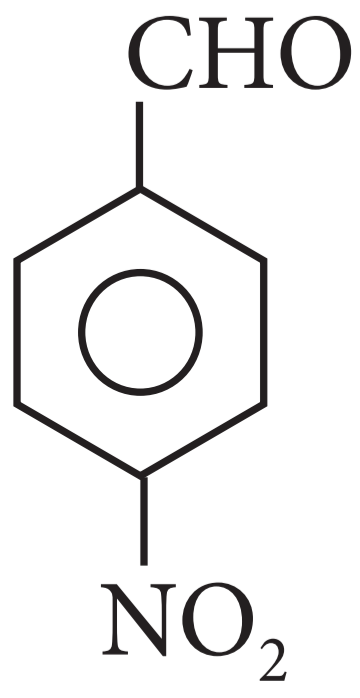
Reason: Aldehydes and ketones undergo nucleophilic addition reactions.

  1. Assertion: The formation of cyanohydrin from an aldehyde or ketone occurs very slowly with pure HCN. The is reaction is catalysed by a base.

Reason: Base generates CN- ion which is a stronger nucleophile.

  1. Assertion:  is more reactive towards nucleophilic addition reaction than .
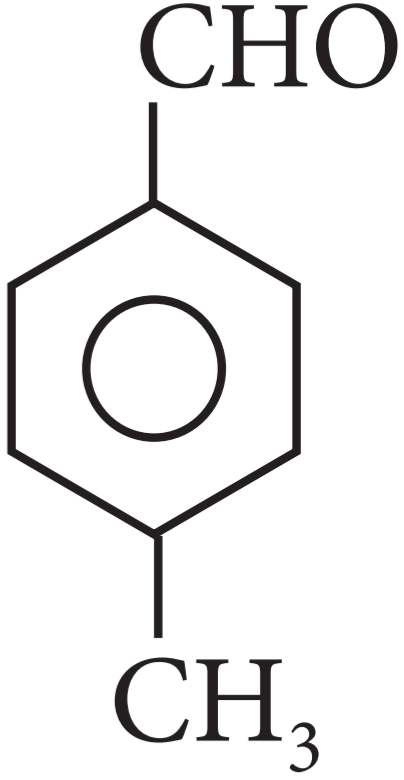
Reason: Reactivity of carbonyl group is due to electrophilic nature of carbonyl carbon.

Read the passage given below and answer the following questions:
To explain bonding in coordination compounds various theories were proposed. One of the important theory was valence bond theory. According to that, the central metal ion in the complex makes available a number of empty orbitals for the formation of coordination bonds with suitable ligands. The appropriate atomic orbitals of the metal hybridise to give a set of equivalent orbitals of definite geometry.
The d-orbitals involved in the hybridisation may be either inner d-orbitals i.e., (n - 1)d or outer d-orbitals i.e., nd. For example, Co3+ forms both inner orbital and outer orbital complexes, with ammonia it forms [Co(NH3)6]3+ and with fluorine it forms [CoF6]3- complex ion.
The following questions are multiple choice questions. Choose the most appropriate answer:
  1. Which of the following is not true for [CoF6]3-?
  1. It is paramagnetic.
  2. It has coordination number of 6.
  3. It is outer orbital complex.
  4. It involves d2sp3 hybridisation.
  1. [Cr(H2O)6]Cl3 (at. no. of Cr = 24) has a magnetic moment of 3.83B.M. The correct distribution of 3d-electrons in the central metal of the complex is:
  1. $3\text{d}^1_\text{xy},3\text{d}^1_{\text{x}^2-\text{y}^2},3\text{d}^1_\text{yz}$
  2. $3\text{d}^1_\text{xy},3\text{d}^1_{\text{yz}},3\text{d}^1_\text{zx}$
  3. $3\text{d}^1_\text{xy},3\text{d}^1_{\text{zy}},3\text{d}^1_{\text{z}^2}$
  4. $3\text{d}^1_{\text{x}^2-\text{y}^2},3\text{d}^1_{\text{z}^2},3\text{d}^1_\text{xz}$
  1. Which of the following is true for [Co(NH3)6]3+?
  1. It is an octahedral, di magnetic and outer orbital complex.
  2. It is an octahedral, paramagnetic and outer orbital complex.
  3. It is an octahedral, paramagnetic and inner orbital complex.
  4. It is an octahedral, di magnetic and inner orbital complex.
  1. The paramagnetism of [CoF6]3- is due to.
  1. 3 electrons.
  2. 4 electrons.
  3. 2 electrons.
  4. 1 electron.
  1. Which of the following is an inner orbital or low spin complex?
  1. [Ni(H2O)6]3+
  2. [FeF6]3-
  3. [Co(CN)6]3-
  4. [NiCl4]2-
Read the passage given below and answer the following questions:
The concentration of a solute is very important in studying chemical reactions because it determines how often molecules collide in solution and thus indirectly determine the rate of reactions and the conditions at equilibrium. There are several ways to express the amount of solute present in a solution. The concentration of a solution is a measure of the amount of solute that has been dissolved in a given amount of solvent or solution. Concentration can be expressed in terms of molarity, molality, parts per million, mass percentage, volume percentage, etc.
The following questions are multiple choice questions. Choose the most appropriate answer:
  1. A solution is prepared using aqueous Kl which is turned out to be 20% w/w Density of Kl is 1.202 g/mL the molality of the given solution and mole fraction of solute are respectively.
  1. 1.95m, 0.120
  2. 1.5m, 0.0263
  3. 2.5m, 0.0569
  4. 3.0m, 0.0352
  1. The molarity (in mol L-1) of the given solution will be.
  1. 1.56
  2. 1.89
  3. 0.263
  4. 1.44
  1. Which of the following is correct relationship between mole fraction and molality?
  1. $\text{x}_2=\frac{\text{mM}_1}{1+\text{mM}_1}$
  2. $\text{x}_2=\frac{\text{mM}_1}{1-\text{mM}_1}$
  3. $\text{x}_2=\frac{1+\text{mM}_1}{\text{mM}_1}$
  4. $\text{x}_2=\frac{1-\text{mM}_1}{\text{mM}_1}$
  1. Which of the following is temperature dependent?
  1. Molarity
  2. Molality
  3. Mole fraction
  4. Mass percentage
  1. Which of the following is true for an aqueous solution of the solute in terms of concentration?
  1. 1M = 1m
  2. 1M > 1m
  3. 1M < 1m
  4. Cannot be predicted
Read the passage given below and answer the following questions:

Due to intermolecular hydrogen bonding, the boiling points of alcohols and phenols are much higher than those of corresponding haloalkanes, haloarenes, aliphatic and aromatic hydrocarbons. Among isomeric alcohols, the boiling points follow the order: primary > secondary > tertiary. Boiling points of ethers are much lower than those of isomeric alcohols. The solubility of alcohols in water decreases as the molecular mass of alcohols increases. Amongst isomeric alcohols solubility increases with branching. The solubility of phenols in water is much lower than that of alcohols. Lower ethers such as dimethyl ether and ethyl methyl ether are soluble in water, but the solubility decreases as the molecular mass increases.

In these questions (Q. No. i-iv), a statement of assertion followed by a statement of reason is given. Choose the correct answer out of the following choices.

  1. Assertion and reason both are correct statements and reason is correct explanation for assertion.
  2. Assertion and reason both are correct statements but reason is not correct explanation for assertion.
  3. Assertion is correct statement but reason is wrong statement.
  4. Assertion is wrong statement but reason is correct statement.
  1. Assertion: Alcohols have higher boiling points than ethers of comparable molecular masses.

Reason: Alcohols and ethers are isomeric in nature.

  1. Assertion: The solubility of phenols in water is much lower than that of alcohols.

Reason: Phenols do not form H-bonds with water.

  1. Assertion: Among n-butane, ethoxyethane, 1-propanol and 2-propanol, the increasing order of boiling points is, 1-butanol < 1-propanol < ethoxyethane < n-butane.

Reason: Boiling point increases with increase in molecular mass.

  1. Assertion: Dimethyl ether and diethylether are soluble in water.

Reason: As the molecular mass increases, solubility of ethers in water decreases.

  1. Assertion: Butan-2-ol has higher boiling point than 2-methylpropan-2-ol.

Reason: Amongst isomeric alcohols, the boiling points decreases with branching.

Read the passage given below and answer the following questions:

The sequence of bases along the DNA and RNA chain establishes its primary structure which controls the specific properties of the nucleic acid. An RNA molecule is usually a single chain ofribose-containing nucleotide. On the basis of X-ray analysis of DNA, J.D., Watson and EH.C. crick (shared noble prize in 1962) proposed a three dimensional secondary structure for DNA. DNA molecule is a long and highly complex, spirally twisted, double helix, ladder like structure. The two polynucleotide chains or strands are linked up by hydrogen bonding between the nitrogeneous base molecules of their nucleotide monomers. Adenine (purine) always links with thymine (pyrimidine) with the help of two hydrogen bonds and guanine (purine) with cytosine (pyrimidine) with the help of three hydrogen bonds. Hence, the two strands extend in opposite directions, i.e., are antiparallel and complimentary.

  1. Assertion and reason both are correct statements and reason is correct explanation for assertion.
  2. Assertion and reason both are correct statements but reason is not correct explanation for assertion.
  3. Assertion is correct statement but reason is wrong statement.
  4. Assertion is wrong statement but reason is correct statement.
  1. Assertion: DNA molecules and RNA molecules are found in the nucleus of a cell.

Reason: There are two types of nitrogenous bases, purines and pyrimidines. Adenine (A) and guanine (G) are substituted purines; cytosine (C), thymine (T) and uracil (U) are substituted pyrimidines.

  1. Assertion: In both DNA and RNA, heterocyclic base and phosphate ester linkages are at C-1' and C-5' respectively of the sugar molecule.

Reason: Nucleotides and nucleosides mainly differ from each other in presence of phosphate units.

  1. Assertion: The backbone of RNA molecule is a linear chain consisting of an alternating units of a heterocylic base, D-ribose and a phosphate.

Reason: The segment of DNA which acts as the instruction manual for the synthesis of protein is ribose.

  1. Assertion: The double helical structure of DNA was proposed by Emil Fischer.

Reason: A nucleoside is an N-glycoside of heterocyclic base.

  1. Assertion: In DNA, the complementary bases are, adenine and guanine; thymine and cytosine.

Reason: The phenomenon of mutation is chemical change in DNA molecule.

Read the passage given below and answer the following questions:

Proteins are high molecular mass complex biomolecules of amino acids. The important proteins required for our body are enzymes, hormones, antibodies, transport proteins, structural proteins, contractile proteins etc. Except for glycine, all $\alpha$-amino acids have chiral carbon atom and most of them have L-configuration. The amino acids exists as dipolar ion called zwitter ion, in which a proton goes from the carboxyl group to the amino group. A large number of $\alpha$-amino acids are joined by peptide bonds forming polypeptides. The peptides having very large molecular mass (more than 10,000) are called proteins. The structure of proteins is described as primary structure giving sequence of linking of amino acids; secondary structure giving manner in which polypeptide chains are arranged and folded; tertiary structure giving folding, coiling or bonding polypeptide chains producing three dimensional structures and quaternary structure giving arrangement of sub-units in an aggregate protein molecule.

A statement of assertion followed by a statement of reason is given. Choose the correct answer out of the following choices.

  1. Assertion and reason both are correct statements and reason is correct explanation for assertion.
  2. Assertion and reason both are correct statements but reason is not correct explanation for assertion.
  3. Assertion is correct statement but reason is wrong statement.
  4. Assertion is wrong statement but reason is correct statement.
  1. Assertion: Except glycine, all naturally occurring CL-amino acids are optically active.

Reason: All naturally occurring CL-amino acids, except glycine, has at least one asymmetric carbon.

  1. Assertion: All amino acids are optically active.

Reason: Amino acids contain asymmetric carbon atoms.

  1. Assertion: In $\alpha$-helix structure, intramolecular H-bonding takes place whereas in $\beta$-pleated structure, intermolecular H-bonding takes place.

Reason: An egg contains a soluble globular protein called albumin which is present in the white part.

  1. Assertion: Secondary structure of protein refers to regular folding patterns of continuos portions of the polypeptide chain.

Reason: Out of 20 amino acids, only 12 amino acids can be synthesised by human body.

  1. Assertion: The helical structure of protein is stabilised by intramolecular hydrogen bond between -NH and carbonyl oxygen.

Reason: Sanger's reagent is used for the identification of N-tenninal amino acid of peptide chain.

Read the passage given below and answer the following questions:

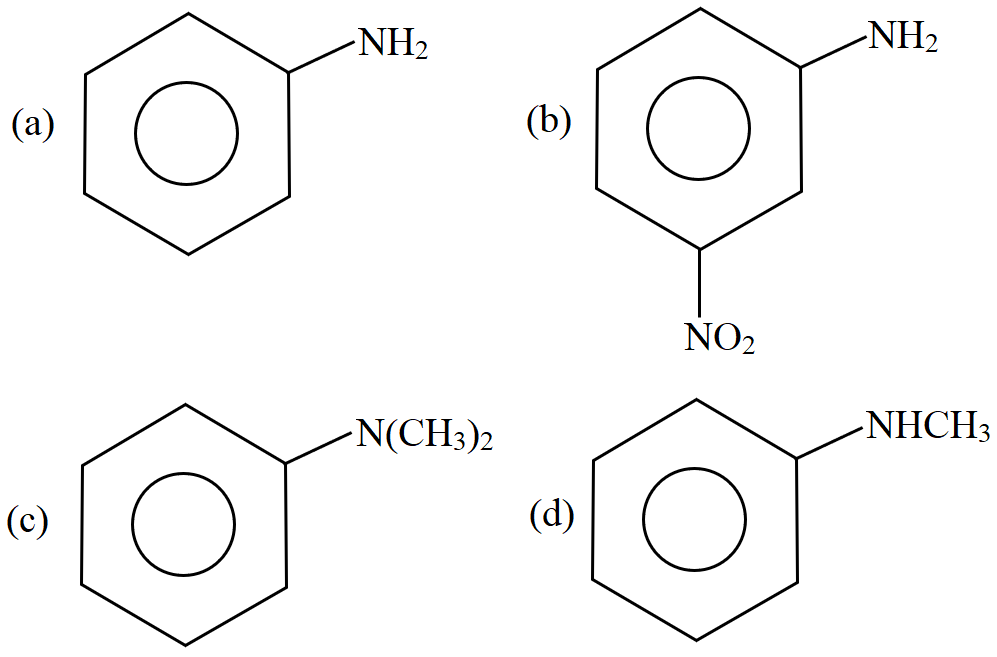
Amines are basic in nature. The basic strength of amines can be expressed by their dissociation constant, Kb or pKb.

$\text{RNH}_2+\text{H}_2\text{O}\rightleftharpoons\text{RNH}^+_3+\text{OH}^-$

$\text{k}_\text{b}=\frac{[\text{RNH}^+_3][\text{OH}^-]}{[\text{RNH}_2]}\text{and}\text{ pk}_\text{b}=-\log\text{k}_\text{b}$

Greater the Kb value or smaller the pKb value, more is the basic strength of a mine. Aryl amines such as aniline are less basic than aliphatic amines due to the involvement of lone pair of electrons on N-atom with the resonance in benzene. In derivatives of aniline, the electron releasing groups increase the basic strength while electron withdrawing groups decrease the basic strength. The base weakening effect of electron withdrawing group and base strengthening effect of electron releasing group is more marked at p-position than at m-position. a-Substituted aniline is less basic than aniline due to ortho effect and is probable due to combination of electronic and steric effect.

The following questions are multiple choice questions. Choose the most appropriate answer:

  1. Which of the following has lowest pKb value?

  1. The strongest base among the following is:
  1. C6H5NH2

  2. p-NO2 - C6H4NH2

  3. m-NO2 - C6H4NH2

  4. C6H5CH2NH2

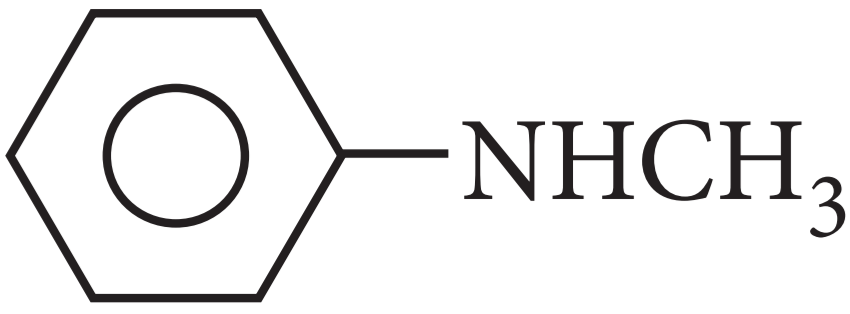
  1. Maximum pKb value of:
  1.  

  1.  

  1. (CH3CH2)2NH

  2. (CH3)2NH

  1.  The order of basic strength among the following amines in benzene solution is:
  1. Methylamine is more basic than NH3.
  2. Amines form hydrogen bonds.
  3. Ethylamine has higher boiling point than propane.
  4. Dimethylamine is less basic than methylamine.
  1. CH3CH2NH2 contains a basic -NH2 group, but CH3CONH2 does not because:
  1. Acetamide is amphoteric in character.
  2. In ethylamine the electron pair on N-atom is delocalised by resonance.
  3. In ethylamine there is no resonance while in acetamide the lone pair of electrons on N-atom is delocalised and is less available for protonation.
  4. None of these.
ln a reaction, the rates of disappearance of different reactants or rates of formation of different products may not be equal but rate of reaction at any instant of time has the same value expressed in terms of any reactant or product. Further, the rate of reaction may not depend upon the stoichiometric coefficients of the balanced chemical equation. The exact powers of molar concentrations of reactants on which rate depends are found experimentally and expressed in terms of 'order of reaction'. Each reaction has a characteristic rate constant depends upon temperature. The units of the rate constant depend upon the order of reaction.
The following questions are multiple choice questions. Choose the most appropriate answer:
  1. The rate constant of a reaction is found to be 3 × 10-3 mol-2 L2 sec-1. The order of the reaction is:
  1. 0.5
  2. 2
  3. 3
  4. 1
  1. ln the reaction, A + 3B → 2C, the rate of formation of C is:
  1. The same as rate of consumption of A.
  2. The same as the rate of consumption of B.
  3. Twice the rate of consumption of A.
  4. $\frac{3}{2}$ times the rate of consumption of B.
  1. Rate of a reaction can be expressed by following rate expression, Rate = k[A]2 [B], if concentration of A is increased by 3 times and concentration of B is increased by 2 times, how many times rate of reaction increases?
  1. 9 times
  2. 27 times
  3. 18 times
  4. 8 times
  1. The rate of a certain reaction is given by, rate = k[H+]n.The rate increases 100 times when the pH changes from 3 to 1. The order (n) of the reaction is:
  1. 2
  2. 0
  3. 1
  4. 1.5
  1. ln a chemical reaction A + 2B → products, when concentration of A is doubled, rate of the reaction increases 4 times and when concentration of B alone is doubled rate continues to be the same. The order of the reaction is:
  1. 1
  2. 2
  3. 3
  4. 4