Question
Read the passage given below and answer the following questions:
Coordination compounds are formulated and named according to the IUPAC system.
Few rules for naming coordination compounds are:
  1. In ionic complex, the cation is named first and then the anion.
  2. In the coordination entity, the ligands are named first and then the central metal ion.
  3. When more than one type of ligands are present, they are named in alphabetical order of preference without any consideration of charge.
The following questions are multiple choice questions. Choose the most appropriate answer:
  1. The IUPAC name of the complex [Pt(NH3)3Br(NO2)Cl]Cl is:
  1. Triamminechlorobromonitroplatinum (IV) chloride.
  2. Triamminebromonitrochloroplatinum (IV) chloride.
  3. Triamminebromidochloridonitroplatinum (IV) chloride.
  4. Triamminenitrochlorobromoplatinum (IV) chloride.
  1. The IUPAC name of [Ni(CO)4] is:
  1. Tetracarbonylnickel (II).
  2. Tetracarbonylnickel (0).
  3. Tetracarbonylnickelate (II).
  4. Tetracarbonylnickelate (0).
  1. As per IUPAC nomenclature, the name of the complex [Co(H2O)4(NH3)2]Cl3 is:
  1. Tetraaquadiamminecobalt (II) chloride.
  2. Tetraaquadiamminecobalt (III) chloride.
  3. Diamminetetraaquacobalt (II) chloride.
  4. Diamminetetraaquacobalt (III) chloride.
  1. Which of the following represents correct formula of dichloridobis(ethane -1, 2-diamine)cobalt (III) ion?
  1. [CoCl2(en)]2+
  2. [CoCl2(en)2]2+
  3. [CoCl2(en)]+
  4. [CoCl2(en)2]+
  1. Correct formula of pentaamminenitro-O-cobalt (III) sulphate is:
  1. [Co(NO2)(NH3)5]SO4
  2. [Co(ONO)(NH3)5]SO4
  3. [Co(NO2)(NH3)4](SO4)2
  4. [Co(ONO)(NH3)4](SO4)2

Answer

  1. (c) Triamminebromidochloridonitroplatinum (IV) chloride.

Explanation:

Ligands are named in alphabetical order irrespective of their charge.

  1. (b) Tetracarbonylnickel (0).
  2. (d) Diamminetetraaquacobalt (III) chloride.
  3. (d) [CoCl2(en)2]+
  4. (b) [Co(ONO)(NH3)5]SO4

Explanation:

Ligand $\text{NO}_2^-$ is ambidentate ligand as it can donate electrons through either nitrogen (NO2) or oxygen (ONO).

Need a full question paper?

Generate a complete, print-ready paper with questions like this in minutes — across 16+ boards, with answer keys.

Start Generating Free

Similar questions

Read the passage given below and answer the following questions:

For understanding the structure and bonding in transition metal complexes, the magnetic properties are very helpful. Low spin complexes are generally diamagnetic because of pairing of electrons, whereas high spin complexes are usually paramagnetic because of presence of unpaired electrons. Larger the number of unpaired electrons, stronger will be the paramagnetism. However magnetic behaviour of a complex can be confirmed from magnetic moment measurement. Magnetic moment $\mu=\sqrt{\text{n(n+2)}}\text{B.M.}$ where n = number of unpaired electrons. Greater the number of unpaired electrons, more will be the magnetic moment.

In these questions (Q. No. i-iv), a statement of assertion followed by a statement ofreason is given. Choose the correct answer out of the following choices.

  1. Assertion and reason both are correct statements and reason is correct explanation for assertion.
  2. Assertion and reason both are correct statements but reason is not correct explanation for assertion.
  3. Assertion is correct statement but reason is wrong statement.
  4. Assertion is wrong statement but reason is correct statement.
The following questions are multiple choice questions. Choose the most appropriate answer:

  1. Assertion: Both [Cr(H2O)6]2+ and [Fe(H2O)6]2+ have same magnetic moment.

Reason: Number of unpaired electrons in Cr2+ and Fe2+ are same.

  1. Assertion: [Fe(H2O)5NO]SO4 is paramagnetic.

Reason: The Fe in [Fe(H2O)5NO]SO4 has three unpaired electrons.

  1. Assertion: [Co(en)3]3+ is paramagnetic.

Reason: It is an inner orbital complex.

  1. Assertion: [Ni(CO)4] is diamagnetic and tetrahedral in shape.

Reason: [Ni(CO)4] contains no unpaired electrons and involves dsp2 hybridisation.

  1. Assertion: [Ni(CN)4]2- is diamagnetic complex.

Reason: It involves dsp2 hybridisation and there is no unpaired electron.

Read the passage given below and answer the following questions:

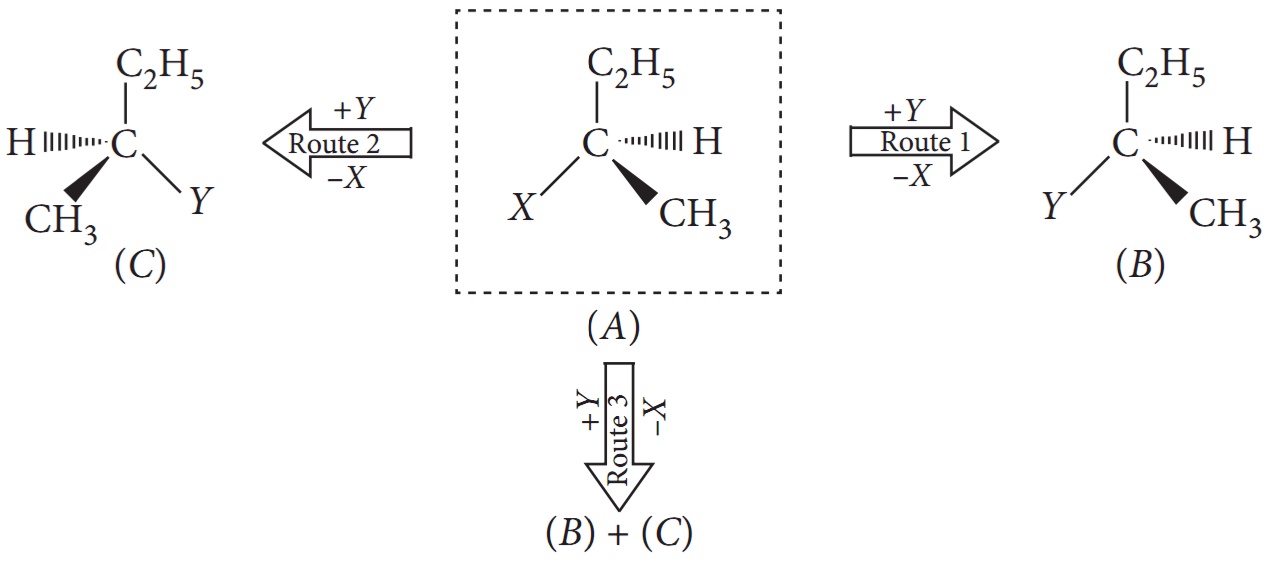
When a chemical reaction involves bond cleavage or bond formation at an asymmetric carbon atom, three different products may be formed. For example, during the substitution of a group X by Y in the following reaction, the three possible products may be shown below:

  1. If Bis the only product, the process is called retention of configuration because B has the same configuration as the starting reactant (A).
  2. If C is the only product, the process is called inversion of configuration because C has the configuration opposite to the starting reactant (A).
  3. If an equimolar mixture of Band C (r.e., a 50 : 50 mixture) is fanned, then the process is called racemisation and the product is optically inactive because one isomer will rotate the light in the direction opposite to another.

In these questions (Q. No. i-iv), a statement of assertion followed by a statement of reason is given. Choose the correct answer out of the following choices.

  1. Assertion and reason both are correct statements and reason is correct explanation for assertion.
  2. Assertion and reason both are correct statements but reason is not correct explanation for assertion.
  3. Assertion is correct statement but reason is wrong statement.
  4. Assertion is wrong statement but reason is correct statement.
  1. Assertion: A reaction is said to be stereospecific if a particular stereoisomer of the reactant produces a specific stereoisomer of the product.

Reason: Bromination of cis-2-butene gives meso-2, 3-dibromobutane which is stereospecific.

  1. Assertion: Addition of Br2 to cis-but-2-ene is stereoselective.

Reason: SN2 reactions are stereospecific as well as stereoselective.

  1. Assertion: Optically active 2-iodobutane on treatment with Nal in acetone undergoes recemization.

Reason: Repeated Walden inversions on the reactant and its product eventually gives a racemic mixture.

  1. Assertion: SN2 reaction of an optically active alkyl halide with an aqueous solution of KOH always gives an alcohol with opposite sign of rotation.

Reason: SN2 reactions always proceed with inversion of configuration.

  1. Assertion: Nudeophilic substitution reaction of an optically active alkyl halide gives a mixture of en an ti om ers.

Reason: The reaction occurs by SN2 mechanism.


Read the passage given below and answer the following questions:

Carboxylic acids having an $\alpha$-hydrogen atom when treated with chlorine or bromine in the presence of small amount of red phosphorus gives $\alpha$-halocarboxytic acids. The reaction is known as Hell-Volhard-Zelinsky reaction.

$\text{R}-\text{CH}_2-\text{COOH}+\text{X}_2\xrightarrow{\text{red p}}\text{R}-\text{CH}-\text{COOH}\\ \ \ \ \ \ \ \ \ \ \ \ \ \ \ \ \ \ \ \ \ \ \ \ \ \ \ \ \ \ \ \ \ \ \ \ \ \ \ \ \ \ \ \ \ \ \ \ \ \ \ \ \ \ \ \ \ \ \ \ \ \ |\\ \ \ \ \ \ \ \ \ \ \ \ \ \ \ \ \ \ \ \ \ \ \ \ \ \ \ \ \ \ \ \ \ \ \ \ \ \ \ \ \ \ \ \ \ \ \ \ \ \ \ \ \ \ \ \ \ \ \ \ \ \text{X}\\ \ \ \ \ \ \ \ \ \ \ \ \ \ \ \ \ \ \ \ \ \ \ \ \ \ \ \ \ \ \ \ \ \ \ \ \ \ \ \ \ \ \ \ \ \ \ \ \ \ \ \ \ \ \ (\text{X = Cl, Br)}$

When sodium salt of carboxylic acid is heated with soda lime it loses carbon dioxide and gives hydrocarbon with less number of C-atoms.

$\text{R}-\text{COOH}\xrightarrow{\text{NaOH}}\text{R}-\text{COONa}\xrightarrow[\Delta]{\text{NaOH}+\text{CaO}}\text{R}-\text{H}+\text{Na}_2\text{CO}_3\\\text{Carboxylic}\ \ \ \ \ \ \ \ \ \ \ \ \ \ \ \ \ \ \ \ \ \text{Sod.}\ \ \ \ \ \ \ \ \ \ \ \ \ \ \ \ \ \ \ \ \ \ \ \ \ \ \ \ \ \text{Alkane}\\\ \ \ \ \ \text{acid}\ \ \ \ \ \ \ \ \ \ \ \ \ \ \ \ \ \ \ \ \ \ \text{carboxylate}$

In these questions (Q. No. l-iv), a statement of assertion followed by a statement ofreason is given. Choose the correct answer out of the following choices.

  1. Assertion and reason both are correct statements and reason is correct explanation for assertion.
  2. Assertion and reason both are correct statements but reason is not correct explanation for assertion.
  3. Assertion is correct statement but reason is wrong statement.
  4. Assertion is wrong statement but reason is correct statement.
  1. Assertion: (CH3)3CCOOH does not give H.V.Z reaction.

Reason: (CH3)3CCOOH does not have $\alpha$-hydrogen atom.

  1. Assertion: H.V.Z. reaction involves the treatment of carboxylic acids having $\alpha$-hydrogens with Cl2 or Br2 in presence of small amount of red phosphorus.

Reason: Phosphorus reacts with halogens to form phosphorus trihalides.

  1. Assertion: Propionic acid with $\frac{\text{Br}_2}{\text{P}}$ yields CH2Br - CHBr - COOH.

Reason: Propionic acid has two $\alpha$-hydrogen atoms.

  1. Assertion: C6H5COCH2COOH undergoes decarboxylation easily than C6H5COCH2COOH.

Reason: C6H5COCH2COOH is $\beta$-keto acid.

  1. Assertion: On heating 3-methylbutanoic acid with soda lime, isobutane is obtained.

Reason: Soda lime is a mixture of NaOH + CaO in the ratio 3 : 1.

Read the passage given below and answer the following questions:

Glucose is known as dextrose because it occurs in nature as the optically active dextrorotatory isomer. lt is essential constituent of human blood. The blood normally contains 65 to 110mg of glucose per 100mL (hence named Blood sugar). The level may be much higher in diabetic persons. The urine of diabetic persons also contain considerable amount of glucose. ln combined form, it occurs in cane sugar and polysaccharides such as starch and cellulose.

Glucose has an aldehyde group (-CHO), one primary alcoholic group (-CH2OH) and four secondary alcoholic groups (-CHOH) in their structure. Due to the presence five hydroxyl groups (-OH). glucose undergoes acetylation. Glucose also undergoes oxidation with mild oxidising agents like bromine water as well as with strong oxidising agents like nitric acid. Since glucose is readily oxidised, it acts as a strong reducing agent and reduces Tollen's reagent and Fehling solution. Glucose exists in two crystalline forms: $\alpha$-D-glucose and $\beta$-D-glucose. If either of the two forms is dissolved in water and allowed to stand, the specific rotation of the solution changes gradually, until a constant value is obtained. This change is called mutarotation.

A statement of assertion followed by a statement of reason is given. Choose the correct answer out of the following choices.

  1. Assertion and reason both are correct statements and reason is correct explanation for assertion.
  2. Assertion and reason both are correct statements but reason is not correct explanation for assertion.
  3. Assertion is correct statement but reason is wrong statement.
  4. Assertion is wrong statement but reason is correct statement.
  1. Assertion: A diabetic person carries a packet of glucose with him always.

Reason: Glucose increases the blood sugar level almost instantaneously.

  1. Assertion: On oxidation with nitric acid, glucose as well as gluconic acid both yield saccharic acid.

Reason: The pentaacetate of glucose does not react with hydroxylamine indicating the absence of free -CHO group.

  1. Assertion: Glucose reacts with acetyl chloride to form pentaacetyl glucose.

Reason: The formation of pentaacetyl derivative confirms the presence of five -OH groups in glucose.

  1. Assertion: A certain compound gives negative test with ninhydrin and positive test with Benedict's solution, the compound is an amino acid.

Reason: Glucose is a monosaccharide.

  1. Assertion: The rapid interconversion of $\alpha$-D-glucose and $\beta$-D-glucose in solution is known as racemisation.

Reason: Hydrolysis reaction will take place when a mineral acid is treated with sugar.

Read the passage given below and answer the following questions:

Transition elements are elements that have partially filled d-orbitals. The configuration of these elements corresponds to (n - 1)d1-10ns1-2. It is important to note that the elements mercury, cadmium and zinc are not considered transition elements because of their electronic configurations, which corresponds to (n - 1)d10ns2. Some general properties of transition elements are:

These elements can fonn coloured compounds and ions due to d-d transition;

These elements exhibit many oxidation states;

A large variety of ligands can bind themselves to these elements, due to this, a wide variety of stable complexes formed by these ions. The boiling and melting point of these elements are high. These elements have a large ratio of charge to the radius.

In these questions (Q. No. i-iv), a statement of assertion followed by a statement ofreason is given. Choose the correct answer out of the following choices.

  1. Assertion and reason both are correct statements and reason is correct explanation for assertion.
  2. Assertion and reason both are correct statements but reason is not correct explanation for assertion.
  3. Assertion is correct statement but reason is wrong statement.
  4. Assertion is wrong statement but reason is correct statement.
  1. Assertion: Tungsten has very high melting point.

Reason: Tungsten is a covalent compound.

  1. Assertion: Zn, Cd and Hg are normally not considered transition metals.

Reason: d-Orbitals in Zn, Cd and Hg elements are completely filled, hence these metals do not show the general characteristics properties of the transition elements.

  1. Assertion: Copper metal gets readily corroded in acidic aqueous solution such as HCl and dil. H2SO4.

Reason: Free energy change for this process is positive.

  1. Assertion: Tailing of mercury occurs on passing ozone through it.

Reason: Due to oxidation of mercury.

  1. Assertion: Transition metals are poor reducing agents.

Reason: Transition metals fonn numerous alloys with other metals.

Read the passage given below and answer the following questions:
A compound (X) containing C, H and O is unreactive towards sodium. It also does not react with Schiff s reagent. On refluxing with an excess of hydroiodic acid, (X) yields only one organic product ( Y). On hydrolysis, (Y) yields a new compound (Z) which can be converted into (Y) by reaction with red phosphorus and iodine. The compound (Z) on oxidation with potassium permanganate gives a carboxylic acid. The equivalent weight of this acid is 60.
The following questions are multiple choice questions. Choose the most appropriate answer:
  1. The compound (X) is an:
  1. Acid.
  2. Aldehyde.
  3. Alcohol.
  4. Ether.
  1. The IUPAC name of the acid formed is:
  1. Methanoic acid.
  2. Ethanoic acid.
  3. Propanoic acid.
  4. Butanoic acid.
  1. Compound (Y) is:
  1. Ethyl iodide.
  2. Methyl iodide.
  3. Propyl iodide.
  4. Mixture of (a) and (b).
  1. Compound (Z) is:
  1. Methanol.
  2. Ethanol.
  3. Propanol.
  4. Butanol.
  1. Compound (X) on treatment with excess of Cl2 in presence of tight gives:
  1. $\propto-$ Chlorodiethyl ether.
  2. $\propto,\propto'-$ Dichlorodiethyl ether.
  3. Perchlorodiethyl ether.
  4. None of these.
A reaction is said to be of the first order if the rate of the reaction depends upon one concentration term only. For a first order reaction of the type A → Products, the rate of the reaction is given as: rate = k[A]. The differential rate law is given as: $\frac{\text{dA}}{\text{dt}}=-\text{k}[\text{A}].$ The integrated rate law is: In $\frac{[\text{A}]}{[\text{A}]_0}=-\text{kt},$ [A] is the concentration of reactant left at time t and [A]0 is the initial concentration of the reactant, k is the rate constant.
The following questions are multiple choice questions. Choose the most appropriate answer:
  1. The unit of rate constant for a first order reaction is:
  1. S-1
  2. mol L-1 s-1
  3. L mol-1 s-1
  4. L2 mol-2 s-1
  1. Half-life period of a first order reaction is 10min. Starting with initial concentration 12M, the rate after 20min is:
  1. 0.693 × 3M min-1
  2. 0.0693 × 4M min-1
  3. 0.0693 × M min-1
  4. 0.0693 × 3M min-1
  1. 50% of a first order reaction is complete in 23 minutes. Calculate the ti me required to complete 90% of the reaction.
  1. 70.4 minutes.
  2. 76.4 minutes.
  3. 38.7 minutes.
  4. 35.2 minutes.
  1. For a first order reaction, (A) → products, the concentration of A changes from 0.1M to 0.025M in 40 minutes. The rate of reaction when the concentration of A is 0.01M, is:
  1. 3.47 × 10⁻⁴ M/ min
  2. 3.47 × 10⁻⁵ M/ min
  3. 1.73 × 10⁻⁴ M/ min
  4. 1.73 × 10⁻⁵ M/ min
  1. The half-life period ofa 1st order reaction is 60 minutes. What percentage will be left over after 240 minutes?
  1. 6.25%
  2. 4.25%
  3. 5%
  4. 6%
Read the passage given below and answer the following questions:
Amines are alkyl or aryl derivatives of ammonia formed by replacement of one or more hydrogen atoms. Alkyl derivatives are called aliphatic amines and aryl derivatives are known as aromatic amines. The presence of aromatic amines can be identified by performing dye test. Aniline is the simplest example of aromatic amine. It undergoeselectrophilic substitution reactions in which -NH2 group strongly activates the aromatic ring through delocalisation of lone pair of electrons of N-atom. Aniline undergoes electrophilic substitution reactions. Ortho and para positions to the -NH2 group become centres of high electrons density. Thus, -NH2 group is ortho and para-directing and powerful activating group.
The following questions are multiple choice questions. Choose the most appropriate answer:
  1. Cyclohexylamine and aniline can be distinguished by:
  1. Hinsberg test.
  2. carbylamine test.
  3. Lassaigne test.
  4. azo dye test.
  1. Which of the following compounds gives dye test?
  1. Aniline.
  2. Methyl amine.
  3. Diphenyl amine.
  4. Ethyl amine.
  1. Aniline when acetylated, the major product on nitration followed by alkaline hydrolysis gives:
  1.  Acetanilide.
  2. o-nitroacetanitide.
  3. p-nitroaniline.
  4. m-nitroanitine.
  1. Oxidation of aniline with manganese dioxide and sulphuric acid produces:
  1. Phenylhydroxylamine.
  2. Nitrobenzene.
  3. p-benzoquinone.
  4. Phenol.
  1. Aniline when treated with cone. HNO3 and H2S04 gives:
  1.  p-phenylenediamine.
  2. m-nitroaniline.
  3. p-benzoquinone.
  4. Nitrobenzene.
Read the passage given below and answer the following questions:

The sequence of bases along the DNA and RNA chain establishes its primary structure which controls the specific properties of the nucleic acid. An RNA molecule is usually a single chain ofribose-containing nucleotide. On the basis of X-ray analysis of DNA, J.D., Watson and EH.C. crick (shared noble prize in 1962) proposed a three dimensional secondary structure for DNA. DNA molecule is a long and highly complex, spirally twisted, double helix, ladder like structure. The two polynucleotide chains or strands are linked up by hydrogen bonding between the nitrogeneous base molecules of their nucleotide monomers. Adenine (purine) always links with thymine (pyrimidine) with the help of two hydrogen bonds and guanine (purine) with cytosine (pyrimidine) with the help of three hydrogen bonds. Hence, the two strands extend in opposite directions, i.e., are antiparallel and complimentary.

  1. Assertion and reason both are correct statements and reason is correct explanation for assertion.
  2. Assertion and reason both are correct statements but reason is not correct explanation for assertion.
  3. Assertion is correct statement but reason is wrong statement.
  4. Assertion is wrong statement but reason is correct statement.
  1. Assertion: DNA molecules and RNA molecules are found in the nucleus of a cell.

Reason: There are two types of nitrogenous bases, purines and pyrimidines. Adenine (A) and guanine (G) are substituted purines; cytosine (C), thymine (T) and uracil (U) are substituted pyrimidines.

  1. Assertion: In both DNA and RNA, heterocyclic base and phosphate ester linkages are at C-1' and C-5' respectively of the sugar molecule.

Reason: Nucleotides and nucleosides mainly differ from each other in presence of phosphate units.

  1. Assertion: The backbone of RNA molecule is a linear chain consisting of an alternating units of a heterocylic base, D-ribose and a phosphate.

Reason: The segment of DNA which acts as the instruction manual for the synthesis of protein is ribose.

  1. Assertion: The double helical structure of DNA was proposed by Emil Fischer.

Reason: A nucleoside is an N-glycoside of heterocyclic base.

  1. Assertion: In DNA, the complementary bases are, adenine and guanine; thymine and cytosine.

Reason: The phenomenon of mutation is chemical change in DNA molecule.