Question
Read the passage given below and answer the following questions:
Although chlorobenzene is inert to nucleophilic substitution, however it gives quantitative yield of phenol when heated with aq. $Na OH$ at high temperature and under high pressure. As far as electrophilic substitution in phenol is concemed the — $OH$ group is an activating group, hence, its presence enhances the electrophilic substitution at $o -$ and $p -$ positions.
The following questions are multiple choice questions. Choose the most appropriate answer:
  1. Conversion of chlorobenzene into phenol involves:
  1. Modified $S_N1$ mechanism.
  2. Modified $S_N2$ mechanism.
  3. Both $(a)$ and $(b).$
  4. Elimination$-$addition mechanism.
  1. Phenol undergoes electrophilic substitution more readily than benzene because:
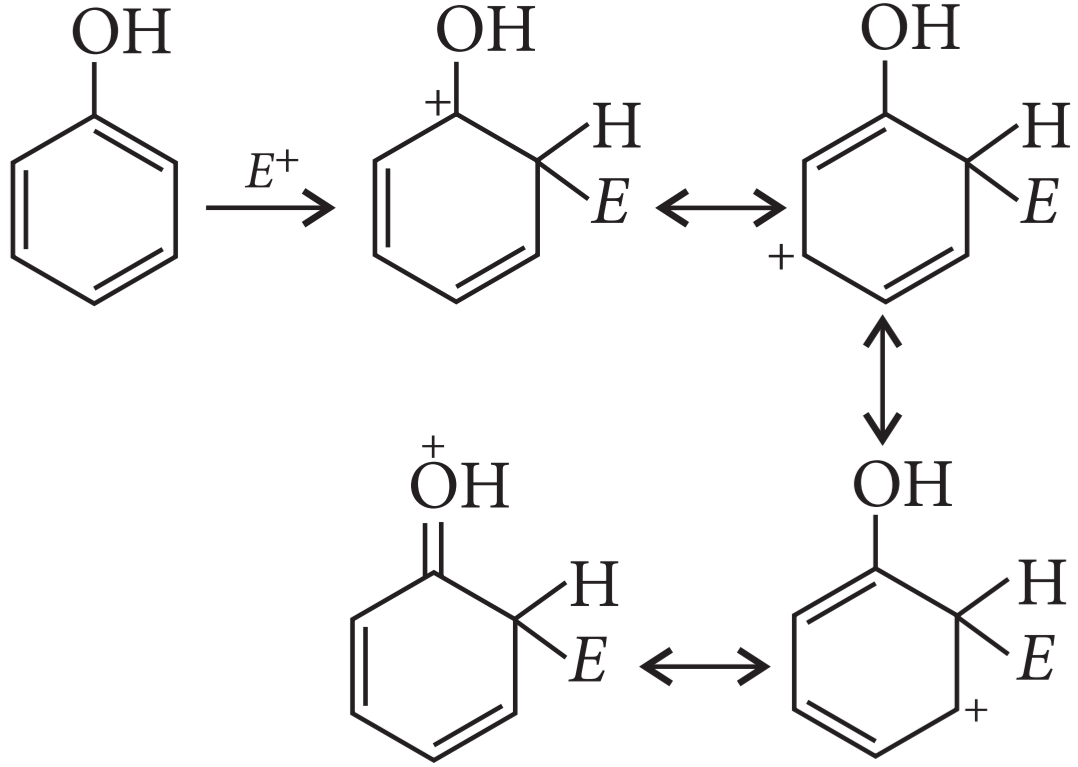
  1. The intermediate carbocation is a resonance hybrid of more resonating structures than that from benzene.
  2. The intermediate is more stable as it has positive charge on oxygen, which can be better accommodated than on carbon.
  3. In one of the canonical structures, every atom $($except hydrogen$)$ has complete octet.
  4. The $— OH$ group is $o, p-$directing which like all other $o, p -$ directing group, is activating.
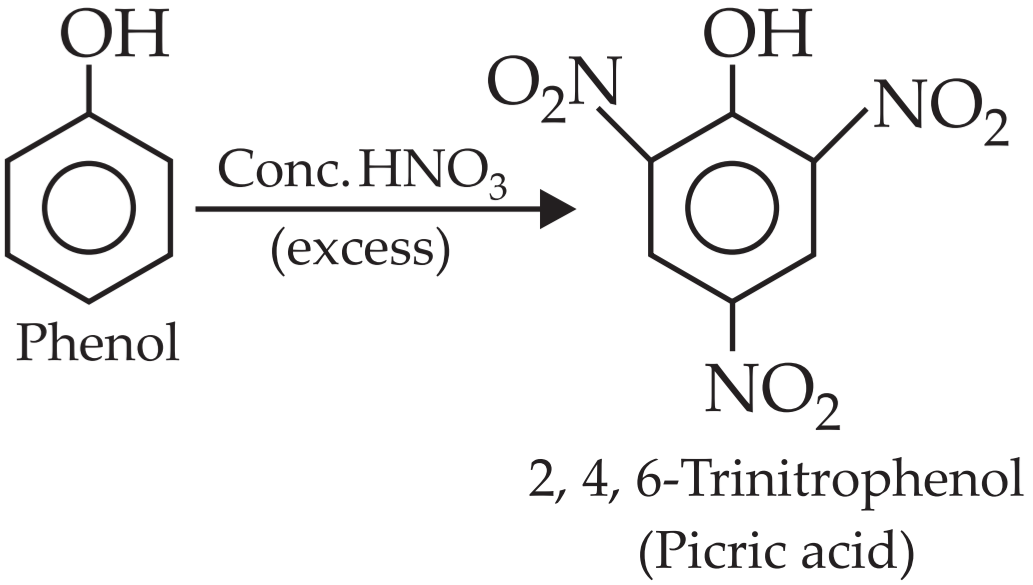
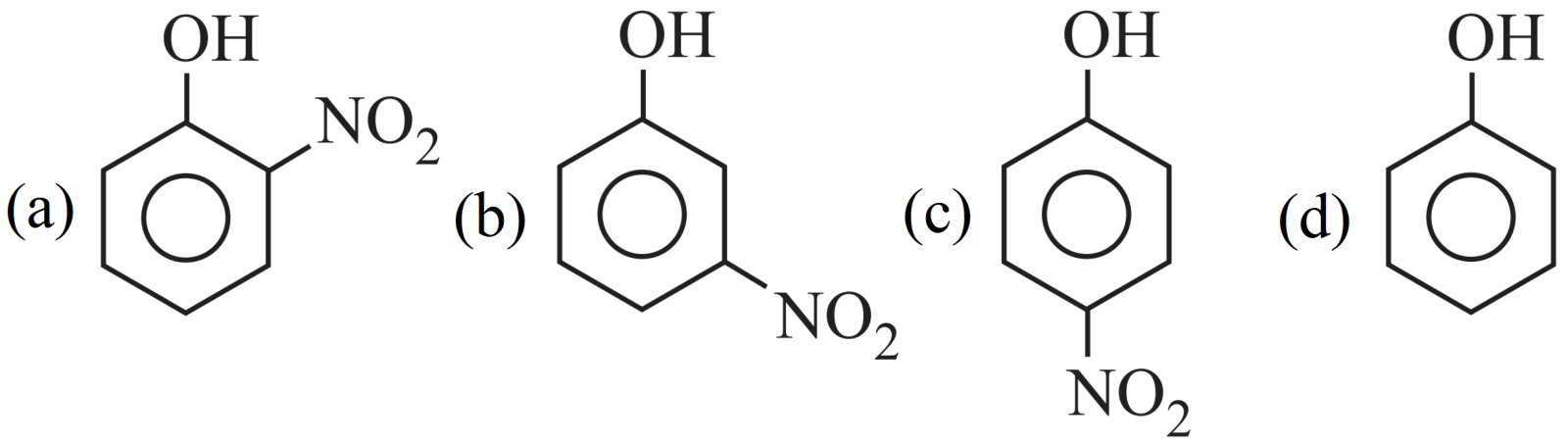
  1. Phenol on treatment with excess of cone. $HNO_3$ gives:
  1. $O -$ nitrophenol.
  2. $P -$ nitrophenol.
  3. $O -$ and $p -$ nitrophenol.
  4. $2, 4, 6 -$ trinitrophenol.
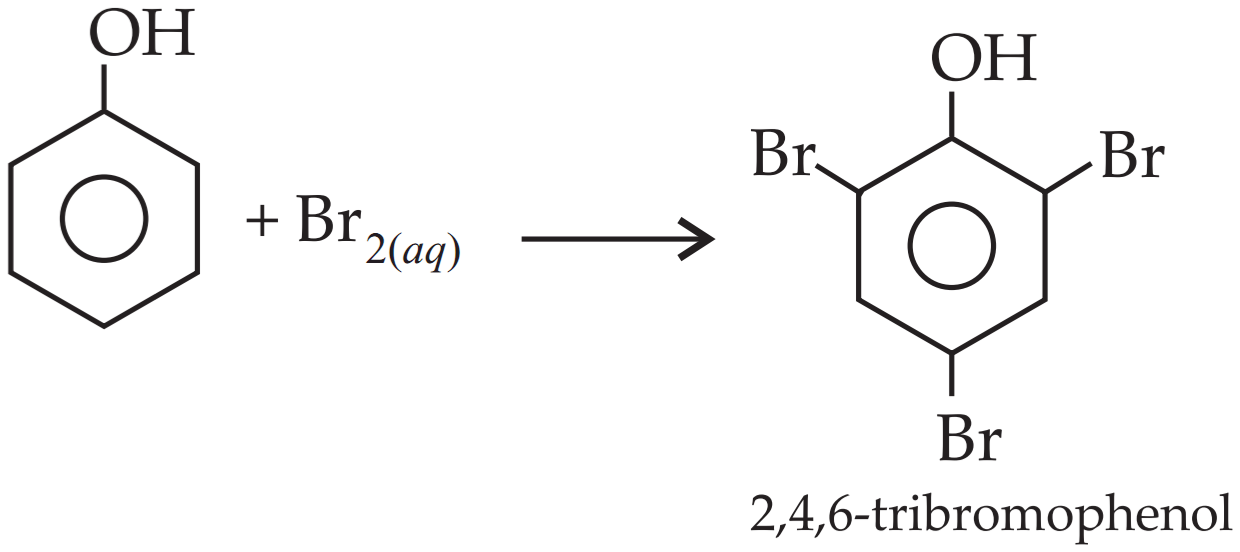
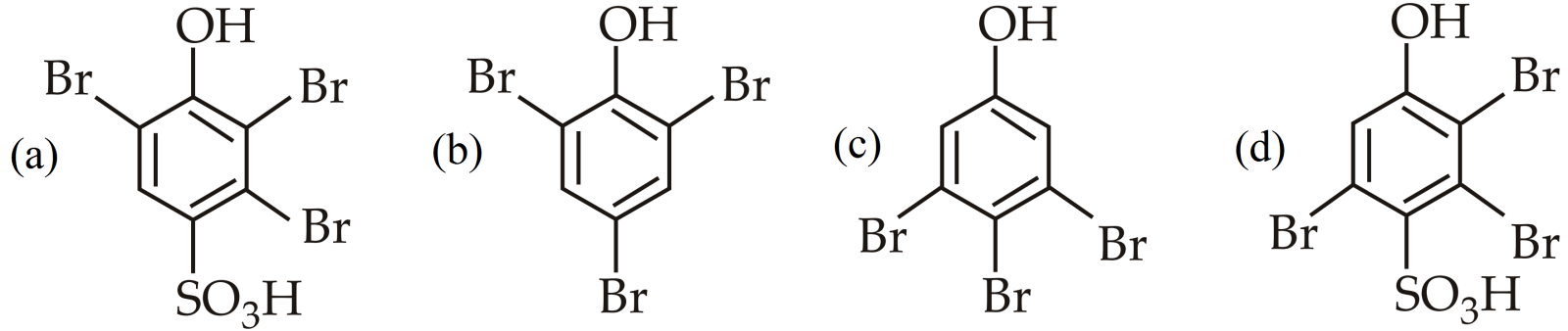
  1. Phenol is heated with a solution of mixture of $KBr$ and $KBrO_3.$ The major product obtained in the above reaction is:
  1. $2 -$ bromophenol.
  2. $3 -$ bromophenol.
  3. $4 -$ bromophenol.
  4. $2, 4, 6 -$ tribromophenol.
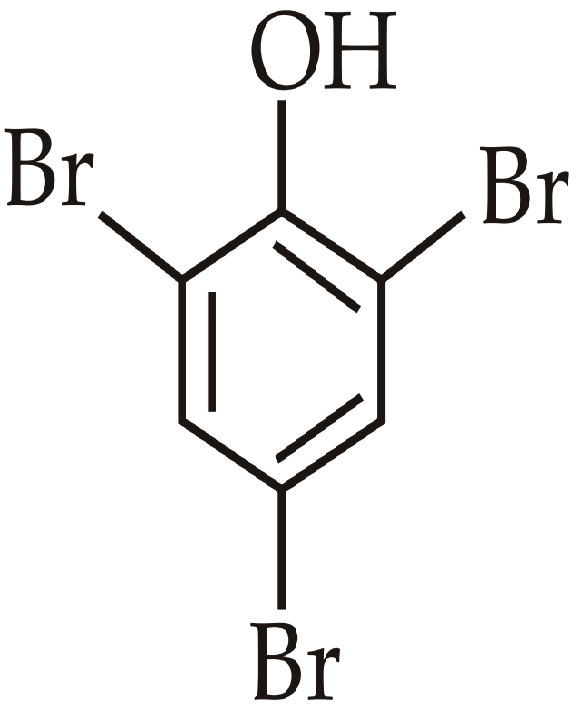
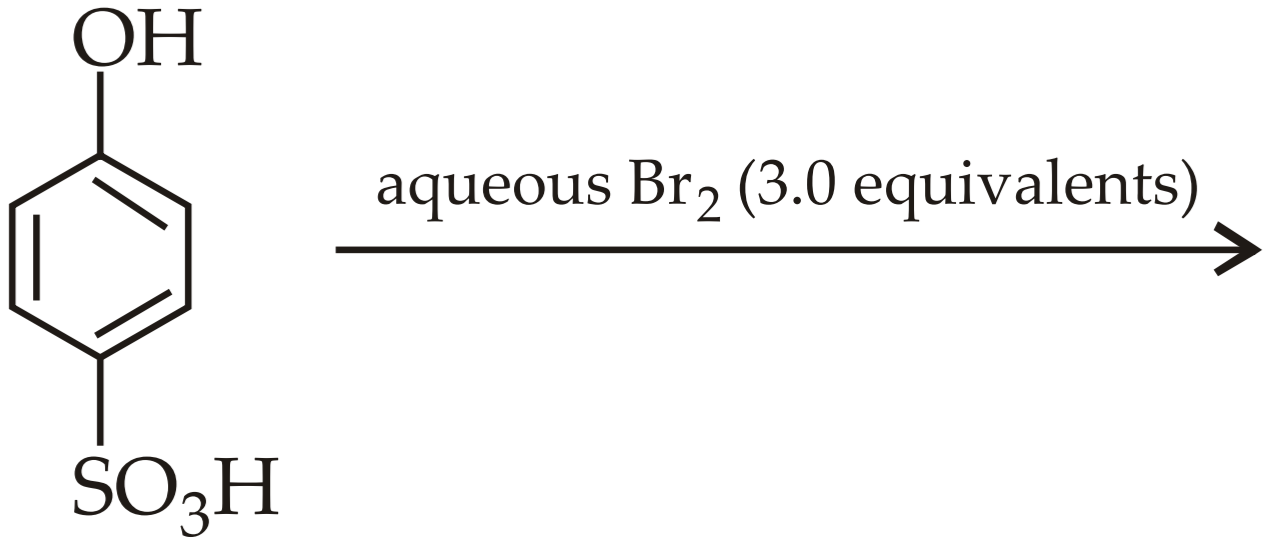
  1. The major product of the following reaction is:
Answer

    1. $(d)$ Elimination$-$addition mechanism.
    2. $(c)$ In one of the canonical structures, every atom $($except hydrogen$)$ has complete octet.
    1. $(d)\ 2, 4, 6 -$ trinitrophenol.
    1. $(d)\ 2, 4, 6 -$ tribromophenol.
    $\text{KBr}_{\text{(aq)}}+\text{KBrO}_{3\text{(aq)}}\rightarrow\text{Br}_{2\text{(aq)}}$
    This bromine reacts with phenol and $2, 4, 6 -$ tribromophenol.
    1. $(b)$
    ​​​​​​​

Need a full question paper?

Generate a complete, print-ready paper with questions like this in minutes — across 16+ boards, with answer keys.

Start Generating Free

Similar questions

Read the passage given below and answer the following questions:
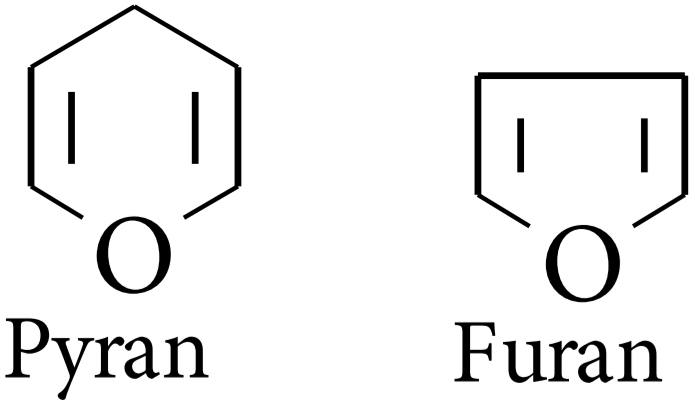
Pentose and hexose undergo intramolecular hemiacetal or hemiketal formation due to combination of the $–\ce{OH}$ group with the carbonyl group. The actual structure is either of five or six membered ring containing an oxygen atom. In the free state all pentoses and hexoses exist in pyranose form $($resembling pyran$).$ However,inthe combined state some of them exist as five membered cyclic structures, called furanose $($resembling furan$).$

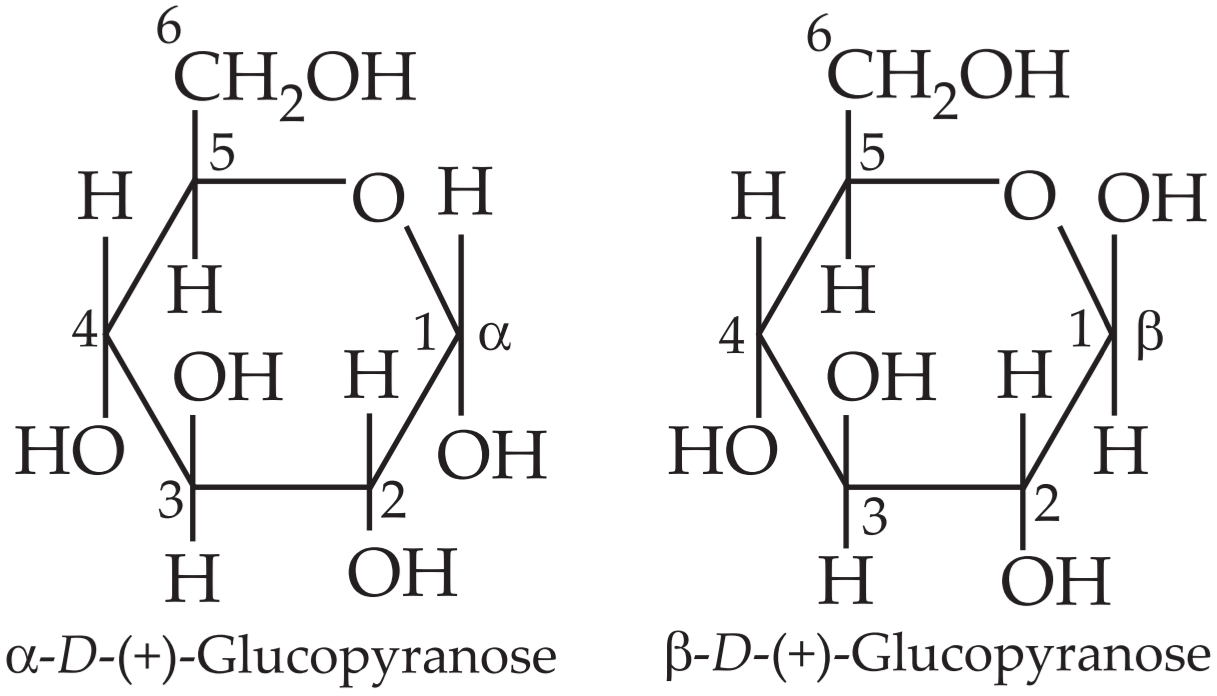
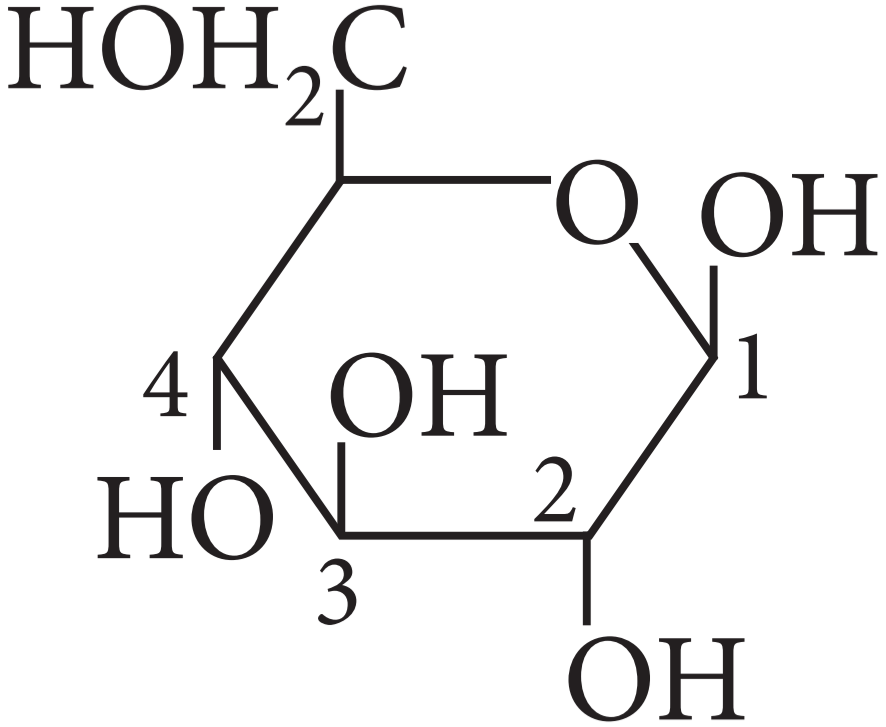
The cyclic structure of glucose is represented by Haworth structure:

$\alpha$ and $\beta D-$glucose have different configuration at anomeric $(C-1)$ carbon atom, hence are called anomers and the $C-1$ carbon atom is called anomeric carbon $($glycosidic carbon$).$
The six membered cyclic structure of glucose is called pyranose structure.
The following questionsare multiple choice questions. Choose the most appropriate answer:
  1. $\alpha D(+)-$glucose and $\beta D(+)$ glucose are:
  1. Enantiomers.
  2. Conformers.
  3. Epimers.
  4. Anomers.
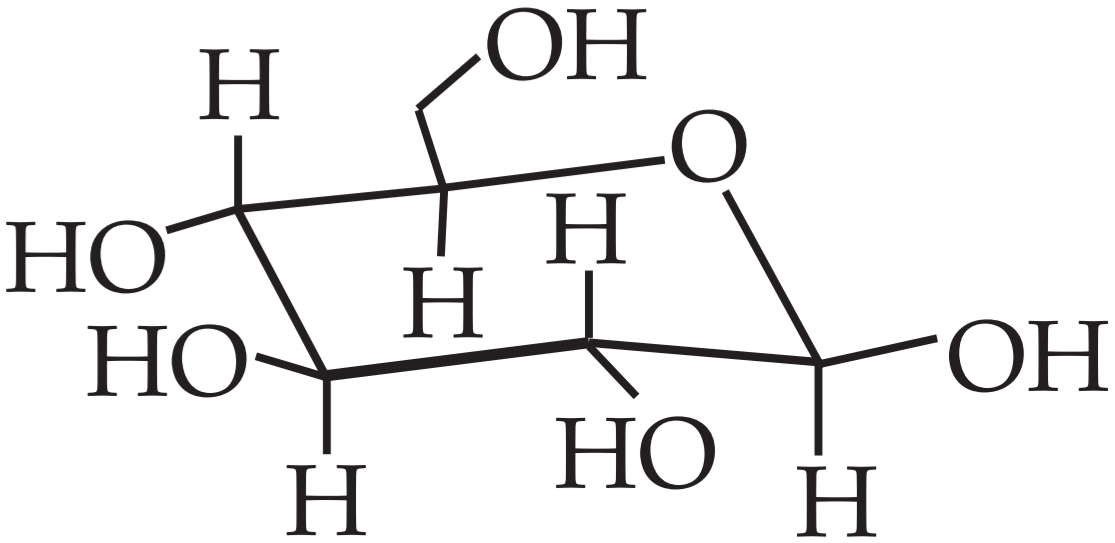
  1. The following carbohydrate is:
 
  1. A ketohexose.
  2. An aldohexose.
  3. An $n-$furanose.
  4. An $\alpha-$pyranose.
  1. In the following structure, anomeric carbon is:
  1. $C-1$
  2. $C-2$
  3. $C-3$
  4. $C-4$
  1. The term anomers of glucose refers to:
  1. Isomers of glucose that differ in configurations at carbons one and four $(C-1$ and $C-4).$
  2. A mixture of $(D)-$glucose and $(L)-$glucose.
  3. Enantiomers of glucose.
  4. Isomers of glucose that differ in configuration at carbon one $(C-1).$
  1. What percentage of $\beta-D-(+)$ glucopyranose is found at equilibrium in the aqueous solution?
  1. $50\%$
  2. $\approx100%$
  3. $36\%$
  4. $64\%$
Read the passage given below and answer the following questions: The sequence of bases along the DNA and RNA chain establishes its primary structure which controls the specific properties of the nucleic acid. An RNA molecule is usually a single chain ofribose-containing nucleotide. On the basis of X-ray analysis of DNA, J.D., Watson and EH.C. crick (shared noble prize in 1962) proposed a three dimensional secondary structure for DNA. DNA molecule is a long and highly complex, spirally twisted, double helix, ladder like structure. The two polynucleotide chains or strands are linked up by hydrogen bonding between the nitrogeneous base molecules of their nucleotide monomers. Adenine (purine) always links with thymine (pyrimidine) with the help of two hydrogen bonds and guanine (purine) with cytosine (pyrimidine) with the help of three hydrogen bonds. Hence, the two strands extend in opposite directions, i.e., are antiparallel and complimentary.
  1. Assertion and reason both are correct statements and reason is correct explanation for assertion.
  2. Assertion and reason both are correct statements but reason is not correct explanation for assertion.
  3. Assertion is correct statement but reason is wrong statement.
  4. Assertion is wrong statement but reason is correct statement.
  1. Assertion: DNA molecules and RNA molecules are found in the nucleus of a cell.
Reason: There are two types of nitrogenous bases, purines and pyrimidines. Adenine (A) and guanine (G) are substituted purines; cytosine (C), thymine (T) and uracil (U) are substituted pyrimidines.
  1. Assertion: In both DNA and RNA, heterocyclic base and phosphate ester linkages are at C-1' and C-5' respectively of the sugar molecule.
Reason: Nucleotides and nucleosides mainly differ from each other in presence of phosphate units.
  1. Assertion: The backbone of RNA molecule is a linear chain consisting of an alternating units of a heterocylic base, D-ribose and a phosphate.
Reason: The segment of DNA which acts as the instruction manual for the synthesis of protein is ribose.
  1. Assertion: The double helical structure of DNA was proposed by Emil Fischer.
Reason: A nucleoside is an N-glycoside of heterocyclic base.
  1. Assertion: In DNA, the complementary bases are, adenine and guanine; thymine and cytosine.
Reason: The phenomenon of mutation is chemical change in DNA molecule.
What change in the concentration of H₂ will triple the rate of reaction?
(c). Suppose a reaction between A and B, was experimentally found to be first order with respect to both A and B. So the rate equation is:
Rate = k[A][B]
Which of these two mechanisms is consistent with this experimental finding? Why?
Mechanism 1
A → C + D (slow)
B+C → E (fast)
Mechanism 2
A+B →C + D (slow)
C → E (fast)
ln a reaction, the rates of disappearance of different reactants or rates of formation of different products may not be equal but rate of reaction at any instant of time has the same value expressed in terms of any reactant or product. Further, the rate of reaction may not depend upon the stoichiometric coefficients of the balanced chemical equation. The exact powers of molar concentrations of reactants on which rate depends are found experimentally and expressed in terms of 'order of reaction'. Each reaction has a characteristic rate constant depends upon temperature. The units of the rate constant depend upon the order of reaction.
The following questions are multiple choice questions. Choose the most appropriate answer:
  1. The rate constant of a reaction is found to be $3 \times 10^{-3} \text{mol}^{-2} L^2 \sec^{-1}$. The order of the reaction is:
  1. $0.5$
  2. $2$
  3. $3$
  4. $1$
  1. ln the reaction$, A + 3B \rightarrow 2C,$ the rate of formation of $C$ is:
  1. The same as rate of consumption of $A$.
  2. The same as the rate of consumption of $B$.
  3. Twice the rate of consumption of $A$.
  4. $\frac{3}{2}$ times the rate of consumption of $B$.
  1. Rate of a reaction can be expressed by following rate expression, Rate $= k[A]^2 [B],$ if concentration of $A$ is increased by $3$ times and concentration of $B$ is increased by $2$ times, how many times rate of reaction increases?
  1. $9$ times
  2. $27$ times
  3. $18$ times
  4. $8$ times
  1. The rate of a certain reaction is given by, rate $= k[H^+]^n.$ The rate increases $100$ times when the $pH$ changes from $3$ to $1$. The order $(n)$ of the reaction is:
  1. $2$
  2. $0$
  3. $1$
  4. $1.5$
  1. ln a chemical reaction $A + 2B \rightarrow$ products, when concentration of $A$ is doubled, rate of the reaction increases $4$ times and when concentration of $B$ alone is doubled rate continues to be the same. The order of the reaction is:
  1. $1$
  2. $2$
  3. $3$
  4. $4$

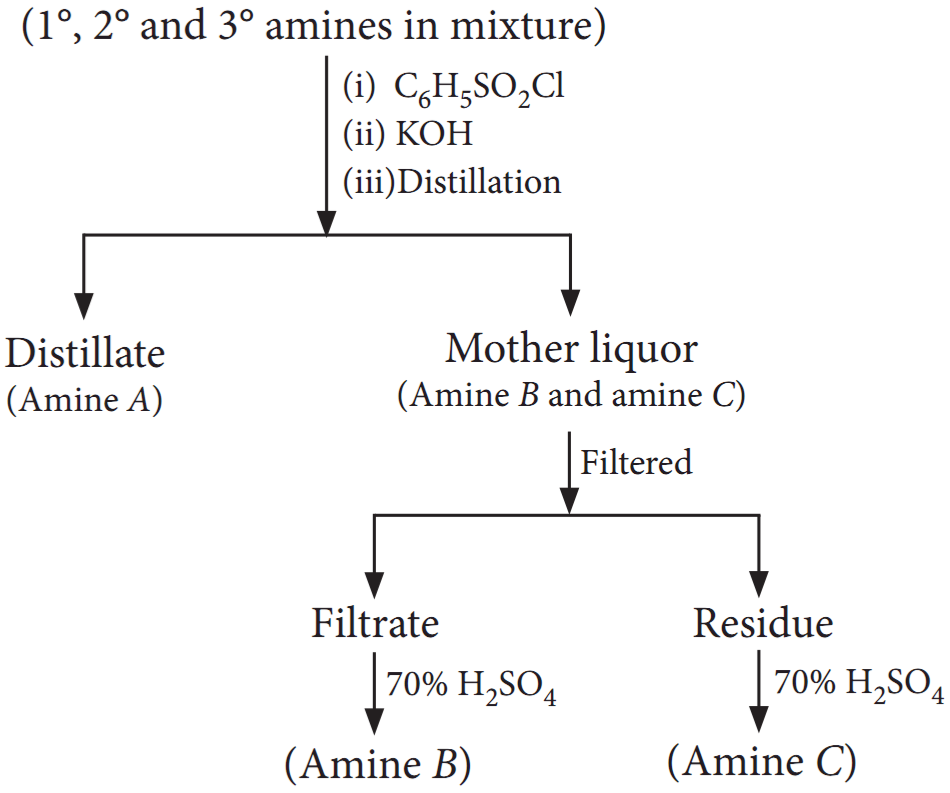
When the mixture contains the three amine salts (1º, 2º and 3º) along with quaternary salt, it is distilled with KOH solution. The three amines distill, leaving the quaternary salt unchanged in the solution. Then the mixture of amines is separated by fractional distillation, Hinsberg's method and Hoffmann's method.

The following questions are multiple choice questions. Choose the most appropriate answer:
  1. Hinsberg reagent is:
  1. Aliphatic sulphonyl chloride.
  2. Phthalamide.
  3. Aromatic sulphonyl chloride.
  4. Anhydrous ZnCl2 + cone. HCI.
  1. Primary amine with Hinsberg's reagent forms:
  1. N-alkyl benzene sulphonamide soluble in KOH solution.
  2. N-alkyl benzene sulphonamide insoluble in KOH solution.
  3. N, N-alkyl benzene sulphonamide soluble in KOH solution.
  4. N, N-alkyl benzene sulphonamide insoluble in KOH solution.
  1. Secondary amine with Hinsberg's reagent forms:
  1. N-alkyl benzene sulphonamide soluble in KOH solution.
  2. N-alkyl benzene sulphonamide insoluble in KOH solution.
  3. N,N-dialkyl benzene sulphonamide soluble in KOH solution.
  4. N,N-dialkyl benzene sulphonamide insoluble in KOH solution.
  1. To separate amines in a mixture Hoffmann's method is used. The Hoffman n's reagent is:
  1. Benzenesulphonyl chloride.
  2. Diethyl oxalate.
  3. Benzeneisocyanide.
  4. P-toulenesulphonic acid.
  1. 3º amines with Hinsberg's reagent give:
  1. No reaction.
  2. Product which is same as that of 1° amine.
  3. Product which is same as that of 2° amine.
  4. Products which is a quaternary salt.
Read the passage given below and answer the following questions : Transition metal oxides are compounds fanned by the reaction of metals with oxygen at high temperature. The highest oxidation number in the oxides coincides with the group number. In vanadium, there is a gradual change from the basic $V_2O_3$ to less basic $V_2O_4$ and to amphoteric $V_2O_5· V_2O_4$ dissolves in acids to give $VO^{2+}$ salts. Transition metal oxides are commonly utilized for their catalytic activity and semi conductive properties. Transition metal oxides are also frequently used as pigments in paints and plastic. Most notably titatnium dioxide. One of the earliest application of transition metal oxides to chemical industry involved the use of vanadium oxide for catalytic oxidation of sulfur dioxide to sulphuric acid. Since then, many other applications have emerged, which include benzene oxidation to maleic anhydride on vandium oxides; cyclohexane oxidation to adipic acid on cobalt oxides. An important property of the catalyst material used in these processes is the ability of transition metals to change their oxidation state under a given chemical potential of reductants and oxidants. The following questions are multiple choice questions. Choose the most appropriate answer:
  1. Which oxide of vanadium is most likely to be basic and ionic?
  1. $VO$
  2. $V_2O_3$
  3. $VO_2$
  4. $V_2O_5$
  1. Vanadyl ion is:
  1. $\text{VO}^{2+}$
  2. $\text{VO}^{+}_2$
  3. $\text{V}_{2}\text{O}^+$
  4. $\text{VO}^{3-}_4$
  1. Which of the following statements is false?
  1. With fluorine vanadium can form $VF_5.$
  2. With chlorine vanadium can form $VCl^5.$
  3. Vanadium exhibits highest oxidation state in oxohalides $VOCl_3, VOBr_3$ and fluoride $VF_5.$
  4. With iodine vanadium cannot form $Vl_5$ due to oxidising power of $V^{5+}$ and reducing nature of $I^-.$
  1. The oxidation state of vanadium in $V_2O_5$ is:
  1. $\frac{+5}{2}$
  2. $+7$
  3. $+5$
  4. $+6$
  1. Identify the oxidising agent in the following reaction.
$V_2O_{5 }+ 5Ca \rightarrow 2V + 5CaO$
  1. $V_2O_5$
  2. $Ca$
  3. $V$
  4. None of these.
Number of molecules which must collide simultaneously to give product is called molecularity. It is equal to sum of coefficients of reactants present in stoichiometric chemical equation. For reaction, $m_1A + m_2B \rightarrow$ Product Molecularity $= [m_1 + m_2]$ ln complex reaction each step has its own molecularity which is equal to the sum of coefficients of reactants present in a particular step. Molecularity is a theoretical property. Its value is any whole number. Number of concentration terms on which rate of reaction depends is called order of reaction or sum of powers of concentration terms present in the rate equation is called order of reaction. If rate equation ofreaction is: Rate $=\text{k}\cdot\text{C}^{\text{m}_1}_\text{A}\cdot\text{C}^{\text{m}_2}_\text{B}$ Then order of reaction $= m_1 + m_2.$ ln simple reaction, order and molecularity are same. ln complex reaction, order of slowest step is the order ofover all reaction. This step is known as rate determining step. Order is an experimental property. Its value may be zero, fractional or negative. The following questions are multiple choice questions. Choose the most appropriate answer:
  1. Higher order $(> 3)$ reactions are rare due to:
  1. Shifting of equilibrium towards reactants due to elastic collisions.
  2. Loss of active species on collision.
  3. Low probability of simultaneous collision of all the reacting species.
  4. Increase in entropy and activation energy as more molecules are involved.
  1. The molecularity of the reaction:
$6\text{FeSO}_4+3\text{H}_2\text{SO}_4+\text{KClO}_3\rightarrow\text{KCl}+3\text{Fe}_2(\text{SO}_4)_3+3\text{H}_2\text{O}$ is:
  1. $6$
  2. $10$
  3. $3$
  4. $7$
  1. Which of the following statements is false in the following?
  1. Order of a reaction may be even zero.
  2. Molecularity of a reaction is always a whole number.
  3. Molecularity and order always have same values for a reaction.
  4. Order of a reaction depends upon the mechanism of the reaction.
  1. The rate of reaction, $A + 2B \rightarrow$ products, is given by the following equation:
$-\frac{\text{d}[\text{A}]}{\text{dt}}=\text{k}[\text{A}][\text{B}]^2$
If B is present in large excess, the order of the reaction is:
  1. Zero
  2. First
  3. Second
  4. Third
  1. The rate of the reaction, $A + B + C \rightarrow$  products, is given by $\text{r}=\frac{\text{d}[\text{A}]}{\text{dt}}=\text{k}[\text{A}]^\frac{1}{2}[\text{B}]^\frac{1}{3}[\text{C}]^\frac{1}{4}.$ The order of the reaction is:
  1. $\frac{1}{3}$
  2. $\frac{1}{4}$
  3. $\frac{1}{2}$
  4. $\frac{13}{12}$
Read the passage given below and answer the following questions :
A chlorocompound $(A)$ on reduction with $Zn-Cu$ and ethanol gives the hydrocarbon $(B)$ with five carbon atoms. When $(A)$ is dissolved in dry ether and treated with sodium metal it gave $2, 2, 5, 5 -$ tetramethylhexane. The treatment of $(A)$ with alcoholic $\ce{KCN}$ gives compound $(C)$.
The following questions are multiple choice questions. Choose the most appropriate answer :
  1. The compound $(A)$ is :
  1. $1-$chloro$-2, 2-$dimethylpropane.
  2. $1-$chloro$-2, 2-$dimethyl butane.
  3. $1-$chloro$-2-$methyl butane.
  4. $2-$chloro$-2-$methyl butane.
  1. The reaction of $(C)$ with $\ce{Na, C2H5OH}$ gives :
  1. $\ce{(CH3)3C CH2CONH2}$
  2. $\ce{(CH3)3C NH2}$
  3. $\ce{(CH3)3C CH2CH2NH2}$
  4. $\ce{(CH3)2CHCH2NH2}$
  1. The reaction of $(C)$ with $\ce{Na, C2H5OH}$ is called :
  1. Gilman reaction.
  2. Mendius reaction.
  3. Grooves process.
  4. Swart's reaction.
  1. The reaction of $(A)$ with aq. $\ce{KOH}$ will preferably favour:
  1. $S_N1$ mechanism.
  2. $S_N2$ mechanism.
  3. $E_1$ mechanism.
  4. $E_2$ mechanism.
  1. Compound $(B)$ is:
  1. $N-$pentane.
  2. $2, 2-$dimethylpropane.
  3. $2-$methylbutane.
  4. None of these.
Read the passage given below and answer the following questions:
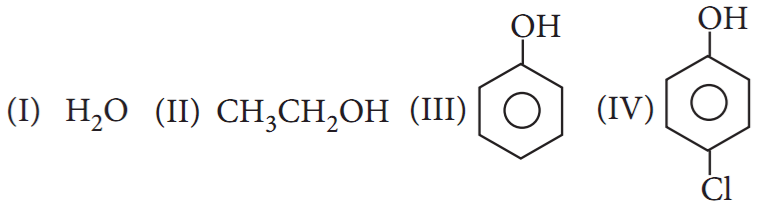
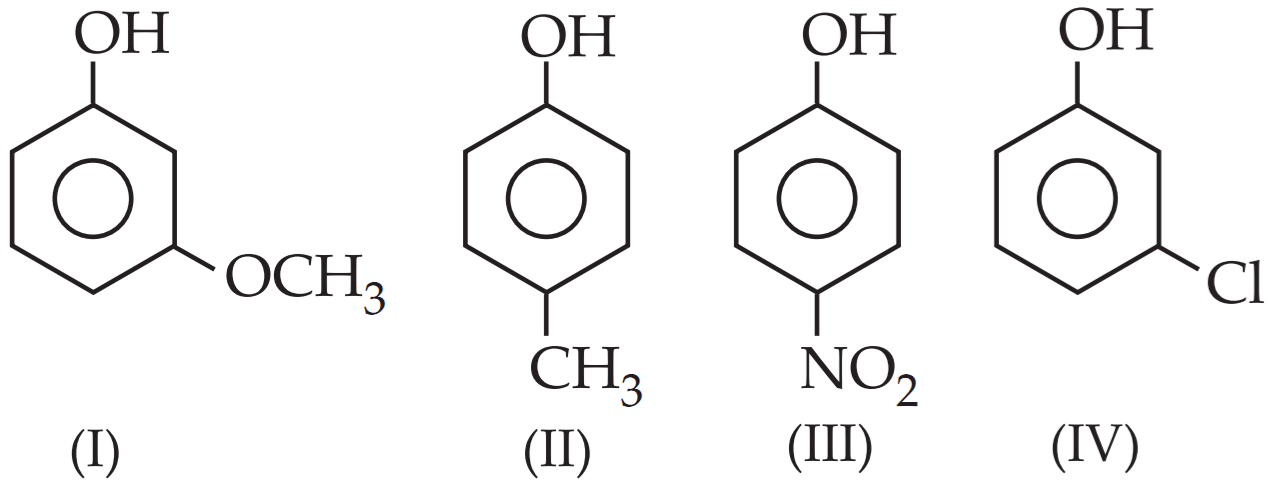
Both alcohols and phenols are acidic in nature, but phenols are more acidic than alcohols. Acidic strength of alcohols mainly depends upon the inductive effect. Acidic strength of phenols depends upon a combination of both inductive effect and resonance effects of the substituent and its position on the benzene ring. Electron withdrawing groups increases the acidic strength of phenols whereas electron donating groups decreases the acidic strength of phenols. Phenol is a weaker acid than carboxylic acid.
The following questions are multiple choice questions. Choose the most appropriate answer:
  1. Phenols are highly acidic as compare to alcohols due to:
  1. The higher molecular mass of phenols.
  2. The stronger hydrogen bonds in phenols.
  3. Alkoxide ion is a strong conjugate base.
  4. Phenoxide ion is resonance stabilised.
  1. The correct order of acidic strength among the following is:
  1. $(III) > (IV) > (II) > (I)$
  2. $(IV) > (III) > (I) > (II)$
  3. $(IV) > (III) > (II) > (I)$
  4. $(I) > (II) > (IV) > (III)$
  1. The correct decreasing order of $pK_a$ value is:
  1. $II > IV > I > III$
  2. $IV > II > III > I$
  3. $II I> II > IV > I$
  4. $IV > I > II > III$
  1. The compound that does not liberate $CO_2,$ on treatment with aqueous sodium bicarbonate solution is:
  1. Benzoic acid.
  2. Benzenesulphonic acid.
  3. Salicylic acid.
  4. Carbolic acid.
  1. Most acidic amongst the following is:
Read the passage given below and answer the following questions: At the freezing point of a solvent, the solid and the liquid are in equilibrium. Therefore, a solution will freeze when its vapour pressure becomes equal to the vapour pressure of the pure solid solvent. It has been observed that when a non-volatile solute is added to a solvent, the freezing point of the solution is always lower than that of the pure solvent. Depression in freezing point can be given as, $\Delta\text{T}_\text{f}=\text{K}_\text{f}\text{m}$ Where $, K_f =$ Molal freezing point depression constant or we can write, $\Delta\text{T}_\text{f}=\frac{\text{K}_\text{f}\times\text{W}_\text{B}\times1000}{\text{W}_A\times\text{M}_\text{B}}$ a statement of assertion followed by a statement of reason is given. Choose the correct answer out of the following choices.
  1. Assertion and reason both are correct statements and reason is correct explanation for assertion.
  2. Assertion and reason both are correct statements but reason is not correct explanation for assertion.
  3. Assertion is correct statement but reason is wrong statement.
  4. Assertion is wrong statement but reason is correct statement.
  1. Assertion : $0.1M$ solution of glucose has same depression in the freezing point as $0.1M$ solution of urea.
Reason : $K_f$ for both has same value.
  1. Assertion : Increasing pressure on pure water decreases its freezing point.
Reason : Density of water is maximum at $273K$.
  1. Assertion : Larger the value of cryoscopic constant of the solvent, lesser will be the freezing point of the solution.
Reason : Extent of depression in the freezing point depends on the nature of the solvent.
  1. Assertion : The water pouch of instant cold pack for treating athletic injuries breaks when squeezed and $\text{NH4N03}$ dissolves thus lowering the temperature.
Reason : Addition of non $-$ volatile solute into solvent results into depression of freezing point of solvent.
  1. Assertion : If a non $-$ volatile solute is mixed in a solution then elevation in boiling point and depression in freezing point both wiII be same.
Reason : Elevation in boiling point and depression in freezing point both depend on number of particles of solute.