Question
Read the passage given below and answer the following questions:
Both alcohols and phenols are acidic in nature, but phenols are more acidic than alcohols. Acidic strength of alcohols mainly depends upon the inductive effect. Acidic strength of phenols depends upon a combination of both inductive effect and resonance effects of the substituent and its position on the benzene ring. Electron withdrawing groups increases the acidic strength of phenols whereas electron donating groups decreases the acidic strength of phenols. Phenol is a weaker acid than carboxylic acid.
The following questions are multiple choice questions. Choose the most appropriate answer:
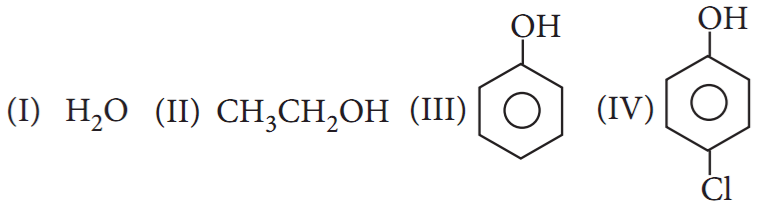
  1. Phenols are highly acidic as compare to alcohols due to:
  1. The higher molecular mass of phenols.
  2. The stronger hydrogen bonds in phenols.
  3. Alkoxide ion is a strong conjugate base.
  4. Phenoxide ion is resonance stabilised.
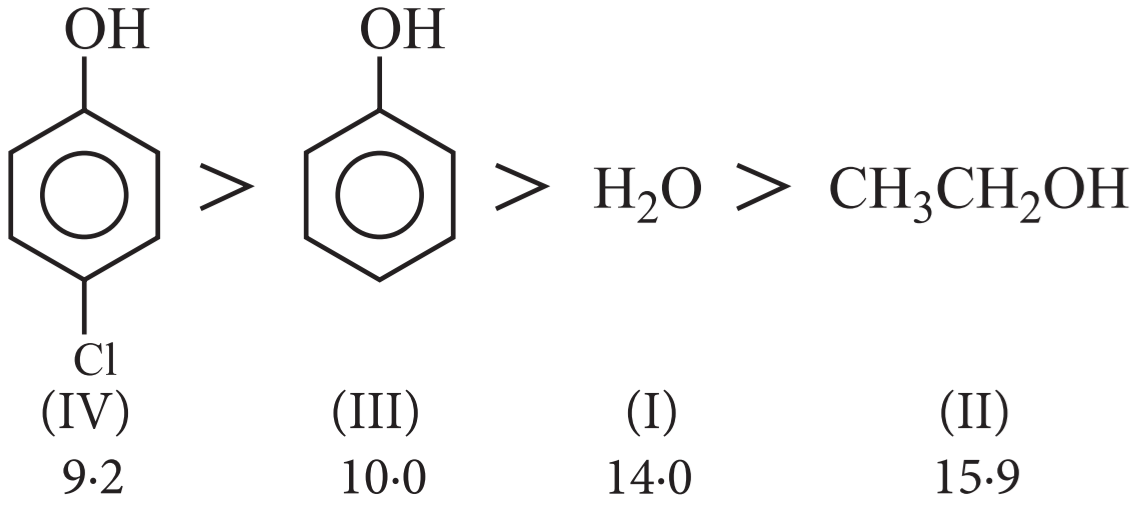
  1. The correct order of acidic strength among the following is:
  1. $(III) > (IV) > (II) > (I)$
  2. $(IV) > (III) > (I) > (II)$
  3. $(IV) > (III) > (II) > (I)$
  4. $(I) > (II) > (IV) > (III)$
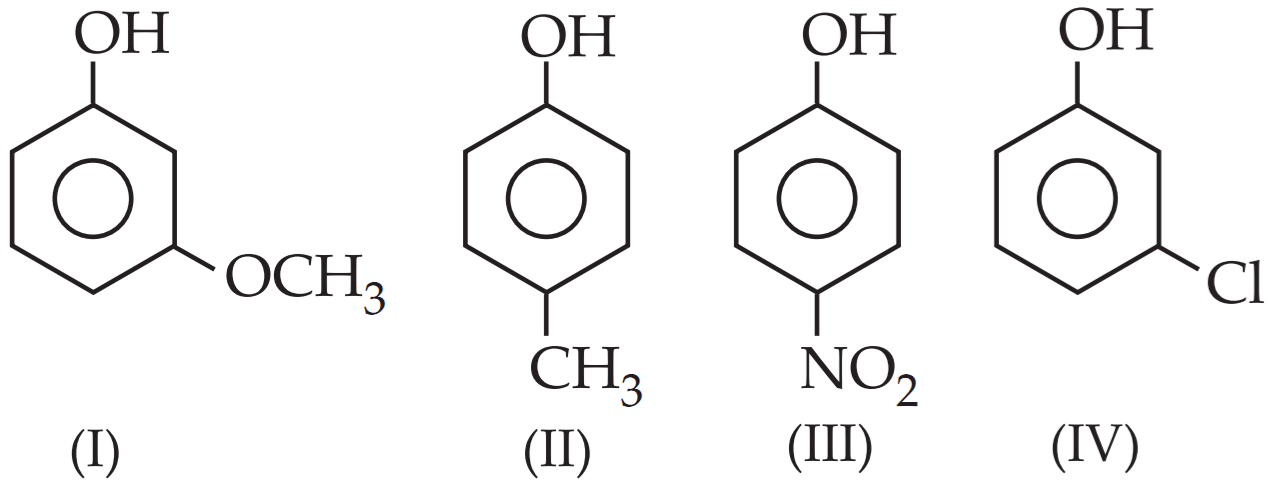
  1. The correct decreasing order of $pK_a$ value is:
  1. $II > IV > I > III$
  2. $IV > II > III > I$
  3. $II I> II > IV > I$
  4. $IV > I > II > III$
  1. The compound that does not liberate $CO_2,$ on treatment with aqueous sodium bicarbonate solution is:
  1. Benzoic acid.
  2. Benzenesulphonic acid.
  3. Salicylic acid.
  4. Carbolic acid.
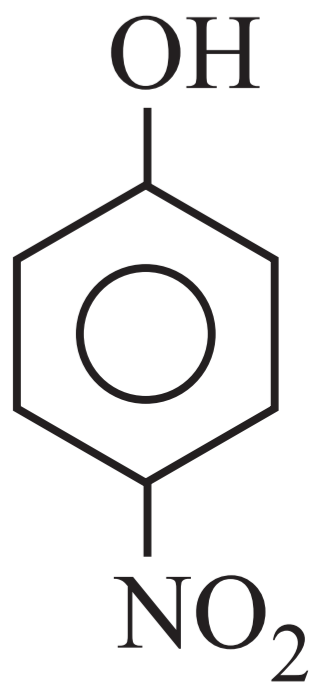
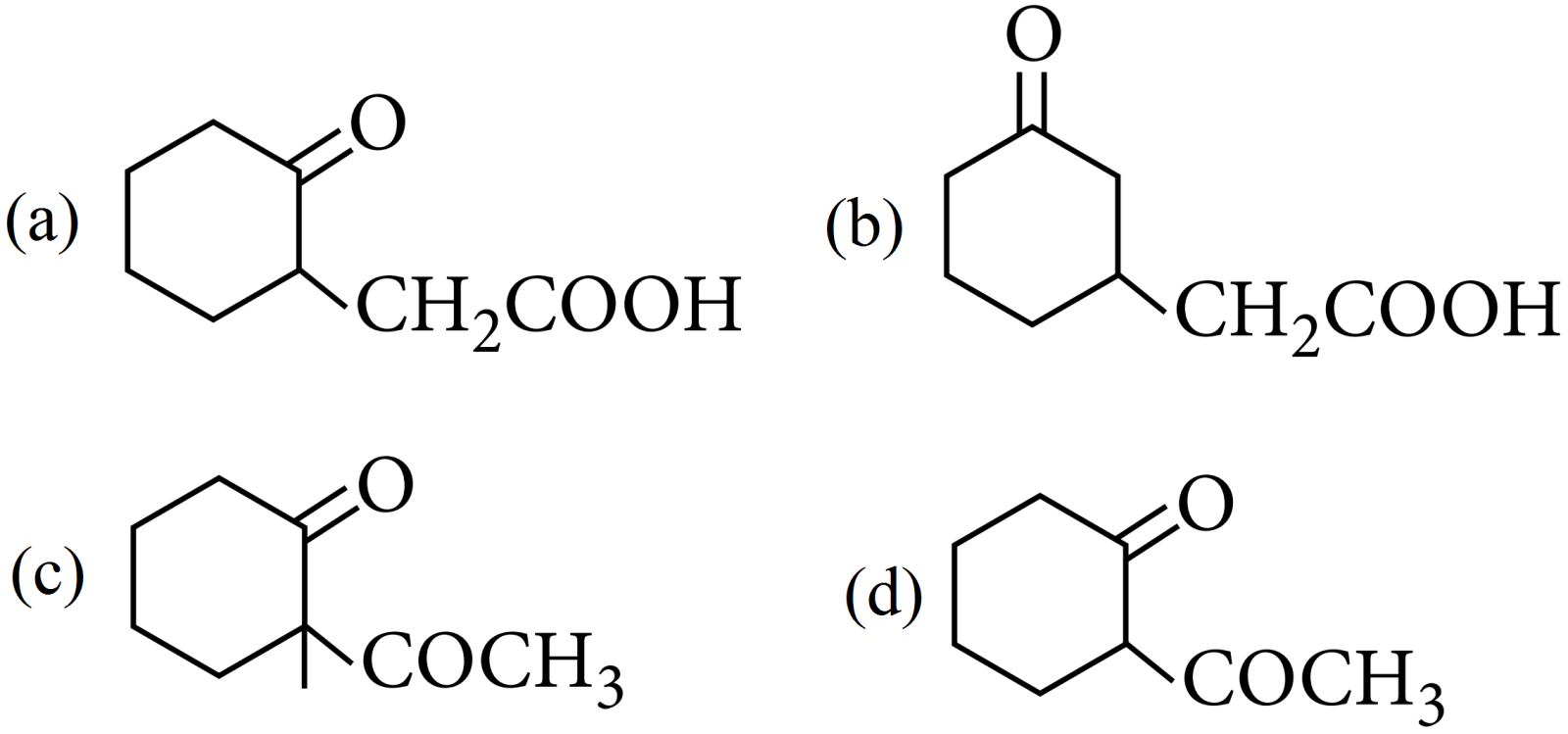
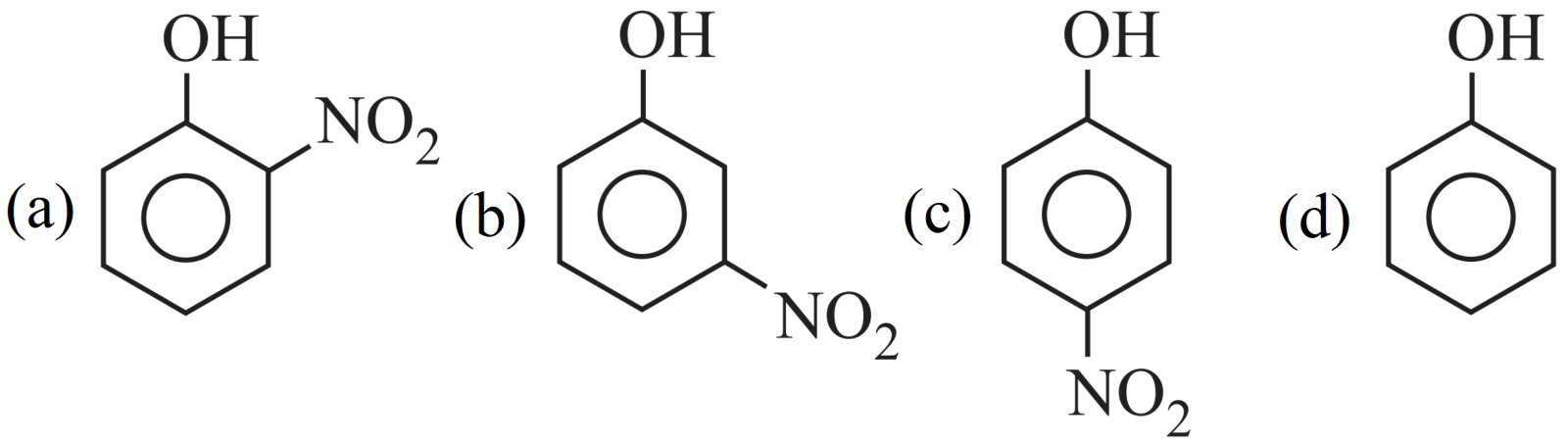
  1. Most acidic amongst the following is:

Answer

  1. $(d)$ Phenoxide ion is resonance stabilised.
  2. $(b)\  (IV) > (III) > (I) > (II)$
The order of acidic strength is,
  1. $(a)\ II > IV > I > III$
Weaker acids have higher $\ce{pK_a. - OCH_3}$ at meta-position exerts only $- I$ effect, hence increases the acidity.
$- I$ effect order : $- \ce{NO_2 > - OCH_3 > - Cl}.$
$- CH_3$ has $+ I$ effect.
So, order is $(a).$
  1. $(d)$ Carbolic acid.
Phenol $($Carbolic acid$)$ is a weaker acid than carbonic acid $\ce{(H_2CO_3)}$ and does not liberate $\ce{CO_2}$ on treatment with aqueous sodium bicarbonate solution.
  1. $(c)$

$- NO_2$ exhibits both $- I$ and $- R$ influence to stabilise the corresponding phenoxide.
ln ortho derivative, intermolecular $H -$ bonding lowers the acidity.

Need a full question paper?

Generate a complete, print-ready paper with questions like this in minutes — across 16+ boards, with answer keys.

Start Generating Free

Similar questions

Read the passage given below and answer the following questions:
At $298 K,$ the vapour pressure of pure benzene $, C_6, H_6$ is $0.256$ bar and the vapour pressure of pure toluene $\ce{C_6 H_5 CH_3}$ is $0.0925$ bar. Two mixtures were prepared as follows:
  1. $7.8g$ of $\ce{C_6 H_6 + 9.2g}$ of toluene
  2. $3.9g$ of $\ce{C_6 H_6 + 13.8g}$ of toluene
The following questions are multiple choice questions. Choose the most appropriate answer:
  1. The total vapour pressure $($bar$)$ of solution I is.
  1. $0.128$
  2. $0.174$
  3. $0.198$
  4. $0.258$
  1. Which of the given solutions have higher vapour pressure?
  1. $I$
  2. $II$
  3. Both have equal vapour pressure
  4. Cannot be predicted
  1. Mole fraction of benzene in vapour phase in solution I is.
  1. $0.128$
  2. $0.174$
  3. $0.734$
  4. $0.266$
  1. Which of the following statements is/are correct?
  1. Mole fraction of toluene in vapour phase is more in solution $ I$.
  2. Mole fraction of toluene in vapour phase is less in solution $I.$
  3. Mole fraction of benzene in vapour phase is less in solution $I.$
  1. Only $II$
  2. Only $I$
  3. $I$ and $III$
  4. $II$ and $III$
  1. Solution I is an example of a/an.
  1. Ideal solution.
  2. Non $-$ ideal solution with positive deviation.
  3. Non $-$ ideal solution with negative deviation.
  4. Can't be predicted.
Read the passage given below and answer the following questions:
To explain bonding in coordination compounds various theories were proposed. One of the important theory was valence bond theory. According to that, the central metal ion in the complex makes available a number of empty orbitals for the formation of coordination bonds with suitable ligands. The appropriate atomic orbitals of the metal hybridise to give a set of equivalent orbitals of definite geometry.
The $d-$orbitals involved in the hybridisation may be either inner $d-$orbitals i.e.$, (n - 1)d$ or outer $d-$orbitals i.e.$, nd.$
For example, $Co^{3+}$ forms both inner orbital and outer orbital complexes, with ammonia it forms $[\ce{Co(NH3)6]^{3+}}$ and with fluorine it forms $[\ce{CoF6]^{3-}}$ complex ion.
The following questions are multiple choice questions. Choose the most appropriate answer :
  1. Which of the following is not true for $[\ce{CoF6}]^{3-}$?
  1. It is paramagnetic.
  2. It has coordination number of $6.$
  3. It is outer orbital complex.
  4. It involves $d^2sp^3$ hybridisation.
  1. $[\ce{Cr(H2O)6]Cl3}\ ($at. no. of $Cr = 24)$ has a magnetic moment of $3.83\ B.M.$ The correct distribution of $3d-$electrons in the central metal of the complex is :
  1. $3\text{d}^1_\text{xy},3\text{d}^1_{\text{x}^2-\text{y}^2},3\text{d}^1_\text{yz}$
  2. $3\text{d}^1_\text{xy},3\text{d}^1_{\text{yz}},3\text{d}^1_\text{zx}$
  3. $3\text{d}^1_\text{xy},3\text{d}^1_{\text{zy}},3\text{d}^1_{\text{z}^2}$
  4. $3\text{d}^1_{\text{x}^2-\text{y}^2},3\text{d}^1_{\text{z}^2},3\text{d}^1_\text{xz}$
  1. Which of the following is true for $[\ce{Co(NH3)6}]^{3+}$?
  1. It is an octahedral, di magnetic and outer orbital complex.
  2. It is an octahedral, paramagnetic and outer orbital complex.
  3. It is an octahedral, paramagnetic and inner orbital complex.
  4. It is an octahedral, di magnetic and inner orbital complex.
  1. The paramagnetism of $[\ce{CoF6}]^{3-}$ is due to.
  1. $3$ electrons.
  2. $4$ electrons.
  3. $2$ electrons.
  4. $1$ electron.
  1. Which of the following is an inner orbital or low spin complex?
  1. $[\ce{Ni(H2O)6}]^{3+}$
  2. $[\ce{FeF6}]^{3-}$
  3. $[\ce{Co(CN)6}]^{3-}$
  4. $[\ce{NiCl4}]^{2-}$
Read the passage given below and answer the following questions: Arrangement of ligands in order of their ability to cause splitting $(\Delta)$ is called spectrochemical series. Ligands which cause large splitting $($large $\Delta)$ are called strong field ligands while those which cause small splitting $($small $\Delta)$ are called weak field ligands. When strong field ligands approach metal atom/ ion, the value of $\Delta_0$ is large, so that electrons are forced to get paired up in lower energy $t_{2g}$ orbitals. Hence, a low$-$spin complex is resulted from strong field ligand. When weak field ligands approach metal atom/ ion, the value of $\Delta_0$ is small, so that electrons enter high energy egorbitals rather than pairing in low energy $t_{2g}$ orbitals. Hence, a high$-$spin complex is resulted from weak field ligands. Strong field ligands have tendency to form inner orbital complexes by forcing the electrons to pair up. Whereas weak field ligands have tendency to form outer orbital complex because inner electrons generally do not pair up. In these questions $(Q.$ No. $i-iv),$ a statement of assertion followed by a statement ofreason is given. Choose the correct answer out of the following choices.
  1. Assertion and reason both are correct statements and reason is correct explanation for assertion.
  2. Assertion and reason both are correct statements but reason is not correct explanation for assertion.
  3. Assertion is correct statement but reason is wrong statement.
  4. Assertion is wrong statement but reason is correct statement.
The following questions are multiple choice questions. Choose the most appropriate answer:
  1. Assertion: In tetrahedral coordination entity formation, the $d$ orbital splitting is inverted and is smaller as compared to the octahedral field splitting.
Reason : Spectrochemical series is based on the absorption of light by complexes with different ligands.
  1. Assertion: In high spin situation, configuration of $d^5$ ions will be $\text{t}^3_{2\text{g}}\text{e}^2_\text{g}.$
Reason : In high spin situation, pairing energy is less than crystal field energy.
  1. Assertion: $F^-$ ion is a weak field ligand and fonns outer orbital complex.
Reason : $F^-$ ion cannot force the electrons of $d_{z^2}$ and $d_{x^2-y^2}$ orbitals of the inner shell to occupy $d_{xy}, d_{yz}$ and $d_{zx} $orbitals of the same shell.
  1. Assertion: The crystal field model is successful in explaining the formation, structures, colour and magnetic properties of coordination compounds.
Reason: In spectrochemical series, ligands are arranged in a series of increasing field strength.
  1. Assertion: $NF_3$ is a weaker ligand than $N(CH_3)_3.$
Reason: $NF_3$ ionizes to give $F^-$ ions in aqueous solution.
Describe detailed information on classification of carbohydrates.
Nemst equation relates the reduction potential of an electrochemical reaction to the standard potential and activities of the chemical species undergoing oxidation and reduction. Let us consider the reaction $, \text{M}^{\text{n+}}_{(\text{aq})}\xrightarrow{\ \ \ \ \ \ \ \ }\text{nM}_\text{(s)}$ For this reaction, the electrode potential measured with respect to standard hydrogen electrode can be given as $\text{E}_{\Big(\frac{\text{M}^{\text{n+}}}{\text{M}}\Big)}=\text{E}^\circ_{\Big(\frac{\text{M}^\text{n+}}{\text{M}}\Big)}-\frac{\text{RT}}{\text{nF}}\text{ln}\frac{[\text{M}]}{[\text{M}^{\text{n}+}]}$ In these questions $(Q$. No. $i-iv),$ a statement of assertion followed by a statement ofreason is given. Choose the correct answer out of the following choices.
  1. Assertion and reason both are correct statements and reason is correct explanation for assertion.
  2. Assertion and reason both are correct statements but reason is not correct explanation for assertion.
  3. Assertion is correct statement but reason is wrong statement.
  4. Assertion is wrong statement but reason is correct statement.
  1. Assertion : For concentration cell, $\text{Zn}_{(\text{s})}|\text{ Zn}^{2+}_{\text{(aq)}}||\text{ Zn}^{2+}_{(\text{aq})}|\text{ Zn}\\\ \ \ \ \ \ \ \ \ \ \ \ \text{C}_1\ \ \ \ \ \ \ \ \text{C}_2$
For spontaneous cell reaction $, C_1 < C_2$
Reason : For concentration cell, $\text{E}_\text{cell}=\frac{\text{RT}}{\text{nF}}\log\frac{\text{C}_2}{\text{C}_1}$
For spontaneous reaction, $\text{E}_\text{cell}=+\text{ve}\Rightarrow\text{C}_2>\text{C}_1$
  1. Assertion : For the cell reaction, $\text{Zn}_{(\text{s})}+\text{Cu}^{2+}_{(\text{aq})}\xrightarrow{\ \ \ \ \ }\text{Zn}^{2+}_{(\text{aq})}+\text{Cu}_{(\text{s})}$ voltmeter gives zero reading at equilibrium.
Reason : At the equilibrium, there is no change in concentration of $\ce{Cu2+}$ and $\ce{Zn2+}$ ions.
  1. Assertion : The Nernst equation gives the concentration dependence of emf of the cell.
Reason : In a cell, current flows from cathode to anode.
  1. Assertion : Increase in the concentration of copper half cell in a cell, increases the emfofthe cell.
Reason : $\text{E}_\text{cell}=\text{E}^\circ_\text{cell}+\frac{0.059}{2}\log\frac{[\text{Cu}^{2+}]}{[\text{Zn}^{2+}]}$
  1. Assertion : Electrode potential for the electrode $\frac{\text{Mn}^+}{\text{Mn}}$ with concentration is given by the expression under $\text{STP}$ conditions.
$\text{E}=\text{E}^\circ+\frac{0.059}{\text{n}}\log[\text{Mn}^{+}]$
Reason : $\text{STP}$ conditions require the temperature to be $273K$.
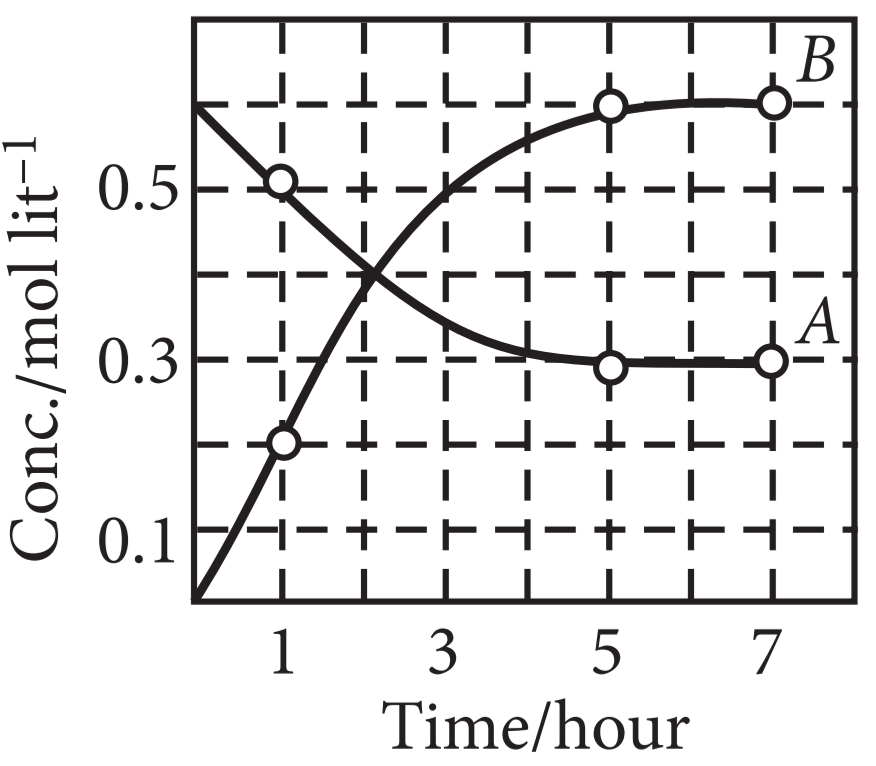
The progress of the reaction$, \text{A}\rightleftharpoons\text{nB}$ with time is represented in the following figure :

The following questions are multiple choice questions. Choose the most appropriate answer :
  1. What is the value of $n$?
  1. $1$
  2. $2$
  3. $3$
  4. $4$
  1. Find the value of the equilibrium constant.
  1. $0.6M$
  2. $1.2M$
  3. $0.3M$
  4. $2.4M$
  1. The initial rate of conversion of $A$ will be:
  1. $0.1 mol L^{-1}hr^{-1}$
  2. $0.2 mol L^{-1}hr^{-1}$
  3. $0.4 mol L^{-1}hr^{-1}$
  4. $0.8 mol L^{-1}hr^{-1}$
  1. For the reaction, if $\frac{\text{d}[\text{B}]}{\text{dt}}=2\times10^{-4},$ value of $-\frac{\text{d}[\text{A}]}{\text{dt}}$ will be:
  1. $2 \times 10^{-4}$
  2. $10^{-4}$
  3. $4 \times 10^{-4}$
  4. $0.5 \times 10^{-4}$
  1. Which factor has no effect on rate of reaction?
  1. Temperature.
  2. Nature of reactant.
  3. Concentration of reactant.
  4. Molecularity.
A reaction is said to be of the first order if the rate of the reaction depends upon one concentration term only. For a first order reaction of the type $A \rightarrow$ Products, the rate of the reaction is given as: rate $= k[A]$. The differential rate law is given as : $\frac{\text{dA}}{\text{dt}}=-\text{k}[\text{A}].$ The integrated rate law is : In $\frac{[\text{A}]}{[\text{A}]_0}=-\text{kt}, [A]$ is the concentration of reactant left at time $t$ and $[A]_0$ is the initial concentration of the reactant$, k$ is the rate constant.
The following questions are multiple choice questions. Choose the most appropriate answer :
  1. The unit of rate constant for a first order reaction is:
  1. $S^{-1}$
  2. $mol\ L^{-1} s^{-1}$
  3. $L\ mol^{-1} s^{-1}$
  4. $L^2\ mol^{-2} s^{-1}$
  1. Half$-$life period of a first order reaction is $10$ min. Starting with initial concentration $12M,$ the rate after $20$ min is:
  1. $0.693 \times 3M\ min^{-1}$
  2. $0.0693 \times 4M\ min^{-1}$
  3. $0.0693 \times M\ min^{-1}$
  4. $0.0693 \times 3M\ min^{-1}$
  1. $50\%$ of a first order reaction is complete in $23$ minutes. Calculate the ti me required to complete $90\%$ of the reaction.
  1. $70.4$ minutes.
  2. $76.4$ minutes.
  3. $38.7$ minutes.
  4. $35.2$ minutes.
  1. For a first order reaction$, (A) \rightarrow$ products, the concentration of $A$ changes from $0.1M$ to $0.025M$ in $40$ minutes. The rate of reaction when the concentration of $A$ is $0.01M,$ is:
  1. $3.47 \times 10^{-4} M/ min$
  2. $3.47 \times 10^{-5} M/ min$
  3. $1.73 \times 10^{-4} M/ min$
  4. $1.73 \times 10^{-5} M/ min$
  1. The half$-$life period ofa $1^{st}$ order reaction is $60$ minutes. What percentage will be left over after $240$ minutes?
  1. $6.25\%$
  2. $4.25\%$
  3. $5\%$
  4. $6\%$
The potential of each electrode is known as electrode potential. Standard electrode potential is the potential when concentration of each species taking part in electrode reaction is unity and the reaction is taking place at $298K$. By convention, the standard electrode potential of hydrogen $\text{(SHE)}$ is $0.0V$. The electrode potential value for each electrode process is a measure of relative tendency of the active species in the process to remain in the oxidised/ reduced form. The negative electrode potential means that the redox couple is stronger reducing agent than $\frac{\text{H}^+}{\text{H}_2}$ couple. A positive electrode potential means that the redox couple is a weaker reducing agent than the $\frac{\text{H}^+}{\text{H}_2}$ couple. Metals which have higher positive value of standard reduction potential form the oxides of greater thermal stability. In these questions $(Q$. No. $i-iv),$ a statement of assertion followed by a statement ofreason is given. Choose the correct answer out of the following choices.
  1. Assertion and reason both are correct statements and reason is correct explanation for assertion.
  2. Assertion and reason both are correct statements but reason is not correct explanation for assertion.
  3. Assertion is correct statement but reason is wrong statement.
  4. Assertion is wrong statement but reason is correct statement.
  1. Assertion : An electrochemical cell can be set $-$ up only if the redox reaction is spontaneous.
Reason : A reaction is spontaneous if the free energy change is negative.
  1. Assertion : The standard electrode potential of hydrogen is $0.0V.$
Reason : It is by convention.
  1. Assertion : The more negative is the standard reduction potential, greater is its ability to displace $H_2 $ from acid.
Reason : Strength of reducing agent increases with the increase in negative value of the standard reduction potential.
  1. Assertion : The negative value of standard reduction potential means that reduction takes place on this electrode with reference to hydrogen electrode.
Reason : The standard electrode potential of a half cell has a fixed value.
  1. Assertion : The absolute value of electrode potential cannot be determined experimentally.
Reason : The electrode potential values are generally determined with respect to $\text{SHE}$.
Read the passage given below and answer the following questions:
Aldehydes and ketones having acetyl group $\left(\begin{array}{c}\ \ \ \ \ \ \ \ \ \ \ \ \text{O}\\\ \ \ \ \ \ \ \ \ \ \ \ ||\\\ \ \ \text{CH}_3-\text{C}-\end{array}\right)$ are oxidised by sodium hypohalate $(\text{NaOX})$ or halogen and alkali $(X_2 + OH^-)$ to corresponding sodium salt having one carbon atoms less than the carbonyl compound and give a haloform.
$\ \ \ \ \ \ \ \ \text{O}\\\ \ \ \ \ \ \ \ ||\\\text{R}-\text{C}-\text{CH}_3\xrightarrow[\text{orX}_2+\text{NaOH}]{\text{NaOX}}\\ \ \ \ \ \ \ \ \ \text{O}\\\ \ \ \ \ \ \ \ ||\\\text{R}-\text{C}-\stackrel{-}{\hbox{ O}}\stackrel{+}{\hbox{Na}}+\text{CHX}_3(\text{X = Cl, Br, I})$
Sodium hypoiodite $\text{(NaOl)}$ when treated with compounds containing $\ce{CH_3CO}-$ group gives yellow precipitate of iodoform. Haloform reaction does not affect a carbon $-$ carbon double bond present in the compound.
The following questions are multiple choice questions. Choose the most appropriate answer:
  1. Which of the following compounds will give positive iodoform test?
  1. Isopropyl alcohol.
  2. Propionaldehyde.
  3. Ethylphenyl ketone.
  4. Benzyl alcohol.
  1. Which of the following compounds is not formed in iodoform reaction of acetone?
  1. $\ce{CH_3COCH_2l}$
  2. $\ce{lCH_2COCH_2l}$
  3. $\ce{CH_3COCHl_2}$
  4. $\ce{CH_3COCl_3}$
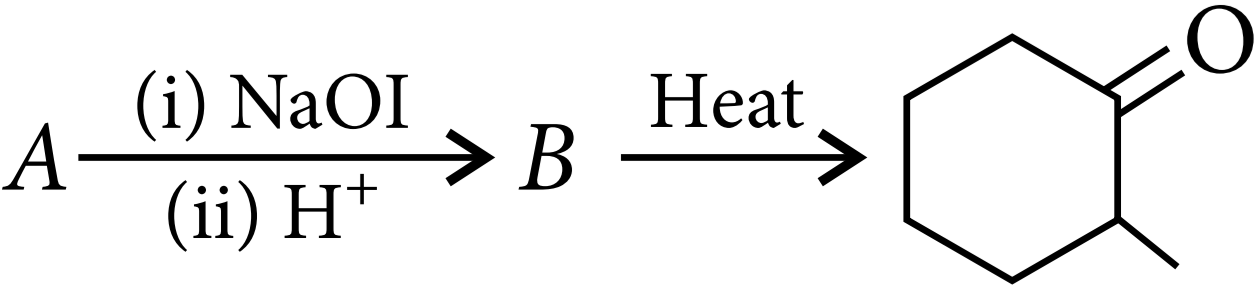
  1. For the given set of reactions,

starting compound $A$ corresponds to:
  1. In the following reaction sequence, the correct structures of $E, F$ and $G$ are:

$(*$ implies $^{13}C$ labelled carbon$)$
  1. An organic compound $'A\ '$ has the molecular formula $\ce{C_3H_6O}$. It undergoes iodoform test. When saturated with $\text{HCl}$ it gives $'B\ '$ of molecular formula $\ce{C_9H_{14}O}. 'A\ ' $ and $'B\ '$ respectively are:
  1. propanal and mesityl oxide.
  2. Propanone and mesityl oxide.
  3. propanone and $2,6-$ dimethyl $-2,5-$ hepta $-$ dien $-4-$ one.
  4. propanone and propionaldehyde.
A reaction in which rate ofreaction is independent of concentration of the reactants is called zero order reaction. Photochemical combination of hydrogen and chlorine to give hydrogen chloride is an example of zero order reaction. The rate constant of a zero order reaction is equal to the rate of reaction. The half life period of a zero order reaction is directly proportional to initial concentration of the reactant. For a zero order reaction, $\text{k}=\frac{1}{\text{t}}\left\{[\text{A}]-[\text{A}]\right\}$ In these questions $(Q. No. i-iv),$ a statement of assertion followed by a statement of reason is given. Choose the correct answer out of the following choices.
  1. Assertion and reason both are correct statements and reason is correct explanation for assertion.
  2. Assertion and reason both are correct statements but reason is not correct explanation for assertion.
  3. Assertion is correct statement but reason is wrong statement.
  4. Assertion is wrong statement but reason is correct statement.
  1. Assertion: For a zero order reaction, plot of rate vs concentration will be a straight line parallel to concentration axis.
Reason: For a zero order reaction, rate is independent of concentration.
  1. Assertion: Photochemical combination of hydrogen and chlorine to give hydrogen chloride is an example of zero order reaction.
Reason: The rate of reaction depends on the concentration of hydrogen and independent of concentration of chlorine.
  1. Assertion: If in a zero order reaction, the concentration of the reactant is doubled, the half$-$life period is also doubled.
Reason: For a zero order reaction, the rate of reaction is independent of initial concentration.
  1. Assertion: ln a reaction $A \rightarrow $ products, the concentration of the reactant is reduced to zero after a finite time.
Reason: The order of reaction is zero.
  1. Assertion: Rate constant of a zero order reaction has same units as the rate of reaction.
Reason: Rate constant of a zero order reaction does not depend on the unit of concentration.