Question
Number of molecules which must collide simultaneously to give product is called molecularity. It is equal to sum of coefficients of reactants present in stoichiometric chemical equation. For reaction, $m_1A + m_2B \rightarrow$ Product Molecularity $= [m_1 + m_2]$ ln complex reaction each step has its own molecularity which is equal to the sum of coefficients of reactants present in a particular step. Molecularity is a theoretical property. Its value is any whole number. Number of concentration terms on which rate of reaction depends is called order of reaction or sum of powers of concentration terms present in the rate equation is called order of reaction. If rate equation ofreaction is: Rate $=\text{k}\cdot\text{C}^{\text{m}_1}_\text{A}\cdot\text{C}^{\text{m}_2}_\text{B}$ Then order of reaction $= m_1 + m_2.$ ln simple reaction, order and molecularity are same. ln complex reaction, order of slowest step is the order ofover all reaction. This step is known as rate determining step. Order is an experimental property. Its value may be zero, fractional or negative. The following questions are multiple choice questions. Choose the most appropriate answer:
  1. Higher order $(> 3)$ reactions are rare due to:
  1. Shifting of equilibrium towards reactants due to elastic collisions.
  2. Loss of active species on collision.
  3. Low probability of simultaneous collision of all the reacting species.
  4. Increase in entropy and activation energy as more molecules are involved.
  1. The molecularity of the reaction:
$6\text{FeSO}_4+3\text{H}_2\text{SO}_4+\text{KClO}_3\rightarrow\text{KCl}+3\text{Fe}_2(\text{SO}_4)_3+3\text{H}_2\text{O}$ is:
  1. $6$
  2. $10$
  3. $3$
  4. $7$
  1. Which of the following statements is false in the following?
  1. Order of a reaction may be even zero.
  2. Molecularity of a reaction is always a whole number.
  3. Molecularity and order always have same values for a reaction.
  4. Order of a reaction depends upon the mechanism of the reaction.
  1. The rate of reaction, $A + 2B \rightarrow$ products, is given by the following equation:
$-\frac{\text{d}[\text{A}]}{\text{dt}}=\text{k}[\text{A}][\text{B}]^2$
If B is present in large excess, the order of the reaction is:
  1. Zero
  2. First
  3. Second
  4. Third
  1. The rate of the reaction, $A + B + C \rightarrow$  products, is given by $\text{r}=\frac{\text{d}[\text{A}]}{\text{dt}}=\text{k}[\text{A}]^\frac{1}{2}[\text{B}]^\frac{1}{3}[\text{C}]^\frac{1}{4}.$ The order of the reaction is:
  1. $\frac{1}{3}$
  2. $\frac{1}{4}$
  3. $\frac{1}{2}$
  4. $\frac{13}{12}$

Answer

  1. $(c)$ Low probability of simultaneous collision of all the reacting species.
The reactions of higher order are very rare because of the less chances of the molecules to come together simultaneously and collide.
  1. $(c)\ 3$
The total number of reactant molecules participating in a chemical reaction is known as its molecularity, hence the molecularity $= 6 + 3 + 1 = 10.$
  1. $(c)$ Molecularity and order always have same values for a reaction.
Molecularity may or may not be equal to the order of a reaction.
  1. $(b)$ First
From the expression
$-\frac{\text{d}[\text{A}]}{\text{dt}}=\text{k}[\text{A}][\text{B}]^2$
when $B$ is present in large excess, rate will be independent upon the change in cone. of $B,$ therefore order of reaction will be one.
  1. $(d)\ \frac{13}{12}$
Order of reaction $=\frac{1}{2}+\frac{1}{3}+\frac{1}{4}=\frac{6+4+3}{12}=\frac{13}{12}$

Need a full question paper?

Generate a complete, print-ready paper with questions like this in minutes — across 16+ boards, with answer keys.

Start Generating Free

Similar questions

The half$-$life of a reaction is the time required for the concentration of reactant to decrease by half, i.e.,

$[\text{A}]_\text{t}=\frac{1}{2}[\text{A}]$
For first order reaction,
$\text{t}_\frac{1}{2}=\frac{0.693}{\text{k}}$
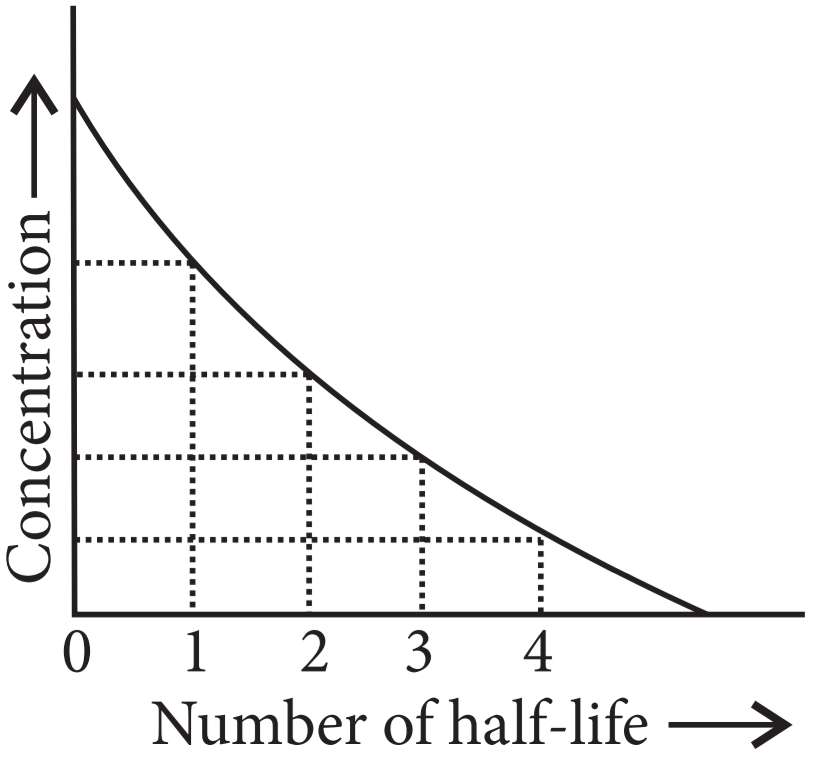
this means $\text{t}\frac{1}{2}$ is independent of initial concentration. Figure shows that typical variation of concentration of reactant exhibiting first order kinetics. It may be noted that though the major portion of the first order kinetics may be over in a finite time, but the reaction will never cease as the concentration of reactant will be zero only at infinite time.
The following questions are multiple choice questions. Choose the most appropriate answer:
  1. A first order reaction has a rate constant $k = 3.01 \times 10^{-3} /s$. How long it will take to decompose half of the reactant?
  1. $2.303s$
  2. $23.03s$
  3. $230.3s$
  4. $2303s$
  1. The rate constant for a first order reaction is $7.0 \times 10^{-4} s^{-1}$. If initial concentration ofreactant is $0.080 M,$ what is the half life of reaction?
  1. $990s$
  2. $79.2s$
  3. $12375s$
  4. $10.10 \times 10^{-4}s$
  1. For the half$-$life period of a first order reaction, which one of the following statements is generally false?
  1. It is independent of initial concentration.
  2. It is independent of temperature.
  3. It decreases with the introduction of a catalyst.
  4. None of these.
  1. The rate of a first order reaction is $0.04\ mol\  L^{-1} s^{-1}$ at $10$ minutes and $0.03\ mol\ L^{-1}\ s^{-1}$ at $20$ minutes after initiation. The half$-$life of the reaction is :
  1. $4.408$ min
  2. $44.086$ min
  3. $24.086$ min
  4. $2.408$ min
  1. The plot of $\text{t}_\frac{1}{2}$ vs initial concentration $[A]_0$ for a first order reaction is given by :
Read the passage given below and answer the following questions :
The transition elements have incompletely filled $d-$subshells in their ground state or in any of their oxidation states. The transition elements occupy position in betweens- and $p-$blocks in groups $3-12$ of the Periodic table. Starting from fourth period, transition elements consists of four complete series : $Sc$ to $Zn, Y$ to $Cd$ and $La, Hf$ to $Hg$ and $Ac, Rf$ to $Cn$. In general, the electronic configuration of outer orbitals of these elements is $(n - 1)d^{1-10} n^{1-2}$. The electronic configurations of outer orbitals of $Zn, Cd, Hg$ and $Cn$ are represented by the general formula $(n - 1)d^{10}ns^2$. All the transition elements have typical metallic properties such as high tensile strength, ductility, malleability. Except mercury, which is liquid at room temperature, other transition elements have typical metallic structures. The transition metals and their compounds also exhibit catalytic property and paramagnetic behaviour. Transition metal also forms alloys. An alloy is a blend of metals prepared by mixing the components. Alloys may be homogeneous solid solutions in which the atoms of one metal are distributed randomly among the atoms of the other.
The following questions are multiple choice questions. Choose the most appropriate answer:
  1. Which of the following characteristics of transition metals is associated with higher catalytic activity?
  1. High enthalpy of atomisation.
  2. Variable oxidation states.
  3. Paramagnetic behaviour.
  4. Colour of hydrated ions.
  1. Transition elements form alloys easily because they have.
  1. Same atomic number.
  2. Same electronic configuration.
  3. Nearly same atomic size.
  4. Same oxidation states.
  1. The electronic configuration of tantalum $(Ta)$ is:
  1. $[Xe]4f^05d^16s^2$
  2. $[Xe]4f^{14}5d^26s^2$
  3. $[Xe]4f^{14}5d^36s^2$
  4. $[Xe]4f^{14}5d^46s^2$
  1. Which one of the following outer orbital configurations may exhibit the largest number of oxidation states?
  1. $3d^54s^1$
  2. $3d^54s^2$
  3. $3d^24s^2$
  4. $3d^34s^2$
  1. The correct statement$(s)$ among the following is/ are :
  1. All $d$ and $f-$block elements are metals.
  2. All $d$ and $f-$block elements form coloured ions.
  3. All $d$ and $f-$block elements are paramagnetic.
  1. $(I)$ only
  2. $(I)$ and $(II)$ only
  3. $(II)$ and $(III)$ only
  4. $(I), (II)$ and $(III)$
Read the passage given below and answer the following questions:
The properties of the solutions which depend only on the number of solute particles but not on the nature of the solute are called colligative properties. Relative lowering in vapour pressure is also an example of colligative properties. For an experiment, sugar solution is prepared, for which lowering in vapour pressure was found to be 0.061 mm of Hg. (Vapour pressure of water at 20° C is 17.5 mm of Hg)
The following questions are multiple choice questions. Choose the most appropriate answer:
  1. Relative lowering of vapour pressure for the given solution is.
  1. 0.00348
  2. 0.061
  3. 0.122
  4. 1.75
  1. The vapour pressure (mm of Hg) of solution will be.
  1. 17.5
  2. 0.61
  3. 17.439
  4. 0.00348
  1. Mole fraction of sugar in the solution is.
  1. 0.00348
  2. 0.9965
  3. 0.061
  4. 1.75
  1. If weight of sugar taken is 5g in 108g of water, then molar mass of sugar will be.
  1. 358
  2. 120
  3. 240
  4. 400
  1. The vapour pressure (mm of Hg) of water at 293K when 25g of glucose is dissolved in 450g of water is.
  1. 17.2
  2. 17.4
  3. 17.120
  4. 17.02
Read the passage given below and answer the following questions:
Amines are alkyl or aryl derivatives of ammonia formed by replacement of one or more hydrogen atoms. Alkyl derivatives are called aliphatic amines and aryl derivatives are known as aromatic amines. The presence of aromatic amines can be identified by performing dye test. Aniline is the simplest example of aromatic amine. It undergoeselectrophilic substitution reactions in which $-\ce{NH_2}$ group strongly activates the aromatic ring through delocalisation of lone pair of electrons of $N-$atom. Aniline undergoes electrophilic substitution reactions. Ortho and para positions to the $-\ce{NH_2}$ group become centres of high electrons density. Thus, $-\ce{NH_2}$ group is ortho and para$-$directing and powerful activating group.
The following questions are multiple choice questions. Choose the most appropriate answer:
  1. Cyclohexylamine and aniline can be distinguished by:
  1. Hinsberg test.
  2. carbylamine test.
  3. Lassaigne test.
  4. azo dye test.
  1. Which of the following compounds gives dye test?
  1. Aniline.
  2. Methyl amine.
  3. Diphenyl amine.
  4. Ethyl amine.
  1. Aniline when acetylated, the major product on nitration followed by alkaline hydrolysis gives:
  1.  Acetanilide.
  2. $o-$nitroacetanitide.
  3. $p-$nitroaniline.
  4. $m-$nitroanitine.
  1. Oxidation of aniline with manganese dioxide and sulphuric acid produces:
  1. Phenylhydroxylamine.
  2. Nitrobenzene.
  3. $p-$benzoquinone.
  4. Phenol.
  1. Aniline when treated with cone. $\ce{HNO_3}$ and $\ce{H_2SO_4}$​​​​​​​​​​​​​​ gives:
  1.  $p-$phenylenediamine.
  2. $m-$nitroaniline.
  3. $p-$benzoquinone.
  4. Nitrobenzene.
Read the passage given below and answer the following questions:
To explain bonding in coordination compounds various theories were proposed. One of the important theory was valence bond theory. According to that, the central metal ion in the complex makes available a number of empty orbitals for the formation of coordination bonds with suitable ligands. The appropriate atomic orbitals of the metal hybridise to give a set of equivalent orbitals of definite geometry.
The $d-$orbitals involved in the hybridisation may be either inner $d-$orbitals i.e.$, (n - 1)d$ or outer $d-$orbitals i.e.$, nd.$
For example, $Co^{3+}$ forms both inner orbital and outer orbital complexes, with ammonia it forms $[\ce{Co(NH3)6]^{3+}}$ and with fluorine it forms $[\ce{CoF6]^{3-}}$ complex ion.
The following questions are multiple choice questions. Choose the most appropriate answer :
  1. Which of the following is not true for $[\ce{CoF6}]^{3-}$?
  1. It is paramagnetic.
  2. It has coordination number of $6.$
  3. It is outer orbital complex.
  4. It involves $d^2sp^3$ hybridisation.
  1. $[\ce{Cr(H2O)6]Cl3}\ ($at. no. of $Cr = 24)$ has a magnetic moment of $3.83\ B.M.$ The correct distribution of $3d-$electrons in the central metal of the complex is :
  1. $3\text{d}^1_\text{xy},3\text{d}^1_{\text{x}^2-\text{y}^2},3\text{d}^1_\text{yz}$
  2. $3\text{d}^1_\text{xy},3\text{d}^1_{\text{yz}},3\text{d}^1_\text{zx}$
  3. $3\text{d}^1_\text{xy},3\text{d}^1_{\text{zy}},3\text{d}^1_{\text{z}^2}$
  4. $3\text{d}^1_{\text{x}^2-\text{y}^2},3\text{d}^1_{\text{z}^2},3\text{d}^1_\text{xz}$
  1. Which of the following is true for $[\ce{Co(NH3)6}]^{3+}$?
  1. It is an octahedral, di magnetic and outer orbital complex.
  2. It is an octahedral, paramagnetic and outer orbital complex.
  3. It is an octahedral, paramagnetic and inner orbital complex.
  4. It is an octahedral, di magnetic and inner orbital complex.
  1. The paramagnetism of $[\ce{CoF6}]^{3-}$ is due to.
  1. $3$ electrons.
  2. $4$ electrons.
  3. $2$ electrons.
  4. $1$ electron.
  1. Which of the following is an inner orbital or low spin complex?
  1. $[\ce{Ni(H2O)6}]^{3+}$
  2. $[\ce{FeF6}]^{3-}$
  3. $[\ce{Co(CN)6}]^{3-}$
  4. $[\ce{NiCl4}]^{2-}$
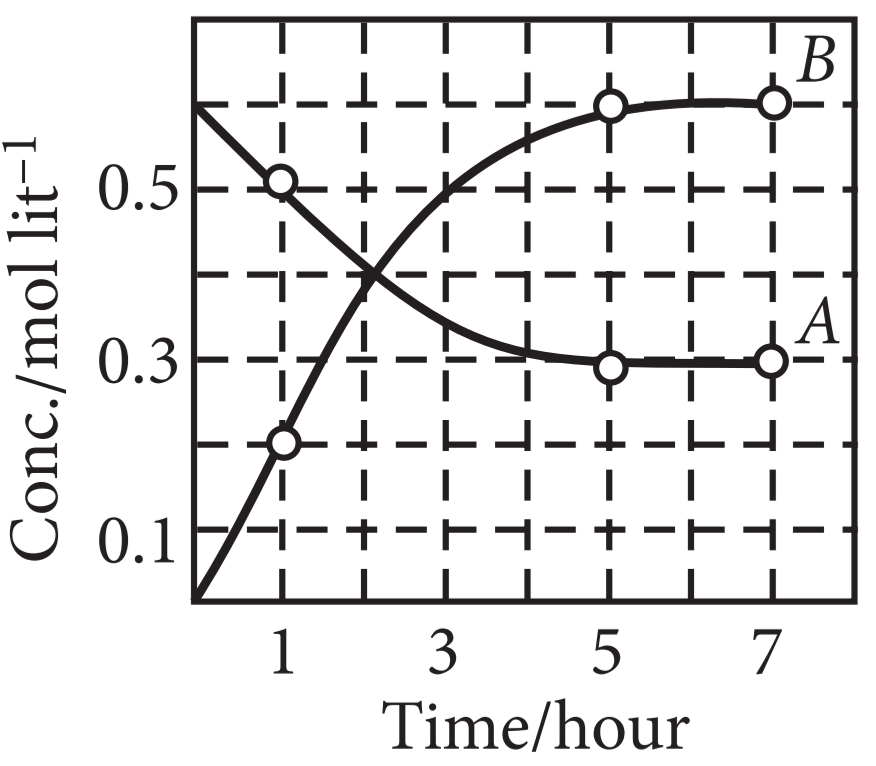
The progress of the reaction$, \text{A}\rightleftharpoons\text{nB}$ with time is represented in the following figure :

The following questions are multiple choice questions. Choose the most appropriate answer :
  1. What is the value of $n$?
  1. $1$
  2. $2$
  3. $3$
  4. $4$
  1. Find the value of the equilibrium constant.
  1. $0.6M$
  2. $1.2M$
  3. $0.3M$
  4. $2.4M$
  1. The initial rate of conversion of $A$ will be:
  1. $0.1 mol L^{-1}hr^{-1}$
  2. $0.2 mol L^{-1}hr^{-1}$
  3. $0.4 mol L^{-1}hr^{-1}$
  4. $0.8 mol L^{-1}hr^{-1}$
  1. For the reaction, if $\frac{\text{d}[\text{B}]}{\text{dt}}=2\times10^{-4},$ value of $-\frac{\text{d}[\text{A}]}{\text{dt}}$ will be:
  1. $2 \times 10^{-4}$
  2. $10^{-4}$
  3. $4 \times 10^{-4}$
  4. $0.5 \times 10^{-4}$
  1. Which factor has no effect on rate of reaction?
  1. Temperature.
  2. Nature of reactant.
  3. Concentration of reactant.
  4. Molecularity.
Read the passage given below and answer the following questions:
When a solution of an et$-$amino acid is placed in an electric field depending on the $pH$ of the medium, following three cases may happen.
  1. In alkaline solution, $CL-$amino acids exist as anion $II,$ and there is a net migration of amino acid towards the anode.
  2. In acidic solution, a$-$amino acids exist as cation $III,$ and there is a net migration of amino acid towards the cathode.
  3. If $II$ and $III$ are exactly balanced there is no net migration; under such conditions any one molecule exists as a positive ion and as a negative ion for exactly the same amount of time, and any small movement in the direction of one electrode is subsequently cancelled by an equal movement back toward the other electrode. The $pH$ of the solution in which a particular amino acid does not migrate under the influence of an electric field is called the is oelectric point of that amino acid.
The following questions are multiple choice questions. Choose the most appropriate answer:
  1.  

Arrange in order of increasing acid strengths. 
  1. $\ce{X > Z > Y}$
  2. $\ce{Z < X < Y}$
  3. $\ce{X > Y > Z}$
  4. $\ce{Z > X > Y}$
  1. In aqueous solutions, amino acids mostly exist as:
  1. $\ce{NH_2 - CHR - COOH}$
  2. $\ce{NH_2 - CHR - COO^-}$
  3. $\stackrel{+}{\hbox{ N}}\text{H}_3\text{CHRCOOH}$
  4. $\text{H}_3\stackrel{{+}}{\hbox{N}}\text{CHRCOO}^-$
  1. Amino acids are least soluble:
  1. at $\ce{pH 1}$
  2. at $\ce{pH 7}$
  3. At their isoelectric points.
  4. None of these.
  1. The $\text{pK}_{\text{a}_1}$ and $\text{pK}_{\text{a}_2}$ of an amino acid are $2.3$ and $9.7$ respectively. The is oelectric point of the amino acid is:
  1. $12.0$
  2. $7.4$
  3. $6.0$
  4. $3.7$
  1. A tripeptide $(X)$ on partial hydrolysis gave two dipeptides $\ce{Cys-Gly}$ and $\ce{Glu-Cys.}$ Identify the tripeptide.
  1. $\ce{Glu-Cys-Gly}$
  2. $\ce{Gly-Glu-Cys}$
  3. $\ce{Cys-Gly-Glu}$
  4. $\ce{Cys-Glu-Gly}$
Read the passage given below and answer the following questions:
Coordination compounds are formulated and named according to the $\text{IUPAC}$ system.
Few rules for naming coordination compounds are:
  1. In ionic complex, the cation is named first and then the anion.
  2. In the coordination entity, the ligands are named first and then the central metal ion.
  3. When more than one type of ligands are present, they are named in alphabetical order of preference without any consideration of charge.
The following questions are multiple choice questions. Choose the most appropriate answer:
  1. The $\ce{[Pt(NH_3)_3Br(NO_2)Cl]Cl}$ name of the complex $\ce{[Pt(NH_3)_3Br(NO_2)Cl]Cl}$ is:
  1. Triamminechlorobromonitroplatinum $(IV)$ chloride.
  2. Triamminebromonitrochloroplatinum $(IV)$ chloride.
  3. Triamminebromidochloridonitroplatinum $(IV)$ chloride.
  4. Triamminenitrochlorobromoplatinum $(IV)$ chloride.
  1. The $\text{IUPAC}$ name of $\ce{[Ni(CO)_4]}$ is:
  1. Tetracarbonylnickel $(II).$
  2. Tetracarbonylnickel $(0).$
  3. Tetracarbonylnickelate $(II).$
  4. Tetracarbonylnickelate $(0).$
  1. As per $\text{IUPAC}$ nomenclature, the name of the complex $\ce{[Co(H_2O)_4(NH_3)_2]Cl_3}$ is:
  1. Tetraaquadiamminecobalt $(II)$ chloride.
  2. Tetraaquadiamminecobalt $(III)$ chloride.
  3. Diamminetetraaquacobalt $(II)$ chloride.
  4. Diamminetetraaquacobalt $(III)$ chloride.
  1. Which of the following represents correct formula of dichloridobis $($ethane $-1, 2-$diamine$)$ cobalt $(III)$ ion?
  1. $\ce{[CoCl_2(en)]^{2+}}$
  2. $\ce{[CoCl_2(en)_2]^{2+}}$
  3. $\ce{[CoCl_2(en)]^+}$
  4. $\ce{[CoCl_2(en)_2]^+}$
  1. Correct formula of pentaamminenitro$-O-$cobalt $(III)$ sulphate is:
  1. $\ce{[Co(NO_2)(NH_3)_5]SO_4}$
  2. $\ce{[Co(ONO)(NH_3)_5]SO_4}$
  3. $\ce{[Co(NO_2)(NH_3)_4](SO_4)_2}$
  4. $\ce{[Co(ONO)(NH_3)_4](SO_4)_2}$
Read the passage given below and answer the following questions:
Metal carbonyl is an example of coordination compounds in which carbon monoxide $(CO)$ acts as ligand. These are also called homoleptic carbonyls. These compounds contain both $\sigma$ and $\pi$ character. Some carbonyls have metal$-$metal bonds. The reactivity of metal carbonyls is due to $(i)$ the metal centre and $(ii)$ the $CO$ ligands. $CO$ is capable of accepting an appreciable amount of electron density from the metal atom into their empty $\pi$ or $\pi-\text{orbital}.$ These types of ligands are called $\pi-\text{accepter}$ or $\pi-\text{acid}$ ligands. These interactions increases the $\Delta_0$ value.
The following questions are multiple choice questions. Choose the most appropriate answer:
  1. What is the oxidation state of metal in $\ce{[Mn_2(CO)_{10}]}?$
  1. $+1$
  2. $-1$
  3. $+2$
  4. $0$
  1. Among the following metal carbonyls, the $C-O$ bond order is lowest in:
  1. $\ce{[Mn(CO)_6]^+}$
  2. $\ce{[Fe(CO)_5]}$
  3. $\ce{[Cr(CO)_6]}$
  4. $\ce{[V(CO)_6]^-}$
  1. Which of the following can be reduced easily?
  1. $\ce{V(CO)_6}$
  2. $\ce{Mo(CO)_6}$
  3. $\ce{[Co(CO)_4]^-}$
  4. $\ce{Fe(CO)_5}$
  1. The oxidation state of cobalt in $\ce{K[Co(CO)_4]}$ is:
  1. $+1$
  2. $+3$
  3. $-1$
  4. $0$
  1. Structure of decacarbonyl manganese is:
  1. Trigonal bipyramidial
  2. Octahedral
  3. Tetrahedral
  4. Square pyramidal
Read the passage given below and answer the following questions: According to Raoult's law, the partial pressure of two components of the solution maybe given as: $\text{P}_\text{A}=\stackrel{{0}}{\hbox{PA }}\text{x}_\text{A}$ and $\text{P}_\text{B}=\stackrel{{0}}{\hbox{PB }}\text{x}_\text{B}$ For an ideal solution (obeys Raoult's law always) $\Delta\text{H}_\text{mix}=0,\Delta\text{mix}=0$ All solutions do not obey Raoults law over entire range of concentration. These are known as non-ideal solutions. For non-ideal solutions, $\text{P}_\text{A}\not=\stackrel{{0}}{\hbox{PA }}\text{x}_\text{A}$ or $\text{P}_\text{B}\not=\stackrel{{0}}{\hbox{PB }}\text{x}_\text{B}$ Positive deviation $\Rightarrow\text{P}_\text{A}>\stackrel{{0}}{\hbox{PA }}\text{x}_\text{A}$ and $\text{P}_\text{B}>\stackrel{{0}}{\hbox{PB }}\text{x}_\text{B}$ Negative deviation $\text{P}_\text{A}<\stackrel{{0}}{\hbox{PA }}\text{x}_\text{A}$ and $\text{P}_\text{B}\stackrel{{0}}{\hbox{PB }}\text{x}_\text{B}$ A statement of assertion followed by a statement ofreason is given. Choose the correct answer out of the following choices.
  1. Assertion and reason both are correct statements and reason is correct explanation for assertion.
  2. Assertion and reason both are correct statements but reason is not correct explanation for assertion.
  3. Assertion is correct statement but reason is wrong statement.
  4. Assertion is wrong statement but reason is correct statement.
  1. Assertion: An ideal solution obeys Raoult's law.
Reason: In an ideal solution, solute-solute as well as solvent-solvent interactions are similar to solute-solvent interactions.
  1. Assertion: Acetone and aniline show negative deviations.
Reason: H-bonding between acetone and aniline is stronger than that between acetone-acetone and aniline-aniline.
  1. Assertion: Azeotropic mixtures are formed only by non-ideal solutions and they may have boiling points either greater than both the components or lesser than both the components.
Reason: The composition of the vapour phase is same as that of the liquid phase of an azeotropic mixture.
  1. Assertion: The solutions which show negative deviations from Raoult's law are called maximum boiling azeotropes.
Reason: 68% nitric acid and 32% water by mass fonn maximum boiling azeotrope.
  1. Assertion: $\Delta\text{H}_{\text{mix}}$ mix and $\Delta\text{V}_{\text{mix}}$ are positive for an ideal solution.
Reason: The interactions between the particles of the components of an ideal solution are almost identical as between particles in the liquids.