Question
Read the passage given below and answer the following questions:
Carbohydrates are polyhydroxy aldehydes and ketones and those compounds which on hydrolysis give such compounds are also carbohydrates. The carbohydrates which are not hydrolysed are called monosaccharides. Monosaccharides with aldehydic group are called aldose and those which free ketonic groups are called ketose. Carbohydrates are optically active. Number of optical isomers $= 2^n$
Where $n =$ numberofasymmetric carbons. Carbohydrates are mainlysynthesised by plants during photosynthesis. The monosaccharides give the characteristic reactions of alcohols and carbonyl group (aldehydes and ketones). It has been found that these monosaccharides exist in the form of cyclic structures. In cyctization, the $-OH$ groups $($generally $C_5$ or $C_4$ in aldohexoses and $C_5$ or $C_6$ in ketohexoses$)$ combine with the aldehyde or keto group. As a result, cyclic structures of five or six membered rings containing one oxygen atom are formed, e.g., glucose forms a ring structure. Glucose contains one aldehyde group, one $IO$ alcoholic group and four $2^\circ$ alcoholic groups in its open chain structure.
The following questions are multiple choice questions. Choose the most appropriate answer:
  1. First member of ketos sugar is:
  1. Ketotriose.
  2. Ketotetrose.
  3. Ketopentose.
  4. Ketohexose.
  1. In $CH_2OHCHOHCHOHCHOHCHOHCHO$, the number of optical isomers will be:
  1. $16$
  2. $8$
  3. $32$
  4. $4$
  1. Some statements are given below:
  1. Glucose is aldohexose.
  2. Naturally occurring glucose is dextrorotatory.
  3. Glucose contains three chiral centres.
  4. Glucose contains one $1^\circ$ alcoholic group and four $2^\circ$ alcoholic groups.
Among the above, correct statements are:
  1. $1$ and $2$ only
  2. $3$ and $4$ only
  3. $1, 2$ and $4$ only
  4. $1, 2, 3$ and $4$
  1. Two hexoses fonn the same osazone, find the correct statement about these hexoses.
  1. Both of them must be aldoses.
  2. They are epimers at $C-3.$
  3. The carbon atoms $I$ and $2$ in both have the same configuration.
  4. The carbon atoms $3, 4$ and $5$ in both have the same configuration.
  1. Which of the following reactions of glucose can be explained only by its cyclic structure?
  1. Glucose forms cyanohydrin with HCN.
  2. Glucose reacts with hydroxylamine to form an oxime.
  3. Pentaacetate of glucose does not react with hydroxylamine.
  4. Glucose is oxidised by nitric acid to gluconic acid.
Answer

  1. (a) Ketotriose.
  1. (a) $16$
  1. (c) $1, 2$ and $4$ only
Explanation:

Glucose contains four chiral centres.
  1. (d) The carbon atoms $3, 4$ and $5$ in both have the same configuration.
Explanation:

In the formation of osazone, $C-1$ and $C-2$ react with phenylhydrazine to form phenylhydrazone. If $C-3, C-4, C-5$ have same configuration they will form same osazone even if they differ in configuration at $C-1$ or $C-2.$
  1. (c) Pentaacetate of glucose does not react with hydroxylamine.
Explanation:

Pentacetate of glucose does not react with hydroxylamine showing absence of free $-CHO$ group. This cannot be explained by open structure of glucose.

Need a full question paper?

Generate a complete, print-ready paper with questions like this in minutes — across 16+ boards, with answer keys.

Start Generating Free

Similar questions

Read the passage given below and answer the following questions: A compound (X) containing C, H and O is unreactive towards sodium. It also does not react with Schiff s reagent. On refluxing with an excess of hydroiodic acid, (X) yields only one organic product ( Y). On hydrolysis, (Y) yields a new compound (Z) which can be converted into (Y) by reaction with red phosphorus and iodine. The compound (Z) on oxidation with potassium permanganate gives a carboxylic acid. The equivalent weight of this acid is 60. The following questions are multiple choice questions. Choose the most appropriate answer:
  1. The compound (X) is an:
  1. Acid.
  2. Aldehyde.
  3. Alcohol.
  4. Ether.
  1. The IUPAC name of the acid formed is:
  1. Methanoic acid.
  2. Ethanoic acid.
  3. Propanoic acid.
  4. Butanoic acid.
  1. Compound (Y) is:
  1. Ethyl iodide.
  2. Methyl iodide.
  3. Propyl iodide.
  4. Mixture of (a) and (b).
  1. Compound (Z) is:
  1. Methanol.
  2. Ethanol.
  3. Propanol.
  4. Butanol.
  1. Compound (X) on treatment with excess of $Cl_2$ in presence of tight gives:
  1. $\propto-$ Chlorodiethyl ether.
  2. $\propto,\propto'-$ Dichlorodiethyl ether.
  3. Perchlorodiethyl ether.
  4. None of these.
Read the passage given below and answer the following questions:
The halogen elements show great resemblances to one another in their chemical behaviour and properties of their compounds with other elements. There is, however, a progressive change in properties from F through $Cl, Br,$ and I to At. F is most reactive among the halogens and in fact, from all other elements and it has certain other properties that set it apart from the other halogens.
In these questions (Q.No. i - iv), a statement of assertion followed by a statement of reason is given. Choose the correct answer out of the following choices.
  1. Assertion and reason both are correct statements and reason is correct explanation for assertion.
  2. Assertion and reason both are correct statements but reason is not correct explanation for assertion.
  3. Assertion is correct statement but reason is wrong statement.
  4. Assertion is wrong statement but reason is correct statement.
  1. Assertion: $F_2 $ has high reactivity.
Reason: $F_2$ has low bond dissociation enthalpy.
  1. Assertion: The bond between $F - F$ is weaker than between $Cl - Cl.$
Reason: Atomic size of $F$ is smaller than that of $Cl.$
  1. Assertion: Fluoride does not show oxidation number greater than zero.
Reason: The halogens chlorine, bromine and iodine can show positive oxidation state of $+1, +3$ and $+7.$
  1. Assertion: F atom has less negative electron affinity than Cl atom.
Reason: Additional electrons are repelled more effectively by $3p-$electrons in $Cl$ than by $2p-$electrons in Fatom.
  1. Assertion: Fluorine is strongest oxidising agent in halogens.
Reason: It displaces other halogens from its aqueous solution.
Read the passage given below and answer the following questions:
The concentration of a solute is very important in studying chemical reactions because it determines how often molecules collide in solution and thus indirectly determine the rate of reactions and the conditions at equilibrium. There are several ways to express the amount of solute present in a solution. The concentration of a solution is a measure of the amount of solute that has been dissolved in a given amount of solvent or solution. Concentration can be expressed in terms of molarity, molality, parts per million, mass percentage, volume percentage, etc.
The following questions are multiple choice questions. Choose the most appropriate answer:
  1. A solution is prepared using aqueous Kl which is turned out to be $20\%$ w/w Density of Kl is $1.202$ g/mL the molality of the given solution and mole fraction of solute are respectively.
  1. $1.95m, 0.120$
  2. $1.5m, 0.0263$
  3. $2.5m, 0.0569$
  4. $3.0m, 0.0352$
  1. The molarity $($in $mol\ L^{-1})$ of the given solution will be.
  1. $1.56$
  2. $1.89$
  3. $0.263$
  4. $1.44$
  1. Which of the following is correct relationship between mole fraction and molality?
  1. $\text{x}_2=\frac{\text{mM}_1}{1+\text{mM}_1}$
  2. $\text{x}_2=\frac{\text{mM}_1}{1-\text{mM}_1}$
  3. $\text{x}_2=\frac{1+\text{mM}_1}{\text{mM}_1}$
  4. $\text{x}_2=\frac{1-\text{mM}_1}{\text{mM}_1}$
  1. Which of the following is temperature dependent?
  1. Molarity
  2. Molality
  3. Mole fraction
  4. Mass percentage
  1. Which of the following is true for an aqueous solution of the solute in terms of concentration?
  1. $1M = 1m$
  2. $1M > 1m$
  3. $1M < 1m$
  4. Cannot be predicted
Read the passage given below and answer the following questions:
In an assembly of atoms or molecules, a solid phase is formed whenever the interatomic attractive forces significantly exceed the disruptive thermal forces and thus restrict the mobility of atoms, forcing them into more or less fixed positions. From energy considerations, it is evident that in such solids the atoms or molecules will always attempt to assume highly ordered structures which are characterised by symmetry. Depending on the nature of the active interatomic forces, all solids may be subdivided into the following categories :
Ionic solids: These solids consist of positively and negatively charged ions arranged in a regular fashion throughout the solid. These solids are very hard and brittle, have very high melting points and have high enthalpies of vaporisation, e.g., NaCl, MgO, KCl, LiCl etc.
Covalent solids: In these solids, the constituent particles are atoms which are linked together by a continuous system of covalent bonds. These bonds are strong and directional in nature. The covalent crystals are hard, have high melting points, are poor conductors of electricity. Diamond is a typical example of covalent solids.
Metallic solids: ln these solids, the constituent particles are positive ions immersed in a sea of mobile electrons. Metallic solids may be hard as well as soft. They are good conductors of heat and electricity, e.g., common metals such as nickel, copper and alloys.
Molecular solids: ln these the constituent particles are molecules. The molecules are held together by dispersion forces or London forces, dipole-dipole forces or hydrogen bonds.
In these questions (Q. No. i-iv), a statement of assertion followed by a statement of reason is given. Choose the correct answer out of the following choices.
  1. Assertion and reason both are correct statements, and reason is correct explanation for assertion.
  2. Assertion and reason both are correct statements, but reason is not correct explanation for assertion.
  3. Assertion is correct statement, but reason is wrong statement.
  4. Assertion is wrong statement, but reason is correct statement.
  1. Assertion: Molecular solids are characterized by low melting point.
Reason: Molecular solids are made up of covalent molecules.
  1. Assertion: Ionic solids are characterized by high melting and boiling point.
Reason: Ionic solids have coulombic forces of attraction between their ions.
  1. Assertion: Covalent solids are insulators of electricity.
Reason: Covalent solids are constituted by ions.
  1. Assertion: Diamond and graphite do not have the same covalent structure.
Reason: Silicon carbide is typical example of network solid.
  1. Assertion: Covalent solids have high melting points.
Reason: Covalent solids have strong electrostatic forces of attraction.
Read the passage given below and answer the following questions:
Nucleophilic substitution reactions are of two types; substitution nucleophilic bimolecular $(S_N2)$ and substitution nucleophilic unimolecular $(S_N1)$ depending on molecules taking part in determining the rate of reaction. Reactivity of alkyl halide towards $S_N1$ and $S_N2$ reactions depends on various factors such as steric hindrance, stability of intermediate or transition state, and polarity of solvent. $S_N2$ reaction mechanism is favoured mostly by primary alkyl halide then secondary and then tertiary. This order is reversed in case of $S_N1$ reactions.
The following questions are multiple choice questions. Choose the most appropriate answer:
  1. Which of the following is most reactive towards nucleophilic substitution reaction?
  1. $C_6H_5Cl$
  2. $CH_2 = CHCl$
  3. $ClCH_2CH = CH_2$
  4. $CH_3CH = CHCl$
  1. Isopropyl chloride undergoes hydrolysis by:
  1. $S_N1$ mechanism.
  2. $S_N2$ mechanism.
  3. $S_N1$ and $S_N2$ mechanism.
  4. Neither $S_N1$ nor $S_N2$ mechanism.
  1. The most reactive nucleophile among the following is:
  1. $CH_3O^-$
  2. $C_6H_5O^-$
  3. $(CH_3)_2CHO^-$
  4. $(CH_3)_3CO^-$
  1. Tertiary alkyl halides are practically inert to substitution by $S_N2$ mechanism because of:
  1. Insolubility.
  2. Instability.
  3. Inductive effect.
  4. Stearic hindrance.
  1. Which of the following is the correct order of decreasing $S_N2$ reactivity?
  1. $RCH_2X > R_2CHX > R_3CX$
  2. $R_3CX > R_2CHX > RCH_2X$
  3. $R_2CHX > R_3CX > RCH_2X$
  4. $RCH_2X > R_3CX > R_2CHX$
For a first order reaction, A → Products, $\text{k}=\frac{2.303}{\text{t}}\log\frac{\text{a}}{\text{a}-\text{x}},$ where a is the initial concentration of A and (a - x) is the concentration of A after time t. k is rate constant. Its value is constant at constant temperature for a reaction. The time in which half of the reactant is consumed is called half-life period. Half-life period of a first order reaction is constant. Its value is independent of initial concentration or any other external conditions.In these questions (Q. No. i-iv), a statement of assertion followed by a statement ofreason is given. Choose the correct answer out of the following choices.
  1. Assertion and reason both are correct statements and reason is correct explanation for assertion.
  2. Assertion and reason both are correct statements but reason is not correct explanation for assertion.
  3. Assertion is correct statement but reason is wrong statement.
  4. Assertion is wrong statement but reason is correct statement.
  1. Assertion: Rate of reaction doubles when concentration of reactant is doubled if it is a first order reaction.
Reason: Rate constant also doubles.
  1. Assertion: For the first order reaction, half-life period is expressed as $\text{t}_\frac{1}{2}=\frac{2.303}{\text{k}}\log2.$
Reason: The half-life time of a first order reaction is not always constant and it depends upon the initial concentration of reactants.
  1. Reason: The half-life time of a first order reaction is not always constant and it depends upon the initial concentration of reactants.
Reason: Acid only acts as a catalyst whereas alkali acts as one of the reactants.
  1. Assertion: For a first order reaction, the concentration of the reactant decreases exponentially with time.
Reason: Rate of reaction at any time depends upon the concentration of the reactant at that time.
  1. Assertion: Half-life period for a first order reaction is independent of initial concentration of the reactant.
Reason: For a first order reaction, $\text{t}_\frac{1}{2}=\frac{0.693}{\text{k}},$ where k is rate constant.
In these questions, a statement of assertion followed by a statement of reason is given. Choose the correct answer out of the following choices.
Assertion: The enthalpy of physisorption is lesser than chemisorption.
Reason: Molecules of adsorbate and adsorbent are held by van der Waal's forces in physisorption and by chemical bonds in chemisorption.
Read the passage given below and answer the following questions:
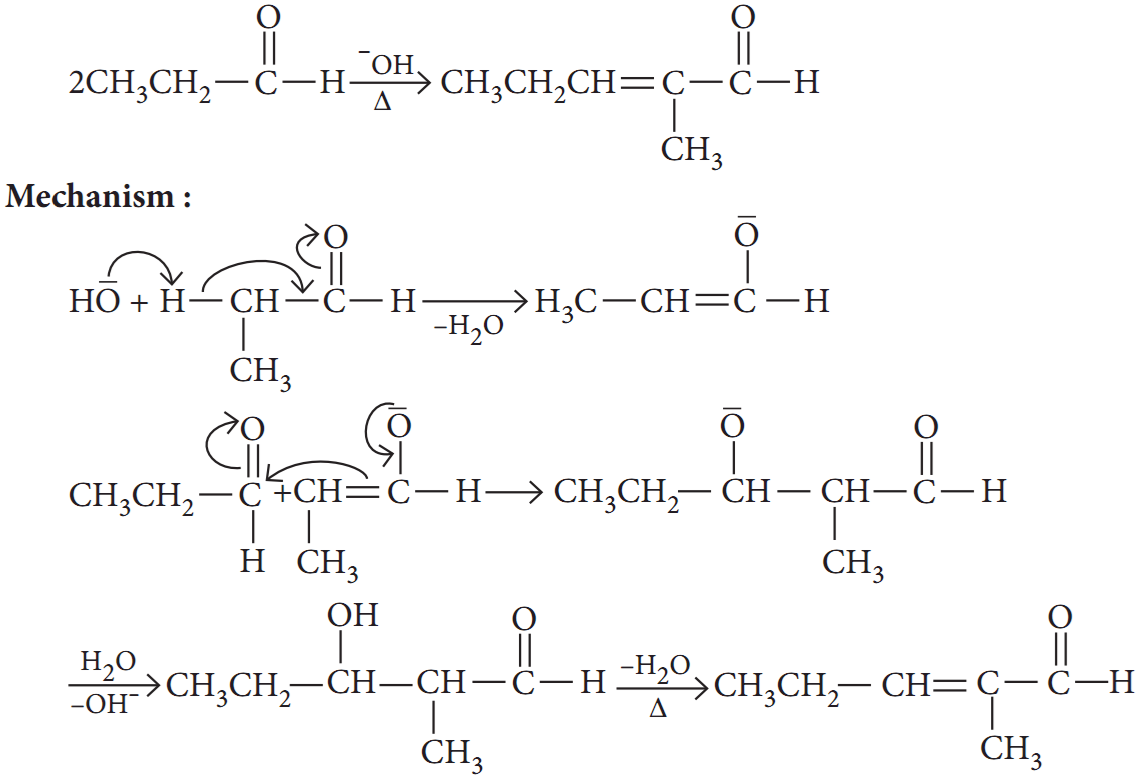
The addition reaction of enol or enolate to the carbonyl functional group of aldehyde or ketone is known as aldol addition. The $\beta-$ hydroxyaldehyde or $\beta-$hydroxyketone so obtained undergo dehydration in second step to produce a conjugated enone. The first part of reaction is an addition reaction and the second part is an elimination reaction. Carbonyl compound having $\propto-$hydrogen undergoes aldol condensation reaction.

The following questions are multiple choice questions. Choose the most appropriate answer:
  1. Condensation reaction is the reverse of which of the following reaction?
  1. Lock and key hypothesis.
  2. Oxidation.
  3. Hydrolysis.
  4. Glycogen formation.
  1. Which of the following compounds would be the main product of an aldol condensation of acetaldehyde and acetone?
  1. $CH_3CH = CHCHO$
  2. $CH_3CH = CHCOCH_3$
  3. $(CH_3)_2C = CHCHO$
  4. $(CH_3)_2C = CHCOCH_3$
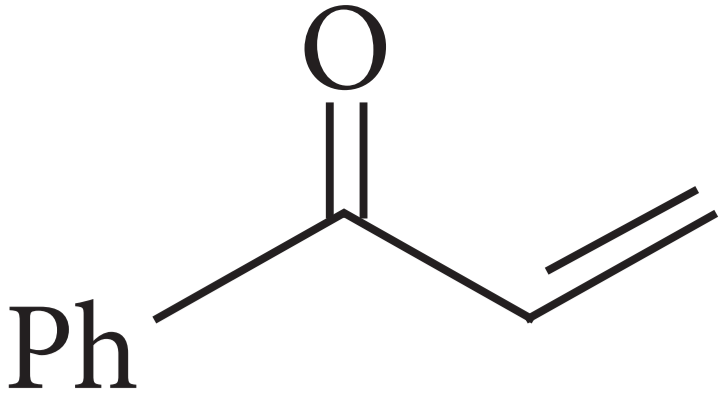
  1. Which combination of carbonyl compounds gives phenyl vinyl ketone by an aldol condensation?
  1. Acetophenone and Formaldehyde.
  2. Acetophenone and acetaldehyde.
  3. Benzaldehyde and acetaldehyde.
  4. Benzaldehyde and acetone.
  1. Which of the following will undergo aldol condensation?
  1. $HCHO$
  2. $CH_3CH_2OH$
  3. $C_6H_5CHO$
  4. $CH_3CH_2CHO$
  1. Which of the following does not undergo aldol condensation?
  1. $CH_3CHO$
  2. $CH_3CH_2CHO$
  3. $CH_3COCH_3$
  4. $C_3H_2CHO$
Standard electrode potentials are used for various processes:
  • It is used to measure relative strengths of various oxidants and reductants.
  • It is used to calculate standard cell potential.
  • It is used to predict possible reactions.
A set of half-reactions (in acidic medium) along with their standard reduction potential, $E^\circ ($in volt$)$ values are given below:
$I_2 + 2e^- \rightarrow 2I^- ; E^\circ = 0.54 V$
$Cl_2 + 2e^- \rightarrow 2Cl^- ; E^\circ = 1.36 V$
$Mn^{3+} +e^- \rightarrow Mn^{2+}; E^\circ = 1.50 V$
$Fe^{3+} + e^- \rightarrow Fe^{2+}; E^\circ = 0.77 V$
$O_2 + 4H^+ + 4e^- \rightarrow 2H_2O ; E^\circ = 1.23 V$
The following questions are multiple choice questions. Choose the most appropriate answer:
  1. Which of the following statements is correct?
  1. $Cl^-$ is oxidised by $O_2.$
  2. $Fe^{2+}$ is oxidised by iodine.
  3. $I^-$ is oxidised by chlorine.
  4. $Mn^{2+}$ is oxidised by chlorine.
  1. $Mn^{3+}$ is not stable in acidic medium, while $Fe^{3+}$ is stable because:
  1. $O_2$ oxidises $Mn^{2+}$ to $Mn^{3+}$
  2. $O_2$ oxidises both $Mn^{2+}$ to $Mn^{3+}$ and $Fe^{2+}$ to $Fe^{3+}$
  3. $Fe^{3+}$ oxidises $H_2O$ to $O_2$
  4. $Mn^{3+}$ oxidises $H_2O$ to $O_2$
  1. The strongest reducing agent in the aqueous solution is:
  1. $I^-$
  2. $Cl^-$
  3. $Mn^{2+}$
  4. $Fe^{2+}$
  1. The emf for the following reaction is:
$\text{I}_2+\text{KCl}\rightleftharpoons2\text{KI}+\text{Cl}_2$
  1. $-0.82\ V$
  2. $+0.82\ V$
  3. $-0.73\ V$
  4. $+0.73\ V$
  1. Which of the following statements is correct for the following reaction?
$Fe^{3+} + Mn^{2+} \rightarrow Fe^{2+}+ Mn^{3+}$
  1. The emf of the cell is positive.
  2. $Fe^{3+}$ oxidises $Mn^{2+}.$
  3. The reaction does not occur.
  4. All are correct.

 
Read the passage given below and answer the following questions:
Interhalogen compounds are formed when halogen group elements react with each other. These are the compounds which consist of two or more different elements of group$-17$. A halogen with large size and low electronegativity reacts with an element of group$-17$ with small size and high electronegativity. As the ratio of radius of larger and smaller halogen increases, the number of atoms in a molecule also increases.
The following questions are multiple choice questions. Choose the most appropriate answer:
  1. The stability of interhalogen compounds follows the order.
  1. $IF_3 > BrF_3 > CIF_3$
  2. $CIF_3 > BrF_3 > IF_3$
  3. $BrF_3 > IF_3 > CIF_3$
  4. $CIF_3 > IF_3 > BrF_3$
  1. Identify the correct match from the following.
  1. $[ICI_2]^- - $ bent.
  2. $IF_7 $- pentagonal bipyramidal.
  3. $CIF_3 $- trigonal planar.
  4. $[BrF_4]^-$ - square pyramidal.
  1. In $XA_5$, the central atom has $($both $X$ and $A$ are halogens$).$
  1. $5$ bond pairs and no lone pairs.
  2. $5$ bond pairs and one lone pair.
  3. $6$ bond pairs and no lone pairs.
  4. $4$ bond pairs and one lone pair.
  1. In the known interbalogen compounds, the maximum number of atoms are,
  1. $4$
  2. $5$
  3. $8$
  4. $7$
  1. Which of the following is not the characteristic of interhalogen compounds.
  1. They are more reactive than halogens.
  2. They are quite unstable but none of them is explosive.
  3. They are covalent in nature.
  4. They have low boiling points and are highly volatile.