Question

Read the passage given below and answer the following questions:
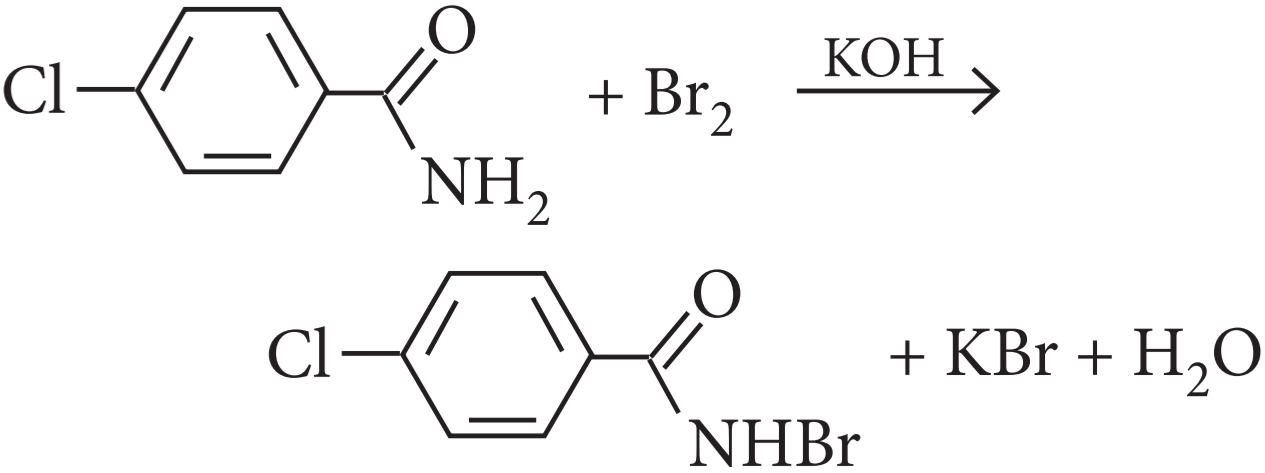
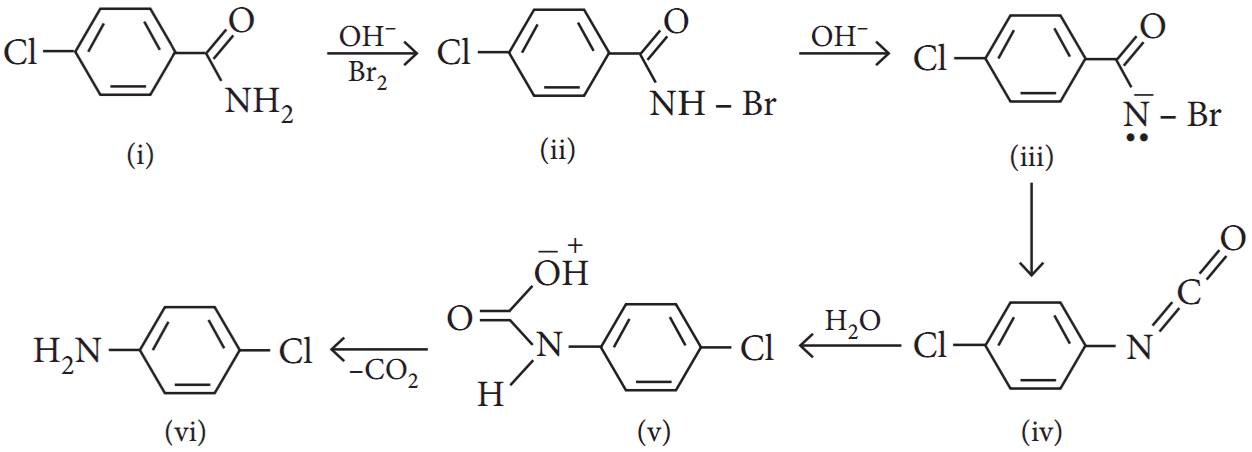
$\ce{RCONH_2}$ is converted into $\ce{RNH_2}$ by means of Hoffmann bromamide degradation. During the reaction amide is treated with $\ce{Br_2}$ and alkali to get amine. This reaction is used to descend the series in which carbon atom is removed as carbonate ion $(\text{CO}^{2-}_3)$ Hoffmann bromide degradation reaction can be written as:
The following questions are multiple choice questions. Choose the most appropriate answer:
  1. Hoffmann bromamide degradation is used for the preparation of
  1. Primary amines.
  2. Secondary amines.
  3. Tertiary amines.
  4. Secondary aromatic amines.
  1. Which is the rate determining step in Hoffmann bromamide degradation?
  1. Formation of $(i)$
  2. Formation of $(ii)$
  3. Formation of $(iii)$
  4. Formation of $(iv).$
  1. Which of the following are used for the conversion of $(i)$ to $(ii)?$
  1. $\ce{KBr}$
  2. $\ce{KBr + CH_3ONa}$
  3. $\ce{KBr + KOH}$
  4. $\ce{Br_2 + KOH}$
  1. Identify Bin the following reaction.
$\text{R}-\text{C}\equiv\text{N}\xrightarrow[\text{(Partially hydrolysis) }]{\text{Cone. HCI}}\text{A}\xrightarrow{\frac{\text{Br}_2}{\text{KOH}}}\text{B}$
  1. $\ce{RCONH_2}$
  2. $\ce{RNH_2}$
  3. $\ce{RNHBr}$
  4. $\ce{R = N = C = O}$
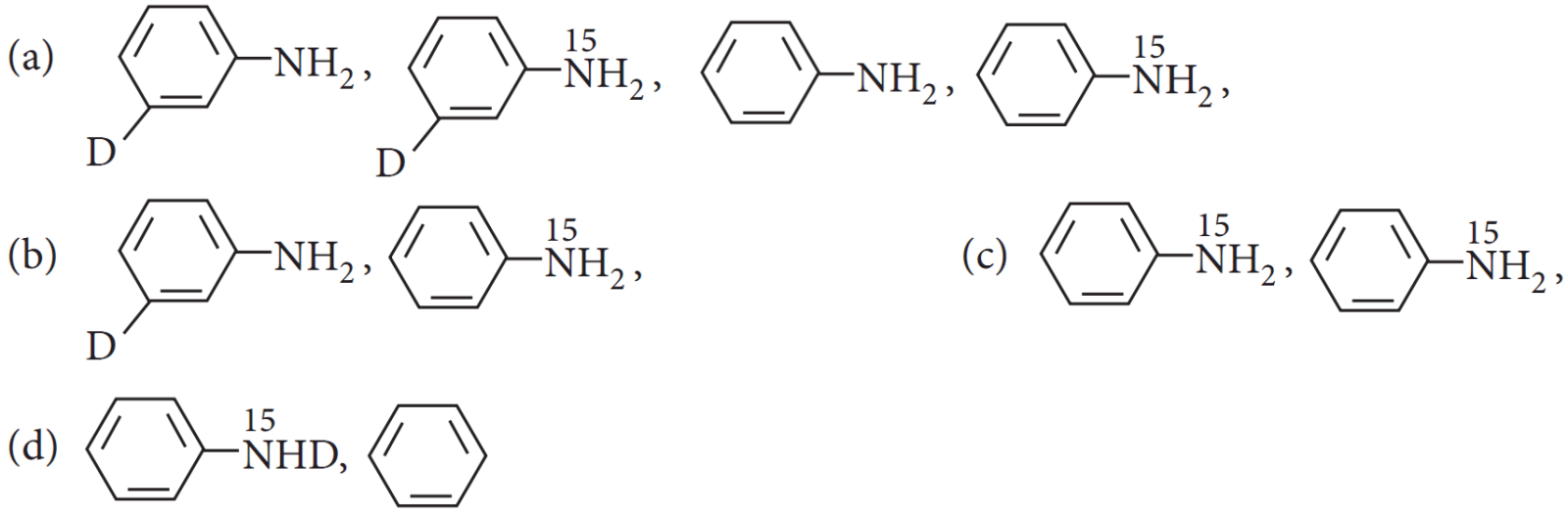
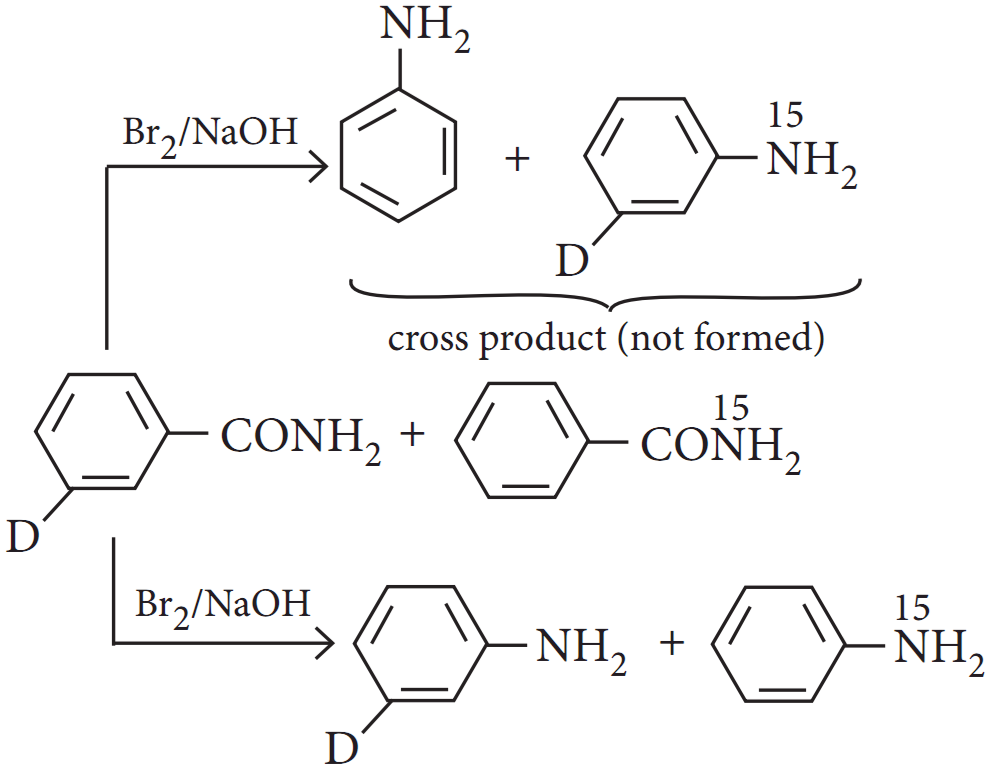
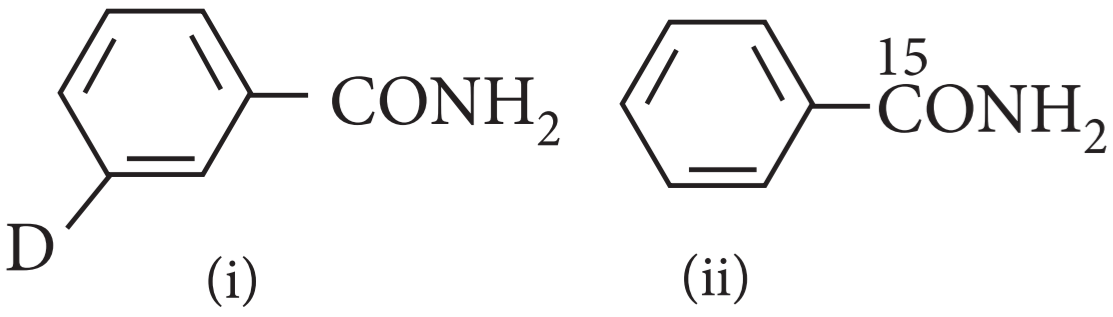
  1. What are the constituent amines formed when the mixture of $(i)$ and $(ii)$ undergoes Hoffmann bromamide degradation?
 

Answer

  1. $(a)$ Primary amines.
  1. $(d)$ Formation of $(iv).$
The rate determining step is probably loss of $Br^-$ to form is ocyanate as this is the slowest step.
  1. $(d)\  \ce{Br_2 + KOH}$

  1. $(b)\ \ce{RNH_2}$

$\ \ \ \ \ \ \ \ \ \ \ \ \ \ \ \ \ \ \ \ \ \ \ \ \ \ \ \ \ \ \ \ \ \ \ \ \ \ \ \ \ \ \ \ \ \ \ \ \ \ \ \ \ \ \ \ \ \text{O}\\\ \ \ \ \ \ \ \ \ \ \ \ \ \ \ \ \ \ \ \ \ \ \ \ \ \ \ \ \ \ \ \ \ \ \ \ \ \ \ \ \ \ \ \ \ \ \ \ \ \ \ \ \ \ \ \ \ ||\\\text{R}-\text{C}\equiv\text{N}\xrightarrow[\text{(partially hydrolysis)}]{\text{Cone. HCI}}\text{R}-\text{C}-\text{NH}_2\\\ \ \ \ \ \ \ \ \ \ \ \ \ \ \ \ \ \ \ \ \ \ \ \ \ \ \ \ \ \ \ \ \ \ \ \ \ \ \ \ \ \ \ \ \ \ \ \xrightarrow{\frac{\text{br}_2}{\text{KHO}}}\text{R}-\text{NH}_2$
  1. $(b)$ In ethylamine there is no resonance while in acetamide the lone pair of electrons on $N-$atom is delocalised and is less available for protonation.

Since, the overall reaction is intermolecular, hence there will be no effect on product fonnation.
 

Need a full question paper?

Generate a complete, print-ready paper with questions like this in minutes — across 16+ boards, with answer keys.

Start Generating Free

Similar questions

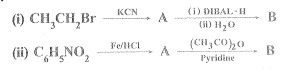
Give the structures of A and B in the following reactions
Image
What change in the concentration of H₂ will triple the rate of reaction?
(c). Suppose a reaction between A and B, was experimentally found to be first order with respect to both A and B. So the rate equation is:
Rate = k[A][B]
Which of these two mechanisms is consistent with this experimental finding? Why?
Mechanism 1
A → C + D (slow)
B+C → E (fast)
Mechanism 2
A+B →C + D (slow)
C → E (fast)
Two types of conductors are generally used, metallic and electrolytic. Free electrons are the current carrier in metallic and in electrolytic conductors, free ions. Specific conductance or conductivity of an electrolytic solution is given by $\text{K}=\text{C}\times\frac{\text{l}}{\text{A}}$ where, $\text{C}\times\frac{1}{\text{R}}$ and $\frac{\text{l}}{\text{A}}=\text{G}^\star$ (cell constant) Molar conductance $(\wedge_\text{m})$ and equivalent conductance $(\wedge_\text{e})$ of an electrolyte solution are calculated as $\wedge_\text{m}=\frac{\text{K}\times1000}{\text{M}}$ or $\wedge_\text{e}=\frac{\text{K}\times1000}{\text{N}}$ where, M = molarity of solution and N is normality of solution. Molar conductance of strong electrolyte depends on the concentration. $\wedge_\text{m}=\wedge^\circ_{\text{m}^-}\text{b}\sqrt{\text{C}}$ $\wedge^\circ_\text{m}=$ molar conductance at infinite dilution, b = constant, C = cone.of solution In these questions (Q. No. i-iv), a statement of assertion followed by a statement of reason is given. Choose the correct answer out of the following choices.
  1. Assertion and reason both are correct statements and reason is correct explanation for assertion.
  2. Assertion and reason both are correct statements but reason is not correct explanation for assertion.
  3. Assertion is correct statement but reason is wrong statement.
  4. Assertion is wrong statement but reason is correct statement.
  1. Assertion: The molar conductivity of strong electrolyte decreases with increase in concentration.
Reason: At high concentration, migration ofions is slow.
  1. Assertion: The molar conductance of weak electrolyte at infinite dilution is equal to the sum of molar conductance of cations and anions.
Reason: Kohlrausch's law is applicable for strong electrolytes.
  1. Assertion: Equivalent conductance of all electrolytes increases with increasing concentration.
Reason: More number ofions are available per gram equivalent at higher concentration.
  1. Assertion: Specific conductance decreases with dilution whereas equivalent conductance increases.
Reason: On dilution, number of ions per millilitre decreases but total number ofions increases considerably.
  1. Assertion: The ratio of specific conductivity to the observed conductance does not depend upon the concentration of the solution taken in the conductivity cell.
Reason: Specific conductivity decreases with dilution whereas observed conductance increases with dilution.
What is fructose? Explain the structure of fructose.
Read the passage given below and answer the following questions: At the freezing point of a solvent, the solid and the liquid are in equilibrium. Therefore, a solution will freeze when its vapour pressure becomes equal to the vapour pressure of the pure solid solvent. It has been observed that when a non-volatile solute is added to a solvent, the freezing point of the solution is always lower than that of the pure solvent. Depression in freezing point can be given as, $\Delta\text{T}_\text{f}=\text{K}_\text{f}\text{m}$ Where $, K_f =$ Molal freezing point depression constant or we can write, $\Delta\text{T}_\text{f}=\frac{\text{K}_\text{f}\times\text{W}_\text{B}\times1000}{\text{W}_A\times\text{M}_\text{B}}$ a statement of assertion followed by a statement of reason is given. Choose the correct answer out of the following choices.
  1. Assertion and reason both are correct statements and reason is correct explanation for assertion.
  2. Assertion and reason both are correct statements but reason is not correct explanation for assertion.
  3. Assertion is correct statement but reason is wrong statement.
  4. Assertion is wrong statement but reason is correct statement.
  1. Assertion : $0.1M$ solution of glucose has same depression in the freezing point as $0.1M$ solution of urea.
Reason : $K_f$ for both has same value.
  1. Assertion : Increasing pressure on pure water decreases its freezing point.
Reason : Density of water is maximum at $273K$.
  1. Assertion : Larger the value of cryoscopic constant of the solvent, lesser will be the freezing point of the solution.
Reason : Extent of depression in the freezing point depends on the nature of the solvent.
  1. Assertion : The water pouch of instant cold pack for treating athletic injuries breaks when squeezed and $\text{NH4N03}$ dissolves thus lowering the temperature.
Reason : Addition of non $-$ volatile solute into solvent results into depression of freezing point of solvent.
  1. Assertion : If a non $-$ volatile solute is mixed in a solution then elevation in boiling point and depression in freezing point both wiII be same.
Reason : Elevation in boiling point and depression in freezing point both depend on number of particles of solute.
Read the passage given below and answer the following questions: Transition elements are elements that have partially filled $d-$orbitals. The configuration of these elements corresponds to$ (n - 1)d^{1-10} \ ns^{1-2}.$ It is important to note that the elements mercury, cadmium and zinc are not considered transition elements because of their electronic configurations, which corresponds to $(n - 1)d^{10} \ ns^2.$ Some general properties of transition elements are: These elements can fonn coloured compounds and ions due to $d-d$ transition; These elements exhibit many oxidation states; A large variety of ligands can bind themselves to these elements, due to this, a wide variety of stable complexes formed by these ions. The boiling and melting point of these elements are high. These elements have a large ratio of charge to the radius. In these questions $(Q.$ No. $i-iv),$ a statement of assertion followed by a statement ofreason is given. Choose the correct answer out of the following choices.
  1. Assertion: Tungsten has very high melting point.
Reason: Tungsten is a covalent compound.
  1. Assertion: $Zn, Cd$ and $Hg$ are normally not considered transition metals.
Reason: $d-$Orbitals in $Zn, Cd$ and $Hg$ elements are completely filled, hence these metals do not show the general characteristics properties of the transition elements.
  1. Assertion: Copper metal gets readily corroded in acidic aqueous solution such as $\ce{HCl}$ and dil. $\ce{H_2SO_4}.$
Reason: Free energy change for this process is positive.
  1. Assertion: Tailing of mercury occurs on passing ozone through it.
Reason: Due to oxidation of mercury.
  1. Assertion: Transition metals are poor reducing agents.
Reason: Transition metals fonn numerous alloys with other metals.
A reaction is said to be of the first order if the rate of the reaction depends upon one concentration term only. For a first order reaction of the type $A \rightarrow$ Products, the rate of the reaction is given as: rate $= k[A]$. The differential rate law is given as : $\frac{\text{dA}}{\text{dt}}=-\text{k}[\text{A}].$ The integrated rate law is : In $\frac{[\text{A}]}{[\text{A}]_0}=-\text{kt}, [A]$ is the concentration of reactant left at time $t$ and $[A]_0$ is the initial concentration of the reactant$, k$ is the rate constant.
The following questions are multiple choice questions. Choose the most appropriate answer :
  1. The unit of rate constant for a first order reaction is:
  1. $S^{-1}$
  2. $mol\ L^{-1} s^{-1}$
  3. $L\ mol^{-1} s^{-1}$
  4. $L^2\ mol^{-2} s^{-1}$
  1. Half$-$life period of a first order reaction is $10$ min. Starting with initial concentration $12M,$ the rate after $20$ min is:
  1. $0.693 \times 3M\ min^{-1}$
  2. $0.0693 \times 4M\ min^{-1}$
  3. $0.0693 \times M\ min^{-1}$
  4. $0.0693 \times 3M\ min^{-1}$
  1. $50\%$ of a first order reaction is complete in $23$ minutes. Calculate the ti me required to complete $90\%$ of the reaction.
  1. $70.4$ minutes.
  2. $76.4$ minutes.
  3. $38.7$ minutes.
  4. $35.2$ minutes.
  1. For a first order reaction$, (A) \rightarrow$ products, the concentration of $A$ changes from $0.1M$ to $0.025M$ in $40$ minutes. The rate of reaction when the concentration of $A$ is $0.01M,$ is:
  1. $3.47 \times 10^{-4} M/ min$
  2. $3.47 \times 10^{-5} M/ min$
  3. $1.73 \times 10^{-4} M/ min$
  4. $1.73 \times 10^{-5} M/ min$
  1. The half$-$life period ofa $1^{st}$ order reaction is $60$ minutes. What percentage will be left over after $240$ minutes?
  1. $6.25\%$
  2. $4.25\%$
  3. $5\%$
  4. $6\%$
For a first order reaction$, A \rightarrow$ Products$, \text{k}=\frac{2.303}{\text{t}}\log\frac{\text{a}}{\text{a}-\text{x}},$ where a is the initial concentration of $A$ and $(a - x)$ is the concentration of $A$ after time $t. k$ is rate constant. Its value is constant at constant temperature for a reaction. The time in which half of the reactant is consumed is called half$-$life period. Half$-$life period of a first order reaction is constant. Its value is independent of initial concentration or any other external conditions.In these questions $(Q.$ No. $i-iv),$ a statement of assertion followed by a statement ofreason is given. Choose the correct answer out of the following choices.
  1. Assertion and reason both are correct statements and reason is correct explanation for assertion.
  2. Assertion and reason both are correct statements but reason is not correct explanation for assertion.
  3. Assertion is correct statement but reason is wrong statement.
  4. Assertion is wrong statement but reason is correct statement.
  1. Assertion : Rate of reaction doubles when concentration of reactant is doubled if it is a first order reaction.
Reason : Rate constant also doubles.
  1. Assertion : For the first order reaction, half$-$life period is expressed as $\text{t}_\frac{1}{2}=\frac{2.303}{\text{k}}\log2.$
Reason : The half$-$life time of a first order reaction is not always constant and it depends upon the initial concentration of reactants.
  1. Reason : The half$-$life time of a first order reaction is not always constant and it depends upon the initial concentration of reactants.
Reason : Acid only acts as a catalyst whereas alkali acts as one of the reactants.
  1. Assertion : For a first order reaction, the concentration of the reactant decreases exponentially with time.
Reason : Rate of reaction at any time depends upon the concentration of the reactant at that time.
  1. Assertion : Half$-$life period for a first order reaction is independent of initial concentration of the reactant.
Reason : For a first order reaction, $\text{t}_\frac{1}{2}=\frac{0.693}{\text{k}},$ where $k$ is rate constant.
Read the passage given below and answer the following questions: The order of reactivity towards $S_N1$ reaction depends upon the stability of carbocation in the first step. Greater the stability of the carbocation, greater will be its ease of formation from alkyl halide and hence faster will be the rate of the reaction. As we know $, 3^\circ$ carbocation is most stable, therefore, the tert $-$ alkyl that halides will undergo $S_N1$ reaction very fast. For example, it has been observed that the reaction $\ce{(CH_3)_3CBr}$ with $\ce{OH}^-$ ion to give $2-$ methyl $-2-$ propanol is about I million times as fast as the corresponding reaction of the methyl bromide to give methanol. The primary alkyl halides always react predominantly by $S_N2$ mechanism. On the other hand, the tertiary alkyl halides react predominantly by $S_N1$ mechanism. Secondary alkyl halides may react by either mechanism or by both the mechanisms without much preference depending upon the nature of the nucleophile and solvent. In these questions $(Q$. No. $i-tv),$ a statement of assertion followed by a statement of reason is given. Choose tile correct answer out of tile following choices.
  1. Assertion and reason both are correct statements and reason is correct explanation for assertion.
  2. Assertion and reason both are correct statements but reason is not correct explanation for assertion.
  3. Assertion is correct statement but reason is wrong statement.
  4. Assertion is wrong statement but reason is correct statement.
  1. Assertion : Low concentration of nudeophile favours $S_N1$ mechanism.
Reason : $2^\circ$ alkyl halides are less reactive than $1^\circ$ towards $S_N1$ reactions.​​​​​​​
  1. Assertion : Polar solvent slows down $S_N2$ reactions.
Reason : $\ce{CH_3-Br}$ is less reactive than $\ce{CH_3Cl}$.​​​​​​​
  1. Assertion : Benzyl bromide when kept in acetone $-$ water it produces benzyl alcohol.
Reason : The reaction follows $S_N2$ mechanism.
  1. Assertion : Rate of hydrolysis of methyl chloride to methanol is higher in $\text{DMF}$ than in water.
Reason : Hydrolysis of methyl chloride follows second order kinetics.
  1. Assertion : $S_N1$ reaction is carried out in the presence of a polar protic solvent.
Reason : A polar protic solvent increases the stability of carbocation due to solvation.
What is the most suitable pKa value of the substituted propylamine formed with substituent "X" with electronegativity 3.0
(i)10.67 (ii)10.08 (iii) 10.15 (iv)11.10