Question
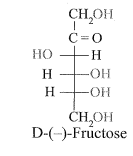
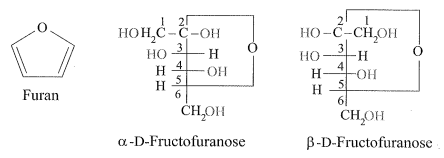
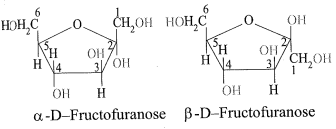
What is fructose? Explain the structure of fructose.

Need a full question paper?

Generate a complete, print-ready paper with questions like this in minutes — across 16+ boards, with answer keys.

Start Generating Free

Similar questions

Read the passage given below and answer the following questions:
Nucleophilic substitution reactions are of two types; substitution nucleophilic bimolecular $(S_N2)$ and substitution nucleophilic unimolecular $(S_N1)$ depending on molecules taking part in determining the rate of reaction. Reactivity of alkyl halide towards $S_N1$ and $S_N2$ reactions depends on various factors such as steric hindrance, stability of intermediate or transition state, and polarity of solvent. $S_N2$ reaction mechanism is favoured mostly by primary alkyl halide then secondary and then tertiary. This order is reversed in case of $S_N1$ reactions.
The following questions are multiple choice questions. Choose the most appropriate answer:
  1. Which of the following is most reactive towards nucleophilic substitution reaction?
  1. $\ce{C_6H_5Cl}$
  2. $\ce{CH_2 = CHCl}$
  3. $\ce{ClCH_2CH = CH_2}$
  4. $\ce{CH_3CH = CHCl}$
  1. Isopropyl chloride undergoes hydrolysis by:
  1. $S_N1$ mechanism.
  2. $S_N2$ mechanism.
  3. $S_N1$ and $S_N2$ mechanism.
  4. Neither $S_N1$ nor $S_N2$ mechanism.
  1. The most reactive nucleophile among the following is:
  1. $\ce{CH_3O^-}$
  2. $\ce{C_6H_5O^-}$
  3. $\ce{(CH_3)_2CHO^-}$
  4. $\ce{(CH_3)_3CO^-}$
  1. Tertiary alkyl halides are practically inert to substitution by $S_N2$ mechanism because of:
  1. Insolubility.
  2. Instability.
  3. Inductive effect.
  4. Stearic hindrance.
  1. Which of the following is the correct order of decreasing $S_N2$ reactivity?
  1. $\ce{RCH_2X > R_2CHX > R_3CX}$
  2. $\ce{R_3CX > R_2CHX > RCH_2X}$
  3. $\ce{R_2CHX > R_3CX > RCH_2X}$
  4. $\ce{RCH_2X > R_3CX > R_2CHX}$
Read the passage given below and answer the following questions: Boiling point or freezing point of liquid solution would be affected by the dissolved solids in the liquid phase. A soluble solid in solution has the effect of raising its boiling point and depressing its freezing point. The addition of non-volatile substances to a solvent decreases the vapor pressure and the added solute particles affect the formation of pure solvent crystals. According to many researches the decrease in freezing point directly correlated to the concentration of solutes dissolved in the solvent. This phenomenon is expressed as freezing point depression and it is useful for several applications such as freeze concentration of liquid food and to find the molar mass of an unknown solute in the solution. Freeze concentration is a high quality liquid food concentration method where water is removed by forming ice crystals. This is done by cooling the liquid food below the freezing point of the solution. The freezing point depression is referred as a colligative property and it is proportional to the molar concentration of the solution (m), along with vapor pressure lowering, boiling point elevation, and osmotic pressure. These are physical characteristics of solutions that depend only on the identity of the solvent and the concentration of the solute. The characters are not depending on the solute’s identity.
  1. When a non volatile solid is added to pure water it will:
  1. boil above 100°C and freeze above 0°C
  2. boil below 100°C and freeze above 0°C
  3. boil above 100°C and freeze below 0°C
  4. boil below 100°C and freeze below 0°C
  1. Colligative properties are:
  1. dependent only on the concentration of the solute and independent of the solvent’s and solute’s identity.
  2. dependent only on the identity of the solute and the concentration of the solute and independent of the solvent's identity.
  3. dependent on the identity of the solvent and solute and thus on the concentration of the solute.
  4. dependent only on the identity of the solvent and the concentration of the solute and independent of the solute’s identity.
  1. Assume three samples of juices A, B and C have glucose as the only sugar present in them. The concentration of sample A, B and C are 0.1M, 5M and 0.2 M respectively. Freezing point will be highest for the fruit juice:
  1. A
  2. B
  3. C
  4. All have same freezing point
  1. Identify which of the following is a colligative property:
  1. freezing point
  2. boiling point
  3. osmotic pressure
  4. all of the above
Read the passage given below and answer the following questions: The sequence of bases along the DNA and RNA chain establishes its primary structure which controls the specific properties of the nucleic acid. An RNA molecule is usually a single chain ofribose-containing nucleotide. On the basis of X-ray analysis of DNA, J.D., Watson and EH.C. crick (shared noble prize in 1962) proposed a three dimensional secondary structure for DNA. DNA molecule is a long and highly complex, spirally twisted, double helix, ladder like structure. The two polynucleotide chains or strands are linked up by hydrogen bonding between the nitrogeneous base molecules of their nucleotide monomers. Adenine (purine) always links with thymine (pyrimidine) with the help of two hydrogen bonds and guanine (purine) with cytosine (pyrimidine) with the help of three hydrogen bonds. Hence, the two strands extend in opposite directions, i.e., are antiparallel and complimentary.
  1. Assertion and reason both are correct statements and reason is correct explanation for assertion.
  2. Assertion and reason both are correct statements but reason is not correct explanation for assertion.
  3. Assertion is correct statement but reason is wrong statement.
  4. Assertion is wrong statement but reason is correct statement.
  1. Assertion: DNA molecules and RNA molecules are found in the nucleus of a cell.
Reason: There are two types of nitrogenous bases, purines and pyrimidines. Adenine (A) and guanine (G) are substituted purines; cytosine (C), thymine (T) and uracil (U) are substituted pyrimidines.
  1. Assertion: In both DNA and RNA, heterocyclic base and phosphate ester linkages are at C-1' and C-5' respectively of the sugar molecule.
Reason: Nucleotides and nucleosides mainly differ from each other in presence of phosphate units.
  1. Assertion: The backbone of RNA molecule is a linear chain consisting of an alternating units of a heterocylic base, D-ribose and a phosphate.
Reason: The segment of DNA which acts as the instruction manual for the synthesis of protein is ribose.
  1. Assertion: The double helical structure of DNA was proposed by Emil Fischer.
Reason: A nucleoside is an N-glycoside of heterocyclic base.
  1. Assertion: In DNA, the complementary bases are, adenine and guanine; thymine and cytosine.
Reason: The phenomenon of mutation is chemical change in DNA molecule.

Read the passage given below and answer the following questions: Lucas test is a test to differentiate between primary, secondary and tertiary alcohols. This test consists of treating an alcohol with Lucas' reagent, and turbidity, due to the formation of insoluble alkyl chloride, is observed. Lucas test is based on the difference in reacting of three classes of alcohols with hydrogen chloride via $S_N1$ reaction. The different reactivity reflects the differing ease of formation of the corresponding carbocations. In these questions $($Q. No. $i-iv),$ a statement of assertion followed by a statement ofreason is given. Choose the correct answer out of the following choices.
  1. Assertion and reason both are correct statements and reason is correct explanation for assertion.
  2. Assertion and reason both are correct statements but reason is not correct explanation for assertion.
  3. Assertion is correct statement but reason is wrong statement.
  4. Assertion is wrong statement but reason is correct statement.
  1. Assertion: Equimolar mixture of cone. $\ce{HCI}$ and anhydrous $\ce{ZnCl_2}$ is called Lucas' reagent.
Reason: Lucas' reagent can be used to distinguish between methanol and ethanol.
  1. Assertion: $2-$Methyl$-2-$butanol gives no turbidity with Lucas' reagent at room temperature.
Reason: It is a $3^\circ$ alcohol.
  1. Assertion: Tertiary alcohols react fastest with Lucas' reagent by $S_N1$ mechanism.
Reason: $3^\circ$ carbocation is most stable.
  1. Assertion: Amongst the compounds, $\ce{H2C = CHCH_2OH (I), C_6H_5OH (II), CH_3CH_2CH_2OH (III)}$ and $\ce{(CH_3)_3COH (IV),}$ only $\ce{(IV)}$ reacts with Lucas' reagent at room temperature.
Reason: Tertiary alcohol gives turbidity immediately with Lucas' reagent.
  1. Assertion: Lucas test can be used to distinguish between $1-$propanol and $2-$propanol.
Reason: Lucas test is based upon the difference in reactivity of primary, secondary and tertiary alcohols with cone. $\ce{HCI}$ and anhyd. $\ce{ZnCl_2.}$
Read the passage given below and answer the following questions: Williamson's synthesis is used for the preparation of symmetrical as well as unsymmerical ether. It is $S_N2$ reaction mechanism. In Williamson's synthesis, $1^\circ$ alkyl halide are used for preparation of ethers because $2^\circ$ and $3^\circ$ alkyl halide give alkene. Ethers are cleaved by hydrogen halides to alcohol and alkyl halide where alkyl halide is corresponding to that alkyl which has less number of carbon atom $($it is because of less steric hindrance$).$ In polar media unsymmetrical ether like tertiary butyl ethyl ether gives ethyl alcohol and tertiary butyl halide as reaction proceeds via carbocation. In these questions $(Q.$ No. $i-iv),$ a statement of assertion followed by a statement of reason is given. Choose the correct answer out of the following choices.
  1. Assertion and reason both are correct statements and reason is correct explanation for assertion.
  2. Assertion and reason both are correct statements but reason is not correct explanation for assertion.
  3. Assertion is correct statement but reason is wrong statement.
  4. Assertion is wrong statement but reason is correct statement.
  1. Assertion: Rate of reaction of alkyl halide in Williamson's synthesis reaction is $\ce{1^\circ RX > 2^\circ RX > 3^\circ RX}.$
Reason: It is a type of bimolecular substitution reaction $(S_N2).$
  1. Assertion: $T-$Butyl methyl ether is not prepared by the reaction of $t-$butyl bromide with sodium methoxide.
Reason: Sodium methoxide is a weak nucleophile.
  1. Assertion: Williamson's synthesis method cannot be used for preparing diphenyl ether.
Reason: Aryl halides do not undergo nucleophilic substitution easily.
  1. Assertion: When isopropyl bromide is treated with sodium isopropoxide, di$-$isopropyl ether is obtained as a major product.
Reason: With secondary alkyl halides, both substitution and elimination occur.
  1. Assertion: Both symmetrical and unsymmetrical ethers can be prepared by Williamson's synthesis.
Reason: Williamson's synthesis is an example of nucleophilic substitution reaction.
Read the passage given below and answer the following questions:
Consider the given sequence of reactions:

The following questions are multiple choice questions. Choose the most appropriate answer:
  1. Identify $W.$
  1. Compound $Y$ is:
  1. When $X$ reacts with $CH_3COCl$ in presence of anhy. $AlCl_3$, the reaction is known as:
  1. Benzene.
  2. Phenol.
  3. P-chlorophenol.
  4. Triphenyl.
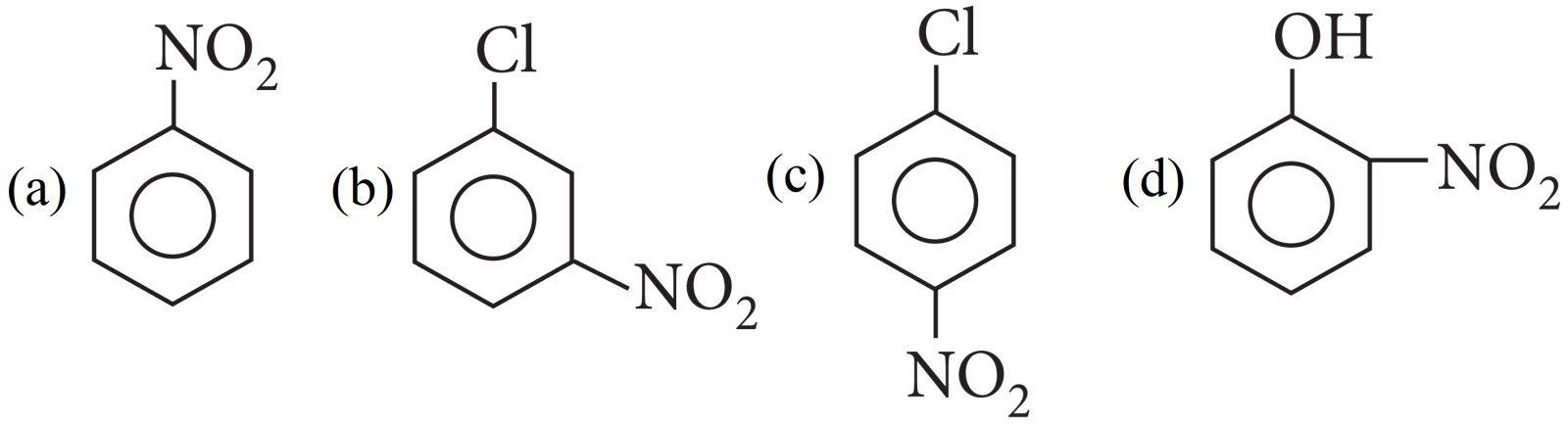
  5. When $X$ is treated $Ni-Al/ \text{NaOH}$ the product obtained is:
  6. Fittig reaction.
  7. Ullmann reaction.
  8. Wurtz$-$Fittig reaction.
  9. Friedel$-$Crafts acylation reaction.
  1. Compound $Z$ is:
  1. Phenol.
  2. $P-$chlorophenol.
  3. $P-$nitrophenol.
  4. Nitrobenzene.
Nemst equation relates the reduction potential of an electrochemical reaction to the standard potential and activities of the chemical species undergoing oxidation and reduction. Let us consider the reaction $, \text{M}^{\text{n+}}_{(\text{aq})}\xrightarrow{\ \ \ \ \ \ \ \ }\text{nM}_\text{(s)}$ For this reaction, the electrode potential measured with respect to standard hydrogen electrode can be given as $\text{E}_{\Big(\frac{\text{M}^{\text{n+}}}{\text{M}}\Big)}=\text{E}^\circ_{\Big(\frac{\text{M}^\text{n+}}{\text{M}}\Big)}-\frac{\text{RT}}{\text{nF}}\text{ln}\frac{[\text{M}]}{[\text{M}^{\text{n}+}]}$ In these questions $(Q$. No. $i-iv),$ a statement of assertion followed by a statement ofreason is given. Choose the correct answer out of the following choices.
  1. Assertion and reason both are correct statements and reason is correct explanation for assertion.
  2. Assertion and reason both are correct statements but reason is not correct explanation for assertion.
  3. Assertion is correct statement but reason is wrong statement.
  4. Assertion is wrong statement but reason is correct statement.
  1. Assertion : For concentration cell, $\text{Zn}_{(\text{s})}|\text{ Zn}^{2+}_{\text{(aq)}}||\text{ Zn}^{2+}_{(\text{aq})}|\text{ Zn}\\\ \ \ \ \ \ \ \ \ \ \ \ \text{C}_1\ \ \ \ \ \ \ \ \text{C}_2$
For spontaneous cell reaction $, C_1 < C_2$
Reason : For concentration cell, $\text{E}_\text{cell}=\frac{\text{RT}}{\text{nF}}\log\frac{\text{C}_2}{\text{C}_1}$
For spontaneous reaction, $\text{E}_\text{cell}=+\text{ve}\Rightarrow\text{C}_2>\text{C}_1$
  1. Assertion : For the cell reaction, $\text{Zn}_{(\text{s})}+\text{Cu}^{2+}_{(\text{aq})}\xrightarrow{\ \ \ \ \ }\text{Zn}^{2+}_{(\text{aq})}+\text{Cu}_{(\text{s})}$ voltmeter gives zero reading at equilibrium.
Reason : At the equilibrium, there is no change in concentration of $\ce{Cu2+}$ and $\ce{Zn2+}$ ions.
  1. Assertion : The Nernst equation gives the concentration dependence of emf of the cell.
Reason : In a cell, current flows from cathode to anode.
  1. Assertion : Increase in the concentration of copper half cell in a cell, increases the emfofthe cell.
Reason : $\text{E}_\text{cell}=\text{E}^\circ_\text{cell}+\frac{0.059}{2}\log\frac{[\text{Cu}^{2+}]}{[\text{Zn}^{2+}]}$
  1. Assertion : Electrode potential for the electrode $\frac{\text{Mn}^+}{\text{Mn}}$ with concentration is given by the expression under $\text{STP}$ conditions.
$\text{E}=\text{E}^\circ+\frac{0.059}{\text{n}}\log[\text{Mn}^{+}]$
Reason : $\text{STP}$ conditions require the temperature to be $273K$.
Read the passage given below and answer the following questions:
Amines are basic in nature. The basic strength of amines can be expressed by their dissociation constant, $K_b$ or $pK_b.$
$\text{RNH}_2+\text{H}_2\text{O}\rightleftharpoons\text{RNH}^+_3+\text{OH}^-$
$\text{k}_\text{b}=\frac{[\text{RNH}^+_3][\text{OH}^-]}{[\text{RNH}_2]}\text{and}\text{ pk}_\text{b}=-\log\text{k}_\text{b}$
Greater the $K_b$ value or smaller the $pK_b$ value, more is the basic strength of a mine. Aryl amines such as aniline are less basic than aliphatic amines due to the involvement of lone pair of electrons on $N-$atom with the resonance in benzene. In derivatives of aniline, the electron releasing groups increase the basic strength while electron withdrawing groups decrease the basic strength. The base weakening effect of electron withdrawing group and base strengthening effect of electron releasing group is more marked at $p-$position than at $m-$position. $a-$Substituted aniline is less basic than aniline due to ortho effect and is probable due to combination of electronic and steric effect.
The following questions are multiple choice questions. Choose the most appropriate answer:
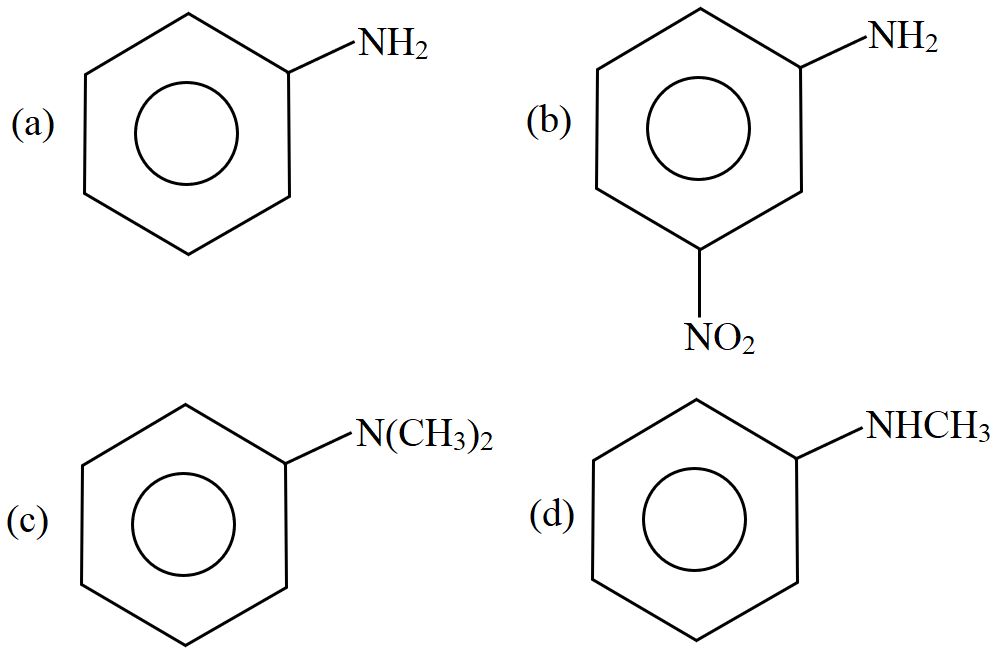
  1. Which of the following has lowest $pK_b$ value?
  1. The strongest base among the following is:
  1. $\ce{C_6H_5NH_2}$
  2. $\ce{p-NO_2 - C_6H_4NH_2}$
  3. $\ce{m-NO_2 - C_6H_4NH_2}$
  4. $\ce{C_6H_5CH_2NH_2}$
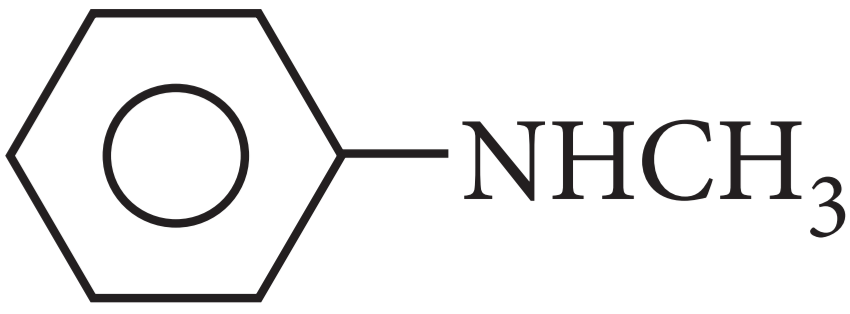
  1. Maximum $pK_b$ value of:
  1.  
  1.  
  1. $\ce{(CH_3CH_2)_2NH}$
  2. $\ce{(CH_3)_2NH}$
  1.  The order of basic strength among the following amines in benzene solution is:
  1. Methylamine is more basic than $NH_3.$
  2. Amines form hydrogen bonds.
  3. Ethylamine has higher boiling point than propane.
  4. Dimethylamine is less basic than methylamine.
  1. $\ce{CH_3CH_2NH_2}$ contains a basic $-NH_2$ group, but $\ce{CH_3CONH_2}$ does not because:
  1. Acetamide is amphoteric in character.
  2. In ethylamine the electron pair on $N-$atom is delocalised by resonance.
  3. In ethylamine there is no resonance while in acetamide the lone pair of electrons on $N-$ atom is delocalised and is less available for protonation.
  4. None of these.
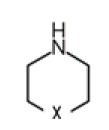
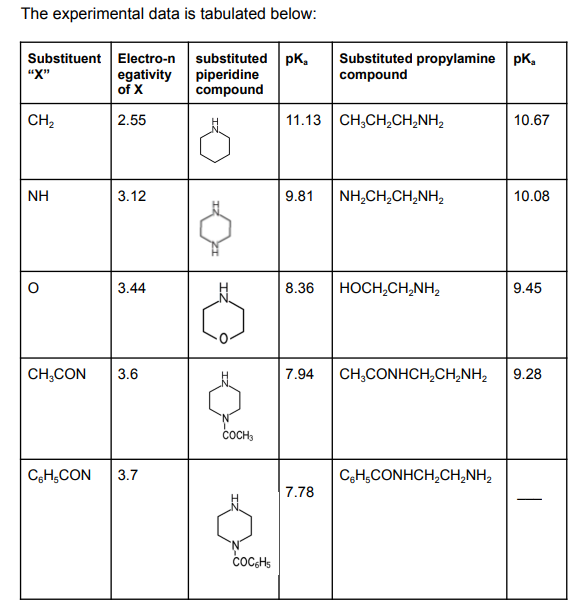
Amines are basic in nature. The $pK_b$ value is a measure of the basic strength of an amine. Lower the value of $pK_b$ more basic is the amine. The effect of substituent on the basic strength of amines in aqueous solution was determined using titrations. The substituent $''X\ ''$ replaced $''-CH_2\ ''$ group in piperidine $($ compound $1)$ and propylamine $\ce{CH_3CH_2CH_2NH_2}, ($compound $2).$
Compound $1:$ Image
Compound $2: \ce{HXCH_2CH_2NH_2}$
Image
$($source: Hall $\text{Jr, H. K.} (1956).$ Field and inductive effects on the base strengths of amines. Journal of the American Chemical Society, $78(11), 2570-2572.)$
Study the above data and answer the following questions:
$a.$ Plot a graph between the electronegativity of the substituent vs $pK_b$ value of the corresponding substituted propyl amine $($given that $pK_a + pK_b =14).$ Is there any relation between the electronegativity of the substituent and its basic strength?
$b.$ The electronegativity of the substituent $''C_6H_5CON\ ''$ is $3.7,$ what is the expected $pKa$ value of compound $\ce{C_6H_5CONHCH_2CH_2NH_2}$?
$(i)\ 9.9\ (ii)\ 9.5\ (iii)\ 9.3\ (iv)\ 9.1$
$c.$ The pKa value of the substituted piperidine formed with substituent $''X\ ''$ is found to be $8.28.$ What is the expected electronegativity of $''X\ ''$
$(i)\ 3.5\ (ii)\ 3.4\ (iii)\ 3.8\ (iv)\ 3.1$
Read the passage given below and answer the following questions:
Amines are alkyl or aryl derivatives of ammonia formed by replacement of one or more hydrogen atoms. Alkyl derivatives are called aliphatic amines and aryl derivatives are known as aromatic amines. The presence of aromatic amines can be identified by performing dye test. Aniline is the simplest example of aromatic amine. It undergoeselectrophilic substitution reactions in which $-\ce{NH_2}$ group strongly activates the aromatic ring through delocalisation of lone pair of electrons of $N-$atom. Aniline undergoes electrophilic substitution reactions. Ortho and para positions to the $-\ce{NH_2}$ group become centres of high electrons density. Thus, $-\ce{NH_2}$ group is ortho and para$-$directing and powerful activating group.
The following questions are multiple choice questions. Choose the most appropriate answer:
  1. Cyclohexylamine and aniline can be distinguished by:
  1. Hinsberg test.
  2. carbylamine test.
  3. Lassaigne test.
  4. azo dye test.
  1. Which of the following compounds gives dye test?
  1. Aniline.
  2. Methyl amine.
  3. Diphenyl amine.
  4. Ethyl amine.
  1. Aniline when acetylated, the major product on nitration followed by alkaline hydrolysis gives:
  1.  Acetanilide.
  2. $o-$nitroacetanitide.
  3. $p-$nitroaniline.
  4. $m-$nitroanitine.
  1. Oxidation of aniline with manganese dioxide and sulphuric acid produces:
  1. Phenylhydroxylamine.
  2. Nitrobenzene.
  3. $p-$benzoquinone.
  4. Phenol.
  1. Aniline when treated with cone. $\ce{HNO_3}$ and $\ce{H_2SO_4}$​​​​​​​​​​​​​​ gives:
  1.  $p-$phenylenediamine.
  2. $m-$nitroaniline.
  3. $p-$benzoquinone.
  4. Nitrobenzene.