Question
Read the passage given below and answer the following questions
Few colligative properties are:
  1. Relative lowering of vapour pressure: depends only on molar concentration of solute $($mole fraction$)$ and independent of its nature.
  2. Depression in freezing point: it is proportional to the molal concentration of solution.
  3. Elevation of boiling point: it is proportional to the molal concentration of solute.
  4. Osmotic pressure: it is proportional to the molar concentration of solute
A solution of glucose is prepared with $0.052 g$ at glucose in $80.2 g$ of water.$(KJ = 1.86K \ \text{kg \ mol}^{-1}$ and $K_b = 5.2K \ \text{kg \ mol}^{-1})$
The following questions are multiple choice questions. Choose the most appropriate answer:
  1. Molality of the given solution is.
  1. $0.0052m$
  2. $0.0036m$
  3. $0.0006m$
  4. $1.29m$
  1. Boiling point for the solution will be.
  1. $373.05K$
  2. $373.15K$
  3. $373.02K$
  4. $373.02K$
  1. The depression in freezing point of solution will be.
  1. $0.0187K$
  2. $0.035K$
  3. $0.082K$
  4. $0.067K$
  1. Mole fraction of glucose in the given solution is.
  1. $6.28 \times 10^{-5}$
  2. $6.28 \times 10^{-4}$
  3. $0.00625$
  4. $0.00028$
  1. If same amount of sucrose $\ce{(C_{12} H_{22} O_{11})}$ is taken instead of glucose, then.
  1. Elevation in boiling point will be higher.
  2. Depression in freezing point will be higher.
  3. Depression in freezing point will be lower.
  4. Both $(a)$ and $(b).$

Answer

  1. $(b) \ 0.0036\ m$
$\text{m}=\frac{0.052}{180}\times\frac{1000}{80.2}=0.0036$
  1. $(c) \ 373.02K$
$\Delta\text{T}_\text{b}=\text{k}_\text{b}\times\text{m}=5.2\times0.0036=0.0187\ \text{K}$
$T_b = 373 + 0.0187 = 373.0187 K $ approx $ 373.02 K$
  1. $(d)\  0.067 K$
$\Delta\text{T}_\text{f}=\text{k}_\text{f}\times\text{m}=1.86\times0.0036=0.067\ \text{K}$
  1. $(a) \ 6.28 \times 10^{-5}$
Moles of water $\frac{80.2}{18}=4.455$
Mole fraction of glucose $=\frac{0.00028}{4.45+0.00028}=6.28\times10^{-5}$
  1. $(c)$ Depression in freezing point will be lower.
Depression in freezing point or elevation in boiling point is proportional to molarity, which is proportional to number of moles.
For same amount, higher the molar mass of solute, lower will be number of moles.
Hence, lower will be the colligative property.

Need a full question paper?

Generate a complete, print-ready paper with questions like this in minutes — across 16+ boards, with answer keys.

Start Generating Free

Similar questions

Read the passage given below and answer the following questions :
A chlorocompound $(A)$ on reduction with $Zn-Cu$ and ethanol gives the hydrocarbon $(B)$ with five carbon atoms. When $(A)$ is dissolved in dry ether and treated with sodium metal it gave $2, 2, 5, 5 -$ tetramethylhexane. The treatment of $(A)$ with alcoholic $\ce{KCN}$ gives compound $(C)$.
The following questions are multiple choice questions. Choose the most appropriate answer :
  1. The compound $(A)$ is :
  1. $1-$chloro$-2, 2-$dimethylpropane.
  2. $1-$chloro$-2, 2-$dimethyl butane.
  3. $1-$chloro$-2-$methyl butane.
  4. $2-$chloro$-2-$methyl butane.
  1. The reaction of $(C)$ with $\ce{Na, C2H5OH}$ gives :
  1. $\ce{(CH3)3C CH2CONH2}$
  2. $\ce{(CH3)3C NH2}$
  3. $\ce{(CH3)3C CH2CH2NH2}$
  4. $\ce{(CH3)2CHCH2NH2}$
  1. The reaction of $(C)$ with $\ce{Na, C2H5OH}$ is called :
  1. Gilman reaction.
  2. Mendius reaction.
  3. Grooves process.
  4. Swart's reaction.
  1. The reaction of $(A)$ with aq. $\ce{KOH}$ will preferably favour:
  1. $S_N1$ mechanism.
  2. $S_N2$ mechanism.
  3. $E_1$ mechanism.
  4. $E_2$ mechanism.
  1. Compound $(B)$ is:
  1. $N-$pentane.
  2. $2, 2-$dimethylpropane.
  3. $2-$methylbutane.
  4. None of these.
Read the passage given below and answer the following questions:
When a protein in its native form, is subjected to physical changes like change in temperature or chemical changes like change in pH, the hydrogen bonds are disturbed. Due to this, globules unfold and helix get uncoiled and protein loses its biological activity. This is called denaturation of protein.
The denaturation causes change in secondary and tertiary structures but primary structures remains intact. Examples of denaturation of protein are coagulation of egg white on boiling, curdling of milk, formation of cheese when an acid is added to milk.
The following questions are multiple choice questions. Choose the most appropriate answer:
  1. Mark the wrong statement about denaturation of proteins.
  1. The primary structure of the protein does not change.
  2. Globular proteins are converted into fibrous proteins.
  3. Fibrous proteins are converted into globular proteins.
  4. The biological activity of the protein is destroyed.
  1. Which structure(s) of proteins remains(s) intact during denaturation process?
  1. Both secondary and tertiary structures.
  2. Primary structure only.
  3. Secondary structure only.
  4. Tertiary structure only.
  1. $\alpha$-helix and $\beta$-pleated structures of proteins are classified as:
  1. Primary structure.
  2. Secondary structure.
  3. Tertiary structure.
  4. Quaternary structure.
  1. Cheese is a:
  1. Globular protein.
  2. Conjugated protein.
  3. Denatured protein.
  4. Derived protein.
  1. Secondary structure of protein refers to:
  1. Mainly denatured proteins and structure of prosthetic groups.
  2. Three-dimensional structure, especially the bond between amino acid residues that are distant from each other in the polypeptide chain.
  3. Linear sequence of amino acid residues in the polypeptide chain.
  4. Regular folding patterns of continuous portions of the polypeptide chain.
Read the passage given below and answer the following questions: Transition elements are elements that have partially filled $d-$orbitals. The configuration of these elements corresponds to$ (n - 1)d^{1-10} \ ns^{1-2}.$ It is important to note that the elements mercury, cadmium and zinc are not considered transition elements because of their electronic configurations, which corresponds to $(n - 1)d^{10} \ ns^2.$ Some general properties of transition elements are: These elements can fonn coloured compounds and ions due to $d-d$ transition; These elements exhibit many oxidation states; A large variety of ligands can bind themselves to these elements, due to this, a wide variety of stable complexes formed by these ions. The boiling and melting point of these elements are high. These elements have a large ratio of charge to the radius. In these questions $(Q.$ No. $i-iv),$ a statement of assertion followed by a statement ofreason is given. Choose the correct answer out of the following choices.
  1. Assertion: Tungsten has very high melting point.
Reason: Tungsten is a covalent compound.
  1. Assertion: $Zn, Cd$ and $Hg$ are normally not considered transition metals.
Reason: $d-$Orbitals in $Zn, Cd$ and $Hg$ elements are completely filled, hence these metals do not show the general characteristics properties of the transition elements.
  1. Assertion: Copper metal gets readily corroded in acidic aqueous solution such as $\ce{HCl}$ and dil. $\ce{H_2SO_4}.$
Reason: Free energy change for this process is positive.
  1. Assertion: Tailing of mercury occurs on passing ozone through it.
Reason: Due to oxidation of mercury.
  1. Assertion: Transition metals are poor reducing agents.
Reason: Transition metals fonn numerous alloys with other metals.
Read the passage given below and answer the following questions:
To explain bonding in coordination compounds various theories were proposed. One of the important theory was valence bond theory. According to that, the central metal ion in the complex makes available a number of empty orbitals for the formation of coordination bonds with suitable ligands. The appropriate atomic orbitals of the metal hybridise to give a set of equivalent orbitals of definite geometry.
The $d-$orbitals involved in the hybridisation may be either inner $d-$orbitals i.e.$, (n - 1)d$ or outer $d-$orbitals i.e.$, nd.$
For example, $Co^{3+}$ forms both inner orbital and outer orbital complexes, with ammonia it forms $[\ce{Co(NH3)6]^{3+}}$ and with fluorine it forms $[\ce{CoF6]^{3-}}$ complex ion.
The following questions are multiple choice questions. Choose the most appropriate answer :
  1. Which of the following is not true for $[\ce{CoF6}]^{3-}$?
  1. It is paramagnetic.
  2. It has coordination number of $6.$
  3. It is outer orbital complex.
  4. It involves $d^2sp^3$ hybridisation.
  1. $[\ce{Cr(H2O)6]Cl3}\ ($at. no. of $Cr = 24)$ has a magnetic moment of $3.83\ B.M.$ The correct distribution of $3d-$electrons in the central metal of the complex is :
  1. $3\text{d}^1_\text{xy},3\text{d}^1_{\text{x}^2-\text{y}^2},3\text{d}^1_\text{yz}$
  2. $3\text{d}^1_\text{xy},3\text{d}^1_{\text{yz}},3\text{d}^1_\text{zx}$
  3. $3\text{d}^1_\text{xy},3\text{d}^1_{\text{zy}},3\text{d}^1_{\text{z}^2}$
  4. $3\text{d}^1_{\text{x}^2-\text{y}^2},3\text{d}^1_{\text{z}^2},3\text{d}^1_\text{xz}$
  1. Which of the following is true for $[\ce{Co(NH3)6}]^{3+}$?
  1. It is an octahedral, di magnetic and outer orbital complex.
  2. It is an octahedral, paramagnetic and outer orbital complex.
  3. It is an octahedral, paramagnetic and inner orbital complex.
  4. It is an octahedral, di magnetic and inner orbital complex.
  1. The paramagnetism of $[\ce{CoF6}]^{3-}$ is due to.
  1. $3$ electrons.
  2. $4$ electrons.
  3. $2$ electrons.
  4. $1$ electron.
  1. Which of the following is an inner orbital or low spin complex?
  1. $[\ce{Ni(H2O)6}]^{3+}$
  2. $[\ce{FeF6}]^{3-}$
  3. $[\ce{Co(CN)6}]^{3-}$
  4. $[\ce{NiCl4}]^{2-}$
For a first order reaction$, A \rightarrow$ Products$, \text{k}=\frac{2.303}{\text{t}}\log\frac{\text{a}}{\text{a}-\text{x}},$ where a is the initial concentration of $A$ and $(a - x)$ is the concentration of $A$ after time $t. k$ is rate constant. Its value is constant at constant temperature for a reaction. The time in which half of the reactant is consumed is called half$-$life period. Half$-$life period of a first order reaction is constant. Its value is independent of initial concentration or any other external conditions.In these questions $(Q.$ No. $i-iv),$ a statement of assertion followed by a statement ofreason is given. Choose the correct answer out of the following choices.
  1. Assertion and reason both are correct statements and reason is correct explanation for assertion.
  2. Assertion and reason both are correct statements but reason is not correct explanation for assertion.
  3. Assertion is correct statement but reason is wrong statement.
  4. Assertion is wrong statement but reason is correct statement.
  1. Assertion : Rate of reaction doubles when concentration of reactant is doubled if it is a first order reaction.
Reason : Rate constant also doubles.
  1. Assertion : For the first order reaction, half$-$life period is expressed as $\text{t}_\frac{1}{2}=\frac{2.303}{\text{k}}\log2.$
Reason : The half$-$life time of a first order reaction is not always constant and it depends upon the initial concentration of reactants.
  1. Reason : The half$-$life time of a first order reaction is not always constant and it depends upon the initial concentration of reactants.
Reason : Acid only acts as a catalyst whereas alkali acts as one of the reactants.
  1. Assertion : For a first order reaction, the concentration of the reactant decreases exponentially with time.
Reason : Rate of reaction at any time depends upon the concentration of the reactant at that time.
  1. Assertion : Half$-$life period for a first order reaction is independent of initial concentration of the reactant.
Reason : For a first order reaction, $\text{t}_\frac{1}{2}=\frac{0.693}{\text{k}},$ where $k$ is rate constant.
Read the passage given below and answer the following questions:
An organic compound $(A)$ having molecular formula $C_6H_6O$ gives a characteristic colour with aqueous $FeCl_3$ solution. $(A)$ on treatment with $CO_2$ and $\text{NaOH}$ at $400K$ under pressure gives $(B),$ which on acidification gives a compound $(C).$ The compound $(C)$ reacts with acetyl chloride to give $(D)$ which is a popular pain killer.
The following questions are multiple choice questions. Choose the most appropriate answer:
  1. Compound $(A)$ is:
  1. $2-$Hexanol.
  2. Dimethyl ether.
  3. Phenol.
  4. $2-$Methyl pentanol.
  1. Compound $(C)$ is:
  1. Salicylic acid.
  2. Salicyladehyde.
  3. Benzoic acid.
  4. Benzaldehyde.
  1. Number of carbon atoms in compound $(D)$ is:
  1. $7$
  2. $6$
  3. $8$
  4. $9$
  1. The conversion of compound $(A)$ to $(C)$ is known as:
  1. Reimer$-$Tiemann reaction.
  2. Kolbe's reaction.
  3. Schimdt reaction.
  4. Swarts reaction.
  1. Compound $(A)$ on heating with compound $(C)$ in presence of $POCl_3$ gives a compound $(D)$ which is used:
  1. In perfumery as a ftavouring agent
  2. As an antipyretic
  3. As an analgesic
  4. As an intestinal antiseptic.
Read the passage given below and answer the following questions : Transition metal oxides are compounds fanned by the reaction of metals with oxygen at high temperature. The highest oxidation number in the oxides coincides with the group number. In vanadium, there is a gradual change from the basic $V_2O_3$ to less basic $V_2O_4$ and to amphoteric $V_2O_5· V_2O_4$ dissolves in acids to give $VO^{2+}$ salts. Transition metal oxides are commonly utilized for their catalytic activity and semi conductive properties. Transition metal oxides are also frequently used as pigments in paints and plastic. Most notably titatnium dioxide. One of the earliest application of transition metal oxides to chemical industry involved the use of vanadium oxide for catalytic oxidation of sulfur dioxide to sulphuric acid. Since then, many other applications have emerged, which include benzene oxidation to maleic anhydride on vandium oxides; cyclohexane oxidation to adipic acid on cobalt oxides. An important property of the catalyst material used in these processes is the ability of transition metals to change their oxidation state under a given chemical potential of reductants and oxidants. The following questions are multiple choice questions. Choose the most appropriate answer:
  1. Which oxide of vanadium is most likely to be basic and ionic?
  1. $VO$
  2. $V_2O_3$
  3. $VO_2$
  4. $V_2O_5$
  1. Vanadyl ion is:
  1. $\text{VO}^{2+}$
  2. $\text{VO}^{+}_2$
  3. $\text{V}_{2}\text{O}^+$
  4. $\text{VO}^{3-}_4$
  1. Which of the following statements is false?
  1. With fluorine vanadium can form $VF_5.$
  2. With chlorine vanadium can form $VCl^5.$
  3. Vanadium exhibits highest oxidation state in oxohalides $VOCl_3, VOBr_3$ and fluoride $VF_5.$
  4. With iodine vanadium cannot form $Vl_5$ due to oxidising power of $V^{5+}$ and reducing nature of $I^-.$
  1. The oxidation state of vanadium in $V_2O_5$ is:
  1. $\frac{+5}{2}$
  2. $+7$
  3. $+5$
  4. $+6$
  1. Identify the oxidising agent in the following reaction.
$V_2O_{5 }+ 5Ca \rightarrow 2V + 5CaO$
  1. $V_2O_5$
  2. $Ca$
  3. $V$
  4. None of these.
Dependence of the rate of reaction on the concentration of reactants, temperature, and other factors is the most general method for weeding out unsuitable reaction mechanisms. The term mechanism means all the individual collisional or elementary processes involving molecules $($atoms, radicals, and ions included$)$ that take place simultaneously or consecutively to produce the observed overall reaction. For example, when hydrogen gas reacts with bromine, the rate of the reaction was found to be proportional to the concentration of $H_2$ and to the square root of the concentration of $Br_2.$ Furthermore, the rate was inhibited by increasing the concentration of $HBr$ as the reaction proceeded. These observations are not consistent with a mechanism involving bimolecular collisions of a single molecule of each kind. The currently accepted mechanism is considerably more complicated, involving the dissociation of bromine molecules into atoms followed by reactions between atoms and molecules:
It is clear from this example that the mechanism cannot be predicted from the overall stoichiometry.
$($source: Moore, J. W., Pearson, $R. G. (1981).$ Kinetics and mechanism. John Wiley Sons.$)$
$(a).$ Predict the expression for the rate of reaction and order for the following:
$H_2 + Br_2 \rightarrow 2 HBr$
What are the units of rate constant for the above reaction?
$(b).$ How will the rate of reaction be affected if the concentration of $Br_2$ is tripled?
Read the passage given below and answer the following questions:
Amines are alkyl or aryl derivatives of ammonia formed by replacement of one or more hydrogen atoms. Alkyl derivatives are called aliphatic amines and aryl derivatives are known as aromatic amines. The presence of aromatic amines can be identified by performing dye test. Aniline is the simplest example of aromatic amine. It undergoeselectrophilic substitution reactions in which $-\ce{NH_2}$ group strongly activates the aromatic ring through delocalisation of lone pair of electrons of $N-$atom. Aniline undergoes electrophilic substitution reactions. Ortho and para positions to the $-\ce{NH_2}$ group become centres of high electrons density. Thus, $-\ce{NH_2}$ group is ortho and para$-$directing and powerful activating group.
The following questions are multiple choice questions. Choose the most appropriate answer:
  1. Cyclohexylamine and aniline can be distinguished by:
  1. Hinsberg test.
  2. carbylamine test.
  3. Lassaigne test.
  4. azo dye test.
  1. Which of the following compounds gives dye test?
  1. Aniline.
  2. Methyl amine.
  3. Diphenyl amine.
  4. Ethyl amine.
  1. Aniline when acetylated, the major product on nitration followed by alkaline hydrolysis gives:
  1.  Acetanilide.
  2. $o-$nitroacetanitide.
  3. $p-$nitroaniline.
  4. $m-$nitroanitine.
  1. Oxidation of aniline with manganese dioxide and sulphuric acid produces:
  1. Phenylhydroxylamine.
  2. Nitrobenzene.
  3. $p-$benzoquinone.
  4. Phenol.
  1. Aniline when treated with cone. $\ce{HNO_3}$ and $\ce{H_2SO_4}$​​​​​​​​​​​​​​ gives:
  1.  $p-$phenylenediamine.
  2. $m-$nitroaniline.
  3. $p-$benzoquinone.
  4. Nitrobenzene.
Read the passage given below and answer the following questions:
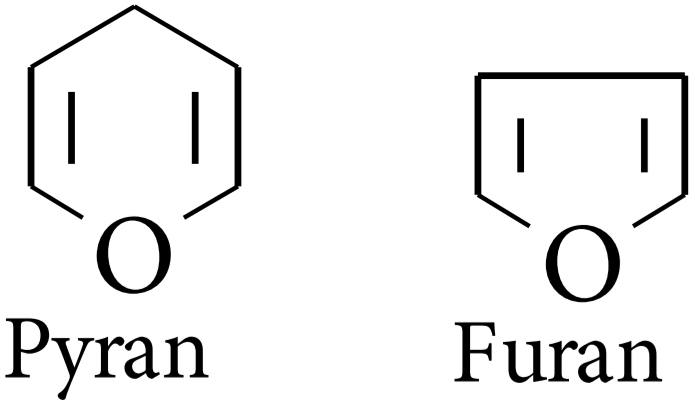
Pentose and hexose undergo intramolecular hemiacetal or hemiketal formation due to combination of the $–\ce{OH}$ group with the carbonyl group. The actual structure is either of five or six membered ring containing an oxygen atom. In the free state all pentoses and hexoses exist in pyranose form $($resembling pyran$).$ However,inthe combined state some of them exist as five membered cyclic structures, called furanose $($resembling furan$).$

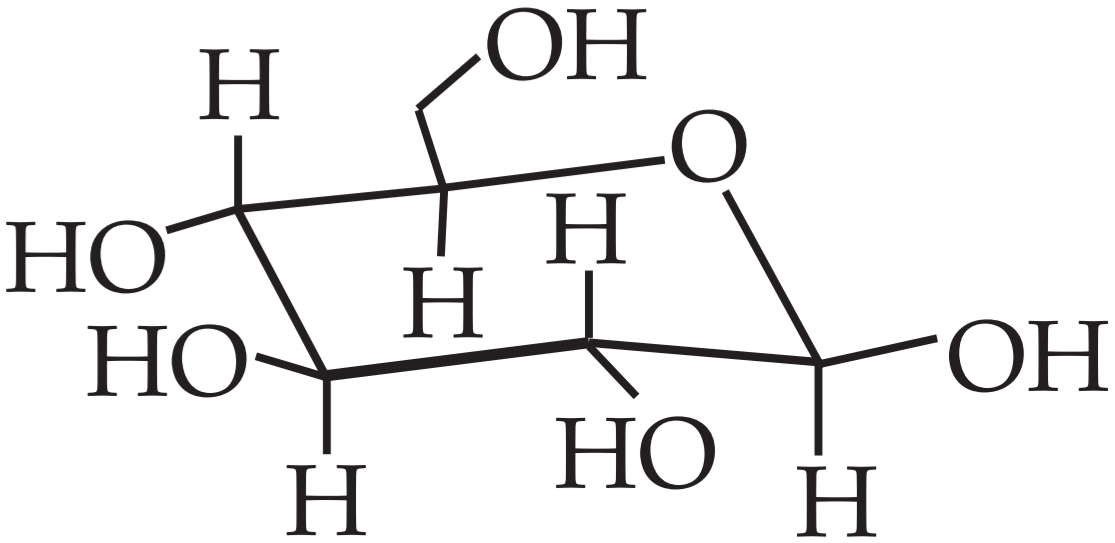
The cyclic structure of glucose is represented by Haworth structure:

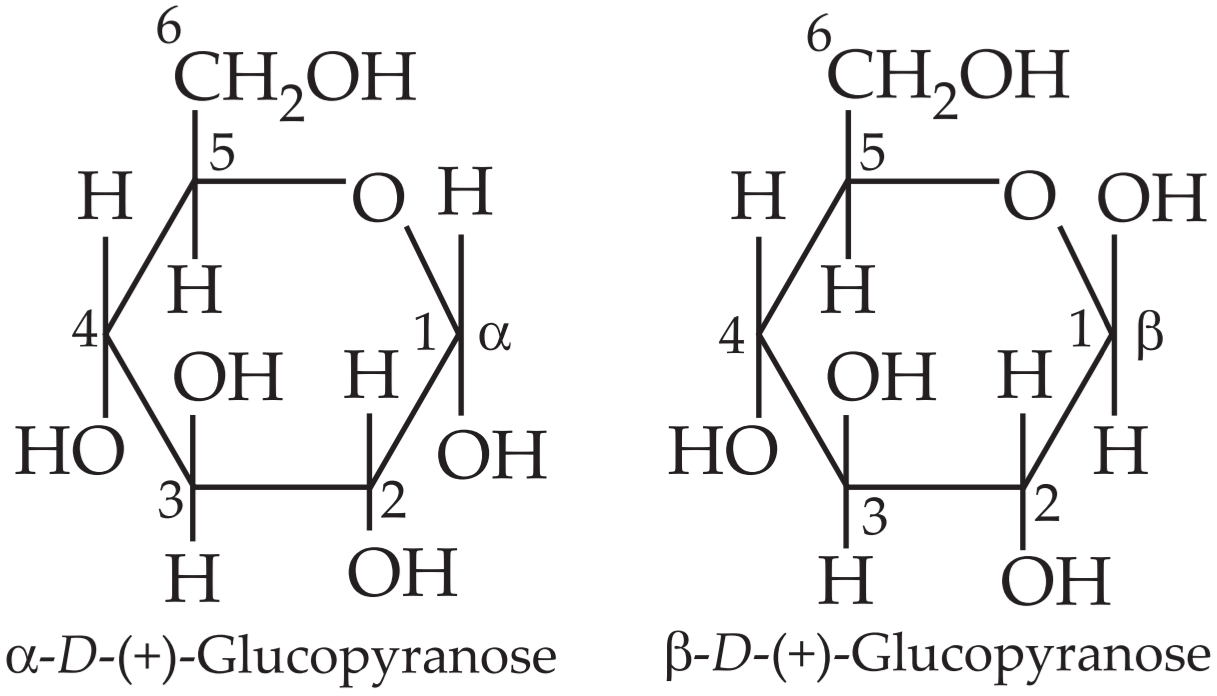
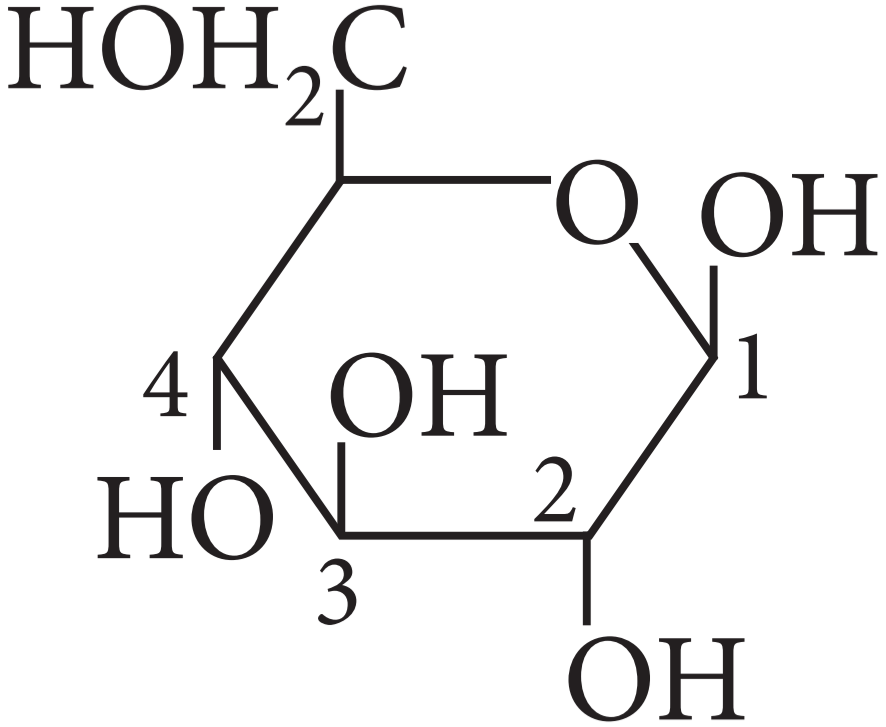
$\alpha$ and $\beta D-$glucose have different configuration at anomeric $(C-1)$ carbon atom, hence are called anomers and the $C-1$ carbon atom is called anomeric carbon $($glycosidic carbon$).$
The six membered cyclic structure of glucose is called pyranose structure.
The following questionsare multiple choice questions. Choose the most appropriate answer:
  1. $\alpha D(+)-$glucose and $\beta D(+)$ glucose are:
  1. Enantiomers.
  2. Conformers.
  3. Epimers.
  4. Anomers.
  1. The following carbohydrate is:
 
  1. A ketohexose.
  2. An aldohexose.
  3. An $n-$furanose.
  4. An $\alpha-$pyranose.
  1. In the following structure, anomeric carbon is:
  1. $C-1$
  2. $C-2$
  3. $C-3$
  4. $C-4$
  1. The term anomers of glucose refers to:
  1. Isomers of glucose that differ in configurations at carbons one and four $(C-1$ and $C-4).$
  2. A mixture of $(D)-$glucose and $(L)-$glucose.
  3. Enantiomers of glucose.
  4. Isomers of glucose that differ in configuration at carbon one $(C-1).$
  1. What percentage of $\beta-D-(+)$ glucopyranose is found at equilibrium in the aqueous solution?
  1. $50\%$
  2. $\approx100%$
  3. $36\%$
  4. $64\%$