Question
Read the passage given below and answer the following questions:
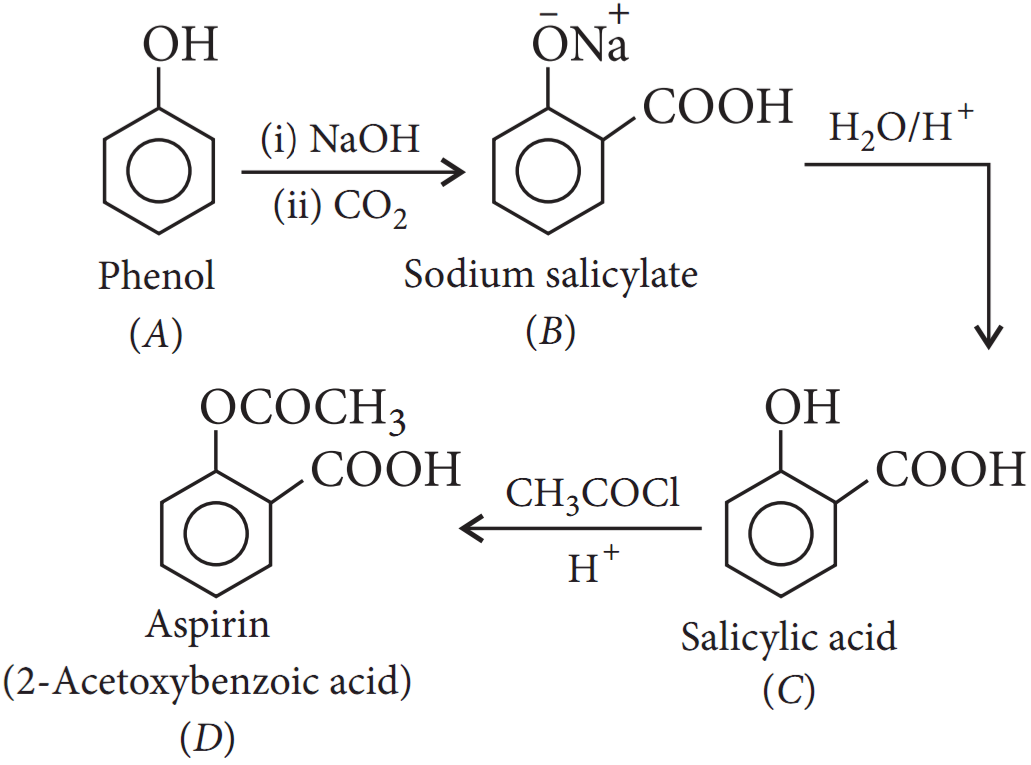
An organic compound $(A)$ having molecular formula $C_6H_6O$ gives a characteristic colour with aqueous $FeCl_3$ solution. $(A)$ on treatment with $CO_2$ and $\text{NaOH}$ at $400K$ under pressure gives $(B),$ which on acidification gives a compound $(C).$ The compound $(C)$ reacts with acetyl chloride to give $(D)$ which is a popular pain killer.
The following questions are multiple choice questions. Choose the most appropriate answer:
  1. Compound $(A)$ is:
  1. $2-$Hexanol.
  2. Dimethyl ether.
  3. Phenol.
  4. $2-$Methyl pentanol.
  1. Compound $(C)$ is:
  1. Salicylic acid.
  2. Salicyladehyde.
  3. Benzoic acid.
  4. Benzaldehyde.
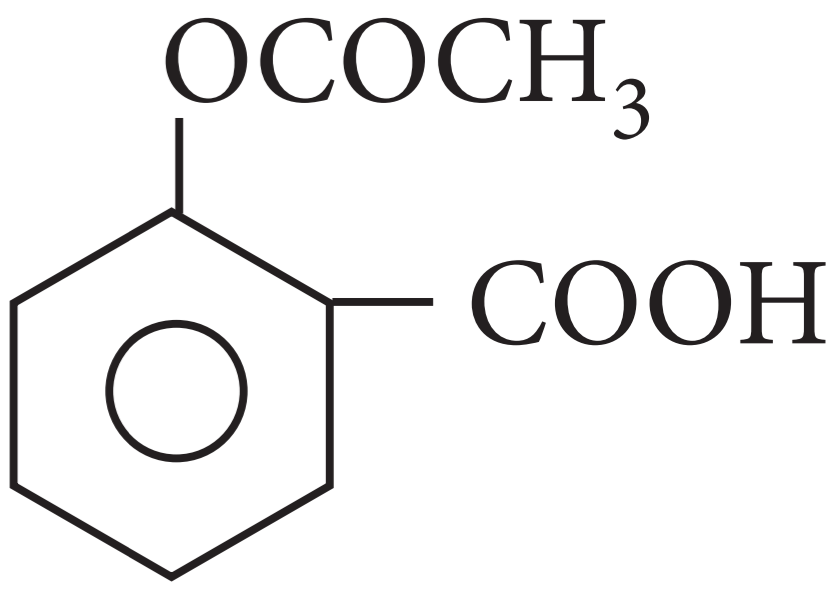
  1. Number of carbon atoms in compound $(D)$ is:
  1. $7$
  2. $6$
  3. $8$
  4. $9$
  1. The conversion of compound $(A)$ to $(C)$ is known as:
  1. Reimer$-$Tiemann reaction.
  2. Kolbe's reaction.
  3. Schimdt reaction.
  4. Swarts reaction.
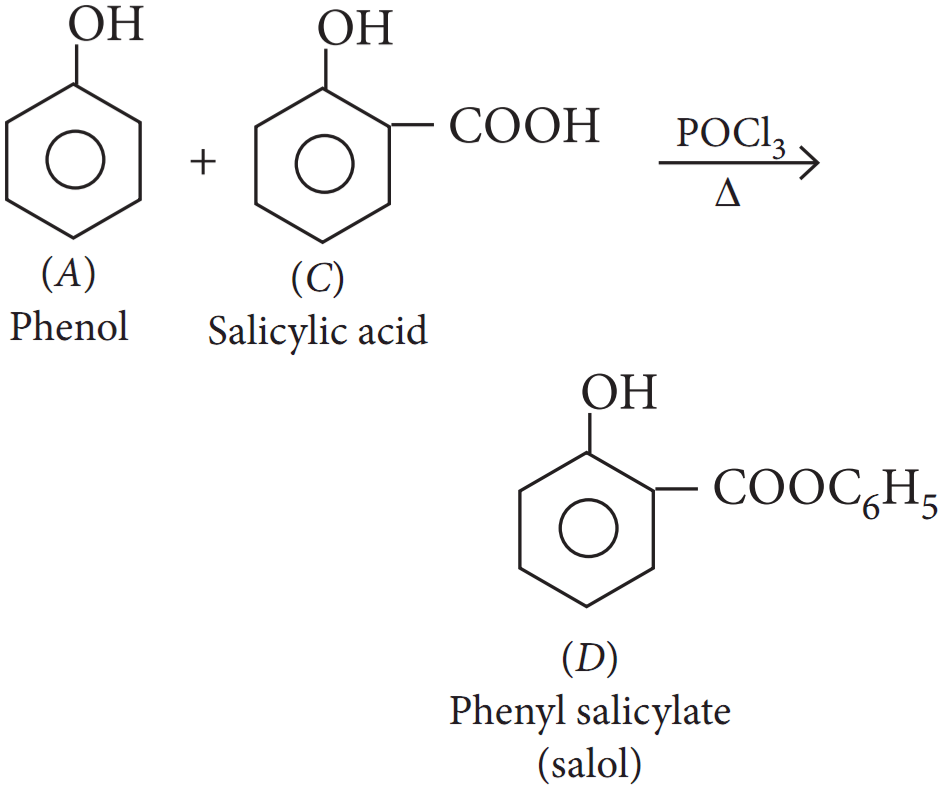
  1. Compound $(A)$ on heating with compound $(C)$ in presence of $POCl_3$ gives a compound $(D)$ which is used:
  1. In perfumery as a ftavouring agent
  2. As an antipyretic
  3. As an analgesic
  4. As an intestinal antiseptic.

Answer

  1. $(a)$ Salicylic acid.
  2. $(d)\ 9$

It has $9 C-$atoms.
  1. $(b)$ Kolbe's reaction.
Sodium phenoxide when heated with $CO_2$ at $400K$ under a pressure of $4-7$ atm followed by acidification gives $2-$hydroxybenzoic acid $($salicylic acid$)$ as the main product along with a small amount of $4-$hydroxybenzoic acid. This reaction is called Kolbe's reaction.
  1. $(d)$ As an intestinal antiseptic.

Salol is used as an intestinal antiseptic.

Need a full question paper?

Generate a complete, print-ready paper with questions like this in minutes — across 16+ boards, with answer keys.

Start Generating Free

Similar questions

Explain the D and L notation method of spatial arrangement with respect to glucose.
Read the passage given below and answer the following questions:
When haloalkanes with $\beta-$hydrogen atom are boiled with alcoholic solution of $\text{KOH}$, they undergo elimination of hydrogen halide resulting in the formation of alkenes. These reactions are called $\beta-$elimination reactions or dehydrohalogenation reactions. These reactions follow Saytzeff's rule. Substitution and elimination reactions often compete with each other. Mostly bases behave as nucleophiles and therefore can engage in substitution or elimination reactions depending upon the alkyl halide and the reaction conditions.
The following questions are multiple choice questions. Choose the most appropriate answer:
  1. Among the following the most reactive towards alcoholic $\text{KOH}$ is:
  1. $\ce{CH_2 = CHBr}$
  2. $\ce{CH_3COCH_2CH_2Br}$
  3. $\ce{CH_3CH2Br}$
  4. $\ce{CH_3CH_2CH_2Br}$
  1. The general reaction, $\text{R}-\text{X}\xrightarrow{\text{aq.OH}^-}\text{ROH}+\text{X}^-,$ is expected to follow decreasing order of reactivity as in:
  1. $\ce{t-BuI > t-BuBr > t-BuCI > t-BuF}$
  2. $\ce{t-BuF > t-BuCI > t-BuBr > t-BuI}$
  3. $\ce{t-BuBr > t-BuCI > t-BuI > t-BuF}$
  4. $\ce{t-BuF > t-BuCI > t-BuI > t-BuBr}$
  1. Reaction of $t-$butyl bromide with sodium methoxide produces:
  1. Sodium $t-$butoxide.
  2. $t-$butyl methyl ether.
  3. Iso$-$butane.
  4. Iso$-$butylene.
  1. In the elimination reactions, the reactivity of alkyl halides follows the sequence:
  1. $\ce{R - F > R - CI > R - Br > R - I}$
  2. $\ce{R - I > R - Br > R - Cl > R - F}$
  3. $\ce{R - I > R - F > R - Br > R - CI}$
  4. $\ce{R - F > R - I > R - Br > R - CI}$
  1. The ease of dehydrohalogenation of alkyl halide with alcoholic $\text{KOH}$ is:
  1. $3^\circ < 2^\circ < 1^\circ$
  2. $3^\circ > 2^\circ > 1^\circ$
  3. $3^\circ < 2^\circ > 1^\circ$
  4. $3^\circ > 2^\circ < 1^\circ$
Read the passage given below and answer the following questions: For understanding the structure and bonding in transition metal complexes, the magnetic properties are very helpful. Low spin complexes are generally diamagnetic because of pairing of electrons, whereas high spin complexes are usually paramagnetic because of presence of unpaired electrons. Larger the number of unpaired electrons, stronger will be the paramagnetism. However magnetic behaviour of a complex can be confirmed from magnetic moment measurement. Magnetic moment $\mu=\sqrt{\text{n(n+2)}}\text{B.M.}$ where $n =$ number of unpaired electrons. Greater the number of unpaired electrons, more will be the magnetic moment. In these questions $(Q$. No. $i-iv),$ a statement of assertion followed by a statement ofreason is given. Choose the correct answer out of the following choices.
  1. Assertion and reason both are correct statements and reason is correct explanation for assertion.
  2. Assertion and reason both are correct statements but reason is not correct explanation for assertion.
  3. Assertion is correct statement but reason is wrong statement.
  4. Assertion is wrong statement but reason is correct statement.
The following questions are multiple choice questions. Choose the most appropriate answer:
  1. Assertion : Both $\ce{[Cr(H_2O)_6]^{2+}}$ and $\ce{[Fe(H_2O)_6]^{2+}}$ have same magnetic moment.
Reason : Number of unpaired electrons in $Cr^{2+}$ and $Fe^{2+}$ are same.
  1. Assertion : $\ce{ [Fe(H_2O)_5NO]SO_4}$ is paramagnetic.
Reason : The $Fe$ in $\ce{[Fe(H_2O)_5NO]SO_4}$ has three unpaired electrons.
  1. Assertion : $\ce{[Co(en)_3]^{3+}}$ is paramagnetic.
Reason : It is an inner orbital complex.
  1. Assertion : $\ce{[Ni(CO)_4]}$ is diamagnetic and tetrahedral in shape.
Reason : $ \ce{[Ni(CO)_4]} $ contains no unpaired electrons and involves $\text{dsp}^2$ hybridisation.
  1. Assertion : $\ce{[Ni(CN)_4]^{2-}​​​​​​​}$ is diamagnetic complex.
Reason : It involves $\text{dsp}^2$ hybridisation and there is no unpaired electron.
Read the passage given below and answer the following questions:
Ethers are readily cleaved by $\ce{HI}$ or $\ce{HBr}$ at $373K$ to form an alcohol and an alkyl halide.
$\text{R}-\text{O}-\text{R}+\text{HX}\xrightarrow{373\text{K}}\text{R}-\text{X}+\text{R}-\text{OH}$
$\text{R}-\text{OH}+\text{HX}\xrightarrow{373\text{K}}\text{R}-\text{X}+\text{H}_2\text{O}$
Mixed ether, containing primary or secondary alkyl group, when heated with hydrogen halide, the lower alkyl group forms halide and higher will form an alcohol. Tertiary alkyl ether when heated with hydrogen halide gives tertiary alkyl halide.
The following questions are multiple choice questions. Choose the most appropriate answer:
  1. Among the following ethers, which one will produce methyl alcohol on treatment with hot concentrated $\ce{HI}$?
  1. $\ \ \ \ \ \ \ \ \ \ \ \ \text{CH}_3\\\ \ \ \ \ \ \ \ \ \ \ \ \ \ |\\\text{CH}_3-\text{C}-\text{O}- \text{CH}_3\\\ \ \ \ \ \ \ \ \ \ \ \ \ \ |\\\ \ \ \ \ \ \ \ \ \ \ \ \ \text{CH}_3 $
  2. $\text{CH}_3-\text{CH}-\text{CH}_2-\text{O}-\text{CH}_3\\\ \ \ \ \ \ \ \ \ \ \ \ \ |\\\ \ \ \ \ \ \ \ \ \ \ \text{CH}_3$
  3. $\text{CH}_3-\text{CH}_2-\text{CH}_2-\text{CH}_2-\text{O}-\text{CH}_3$
  4. $\text{CH}_3-\text{CH}_2-\text{CH}-\text{O}-\text{CH}_3\\\ \ \ \ \ \ \ \ \ \ \ \ \ \ \ \ \ \ \ \ \ \ \ \ \ \ |\\\ \ \ \ \ \ \ \ \ \ \ \ \ \ \ \ \ \ \ \ \ \ \ \ \ \text{CH}_3$
  1. When $\ce{CH_2 = CH - O - CH_2 - CH_3}$ reacts with one mole of $\ce{HI},$ one of the products formed is:
  1. Ethane.
  2. Ethanol.
  3. Iodoethene.
  4. Ethanal.
  1. $\ce{(CH_3)_3COCH_3}$ and $\ce{CH_3OC_2H_5}$ are treated with hydroiodic acid. The fragments obtained after reactions are respectively:
  1. $\ce{(CH_3)_3CI + CH_3OH; CH_3I + C_2H_5OH}$
  2. $\ce{(CH_3)_3CI + CH_3OH; CH_3OH + C_2H_5I}$
  3. $\ce{(CH_3)_3COH + CH_3I; CH_3OH + C_2H_5I}$
  4. $\ce{CH_3I + (CH_3)_3COH; CH_3I + C_2H_5OH}$
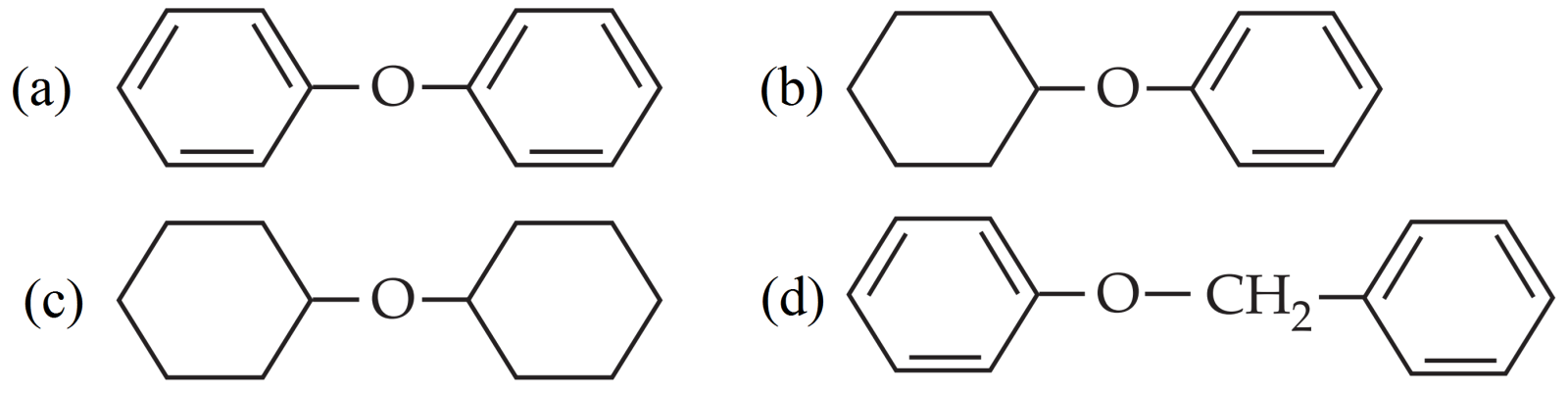
  1. Which of the following ether is unlikely to be cleaved by hot cone. $\ce{HBr}$?

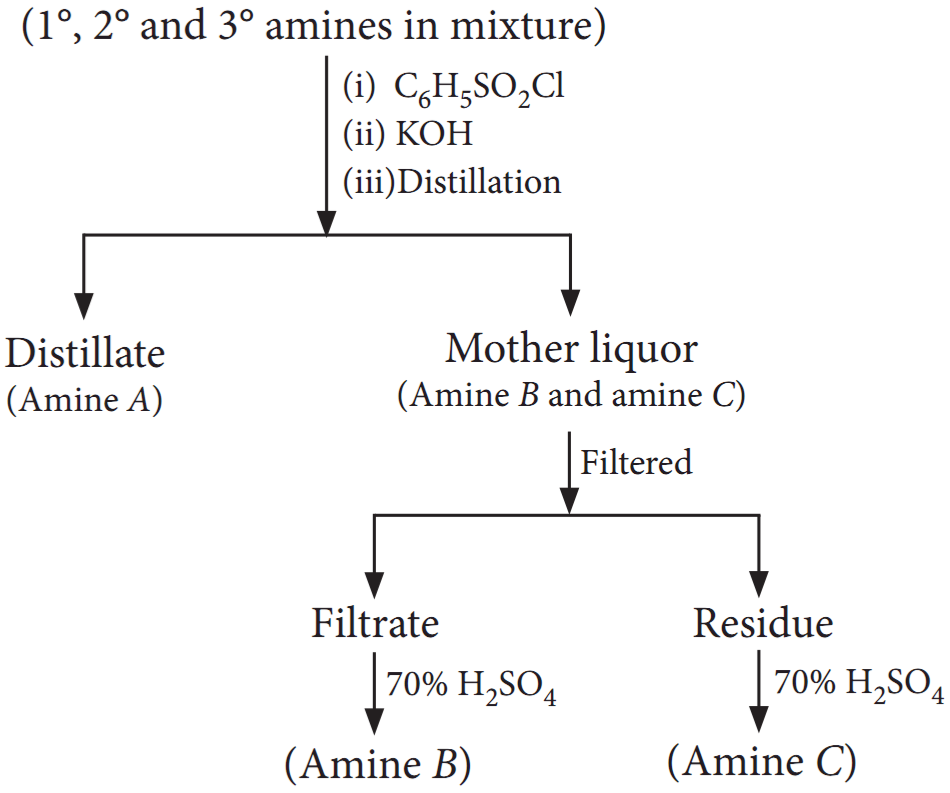
When the mixture contains the three amine salts (1º, 2º and 3º) along with quaternary salt, it is distilled with KOH solution. The three amines distill, leaving the quaternary salt unchanged in the solution. Then the mixture of amines is separated by fractional distillation, Hinsberg's method and Hoffmann's method.

The following questions are multiple choice questions. Choose the most appropriate answer:
  1. Hinsberg reagent is:
  1. Aliphatic sulphonyl chloride.
  2. Phthalamide.
  3. Aromatic sulphonyl chloride.
  4. Anhydrous ZnCl2 + cone. HCI.
  1. Primary amine with Hinsberg's reagent forms:
  1. N-alkyl benzene sulphonamide soluble in KOH solution.
  2. N-alkyl benzene sulphonamide insoluble in KOH solution.
  3. N, N-alkyl benzene sulphonamide soluble in KOH solution.
  4. N, N-alkyl benzene sulphonamide insoluble in KOH solution.
  1. Secondary amine with Hinsberg's reagent forms:
  1. N-alkyl benzene sulphonamide soluble in KOH solution.
  2. N-alkyl benzene sulphonamide insoluble in KOH solution.
  3. N,N-dialkyl benzene sulphonamide soluble in KOH solution.
  4. N,N-dialkyl benzene sulphonamide insoluble in KOH solution.
  1. To separate amines in a mixture Hoffmann's method is used. The Hoffman n's reagent is:
  1. Benzenesulphonyl chloride.
  2. Diethyl oxalate.
  3. Benzeneisocyanide.
  4. P-toulenesulphonic acid.
  1. 3º amines with Hinsberg's reagent give:
  1. No reaction.
  2. Product which is same as that of 1° amine.
  3. Product which is same as that of 2° amine.
  4. Products which is a quaternary salt.
Read the passage given below and answer the following questions : Transition metal oxides are compounds fanned by the reaction of metals with oxygen at high temperature. The highest oxidation number in the oxides coincides with the group number. In vanadium, there is a gradual change from the basic $V_2O_3$ to less basic $V_2O_4$ and to amphoteric $V_2O_5· V_2O_4$ dissolves in acids to give $VO^{2+}$ salts. Transition metal oxides are commonly utilized for their catalytic activity and semi conductive properties. Transition metal oxides are also frequently used as pigments in paints and plastic. Most notably titatnium dioxide. One of the earliest application of transition metal oxides to chemical industry involved the use of vanadium oxide for catalytic oxidation of sulfur dioxide to sulphuric acid. Since then, many other applications have emerged, which include benzene oxidation to maleic anhydride on vandium oxides; cyclohexane oxidation to adipic acid on cobalt oxides. An important property of the catalyst material used in these processes is the ability of transition metals to change their oxidation state under a given chemical potential of reductants and oxidants. The following questions are multiple choice questions. Choose the most appropriate answer:
  1. Which oxide of vanadium is most likely to be basic and ionic?
  1. $VO$
  2. $V_2O_3$
  3. $VO_2$
  4. $V_2O_5$
  1. Vanadyl ion is:
  1. $\text{VO}^{2+}$
  2. $\text{VO}^{+}_2$
  3. $\text{V}_{2}\text{O}^+$
  4. $\text{VO}^{3-}_4$
  1. Which of the following statements is false?
  1. With fluorine vanadium can form $VF_5.$
  2. With chlorine vanadium can form $VCl^5.$
  3. Vanadium exhibits highest oxidation state in oxohalides $VOCl_3, VOBr_3$ and fluoride $VF_5.$
  4. With iodine vanadium cannot form $Vl_5$ due to oxidising power of $V^{5+}$ and reducing nature of $I^-.$
  1. The oxidation state of vanadium in $V_2O_5$ is:
  1. $\frac{+5}{2}$
  2. $+7$
  3. $+5$
  4. $+6$
  1. Identify the oxidising agent in the following reaction.
$V_2O_{5 }+ 5Ca \rightarrow 2V + 5CaO$
  1. $V_2O_5$
  2. $Ca$
  3. $V$
  4. None of these.
Read the passage given below and answer the following questions:
To explain bonding in coordination compounds various theories were proposed. One of the important theory was valence bond theory. According to that, the central metal ion in the complex makes available a number of empty orbitals for the formation of coordination bonds with suitable ligands. The appropriate atomic orbitals of the metal hybridise to give a set of equivalent orbitals of definite geometry.
The $d-$orbitals involved in the hybridisation may be either inner $d-$orbitals i.e.$, (n - 1)d$ or outer $d-$orbitals i.e.$, nd.$
For example, $Co^{3+}$ forms both inner orbital and outer orbital complexes, with ammonia it forms $[\ce{Co(NH3)6]^{3+}}$ and with fluorine it forms $[\ce{CoF6]^{3-}}$ complex ion.
The following questions are multiple choice questions. Choose the most appropriate answer :
  1. Which of the following is not true for $[\ce{CoF6}]^{3-}$?
  1. It is paramagnetic.
  2. It has coordination number of $6.$
  3. It is outer orbital complex.
  4. It involves $d^2sp^3$ hybridisation.
  1. $[\ce{Cr(H2O)6]Cl3}\ ($at. no. of $Cr = 24)$ has a magnetic moment of $3.83\ B.M.$ The correct distribution of $3d-$electrons in the central metal of the complex is :
  1. $3\text{d}^1_\text{xy},3\text{d}^1_{\text{x}^2-\text{y}^2},3\text{d}^1_\text{yz}$
  2. $3\text{d}^1_\text{xy},3\text{d}^1_{\text{yz}},3\text{d}^1_\text{zx}$
  3. $3\text{d}^1_\text{xy},3\text{d}^1_{\text{zy}},3\text{d}^1_{\text{z}^2}$
  4. $3\text{d}^1_{\text{x}^2-\text{y}^2},3\text{d}^1_{\text{z}^2},3\text{d}^1_\text{xz}$
  1. Which of the following is true for $[\ce{Co(NH3)6}]^{3+}$?
  1. It is an octahedral, di magnetic and outer orbital complex.
  2. It is an octahedral, paramagnetic and outer orbital complex.
  3. It is an octahedral, paramagnetic and inner orbital complex.
  4. It is an octahedral, di magnetic and inner orbital complex.
  1. The paramagnetism of $[\ce{CoF6}]^{3-}$ is due to.
  1. $3$ electrons.
  2. $4$ electrons.
  3. $2$ electrons.
  4. $1$ electron.
  1. Which of the following is an inner orbital or low spin complex?
  1. $[\ce{Ni(H2O)6}]^{3+}$
  2. $[\ce{FeF6}]^{3-}$
  3. $[\ce{Co(CN)6}]^{3-}$
  4. $[\ce{NiCl4}]^{2-}$
Read the passage given below and answer the following questions:
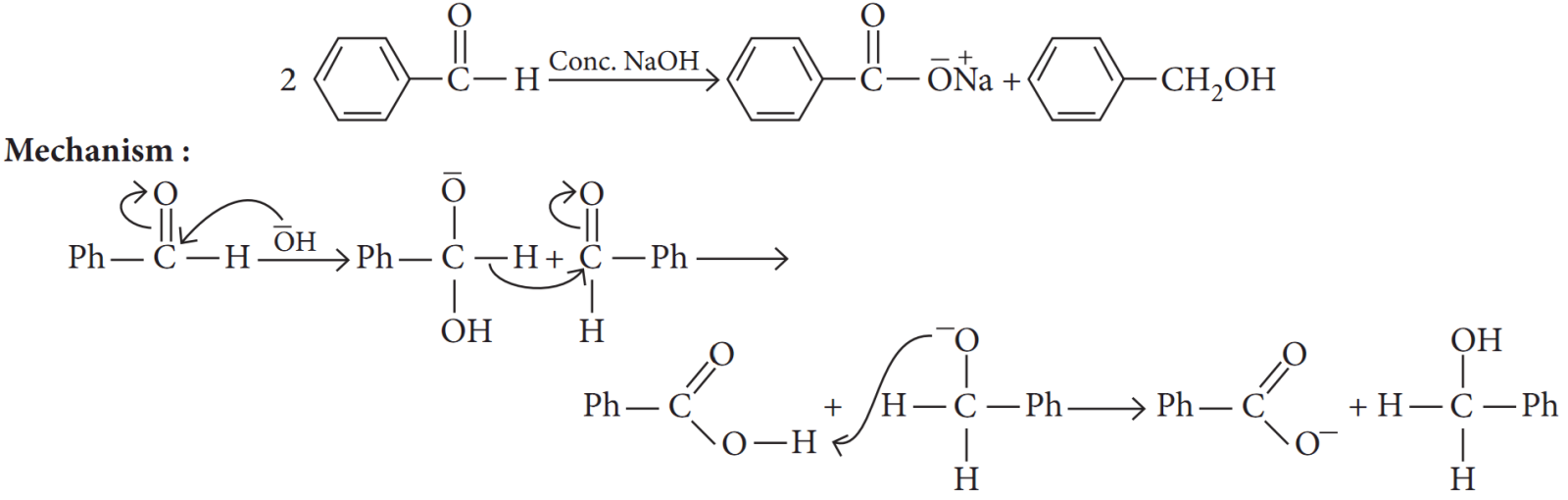
When an aldehyde with no et $-$ hydrogen reacts with concentrated aqueous $\ce{NaOH},$ half the aldehyde is converted to carboxylic acid salt and other half is converted to an alcohol. In other words, half of the reactant is oxidized and other half is reduced. This reaction is known as Cannizzaro reaction.

The following questions are multiple choice questions. Choose the most appropriate answer:
  1. A mixture of benzaldehyde and formaldehyde on heating with aqueous $\ce{NaOH}$ solution gives:
  1. Benzyl alcohol and sodium formate.
  2. Sodium benzoate and methyl alcohol.
  3. Sodium benzoate and sodium formate.
  4. Benzyl alcohol and methyl alcohol.
  1. Which of the following compounds will undergo Cannizzaro reaction?
  1. $\ce{CH_3CHO}$
  2. $\ce{CH_3COCH_3}$
  3. $\ce{C_6H_5CHO}$
  4. $\ce{C_6H_5CH_2CHO}$
  1. Trichloroacetaldehyde is subjected to Cannizzaro's reaction by using $\ce{NaOH}$. The mixture of the products contains sodium trichloroacetate ion and another compound. The other compounds is:
  1. $2, 2, 2-$ trichloroethanol.
  2. Trichloromethanol.
  3. $2, 2, 2-$ trichloropropanol.
  4. Chloroform.
  1. In Cannizzaro reaction given below:
$2\text{PhCHO}\xrightarrow{\stackrel{-}{\hbox{ OH}}}\text{PhCH}_2+\text{OH}+\text{PhCO}_2^-$ the slowest step is:
  1. The attack $^-OH$ at the carboxyl group.
  2. The transfer of hydride to the carbonyl group.
  3. The abstraction of proton from the carboxylic group.
  4. The deprotonation of $\ce{PhCH_2OH}.$
  1. Which of the following reaction will not result in the formation of carbon $-$ carbon bonds?
  1. Cannizzaro reaction.
  2. Wurtz reaction.
  3. Reimer $-$Tiemann reaction.
  4. Friedel $-$ Crafts' acylation.
Read the passage given below and answer the following questions: According to Raoult's law, the partial pressure of two components of the solution maybe given as: $\text{P}_\text{A}=\stackrel{{0}}{\hbox{PA }}\text{x}_\text{A}$ and $\text{P}_\text{B}=\stackrel{{0}}{\hbox{PB }}\text{x}_\text{B}$ For an ideal solution (obeys Raoult's law always) $\Delta\text{H}_\text{mix}=0,\Delta\text{mix}=0$ All solutions do not obey Raoults law over entire range of concentration. These are known as non-ideal solutions. For non-ideal solutions, $\text{P}_\text{A}\not=\stackrel{{0}}{\hbox{PA }}\text{x}_\text{A}$ or $\text{P}_\text{B}\not=\stackrel{{0}}{\hbox{PB }}\text{x}_\text{B}$ Positive deviation $\Rightarrow\text{P}_\text{A}>\stackrel{{0}}{\hbox{PA }}\text{x}_\text{A}$ and $\text{P}_\text{B}>\stackrel{{0}}{\hbox{PB }}\text{x}_\text{B}$ Negative deviation $\text{P}_\text{A}<\stackrel{{0}}{\hbox{PA }}\text{x}_\text{A}$ and $\text{P}_\text{B}\stackrel{{0}}{\hbox{PB }}\text{x}_\text{B}$ A statement of assertion followed by a statement ofreason is given. Choose the correct answer out of the following choices.
  1. Assertion and reason both are correct statements and reason is correct explanation for assertion.
  2. Assertion and reason both are correct statements but reason is not correct explanation for assertion.
  3. Assertion is correct statement but reason is wrong statement.
  4. Assertion is wrong statement but reason is correct statement.
  1. Assertion: An ideal solution obeys Raoult's law.
Reason: In an ideal solution, solute-solute as well as solvent-solvent interactions are similar to solute-solvent interactions.
  1. Assertion: Acetone and aniline show negative deviations.
Reason: H-bonding between acetone and aniline is stronger than that between acetone-acetone and aniline-aniline.
  1. Assertion: Azeotropic mixtures are formed only by non-ideal solutions and they may have boiling points either greater than both the components or lesser than both the components.
Reason: The composition of the vapour phase is same as that of the liquid phase of an azeotropic mixture.
  1. Assertion: The solutions which show negative deviations from Raoult's law are called maximum boiling azeotropes.
Reason: 68% nitric acid and 32% water by mass fonn maximum boiling azeotrope.
  1. Assertion: $\Delta\text{H}_{\text{mix}}$ mix and $\Delta\text{V}_{\text{mix}}$ are positive for an ideal solution.
Reason: The interactions between the particles of the components of an ideal solution are almost identical as between particles in the liquids.
Read the passage given below and answer the following questions:
The concentration of a solute is very important in studying chemical reactions because it determines how often molecules collide in solution and thus indirectly determine the rate of reactions and the conditions at equilibrium. There are several ways to express the amount of solute present in a solution. The concentration of a solution is a measure of the amount of solute that has been dissolved in a given amount of solvent or solution. Concentration can be expressed in terms of molarity, molality, parts per million, mass percentage, volume percentage, etc.
The following questions are multiple choice questions. Choose the most appropriate answer:
  1. A solution is prepared using aqueous $Kl$ which is turned out to be $20\%$ w/w Density of $Kl$ is $1.202 g/mL$ the molality of the given solution and mole fraction of solute are respectively.
  1. $1.95m, 0.120$
  2. $1.5m, 0.0263$
  3. $2.5m, 0.0569$
  4. $3.0m, 0.0352$
  1. The molarity $($in mol $L^{-1})$ of the given solution will be.
  1. $1.56$
  2. $1.89$
  3. $0.263$
  4. $1.44$
  1. Which of the following is correct relationship between mole fraction and molality?
  1. $\text{x}_2=\frac{\text{mM}_1}{1+\text{mM}_1}$
  2. $\text{x}_2=\frac{\text{mM}_1}{1-\text{mM}_1}$
  3. $\text{x}_2=\frac{1+\text{mM}_1}{\text{mM}_1}$
  4. $\text{x}_2=\frac{1-\text{mM}_1}{\text{mM}_1}$
  1. Which of the following is temperature dependent?
  1. Molarity
  2. Molality
  3. Mole fraction
  4. Mass percentage
  1. Which of the following is true for an aqueous solution of the solute in terms of concentration?
  1. $1M = 1m$
  2. $1M > 1m$
  3. $1M < 1m$
  4. Cannot be predicted