Question
Read the passage given below and answer the following questions:
To explain bonding in coordination compounds various theories were proposed. One of the important theory was valence bond theory. According to that, the central metal ion in the complex makes available a number of empty orbitals for the formation of coordination bonds with suitable ligands. The appropriate atomic orbitals of the metal hybridise to give a set of equivalent orbitals of definite geometry.
The $d-$orbitals involved in the hybridisation may be either inner $d-$orbitals i.e.$, (n - 1)d$ or outer $d-$orbitals i.e.$, nd.$
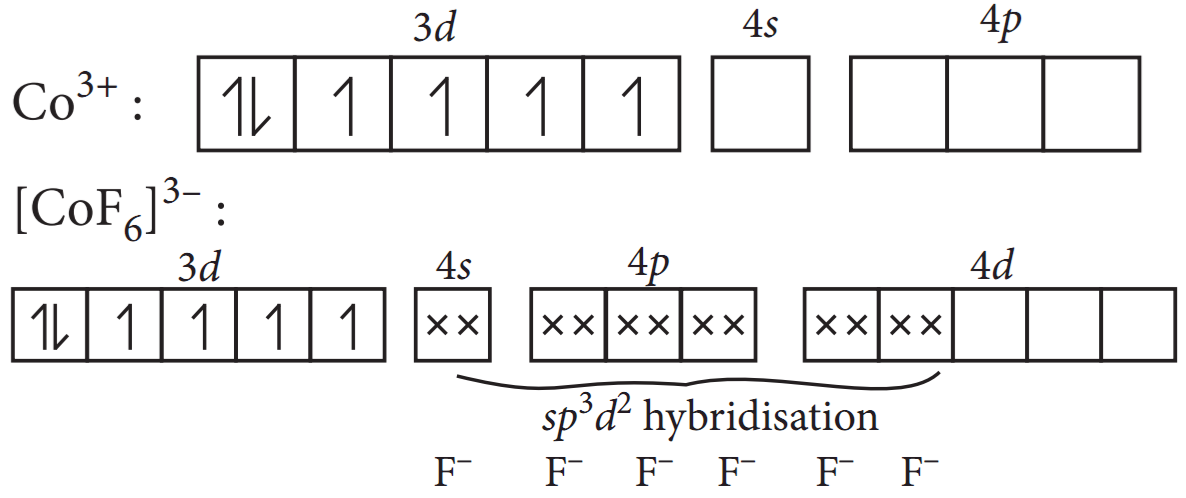
For example, $Co^{3+}$ forms both inner orbital and outer orbital complexes, with ammonia it forms $[\ce{Co(NH3)6]^{3+}}$ and with fluorine it forms $[\ce{CoF6]^{3-}}$ complex ion.
The following questions are multiple choice questions. Choose the most appropriate answer :
  1. Which of the following is not true for $[\ce{CoF6}]^{3-}$?
  1. It is paramagnetic.
  2. It has coordination number of $6.$
  3. It is outer orbital complex.
  4. It involves $d^2sp^3$ hybridisation.
  1. $[\ce{Cr(H2O)6]Cl3}\ ($at. no. of $Cr = 24)$ has a magnetic moment of $3.83\ B.M.$ The correct distribution of $3d-$electrons in the central metal of the complex is :
  1. $3\text{d}^1_\text{xy},3\text{d}^1_{\text{x}^2-\text{y}^2},3\text{d}^1_\text{yz}$
  2. $3\text{d}^1_\text{xy},3\text{d}^1_{\text{yz}},3\text{d}^1_\text{zx}$
  3. $3\text{d}^1_\text{xy},3\text{d}^1_{\text{zy}},3\text{d}^1_{\text{z}^2}$
  4. $3\text{d}^1_{\text{x}^2-\text{y}^2},3\text{d}^1_{\text{z}^2},3\text{d}^1_\text{xz}$
  1. Which of the following is true for $[\ce{Co(NH3)6}]^{3+}$?
  1. It is an octahedral, di magnetic and outer orbital complex.
  2. It is an octahedral, paramagnetic and outer orbital complex.
  3. It is an octahedral, paramagnetic and inner orbital complex.
  4. It is an octahedral, di magnetic and inner orbital complex.
  1. The paramagnetism of $[\ce{CoF6}]^{3-}$ is due to.
  1. $3$ electrons.
  2. $4$ electrons.
  3. $2$ electrons.
  4. $1$ electron.
  1. Which of the following is an inner orbital or low spin complex?
  1. $[\ce{Ni(H2O)6}]^{3+}$
  2. $[\ce{FeF6}]^{3-}$
  3. $[\ce{Co(CN)6}]^{3-}$
  4. $[\ce{NiCl4}]^{2-}$

Answer

  1. $(d)$ It involves $d^2sp^3$ hybridisation.
lt involves $sp^3d^2$ hybridisation and not $d^2sp^3.$
  1. $(b)\ 3\text{d}^1_\text{xy},3\text{d}^1_{\text{yz}},3\text{d}^1_\text{zx}$
Magnetic moment of $3.83B.M$. suggests that it has $3$ unpaired electrons,
$\therefore n = 3 i.e., Cr^{3+}: 3d^3$
It involves $d^2sp^3$ hybridisation so correct distribution of electrons is $3\text{d}^1_\text{xy},3\text{d}^1_{\text{yz}},3\text{d}^1_\text{zx}.$
  1. $(d)$ It is an octahedral, di magnetic and inner orbital complex.
$[\ce{Co(NH3)6}]^{3+}$ is $d^2sp^3$ hybridised with all electrons paired hence, it is diamagnetic and inner orbital complex.
  1. $(b)\ 4$ electrons.
  1. $(c)\ [\ce{Co(CN)6}]^{3-}$
Inner orbital complexes are formed with strong ligands as they force electrons to pair up and hence the complex will be either diamagnetic or will have less number of unpaired electrons.

Need a full question paper?

Generate a complete, print-ready paper with questions like this in minutes — across 16+ boards, with answer keys.

Start Generating Free

Similar questions

Read the passage given below and answer the following questions:
At $298 K,$ the vapour pressure of pure benzene $, C_6, H_6$ is $0.256$ bar and the vapour pressure of pure toluene $\ce{C_6 H_5 CH_3}$ is $0.0925$ bar. Two mixtures were prepared as follows:
  1. $7.8g$ of $\ce{C_6 H_6 + 9.2g}$ of toluene
  2. $3.9g$ of $\ce{C_6 H_6 + 13.8g}$ of toluene
The following questions are multiple choice questions. Choose the most appropriate answer:
  1. The total vapour pressure $($bar$)$ of solution I is.
  1. $0.128$
  2. $0.174$
  3. $0.198$
  4. $0.258$
  1. Which of the given solutions have higher vapour pressure?
  1. $I$
  2. $II$
  3. Both have equal vapour pressure
  4. Cannot be predicted
  1. Mole fraction of benzene in vapour phase in solution I is.
  1. $0.128$
  2. $0.174$
  3. $0.734$
  4. $0.266$
  1. Which of the following statements is/are correct?
  1. Mole fraction of toluene in vapour phase is more in solution $ I$.
  2. Mole fraction of toluene in vapour phase is less in solution $I.$
  3. Mole fraction of benzene in vapour phase is less in solution $I.$
  1. Only $II$
  2. Only $I$
  3. $I$ and $III$
  4. $II$ and $III$
  1. Solution I is an example of a/an.
  1. Ideal solution.
  2. Non $-$ ideal solution with positive deviation.
  3. Non $-$ ideal solution with negative deviation.
  4. Can't be predicted.
Read the passage given below and answer the following questions:
An organic compound $(A)$ having molecular formula $C_6H_6O$ gives a characteristic colour with aqueous $FeCl_3$ solution. $(A)$ on treatment with $CO_2$ and $\text{NaOH}$ at $400K$ under pressure gives $(B),$ which on acidification gives a compound $(C).$ The compound $(C)$ reacts with acetyl chloride to give $(D)$ which is a popular pain killer.
The following questions are multiple choice questions. Choose the most appropriate answer:
  1. Compound $(A)$ is:
  1. $2-$Hexanol.
  2. Dimethyl ether.
  3. Phenol.
  4. $2-$Methyl pentanol.
  1. Compound $(C)$ is:
  1. Salicylic acid.
  2. Salicyladehyde.
  3. Benzoic acid.
  4. Benzaldehyde.
  1. Number of carbon atoms in compound $(D)$ is:
  1. $7$
  2. $6$
  3. $8$
  4. $9$
  1. The conversion of compound $(A)$ to $(C)$ is known as:
  1. Reimer$-$Tiemann reaction.
  2. Kolbe's reaction.
  3. Schimdt reaction.
  4. Swarts reaction.
  1. Compound $(A)$ on heating with compound $(C)$ in presence of $POCl_3$ gives a compound $(D)$ which is used:
  1. In perfumery as a ftavouring agent
  2. As an antipyretic
  3. As an analgesic
  4. As an intestinal antiseptic.
Read the passage given below and answer the following questions: Carboxylic acids having an $\alpha-$ hydrogen atom when treated with chlorine or bromine in the presence of small amount of red phosphorus gives $\alpha-$ halocarboxytic acids. The reaction is known as Hell $-$ Volhard $-$ Zelinsky reaction. $\text{R}-\text{CH}_2-\text{COOH}+\text{X}_2\xrightarrow{\text{red p}}\text{R}-\text{CH}-\text{COOH}\\ \ \ \ \ \ \ \ \ \ \ \ \ \ \ \ \ \ \ \ \ \ \ \ \ \ \ \ \ \ \ \ \ \ \ \ \ \ \ \ \ \ \ \ \ \ \ \ \ \ \ \ \ \ \ \ \ \ \ \ \ \ |\\ \ \ \ \ \ \ \ \ \ \ \ \ \ \ \ \ \ \ \ \ \ \ \ \ \ \ \ \ \ \ \ \ \ \ \ \ \ \ \ \ \ \ \ \ \ \ \ \ \ \ \ \ \ \ \ \ \ \ \ \ \text{X}\\ \ \ \ \ \ \ \ \ \ \ \ \ \ \ \ \ \ \ \ \ \ \ \ \ \ \ \ \ \ \ \ \ \ \ \ \ \ \ \ \ \ \ \ \ \ \ \ \ \ \ \ \ \ \ (\text{X = Cl, Br)}$ When sodium salt of carboxylic acid is heated with soda lime it loses carbon dioxide and gives hydrocarbon with less number of $C-$ atoms. $\text{R}-\text{COOH}\xrightarrow{\text{NaOH}}\text{R}-\text{COONa}\xrightarrow[\Delta]{\text{NaOH}+\text{CaO}}\text{R}-\text{H}+\text{Na}_2\text{CO}_3\\\text{Carboxylic}\ \ \ \ \ \ \ \ \ \ \ \ \ \ \ \ \ \ \ \ \ \text{Sod.}\ \ \ \ \ \ \ \ \ \ \ \ \ \ \ \ \ \ \ \ \ \ \ \ \ \ \ \ \ \text{Alkane}\\\ \ \ \ \ \text{acid}\ \ \ \ \ \ \ \ \ \ \ \ \ \ \ \ \ \ \ \ \ \ \text{carboxylate}$ In these questions $(Q$. No. $l-iv),$ a statement of assertion followed by a statement ofreason is given. Choose the correct answer out of the following choices.
  1. Assertion and reason both are correct statements and reason is correct explanation for assertion.
  2. Assertion and reason both are correct statements but reason is not correct explanation for assertion.
  3. Assertion is correct statement but reason is wrong statement.
  4. Assertion is wrong statement but reason is correct statement.
  1. Assertion : $\ce{(CH_3)_3CCOOH}$ does not give $\text{H.V.Z}$ reaction.
Reason : $\ce{(CH_3)_3CCOOH}$ does not have $\alpha-$ hydrogen atom.
  1. Assertion : $\text{H.V.Z}$. reaction involves the treatment of carboxylic acids having $\alpha-$ hydrogens with $Cl_2$ or $Br_2$ in presence of small amount of red phosphorus.
Reason : Phosphorus reacts with halogens to form phosphorus trihalides.
  1. Assertion : Propionic acid with $\frac{\text{Br}_2}{\text{P}}$ yields $\ce{CH_2Br - CHBr - COOH}$.
Reason : Propionic acid has two $\alpha-$ hydrogen atoms.
  1. Assertion : $\ce{C_6H_5COCH_2COOH}$ undergoes decarboxylation easily than $\ce{C_6H_5COCH_2COOH}.$
Reason : $\ce{C_6H_5COCH_2COOH}$ is $\beta-$ keto acid.
  1. Assertion : On heating $3-$ methylbutanoic acid with soda lime, isobutane is obtained.
Reason : Soda lime is a mixture of $\ce{NaOH + CaO}$ in the ratio $3 : 1.$
Read the passage given below and answer the following questions:
The concentration of a solute is very important in studying chemical reactions because it determines how often molecules collide in solution and thus indirectly determine the rate of reactions and the conditions at equilibrium. There are several ways to express the amount of solute present in a solution. The concentration of a solution is a measure of the amount of solute that has been dissolved in a given amount of solvent or solution. Concentration can be expressed in terms of molarity, molality, parts per million, mass percentage, volume percentage, etc.
The following questions are multiple choice questions. Choose the most appropriate answer:
  1. A solution is prepared using aqueous $Kl$ which is turned out to be $20\%$ w/w Density of $Kl$ is $1.202 g/mL$ the molality of the given solution and mole fraction of solute are respectively.
  1. $1.95m, 0.120$
  2. $1.5m, 0.0263$
  3. $2.5m, 0.0569$
  4. $3.0m, 0.0352$
  1. The molarity $($in mol $L^{-1})$ of the given solution will be.
  1. $1.56$
  2. $1.89$
  3. $0.263$
  4. $1.44$
  1. Which of the following is correct relationship between mole fraction and molality?
  1. $\text{x}_2=\frac{\text{mM}_1}{1+\text{mM}_1}$
  2. $\text{x}_2=\frac{\text{mM}_1}{1-\text{mM}_1}$
  3. $\text{x}_2=\frac{1+\text{mM}_1}{\text{mM}_1}$
  4. $\text{x}_2=\frac{1-\text{mM}_1}{\text{mM}_1}$
  1. Which of the following is temperature dependent?
  1. Molarity
  2. Molality
  3. Mole fraction
  4. Mass percentage
  1. Which of the following is true for an aqueous solution of the solute in terms of concentration?
  1. $1M = 1m$
  2. $1M > 1m$
  3. $1M < 1m$
  4. Cannot be predicted
Explain the D and L notation method of spatial arrangement with respect to glucose.
For a reaction, $A + B \rightarrow$ Products, the rate law is $-$ Rate $= k[A][B]^{3/2}$ Can the reaction be an elementary reaction? Explain.
Read the passage given below and answer the following questions:
The solubility of gases increases with increase of pressure. William Henry made a systematic investigation of the solubility of a gas in a liquid. According to Henry's law "the mass of a gas dissolved per unit volume of the solvent at constant temperature is directly proportional to the pressure of the gas in equilibrium with the solution". Dalton during the same period also concluded independently that the solubility of a gas in a ti quid solution depends upon the partial pressure of the gas. If we use the mole fraction of gas in the solution as a measure of its solubility, then Henry's law can be modified as "the partial pressure of the gas in the vapour phase is directly proportional to the mole fraction of the gas in the solution"
The following questions are multiple choice questions. Choose the most appropriate answer:
  1. Henry's law constant for the solubility of methane in benzene at $298K$ is $4.27 \times 10^5\ mm\ Hg$. The solubility of methane in benzene at $298K$ under $760\ mm\ Hg$ is :
  1. $4.27 \times 10^{-5}$
  2. $1.78 \times 10^{-3}$
  3. $4.27 \times 10^{-3}$
  4. $1.78 \times 10^{-5}$
  1. The partial pressure of ethane over a saturated solution containing $6.56 \times 10^{-2}g$ of ethane is $I$ bar. If the solution contains $5.00 \times 10^{-2}g$ of ethane then what will be the partial pressure $($in bar$)$ of the gas?
  1. $0.762$
  2. $1.312$
  3. $3.81$
  4. $5.0$
  1. $K_H\ (K$ bar$)$ values for $\ce{Ar(g), CO2(g), HCHO(g)}$ and $\ce{CH4(g)}$ are $40.39, 1.67, 1.83 \times 10^{-5}$ and $0.413$ respectively. Arrange these gases in the order of their increasing solubility. Arrange these gases in the order of their increasing solubility.
  1. $\ce{HCHO < CH4 < CO2 < Ar}$
  2. $\ce{HCHO < CO2 < CH4 < Ar}$
  3. $\ce{Ar < CO2 < CH4 < HCHO}$
  4. $\ce{Ar < CH4 < CO2 < HCHO}$
  1. When a gas is bubbled through water at $298K,$ a very dilute solution of the gas is obtained. Henry's law constant for the gas at $298K$ is $150k$ bar. If the gas exerts a partial pressure of $2$ bar, the number of millimoles of the gas dissolved in $IL$ of water is :
  1. $0.55$
  2. $0.87$
  3. $0.37$
  4. $0.66$
  1. Which of the following statements is correct?
  1. $K_H$ increases with increase of temperature.
  2. $K_H$ decreases with increase of temperature.
  3. $K_H$ remains constant with increase of temperature.
  4. $K_H$ first increases then decreases, with increase of temperature.
Read the passage given below and answer the following questions:
The properties of the solutions which depend only on the number of solute particles but not on the nature of the solute are called colligative properties. Relative lowering in vapour pressure is also an example of colligative properties. For an experiment, sugar solution is prepared, for which lowering in vapour pressure was found to be 0.061 mm of Hg. (Vapour pressure of water at 20° C is 17.5 mm of Hg)
The following questions are multiple choice questions. Choose the most appropriate answer:
  1. Relative lowering of vapour pressure for the given solution is.
  1. 0.00348
  2. 0.061
  3. 0.122
  4. 1.75
  1. The vapour pressure (mm of Hg) of solution will be.
  1. 17.5
  2. 0.61
  3. 17.439
  4. 0.00348
  1. Mole fraction of sugar in the solution is.
  1. 0.00348
  2. 0.9965
  3. 0.061
  4. 1.75
  1. If weight of sugar taken is 5g in 108g of water, then molar mass of sugar will be.
  1. 358
  2. 120
  3. 240
  4. 400
  1. The vapour pressure (mm of Hg) of water at 293K when 25g of glucose is dissolved in 450g of water is.
  1. 17.2
  2. 17.4
  3. 17.120
  4. 17.02
Read the passage given below and answer the following questions:
The $f-$block elements are those in which the differentiating electron enters the $(n -2)f$ orbital. There are two series of $F-$block elements corresponding to filling of $4f$ and $5f-$orbitals. The series of $4f-$orbitals is called lanthanides. Lanthanides show different oxidation states depending upon stability of $f^0, f^7$ and $F^{14}$ configurations, though the most conunon oxidation states is $+3.$ There is a regular decrease in size oflanthanides ions with increase in atomic number which is known as lanthanide contraction.
The following questions are multiple choice questions. Choose the most appropriate answer:
  1. The atomic numbers of three lanthanide elements $X, Y$ and $Z$ are $65, 68$ and $70$ respectively, their $Ln^{3+}$ electronic configuration is:
  1. $\ce{4f^8, 4f^{11}, 4f^{13}}$
  2. $\ce{4f^{11}, 4f^8, 4f^{13}}$
  3. $\ce{4f^0, 4f^2, 4f^{11}}$
  4. $\ce{4f^3, 4f^7, 4f^9}$
  1. Lanthanide contraction is observed in:
  1. $Gd$
  2. $At$
  3. $Xe$
  4. $Te$
  1. Which of the following is not the configuration oflanthanoid?
  1. $\ce{[Xe]4f^{10}6s^2}$
  2. $\ce{[Xe]4f^15d^16s^2}$
  3. $\ce{[Xe]4d^{14}5d^{10}6s^2}$
  4. $\ce{[Xe]4f^75d^16s^2}$
  1. Name a member of the lanthanoid series which is well known to exhibit $+4$ oxidation state.
  1. Cerium $(Z = 58)$
  2. Europium $(Z = 63)$
  3. Lanthanum $(Z = 57)$
  4. Gadolinium $(Z = 64)$
  1. Identify the incorrect statement among the following.
  1. Lanthanoid contraction is the accumulation of successive shrinkages.
  2. The different radii of $Zr$ and $Hf$ due to consequence of the lanthanoid contraction.
  3. Shielding power of $4f$ electrons is quite weak.
  4. There is a decrease in the radii of the atoms or ions as one proceeds from $La$ to $Lu.$
Molar conductivity of ions are given as product of charge on ions to their ionic mobilities and Faradays constant.
$\lambda_\text{A}\text{n}+=\text{n}\mu_\text{A}\text{n}+\text{F} ($here $\mu$ is the ionic mobility of $A^{n+})$
For electrolytes say $A_xB_y,$ molar conductivity is given by
$\lambda_{\text{m}(\text{A}_\text{x}\text{B}_\text{y})}=\text{x}_\text{n}\mu_{\text{A}^\text{n}}+\text{F}+\text{y}_\text{m}\lambda_{\text{A}^\text{m}}-\text{F}$
Ions
Ionic mobility
$K^+$ $7.616 \times 10^{-4}$
$Ca^{2+}$ $12.33 \times 10^{-4}$
$Br^-$ $8.09 \times 10^{-4}$
$\text{SO}_{4}^{2-}$
$16.58 \times 10^{-4}$
The following questions are multiple choice questions. Choose the most appropriate answer:
  1. At infinite dilution, the equivalent conductance of $\ce{CaSO_4}$ is:
  1. $256 \times 10^{-4}$
  2. $279$
  3. $23.7$
  4. $2.0 \times 10^{-8}$
  1. If the degre
  2. e of dissociation of $\ce{CaSO_4}$ solution is $10\%$ then equivalent conductance of $\ce{CaSO_4}$ is:
  1. $3.59$
  2. $36.9$
  3. $27.9$
  4. $30.6$
  1. The correct order of equivalent conductance at infinite dilution of $\ce{LiCl, NaCl, KCl}$ is:
  1. $\ce{LiCl = NaCl = KCl}$
  2. $\ce{LiCl > NaCl > KCl}$
  3. $\ce{KCl > LiCl > NaCl}$
  4. $\ce{KCl > NaCl > LiCl}$
  1. What is the unit of equivalent conductivity?
  1. $ohm^{-1} \ cm^2 eq^{-1}$
  2. $ohm \ cm^2 eq-1$
  3. $ohm^{-1} \ cm eq^{-1}$
  4. $ohm \ cm^{-2}eq^{-2}$
  1. If the molar conductance value of $Ca^{2+}$ and $Cl^-$ at infinite dilution are $118.88 \times 10^{-4}\ m^2\ mho\ mol^{-1}$ and $77.33 \times 10^{-4}\ m^2\ mho\ mol^{-1}$ respectively then the molar conductance of $CaCl_2 ($ in $m^2 mho\ mol^{-1})$ will be:
  1. $120.18 \times 10^{-4}$
  2. $135 \times 10^{-4}$
  3. $273.54 \times 10^{-4}$
  4. $192.1 \times 10^{-4}$