Question
Read the passage given below and answer the following questions: For understanding the structure and bonding in transition metal complexes, the magnetic properties are very helpful. Low spin complexes are generally diamagnetic because of pairing of electrons, whereas high spin complexes are usually paramagnetic because of presence of unpaired electrons. Larger the number of unpaired electrons, stronger will be the paramagnetism. However magnetic behaviour of a complex can be confirmed from magnetic moment measurement. Magnetic moment $\mu=\sqrt{\text{n(n+2)}}\text{B.M.}$ where $n =$ number of unpaired electrons. Greater the number of unpaired electrons, more will be the magnetic moment. In these questions $(Q$. No. $i-iv),$ a statement of assertion followed by a statement ofreason is given. Choose the correct answer out of the following choices.
  1. Assertion and reason both are correct statements and reason is correct explanation for assertion.
  2. Assertion and reason both are correct statements but reason is not correct explanation for assertion.
  3. Assertion is correct statement but reason is wrong statement.
  4. Assertion is wrong statement but reason is correct statement.
The following questions are multiple choice questions. Choose the most appropriate answer:
  1. Assertion : Both $\ce{[Cr(H_2O)_6]^{2+}}$ and $\ce{[Fe(H_2O)_6]^{2+}}$ have same magnetic moment.
Reason : Number of unpaired electrons in $Cr^{2+}$ and $Fe^{2+}$ are same.
  1. Assertion : $\ce{ [Fe(H_2O)_5NO]SO_4}$ is paramagnetic.
Reason : The $Fe$ in $\ce{[Fe(H_2O)_5NO]SO_4}$ has three unpaired electrons.
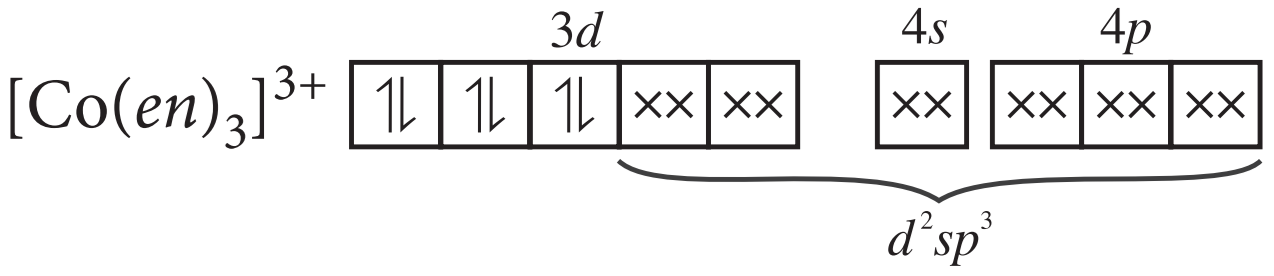
  1. Assertion : $\ce{[Co(en)_3]^{3+}}$ is paramagnetic.
Reason : It is an inner orbital complex.
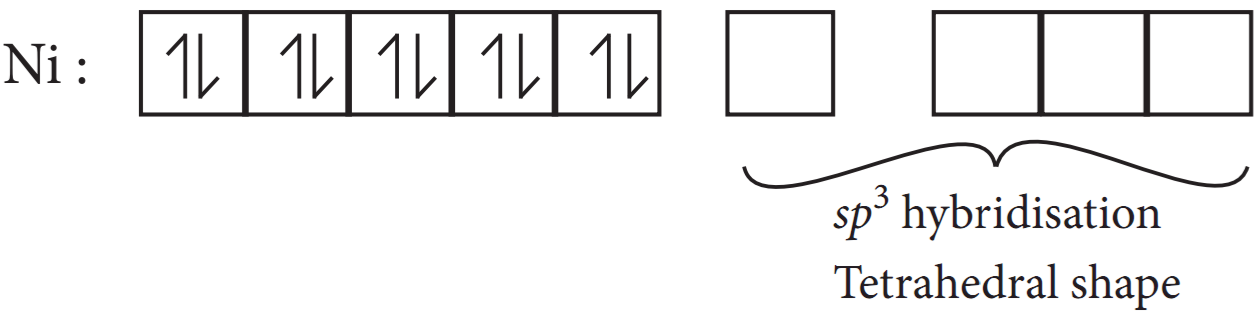
  1. Assertion : $\ce{[Ni(CO)_4]}$ is diamagnetic and tetrahedral in shape.
Reason : $ \ce{[Ni(CO)_4]} $ contains no unpaired electrons and involves $\text{dsp}^2$ hybridisation.
  1. Assertion : $\ce{[Ni(CN)_4]^{2-}​​​​​​​}$ is diamagnetic complex.
Reason : It involves $\text{dsp}^2$ hybridisation and there is no unpaired electron.

Answer

  1. $(a)$ Assertion and reason both are correct statements and reason is correct explanation for assertion.
Spinonlymagneticmoment, $\mu=\sqrt{\text{n(n+2)}}$ where $n =$ number of unpaired electrons.
As the number of unpaired electrons in $\ce{Cr^{2+}[(Ar)3d^{4]}}$ and $\ce{Fe^{2+}[(Ar)3d^6]}$ are same,
Hence $\ce{[Cr(H_2O)_6]^{2+}}$ and $\ce{[Fe(H_2O)_6]^{2+}}$ will have same magnetic moment.
  1. $(a)$ Assertion and reason both are correct statements and reason is correct explanation for assertion.
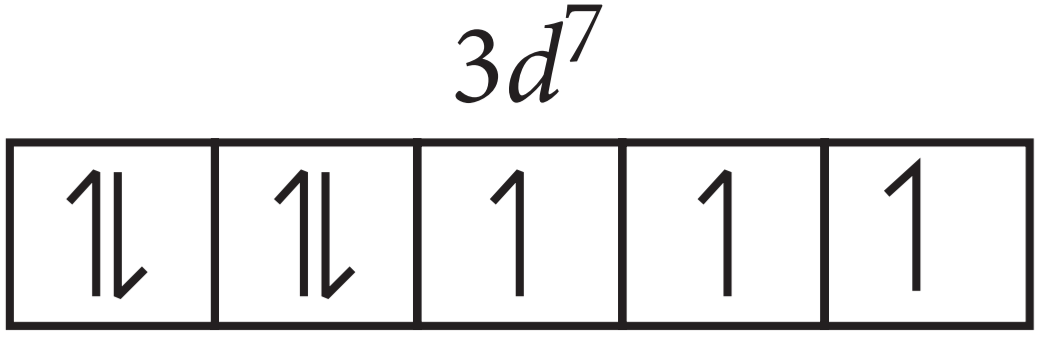
$\ce{Fe^+: (Ar)3d^74s^0}$
When the weak field ligand $\ce{H_2O}$ and strong field ligand $\ce{NO^}+$ attack, the configuration changes as follows: $\ce{Fe^+: (Ar)3d^74s^0}$

$\therefore Fe^{2+}$ has $3$ unpaired electrons.​​​​​​​
  1. $(d)$ Assertion is wrong statement but reason is correct statement.

In presence of strong ethylenediamine ligand the electrons get paired.

Thus inner orbital complex with no unpaired electrons.
  1. $(c)$ Assertion is correct statement but reason is wrong statement.
$\ce{[Ni(CO)_4]}$ contains $Ni(O).$​​​​​​​

$CO$ is strong ligand thus,
  1. $(a)$ Assertion and reason both are correct statements and reason is correct explanation for assertion.

Need a full question paper?

Generate a complete, print-ready paper with questions like this in minutes — across 16+ boards, with answer keys.

Start Generating Free

Similar questions

Read the passage given below and answer the following questions: Carboxylic acids having an $\alpha-$ hydrogen atom when treated with chlorine or bromine in the presence of small amount of red phosphorus gives $\alpha-$ halocarboxytic acids. The reaction is known as Hell $-$ Volhard $-$ Zelinsky reaction. $\text{R}-\text{CH}_2-\text{COOH}+\text{X}_2\xrightarrow{\text{red p}}\text{R}-\text{CH}-\text{COOH}\\ \ \ \ \ \ \ \ \ \ \ \ \ \ \ \ \ \ \ \ \ \ \ \ \ \ \ \ \ \ \ \ \ \ \ \ \ \ \ \ \ \ \ \ \ \ \ \ \ \ \ \ \ \ \ \ \ \ \ \ \ \ |\\ \ \ \ \ \ \ \ \ \ \ \ \ \ \ \ \ \ \ \ \ \ \ \ \ \ \ \ \ \ \ \ \ \ \ \ \ \ \ \ \ \ \ \ \ \ \ \ \ \ \ \ \ \ \ \ \ \ \ \ \ \text{X}\\ \ \ \ \ \ \ \ \ \ \ \ \ \ \ \ \ \ \ \ \ \ \ \ \ \ \ \ \ \ \ \ \ \ \ \ \ \ \ \ \ \ \ \ \ \ \ \ \ \ \ \ \ \ \ (\text{X = Cl, Br)}$ When sodium salt of carboxylic acid is heated with soda lime it loses carbon dioxide and gives hydrocarbon with less number of $C-$ atoms. $\text{R}-\text{COOH}\xrightarrow{\text{NaOH}}\text{R}-\text{COONa}\xrightarrow[\Delta]{\text{NaOH}+\text{CaO}}\text{R}-\text{H}+\text{Na}_2\text{CO}_3\\\text{Carboxylic}\ \ \ \ \ \ \ \ \ \ \ \ \ \ \ \ \ \ \ \ \ \text{Sod.}\ \ \ \ \ \ \ \ \ \ \ \ \ \ \ \ \ \ \ \ \ \ \ \ \ \ \ \ \ \text{Alkane}\\\ \ \ \ \ \text{acid}\ \ \ \ \ \ \ \ \ \ \ \ \ \ \ \ \ \ \ \ \ \ \text{carboxylate}$ In these questions $(Q$. No. $l-iv),$ a statement of assertion followed by a statement ofreason is given. Choose the correct answer out of the following choices.
  1. Assertion and reason both are correct statements and reason is correct explanation for assertion.
  2. Assertion and reason both are correct statements but reason is not correct explanation for assertion.
  3. Assertion is correct statement but reason is wrong statement.
  4. Assertion is wrong statement but reason is correct statement.
  1. Assertion : $\ce{(CH_3)_3CCOOH}$ does not give $\text{H.V.Z}$ reaction.
Reason : $\ce{(CH_3)_3CCOOH}$ does not have $\alpha-$ hydrogen atom.
  1. Assertion : $\text{H.V.Z}$. reaction involves the treatment of carboxylic acids having $\alpha-$ hydrogens with $Cl_2$ or $Br_2$ in presence of small amount of red phosphorus.
Reason : Phosphorus reacts with halogens to form phosphorus trihalides.
  1. Assertion : Propionic acid with $\frac{\text{Br}_2}{\text{P}}$ yields $\ce{CH_2Br - CHBr - COOH}$.
Reason : Propionic acid has two $\alpha-$ hydrogen atoms.
  1. Assertion : $\ce{C_6H_5COCH_2COOH}$ undergoes decarboxylation easily than $\ce{C_6H_5COCH_2COOH}.$
Reason : $\ce{C_6H_5COCH_2COOH}$ is $\beta-$ keto acid.
  1. Assertion : On heating $3-$ methylbutanoic acid with soda lime, isobutane is obtained.
Reason : Soda lime is a mixture of $\ce{NaOH + CaO}$ in the ratio $3 : 1.$
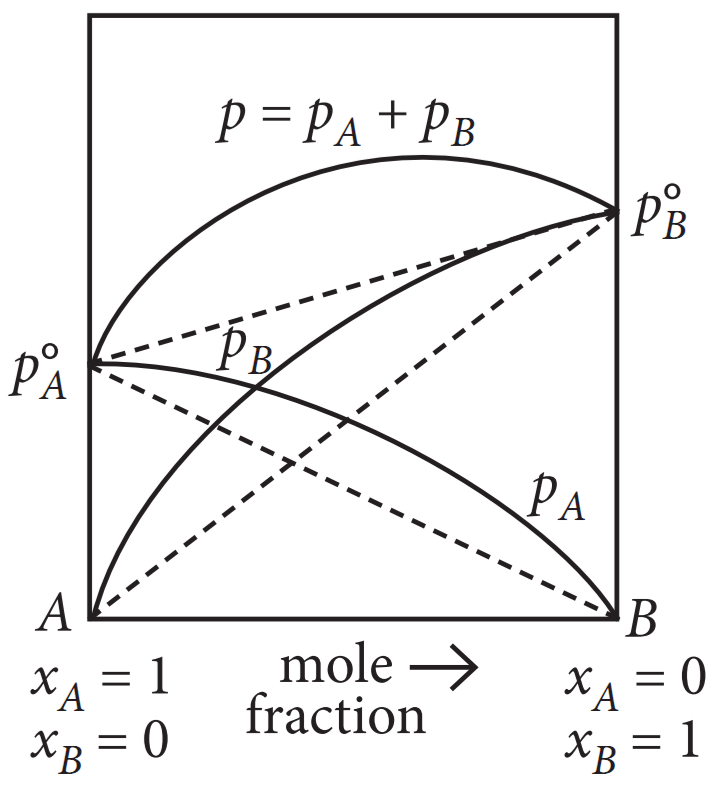
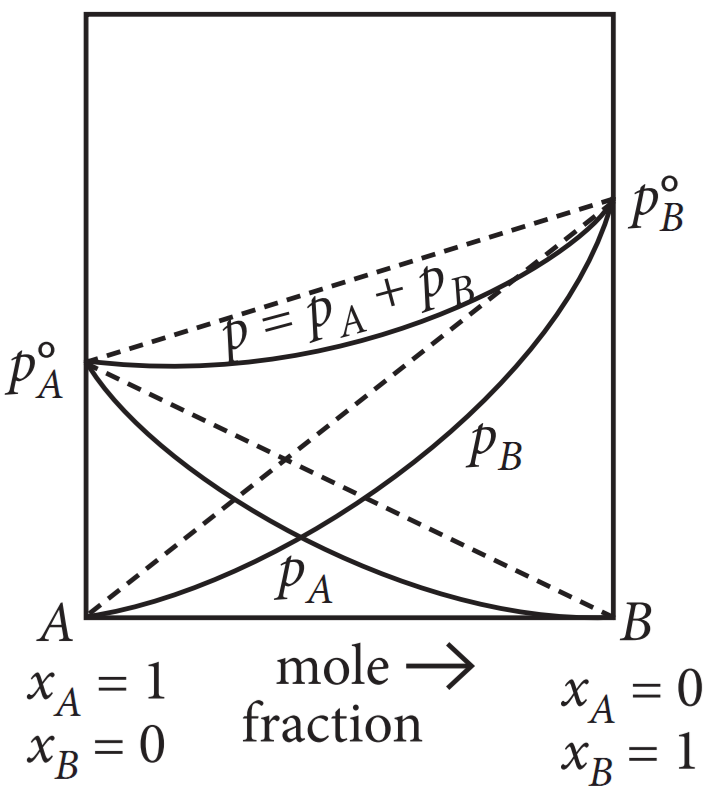
Read the passage given below and answer the following questions: An ideal solution may be defined as the solution which obeys Raoult's law exactly over the entire range of concentration. The solutions for which vapour pressure is either higher or lower than that predicted by Raoult's law are called non-ideal solutions.Non-ideal solutions can show either positive or negative deviations from Raoult's law depending on whether the A-B interactions in solution are stronger or weaker than A - A and B - B interactions. The following questions are multiple choice questions. Choose the most appropriate answer:
  1. Which of the following solutions is/are ideal solution(s)?
  1. Bromoethane and iodoethane.
  2. Acetone and chloroform
  3. Benzene and acetone
  4. n-heptane and n-hexane
  1. Only I
  2. I and II
  3. II and III
  4. I and Iv
  1. For which of the following solutions $\Delta\text{H}_{\text{mix}}$ and $\Delta\text{V}_{\text{mix}}$ is negative?
  1. Acetone and aniline
  2. Ethyl alcohol and cyclohexane
  3. Acetone and CS2
  4. Benzene and toluene
  1. Which of the following is not true for positive deviations?
  1. The A-B interactions in solution are weaker than the A - A and B - B interactions.
  2. $\text{P}_\text{A}<\text{P}\mathring{\text{A}}\ \text{x}_\text{A}$ and $\text{P}_\text{B}<\text{P}\mathring{\text{B}}\ \text{x}_\text{B}$
  3. Carbon tetrachloride and chloroform mixture is an example of positive deviations.
  4. All of these.
  1. For water and nitric acid mixture, which of the given graph is correct?
 
  1.  
 
  1.  
  1. Both of these
  2. None of these
  1. Water-HCI mixture.
  1. Shows positive deviations.
  2. Forms minimum boiling azeotrope.
  3. Shows negative deviations.
  4. Forms maximum boiling azeotrope.
  1. I and II
  2. I and III
  3. I and IV
  4. III and IV
Read the passage given below and answer the following questions:
When a solution of an et$-$amino acid is placed in an electric field depending on the $pH$ of the medium, following three cases may happen.
  1. In alkaline solution, $CL-$amino acids exist as anion $II,$ and there is a net migration of amino acid towards the anode.
  2. In acidic solution, a$-$amino acids exist as cation $III,$ and there is a net migration of amino acid towards the cathode.
  3. If $II$ and $III$ are exactly balanced there is no net migration; under such conditions any one molecule exists as a positive ion and as a negative ion for exactly the same amount of time, and any small movement in the direction of one electrode is subsequently cancelled by an equal movement back toward the other electrode. The $pH$ of the solution in which a particular amino acid does not migrate under the influence of an electric field is called the is oelectric point of that amino acid.
The following questions are multiple choice questions. Choose the most appropriate answer:
  1.  

Arrange in order of increasing acid strengths. 
  1. $\ce{X > Z > Y}$
  2. $\ce{Z < X < Y}$
  3. $\ce{X > Y > Z}$
  4. $\ce{Z > X > Y}$
  1. In aqueous solutions, amino acids mostly exist as:
  1. $\ce{NH_2 - CHR - COOH}$
  2. $\ce{NH_2 - CHR - COO^-}$
  3. $\stackrel{+}{\hbox{ N}}\text{H}_3\text{CHRCOOH}$
  4. $\text{H}_3\stackrel{{+}}{\hbox{N}}\text{CHRCOO}^-$
  1. Amino acids are least soluble:
  1. at $\ce{pH 1}$
  2. at $\ce{pH 7}$
  3. At their isoelectric points.
  4. None of these.
  1. The $\text{pK}_{\text{a}_1}$ and $\text{pK}_{\text{a}_2}$ of an amino acid are $2.3$ and $9.7$ respectively. The is oelectric point of the amino acid is:
  1. $12.0$
  2. $7.4$
  3. $6.0$
  4. $3.7$
  1. A tripeptide $(X)$ on partial hydrolysis gave two dipeptides $\ce{Cys-Gly}$ and $\ce{Glu-Cys.}$ Identify the tripeptide.
  1. $\ce{Glu-Cys-Gly}$
  2. $\ce{Gly-Glu-Cys}$
  3. $\ce{Cys-Gly-Glu}$
  4. $\ce{Cys-Glu-Gly}$
For a reaction, $A + B \rightarrow$ Products, the rate law is $-$ Rate $= k[A][B]^{3/2}$ Can the reaction be an elementary reaction? Explain.
Read the passage given below and answer the following questions: Carbohydrates are polyhydroxy aldehydes and ketones and those compounds which on hydrolysis give such compounds are also carbohydrates. The carbohydrates which are not hydrolysed are called monosaccharides. Monosaccharides with aldehydic group are called aldose and those which free ketonic groups are called ketose. Carbohydrates are optically active. Number of optical isomers $= 2^n$ Where $n =$ numberofasymmetric carbons. Carbohydrates are mainlysynthesised by plants during photosynthesis. The monosaccharides give the characteristic reactions of alcohols and carbonyl group $($aldehydes and ketones$).$ It has been found that these monosaccharides exist in the form of cyclic structures. In cyctization, the $-OH$ groups $($generally $C_5$ or $C_4$ in aldohexoses and $C_5$ or $C_6$ in ketohexoses$)$ combine with the aldehyde or keto group. As a result, cyclic structures of five or six membered rings containing one oxygen atom are formed, e.g., glucose forms a ring structure. Glucose contains one aldehyde group, one $IO$ alcoholic group and four $2^\circ$ alcoholic groups in its open chain structure. The following questions are multiple choice questions. Choose the most appropriate answer:
  1. First member of ketos sugar is:
  1. Ketotriose.
  2. Ketotetrose.
  3. Ketopentose.
  4. Ketohexose.
  1. In $\ce{CH_2OHCHOHCHOHCHOHCHOHCHO,}$ the number of optical isomers will be:
  1. $16$
  2. $8$
  3. $32$
  4. $4$
  1. Some statements are given below:
  1. Glucose is aldohexose.
  2. Naturally occurring glucose is dextrorotatory.
  3. Glucose contains three chiral centres.
  4. Glucose contains one $1^\circ $ alcoholic group and four $2^\circ$ alcoholic groups.
Among the above, correct statements are:
  1. $1$ and $2$ only
  2. $3$ and $4$ only
  3. $1, 2$ and $4$ only
  4. $1, 2, 3$ and $4$
  1. Two hexoses fonn the same osazone, find the correct statement about these hexoses.
  1. Both of them must be aldoses.
  2. They are epimers at $C-3.$
  3. The carbon atoms $I$ and $2$ in both have the same configuration.
  4. The carbon atoms $3, 4$ and $5$ in both have the same configuration.
  1. Which of the following reactions of glucose can be explained only by its cyclic structure?
  1. Glucose forms cyanohydrin with $\text{HCN}.$
  2. Glucose reacts with hydroxylamine to form an oxime.
  3. Pentaacetate of glucose does not react with hydroxylamine.
  4. Glucose is oxidised by nitric acid to gluconic acid.
Read the passage given below and answer the following questions:
A mixture of two aromatic compounds $(A)$ and $(B)$ was separated by dissolving in chloroform followed by extraction with aqueous $\ce{KOH}$ solution. The organic layer containing compound $(A),$ when heated with alcoholic solution of $\ce{KOH}$ produce $\ce{C_7H_5N (C)}$ associated with unpleasant odour.
The following questions are multiple choice questions. Choose the most appropriate answer:
  1. What is $A?$
  1. $\ce{C_6H_5NH_2}$
  2. $\ce{C_6H_5CH_3}$
  3. $\ce{C_6H_5CH_3}$
  4. None of these.
  1. The reaction of $(A)$ with alcoholic solution of $\ce{KOH}$ to produce $(C)$ of unpleasant odour is called:
  1. Sandmeyer reaction.
  2. Carbylamine reaction.
  3. Ullmann reaction.
  4. Reimer$-$Tiemann reaction..
  1. The alkaline aqueous layer $(B)$ when heated with chloroform and then acidified give a mixture of isomeric compounds of molecular formula $\ce{C_7H_6O_2. (B)}$ is:
  1. $\ce{C_6H_5CHO}$
  2. $\ce{C_6H_5COOH}$
  3. $\ce{C_6H_5CH_3}$
  4. $\ce{C_6H_5OH}$
  1. In the chemical reaction,
  2. $\ce{CH_3CH_2NH_2 + CHCl_3 + 3KOH \rightarrow (A)+ (B) + 3H_2O,}$
  1. $\ce{C_2H_5NC}$ and $\ce{KCl}$
  2. $\ce{C_2H_5CN}$ and $\ce{KCl}$
  3. $\ce{CH_3CH_2CONH_2}$ and $\ce{KCl}$
  4. $\ce{C_2H_5NC}$ and $\ce{K_2CO_3}$
  1. Direct nitration of an aromatic compound $(A)$ is not feasible because:
  1. The reaction cannot be stopped at the mononitration stage.
  2. A mixture of $o, m$ and $p-$nitroaniline is always obtained.
  3. Nitric acid oxidises most of the aromatic compound to give oxidation products along with only a small amount of nitrated products.
  4. All of the above.

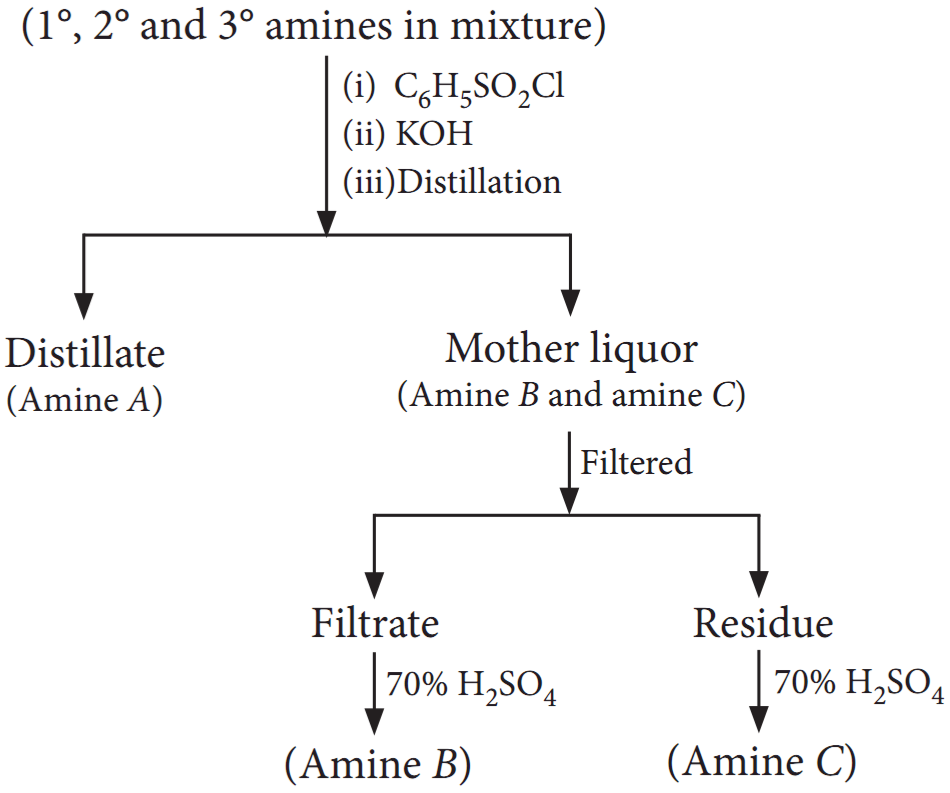
When the mixture contains the three amine salts (1º, 2º and 3º) along with quaternary salt, it is distilled with KOH solution. The three amines distill, leaving the quaternary salt unchanged in the solution. Then the mixture of amines is separated by fractional distillation, Hinsberg's method and Hoffmann's method.

The following questions are multiple choice questions. Choose the most appropriate answer:
  1. Hinsberg reagent is:
  1. Aliphatic sulphonyl chloride.
  2. Phthalamide.
  3. Aromatic sulphonyl chloride.
  4. Anhydrous ZnCl2 + cone. HCI.
  1. Primary amine with Hinsberg's reagent forms:
  1. N-alkyl benzene sulphonamide soluble in KOH solution.
  2. N-alkyl benzene sulphonamide insoluble in KOH solution.
  3. N, N-alkyl benzene sulphonamide soluble in KOH solution.
  4. N, N-alkyl benzene sulphonamide insoluble in KOH solution.
  1. Secondary amine with Hinsberg's reagent forms:
  1. N-alkyl benzene sulphonamide soluble in KOH solution.
  2. N-alkyl benzene sulphonamide insoluble in KOH solution.
  3. N,N-dialkyl benzene sulphonamide soluble in KOH solution.
  4. N,N-dialkyl benzene sulphonamide insoluble in KOH solution.
  1. To separate amines in a mixture Hoffmann's method is used. The Hoffman n's reagent is:
  1. Benzenesulphonyl chloride.
  2. Diethyl oxalate.
  3. Benzeneisocyanide.
  4. P-toulenesulphonic acid.
  1. 3º amines with Hinsberg's reagent give:
  1. No reaction.
  2. Product which is same as that of 1° amine.
  3. Product which is same as that of 2° amine.
  4. Products which is a quaternary salt.
Read the passage given below and answer the following questions:
Although chlorobenzene is inert to nucleophilic substitution, however it gives quantitative yield of phenol when heated with aq. $Na OH$ at high temperature and under high pressure. As far as electrophilic substitution in phenol is concemed the — $OH$ group is an activating group, hence, its presence enhances the electrophilic substitution at $o -$ and $p -$ positions.
The following questions are multiple choice questions. Choose the most appropriate answer:
  1. Conversion of chlorobenzene into phenol involves:
  1. Modified $S_N1$ mechanism.
  2. Modified $S_N2$ mechanism.
  3. Both $(a)$ and $(b).$
  4. Elimination$-$addition mechanism.
  1. Phenol undergoes electrophilic substitution more readily than benzene because:
  1. The intermediate carbocation is a resonance hybrid of more resonating structures than that from benzene.
  2. The intermediate is more stable as it has positive charge on oxygen, which can be better accommodated than on carbon.
  3. In one of the canonical structures, every atom $($except hydrogen$)$ has complete octet.
  4. The $— OH$ group is $o, p-$directing which like all other $o, p -$ directing group, is activating.
  1. Phenol on treatment with excess of cone. $HNO_3$ gives:
  1. $O -$ nitrophenol.
  2. $P -$ nitrophenol.
  3. $O -$ and $p -$ nitrophenol.
  4. $2, 4, 6 -$ trinitrophenol.
  1. Phenol is heated with a solution of mixture of $KBr$ and $KBrO_3.$ The major product obtained in the above reaction is:
  1. $2 -$ bromophenol.
  2. $3 -$ bromophenol.
  3. $4 -$ bromophenol.
  4. $2, 4, 6 -$ tribromophenol.
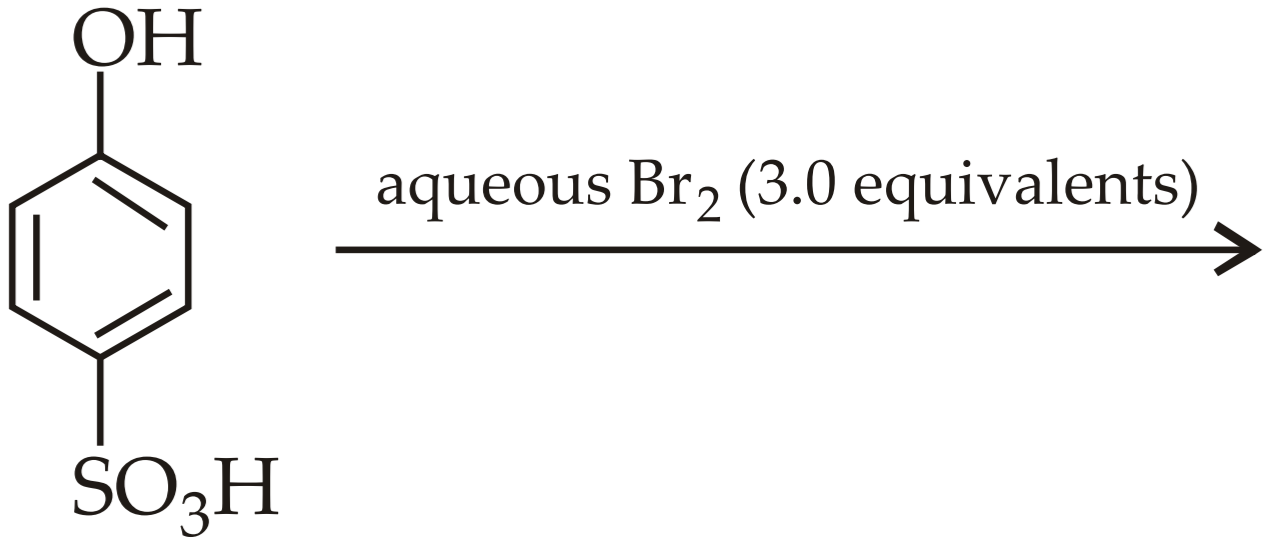
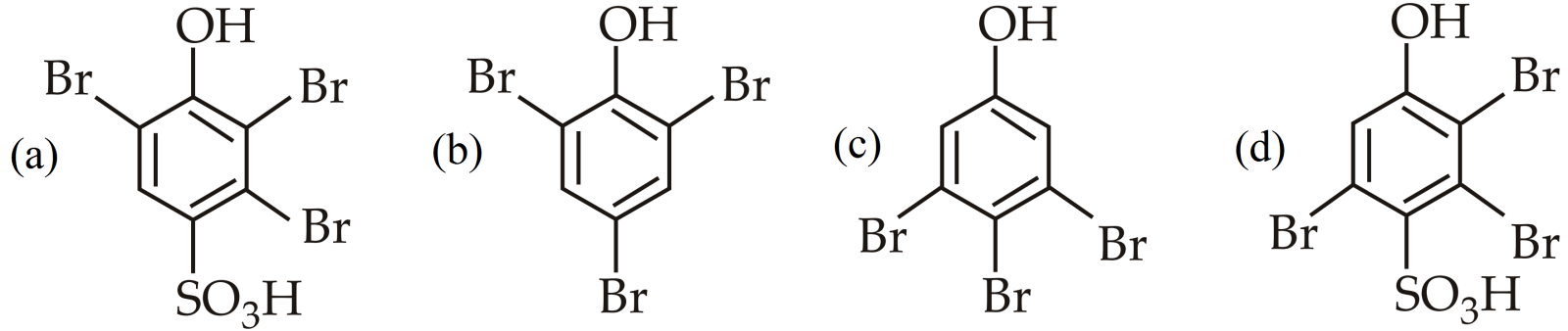
  1. The major product of the following reaction is:
Read the passage given below and answer the following questions: The phenomenon of the flow of solvent through a semipermeable membrane from pure solvent to the solution is called osmosis. Sometimes a pressure is applied to stop the process of osmosis, this is known as osmotic pressure. It is denoted by $\pi.$ Osmotic pressure is expressed as : $\pi=\text{CRT}$ Since, osmotic pressure depends upon the molar concentration of solution, therefore it is a colligative property. A statement of assertion followed by a statement of reason is given. Choose the correct answer out of the following choices.
  1. Assertion and reason both are correct statements and reason is correct explanation for assertion.
  2. Assertion and reason both are correct statements but reason is not correct explanation for assertion.
  3. Assertion is correct statement but reason is wrong statement.
  4. Assertion is wrong statement but reason is correct statement.
  1. Assertion: If red blood cells were removed from the body and placed in pure water, pressure inside the cells increases.
Reason: The concentration of salt content in the cells increases.
  1. Assertion: The osmotic pressure of a solution obtained by mixing 100mL of 3.4% solution of urea and 100mL of 1.6% solution of cane sugar at 293K is 7.46 bar.
Reason: The total osmotic pressure will be equal to the sum of partial osmotic pressures.
  1. Assertion: When a solution is separated from the pure solvent by a semipermeable membrane, the solvent molecules pass through it from pure solvent side to the solution side.
Reason: Diffusion of solvent occurs from a region of high concentration to a region of low concentration solution.
  1. Assertion: Two solutions having same osmotic pressure at a given temperature are called isotonic solutions.
Reason: Osmotic pressure is not a colligative property.
  1. Assertion: The preservation of meat by salting and fruits by adding sugar protects against bacterial action.
Reason: A bacterium on salted meat or candid fruit loses water due to osmosis shrivels and ultimately dies.
Read the passage given below and answer the following questions: Transition elements are elements that have partially filled $d-$orbitals. The configuration of these elements corresponds to$ (n - 1)d^{1-10} \ ns^{1-2}.$ It is important to note that the elements mercury, cadmium and zinc are not considered transition elements because of their electronic configurations, which corresponds to $(n - 1)d^{10} \ ns^2.$ Some general properties of transition elements are: These elements can fonn coloured compounds and ions due to $d-d$ transition; These elements exhibit many oxidation states; A large variety of ligands can bind themselves to these elements, due to this, a wide variety of stable complexes formed by these ions. The boiling and melting point of these elements are high. These elements have a large ratio of charge to the radius. In these questions $(Q.$ No. $i-iv),$ a statement of assertion followed by a statement ofreason is given. Choose the correct answer out of the following choices.
  1. Assertion: Tungsten has very high melting point.
Reason: Tungsten is a covalent compound.
  1. Assertion: $Zn, Cd$ and $Hg$ are normally not considered transition metals.
Reason: $d-$Orbitals in $Zn, Cd$ and $Hg$ elements are completely filled, hence these metals do not show the general characteristics properties of the transition elements.
  1. Assertion: Copper metal gets readily corroded in acidic aqueous solution such as $\ce{HCl}$ and dil. $\ce{H_2SO_4}.$
Reason: Free energy change for this process is positive.
  1. Assertion: Tailing of mercury occurs on passing ozone through it.
Reason: Due to oxidation of mercury.
  1. Assertion: Transition metals are poor reducing agents.
Reason: Transition metals fonn numerous alloys with other metals.