Question
Read the passage given below and answer the following questions:
When a solution of an et$-$amino acid is placed in an electric field depending on the $pH$ of the medium, following three cases may happen.

  1. In alkaline solution, $CL-$amino acids exist as anion $II,$ and there is a net migration of amino acid towards the anode.
  2. In acidic solution, a$-$amino acids exist as cation $III,$ and there is a net migration of amino acid towards the cathode.
  3. If $II$ and $III$ are exactly balanced there is no net migration; under such conditions any one molecule exists as a positive ion and as a negative ion for exactly the same amount of time, and any small movement in the direction of one electrode is subsequently cancelled by an equal movement back toward the other electrode. The $pH$ of the solution in which a particular amino acid does not migrate under the influence of an electric field is called the is oelectric point of that amino acid.
The following questions are multiple choice questions. Choose the most appropriate answer:
  1.  

Arrange in order of increasing acid strengths. 
  1. $\ce{X > Z > Y}$
  2. $\ce{Z < X < Y}$
  3. $\ce{X > Y > Z}$
  4. $\ce{Z > X > Y}$
  1. In aqueous solutions, amino acids mostly exist as:
  1. $\ce{NH_2 - CHR - COOH}$
  2. $\ce{NH_2 - CHR - COO^-}$
  3. $\stackrel{+}{\hbox{ N}}\text{H}_3\text{CHRCOOH}$
  4. $\text{H}_3\stackrel{{+}}{\hbox{N}}\text{CHRCOO}^-$
  1. Amino acids are least soluble:
  1. at $\ce{pH 1}$
  2. at $\ce{pH 7}$
  3. At their isoelectric points.
  4. None of these.
  1. The $\text{pK}_{\text{a}_1}$ and $\text{pK}_{\text{a}_2}$ of an amino acid are $2.3$ and $9.7$ respectively. The is oelectric point of the amino acid is:
  1. $12.0$
  2. $7.4$
  3. $6.0$
  4. $3.7$
  1. A tripeptide $(X)$ on partial hydrolysis gave two dipeptides $\ce{Cys-Gly}$ and $\ce{Glu-Cys.}$ Identify the tripeptide.
  1. $\ce{Glu-Cys-Gly}$
  2. $\ce{Gly-Glu-Cys}$
  3. $\ce{Cys-Gly-Glu}$
  4. $\ce{Cys-Glu-Gly}$

Answer

  1. $(a) \ce{X > Z > Y}$
Carboxytic acids are stronger acids than $-\stackrel{{+}}{\hbox{N}}\text{H}_3,$ therefore $X$ is the strongest acid. Since $–\ce{COOH}$ has $-I$ effect which decreases with distance therefore, effect is more pronounced on $Z$ than on $Y.$
As a result $Z$ is more acidic than $Y,$ therefore, overall order of increasing acid strength is $\ce{X > Z > Y.}$
  1. $(d)\ \text{H}_3\stackrel{{+}}{\hbox{N}}\text{CHRCOO}^-$
In aqueous solutions, amino acids mostly exist as zwitter ion or dipolar ion.
$\ \ \ \ \ \ \ \ \ \ \ \ \ \ \text{R}\\\ \ \ \ \ \ \ \ \ \ \ \ \ \ \ |\\\stackrel{{+}}{\hbox{N}}\text{H}_3-\text{CH}-\text{COO}^-\\\ \ \ \ \ \ \ \ \ \ \text{Zwitter ion}$
  1. $(c)$ At their isoelectric points.
Amino acids are least soluble at their isoelectric points. At a specific $pH,$ called isoelectric point, the positive and negative charges balance each other and the net charge becomes zero.
If there is a charge, the amino acid prefers to interact with water, rather than other amino acid molecules, this charge makes it more soluble.
  1. $(c) 6.0$
Isoelectric point $=\frac{2.3+9.7}{2}=6$
  1. $(a) \ce{Glu-Cys-Gly}$
Since the tripeptide on hydrolysis gave two dipeptides $\ce{Glu-Cys}$ and $\ce{Cys-Gly,}$
hence, cysteine must be in between glutamic acid and glycine as given below:
$\ \ \ \ \ \ \ \ \ \text{CH}_2\text{CH}_2\text{COOH}\\\ \ \ \ \ \ \ \ \ \ |\\\stackrel{{+}}{\hbox{N}}\text{H}_3\text{CH}-\text{C}-\text{NHCH}-\text{CNHCH}_2\text{CO}^-\\\ \ \ \ \ \ \ \ \ \ \ \ \ \ \ \ \ \ \ \ ||\ \ \ \ \ \ \ \ \ \ \ \ |\ \ \ \ \ \ \ \ \ ||\ \ \ \ \ \ \ \ \ \ \ \ \ \ \ ||\\\ \ \ \ \ \ \ \ \ \ \ \ \ \ \ \ \ \ \ \ \text{O}\ \ \ \ \ \ \text{HSCH}_2\ \ \text{O}\ \ \ \ \ \ \ \ \ \ \ \ \ \ \text{O}\\\ \ \ \ \ \ \ \ \ \ \ \ \ \ \ \ \ \ \ \ \ \ \text{Glu-Cys-Gly}$

Need a full question paper?

Generate a complete, print-ready paper with questions like this in minutes — across 16+ boards, with answer keys.

Start Generating Free

Similar questions

Read the passage given below and answer the following questions:
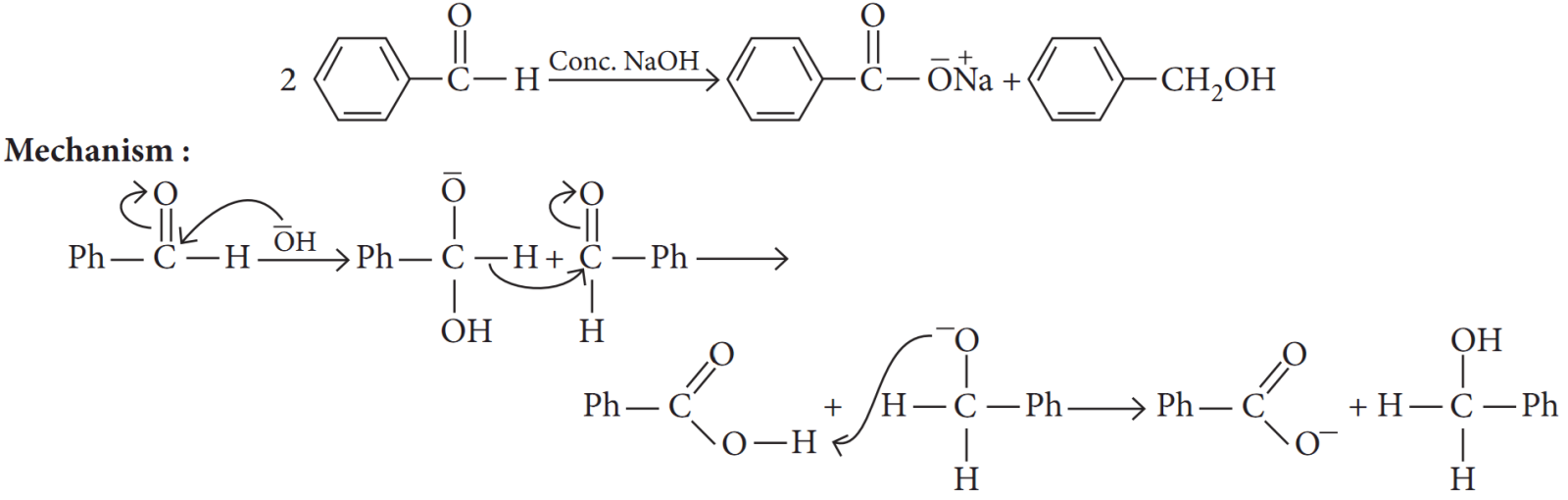
When an aldehyde with no et $-$ hydrogen reacts with concentrated aqueous $\ce{NaOH},$ half the aldehyde is converted to carboxylic acid salt and other half is converted to an alcohol. In other words, half of the reactant is oxidized and other half is reduced. This reaction is known as Cannizzaro reaction.

The following questions are multiple choice questions. Choose the most appropriate answer:
  1. A mixture of benzaldehyde and formaldehyde on heating with aqueous $\ce{NaOH}$ solution gives:
  1. Benzyl alcohol and sodium formate.
  2. Sodium benzoate and methyl alcohol.
  3. Sodium benzoate and sodium formate.
  4. Benzyl alcohol and methyl alcohol.
  1. Which of the following compounds will undergo Cannizzaro reaction?
  1. $\ce{CH_3CHO}$
  2. $\ce{CH_3COCH_3}$
  3. $\ce{C_6H_5CHO}$
  4. $\ce{C_6H_5CH_2CHO}$
  1. Trichloroacetaldehyde is subjected to Cannizzaro's reaction by using $\ce{NaOH}$. The mixture of the products contains sodium trichloroacetate ion and another compound. The other compounds is:
  1. $2, 2, 2-$ trichloroethanol.
  2. Trichloromethanol.
  3. $2, 2, 2-$ trichloropropanol.
  4. Chloroform.
  1. In Cannizzaro reaction given below:
$2\text{PhCHO}\xrightarrow{\stackrel{-}{\hbox{ OH}}}\text{PhCH}_2+\text{OH}+\text{PhCO}_2^-$ the slowest step is:
  1. The attack $^-OH$ at the carboxyl group.
  2. The transfer of hydride to the carbonyl group.
  3. The abstraction of proton from the carboxylic group.
  4. The deprotonation of $\ce{PhCH_2OH}.$
  1. Which of the following reaction will not result in the formation of carbon $-$ carbon bonds?
  1. Cannizzaro reaction.
  2. Wurtz reaction.
  3. Reimer $-$Tiemann reaction.
  4. Friedel $-$ Crafts' acylation.
Read the passage given below and answer the following questions :
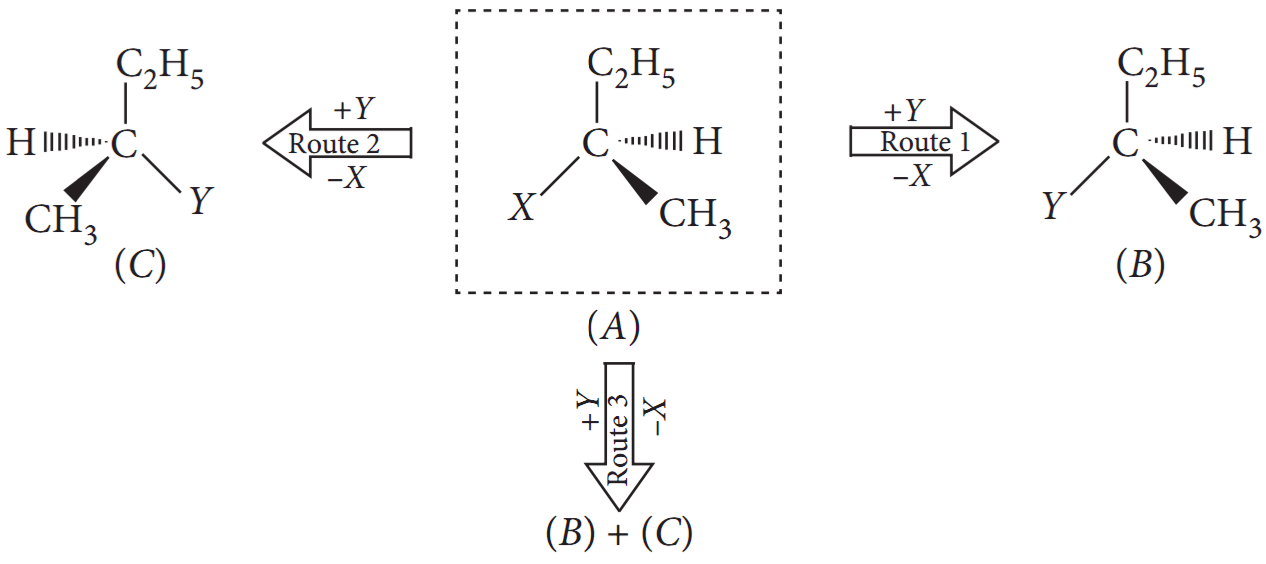
When a chemical reaction involves bond cleavage or bond formation at an asymmetric carbon atom, three different products may be formed.
For example, during the substitution of a group $X$ by $Y$ in the following reaction, the three possible products may be shown below:
  1. If Bis the only product, the process is called retention of configuration because $B$ has the same configuration as the starting reactant $(A).$
  2. If $C$ is the only product, the process is called inversion of configuration because $C$ has the configuration opposite to the starting reactant $(A).$
  3. If an equimolar mixture of Band $C\ ($r.e., a $50 : 50$ mixture$)$ is fanned, then the process is called racemisation and the product is optically inactive because one isomer will rotate the light in the direction opposite to another.
In these questions $(Q$. No. $i-iv),$ a statement of assertion followed by a statement of reason is given.
Choose the correct answer out of the following choices.
  1. Assertion and reason both are correct statements and reason is correct explanation for assertion.
  2. Assertion and reason both are correct statements but reason is not correct explanation for assertion.
  3. Assertion is correct statement but reason is wrong statement.
  4. Assertion is wrong statement but reason is correct statement.
  1. Assertion : A reaction is said to be stereospecific if a particular stereoisomer of the reactant produces a specific stereoisomer of the product.
Reason : Bromination of cis$-2-$butene gives meso$-2, 3-$dibromobutane which is stereospecific.
  1. Assertion: Addition of $Br_2$ to cis$-$but$-2-$ene is stereoselective.
Reason : $S_N2$ reactions are stereospecific as well as stereoselective.
  1. Assertion: Optically active $2-$iodobutane on treatment with Nal in acetone undergoes recemization.
Reason : Repeated Walden inversions on the reactant and its product eventually gives a racemic mixture.
  1. Assertion : $S_N2$ reaction of an optically active alkyl halide with an aqueous solution of $\text{KOH}$ always gives an alcohol with opposite sign of rotation.
Reason : $S_N2$ reactions always proceed with inversion of configuration.
  1. Assertion : Nudeophilic substitution reaction of an optically active alkyl halide gives a mixture of en an ti om ers.
Reason : The reaction occurs by $S_N2$ mechanism.
 
A reaction is said to be of the first order if the rate of the reaction depends upon one concentration term only. For a first order reaction of the type $A \rightarrow$ Products, the rate of the reaction is given as: rate $= k[A]$. The differential rate law is given as : $\frac{\text{dA}}{\text{dt}}=-\text{k}[\text{A}].$ The integrated rate law is : In $\frac{[\text{A}]}{[\text{A}]_0}=-\text{kt}, [A]$ is the concentration of reactant left at time $t$ and $[A]_0$ is the initial concentration of the reactant$, k$ is the rate constant.
The following questions are multiple choice questions. Choose the most appropriate answer :
  1. The unit of rate constant for a first order reaction is:
  1. $S^{-1}$
  2. $mol\ L^{-1} s^{-1}$
  3. $L\ mol^{-1} s^{-1}$
  4. $L^2\ mol^{-2} s^{-1}$
  1. Half$-$life period of a first order reaction is $10$ min. Starting with initial concentration $12M,$ the rate after $20$ min is:
  1. $0.693 \times 3M\ min^{-1}$
  2. $0.0693 \times 4M\ min^{-1}$
  3. $0.0693 \times M\ min^{-1}$
  4. $0.0693 \times 3M\ min^{-1}$
  1. $50\%$ of a first order reaction is complete in $23$ minutes. Calculate the ti me required to complete $90\%$ of the reaction.
  1. $70.4$ minutes.
  2. $76.4$ minutes.
  3. $38.7$ minutes.
  4. $35.2$ minutes.
  1. For a first order reaction$, (A) \rightarrow$ products, the concentration of $A$ changes from $0.1M$ to $0.025M$ in $40$ minutes. The rate of reaction when the concentration of $A$ is $0.01M,$ is:
  1. $3.47 \times 10^{-4} M/ min$
  2. $3.47 \times 10^{-5} M/ min$
  3. $1.73 \times 10^{-4} M/ min$
  4. $1.73 \times 10^{-5} M/ min$
  1. The half$-$life period ofa $1^{st}$ order reaction is $60$ minutes. What percentage will be left over after $240$ minutes?
  1. $6.25\%$
  2. $4.25\%$
  3. $5\%$
  4. $6\%$
Number of molecules which must collide simultaneously to give product is called molecularity. It is equal to sum of coefficients of reactants present in stoichiometric chemical equation. For reaction, $m_1A + m_2B \rightarrow$ Product Molecularity $= [m_1 + m_2]$ ln complex reaction each step has its own molecularity which is equal to the sum of coefficients of reactants present in a particular step. Molecularity is a theoretical property. Its value is any whole number. Number of concentration terms on which rate of reaction depends is called order of reaction or sum of powers of concentration terms present in the rate equation is called order of reaction. If rate equation ofreaction is: Rate $=\text{k}\cdot\text{C}^{\text{m}_1}_\text{A}\cdot\text{C}^{\text{m}_2}_\text{B}$ Then order of reaction $= m_1 + m_2.$ ln simple reaction, order and molecularity are same. ln complex reaction, order of slowest step is the order ofover all reaction. This step is known as rate determining step. Order is an experimental property. Its value may be zero, fractional or negative. The following questions are multiple choice questions. Choose the most appropriate answer:
  1. Higher order $(> 3)$ reactions are rare due to:
  1. Shifting of equilibrium towards reactants due to elastic collisions.
  2. Loss of active species on collision.
  3. Low probability of simultaneous collision of all the reacting species.
  4. Increase in entropy and activation energy as more molecules are involved.
  1. The molecularity of the reaction:
$6\text{FeSO}_4+3\text{H}_2\text{SO}_4+\text{KClO}_3\rightarrow\text{KCl}+3\text{Fe}_2(\text{SO}_4)_3+3\text{H}_2\text{O}$ is:
  1. $6$
  2. $10$
  3. $3$
  4. $7$
  1. Which of the following statements is false in the following?
  1. Order of a reaction may be even zero.
  2. Molecularity of a reaction is always a whole number.
  3. Molecularity and order always have same values for a reaction.
  4. Order of a reaction depends upon the mechanism of the reaction.
  1. The rate of reaction, $A + 2B \rightarrow$ products, is given by the following equation:
$-\frac{\text{d}[\text{A}]}{\text{dt}}=\text{k}[\text{A}][\text{B}]^2$
If B is present in large excess, the order of the reaction is:
  1. Zero
  2. First
  3. Second
  4. Third
  1. The rate of the reaction, $A + B + C \rightarrow$  products, is given by $\text{r}=\frac{\text{d}[\text{A}]}{\text{dt}}=\text{k}[\text{A}]^\frac{1}{2}[\text{B}]^\frac{1}{3}[\text{C}]^\frac{1}{4}.$ The order of the reaction is:
  1. $\frac{1}{3}$
  2. $\frac{1}{4}$
  3. $\frac{1}{2}$
  4. $\frac{13}{12}$
Read the passage given below and answer the following questions :
The transition elements have incompletely filled $d-$subshells in their ground state or in any of their oxidation states. The transition elements occupy position in betweens- and $p-$blocks in groups $3-12$ of the Periodic table. Starting from fourth period, transition elements consists of four complete series : $Sc$ to $Zn, Y$ to $Cd$ and $La, Hf$ to $Hg$ and $Ac, Rf$ to $Cn$. In general, the electronic configuration of outer orbitals of these elements is $(n - 1)d^{1-10} n^{1-2}$. The electronic configurations of outer orbitals of $Zn, Cd, Hg$ and $Cn$ are represented by the general formula $(n - 1)d^{10}ns^2$. All the transition elements have typical metallic properties such as high tensile strength, ductility, malleability. Except mercury, which is liquid at room temperature, other transition elements have typical metallic structures. The transition metals and their compounds also exhibit catalytic property and paramagnetic behaviour. Transition metal also forms alloys. An alloy is a blend of metals prepared by mixing the components. Alloys may be homogeneous solid solutions in which the atoms of one metal are distributed randomly among the atoms of the other.
The following questions are multiple choice questions. Choose the most appropriate answer:
  1. Which of the following characteristics of transition metals is associated with higher catalytic activity?
  1. High enthalpy of atomisation.
  2. Variable oxidation states.
  3. Paramagnetic behaviour.
  4. Colour of hydrated ions.
  1. Transition elements form alloys easily because they have.
  1. Same atomic number.
  2. Same electronic configuration.
  3. Nearly same atomic size.
  4. Same oxidation states.
  1. The electronic configuration of tantalum $(Ta)$ is:
  1. $[Xe]4f^05d^16s^2$
  2. $[Xe]4f^{14}5d^26s^2$
  3. $[Xe]4f^{14}5d^36s^2$
  4. $[Xe]4f^{14}5d^46s^2$
  1. Which one of the following outer orbital configurations may exhibit the largest number of oxidation states?
  1. $3d^54s^1$
  2. $3d^54s^2$
  3. $3d^24s^2$
  4. $3d^34s^2$
  1. The correct statement$(s)$ among the following is/ are :
  1. All $d$ and $f-$block elements are metals.
  2. All $d$ and $f-$block elements form coloured ions.
  3. All $d$ and $f-$block elements are paramagnetic.
  1. $(I)$ only
  2. $(I)$ and $(II)$ only
  3. $(II)$ and $(III)$ only
  4. $(I), (II)$ and $(III)$
Read the passage given below and answer the following questions: Fehling's reagent: Fehling's reagent is a mixture of two solutions. Fehllng's solution $A$ is aqueous copper sulphate solution. Fehling's solution Bis alkaline sodium potassium tartarate $($Rochelle salt$). \ \ \ \ \ \ \ \ \ \ \ \ \ \ \ \ \ \ \ \ \text{CH(OH)COONa}\\\text{CuSo}_{4\text{(aq)}}+|\\\ \ \ \ \ \ \ \ \ \ \ \ \ \ \ \ \ \ \ \ \text{CH(OH)COOK}$ It is a mild oxidising agent. It is weaker than Tollens' reagent. It oxidises only aliphatic aldehydes to carboxylate ions and itself gets reduced to reddish brown precipitate of cuprous oxide. Aromatic aldehydes do not respond to Fehling's test. This reaction is used for the test of aliphatic aldehydes known as Fehling's reagent test. In these questions $(Q$. No. $l-iv),$ a statement of assertion followed by a statement ofreason is given. Choose the correct answer out of the following choices.
  1. Assertion and reason both are correct statements and reason is correct explanation for assertion.
  2. Assertion and reason both are correct statements but reason is not correct explanation for assertion.
  3. Assertion is correct statement but reason is wrong statement.
  4. Assertion is wrong statement but reason is correct statement.
  1. Assertion : Fehling's solution can be used to distinguish between acetaldehyde and acetone.
Reason : Fehling's reagent is a mixture of two solutions.
  1. Assertion : Aromatic aldehydes can be distinguished from aliphatic aldehydes by Fehling's solution.
Reason : Aromatic aldehydes reduce Fehling's solution, but aliphatic aldehydes do not.
  1. Assertion : Fehling's solution oxidises acetaldehyde to acetic acid but not benzaldehyde to benzoic acid.
Reason : The $C-H$ bond of $-\text{CHO}$ group in benzaldehyde is stronger than in acetaldehyde.
  1. Assertion : $\ce{CH_3CHO}$ and $\ce{C_6H_5CH_2CHO}$ cannot be distinguished chemically by Fehling's solution.
Reason : $\ce{CH_3CHO}$ and $\ce{C_6H_5CH_2CHO}$ cannot be distinguished chemically by Fehling's solution.
  1. Assertion : Formaldehyde, when heated with Fehling's reagent produces a reddish brown ppt, of $\ce{Cu}$.
Reason : Fehling's reagent oxidises fonnaldehyde to formate ion.
Read the passage given below and answer the following questions:
The solubility of gases increases with increase of pressure. William Henry made a systematic investigation of the solubility of a gas in a liquid. According to Henry's law "the mass of a gas dissolved per unit volume of the solvent at constant temperature is directly proportional to the pressure of the gas in equilibrium with the solution". Dalton during the same period also concluded independently that the solubility of a gas in a ti quid solution depends upon the partial pressure of the gas. If we use the mole fraction of gas in the solution as a measure of its solubility, then Henry's law can be modified as "the partial pressure of the gas in the vapour phase is directly proportional to the mole fraction of the gas in the solution"
The following questions are multiple choice questions. Choose the most appropriate answer:
  1. Henry's law constant for the solubility of methane in benzene at $298K$ is $4.27 \times 10^5\ mm\ Hg$. The solubility of methane in benzene at $298K$ under $760\ mm\ Hg$ is :
  1. $4.27 \times 10^{-5}$
  2. $1.78 \times 10^{-3}$
  3. $4.27 \times 10^{-3}$
  4. $1.78 \times 10^{-5}$
  1. The partial pressure of ethane over a saturated solution containing $6.56 \times 10^{-2}g$ of ethane is $I$ bar. If the solution contains $5.00 \times 10^{-2}g$ of ethane then what will be the partial pressure $($in bar$)$ of the gas?
  1. $0.762$
  2. $1.312$
  3. $3.81$
  4. $5.0$
  1. $K_H\ (K$ bar$)$ values for $\ce{Ar(g), CO2(g), HCHO(g)}$ and $\ce{CH4(g)}$ are $40.39, 1.67, 1.83 \times 10^{-5}$ and $0.413$ respectively. Arrange these gases in the order of their increasing solubility. Arrange these gases in the order of their increasing solubility.
  1. $\ce{HCHO < CH4 < CO2 < Ar}$
  2. $\ce{HCHO < CO2 < CH4 < Ar}$
  3. $\ce{Ar < CO2 < CH4 < HCHO}$
  4. $\ce{Ar < CH4 < CO2 < HCHO}$
  1. When a gas is bubbled through water at $298K,$ a very dilute solution of the gas is obtained. Henry's law constant for the gas at $298K$ is $150k$ bar. If the gas exerts a partial pressure of $2$ bar, the number of millimoles of the gas dissolved in $IL$ of water is :
  1. $0.55$
  2. $0.87$
  3. $0.37$
  4. $0.66$
  1. Which of the following statements is correct?
  1. $K_H$ increases with increase of temperature.
  2. $K_H$ decreases with increase of temperature.
  3. $K_H$ remains constant with increase of temperature.
  4. $K_H$ first increases then decreases, with increase of temperature.
Read the passage given below and answer the following questions:
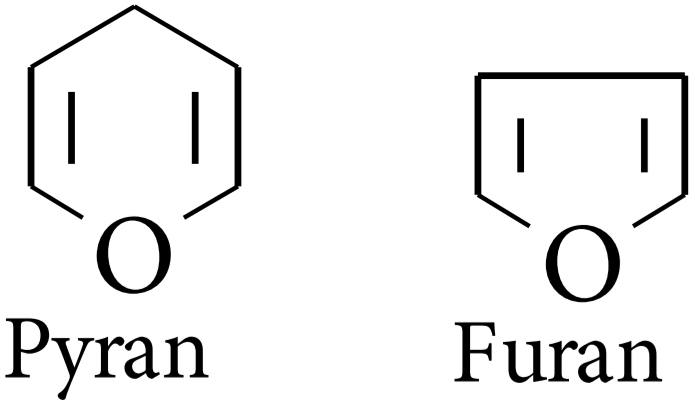
Pentose and hexose undergo intramolecular hemiacetal or hemiketal formation due to combination of the $–\ce{OH}$ group with the carbonyl group. The actual structure is either of five or six membered ring containing an oxygen atom. In the free state all pentoses and hexoses exist in pyranose form $($resembling pyran$).$ However,inthe combined state some of them exist as five membered cyclic structures, called furanose $($resembling furan$).$

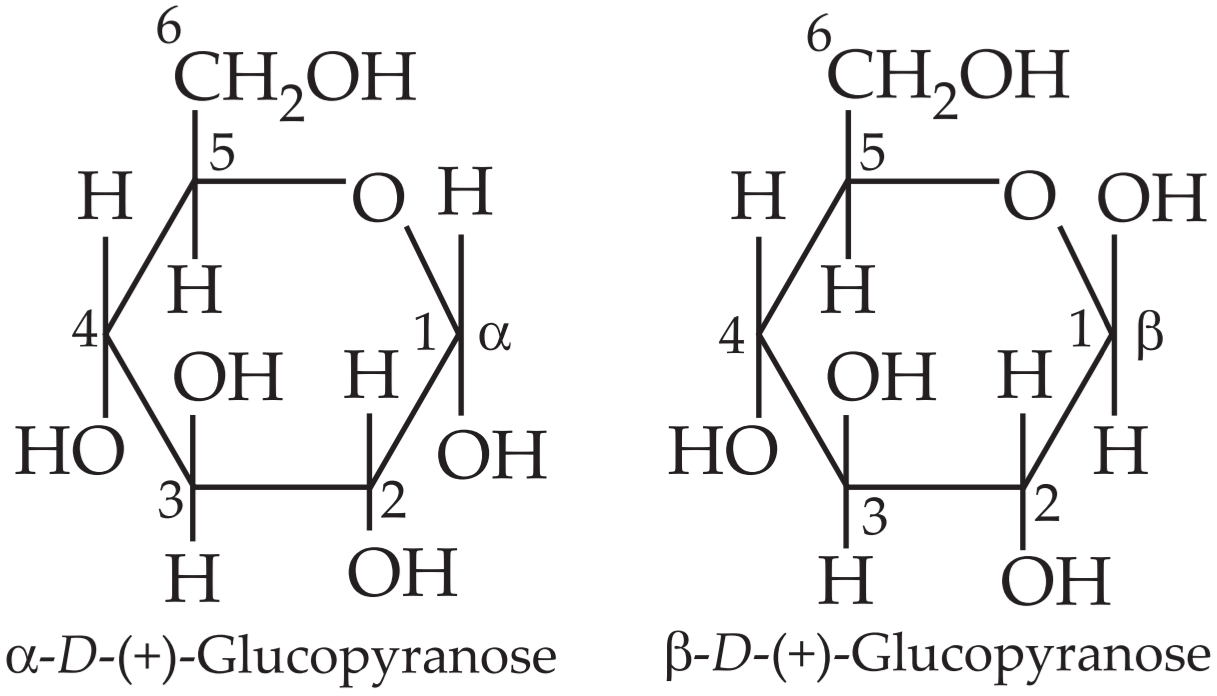
The cyclic structure of glucose is represented by Haworth structure:

$\alpha$ and $\beta D-$glucose have different configuration at anomeric $(C-1)$ carbon atom, hence are called anomers and the $C-1$ carbon atom is called anomeric carbon $($glycosidic carbon$).$
The six membered cyclic structure of glucose is called pyranose structure.
The following questionsare multiple choice questions. Choose the most appropriate answer:
  1. $\alpha D(+)-$glucose and $\beta D(+)$ glucose are:
  1. Enantiomers.
  2. Conformers.
  3. Epimers.
  4. Anomers.
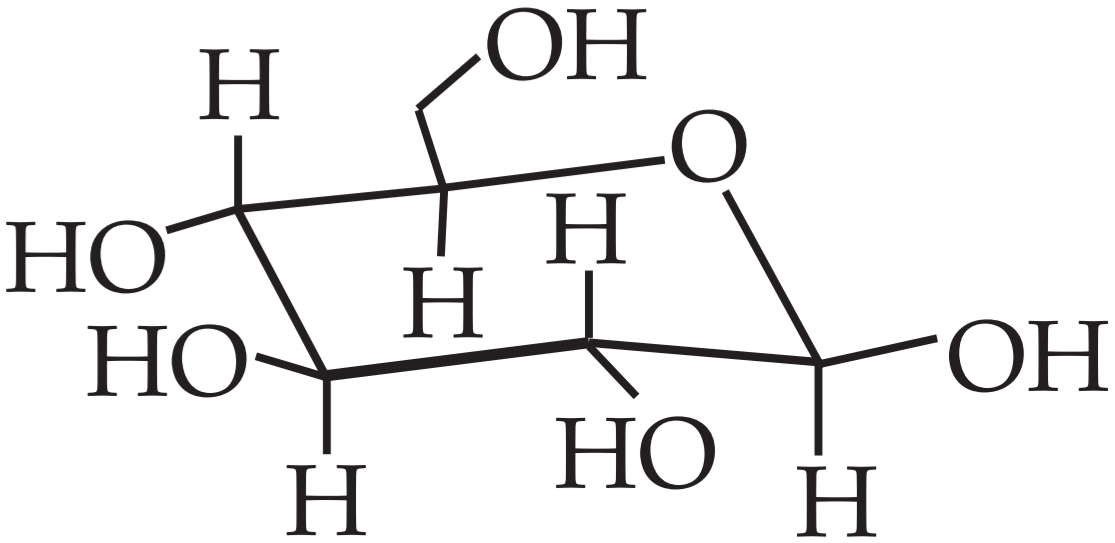
  1. The following carbohydrate is:
 
  1. A ketohexose.
  2. An aldohexose.
  3. An $n-$furanose.
  4. An $\alpha-$pyranose.
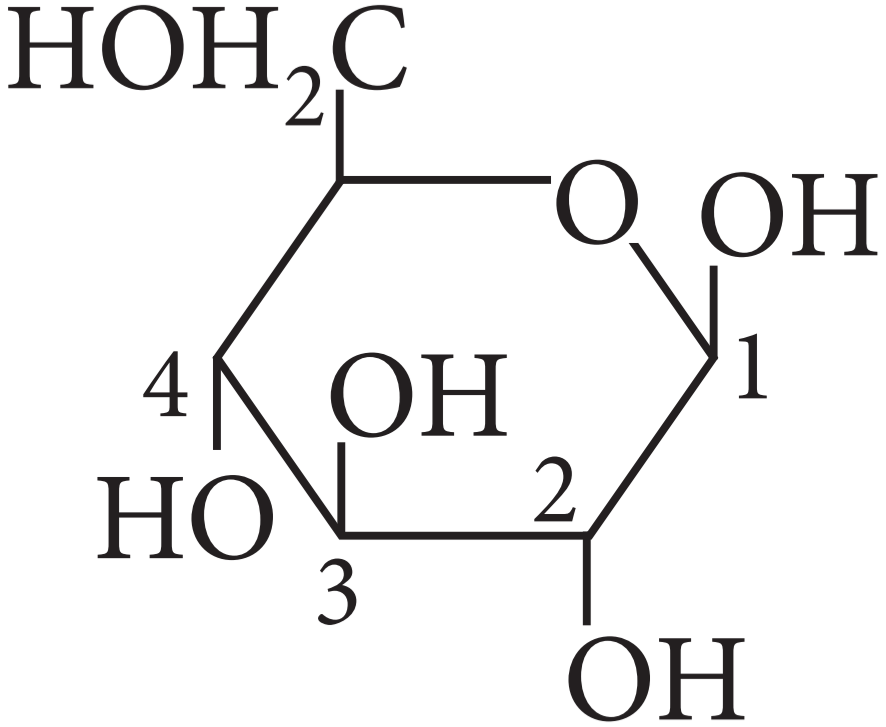
  1. In the following structure, anomeric carbon is:
  1. $C-1$
  2. $C-2$
  3. $C-3$
  4. $C-4$
  1. The term anomers of glucose refers to:
  1. Isomers of glucose that differ in configurations at carbons one and four $(C-1$ and $C-4).$
  2. A mixture of $(D)-$glucose and $(L)-$glucose.
  3. Enantiomers of glucose.
  4. Isomers of glucose that differ in configuration at carbon one $(C-1).$
  1. What percentage of $\beta-D-(+)$ glucopyranose is found at equilibrium in the aqueous solution?
  1. $50\%$
  2. $\approx100%$
  3. $36\%$
  4. $64\%$
Electrical work done in unit time is equal to electrical potential multiplied by total charge passed. ln order to obtain maximum work from a cell, the charge has to be passed reversibly. The reversible work done by a cell is equal to decrease in its Gibb's energy. Hence, Gibb's energy of reaction is given by $\Delta\text{G}=\text{nFE}_\text{cell}$ Hence, Eis the emfof the cell and $nF$ is the amount of energy. In these questions $(Q$. No. $i-Iv),$ a statement of assertion followed by a statement ofreason is given. Choose the correct answer out of the following choices.
  1. Assertion and reason both are correct statements and reason is correct explanation for assertion.
  2. Assertion and reason both are correct statements but reason is not correct explanation for assertion.
  3. Assertion is correct statement but reason is wrong statement.
  4. Assertion is wrong statement but reason is correct statement.
  1. Assertion : $\Delta\text{G}^\circ=-\text{nFE}^\circ$
Reason : $E^\circ$ ​​​​​​​ should be positive for a spontaneous reaction.
  1. Assertion : An electrochemical cell can be set up only if the red ox reaction is spontaneous.
Reason : A reaction is spontaneous if free energy change is negative.
  1. Assertion : For an electrochemical cell, $\Delta\text{G}<0$ and $\text{E}_\text{cell}>0.$
Reason : The given cell is non $-$ spontaneous.
  1. Assertion : Current stops flowing when $E_\text{cell} = 0$.
Reason : Equilibrium of the cell reaction is attained.
  1. Assertion :$ E_\text{cell}$ should have a positive value for the cell to function.
Reason : $E_\text{cell} = E_\text{cathode} - E_\text{anode}$
Read the passage given below and answer the following questions: Lucas test is a test to differentiate between primary, secondary and tertiary alcohols. This test consists of treating an alcohol with Lucas' reagent, and turbidity, due to the formation of insoluble alkyl chloride, is observed. Lucas test is based on the difference in reacting of three classes of alcohols with hydrogen chloride via $S_N1$ reaction. The different reactivity reflects the differing ease of formation of the corresponding carbocations. In these questions $($Q. No. $i-iv),$ a statement of assertion followed by a statement ofreason is given. Choose the correct answer out of the following choices.
  1. Assertion and reason both are correct statements and reason is correct explanation for assertion.
  2. Assertion and reason both are correct statements but reason is not correct explanation for assertion.
  3. Assertion is correct statement but reason is wrong statement.
  4. Assertion is wrong statement but reason is correct statement.
  1. Assertion: Equimolar mixture of cone. $\ce{HCI}$ and anhydrous $\ce{ZnCl_2}$ is called Lucas' reagent.
Reason: Lucas' reagent can be used to distinguish between methanol and ethanol.
  1. Assertion: $2-$Methyl$-2-$butanol gives no turbidity with Lucas' reagent at room temperature.
Reason: It is a $3^\circ$ alcohol.
  1. Assertion: Tertiary alcohols react fastest with Lucas' reagent by $S_N1$ mechanism.
Reason: $3^\circ$ carbocation is most stable.
  1. Assertion: Amongst the compounds, $\ce{H2C = CHCH_2OH (I), C_6H_5OH (II), CH_3CH_2CH_2OH (III)}$ and $\ce{(CH_3)_3COH (IV),}$ only $\ce{(IV)}$ reacts with Lucas' reagent at room temperature.
Reason: Tertiary alcohol gives turbidity immediately with Lucas' reagent.
  1. Assertion: Lucas test can be used to distinguish between $1-$propanol and $2-$propanol.
Reason: Lucas test is based upon the difference in reactivity of primary, secondary and tertiary alcohols with cone. $\ce{HCI}$ and anhyd. $\ce{ZnCl_2.}$