Question
Read the passage given below and answer the following questions from 1 to 5.
Chemistry is the science of molecules and theirtransformations. It is the science not so much of the one hundred elements but of the infinite variety of molecules thatmay be built from them. Chemistry plays a central role in science andis often intertwined with other branches ofscience.to understand thebasic concepts of chemistry, which begin withthe concept of matter. Let us start with thenature of matter. matter can exist in threephysical states viz. solid, liquid and gas.Particles are held very close to each otherin solids in an orderly fashion and there is notmuch freedom of movement. In liquids, theparticles are close to each other but they canmove around. However, in gases, the particlesare far apart as compared to those present insolid or liquid states and their movement iseasy and fast. different states of matter exhibitthe following characteristics:
  1. Solids have definite volume and definiteshape.
  2. Liquids have definite volume but do nothave definite shape. They take the shapeof the container in which they are placed.
  3. Gases have neither definite volume nordefinite shape. They completely occupy thespace in the container in which they are placed.
Matter can be classified as mixture or pure substance. A mixture may be homogeneous or heterogeneous. Pure substances can further be classified into elements and compounds. Particles of an element consist of only one type of atoms. These particles may exist as atoms or molecules. When two or more atoms of different elements combine together in a definite ratio, the molecule of a compound is obtained.
Every substance has unique or characteristic properties. These properties can be classified into two categories — physical properties, such as colour, odour, melting point, boiling point, density, etc., and chemical properties, like composition, combustibility, ractivity with acids and bases, etc. Physical properties can be measured or observed without changing the identity or the composition of the substance. The measurement or observation of chemical properties requires a chemical change to occur. Measurement of physical properties does not require occurance of a chemical change.
  1. Which of the following state of matter have definite volume but do not have definite shape?
  1. Solid
  2. Liquid
  3. Gas
  4. Plasma
  1. Particles are held very close to each other in … in an orderly fashion and there is not much freedom of movement.
  1. Liquid
  2. Gas
  3. Solid
  4. Plasma
  1. Particles of …. consist of only one type of atom.
  1. Compound
  2. Mixture
  3. Element
  4. All the above
  1. Water molecule comprises …hydrogen atoms and … oxygen atom.
  1. One, two
  2. Three, one
  3. One, three
  4. Two, one
  1. Which of the following is not an example of Physical Properties of substance.?
  1. Odour
  2. Melting point
  3. Density
  4. Composition

Answer

  1. (b) Liquid
  1. (c) Solid
  1. (c) Element
  1. (d) Two, one.
  1. (d) Composition

Need a full question paper?

Generate a complete, print-ready paper with questions like this in minutes — across 16+ boards, with answer keys.

Start Generating Free

Similar questions

Read the passage given below and answer the following questions from $(i)$ to $(v).$
Predicting the Direction of the Reaction- The equilibrium constant helps in predicting the direction in which a given reaction will proceed at any stage. For this purpose, we calculate the reaction quotient $Q$. The reaction quotient, $Q (Qc$ with molar concentrations and $QP$ with partial pressures$)$ is defined in the same way as the equilibrium constant Kc except that the concentrations in $Qc$ are not necessarily equilibrium values. For a general reaction:
$\text{a}\text{A}+\text{b}\text{B}\rightleftharpoons\text{c}\text{C}+\text{d}\text{D}$
$\text{Q}\text{c}=\frac{[\text{C}]^\text{c}[\text{D}]^\text{d}}{[\text{A}]^\text{a}[\text{B}]^\text{b}}$
Then,
If $Qc > Kc,$ the reaction will proceed in the direction of reactants (reverse reaction).
If $Qc < Kc,$ the reaction will proceed in the direction of the products (forward reaction).
If $Qc = Kc,$ the reaction mixture is already at equilibrium. Consider the gaseous reaction of $H_2$ with $I_2$ ,
$\text{H}_{2(\text{g})}+\text{l}_{2(\text{g})}\rightleftharpoons2\text{Hl}_{(\text{g})};\text{kc}=57.0\text{at}700\text{k}.$
Suppose we have molar concentrations $[H_2 ]t =0.10M, [I_2 ]t = 0.20 M$ and $[HI]t = 0.40 M.$ (the subscript t on the concentration symbols means that the concentrations were measured at some arbitrary time t, not necessarily at equilibrium). Thus, the reaction quotient, Qc at this stage of the reaction is given by,
$\text{Qc}=\frac{[\text{Hl}]\text{t}^2}{[\text{H}]^2]_\text{t}[\text{l}_2]_\text{t}}=\frac{(0.40)_2}{(0.10)\times(0.20)}=8.0$
Now, in this case, $Qc (8.0)$ does not equal Kc $(57.0)$, so the mixture of $H2 _{(g)}, I2 _{(g)} $ and $HI_{(g)} $ is not at equilibrium; that is, more $H2 _{(g)} $ and $I 2 _{(g)} $ will react to form more $HI_{(g)} $ and their concentrations will decrease till $Qc = Kc.$ The reaction quotient, Qc is useful in predicting the direction of reaction by comparing the values of Qc and Kc.Thus, we can make the following generalisations concerning the direction of the reaction
If $Qc < Kc,$ net reaction goes from left to right
If $Qc > Kc,$ net reaction goes from right to left.
If $Qc = Kc,$ no net reaction occurs.
Calculating Equilibrium Concentrations In case of a problem in which we know the initial concentrations but do not know any of the equilibrium concentrations, the following three steps shall be followed:
Step 1) Write the balanced equation for the reaction.
Step 2) Under the balanced equation, make a table that lists for each substance involved in the reaction: $(a)$ the initial concentration, $(b)$ the change in concentration on going to equilibrium, and $(c)$ the equilibrium concentration. In constructing the table, define $x$ as the concentration (mol/L) of one of the substances that reacts on going to equilibrium, then use the stoichiometry of the reaction to determine the concentrations of the other substances in terms of $x.$
Step 3) Substitute the equilibrium concentrations into the equilibrium equation for the reaction and solve for x. If you are to solve a quadratic equation choose the mathematical solution that makes chemical sense.
Step 4) Calculate the equilibrium concentrations from the calculated value of $x.$
Step 5) Check your results by substituting them into the equilibrium equation.
Relationship between equilibrium constant K, reaction quotient Q and gibbs energy G The value of Kc for a reaction does not depend on the rate of the reaction. However, it is directly related to the thermodynamics of the reaction and in particular, to the change in Gibbs energy, $\triangle\text{G}.$ If,
$\triangle\text{G}$ is negative, then the reaction is spontaneous and proceeds in the forward direction.
$\triangle\text{G}$ is positive, then reaction is considered non-spontaneous. Instead, as reverse reaction would have a negative $\triangle\text{G},$ the products of the forward reaction shall be converted to the reactants.
$\triangle\text{G}$ is 0, reaction has achieved equilibrium; at this point, there is no longer any free energy left to drive the reaction. A mathematical expression of this thermodynamic view of equilibrium can be described by the following equation:
$\triangle\text{G}=\triangle\text{G}^\phi+\text{RT}\text{lnQ}$
where, $\triangle\text{G}^\phi$ is standard Gibbs energy. At equilibrium, when $\triangle\text{G}=0$ and $Q = Kc,$ the equation becomes,
$\triangle\text{G}=\text{G}^\phi+\text{RT}\text{lnk}=0$
$\triangle\text{G}^\phi=-\text{RT}\text{lnk}$
$\text{Ink}=\frac{-\triangle\text{G}^\phi}{\text{RT}}$
Taking antilog of both sides, we get,
$\text{K}=\text{e}-\frac{\triangle\text{G}0}{\text{RT}}$
Hence, using the equation, the reaction spontaneity can be interpreted in terms of the value of $\triangle\text{G}^\phi.$
If $\triangle\text{G}^\phi>0$ then $\frac{-\triangle\text{G}^\phi}{\text{RT}}$ is positive, and $>1$, making $K > 1$, which implies a spontaneous reaction or the reaction which proceeds in the forward direction to such an extent that the products are present predominantly.
If $\triangle\text{G}^\phi>0,$ then $\frac{-\triangle\text{G}^\phi}{\text{RT}}$ is negative, and $< 1$, that is, $K < 1$, which implies a non-spontaneous reaction or a reaction which proceeds in the forward direction to such a small degree that only a very minute quantity of product is formed.
Factors affecting equilibria One of the principal goals of chemical synthesis is to maximise the conversion of the reactants to products while minimizing the expenditure of energy. This implies maximum yield of products at mild temperature and pressure conditions. If it does not happen, then the experimental conditions need to be adjusted. For example, in the Haber process for the synthesis of ammonia from $N_2$ and $H_2,$ the choice of experimental conditions is of real economic importance. Annual world production of ammonia is about hundred million tones, primarily for use as fertilizers. Equilibrium constant, Kc is independent of initial concentrations. But if a system at equilibrium is subjected to a change in the concentration of one or more of the reacting substances, then the system is no longer at equilibrium; and net reaction takes place in some direction until the system returns to equilibrium once again. Similarly, a change in temperature or pressure of the system may also alter the equilibrium. In order to decide what course the reaction adopts and make a qualitative prediction about the effect of a change in conditions on equilibrium we use Le Chatelier’s principle. It states that a change in any of the factors that determine the equilibrium conditions of a system will cause the system to change in such a manner so as to reduce or to counteract the effect of the change. This is applicable to all physical and chemical equilibria.
Effect of Concentration Change In general, when equilibrium is disturbed by the addition/removal of any reactant/ products, Le Chatelier’s principle predicts that:
The concentration stress of an added reactant/product is relieved by net reaction in the direction that consumes the added substance.
The concentration stress of a removed reactant/product is relieved by net reaction in the direction that replenishes the removed substance. or in other words, “When the concentration of any of the reactants or products in a reaction at equilibrium is changed, the composition of the equilibrium mixture changes so as to minimize the effect of concentration changes”. Let us take the reaction,
$\text{H}_{2(\text{g})}+\text{l}_{2(\text{g})}\rightleftharpoons2\text{Hl}_{(\text{g})}$
If $H_2$ is added to the reaction mixture at equilibrium, then the equilibrium of the reaction is disturbed. In order to restore it, the reaction proceeds in a direction wherein $H_2$ is consumed, i.e., more of $H_2$ and $I_2$ react to form HI and finally the equilibrium shifts in right (forward) direction. This is in accordance with the Le Chatelier’s principle which implies that in case of addition of a reactant/product, a new equilibrium will be set up in which the concentration of the reactant/product should be less than what it was after the addition but more than what it was in the original mixture. The same point can be explained in terms of the reaction quotient, $Qc,$​​​​​​​​​​​​​​
Case Study Questions Class 11 Chemistry – Equilibrium
$\text{Qc}=\frac{[\text{HI}]^2}{[\text{H}]_2[\text{I}]_2}$
Addition of hydrogen at equilibrium results in value of $Qc$ being less than $Kc$. Thus, in order to attain equilibrium again reaction moves in the forward direction. Similarly, we can say that removal of a product also boosts the forward reaction and increases the concentration of the products and this has great commercial application in cases of reactions, where the product is a gas or a volatile substance. In case of manufacture of ammonia, ammonia is liquified and removed from the reaction mixture so that reaction keeps moving in forward direction. Similarly, in the large scale production of $CaO$ (used as important building material) from $CaCO_3$, constant removal of $CO_2$ from the kiln drives the reaction to completion. It should be remembered that continuous removal of a product maintains Qc at a value less than Kc and reaction continues to move in the forward direction.
  1. If … the reaction will proceed in the direction of reactants (reverse reaction).
  1. $Qc > Kc$
  2. $Qc < Kc$
  3. $Qc = Kc$
  4. None of above
  1. If … the reaction will proceed in the direction of the products (forward reaction).
  1. $Qc > Kc$
  2. $Qc < Kc$
  3. $Qc = Kc$
  4. None of above
  1. If … the reaction mixture is already at equilibrium. Consider the gaseous reaction.
  1. $Qc > Kc$
  2. $Qc < Kc$
  3. $Qc = Kc$
  4. All of above
  1. If $\triangle\text{G}$ is …. then the reaction is spontaneous and proceeds in the forward direction.
  1. Zero
  2. Positive
  3. Negative
  4. None of above
  1. $\triangle\text{G}$ is … reaction has achieved equilibrium; at this point, there is no longer any free energy left to drive the reaction.
  1. Zero
  2. Positive
  3. Negative
  4. None of above
The existing large number of organic compounds and their ever-increasing numbers has made it necessary to classify them on the basis of their structures. Organic compounds are broadly classified as open-chain compounds which are also called aliphatic compounds. Aliphatic compounds further classified as homocyclic and heterocyclic compounds. Aromatic compounds are special types of compounds. Alicyclic compounds, aromatic compounds may also have heteroatom in the ring. Such compounds are called heterocyclic aromatic compounds. Organic compounds can also be classified on the basis of functional groups, into families or homologous series. The members of a homologous series can be represented by general molecular formula and the successive members differ from each other in a molecular formula by a $- CH _2$ unit.

1. The successive members of a homologous series differ by which mass of amu?
OR
Is tetrahydrofuran is aromatic compounds?
2. Does Pyridine, pyrrole, thiophene are all heteroaromatic compounds
3. Difference between heterocyclic and homocyclic compound.
In order to explain the characteristic geometrical shapes of polyatomic molecules, Pauling introduced the concept of hybridisation. The orbitals undergoing hybridisation should have nearly the same energy. There are various type of hybridisations involving s, p and d-type of orbitals. The type of hybridisation gives the characteristic shape of the molecule or ion.

1. Why all the orbitals in a set of hybridised orbitals have the same shape and energy?
2. Out of $XeF _2$ and $SF _2$ which molecule has the same shape as $NO _2^{+}$ion?
3. Out of $XeF _4$ and $XeF _2$ which molecule doesn't have the same type of hybridisation as P (Phosphorus) has in $PF _5$ ?
OR
Unsaturated compounds undergo additional reactions. Why?
Read the passage given below and answer the following questions from 1 to 5.
Hydrogen Peroxide $(H_2O_2)$ Hydrogen peroxide is an important chemical used in pollution control treatment of domestic and industrial effluents.It can be prepared by the following methods.
i) Acidifying barium peroxide and removing excess water by evaporation under reduced pressure gives hydrogen.
$\text{BaO}_2.8\text{H}_2\text{O}(\text{s})+\text{H}_2\text{SO}_4\text{(aq)}\rightarrow\text{BaSO}_4\text{(s)}+\text{H}_2\text{O}_2\text{(aq)}+8\text{H}_2\text{O}\text{l}$
ii) Peroxodisulphate, obtained by electrolytic oxidation of acidified sulphate solutions at high current density, on hydrolysis yields hydrogen.
$2\text{HSO}_\bar{4}(\text{aq})\xrightarrow{\text{Electrolysis}}\text{HO}_3\text{SOOSO}_3\text{H}(\text{aq})\xrightarrow{\text{Hydrolysis}}2\text{HSO}_\bar{4}\text{(aq)}+2\text{H}^+\text{(aq)}+\text{H}_2\text{O}_2\text{aq}$
This method is now used for the laboratory preparation of $D_2O_{2.}$
_{$\text{K}_2\text{S}_2\text{O}_8(\text{s})+2\text{D}_2\text{O}\text{(l)}\rightarrow2\text{KDSO}_4(\text{aq})+\text{D}_2\text{O}_2\text{(l)}$}
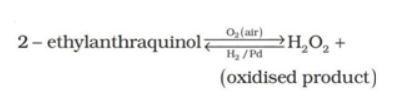
iii) Industrially it is prepared by the auto- oxidation of 2-alklylanthraquinols. 2 ethylanthraquinol H O oxidised product.

In this case 1% $H_2O_2$ is formed. It is extracted with water and concentrated to $\sim30\%$ (by mass) by distillation under reduced pressure. It can be further concentrated to $\sim85\%$ by careful distillation under low pressure. The remaining water can be frozen out to obtain pure $H_2O_2$. Physical Properties of the pure state $H_2O_2$ is an almost colourless (very pale blue) liquid. Its important physical properties. $H_2O_2$ is miscible with water in all proportions and forms a hydrate $H_2O_2.$ $H_2O$ (mp 221K). A 30% solution of $H_2O_2$ is marketed as ‘100 volume’ hydrogen peroxide. It means that one millilitre of 30% $H_2O_2$ solution will give 100 mL of oxygen at STP. Commercially marketed sample is 10 V, which means that the sample contains 3% $H_2O_2$ . Structure Hydrogen peroxide has a non-planar structure.
$H_2O_2$ decomposes slowly on exposure to light.
$2\text{H}_2\text{O}_2\text{(l)}\rightarrow2\text{H}_2\text{O}(\text{l})+\text{O}_2\text{(g)}$
In the presence of metal surfaces or traces of alkali (present in glass containers), the above reaction is catalysed. It is, therefore, stored in wax-lined glass or plastic vessels in dark. Urea can be added as a stabiliser. It is kept away from dust because dust can induce explosive decomposition of the compound.
Its wide scale use has led to tremendous increase in the industrial production of $H_2O_2$. Some of the uses are listed below:
i) In daily life it is used as a hair bleach and as a mild disinfectant. As an antiseptic it is sold in the market as
ii) It is used to manufacture chemicals like sodium perborate and per – carbonate, which are used in high quality detergents.
iii) It is used in the synthesis of hydroquinone, tartaric acid and certain food products and pharmaceuticals (cephalosporin)
iv) It is employed in the industries as a bleaching agent for textiles, paper pulp, leather, oils, fats,
v) Nowadays it is also used in Environmental (Green) Chemistry. For example, in pollution control treatment of domestic and industrial effluents, oxidation of cyanides, restoration of aerobic conditions to sewage wastes,
Heavy water, $D_2O$ It is extensively used as a moderator in nuclear reactors and in exchange reactions for the study of reaction mechanisms. It can be prepared by exhaustive electrolysis of water or as a by-product in some fertilizer industries. It is used for the preparation of other deuterium compounds, for example:
Dihydrogen can be used as a fuel .Dihydrogen releases large quantities of heat on combustion. The data on energy released by combustion of fuels like dihydrogen, methane, LPG etc. are compared in terms of the same amounts in mole, mass and volume Hydrogen Economy is an alternative. The basic principle of hydrogen economy is the transportation and storage of energy in the form of liquid or gaseous dihydrogen. Advantage of hydrogen economy is that energy is transmitted in the form of dihydrogen and not as electric power. It is for the first time in the history of India that a pilot project using dihydrogen as fuel was launched in October 2005 for running automobiles. Initially 5% dihydrogen has been mixed in CNG for use in four-wheeler vehicles. The percentage of dihydrogen would be gradually increased to reach the optimum level. Nowadays, it is also used in fuel cells for generation of electric power. It is expected that economically viable and safe sources of dihydrogen will be identified in the years to come, for its usage as a common source of energy.
  1. In India, a pilot project using dihydrogen as fuel was launched in… for running automobiles.
  1. October 2005
  2. May 2004
  3. August 2014
  4. February 2010
  1. Structure Hydrogen peroxide has a … structure.
  1. Bilateral
  2. Non-planar
  3. Planar
  4. Cubic
  1. One millilitre of 30% $H_2O_2$ solution will give … mL of oxygen at STP.
  1. 30
  2. 10
  3. 100
  4. 300
  1. …. is extensively used as a moderator in nuclear reactors and in exchange reactions for the study of reaction mechanisms.
  1. $H_2O_2$
  2. $T_2O$
  3. $H_2O$
  4. $D_2O$
  1. Colour of pure state $H_2O_2$ is ..
  1. Very Pale red
  2. Very Pale yellow
  3. Very Pale green
  4. Very Pale blue
In order to explain the characteristic geometrical shapes of polyatomic molecules, Pauling introduced the concept of hybridisation. The orbitals undergoing hybridisation should have nearly the same energy. There are various type of hybridisations involving s, p and d-type of orbitals. The type of hybridisation gives the characteristic shape of the molecule or ion.

1. Why all the orbitals in a set of hybridised orbitals have the same shape and energy?
2. Out of $XeF _2$ and $SF _2$ which molecule has the same shape as $NO _2^{+}$ion?
3. Out of $XeF _4$ and $XeF _2$ which molecule doesn't have the same type of hybridisation as P (Phosphorus) has in $PF _5$ ?
OR
Unsaturated compounds undergo additional reactions. Why?
Read the passage given below and answer the following questions from (i) to (v).
When covalent bond is formed betweentwo similar atoms, for example in $H _2, O _2, Cl _2, N_2 Or F _2$, the shared pair of electrons is equally Attracted by the two atoms. As a result electronPair is situated exactly between the twoldentical nuclei. The bond so formed is calledNonpolar covalent bond. As a result of polarisation, the moleculePossesses the dipole moment which can be defined as the productof the magnitude of the charge and theDistance between the centres of positive andNegative charge. It is usually designated by aGreek letter ' $\mu$ '. Mathematically, it is expressedAs follows :Dipole moment $(\mu)=$ charge $( Q ) \times$ distance ofSeparationDipole moment is usually expressed inDebye units (D). The conversion factor is $1 D =3.33564 \times 10^{-30} C$ mWhere C is coulomb and m is meter. Just as all the covalent bonds haveSome partial ionic character, the ionicBonds also have partial covalentCharacter. The partial covalent character of ionic bonds was discussed by Fajans in terms of the following rules:
- The smaller the size of the cation and theLarger the size of the anion, the greater theCovalent character of an ionic bond.
- The greater the charge on the cation, theGreater the covalent character of the ionic bond.
- For cations of the same size and charge, The one, with electronic configuration( $n -1) d ^0 n s ^0$, typical of transition metals, isMore polarising than the one with a nobleGas configuration, ns2 np6, typical of alkali and alkaline earth metal cations.

Sidgwick and Powell in 1940, proposed a simple theoryBased on the repulsive interactions of theElectron pairs in the valence shell of the atoms.It was further developed and redefined byNyholm and Gillespie (1957).The main postulates of VSEPR theory areAs follows:
- The shape of a molecule depends uponThe number of valence shell electron pairs(bonded or nonbonded) around the centralAtom.
- Pairs of electrons in the valence shell repelone another since their electron clouds arenegatively charged.
- These pairs of electrons tend to occupySuch positions in space that minimiseRepulsion and thus maximise distanceBetween them.
- The valence shell is taken as a sphere withThe electron pairs localising on theSpherical surface at maximum distanceFrom one another.
- A multiple bond is treated as if it is a singleElectron pair and the two or three electronPairs of a multiple bond are treated as aSingle super pair.
- Where two or more resonance structuresCan represent a molecule, the VSEPRModel is applicable to any such structure.
 The arrangement of electron pairs and the atoms around the central atom can be : linear,Trigonal planar, tetrahedral, trigonal-Bipyramidal and octahedral. Valence bond theory was introduced byHeitler and London (1927) and developedFurther by Pauling and others. A discussionOf the valence bond theory is based on the knowledge of atomic orbitals, electronicConfigurations of elements.partialmerging of atomic orbitals is called overlappingof atomic orbitals which results in the pairingof electrons. The extent of overlap decides thestrength of a covalent bond. according toorbital overlap concept, the formation of acovalent bond between two atoms results bypairing of electrons present in the valence shellhaving opposite spins. When orbitals of two atoms come close to formbond, their overlap may be positive, negativeor zero depending upon the sign anddirection of orientation of amplitude of orbitalwave function in space. Positive andnegative sign on boundary surface diagramsin the show the sign (phase) of orbitalwave function and are not related to charge.Orbitals forming bond should have same sign(phase) and orientation in space. This is calledpositive overlap. The criterion of overlap, as the main factorfor the formation of covalent bonds appliesuniformly to the homonuclear/heteronucleardiatomic molecules and polyatomic molecules.
  1. Dipole moment is usually expressed in….
  1. Debye
  2. Centimeter
  3. Columbs
  4. Ergs
  1. 1D = .....
  1. $33564\times 10^{–28}Cm$
  2. $3.3564\times 10^{–30}Cm$
  3. $33564\times 10^{–32}Cm$
  4. $33564\times 10^{–34}Cm$
  1. Valence bond theory was introduced by ….
  1. Pauling and lewis
  2. Nyholm and Gillespie
  3. Heitler and London
  4. Sidgwick and Powell
  1. Pair is situated exactly between the two Identical nuclei the bond so formed is called …. covalent bond.
  1. Unipolar
  2. Bipolar
  3. Polar
  4. Nonpolar
  1. Pairs of electrons in the valence shell … one another since their electron clouds are negatively charged.
  1. Attract
  2. Repel
  3. Both a) & b)
  4. None if above
Read the passage given below and answer the following questions from (i) to (v).
A system in thermodynamics refers to that part of universe in which observations are made and remaining universe constitutes the surroundings. The surroundings include everything other than the system. System and the surroundings together constitute the universe. The universe = The system + The surroundings However, the entire universe other than the system is not affected by the changes taking place in the system. Therefore, for all practical purposes, the surroundings are that portion of the remaining universe which can interact with the system. Usually, the region of space in the neighbourhood of the system constitutes its surroundings.
The wall that separates the system from the surroundings is called boundary.
Types of the System We, further classify the systems according to the movements of matter and energy in or out of the system.
  1. Open System In an open system, there is exchange of energy and matter between system and surroundings. The presence of reactants in an open beaker is an example of an open system. Here the boundary is an imaginary surface enclosing the beaker and reactants.
  2. Closed System In a closed system, there is no exchange of matter, but exchange of energy is possible between system and the surroundings. The presence of reactants in a closed vessel made of conducting material e.g., copper or steel is an example of a closed system.
  3. Isolated System In an isolated system, there is no exchange of energy or matter between the system and the surroundings. The presence of reactants in a thermos flask or any other closed insulated vessel is an example of an isolated system.
The State of the System The system must be described in order to make any useful calculations by specifying quantitatively each of the properties such as its pressure (p), volume (V), and temperature (T) as well as the composition of the system. We need to describe the system by specifying it before and after the change. You would recall from your Physics course that the state of a system in mechanics is completely specified at a given instant of time, by the position and velocity of each mass point of the system. In thermodynamics, a different and much simpler concept of the state of a system is introduced. It does not need detailed knowledge of motion of each particle because, we deal with average measurable properties of the system. We specify the state of the system by state functions or state variables. The state of a thermodynamic system is described by its measurable or macroscopic (bulk) properties. We can describe the state of a gas by quoting its pressure (p), volume (V), temperature (T), amount (n) etc. Variables like p, V, T are called state variables or state functions because their values depend only on the state of the system and not on how it is reached. In order to completely define the state of a system it is not necessary to define all the properties of the system; as only a certain number of properties can be varied independently. This number depends on the nature of the system. Once these minimum number of macroscopic properties are fixed, others automatically have definite values. The state of the surroundings can never be completely specified; fortunately it is not necessary to do so.
By conventions of IUPAC in chemical thermodynamics. The q is positive, when heat is transferred from the surroundings to the system and the internal energy of the system increases and q is negative when heat is transferred from system to the surroundings resulting in decrease of the internal energy of the system.
Let us consider the general case in which a change of state is brought about both by doing work and by transfer of heat. We write change in internal energy for this case as: $ \triangle{\text{U}}=\text{q}+\text{w}$
For a given change in state, q and w can vary depending on how the change is carried out. However, $\text{q}+\text{w}=\triangle{\text{U}}$ will depend only on initial and final state. It will be independent of the way the change is carried out. If there is no transfer of energy as heat or as work (isolated system) i.e., if w = 0 and q = 0, then $ \triangle{\text{U}}=0.$ The equation i.e., $ \triangle{\text{U}}=\text{q}+\text{w}$ is mathematical statement of the first law of thermodynamics, which states that The energy of an isolated system is constant. It is commonly stated as the law of conservation of energy i.e., energy can neither be created nor be destroyed.
  1. $\triangle\text{U}=\ ....$
  1. q + w
  2. q + v
  3. q + m
  4. q + z
  1. Which of the following is not an example of state variable?
  1. Pressure
  2. Ionic radius
  3. Volume
  4. Amount
  1. $\triangle\text{U}=\text{q}+\text{w}$ is termed as …
  1. Third law of thermodynamics
  2. Second law of thermodynamics
  3. First law of thermodynamics
  4. None of above
  1. A … in thermodynamics refers to that part of universe in which observations are made.
  1. Universe
  2. System
  3. Surrounding
  4. Boundary
  1. Which of the following is a type if system ?
  1. Open system
  2. Closed system
  3. Lsolated system
  4. All the above
The existing large number of organic compounds and their ever-increasing numbers has made it necessary to classify them on the basis of their structures. Organic compounds are broadly classified as open-chain compounds which are also called aliphatic compounds. Aliphatic compounds further classified as homocyclic and heterocyclic compounds. Aromatic compounds are special types of compounds. Alicyclic compounds, aromatic compounds may also have heteroatom in the ring. Such compounds are called heterocyclic aromatic compounds. Organic compounds can also be classified on the basis of functional groups, into families or homologous series. The members of a homologous series can be represented by general molecular formula and the successive members differ from each other in a molecular formula by a $- CH _2$ unit.

1. The successive members of a homologous series differ by which mass of amu? (1)
2. Does Pyridine, pyrrole, thiophene are all heteroaromatic compounds (1)
3. Difference between heterocyclic and homocyclic compound. (2)
OR
Is tetrahydrofuran is aromatic compounds? (2)
Read the passage given below and answer the following questions from (i) to (v).
It is well known fact that liquids assume theshape of the container. Why is it then smalldrops of mercury form spherical bead insteadof spreading on the surface. Why do particlesof soil at the bottom of river remain separatedbut they stick together when taken out? Whydoes a liquid rise (or fall) in a thin capillary assoon as the capillary touches the surface ofthe liquid? All these phenomena are causeddue to the characteristic property of liquids,called surface tension. A molecule in the bulkof liquid experiences equal intermolecularforces from all sides. The molecule, thereforedoes not experience any net force. But for themolecule on the surface of liquid, net attractiveforce is towards the interior of the liquid, due to the molecules below it. Since thereare no molecules above it.Liquids tend to minimize their surface area.The molecules on the surface experience a netdownward force and have more energy than the molecules in the bulk, which do notexperience any net force. Therefore, liquids tendto have minimum number of molecules at theirsurface. If surface of the liquid is increased bypulling a molecule from the bulk, attractiveforces will have to be overcome. This willrequire expenditure of energy. The energyrequired to increase the surface area of theliquid by one unit is defined as surface energy.Its dimensions are Jm. Surface tension isdefined as the force acting per unit lengthperpendicular to the line drawn on the surfaceof liquid. It is denoted by Greek letter γ(Gamma). It has dimensions of kg $s^{–2}$ and in SIunit it is expressed as $Nm^{–1}.$
The lowest energystate of the liquid will be when surface area isminimum. Liquid tends to rise (or fall) in the capillarybecause of surface tension. Liquids wet thethings because they spread across their surfacesas thin film. Moist soil grains are pulled togetherbecause surface area of thin film of water isreduced. It is surface tension which givesstretching property to the surface of a liquid.On flat surface, droplets are slightly flattenedby the effect of gravity; but in the gravity freeenvironments drops are perfectly spherical. Viscosity is a measure of resistance toflow which arises due to the internal frictionbetween layers of fluid as they slip past oneanother while liquid flows. Strongintermolecular forces between molecules holdthem together and resist movement of layerspast one another.
When a liquid flows over a fixed surface,the layer of molecules in the immediate contactof surface is stationary. The velocity of upperlayers increases as the distance of layers fromthe fixed layer increases. This type of flow inwhich there is a regular gradation of velocityin passing from one layer to the next is calledlaminar flow.‘$ η’$ is proportionality constant and is calledcoefficient of viscosity. Viscosity coefficientis the force when velocity gradient is unity andthe area of contact is unit area. Thus ‘$ η’$ ismeasure of viscosity. SI unit of viscositycoefficient is $1$ newton second per square metre $\left( N s m ^{-2}\right)=$ pascal second (Pa s $\left.=1 g cm ^{-1} s^{-1}\right)$. Incgs system the unit of coefficient of viscosity ispoise (named after great scientist Jean LouisePoiseuille). 1 poise $=1 g cm ^{-1} S^{-1}=10^{-1} kg m ^{-1} S^{-1}$ Greater the viscosity, the more slowly theliquid flows. Hydrogen bonding and van derWaals forces are strong enough to cause highviscosity. Glass is an extremely viscous liquid.It is so viscous that many of its propertiesresemble solids.Viscosity of liquids decreases as thetemperature rises because at high temperaturemolecules have high kinetic energy and canovercome the intermolecular forces to slip pastone another between the layers.
  1. The dimension of surface energy is:
  1. $Jm^{–2}$
  2. $Jm^2$
  3. $Kjm^{–2}$
  4. $Kjm^2$
  1. 1 poise =
  1. $1cmskg^{-1}$
  2. $1gcm^{–1}s^{–1}$
  3. $1gcms^–1$
  4. $1gcm^{–1}s$
  1. Which of the following is most viscous liquid?
  1. Glass
  2. Water
  3. Mercury
  4. Kerosene
  1. Surface Tension denoteed by greek letter...
  1. $\in$
  2. $\zeta$
  3. $\delta$
  4. $\gamma$
  1. Flow in which there is a regular gradation of velocity in passing from one layer to the next is called:
  1. Turbulent flow
  2. Shear flow
  3. Streamline flow
  4. laminar flow.
Read the passage given below and answer the following questions from 1 to 5.
The unusual properties of water in the Condensed phase (liquid and solid states) are Due to the presence of extensive hydrogen Bonding between water molecules. This leads To high freezing point, high boiling point, high Heat of vaporisation and high heat of fusion in Comparison to $H_2S$ and $H_2Se$. In comparison To other liquids, water has a higher specific Heat, thermal conductivity, surface tension, Dipole moment and dielectric constant, etc. these properties allow water to play a key role In the biosphere. In the gas phase water is a bent molecule with a bond angle of $104.5^\circ$ , and O–H bond length Of 95.7 pm
It is a highly polar molecule. Its orbital overlap. In the liquid Phase water molecules are associated together By hydrogen bonds. The crystalline form of water is ice. At Atmospheric pressure ice crystallises in the Hexagonal form, but at very low temperatures It condenses to cubic form.
Density of ice is Less than that of water. Therefore, an ice cube Floats on water. In winter season ice formed On the surface of a lake provides thermal Insulation which ensures the survival of the Aquatic life. This fact is of great ecological Significance. Structure of Ice Ice has a highly ordered three dimensional Hydrogen bonded structure. Examination of ice crystals with X-rays shows that each oxygen atom is Surrounded tetrahedrally by four other oxygen Atoms at a distance of 276 pm.
Hydrogen bonding gives ice a rather open Type structure with wide holes. These holes can Hold some other molecules of appropriate size Interstitially.
Water reacts with a large number of Substances. Some of the important reactions Are given below.
Amphoteric Nature: It has the ability to act as an acid as well as a base i.e., it behaves As an amphoteric substance. In the Brönsted Sense it acts as an acid with $NH_3$ and a base with $H_2S.$
$\text{H}_2\text{O}(\text{l})+\text{NH}_3(\text{aq})\rightleftharpoons\text{OH}^-(\text{aq})+\text{NH}^+_4\text{aq}$
$\text{H}_2\text{O}(\text{l})+\text{H}_2\text{S}(\text{aq})\rightleftharpoons\text{H}_3\text{O}^+(\text{aq})+\text{HS}^-\text{(aq)}$
The auto protolysis (self-ionzation) of water takes palace as follow:
$\text{H}_2\text{O}(\text{l})+\text{H}_2\text{O}(\text{l})\rightleftharpoons\text{H}_3\text{O}^+(\text{aq})+\text{OH}^-(\text{aq})$
$\text{acid-1 base-2 (acid-2) base-1}$
$\text{(acid) (base) (conjugate acid) (conjugate base)}$
Redox Reactions Involving Water: Water Can be easily reduced to dihydrogen by highly Electropositive metals.
$2\text{H}_2\text{O}(\text{l})+2\text{Na}\text{(s)}\rightarrow2\text{NaOH}\text{(aq)}+\text{H}_2\text{g}$
Thus. it is a great source of dihydrogen.
water is oxidished to $O_2$ during photosynthesis.
$6\text{CO}_2\text{g}+12\text{H}_2\text{O}(\text{l})\rightarrow\text{C}_6\text{H}_{12}\text{O}_6(\text{aq})+6\text{H}_2\text{O}{\text{l}}+6\text{O}_2\text{(g)}$
With fluorine also it is oxidised to $O_2.$
$2\text{F}_2\text{g}+2\text{H}_2\text{O}(\text{l})\rightarrow4\text{H}^+(\text{aq})+4\text{F}^-(\text{aq})+\text{O}_2\text{(G)}$
Hydrolysis Reaction: Due to high Dielectric constant, it has a very strong Hydrating tendency. It dissolves many ionic Compounds. However, certain covalent and Some ionic compounds are hydrolysed in water.
$\text{P}_4\text{O}_{10}(\text{s})+6\text{H}_2\text{O}(\text{l})\rightarrow4\text{H}_3\text{PO}_4\text{(aq)}$
$\text{SiCl}_4{\text{l}}+2\text{H}_2\text{O}(\text{l})\rightarrow\text{SiO}_2\text{(s)}+4\text{HCl}\text{(aq)}$
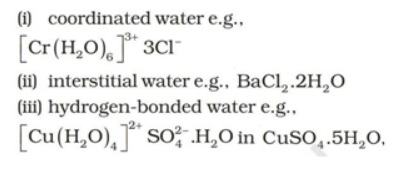
Hydrates Formation: From aqueous Solutions many salts can be crystallised as Hydrated salts. Such an association of water Is of different types viz., Coordinated water e.g.,

Hard and Soft Water- Rain water is almost pure (may contain some Dissolved gases from the atmosphere). Being a Good solvent, when it flows on the surface of The earth, it dissolves many salts. Presence of Calcium and magnesium salts in the form of Hydrogencarbonate, chloride and sulphate in Water makes water ‘hard’. Hard water does Not give lather with soap. Water free from Soluble salts of calcium and magnesium is Called Soft water. It gives lather with soap Easily. Temporary hardness is due to the presence of Magnesium and calcium hydrogen- Carbonates. It can be removed by:
Boiling: During boiling, the soluble $Mg(HCO_3)_2$ is converted into insoluble $Mg(OH)_2$ And $Ca(HCO_3)_2$ is changed to insoluble $CaCO_3$. It is because of high solubility product of $Mg(OH)_2$ as compared to that of $MgCO_3$, that $Mg(OH)_2$ is precipitated. These precipitates can Be removed by filtration. Filtrate thus obtained
Will be soft water.
$\text{Mg}(\text{HCO}_3)_2\xrightarrow{\text{Heating}}\text{Mg}(\text{OH})_2\downarrow+2\text{CO}_2\uparrow$
$\text{Ca}(\text{HCO}_3)_2\xrightarrow{\text{Heating}}\text{CaCO}_3\downarrow+\text{H}_2\text{O}+\text{CO}_2\uparrow$
Clark’s method: In this method calculated Amount of lime is added to hard water. It Precipitates out calcium carbonate and Magnesium hydroxide which can be filtered off.
Permanent Hardness is due to the presence of soluble salts of Magnesium and calcium in the form of Chlorides and sulphates in water. Permanent Hardness is not removed by boiling.
$\text{Ca}(\text{Hco}_3)_2+\text{Ca}(\text{OH)}_2\rightarrow2\text{CaCO}_3\downarrow2\text{H}_2\text{O}$
$\text{Mg}(\text{HCO)}_3+2\text{Ca}\text{(Oh)}_2\rightarrow2\text{CaCO}_3\downarrow+\text{Mg}(\text{OH)}_2\downarrow2\text{H}_2\text{O}$
Permanent Hardness is due to the presence of soluble salts of Magnesium and calcium in the form of Chlorides and sulphates in water. Permanent Hardness is not removed by boiling.
  1. In the gas phase water is a bent molecule with a bond angle of:
  1. $104.5^\circ$
  2. $94.5^\circ$
  3. $110.5^\circ$
  4. $95.5^\circ$
  1. At Atmospheric pressure ice crystallises in the … form.
  1. Cubic
  2. Hexagonal
  3. Octagonal
  4. Pentagonal
  1. Water free from Soluble salts of calcium and magnesium is called …
  1. hard water
  2. dry water
  3. soft water
  4. None of above
  1. Water has…. Nature.
  1. acidic
  2. basic
  3. neutral
  4. amphoteric
  1. Water is…. Molecule.
  1. Polar
  2. Non- Polar
  3. Ionic
  4. All the above