Question
Read the passage given below and answer the following questions from 1 to 5.
Hydrogen Peroxide $(H_2O_2)$ Hydrogen peroxide is an important chemical used in pollution control treatment of domestic and industrial effluents.It can be prepared by the following methods.
i) Acidifying barium peroxide and removing excess water by evaporation under reduced pressure gives hydrogen.
$\text{BaO}_2.8\text{H}_2\text{O}(\text{s})+\text{H}_2\text{SO}_4\text{(aq)}\rightarrow\text{BaSO}_4\text{(s)}+\text{H}_2\text{O}_2\text{(aq)}+8\text{H}_2\text{O}\text{l}$
ii) Peroxodisulphate, obtained by electrolytic oxidation of acidified sulphate solutions at high current density, on hydrolysis yields hydrogen.
$2\text{HSO}_\bar{4}(\text{aq})\xrightarrow{\text{Electrolysis}}\text{HO}_3\text{SOOSO}_3\text{H}(\text{aq})\xrightarrow{\text{Hydrolysis}}2\text{HSO}_\bar{4}\text{(aq)}+2\text{H}^+\text{(aq)}+\text{H}_2\text{O}_2\text{aq}$
This method is now used for the laboratory preparation of $D_2O_{2.}$
_{$\text{K}_2\text{S}_2\text{O}_8(\text{s})+2\text{D}_2\text{O}\text{(l)}\rightarrow2\text{KDSO}_4(\text{aq})+\text{D}_2\text{O}_2\text{(l)}$}
iii) Industrially it is prepared by the auto- oxidation of 2-alklylanthraquinols. 2 ethylanthraquinol H O oxidised product.
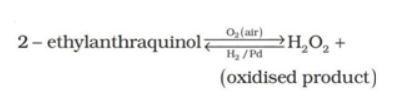
In this case 1% $H_2O_2$ is formed. It is extracted with water and concentrated to $\sim30\%$ (by mass) by distillation under reduced pressure. It can be further concentrated to $\sim85\%$ by careful distillation under low pressure. The remaining water can be frozen out to obtain pure $H_2O_2$. Physical Properties of the pure state $H_2O_2$ is an almost colourless (very pale blue) liquid. Its important physical properties. $H_2O_2$ is miscible with water in all proportions and forms a hydrate $H_2O_2.$ $H_2O$ (mp 221K). A 30% solution of $H_2O_2$ is marketed as ‘100 volume’ hydrogen peroxide. It means that one millilitre of 30% $H_2O_2$ solution will give 100 mL of oxygen at STP. Commercially marketed sample is 10 V, which means that the sample contains 3% $H_2O_2$ . Structure Hydrogen peroxide has a non-planar structure.
$H_2O_2$ decomposes slowly on exposure to light.
$2\text{H}_2\text{O}_2\text{(l)}\rightarrow2\text{H}_2\text{O}(\text{l})+\text{O}_2\text{(g)}$
In the presence of metal surfaces or traces of alkali (present in glass containers), the above reaction is catalysed. It is, therefore, stored in wax-lined glass or plastic vessels in dark. Urea can be added as a stabiliser. It is kept away from dust because dust can induce explosive decomposition of the compound.
Its wide scale use has led to tremendous increase in the industrial production of $H_2O_2$. Some of the uses are listed below:
i) In daily life it is used as a hair bleach and as a mild disinfectant. As an antiseptic it is sold in the market as
ii) It is used to manufacture chemicals like sodium perborate and per – carbonate, which are used in high quality detergents.
iii) It is used in the synthesis of hydroquinone, tartaric acid and certain food products and pharmaceuticals (cephalosporin)
iv) It is employed in the industries as a bleaching agent for textiles, paper pulp, leather, oils, fats,
v) Nowadays it is also used in Environmental (Green) Chemistry. For example, in pollution control treatment of domestic and industrial effluents, oxidation of cyanides, restoration of aerobic conditions to sewage wastes,
Heavy water, $D_2O$ It is extensively used as a moderator in nuclear reactors and in exchange reactions for the study of reaction mechanisms. It can be prepared by exhaustive electrolysis of water or as a by-product in some fertilizer industries. It is used for the preparation of other deuterium compounds, for example:
Dihydrogen can be used as a fuel .Dihydrogen releases large quantities of heat on combustion. The data on energy released by combustion of fuels like dihydrogen, methane, LPG etc. are compared in terms of the same amounts in mole, mass and volume Hydrogen Economy is an alternative. The basic principle of hydrogen economy is the transportation and storage of energy in the form of liquid or gaseous dihydrogen. Advantage of hydrogen economy is that energy is transmitted in the form of dihydrogen and not as electric power. It is for the first time in the history of India that a pilot project using dihydrogen as fuel was launched in October 2005 for running automobiles. Initially 5% dihydrogen has been mixed in CNG for use in four-wheeler vehicles. The percentage of dihydrogen would be gradually increased to reach the optimum level. Nowadays, it is also used in fuel cells for generation of electric power. It is expected that economically viable and safe sources of dihydrogen will be identified in the years to come, for its usage as a common source of energy.
  1. In India, a pilot project using dihydrogen as fuel was launched in… for running automobiles.
  1. October 2005
  2. May 2004
  3. August 2014
  4. February 2010
  1. Structure Hydrogen peroxide has a … structure.
  1. Bilateral
  2. Non-planar
  3. Planar
  4. Cubic
  1. One millilitre of 30% $H_2O_2$ solution will give … mL of oxygen at STP.
  1. 30
  2. 10
  3. 100
  4. 300
  1. …. is extensively used as a moderator in nuclear reactors and in exchange reactions for the study of reaction mechanisms.
  1. $H_2O_2$
  2. $T_2O$
  3. $H_2O$
  4. $D_2O$
  1. Colour of pure state $H_2O_2$ is ..
  1. Very Pale red
  2. Very Pale yellow
  3. Very Pale green
  4. Very Pale blue

Answer

  1. (a) October 2005
  2. (b) Non-planar
  3. (c) 100
  4. (d) $D_2O$
  5. (d) Very Pale blue

Need a full question paper?

Generate a complete, print-ready paper with questions like this in minutes — across 16+ boards, with answer keys.

Start Generating Free

Similar questions

Read the passage given below and answer the following questions from 1 to 5.
Important compounds of calcium are calcium Oxide, calcium hydroxide, calcium sulphate, Calcium carbonate and cement. These are Industrially important compounds. The large Scale preparation of these compounds and Their uses are described below. Calcium Oxide or Quick Lime CaO – It is prepared on a commercial scale by Heating limestone $(CaCO_3)$ in a rotary kiln at 1070-1270 K.
$\text{CaCO}_3\overset{\text{heat}}{\rightleftharpoons}\text{CaO} + \text{CO}_2$
The carbon dioxide is removed as soon as It is produced to enable the reaction to proceed To completion. Calcium oxide is a white amorphous solid. It has a melting point of 2870 K. On exposure To atmosphere, it absorbs moisture and carbon Dioxide.
$\text{CaO}+\text{H}_2\text{O}\rightarrow\text{Ca}{\text{OH}}_2$
$\text{CaO}+\text{CO}_2\rightarrow\text{CaCO}_3$
The addition of limited amount of water Breaks the lump of lime. This process is called Slaking of lime. Quick lime slaked with soda Gives solid sodalime. Being a basic oxide, it Combines with acidic oxides at high Temperature.
$\text{CaO}+\text{SiO}_2\rightarrow\text{CaSiO}_3$
$6\text{CaO}+\text{P}_4\text{O}_{10}\rightarrow2\text{Ca}_3(\text{PO}_4)_2$
Uses: It is an important primary material for Manufacturing cement and is the cheapest Form of alkali. It is used in the manufacture of sodium Carbonate from caustic soda. It is employed in the purification of sugar And in the manufacture of dye stuffs.
Calcium Carbonate – $CaCO_3$ occurs in nature in several Forms like limestone, chalk, marble etc. It can Be prepared by passing carbon dioxide Through slaked lime or by the addition of Sodium carbonate to calcium chloride.
$\text{Ca}\text{(OH)}_2+\text{CO}_2\rightarrow\text{CaCO}_3+\text{H}_2\text{O}$
$\text{CaCl}_2+\text{Na}_2\text{CO}_3+\text{CaCO}_3+2\text{NaCl}$
excess of carbon dioxide should be Avoided since this leads to the formation of Water soluble calcium hydrogencarbonate. Calcium carbonate is a white fluffy powder. It is almost insoluble in water. When heated To 1200 K, it decomposes to evolve carbon Dioxide. It is used as a building material in the form of Marble and in the manufacture of quick lime. Calcium carbonate along with magnesium Carbonate is used as a flux in the extraction of Metals such as iron. Specially precipitated CaCO3 Is extensively used in the manufacture Of high quality paper. It is also used as an Antacid, mild abrasive in tooth paste, a Constituent of chewing gum, and a filler in Cosmetics.
Calcium Sulphate (Plaster of Paris), $\text{CaSO}_4·\frac{1}{2}\text{H}_2\text{O}^ –$ It is a hemihydrate of calcium sulphate. It is Obtained when gypsum, $CaSO_4·2H_2O$, is Heated to 393 K.
$2(\text{CaSO}_4.2\text{H}_2)\rightarrow2\text{(CaSO}_4)\text{H}_2\text{O}+3\text{H}_2\text{O}$
above 393 K, no water of crystallisation is left and anhydrous calcium sulphate, $CaSO_4$ is Formed. This is known as ‘dead burnt plaster’. It has a remarkable property of setting with Water. On mixing with an adequate quantity Of water it forms a plastic mass that gets into a Hard solid in 5 to 15 minutes.
Uses: The largest use of Plaster of Paris is in the Building industry as well as plasters. It is used For immoblising the affected part of organ where There is a bone fracture or sprain. It is also Employed in dentistry, in ornamental work and For making casts of statues and busts.
Cement: Cement is an important building Material. it was first introduced in England in 1824 by Joseph Aspdin. It is also called Portland cement because it resembles with the Natural limestone quarried in the Isle of Portland, England. Cement is a product obtained by Combining a material rich in lime, $CaO$ with Other material such as clay which contains Silica, $SiO_2$ along with the oxides of Aluminium, iron and magnesium. The average Composition of Portland cement is : CaO, 50-60%; $SiO_2, 20-25\%; Al2O_3, 5-10\%; MgO, 2-3\%; Fe2O_3, 1-2\%$ and $SO_3, 1-2\%$. For a good Quality cement, the ratio of silica $(SiO_2)$ to Alumina $(Al2O_3)$ should be between 2.5 and 4 And the ratio of lime (CaO) to the total of the Oxides of silicon $(SiO_2)$ aluminium $(Al2O_3)$ And iron $(Fe2O_3)$ should be as close as possible To 2. The raw materials for the manufacture of Cement are limestone and clay. When clay and Lime are strongly heated together they fuse and React to form ‘cement clinker’. This clinker is Mixed with 2-3% by weight of gypsum $(CaSO_4·2H_2O)$ to form cement. Thus important Ingredients present in Portland cement are Dicalcium silicate $(Ca_2SiO4)$ 26%, tricalcium silicate $(Ca_3SiO_5)$ 51% and tricalcium Aluminate $(Ca_3Al_2O_6)$ 11%.
Setting of Cement: When mixed with water, The setting of cement takes place to give a hard Mass. This is due to the hydration of the Molecules of the constituents and their Rearrangement. The purpose of adding Gypsum is only to slow down the process of Setting of the cement so that it gets sufficiently Hardened.
Uses: Cement has become a commodity of National necessity for any country next to iron And steel. It is used in concrete and reinforced Concrete, in plastering and in the construction Of bridges, dams and buildings.
Biological importance of magnesium and calcium - An adult body contains about 25g of Mg and 1200g of Ca compared with only 5g of iron And 0.06 g of copper. The daily requirement In the human body has been estimated to be 200 – 300 mg. All enzymes that utilise ATP in phosphate Transfer require magnesium as the cofactor. The main pigment for the absorption of light In plants is chlorophyll which contains Magnesium. About 99% of body calcium is Present in bones and teeth. It also plays Important roles in neuromuscular function, Interneuronal transmission, cell membrane Integrity and blood coagulation. The calcium Concentration in plasma is regulated at about $100\ mgL^{–1}.$ It is maintained by two hormones: Calcitonin and parathyroid hormone. Do you Know that bone is not an inert and unchanging Substance but is continuously being Solubilised and redeposited to the extent of 400mg per day in man? All this calcium Passes through the plasma.
  1. Quick Lime is prepared on a commercial scale by heating … in a rotary kiln at 1070-1270 K.
  1. $CaCO_3$
  2. $Ca_3Al_2O_6$
  3. $CaSO_42H_2O$
  4. $CaO$
  1. An adult body contains about … of Ca
  1. 600g
  2. 1200g
  3. 1800g
  4. 2400g
  1. The calcium Concentration in plasma is regulated at about …
  1. 10
  2. 50
  3. 100
  4. 500
  1. It was first introduced in England in 1824 by ….
  1. Edgar Dobbs
  2. Egor Cheliev
  3. James Parker
  4. Joseph Aspdin
  1. Molecular Formula of plaster of paris is …
  1. $CaSO_42H_2O$
  2. $\text{CaSO}_4·\frac{1}{2}\text{H}_2\text{O}^ –$
  3. $Ca_2SiO_4$
  4. $Ca_3Al_2O_6$
Read the passage given below and answer the following questions from $1$ to $5$.
It is prepared by complete combustion of Carbon and carbon containing fuels in excess Of air.
$\text{C(s)}+\text{O}_2\text{(g)}\xrightarrow{\triangle}\text{CO}_2\text{(g)}$
$\text{CH}_4\text{(g)}+2\text{O}_2\text{(g)}\rightarrow\text{CO}_2\text{(g)}+2\text{H}_2\text{O}\text{(g)}$
In the laboratory it is conveniently Prepared by the action of dilute HCl on calcium Carbonate.
$CaCO_3 (s) + 2HCl (aq) \rightarrow CaCl_2 (aq) + CO_2(g) + H_2O(l)$
$\text{H}_2\text{CO}_3(\text{aq})+\text{H}_2\text{O}\text{(l)}\rightleftharpoons\text{HCO}_3^-\text{(aq)}+\text{H}_3\text{O}^+\text{(aq)}$
$\text{H}\text{CO}_3^-(\text{aq})+\text{H}_2\text{O}\text{(l)}\rightleftharpoons\text{CO}_3^{2-}\text{(aq)}+\text{H}_3\text{O}^+\text{(aq)}$
Buffer system helps to Maintain pH of blood between $7.26$ to $7.42$. Being acidic in nature, it combines with alkalies To form metal carbonates. Carbon dioxide, which is normally present To the extent of $\sim0.03 %$ by volume in the Atmosphere, is removed from it by the process Known as photosynthesis. It is the process By which green plants convert atmospheric $CO_2$ into carbohydrates such as glucose. The Overall chemical change can be expressed as:
$6\text{CO}_2+12\text{H}_2\text{O}\xrightarrow[\text{Chlorophyll}]{\text{hv}}\text{C}_6\text{H}_{12}\text{O}_6+6\text{O}_2$
By this process plants make food for Themselves as well as for animals and human Beings. Unlike $CO$, it is not poisonous. But the Increase in combustion of fossil fuels and Decomposition of limestone for cement Manufacture in recent years seem to increase The $CO_2$ content of the atmosphere. This may Lead to increase in green house effect and Thus, raise the temperature of the atmosphere Which might have serious consequences. Carbon dioxide can be obtained as a solid In the form of dry ice by allowing the liquified $CO_2$ to expand rapidly. Dry ice is used as a Refrigerant for ice-cream and frozen food. Gaseous $CO_2$ is extensively used to carbonate Soft drinks. Being heavy and non-supporter Of combustion it is used as fire extinguisher. A Substantial amount of $CO_2$ is used to Manufacture urea. In $CO_2$ molecule carbon atom undergoes Sp hybridisation. Two sp hybridised orbitals Of carbon atom overlap with two p orbitals of Oxygen atoms to make two sigma bonds while Other two electrons of carbon atom are involved.

In $\text{p}\pi-\text{p}\pi$ bonding with oxyglargeen atom. This Results in its linear shape $[$with both $C–O$ bonds Of equal length $(115 pm)]$ with no dipole Moment. The resonance structures are shown Below: Resonance structures of carbon dioxide.
Silicon Dioxide, $SiO_2 95 \%$ of the earth’s crust is made up of silica And silicates. Silicon dioxide, commonly known As silica, occurs in several crystallographic Forms. Quartz, cristobalite and tridymite are Some of the crystalline forms of silica, and they Are interconvertable at suitable temperature. Silicon dioxide is a covalent, three-dimensional network solid in which each silicon atom is Covalently bonded in a tetrahedral manner to Four oxygen atoms. Each oxygen atom in turn Covalently bonded to another silicon atoms as Shown in diagram. Each corner is Shared with another tetrahedron. The entire Crystal may be considered as giant molecule In which eight membered rings are formed with Alternate silicon and oxygen atoms. Silica in its normal form is almost non- Reactive because of very high $Si—O$ bond Enthalpy. It resists the attack by halogens, Dihydrogen and most of the acids and metals Even at elevated temperatures. However, it is Attacked by HF and NaOH.
$SiO_2 + 2NaOH \rightarrow Na2SiO_3 + H_2O SiO_2 + 4HF \rightarrow SiF_4 + 2H_2O$
Quartz is extensively used as a piezoelectric Material; it has made possible to develop extremely Accurate clocks, modern radio and television Broadcasting and mobile radio communications. Silica gel is used as a drying agent and as a support For chromatographic materials and catalysts. Kieselghur, an amorphous form of silica is used In filtration plants.
Silicones are a group of organosilicon polymers, Which have $(R_2SiO)$ as a repeating unit. The Starting materials for the manufacture of Silicones are alkyl or aryl substituted silicon Chlorides, RnSiCl(4–n), where R is alkyl or aryl Group. When methyl chloride reacts with Silicon in the presence of copper as a catalyst At a temperature $573K$ various types of methyl substituted chlorosilane of formula $MeSiCl_3, Me_2SiCl_2, Me3SiCl$ with small amount of $Me4Si$ Are formed. Hydrolysis of dimethyl- Dichlorosilane, $(CH_3) 2SiCl_2$ followed by Condensation polymerisation yields straight Chain polymers.
A large number of silicates minerals exist in Nature. Some of the examples are feldspar, Zeolites, mica and asbestos. The basic structural unit of silicates is $SiO_4^{4–}$ In which silicon atom is bonded to four Oxygen atoms in tetrahedron fashion. In Silicates either the discrete unit is present or A number of such units are joined together Via corners by sharing $1, 2, 3$ or $4$ oxygen Atoms per silicate units. When silicate units Are linked together, they form chain, ring, Sheet or three-dimensional structures. Negative charge on silicate structure is Neutralised by positively charged metal ions. If all the four corners are shared with other Tetrahedral units, three-dimensional network Is formed. Two important man-made silicates are Glass and cement. Zeolites If aluminium atoms replace few silicon atoms In three-dimensional network of silicon dioxide, Overall structure known as aluminosilicate, Acquires a negative charge. Cations such as $Na+, K+$ Or $Ca_2+$ balance the negative charge. Examples are feldspar and zeolites.
Zeolites are Widely used as a catalyst in petrochemical Industries for cracking of hydrocarbons and Isomerisation, e.g., $ZSM-5$ (A type of zeolite) Used to convert alcohols directly into gasoline. Hydrated zeolites are used as ion exchangers In softening of “hard” water.
  1. … is used as a Refrigerant for ice-cream and frozen food.
  1. Dry ice
  2. Wet ice
  3. Crescent Ice
  4. Nugget Ice
  1. $H_2CO_3$ is a …
  1. strong dibasic acid
  2. weak dibasic acid
  3. weak diacidic base
  4. Strong diacidic base
  1. … is extensively used as a piezoelectric Material.
  1. Glass
  2. Ferrite
  3. Quartz
  4. Saphire
  1. … an amorphous form of silica is used In filtration plants.
  1. Ferrite
  2. Quartz
  3. Saphire
  4. Kieselghur
  1. Which of the following is not an example of silicate mineral ?
  1. feldspar
  2. mica
  3. asbestos
  4. hematite
Read the passage given below and answer the following questions from 1 to 5.
Alkenes are unsaturated hydrocarbons containing at least one double bond. What should be the general formula of alkenes? If there is one double bond between two carbon atoms in alkenes, they must possess two hydrogen atoms less than alkanes. Hence, general formula for alkenes is $C_nH_{2n}$. Alkenes are also known as olefins (oil forming) since the first member, ethylene or ethene $(C_2H_4)$ was found to form an oily liquid on reaction with chlorine.
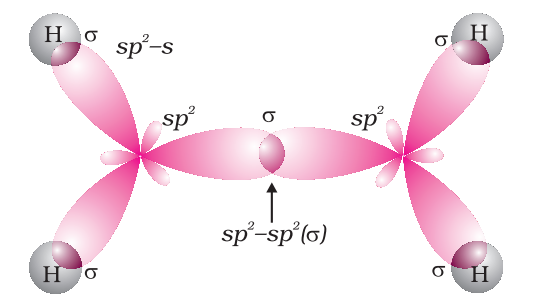
Structure of Double Bond Carbon-carbon double bond in alkenes consists of one strong sigma $(\sigma)$ bond (bond enthalpy about $397\ kJ\ mol^{–1)}$ due to head-on overlapping of $sp^2$ hybridised orbitals and one weak pi $\pi$ bond (bond enthalpy about $284\ kJ\ mol^{–1})$ obtained by lateral or sideways overlapping of the two 2p orbitals of the two carbon atoms. The double bond is shorter in bond length (134 pm) than the C–C single bond (154 pm). You have already read that the pi $(\pi)$ bond is a weaker bond due to poor sideways overlapping between the two 2p orbitals. Thus, the presence of the pi $(\pi)$bond makes alkenes behave as sources of loosely held mobile electrons. Therefore, alkenes are easily attacked by reagents or compounds which are in search of electrons. Such reagents are called electrophilic reagents. The presence of weaker$(\pi)$-bond makes alkenes unstable molecules in comparison to alkanes and thus, alkenes can be changed into single bond compounds by combining with the electrophilic reagents. Strength of the double bond (bond enthalpy, $681\ kJ\ mol^{–1}$) is greater than that of a carbon-carbon single bond in ethane (bond enthalpy, $348\ kJ\ mol^{–1}$). Orbital diagrams of ethene molecule are shown in Figure.

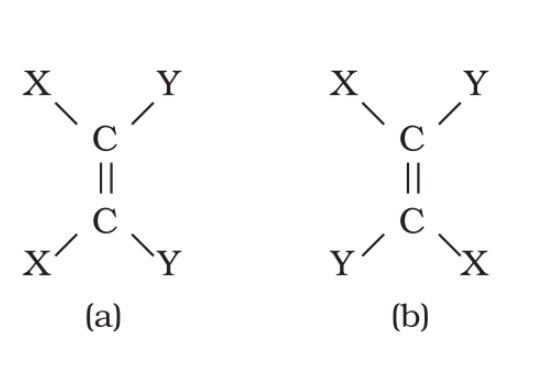
Geometrical isomerism: Doubly bonded Carbon atoms have to satisfy the remaining two Valences by joining with two atoms or groups. If the two atoms or groups attached to each Carbon atom are different, they can be Represented by YX C = C XY like structure. YX C = C XY can be represented in space in the Following two ways:

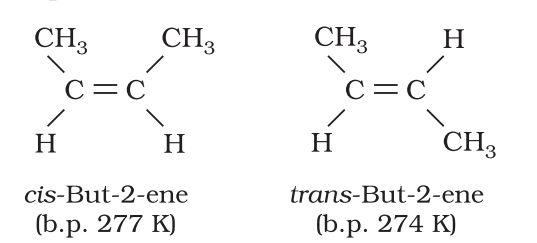
In (a), the two identical atoms i.e., both the X or both the Y lie on the same side of the Double bond but in (b) the two X or two Y lie Across the double bond or on the opposite Sides of the double bond. This results in Different geometry of (a) and (b) i.e. disposition Of atoms or groups in space in the two Arrangements is different. Therefore, they are Stereoisomers. They would have the same Geometry if atoms or groups around C = C bond Can be rotated but rotation around C = C bond Is not free. It is restricted. For understanding This concept, take two pieces of strong Cardboards and join them with the help of two Nails. Hold one cardboard in your one hand And try to rotate the other. Can you really rotate The other cardboard ? The answer is no. The Rotation is restricted. This illustrates that the Restricted rotation of atoms or groups around The doubly bonded carbon atoms gives rise to Different geometries of such compounds. The Stereoisomers of this type are called Geometrical isomers. The isomer of the type (a), in which two identical atoms or groups lie On the same side of the double bond is called Cis isomer and the other isomer of the type (b), in which identical atoms or groups lie on The opposite sides of the double bond is called Trans isomer. Thus cis and trans isomers Have the same structure but have different Configuration (arrangement of atoms or groups In space). Due to different arrangement of Atoms or groups in space, these isomers differ In their properties like melting point, boiling Point, dipole moment, solubility etc. Geometrical or cis-trans isomers of but-2-ene Are represented below:

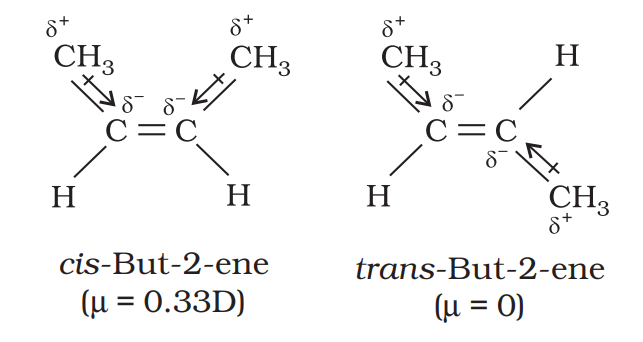
Cis form of alkene is found to be more polar Than the trans form. For example, dipole Moment of cis - but - 2-ene is 0.33 Debye, Whereas, dipole moment of the trans form Is almost zero or it can be said that trans - but - 2 -ene is non-polar. This can be understood by drawing geometries of the two forms as given below from which it is clear that in the trans - but - 2 -ene, the two methyl groups are in opposite directions, Therefore, dipole moments of $C - CH_3$ bonds cancel, thus making the trans form non-polar.

In the case of solids, it is observed that the trans isomer has higher melting point than the cis form. Geometrical or cis-trans isomerism is also shown by alkenes of the types XYC = CXZ and XYC = CZW
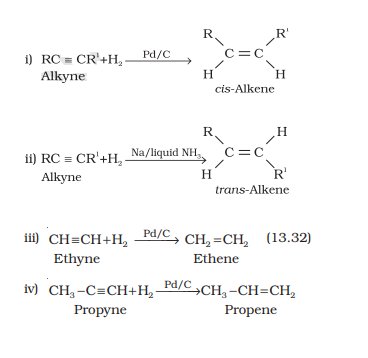
Preparation – From alkynes: Alkynes on partial reduction with calculated amount of dihydrogen in the presence of palladised charcoal partially deactivated with poisons like sulphur
compounds or quinoline give alkenes. Partially deactivated palladised charcoal is known as Lindlar’s catalyst. Alkenes thus obtained are having cis geometry. However, alkynes on reduction with sodium in liquid ammonia form trans alkenes.

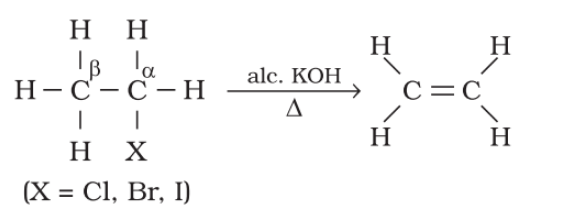
From alkyl halides: Alkyl halides (R-X) on heating with alcoholic potash (potassium hydroxide dissolved in alcohol, say, ethanol) eliminate one molecule of halogen acid to form alkenes. This reaction is known as dehydrohalogenation i.e., removal of halogen acid. This is example of $\beta-$elimination reaction, since hydrogen atom is eliminated from the $\beta$ carbon atom (carbon atom next to the carbon to which halogen is attached).

Nature of halogen atom and the alkyl group determine rate of the reaction. It is observed that for halogens, the rate is: iodine > bromine > chlorine, while for alkyl groups it is: tert > secondary > primary.
Physical properties Alkenes as a class resemble alkanes in physical properties, except in types of isomerism and difference in polar nature. The first three members are gases, the next fourteen are liquids and the higher ones are solids. Ethene is a colourless gas with a faint sweet smell. All other alkenes are colourless and odourless, insoluble in water but fairly soluble in non- polar solvents like benzene, petroleum ether. They show a regular increase in boiling point with increase in size i.e., every $–CH_2$ group added increases boiling point by 20–30 K. Like alkanes, straight chain alkenes have higher boiling point than isomeric branched chain compounds.
  1. The first three members of alkenes are …?
  1. Gases
  2. Liquids
  3. Solids
  4. None of above
  1. General formula for alkenes is ….?
  1. $C_nH_{2n+1}$
  2. $C_nH_{2n}$
  3. $C_nH_{2n-1}$
  4. $C_nH_{2n+2}$
  1. The colour of ethene gas is …?
  1. Red
  2. White
  3. Pale Green
  4. None of above
  1. The bond length of carbon carbon double bond is … pm ?
  1. 154
  2. 143
  3. 134
  4. 120
  1. Alkenes are also knows as …?
  1. Olefines
  2. Paraffines
  3. Oleofines
  4. Paracetofines
Read the passage given below and answer the following questions from $(i)$ to $(v).$
Predicting the Direction of the Reaction- The equilibrium constant helps in predicting the direction in which a given reaction will proceed at any stage. For this purpose, we calculate the reaction quotient $Q$. The reaction quotient, $Q (Qc$ with molar concentrations and $QP$ with partial pressures$)$ is defined in the same way as the equilibrium constant Kc except that the concentrations in $Qc$ are not necessarily equilibrium values. For a general reaction:
$\text{a}\text{A}+\text{b}\text{B}\rightleftharpoons\text{c}\text{C}+\text{d}\text{D}$
$\text{Q}\text{c}=\frac{[\text{C}]^\text{c}[\text{D}]^\text{d}}{[\text{A}]^\text{a}[\text{B}]^\text{b}}$
Then,
If $Qc > Kc,$ the reaction will proceed in the direction of reactants (reverse reaction).
If $Qc < Kc,$ the reaction will proceed in the direction of the products (forward reaction).
If $Qc = Kc,$ the reaction mixture is already at equilibrium. Consider the gaseous reaction of $H_2$ with $I_2$ ,
$\text{H}_{2(\text{g})}+\text{l}_{2(\text{g})}\rightleftharpoons2\text{Hl}_{(\text{g})};\text{kc}=57.0\text{at}700\text{k}.$
Suppose we have molar concentrations $[H_2 ]t =0.10M, [I_2 ]t = 0.20 M$ and $[HI]t = 0.40 M.$ (the subscript t on the concentration symbols means that the concentrations were measured at some arbitrary time t, not necessarily at equilibrium). Thus, the reaction quotient, Qc at this stage of the reaction is given by,
$\text{Qc}=\frac{[\text{Hl}]\text{t}^2}{[\text{H}]^2]_\text{t}[\text{l}_2]_\text{t}}=\frac{(0.40)_2}{(0.10)\times(0.20)}=8.0$
Now, in this case, $Qc (8.0)$ does not equal Kc $(57.0)$, so the mixture of $H2 _{(g)}, I2 _{(g)} $ and $HI_{(g)} $ is not at equilibrium; that is, more $H2 _{(g)} $ and $I 2 _{(g)} $ will react to form more $HI_{(g)} $ and their concentrations will decrease till $Qc = Kc.$ The reaction quotient, Qc is useful in predicting the direction of reaction by comparing the values of Qc and Kc.Thus, we can make the following generalisations concerning the direction of the reaction
If $Qc < Kc,$ net reaction goes from left to right
If $Qc > Kc,$ net reaction goes from right to left.
If $Qc = Kc,$ no net reaction occurs.
Calculating Equilibrium Concentrations In case of a problem in which we know the initial concentrations but do not know any of the equilibrium concentrations, the following three steps shall be followed:
Step 1) Write the balanced equation for the reaction.
Step 2) Under the balanced equation, make a table that lists for each substance involved in the reaction: $(a)$ the initial concentration, $(b)$ the change in concentration on going to equilibrium, and $(c)$ the equilibrium concentration. In constructing the table, define $x$ as the concentration (mol/L) of one of the substances that reacts on going to equilibrium, then use the stoichiometry of the reaction to determine the concentrations of the other substances in terms of $x.$
Step 3) Substitute the equilibrium concentrations into the equilibrium equation for the reaction and solve for x. If you are to solve a quadratic equation choose the mathematical solution that makes chemical sense.
Step 4) Calculate the equilibrium concentrations from the calculated value of $x.$
Step 5) Check your results by substituting them into the equilibrium equation.
Relationship between equilibrium constant K, reaction quotient Q and gibbs energy G The value of Kc for a reaction does not depend on the rate of the reaction. However, it is directly related to the thermodynamics of the reaction and in particular, to the change in Gibbs energy, $\triangle\text{G}.$ If,
$\triangle\text{G}$ is negative, then the reaction is spontaneous and proceeds in the forward direction.
$\triangle\text{G}$ is positive, then reaction is considered non-spontaneous. Instead, as reverse reaction would have a negative $\triangle\text{G},$ the products of the forward reaction shall be converted to the reactants.
$\triangle\text{G}$ is 0, reaction has achieved equilibrium; at this point, there is no longer any free energy left to drive the reaction. A mathematical expression of this thermodynamic view of equilibrium can be described by the following equation:
$\triangle\text{G}=\triangle\text{G}^\phi+\text{RT}\text{lnQ}$
where, $\triangle\text{G}^\phi$ is standard Gibbs energy. At equilibrium, when $\triangle\text{G}=0$ and $Q = Kc,$ the equation becomes,
$\triangle\text{G}=\text{G}^\phi+\text{RT}\text{lnk}=0$
$\triangle\text{G}^\phi=-\text{RT}\text{lnk}$
$\text{Ink}=\frac{-\triangle\text{G}^\phi}{\text{RT}}$
Taking antilog of both sides, we get,
$\text{K}=\text{e}-\frac{\triangle\text{G}0}{\text{RT}}$
Hence, using the equation, the reaction spontaneity can be interpreted in terms of the value of $\triangle\text{G}^\phi.$
If $\triangle\text{G}^\phi>0$ then $\frac{-\triangle\text{G}^\phi}{\text{RT}}$ is positive, and $>1$, making $K > 1$, which implies a spontaneous reaction or the reaction which proceeds in the forward direction to such an extent that the products are present predominantly.
If $\triangle\text{G}^\phi>0,$ then $\frac{-\triangle\text{G}^\phi}{\text{RT}}$ is negative, and $< 1$, that is, $K < 1$, which implies a non-spontaneous reaction or a reaction which proceeds in the forward direction to such a small degree that only a very minute quantity of product is formed.
Factors affecting equilibria One of the principal goals of chemical synthesis is to maximise the conversion of the reactants to products while minimizing the expenditure of energy. This implies maximum yield of products at mild temperature and pressure conditions. If it does not happen, then the experimental conditions need to be adjusted. For example, in the Haber process for the synthesis of ammonia from $N_2$ and $H_2,$ the choice of experimental conditions is of real economic importance. Annual world production of ammonia is about hundred million tones, primarily for use as fertilizers. Equilibrium constant, Kc is independent of initial concentrations. But if a system at equilibrium is subjected to a change in the concentration of one or more of the reacting substances, then the system is no longer at equilibrium; and net reaction takes place in some direction until the system returns to equilibrium once again. Similarly, a change in temperature or pressure of the system may also alter the equilibrium. In order to decide what course the reaction adopts and make a qualitative prediction about the effect of a change in conditions on equilibrium we use Le Chatelier’s principle. It states that a change in any of the factors that determine the equilibrium conditions of a system will cause the system to change in such a manner so as to reduce or to counteract the effect of the change. This is applicable to all physical and chemical equilibria.
Effect of Concentration Change In general, when equilibrium is disturbed by the addition/removal of any reactant/ products, Le Chatelier’s principle predicts that:
The concentration stress of an added reactant/product is relieved by net reaction in the direction that consumes the added substance.
The concentration stress of a removed reactant/product is relieved by net reaction in the direction that replenishes the removed substance. or in other words, “When the concentration of any of the reactants or products in a reaction at equilibrium is changed, the composition of the equilibrium mixture changes so as to minimize the effect of concentration changes”. Let us take the reaction,
$\text{H}_{2(\text{g})}+\text{l}_{2(\text{g})}\rightleftharpoons2\text{Hl}_{(\text{g})}$
If $H_2$ is added to the reaction mixture at equilibrium, then the equilibrium of the reaction is disturbed. In order to restore it, the reaction proceeds in a direction wherein $H_2$ is consumed, i.e., more of $H_2$ and $I_2$ react to form HI and finally the equilibrium shifts in right (forward) direction. This is in accordance with the Le Chatelier’s principle which implies that in case of addition of a reactant/product, a new equilibrium will be set up in which the concentration of the reactant/product should be less than what it was after the addition but more than what it was in the original mixture. The same point can be explained in terms of the reaction quotient, $Qc,$​​​​​​​​​​​​​​
Case Study Questions Class 11 Chemistry – Equilibrium
$\text{Qc}=\frac{[\text{HI}]^2}{[\text{H}]_2[\text{I}]_2}$
Addition of hydrogen at equilibrium results in value of $Qc$ being less than $Kc$. Thus, in order to attain equilibrium again reaction moves in the forward direction. Similarly, we can say that removal of a product also boosts the forward reaction and increases the concentration of the products and this has great commercial application in cases of reactions, where the product is a gas or a volatile substance. In case of manufacture of ammonia, ammonia is liquified and removed from the reaction mixture so that reaction keeps moving in forward direction. Similarly, in the large scale production of $CaO$ (used as important building material) from $CaCO_3$, constant removal of $CO_2$ from the kiln drives the reaction to completion. It should be remembered that continuous removal of a product maintains Qc at a value less than Kc and reaction continues to move in the forward direction.
  1. If … the reaction will proceed in the direction of reactants (reverse reaction).
  1. $Qc > Kc$
  2. $Qc < Kc$
  3. $Qc = Kc$
  4. None of above
  1. If … the reaction will proceed in the direction of the products (forward reaction).
  1. $Qc > Kc$
  2. $Qc < Kc$
  3. $Qc = Kc$
  4. None of above
  1. If … the reaction mixture is already at equilibrium. Consider the gaseous reaction.
  1. $Qc > Kc$
  2. $Qc < Kc$
  3. $Qc = Kc$
  4. All of above
  1. If $\triangle\text{G}$ is …. then the reaction is spontaneous and proceeds in the forward direction.
  1. Zero
  2. Positive
  3. Negative
  4. None of above
  1. $\triangle\text{G}$ is … reaction has achieved equilibrium; at this point, there is no longer any free energy left to drive the reaction.
  1. Zero
  2. Positive
  3. Negative
  4. None of above
Read the passage given below and answer the following questions from 1 to 5.
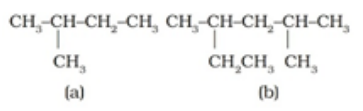
Branched chain hydrocarbons: In a branched chain compound small chains of carbon atoms are attached at one or more carbon atoms of the parent chain. The small carbon chains (branches) are called alkyl groups. For example:

In order to name such compounds, the names of alkyl groups are prefixed to the name of parent alkane. An alkyl group is derived from a saturated hydrocarbon by removing a hydrogen atom from carbon. Thus, $CH_4$becomes$ – CH_3 $and is called methyl group. An alkyl group is named by substituting ‘yl’ for ‘ane’ in the corresponding alkane. Some alkyl groups are listed in Table
Alkane Alkyl Group
Molecular formula Name of alkane Structural formula Name of alkyl group
$CH_4$ Methane $-CH_3$ Methyl
$C_2H_6$ Ethane $-CH_2CH_3​​​​​​​$ Ethyl
$C_3H_8​​​​​​​$ Propane $-CH_2CH_2CH_3$ Propyl
$C_4H_{10}​​​​​​​$ Butane $-CH_2CH_2CH_2CH_3​​​​​​​$ Butyl
$C_{10}H_{22}​​​​​​​$ Decane $-CH_2(CH_2)_8CH_3​​​​​​​$​​​​​​​ Decyl
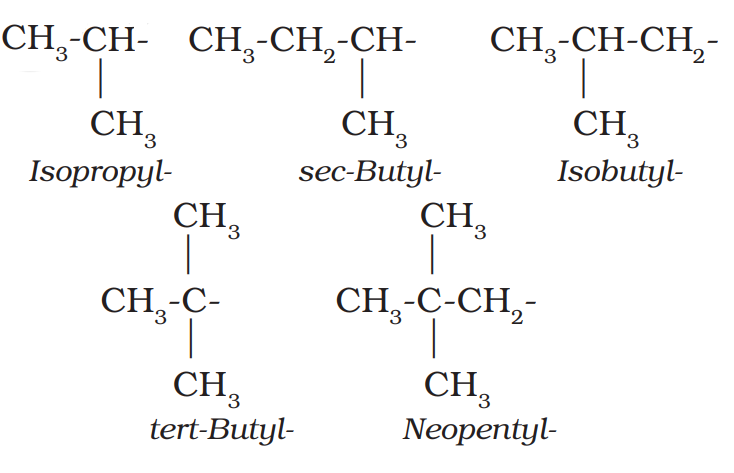
Abbreviations are used for some alkyl groups. For example, methyl is abbreviated as Me, ethyl as Et, propyl as Pr and butyl as Bu. The alkyl groups can be branched also. Thus, propyl and butyl groups can have branched structures as shown below .
Common branched groups have specific trivial names. For example, the propyl groups can either be n-propyl group or isopropyl group. The branched butyl groups are called sec- butyl, isobutyl and tert-butyl group. We also encounter the structural unit, – $CH_2C(CH_3)_3​​​​​​​$​​​​​​​, which is called neopentyl group.
For Nomenclature of branched chain alkanes ,longest carbon chain in the molecule is identified. The numbering is done in such a way that the branched carbon atoms get the lowest possible numbers. lower number is given to the one coming first in the alphabetical listing. Carbon atom of the branch that attaches to the root alkane. in alphabetical order, the prefixes iso- and neo- are considered to be the part of the fundamental name of alkyl group. The prefixes sec- and tert- are not considered to be the part of the fundamental name.
Cyclic Compounds: A saturated monocyclic compound is named by prefixing ‘cyclo’ to the corresponding straight chain alkane. If side chains are present, then the rules given above are applied. Names of some cyclic compounds are given below.

The phenomenon of existence of two or more compounds possessing the same molecular formula but different properties is known as isomerism. Such compounds are called as isomers. The following flow chart shows different types of isomerism.
Structural Isomerism Compounds having the same molecular formula but different structures (manners in which atoms are linked) are classified as structural isomers. Some typical examples of different types of structural isomerism are given below:

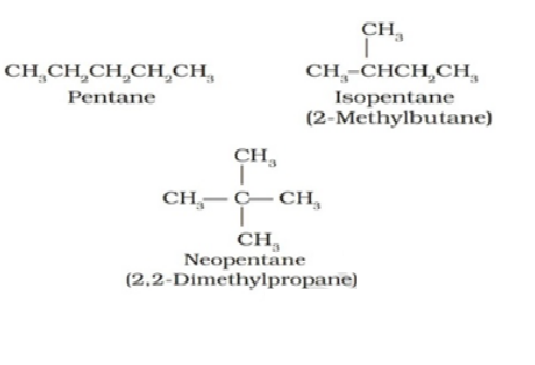
(i) Chain isomerism: When two or more compounds have similar molecular formula but different carbon skeletons, these are referred to as chain isomers and the phenomenon is termed as chain isomerism. For example, $C_5H_{12}​​​​​​​$​​​​​​​ represents three compounds:
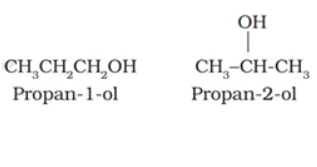
(ii) Position isomerism: When two or more compounds differ in the position of substituent atom or functional group on the carbon skeleton, they are called position isomers and this phenomenon is termed as position isomerism. For example, the molecular formula $C_3H_8O$ represents two alcohols:

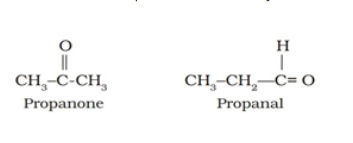
(iii) Functional group isomerism: Two or more compounds having the same molecular formula but different functional groups are called functional isomers and this phenomenon is termed as functional group isomerism. For example, the molecular formula $C_3H_6O$ represents an aldehyde and a ketone:

(iv) Metamerism: It arises due to different alkyl chains on either side of the functional group in the molecule. For example, $C_4H_{10}O$ represents methoxy propane $(CH_3OC_3H_7)$ and ethoxyethane $(C_2H_5OC_2H_5).$
Stereoisomerism The compounds that have the same constitution and sequence of covalent bonds but differ in relative positions of their atoms or groups in space are called stereoisomers. This special type of isomerism is called as stereoisomerism and can be classified as geometrical and optical isomerism.
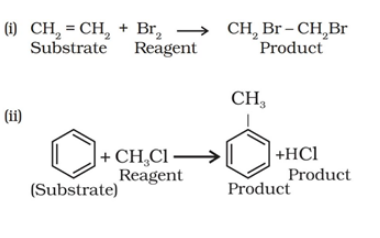
Substrate and Reagent Ions are generally not formed in the reactions of organic compounds. Molecules as such participate in the reaction. It is convenient to name one reagent as substrate and other as reagent. In general, a molecule whose carbon is involved in new bond formation is called substrate and the other one is called reagent. When carbon-carbon bond is formed, the choice of naming the reactants as substrate and reagent is arbitrary and depends on molecule under observation. Example:
  1. $CH_4​​​​​​​$​​​​​​​ becomes –$ CH_3​​​​​​​$​​​​​​​, is called … group.
  1. methyl
  2. ethyl
  3. propyl
  4. butyl
  1. For the Nomenclature of branched chain alkanes …. carbon chain in the molecule is identified.
  1. shortest
  2. longest
  3. smallest
  4. none of above
  1. when two or more compounds possessing the same molecular formula but different properties is known as ….
  1. Allotrops
  2. Isotops
  3. Isomers
  4. Isobars
  1. For the Nomenclature of branched chain alkanes, the numbering is done in such a way that the branched carbon atoms get the … possible numbers.
  1. biggest
  2. Lower
  3. Highest
  4. lowest
  1. Which of the following is not an example of isomerisim?
  1. Functional
  2. Positional
  3. Chain
  4. Preconditional
In order to explain the characteristic geometrical shapes of polyatomic molecules, Pauling introduced the concept of hybridisation. The orbitals undergoing hybridisation should have nearly the same energy. There are various type of hybridisations involving s, p and d-type of orbitals. The type of hybridisation gives the characteristic shape of the molecule or ion.

1. Why all the orbitals in a set of hybridised orbitals have the same shape and energy?
2. Out of $XeF _2$ and $SF _2$ which molecule has the same shape as $NO _2^{+}$ion?
3. Out of $XeF _4$ and $XeF _2$ which molecule doesn't have the same type of hybridisation as P (Phosphorus) has in $PF _5$ ?
OR
Unsaturated compounds undergo additional reactions. Why?
Read the passage given below and answer the following questions from $1$ to $5$. Lithium metal is used to make useful alloys, for example with lead to make ‘white metal’ Bearings for motor engines, with aluminium to make aircraft parts, and with magnesium to make armour plates. It is used in Thermonuclear reactions. Lithium is also used to make electrochemical cells. Sodium is used To make a Na/Pb alloy needed to make $PbEt_4$​​​​​​​ and $PbMe_4​​​​​​​$​​​​​​​. These organolead compounds were Earlier used as anti-knock additives to petrol, But nowadays vehicles use lead-free petrol. Liquid sodium metal is used as a coolant in Fast breeder nuclear reactors. Potassium has a vital role in biological systems. Potassium Chloride is used as a fertilizer. Potassium Hydroxide is used in the manufacture of soft Soap. It is also used as an excellent absorbent of carbon dioxide. Caesium is used in devising Photoelectric cells. Points of Difference between Lithium and other Alkali Metals –
i) Lithium is much harder. Its m.p. and b.p. are higher than the other alkali metals.
ii) Lithium is least reactive but the strongest Reducing agent among all the alkali metals. On combustion in air it forms mainly Monoxide, $Li_2O$ and the nitride, $Li_3N$ unlike Other alkali metals.
 iii) LiCl is deliquescent and crystallises as a Hydrate, LiCl.$2H_2O$ whereas other alkali Metal chlorides do not form hydrates.
iv) Lithium hydrogencarbonate is not Obtained in the solid form while all other Elements form solid hydrogencarbonate.
v) Lithium unlike other alkali metals forms No ethynide on reaction with ethyne.
vi) Lithium nitrate when heated gives lithium Oxide, $Li_2O$, whereas other alkali metal Nitrates decompose to give the Corresponding nitrite. $4\text{LiNO}_3\rightarrow2\text{L}\text{i}_2\text{O}+4\text{NO}_2+\text{O}_2$ $2\text{NaNO}_3\rightarrow2\text{NaNO}_2+\text{O}_2$ vii) LiF and $Li_2O$ are comparatively much less Soluble in water than the corresponding Compounds of other alkali metals. Sodium carbonate is generally prepared by Solvay Process. In this process, advantage is Taken of the low solubility of sodium Hydrogencarbonate whereby it gets Precipitated in the reaction of sodium chloride with ammonium hydrogencarbonate. The Latter is prepared by passing $CO_2​​​​​​​$​​​​​​​ to a Concentrated solution of sodium chloride Saturated with ammonia, where ammonium Carbonate followed by ammonium Hydrogencarbonate are formed. The equations For the complete process may be written as $2\text{NH}_3+\text{H}_2\text{O}+\text{CO}_2\rightarrow{\text{(NH}_4)_2}\text{CO}_3$ $(\text{NH}_4)_2\text{CO}_3+\text{H}_2\text{O}+\text{CO}_2\rightarrow2\text{NH}_4\text{HCO}_3$ $\text{NH}_4\text{HCO}_3+\text{NaCl}\rightarrow\text{NH}_4\text{Cl}+\text{NaHCO}_3$ Sodium hydrogencarbonate crystal Separates. these are heated to give sodium Carbonate. The most abundant source of sodium chloride is sea water which contains $2.7$ to $2.9 \%$ by Mass of the salt. In tropical countries like India, Common salt is generally obtained by Evaporation of sea water. Approximately $50$ Lakh tons of salt are produced annually in India by solar evaporation. Crude sodium Chloride, generally obtained by crystallisation Of brine solution, contains sodium sulphate, Calcium sulphate, calcium chloride and Magnesium chloride as impurities. Calcium Chloride, $CaCl_2$​​​​​​​, and magnesium chloride, $MgCl_2$​​​​​​​ are impurities because they are Deliquescent (absorb moisture easily from the Atmosphere). To obtain pure sodium chloride, The crude salt is dissolved in minimum amount Of water and filtered to remove insoluble Impurities. The solution is then saturated with Hydrogen chloride gas. Crystals of pure Sodium chloride separate out. Calcium and Magnesium chloride, being more soluble than Sodium chloride, remain in solution. Sodium Hydroxide (Caustic Soda), NaOH is generally prepared Commercially by the electrolysis of sodium Chloride in Castner-Kellner cell. A brine Solution is electrolysed using a mercury Cathode and a carbon anode. Sodium metal Discharged at the cathode combines with Mercury to form sodium amalgam. Chlorine Gas is evolved at the anode. Cathod: $\text{Na}^++\bar{\text{e}}\xrightarrow{\text{Hg}}\text{Na}-\text{amalgam}$ Anode: $\text{Cl}^-\rightarrow\frac{1}{2}\text{Cl}_2+\text{e}^-$ The amalgam is treated with water to give Sodium hydroxxide and hydrogen gas. $2$ Na - amalgam $+ 2H_2O \rightarrow 2NaOH + 2Hg + H_2$​​​​​​​
  1. NaOH Sodium hydroxide is generally prepared Commercially by the electrolysis of … in Castner-Kellner cell.
  1. $NaCl$
  2. $Na_2CO_3$
  3. $NaHCO_3$
  4. $NaNH_2$
  1. … is used in the manufacture of soft Soap.
  1. Sodium Hydroxide
  2. Potassium Hydroxide
  3. Aluminium hydroxide
  4. Beryllium hydroxide
  1. … is used in devising Photoelectric cells.
  1. Hydrogen
  2. Lithium
  3. Caesium
  4. Helium
  1. … compounds were Earlier used as anti-knock additives to petrol.
  1. Organomagnesium
  2. Organosilicon
  3. Organochloride
  4. Organolead
  1. The sodium amalgam is treated with water to gives ….
  1. $NaOH$
  2. $Na_2CO_3$
  3. $NaHCO_3$
  4. $NaNH_2$​​​​​​​
Read the passage given below and answer the following questions from 1 to 5. Chemistry deals with varieties of matter and change of one kind of matter into the other. Transformation of matter from one kind into another occurs through the various types of reactions. One important category of such reactions is Redox Reactions. Originally, the term oxidation was used to describe the addition of oxygen to an element or a compound. Because of the presence of dioxygen in the atmosphere (~20%), many elements combine with it and this is the principal reason why they commonly occur on the earth in the form of their oxides. The following reactions represent oxidation processes: $2\text{Mg}(\text{s})\rightarrow2\text{MgO}\text{ (S)}$ $\text{S}(\text{s})+\text{O}_2(\text{g})\rightarrow\text{SO}_2\text{ g}$ the term “oxidation” is defined as the addition of oxygen/electronegative element to a substance or removal of hydrogen/ electropositive element from a substance. In the beginning, reduction was considered as removal of oxygen from a compound. However, the term reduction has been broadened these days to include removal of oxygen/electronegative element from a substance or addition of hydrogen/ electropositive element to a substance. According to the definition given above, the following are the examples of reduction processes: $2\text{HgO}\text{S}\xrightarrow{\triangle}2\text{ Hg}(1)+\text{O}_2(\text{g})$ $2\text{HgCl}_2(\text{aq})+\text{SnCl}_2(\text{aq})\rightarrow\text{Hg}_2\text{Cl}_2(\text{s})+\text{SnCl}_4(\text{aq})$ In reaction simultaneous oxidation of stannous chloride to stannic chloride is also occurring because of the addition of electronegative element chlorine to it. It was soon realised that oxidation and reduction always occur simultaneously (as will be apparent by re-examining all the equations given above), hence, the word “redox” was coined for this class of chemical reactions.The reactions:
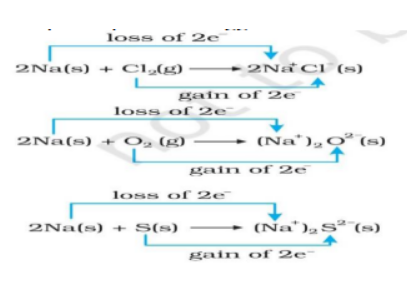
$2\text{Na}(\text{s})+\text{Cl2}\text{g}\rightarrow2\text{NaCl}(\text{s})$ $4\text{Na}(\text{s})+\text{O}_2\text{g}\rightarrow2\text{Na}_2\text{o}(\text{s})$ $2\text{Na}(\text{s})+\text{S}\text{(s)}\rightarrow2\text{Na}_2\text{S}(\text{s})$ are redox reactions because in each of these reactions sodium is oxidised due to the addition of either oxygen or more electronegative element to sodium. Simultaneously, chlorine, oxygen and sulphur are reduced because to each of these, the electropositive element sodium has been added. From our knowledge of chemical bonding we also know that sodium chloride, sodium oxide and sodium sulphide are ionic compounds and perhaps better written as $\mathrm{Na}+\mathrm{Cl}-(\mathrm{s}),\left(\mathrm{Na}^{+}\right)_2 \mathrm{O}^2-(\mathrm{s})$, and $\left(\mathrm{Na}^{+}\right)_2 \mathrm{~S}^{2-}(\mathrm{s})$. Development of charges on the species produced suggests us to rewrite the reactions in the following manner: For convenience, each of the above processes can be considered as two separate steps, one involving the loss of electrons and the other the gain of electrons. As an illustration, we may further elaborate one of these, say, the formation of sodium chloride. $2\text{Na}(\text{s})\rightarrow2\text{Na}^+\text{g}+2\bar{\text{e}}$ $\text{Cl}_2\text{g}+2\bar{\text{e}}\rightarrow2\text{C}\bar{\text{I}}\text{ (g)}$ Each of the above steps is called a half reaction, which explicitly shows involvement of electrons. Sum of the half reactions gives the overall reaction $2\text{Na}(\text{s})+\text{Cl}_2\text{(g)}\rightarrow2\text{Na}^+\text{CI}(\text{s})\text{ or } 2\text{NaCI}(\text{s})$ Above Reactions suggest that half reactions that involve loss of electrons are called oxidation reactions. Similarly, the half reactions that involve gain of electrons are called reduction reactions. To summarise, we may mention that Oxidation: Loss of electron(s) by any species. Reduction: Gain of electron(s) by any species. Oxidising agent: Acceptor of electron(s). Reducing agent: Donor of electron(s).
  1. Addition of electronegative element to a substance is known as..
  1. Oxidation
  2. Reduction
  3. Redox reaction
  4. All the above
  1. Removal of electronegative element to a substance is known as ..
  1. Oxidation
  2. Reduction
  3. Redox reaction
  4. All the above
  1. Acceptor of electrons is …
  1. Reducing Agent
  2. Catalytic Agent
  3. Oxidising Agent
  4. None of above
  1. Donor of electrons is…
  1. Organic Agent
  2. Catalytic Agent
  3. Oxidising Agent
  4. Reducing Agent
  1. Oxidation and Reduction occurs simultaneously is known as …
  1. Exothermic reaction
  2. Endothermic reaction
  3. Redox reaction
  4. Neutralization reaction
The phenomenon of the existence of two or more compounds possessing the same molecular formula but different properties is known as isomerism. Such compounds are called isomers. Compounds having the same molecular formula but different structures (manners in which atoms are linked) are classified as structural isomers. Structural isomers are classified as chain isomer, position isomer, functional group isomer. Meristematic arises due to different alkyl chains on either side of the functional group in the molecule and stereoisomerism and can be classified as geometrical and optical isomerism. Hyperconjugation is a general stabilising interaction. It involves delocalisation of $\sigma$ electrons of the C-H bond of an alkyl group directly attached to an atom of an unsaturated system or to an atom with an unshared p orbital. This type of overlap stabilises the carbocation because electron density from the adjacent $\sigma$ bond helps in dispersing the positive charge.

1. Why Isopentane, pentane and Neopentane are chain isomers?
2. The molecular formula $C _3 H _8 O$ represents which isomer?
3. What type of isomerism is shown by Methoxypropane and ethoxyethane?
OR
Why hyperconjugation is a permanent effect?
Read the passage given below and answer the following questions from (i) to (v).
The identity of a substance is defined not only by the types of atoms or ions it contains, but by the quantity of each type of atom or ion. The experimental approach required the introduction of a new unit for amount of substances, the mole, which remains indispensable in modern chemical science. The mole is an amount unit similar to familiar units like pair, dozen, gross, etc. It provides a specific measure of the number of atoms or molecules in a bulk sample of matter. A mole is defined as the amount of substance containing the same number of discrete entities (atoms, molecules, ions, etc.) as the number of atoms in a sample of pure 12 C weighing exactly 12 g . One Latin connotation for the word "mole" is "large mass" or "bulk," which is consistent with its use as the name for this unit. The mole provides a link between an easily measured macroscopic property, bulk mass, and an extremely important fundamental property, number of atoms, molecules and so forth. The number of entities composing a mole has been experimentally determined to be $6.02214179 \times 10^{23}$. $6.02214179 \times 10^{23}$, a fundamental constant named Avogadro's number (NA) or the Avogadro constant in honor of Italian scientist Amedeo Avogadro. This constant is properly reported with an explicit unit of "per mole," a conveniently rounded version being $6.022 \times 10^{23} / mol$. Consistent with its definition as an amount unit, 1 mole of any element contains the same number of atoms as 1 mole of any other element. The masses of 1 mole of different elements, however, are different, since the masses of the individual atoms are drastically different. The molar mass of an element (or compound) is the mass in grams of 1 mole of that substance, a property expressed in units of grams per mole ( $g / mol$ ). The following questions are multiple choice questions. Choose the most appropriate answer:
i. A sample of copper sulphate pentahydrate contains 8.64 g of oxygen. How many grams of Cu is present in the sample?
  1. A sample of copper sulphate pentahydrate contains 8.64g of oxygen. How many grams of Cu is present in the sample?
  1. 0.952g
  2. 3.816g
  3. 3.782g
  4. 8.64g
  1. A gas mixture contains 50% helium and $50\%$ methane by volume. What is the percent by \ weight of methane in the mixture?
  1. $19.97\%$
  2. $20.05\%$
  3. $50\%$
  4. $80.03\%$
  1. The mass of oxygen gas which occupies 5.6 litres at STP could be:
  1. Gram atomic mass of oxygen
  2. One fourth of the gram atomic mass of oxygen
  3. Double the gram atomic mass of oxygen
  4. Half of the gram atomic mass of oxygen
  1. What is the mass of one molecule of yellow phosphorus? (Atomic mass of phosphorus = 30)
  1. $1.993 \times 10^{-22}$ mg
  2. $1.993 \times 10^{-19}$ mg
  3. $4.983 \times 10^{-20}$ mg
  4. $4.983 \times 10^{-23}$ mg
  1. The number of moles of oxygen in 1L of air containing $21\%$ oxygen by volume, in standard conditions is:
  1. $0.186$ mol
  2. $0.21$ mol
  3. $2.10$ mol
  4. $0.0093$ mol