Question
Read the passage given below and answer the following questions from (i) to (v).
When covalent bond is formed betweentwo similar atoms, for example in $H _2, O _2, Cl _2, N_2 Or F _2$, the shared pair of electrons is equally Attracted by the two atoms. As a result electronPair is situated exactly between the twoldentical nuclei. The bond so formed is calledNonpolar covalent bond. As a result of polarisation, the moleculePossesses the dipole moment which can be defined as the productof the magnitude of the charge and theDistance between the centres of positive andNegative charge. It is usually designated by aGreek letter ' $\mu$ '. Mathematically, it is expressedAs follows :Dipole moment $(\mu)=$ charge $( Q ) \times$ distance ofSeparationDipole moment is usually expressed inDebye units (D). The conversion factor is $1 D =3.33564 \times 10^{-30} C$ mWhere C is coulomb and m is meter. Just as all the covalent bonds haveSome partial ionic character, the ionicBonds also have partial covalentCharacter. The partial covalent character of ionic bonds was discussed by Fajans in terms of the following rules:
- The smaller the size of the cation and theLarger the size of the anion, the greater theCovalent character of an ionic bond.
- The greater the charge on the cation, theGreater the covalent character of the ionic bond.
- For cations of the same size and charge, The one, with electronic configuration( $n -1) d ^0 n s ^0$, typical of transition metals, isMore polarising than the one with a nobleGas configuration, ns2 np6, typical of alkali and alkaline earth metal cations.

Sidgwick and Powell in 1940, proposed a simple theoryBased on the repulsive interactions of theElectron pairs in the valence shell of the atoms.It was further developed and redefined byNyholm and Gillespie (1957).The main postulates of VSEPR theory areAs follows:
- The shape of a molecule depends uponThe number of valence shell electron pairs(bonded or nonbonded) around the centralAtom.
- Pairs of electrons in the valence shell repelone another since their electron clouds arenegatively charged.
- These pairs of electrons tend to occupySuch positions in space that minimiseRepulsion and thus maximise distanceBetween them.
- The valence shell is taken as a sphere withThe electron pairs localising on theSpherical surface at maximum distanceFrom one another.
- A multiple bond is treated as if it is a singleElectron pair and the two or three electronPairs of a multiple bond are treated as aSingle super pair.
- Where two or more resonance structuresCan represent a molecule, the VSEPRModel is applicable to any such structure.
 The arrangement of electron pairs and the atoms around the central atom can be : linear,Trigonal planar, tetrahedral, trigonal-Bipyramidal and octahedral. Valence bond theory was introduced byHeitler and London (1927) and developedFurther by Pauling and others. A discussionOf the valence bond theory is based on the knowledge of atomic orbitals, electronicConfigurations of elements.partialmerging of atomic orbitals is called overlappingof atomic orbitals which results in the pairingof electrons. The extent of overlap decides thestrength of a covalent bond. according toorbital overlap concept, the formation of acovalent bond between two atoms results bypairing of electrons present in the valence shellhaving opposite spins. When orbitals of two atoms come close to formbond, their overlap may be positive, negativeor zero depending upon the sign anddirection of orientation of amplitude of orbitalwave function in space. Positive andnegative sign on boundary surface diagramsin the show the sign (phase) of orbitalwave function and are not related to charge.Orbitals forming bond should have same sign(phase) and orientation in space. This is calledpositive overlap. The criterion of overlap, as the main factorfor the formation of covalent bonds appliesuniformly to the homonuclear/heteronucleardiatomic molecules and polyatomic molecules.
  1. Dipole moment is usually expressed in….
  1. Debye
  2. Centimeter
  3. Columbs
  4. Ergs
  1. 1D = .....
  1. $33564\times 10^{–28}Cm$
  2. $3.3564\times 10^{–30}Cm$
  3. $33564\times 10^{–32}Cm$
  4. $33564\times 10^{–34}Cm$
  1. Valence bond theory was introduced by ….
  1. Pauling and lewis
  2. Nyholm and Gillespie
  3. Heitler and London
  4. Sidgwick and Powell
  1. Pair is situated exactly between the two Identical nuclei the bond so formed is called …. covalent bond.
  1. Unipolar
  2. Bipolar
  3. Polar
  4. Nonpolar
  1. Pairs of electrons in the valence shell … one another since their electron clouds are negatively charged.
  1. Attract
  2. Repel
  3. Both a) & b)
  4. None if above

Answer

  1. (a) Debye
  1. (b) $3.3564\times 10^{–30}Cm$
  1. (d) Sidgwick and Powell
  1. (d) Nonpolar
  1. (b) Repel

Need a full question paper?

Generate a complete, print-ready paper with questions like this in minutes — across 16+ boards, with answer keys.

Start Generating Free

Similar questions

Read the passage given below and answer the following questions from 1 to 5.
Hydrogen Peroxide $(H_2O_2)$ Hydrogen peroxide is an important chemical used in pollution control treatment of domestic and industrial effluents.It can be prepared by the following methods.
i) Acidifying barium peroxide and removing excess water by evaporation under reduced pressure gives hydrogen.
$\text{BaO}_2.8\text{H}_2\text{O}(\text{s})+\text{H}_2\text{SO}_4\text{(aq)}\rightarrow\text{BaSO}_4\text{(s)}+\text{H}_2\text{O}_2\text{(aq)}+8\text{H}_2\text{O}\text{l}$
ii) Peroxodisulphate, obtained by electrolytic oxidation of acidified sulphate solutions at high current density, on hydrolysis yields hydrogen.
$2\text{HSO}_\bar{4}(\text{aq})\xrightarrow{\text{Electrolysis}}\text{HO}_3\text{SOOSO}_3\text{H}(\text{aq})\xrightarrow{\text{Hydrolysis}}2\text{HSO}_\bar{4}\text{(aq)}+2\text{H}^+\text{(aq)}+\text{H}_2\text{O}_2\text{aq}$
This method is now used for the laboratory preparation of $D_2O_{2.}$
_{$\text{K}_2\text{S}_2\text{O}_8(\text{s})+2\text{D}_2\text{O}\text{(l)}\rightarrow2\text{KDSO}_4(\text{aq})+\text{D}_2\text{O}_2\text{(l)}$}
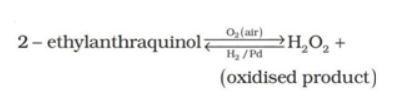
iii) Industrially it is prepared by the auto- oxidation of 2-alklylanthraquinols. 2 ethylanthraquinol H O oxidised product.

In this case 1% $H_2O_2$ is formed. It is extracted with water and concentrated to $\sim30\%$ (by mass) by distillation under reduced pressure. It can be further concentrated to $\sim85\%$ by careful distillation under low pressure. The remaining water can be frozen out to obtain pure $H_2O_2$. Physical Properties of the pure state $H_2O_2$ is an almost colourless (very pale blue) liquid. Its important physical properties. $H_2O_2$ is miscible with water in all proportions and forms a hydrate $H_2O_2.$ $H_2O$ (mp 221K). A 30% solution of $H_2O_2$ is marketed as ‘100 volume’ hydrogen peroxide. It means that one millilitre of 30% $H_2O_2$ solution will give 100 mL of oxygen at STP. Commercially marketed sample is 10 V, which means that the sample contains 3% $H_2O_2$ . Structure Hydrogen peroxide has a non-planar structure.
$H_2O_2$ decomposes slowly on exposure to light.
$2\text{H}_2\text{O}_2\text{(l)}\rightarrow2\text{H}_2\text{O}(\text{l})+\text{O}_2\text{(g)}$
In the presence of metal surfaces or traces of alkali (present in glass containers), the above reaction is catalysed. It is, therefore, stored in wax-lined glass or plastic vessels in dark. Urea can be added as a stabiliser. It is kept away from dust because dust can induce explosive decomposition of the compound.
Its wide scale use has led to tremendous increase in the industrial production of $H_2O_2$. Some of the uses are listed below:
i) In daily life it is used as a hair bleach and as a mild disinfectant. As an antiseptic it is sold in the market as
ii) It is used to manufacture chemicals like sodium perborate and per – carbonate, which are used in high quality detergents.
iii) It is used in the synthesis of hydroquinone, tartaric acid and certain food products and pharmaceuticals (cephalosporin)
iv) It is employed in the industries as a bleaching agent for textiles, paper pulp, leather, oils, fats,
v) Nowadays it is also used in Environmental (Green) Chemistry. For example, in pollution control treatment of domestic and industrial effluents, oxidation of cyanides, restoration of aerobic conditions to sewage wastes,
Heavy water, $D_2O$ It is extensively used as a moderator in nuclear reactors and in exchange reactions for the study of reaction mechanisms. It can be prepared by exhaustive electrolysis of water or as a by-product in some fertilizer industries. It is used for the preparation of other deuterium compounds, for example:
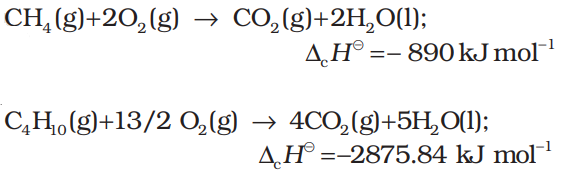
Dihydrogen can be used as a fuel .Dihydrogen releases large quantities of heat on combustion. The data on energy released by combustion of fuels like dihydrogen, methane, LPG etc. are compared in terms of the same amounts in mole, mass and volume Hydrogen Economy is an alternative. The basic principle of hydrogen economy is the transportation and storage of energy in the form of liquid or gaseous dihydrogen. Advantage of hydrogen economy is that energy is transmitted in the form of dihydrogen and not as electric power. It is for the first time in the history of India that a pilot project using dihydrogen as fuel was launched in October 2005 for running automobiles. Initially 5% dihydrogen has been mixed in CNG for use in four-wheeler vehicles. The percentage of dihydrogen would be gradually increased to reach the optimum level. Nowadays, it is also used in fuel cells for generation of electric power. It is expected that economically viable and safe sources of dihydrogen will be identified in the years to come, for its usage as a common source of energy.
  1. In India, a pilot project using dihydrogen as fuel was launched in… for running automobiles.
  1. October 2005
  2. May 2004
  3. August 2014
  4. February 2010
  1. Structure Hydrogen peroxide has a … structure.
  1. Bilateral
  2. Non-planar
  3. Planar
  4. Cubic
  1. One millilitre of 30% $H_2O_2$ solution will give … mL of oxygen at STP.
  1. 30
  2. 10
  3. 100
  4. 300
  1. …. is extensively used as a moderator in nuclear reactors and in exchange reactions for the study of reaction mechanisms.
  1. $H_2O_2$
  2. $T_2O$
  3. $H_2O$
  4. $D_2O$
  1. Colour of pure state $H_2O_2$ is ..
  1. Very Pale red
  2. Very Pale yellow
  3. Very Pale green
  4. Very Pale blue
Read the passage given below and answer the following questions from 1 to 5. Since the isotopes have the same electronic Configuration, they have almost the same Chemical properties.The only difference is in Their rates of reactions, mainly due to their Different enthalpy of bond dissociation . However, in physical properties these Isotopes differ considerably due to their large Mass differences. There are a number of methods for preparing Dihydrogen from metals and metal hydrides. 1.) Laboratory Preparation of Dihydrogen – It is usually prepared by the reaction of Granulated zinc with dilute hydrochloric. $Zn + 2H + \rightarrow Zn_2+ + H_2$ It can also be prepared by the reaction of Zinc with aqueous alkali. $Zn + 2NaOH \rightarrow Na_2ZnO_2 + H_2$ Commercial Production of Dihydrogen – The commonly used processes are outlined Below: i) Electrolysis of acidified water using Platinum electrodes gives hydrogen. ii) High purity (> 99.95%) dihydrogen is Obtained by electrolysing warm aqueous Barium hydroxide solution between nickel iii) It is obtained as a by product in the Manufacture of sodium hydroxide and Chlorine by the electrolysis of brine Solution. During electrolysis, the reactions That take place are: at anode: $2\text{CI}(\text{aq})\rightarrow\text{CI}_2(\text{g})+2\bar{\text{e}}$ at cathode: $2\text{H}_2\text{O}(\text{l})+2\text{e}\rightarrow\text{H}_2(\text{g})+2\text{O}\bar{\text{H}}(\text{aq})$ The overall reaction is $2\text{Na }(\text {aq})+2\text{C}\bar{\text{I}}(\text{aq})+2\text{H}_2\text{O}(\text{l})$ $\text{CI}_2(\text{g})+\text{H}_2(\text{g})+2\text{Na}^+(\text{aq})+2\text{O}\bar{\text{H}}(\text{aq})$ That take place are: iv) Reaction of steam on hydrocarbons or coke At high temperatures in the presence of Catalyst yields hydrogen.

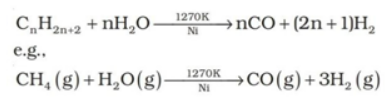
 The mixture of $CO$ and $H_2$ is called water Gas. As this mixture of $CO$ and $H_2$ is used for The synthesis of methanol and a number of Hydrocarbons, it is also called synthesis gas Or ‘syngas’. Nowadays ‘syngas’ is produced From sewage, saw-dust, scrap wood, Newspapers etc. The process of producing ‘syngas’ from coal is called ‘coal gasification’. The production of dihydrogen can be Increased by reacting carbon monoxide of Syngas mixtures with steam in the presence of Iron chromate as catalyst. This is called water-gas shift reaction. Carbon dioxide is removed by scrubbing with Sodium arsenite solution. Presently ~77% of the industrial Dihydrogen is produced from petro-chemicals, 18% from coal, 4% from electrolysis of aqueous Solutions and 1% from other sources. Physical Properties Dihydrogen is a colourless, odourless, Tasteless, combustible gas. It is lighter than Air and insoluble in water. Its other physical Properties are alongwith those of deuterium. The chemical behaviour of dihydrogen (and for That matter any molecule) is determined, to a Large extent, by bond dissociation enthalpy. The H–H bond dissociation enthalpy is the Highest for a single bond between two atoms Of any element. What inferences would you Draw from this fact ? It is because of this factor That the dissociation of dihydrogen into its Atoms is only~0.081% around 2000K which Increases to 95.5% at 5000K. Also, it is Relatively inert at room temperature due to the high H–H bond enthalpy. Thus, the atomic Hydrogen is produced at a high temperature In an electric arc or under ultraviolet Radiations. Since its orbital is incomplete with 1s1 Electronic configuration, it does combine With almost all the elements. It accomplishes Reactions by
i) loss of the only electron to Give H+, ii) gain of an electron to form H–, and iii) Sharing electrons to form a single covalent bond. The chemistry of dihydrogen can be Illustrated by the following reactions: Reaction with halogens: It reacts with Halogens, $X_2$ to give hydrogen halides, $\text{H}_2(\text{g})+\text{x}_2(\text{g})\rightarrow2\text{HX}(\text{g})(\text{x}=\text{F.CI.Br.I})$ While the reaction with fluorine occurs even in The dark, with iodine it requires a catalyst. Reaction with dioxygen: It reacts with Dioxygen to form water. The reaction is highly Exothermic. $2\text{H}_2(\text{g})+\text{O}_2(\text{g})\xrightarrow{\text{catalyst or beading}}2\text{H}_2\text{O}(\text{l}):$ $\triangle\text{H}^-=-285.9\text{kj}\text{mol}^-1$ This is the method for the manufacture of Ammonia by the Haber process. Reactions with metals: With many metals it Combines at a high temperature to yield the Corresponding hydrides $H_2$ (g) + 2M (g) → 2 MH (s); Where M is an alkali metal Reactions with metal ions and metal Oxides: It reduces some metal ions in aqueous Solution and oxides of metals (less active than Iron) into corresponding metals. $\text{H}_2(\text{g})+\text{Pd}^{2+}\text{(aq)}\rightarrow\text{Pd}(\text{s})+2\text{H}^+(\text{aq})$ $\text{y}\text{H}_2(\text{g})+\text{M}_\text{x}\text{O}_\text{y}(\text{S})\rightarrow\text{xM}(\text{s})+\text{y}\text{H}_2\text{O}\text{(l)}$ Reactions with organic compounds: It Reacts with many organic compounds in the Presence of catalysts to give useful Hydrogenated products of commercial Importance. For example: Hydrogenation of vegetable oils using Nickel as catalyst gives edible fats (margarine and vanaspati ghee) Hydroformylation of olefins yields Aldehydes which further undergo Reduction to give alcohols. $\text{H}_2+\text{CO}+\text{RCH}=\text{CH}_2\rightarrow\text{RCH}_2\text{CH}_2\text{CHO}$ $\text{H}_2+\text{RCH}_2\text{CH}_2\text{CHO}\rightarrow\text{RCH}_2\text{CH}_2\text{CH}_2\text{OH}$
  1. The mixture of CO and H2 is called …
  1. water Gas
  2. Dry ice
  3. Dry carbon
  4. Dry hydrogen
  1. Which of the following is not physical property of Dihydrogen.
  1. colourless
  2. Highest dissociation enthalpy
  3. odourless
  4. Tasteless
  1. Dihydrogen is reacts with dioxygen to get ….
  1. $H_2O_2$
  2. $2H_2O_2$
  3. $2H_2O$
  4. $H_2O$
  1. High purity dihydrogen is obtained by electrolysing warm aqueous barium hydroxide solution between… electrodes.
  1. Chromium
  2. Copper
  3. Platinum
  4. Nickel
Read the passage given below and answer the following questions from 1 to 5.

Alkanes are generally inert towards acids, bases, oxidising and reducing agents. However, they undergo the following reactions under certain conditions.
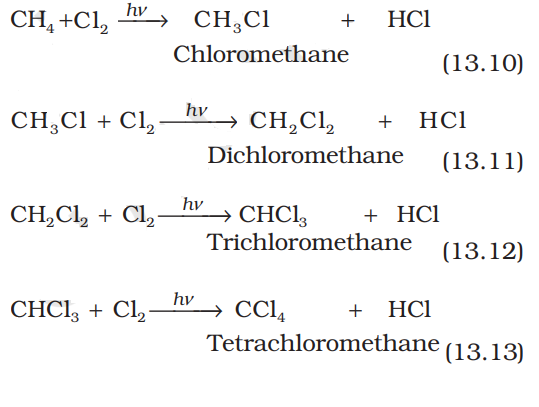
1) Substitution reactions One or more hydrogen atoms of alkanes can be replaced by halogens, nitro group and sulphonic acid group. Halogenation takes place either at higher temperature (573-773K) or in the presence of diffused sunlight or ultraviolet light. Lower alkanes do not undergo nitration and sulphonation reactions. These reactions in which hydrogen atoms of alkanes are substituted are known as substitution reactions. As an example, chlorination of methane is given below: Halogenation
$\text{CH}_3-\text{CH}_3+\text{CL}_2\xrightarrow{\text{hv}}\text{CH}_3-\text{CH}_2\text{Cl}+\text{HCl}$

It is found that the rate of reaction of alkanes with halogens is $F_2 > C_{l2} > Br_2 > I_2$. Rate of replacement of hydrogens of alkanes is: $3^\circ > 2^\circ > 1^\circ$ ​​​​​​​. Fluorination is too violent to be controlled. Iodination is very slow and a reversible reaction. It can be carried out in the presence of oxidizing agents like $HIO_3$ or $HNO_3$.
$\text{CH}_4+\text{I}_2\rightleftharpoons\text{CH}_3\text{I}+\text{HI}$
$\text{HIO}_3+5\text{HI}\rightarrow3\text{I}_2+3\text{H}_2\text{O}$
Halogenation is supposed to proceed via free radical chain mechanism involving three steps namely initiation, propagation and termination.

The General combustion equation for any alkane is:
$\text{C}_\text{n}\text{H}_{2\text{n}+2}+\Bigg(\frac{3\text{n}+1}{2}\Bigg)\text{O}_2\rightarrow\text{nCO}_2+(\text{n}+1)\text{H}_2\text{O}$
Combustion
Alkanes on heating in the presence of air or dioxygen are completely oxidized to carbon dioxide and water with the evolution of large amount of heat.
Due to the evolution of large amount of heat during combustion, alkanes are used as fuels. During incomplete combustion of alkanes with insufficient amount of air or dioxygen, carbon black is formed which is used in the manufacture of ink, printer ink, black pigments and as filters.

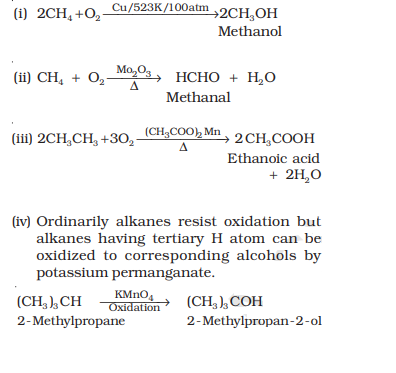
Controlled oxidation Alkanes on heating with a regulated supply of dioxygen or air at high pressure and in the presence of suitable catalysts give a variety of oxidation products.
Ordinarily alkanes resist oxidation but alkanes having tertiary H atom can be oxidized to corresponding alcohols by potassium permanganate .
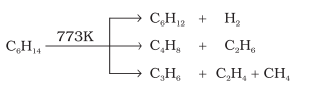
Pyrolysis Higher alkanes on heating to higher temperature decompose into lower alkanes, alkenes etc. Such a decomposition reaction into smaller fragments by the application of heat is called pyrolysis or cracking.

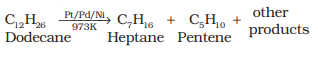
Pyrolysis of alkanes is believed to be a free radical reaction. Preparation of oil gas or petrol gas from kerosene oil or petrol involves the principle of pyrolysis. For example, dodecane, a constituent of kerosene oil on heating to 973K in the presence of platinum, palladium or nickel gives a mixture of heptane and pentene.

Conformations- Alkanes contain carbon-carbon sigma $(\sigma)$bonds. Electron distribution of the sigma molecular orbital is symmetrical around the internuclear axis of the C–C bond which is not disturbed due to rotation about its axis. This permits free rotation about C–C single bond. This rotation results into different spatial arrangements of atoms in space which can change into one another. Such spatial arrangements of atoms which can be converted into one another by rotation around a C-C single bond are called conformations or conformers or rotamers. Alkanes can thus have infinite number of conformations by rotation around C-C single bonds. However, it may be remembered that rotation around a C-C single bond is not completely free. It is hindered by a small energy barrier of $1^{-20}kJ\ mol–1$ due to weak repulsive interaction between the adjacent bonds. Such a type of repulsive interaction is called torsional strain. Conformations of ethane : Ethane molecule $(C_2H_6)$ contains a carbon – carbon single bond with each carbon atom attached to three hydrogen atoms. Considering the ball and stick model of ethane, keep one carbon atom stationary and rotate the other carbon atom around the C-C axis. This rotation results into infinite number of spatial arrangements of hydrogen atoms attached to one carbon atom with respect to the hydrogen atoms attached to the other carbon atom. These are called conformational isomers (conformers). Thus there are infinite number of conformations of ethane. However, there are two extreme cases. One such conformation in which hydrogen atoms attached to two carbons are as closed together as possible is called eclipsed conformation and the other in which hydrogens are as far apart as possible is known as the staggered conformation. Any other intermediate conformation is called a skew conformation. It may be remembered that in all the conformations, the bond angles and the bond lengths remain the same. Eclipsed and the staggered conformations can be represented by Sawhorse and Newman projections.
  1. Alkanes contain carbon-carbon … bonds.
  1. sigma $\sigma$
  2. pi bond$\pi$
  3. delta$\delta$
  4. eta $\eta$
  1. C-C single bond is hindered by a small energy barrier of…. $kJ ~mol^{–1}$​​​​​​​
  1. 10 - 200
  2. 1 - 20
  3. 100 - 427
  4. 342 - 786
  1. A decomposition reaction into smaller fragments by the application of heat is called as ….
  1. pyrolysis
  2. cracking
  3. both (a) & (b)
  4. combustion
  1. Which of the following steps are involving in free radical chain mechanism
  1. initiation
  2. propagation
  3. termination
  4. All the above
  1. The … reaction in which alkanes on heating in the presence of air or dioxygen are completely oxidized to carbon dioxide and water with the evolution of large amount of heat.
  1. pyrolysis
  2. cracking
  3. both (a) & (b)
  4. combustion
The phenomenon of the existence of two or more compounds possessing the same molecular formula but different properties is known as isomerism. Such compounds are called isomers. Compounds having the same molecular formula but different structures (manners in which atoms are linked) are classified as structural isomers. Structural isomers are classified as chain isomer, position isomer, functional group isomer. Meristematic arises due to different alkyl chains on either side of the functional group in the molecule and stereoisomerism and can be classified as geometrical and optical isomerism. Hyperconjugation is a general stabilising interaction. It involves delocalisation of $\sigma$ electrons of the C-H bond of an alkyl group directly attached to an atom of an unsaturated system or to an atom with an unshared p orbital. This type of overlap stabilises the carbocation because electron density from the adjacent $\sigma$ bond helps in dispersing the positive charge.

1. Why Isopentane, pentane and Neopentane are chain isomers?
2. The molecular formula $C _3 H _8 O$ represents which isomer?
3. What type of isomerism is shown by Methoxypropane and ethoxyethane?
OR
Why hyperconjugation is a permanent effect?
Read the passage given below and answer the following questions from 1 to 5.
Important compounds of calcium are calcium Oxide, calcium hydroxide, calcium sulphate, Calcium carbonate and cement. These are Industrially important compounds. The large Scale preparation of these compounds and Their uses are described below. Calcium Oxide or Quick Lime CaO – It is prepared on a commercial scale by Heating limestone $(CaCO_3)$ in a rotary kiln at 1070-1270 K.
$\text{CaCO}_3\overset{\text{heat}}{\rightleftharpoons}\text{CaO} + \text{CO}_2$
The carbon dioxide is removed as soon as It is produced to enable the reaction to proceed To completion. Calcium oxide is a white amorphous solid. It has a melting point of 2870 K. On exposure To atmosphere, it absorbs moisture and carbon Dioxide.
$\text{CaO}+\text{H}_2\text{O}\rightarrow\text{Ca}{\text{OH}}_2$
$\text{CaO}+\text{CO}_2\rightarrow\text{CaCO}_3$
The addition of limited amount of water Breaks the lump of lime. This process is called Slaking of lime. Quick lime slaked with soda Gives solid sodalime. Being a basic oxide, it Combines with acidic oxides at high Temperature.
$\text{CaO}+\text{SiO}_2\rightarrow\text{CaSiO}_3$
$6\text{CaO}+\text{P}_4\text{O}_{10}\rightarrow2\text{Ca}_3(\text{PO}_4)_2$
Uses: It is an important primary material for Manufacturing cement and is the cheapest Form of alkali. It is used in the manufacture of sodium Carbonate from caustic soda. It is employed in the purification of sugar And in the manufacture of dye stuffs.
Calcium Carbonate – $CaCO_3$ occurs in nature in several Forms like limestone, chalk, marble etc. It can Be prepared by passing carbon dioxide Through slaked lime or by the addition of Sodium carbonate to calcium chloride.
$\text{Ca}\text{(OH)}_2+\text{CO}_2\rightarrow\text{CaCO}_3+\text{H}_2\text{O}$
$\text{CaCl}_2+\text{Na}_2\text{CO}_3+\text{CaCO}_3+2\text{NaCl}$
excess of carbon dioxide should be Avoided since this leads to the formation of Water soluble calcium hydrogencarbonate. Calcium carbonate is a white fluffy powder. It is almost insoluble in water. When heated To 1200 K, it decomposes to evolve carbon Dioxide. It is used as a building material in the form of Marble and in the manufacture of quick lime. Calcium carbonate along with magnesium Carbonate is used as a flux in the extraction of Metals such as iron. Specially precipitated CaCO3 Is extensively used in the manufacture Of high quality paper. It is also used as an Antacid, mild abrasive in tooth paste, a Constituent of chewing gum, and a filler in Cosmetics.
Calcium Sulphate (Plaster of Paris), $\text{CaSO}_4·\frac{1}{2}\text{H}_2\text{O}^ –$ It is a hemihydrate of calcium sulphate. It is Obtained when gypsum, $CaSO_4·2H_2O$, is Heated to 393 K.
$2(\text{CaSO}_4.2\text{H}_2)\rightarrow2\text{(CaSO}_4)\text{H}_2\text{O}+3\text{H}_2\text{O}$
above 393 K, no water of crystallisation is left and anhydrous calcium sulphate, $CaSO_4$ is Formed. This is known as ‘dead burnt plaster’. It has a remarkable property of setting with Water. On mixing with an adequate quantity Of water it forms a plastic mass that gets into a Hard solid in 5 to 15 minutes.
Uses: The largest use of Plaster of Paris is in the Building industry as well as plasters. It is used For immoblising the affected part of organ where There is a bone fracture or sprain. It is also Employed in dentistry, in ornamental work and For making casts of statues and busts.
Cement: Cement is an important building Material. it was first introduced in England in 1824 by Joseph Aspdin. It is also called Portland cement because it resembles with the Natural limestone quarried in the Isle of Portland, England. Cement is a product obtained by Combining a material rich in lime, $CaO$ with Other material such as clay which contains Silica, $SiO_2$ along with the oxides of Aluminium, iron and magnesium. The average Composition of Portland cement is : CaO, 50-60%; $SiO_2, 20-25\%; Al2O_3, 5-10\%; MgO, 2-3\%; Fe2O_3, 1-2\%$ and $SO_3, 1-2\%$. For a good Quality cement, the ratio of silica $(SiO_2)$ to Alumina $(Al2O_3)$ should be between 2.5 and 4 And the ratio of lime (CaO) to the total of the Oxides of silicon $(SiO_2)$ aluminium $(Al2O_3)$ And iron $(Fe2O_3)$ should be as close as possible To 2. The raw materials for the manufacture of Cement are limestone and clay. When clay and Lime are strongly heated together they fuse and React to form ‘cement clinker’. This clinker is Mixed with 2-3% by weight of gypsum $(CaSO_4·2H_2O)$ to form cement. Thus important Ingredients present in Portland cement are Dicalcium silicate $(Ca_2SiO4)$ 26%, tricalcium silicate $(Ca_3SiO_5)$ 51% and tricalcium Aluminate $(Ca_3Al_2O_6)$ 11%.
Setting of Cement: When mixed with water, The setting of cement takes place to give a hard Mass. This is due to the hydration of the Molecules of the constituents and their Rearrangement. The purpose of adding Gypsum is only to slow down the process of Setting of the cement so that it gets sufficiently Hardened.
Uses: Cement has become a commodity of National necessity for any country next to iron And steel. It is used in concrete and reinforced Concrete, in plastering and in the construction Of bridges, dams and buildings.
Biological importance of magnesium and calcium - An adult body contains about 25g of Mg and 1200g of Ca compared with only 5g of iron And 0.06 g of copper. The daily requirement In the human body has been estimated to be 200 – 300 mg. All enzymes that utilise ATP in phosphate Transfer require magnesium as the cofactor. The main pigment for the absorption of light In plants is chlorophyll which contains Magnesium. About 99% of body calcium is Present in bones and teeth. It also plays Important roles in neuromuscular function, Interneuronal transmission, cell membrane Integrity and blood coagulation. The calcium Concentration in plasma is regulated at about $100\ mgL^{–1}.$ It is maintained by two hormones: Calcitonin and parathyroid hormone. Do you Know that bone is not an inert and unchanging Substance but is continuously being Solubilised and redeposited to the extent of 400mg per day in man? All this calcium Passes through the plasma.
  1. Quick Lime is prepared on a commercial scale by heating … in a rotary kiln at 1070-1270 K.
  1. $CaCO_3$
  2. $Ca_3Al_2O_6$
  3. $CaSO_42H_2O$
  4. $CaO$
  1. An adult body contains about … of Ca
  1. 600g
  2. 1200g
  3. 1800g
  4. 2400g
  1. The calcium Concentration in plasma is regulated at about …
  1. 10
  2. 50
  3. 100
  4. 500
  1. It was first introduced in England in 1824 by ….
  1. Edgar Dobbs
  2. Egor Cheliev
  3. James Parker
  4. Joseph Aspdin
  1. Molecular Formula of plaster of paris is …
  1. $CaSO_42H_2O$
  2. $\text{CaSO}_4·\frac{1}{2}\text{H}_2\text{O}^ –$
  3. $Ca_2SiO_4$
  4. $Ca_3Al_2O_6$
The molecular orbital theory is based on the principle of a linear combination of atomic orbitals. According to this approach when atomic orbitals of the atoms come closer, they undergo constructive interference as well as destructive interference giving molecular orbitals, i.e., two atomic orbitals overlap to form two molecular orbitals, one of which lies at a lower energy level (bonding molecular orbital). Each molecular orbital can hold one or two electrons in accordance with Pauli's exclusion principle and Hund's rule of maximum multiplicity.
For molecules up to $N _2$, the order of filling of orbitals is:
Image
Bond order $=\frac{1}{2}$ [bonding electrons - antibonding electrons]
Bond order gives the following information:
I. If bond order is greater than zero, the molecule/ion exists otherwise not.
II. Higher the bond order, higher is the bond dissociation energy.
III. Higher the bond order, greater is the bond stability.
IV. Higher the bond order, shorter is the bond length.

1. Arrange the following negative stabilities of $CN , CN ^{+}$and $CN ^{-}$in increasing order of bond. (1)
2. The molecular orbital theory is preferred over valence bond theory. Why? (1)
3. Ethyne is acidic in nature in comparison to ethene and ethane. Why is it so? (2)
OR
Bonding molecular orbital is lowered by a greater amount of energy than the amount by which antibonding molecular orbital is raised. Is this statement correct? (2)
When anions and cations approach each other, the valence shell of anions are pulled towards the cation nucleus and thus, the shape of the anion is deformed. The phenomenon of deformation of anion by a cation is known as polarization and the ability of the cation to polarize the anion is called as polarizing power of cation. Due to polarization, sharing of electrons occurs between two ions to some extent and the bond shows some covalent character.
The magnitude of polarization depends upon a number of factors.

1. Out of $AlCl _3$ and $AlI _3$ which halides show maximum polarization? (1)
2. Out of $AlCl _3$ and $CaCl _2$ which one is more covalent in nature? (1)
3. The non-aqueous solvent like ether is added to the mixture of $LiCl , NaCl$ and KCl . Which will be extracted into the ether? (2)
OR
Out of $CaF _2$ and $CaI _2$ which one has a minimum melting point? (2)
Read the passage given below and answer the following questions from (i) to (vi).
The atomic theory of matter was first proposed on afirm scientific basis by JohnDalton, a British schoolteacher in 1808. His theory, called Dalton’s atomictheory, regarded the atom as the ultimate particle ofmatter Dalton’s atomic theory was able to explainthe law of conservation of mass, law of constantcomposition and law of multiple proportion verysuccessfully. However, it failed to explain the results ofmany experiments.In mid 1850s many scientists mainlyFaraday began to study electrical dischargein partially evacuated tubes, known ascathode ray discharge tubes.Electrical discharge carried out in the modifiedcathode ray tube led to the discovery of canalrays carrying positively charged particles. Thecharacteristics of these positively chargedparticles are listed below.
  1. Unlike cathode rays, mass of positivelycharged particles depends upon thenature of gas present in the cathode raytube. These are simply the positivelycharged gaseous ions.
  2. The charge to mass ratio of the particlesdepends on the gas from which theseoriginate.
  3. Some of the positively charged particlescarry a multiple of the fundamental unitof electrical charge.
  4. The behaviour of these particles in themagnetic or electrical field is opposite tothat observed for electron or cathoderays.
The smallest and lightest positive ion wasobtained from hydrogen and was called
proton. This positively charged particle wascharacterised in 1919. Later, a need was feltfor the presence of electrically neutral particleas one of the constituent of atom. Theseparticles were discovered by Chadwick (1932)by bombarding a thin sheet of beryllium byα-particles. When electrically neutral particleshaving a mass slightly greater than that ofprotons were emitted. He named theseparticles as neutrons.J. J. Thomson, in 1898, proposed that an atom possesses a spherical shape (radiusapproximately 10–10 m) in which the positivecharge is uniformly distributed. The electronsare embedded into it in such a manner as togive the most stable electrostatic arrangementMany different names are given tothis model, for example, plum pudding, raisinpudding or watermelon. This model can be visualised as a pudding or watermelon ofpositive charge with plums or seeds (electrons)embedded into it. An important feature of thismodel is that the mass of the atom is assumed to be uniformly distributed over theatom.Rutherford and his students (Hans Geiger andErnest Marsden) bombarded very thin gold foilwith α–particles. Rutherford’s famous α–particle scattering experiment.The observations of Scattering experiment are as follows-:
  1. most of the α–particles passed throughthe gold foil undeflected.
  2. a small fraction of the α–particles wasdeflected by small angles.
  3. a very few α–particles (∼1 in 20,000)bounced back, that is, were deflected bynearly 180°.
On the basis of observations andconclusions from this experiment, Rutherford proposed the nuclearmodel of atom. According to this model:
  1. The positive charge and most of the massof the atom was densely concentrated inextremely small region. This very smallportion of the atom was called nucleusby Rutherford.
  2. The nucleus is surrounded by electronsthat move around the nucleus with a veryhigh speed in circular paths called orbits.Thus, Rutherford’s model of atomresembles the solar system in which thenucleus plays the role of sun and theelectrons that of revolving planets.
  3. Electrons and the nucleus are held together by electrostatic forces of attraction.
  1. The atomic theory of matter was first proposed on afirm scientific basis by:
  1. John Dalton
  2. Ernest Rutherford
  3. J.Thomson
  4. Henry Moseley
  1. The cathode rays start from … and move towards the….
  1. Anode, Cathode
  2. Centre, Anode
  3. Cathod, Anode
  4. Cathod, Centre
  1. Negativelycharged particles in atoms, called…
  1. Protons
  2. Electrons
  3. Neutron
  4. Positron
  1. The smallest and lightest positive ion wasobtained from …. and was called proton.
  1. Oxygen
  2. Nitrogen
  3. Carbon
  4. Hydrogen
  1. Electrically neutral particles having a mass slightly greater than that of protons, these particles termed as:
  1. Protons
  2. Electrons
  3. Neutron
  4. Positron
  1. J.J. Thomson’s atomic model is also named as:
  1. Plum pudding
  2. Raisin pudding
  3. Watermelon
  4. All the above
Read the passage given below and answer the following questions from 1 to 5 .
Carbon exhibits many allotropic forms; both crystalline as well as amorphous. Diamond and graphite are two wellknown crystalline forms of carbon. In 1985, third form of carbon known as fullerenes was discovered by H.W.Kroto, E.Smalley and R.F.Curl. For this discovery they were awarded the Nobel Prize in 1996.
Diamond It has a crystalline lattice. In diamond each carbon atom undergoes $sp ^3$ hybridisation and linked to four other carbon atoms by using hybridised orbitals in tetrahedral fashion. The C-C bond length is 154 pm . The structure extends in space and produces a rigid three- dimensional network of carbon atoms. It is very difficult to break extended covalent bonding and, therefore, diamond is a hardest substance on the earth. It is used as an abrasive for sharpening hard tools, in making dyes and in the manufacture of tungsten filaments for electric light bulbs. Graphite Graphite has layered structure. Layers are held by van der Waals forces and distance between two layers is 340 pm . Each layer is composed of planar hexagonal rings of carbon atoms. C-C bond length within the layer is 141.5 pm . Each carbon atom in hexagonal ring undergoes $sp ^2$ hybridisation and makes three sigma bonds with three neighbouring carbon atoms. Fourth electron forms a $\pi$ bond. The electrons are delocalised over the whole sheet. Electrons are mobile and, therefore, graphite conducts electricity along the sheet. Graphite cleaves easily between the layers and, therefore, it is very soft and slippery. For this reason graphite is used as a dry lubricant in machines running at high temperature, where oil cannot be used as a lubricant.
Fullerenes Fullerenes are made by the heating of graphite in an electric arc in the presence of inert gases such as helium or argon. The sooty material formed by condensation of vapourised Cn small molecules consists of mainly C60 with smaller quantity of C70 and traces of fullerenes consisting of even number of carbon atoms up to 350 or above. Fullerenes are the only pure form of carbon because they have smooth structure without having 'dangling' bonds. Fullerenes are cage like molecules. C60 molecule has a shape like soccer ball and called Buckminsterfullerene. It contains twenty six-membered rings and twelve five-membered rings. A six membered ring is fused with six or five membered rings but a five membered ring can only fuse with six membered rings. All the carbon atoms are equal and they undergo $sp ^2$ hybridisation. Each carbon atom forms three sigma bonds with other three carbon atoms. The remaining electron at each carbon is delocalised in molecular orbitals, which in turn give aromatic character to molecule. This ball shaped molecule has 60 vertices and each one is occupied by one carbon atom and it also contains both single and double bonds with C-C distances of 143.5 pm and 138.3 pm respectively. Spherical fullerenes are also called bucky balls in short.
Uses of Carbon Graphite fibres embedded in plastic material form high strength, lightweight composites. The composites are used in products such as tennis rackets, fishing rods, aircrafts and canoes. Being good conductor, graphite is used for electrodes in batteries and industrial electrolysis. Crucibles made from graphite are inert to dilute acids and alkalies. Being highly porous, activated charcoal is used in adsorbing poisonous gases; also used in wateof filters to remove organic contaminators and in airconditioning system to control odour. Carbon black is used as black pigment in black ink and as filler in automobile tyres. Coke is used as a fuel and largely as a reducing agent in metallurgy. Diamond is a precious stone and used in jewellery. It is measured in carats (1 carat = 200 mg ). Carbon Monoxide Direct oxidation of C in limited supply of oxygen or air yields carbon monoxide. $2 C ( s ) O ( g ) \rightarrow$ $2 CO ( g )$

When air is used instead of steam, a mixture of CO and $N_2$ is produced, which is called producer gas.
Water gas and producer gas are very important industrial fuels. Carbon monoxide in water gas or producer gas can undergo further combustion forming carbon dioxide with the liberation of heat. Carbon monoxide is a colourless, odourless and almost water insoluble gas. It is a powerful reducing agent and reduces almost all metal oxides other than those of the alkali and alkaline earth metals, aluminium and a few transition metals. This property of CO is used in the extraction of many metals from their oxides ores.
$\text{Fe}_2\text{O}_3(\text{s})+3\text{CO}(\text{g})\xrightarrow{\triangle}2\text{Fe}(\text{s})+3\text{CO}_2\text{(g)}$
$\text{ZnO}\text{(s)}+\text{CO}\text{(s)}\xrightarrow{\triangle}\text{Zn}(\text{s})+\text{CO}_2(\text{g})$
In CO molecule, there are one sigma and two π bonds between carbon and oxygen: C ≡ O Because of the presence of a lone pair on carbon, CO molecule acts as a donor and reacts with certain metals when heated to form metal carbonyls. The highly poisonous nature of CO arises because of its ability to form a complex with haemoglobin, which is about 300 times more stable than the oxygen-haemoglobin complex. This prevents haemoglobin in the red blood corpuscles from carrying oxygen round the body and ultimately resulting in death.
  1. In diamond each carbon atom undergoes … hybridisation.
  1. sp
  2. $sp^2$
  3. $sp^3$
  4. $sp^3d$
  1. Carbon atom in hexagonal ring undergoes … hybridisation.
  1. $sp$
  2. $sp^2$
  3. $sp^3$
  4. $sp^3d$
  1. C—C bond length within the layer in graphite is … pm.
  1. 5
  2. 5
  3. 180
  4. 90
  1. Fullerenes was discovered by …
  1. W.Kroto
  2. Smalley
  3. F.Curl
  4. All the above
  1. The C–C bond length in diamond is … pm.
  1. 5
  2. 5
  3. 180
  4. 154
The uncertainty in the experimental or the calculated values is indicated by mentioning the number of significant figures. Significant figures are meaningful digits which are known with certainty plus one which is estimated or uncertain. The uncertainty is indicated by writing the certain digits and the last uncertain digit. there are certain rules for determining the Number of significant figures. These are Stated below:
  • All non-zero digits are significant. For Example in 285cm, there are three Significant figures and in 0.25 mL, there are two significant figures.
  • Zeros preceding to first non-zero digit are not significant. such zero indicates the position of decimal point. thus, 0.03 has one significant figure and 0.0052 has two significant figures.
  • Zeros between two non-zero digits are significant. thus, 2.005 has four Significant figures.
  • Zeros at the end or right of a number are significant, provided they are on the right side of the decimal point. For example, 0.200 g has three significant figures. But, if otherwise, the terminal zeros are not significant if there is no decimal point.
Precision refers to the closeness of various measurements for the same quantity. However, accuracy is the agreement of a particular valueto the true value of the result.
LAWS OF CHEMICALCOMBINATIONS- The combination of elements to form compounds is governed by the following five basic laws.
  1. Law of Conservation of Mass-This law was put forth by Antoine Lavoisierin 1789. He performed careful experimental studies for combustion reactions and reached to the conclusion that in all physical andchemical changes, there is no net change inmassduring the process. Hence, he reachedto the conclusion that matter can neither becreated nor destroyed. This is called ‘Law ofConservation of Mass’.
  2. Law of Definite Proportions-This law was given by, a French chemist, Joseph Proust. He stated that a given compound always contains exactly the same proportion of elements by weight.
  3. Law of Multiple Proportions-This law was proposed by John Dalton. According to this law, if two elements can combine to form more than one compound, the masses of one element that combine with a fixed mass of the other element, are in the ratio of small whole numbers. For example, hydrogen combines with oxygen to form two compounds, namely, water and hydrogen peroxide.
Hydrogen + Oxygen→ Water

2g 16g 18g

Hydrogen + Oxygen → Hydrogen Peroxide

2g 32g 34g

Here, the masses of oxygen (i.e., 16 g and 32 g), which combine with a fixed mass of hydrogen (2g) bear a simple ratio, i.e., 16:32 or 1:2.
  1. Gay Lussac’s Law of Gaseous Volumes-This law was given by Gay Lussac in 1808. Heobserved that when gases combine or are produced in a chemicalreaction they do so in asimple ratio by volume,provided all gases are at the same temperature and pressure.
  2. Avogadro’s Law – In 1811, Avogadro proposed that equal volumes of all gases at the same temperature and pressure should contain equal number of molecules.
In 1808, Dalton published ‘A New System of Chemical Philosophy’, in which he proposed the following :
  1. Matter consists of indivisible atoms.
  2. All atoms of a given element have identical properties, including identical mass. Atoms of different elements differ in mass.
  3. Compounds are formed when atoms of different elements combine in a fixed ratio.
  4. Chemical reactions involve reorganisati on of atoms. These are neither created nor destroyed in a chemical reaction.
  1. … refers to the closeness of variousmeasurements for the same quantity.
  1. Accuracy
  2. Reliability
  3. Precision
  4. Uncertainty
  1. Law of Conservation of mass was put forth by ….in 1789.
  1. Joseph Proust
  2. Antoine Lavoisier
  3. Joseph Louis
  4. Gay Lussac
  1. Which of the following number has twosignificant figures.
  1. 0.0052
  2. 052
  3. 52
  4. 0052
  1. … is the agreement of a particular valueto the true value of the result.
  1. Accuracy
  2. Reliability
  3. Precision
  4. Uncertainty
  1. Law of Multiple Proportions proposed by....
  1. Joseph Proust
  2. Antoine Lavoisier
  3. Joseph Louis
  4. John Dalton