Question
Read the passage given below and answer the following questions from 1 to 5.
Important compounds of calcium are calcium Oxide, calcium hydroxide, calcium sulphate, Calcium carbonate and cement. These are Industrially important compounds. The large Scale preparation of these compounds and Their uses are described below. Calcium Oxide or Quick Lime CaO – It is prepared on a commercial scale by Heating limestone $(CaCO_3)$ in a rotary kiln at 1070-1270 K.
$\text{CaCO}_3\overset{\text{heat}}{\rightleftharpoons}\text{CaO} + \text{CO}_2$
The carbon dioxide is removed as soon as It is produced to enable the reaction to proceed To completion. Calcium oxide is a white amorphous solid. It has a melting point of 2870 K. On exposure To atmosphere, it absorbs moisture and carbon Dioxide.
$\text{CaO}+\text{H}_2\text{O}\rightarrow\text{Ca}{\text{OH}}_2$
$\text{CaO}+\text{CO}_2\rightarrow\text{CaCO}_3$
The addition of limited amount of water Breaks the lump of lime. This process is called Slaking of lime. Quick lime slaked with soda Gives solid sodalime. Being a basic oxide, it Combines with acidic oxides at high Temperature.
$\text{CaO}+\text{SiO}_2\rightarrow\text{CaSiO}_3$
$6\text{CaO}+\text{P}_4\text{O}_{10}\rightarrow2\text{Ca}_3(\text{PO}_4)_2$
Uses: It is an important primary material for Manufacturing cement and is the cheapest Form of alkali. It is used in the manufacture of sodium Carbonate from caustic soda. It is employed in the purification of sugar And in the manufacture of dye stuffs.
Calcium Carbonate – $CaCO_3$ occurs in nature in several Forms like limestone, chalk, marble etc. It can Be prepared by passing carbon dioxide Through slaked lime or by the addition of Sodium carbonate to calcium chloride.
$\text{Ca}\text{(OH)}_2+\text{CO}_2\rightarrow\text{CaCO}_3+\text{H}_2\text{O}$
$\text{CaCl}_2+\text{Na}_2\text{CO}_3+\text{CaCO}_3+2\text{NaCl}$
excess of carbon dioxide should be Avoided since this leads to the formation of Water soluble calcium hydrogencarbonate. Calcium carbonate is a white fluffy powder. It is almost insoluble in water. When heated To 1200 K, it decomposes to evolve carbon Dioxide. It is used as a building material in the form of Marble and in the manufacture of quick lime. Calcium carbonate along with magnesium Carbonate is used as a flux in the extraction of Metals such as iron. Specially precipitated CaCO3 Is extensively used in the manufacture Of high quality paper. It is also used as an Antacid, mild abrasive in tooth paste, a Constituent of chewing gum, and a filler in Cosmetics.
Calcium Sulphate (Plaster of Paris), $\text{CaSO}_4·\frac{1}{2}\text{H}_2\text{O}^ –$ It is a hemihydrate of calcium sulphate. It is Obtained when gypsum, $CaSO_4·2H_2O$, is Heated to 393 K.
$2(\text{CaSO}_4.2\text{H}_2)\rightarrow2\text{(CaSO}_4)\text{H}_2\text{O}+3\text{H}_2\text{O}$
above 393 K, no water of crystallisation is left and anhydrous calcium sulphate, $CaSO_4$ is Formed. This is known as ‘dead burnt plaster’. It has a remarkable property of setting with Water. On mixing with an adequate quantity Of water it forms a plastic mass that gets into a Hard solid in 5 to 15 minutes.
Uses: The largest use of Plaster of Paris is in the Building industry as well as plasters. It is used For immoblising the affected part of organ where There is a bone fracture or sprain. It is also Employed in dentistry, in ornamental work and For making casts of statues and busts.
Cement: Cement is an important building Material. it was first introduced in England in 1824 by Joseph Aspdin. It is also called Portland cement because it resembles with the Natural limestone quarried in the Isle of Portland, England. Cement is a product obtained by Combining a material rich in lime, $CaO$ with Other material such as clay which contains Silica, $SiO_2$ along with the oxides of Aluminium, iron and magnesium. The average Composition of Portland cement is : CaO, 50-60%; $SiO_2, 20-25\%; Al2O_3, 5-10\%; MgO, 2-3\%; Fe2O_3, 1-2\%$ and $SO_3, 1-2\%$. For a good Quality cement, the ratio of silica $(SiO_2)$ to Alumina $(Al2O_3)$ should be between 2.5 and 4 And the ratio of lime (CaO) to the total of the Oxides of silicon $(SiO_2)$ aluminium $(Al2O_3)$ And iron $(Fe2O_3)$ should be as close as possible To 2. The raw materials for the manufacture of Cement are limestone and clay. When clay and Lime are strongly heated together they fuse and React to form ‘cement clinker’. This clinker is Mixed with 2-3% by weight of gypsum $(CaSO_4·2H_2O)$ to form cement. Thus important Ingredients present in Portland cement are Dicalcium silicate $(Ca_2SiO4)$ 26%, tricalcium silicate $(Ca_3SiO_5)$ 51% and tricalcium Aluminate $(Ca_3Al_2O_6)$ 11%.
Setting of Cement: When mixed with water, The setting of cement takes place to give a hard Mass. This is due to the hydration of the Molecules of the constituents and their Rearrangement. The purpose of adding Gypsum is only to slow down the process of Setting of the cement so that it gets sufficiently Hardened.
Uses: Cement has become a commodity of National necessity for any country next to iron And steel. It is used in concrete and reinforced Concrete, in plastering and in the construction Of bridges, dams and buildings.
Biological importance of magnesium and calcium - An adult body contains about 25g of Mg and 1200g of Ca compared with only 5g of iron And 0.06 g of copper. The daily requirement In the human body has been estimated to be 200 – 300 mg. All enzymes that utilise ATP in phosphate Transfer require magnesium as the cofactor. The main pigment for the absorption of light In plants is chlorophyll which contains Magnesium. About 99% of body calcium is Present in bones and teeth. It also plays Important roles in neuromuscular function, Interneuronal transmission, cell membrane Integrity and blood coagulation. The calcium Concentration in plasma is regulated at about $100\ mgL^{–1}.$ It is maintained by two hormones: Calcitonin and parathyroid hormone. Do you Know that bone is not an inert and unchanging Substance but is continuously being Solubilised and redeposited to the extent of 400mg per day in man? All this calcium Passes through the plasma.
  1. Quick Lime is prepared on a commercial scale by heating … in a rotary kiln at 1070-1270 K.
  1. $CaCO_3$
  2. $Ca_3Al_2O_6$
  3. $CaSO_42H_2O$
  4. $CaO$
  1. An adult body contains about … of Ca
  1. 600g
  2. 1200g
  3. 1800g
  4. 2400g
  1. The calcium Concentration in plasma is regulated at about …
  1. 10
  2. 50
  3. 100
  4. 500
  1. It was first introduced in England in 1824 by ….
  1. Edgar Dobbs
  2. Egor Cheliev
  3. James Parker
  4. Joseph Aspdin
  1. Molecular Formula of plaster of paris is …
  1. $CaSO_42H_2O$
  2. $\text{CaSO}_4·\frac{1}{2}\text{H}_2\text{O}^ –$
  3. $Ca_2SiO_4$
  4. $Ca_3Al_2O_6$

Answer

  1. (a) $CaCO_3$
  2. (b) $1200g$
  3. (c) $100$
  4. (d) Joseph Aspdin
  5. (b) $\text{CaSO}_4·\frac{1}{2}\text{H}_2\text{O}^ –$

Need a full question paper?

Generate a complete, print-ready paper with questions like this in minutes — across 16+ boards, with answer keys.

Start Generating Free

Similar questions

Read the passage given below and answer the following questions from (i) to (vi).
The atomic theory of matter was first proposed on afirm scientific basis by JohnDalton, a British schoolteacher in 1808. His theory, called Dalton’s atomictheory, regarded the atom as the ultimate particle ofmatter Dalton’s atomic theory was able to explainthe law of conservation of mass, law of constantcomposition and law of multiple proportion verysuccessfully. However, it failed to explain the results ofmany experiments.In mid 1850s many scientists mainlyFaraday began to study electrical dischargein partially evacuated tubes, known ascathode ray discharge tubes.Electrical discharge carried out in the modifiedcathode ray tube led to the discovery of canalrays carrying positively charged particles. Thecharacteristics of these positively chargedparticles are listed below.
  1. Unlike cathode rays, mass of positivelycharged particles depends upon thenature of gas present in the cathode raytube. These are simply the positivelycharged gaseous ions.
  2. The charge to mass ratio of the particlesdepends on the gas from which theseoriginate.
  3. Some of the positively charged particlescarry a multiple of the fundamental unitof electrical charge.
  4. The behaviour of these particles in themagnetic or electrical field is opposite tothat observed for electron or cathoderays.
The smallest and lightest positive ion wasobtained from hydrogen and was called
proton. This positively charged particle wascharacterised in 1919. Later, a need was feltfor the presence of electrically neutral particleas one of the constituent of atom. Theseparticles were discovered by Chadwick (1932)by bombarding a thin sheet of beryllium byα-particles. When electrically neutral particleshaving a mass slightly greater than that ofprotons were emitted. He named theseparticles as neutrons.J. J. Thomson, in 1898, proposed that an atom possesses a spherical shape (radiusapproximately 10–10 m) in which the positivecharge is uniformly distributed. The electronsare embedded into it in such a manner as togive the most stable electrostatic arrangementMany different names are given tothis model, for example, plum pudding, raisinpudding or watermelon. This model can be visualised as a pudding or watermelon ofpositive charge with plums or seeds (electrons)embedded into it. An important feature of thismodel is that the mass of the atom is assumed to be uniformly distributed over theatom.Rutherford and his students (Hans Geiger andErnest Marsden) bombarded very thin gold foilwith α–particles. Rutherford’s famous α–particle scattering experiment.The observations of Scattering experiment are as follows-:
  1. most of the α–particles passed throughthe gold foil undeflected.
  2. a small fraction of the α–particles wasdeflected by small angles.
  3. a very few α–particles (∼1 in 20,000)bounced back, that is, were deflected bynearly 180°.
On the basis of observations andconclusions from this experiment, Rutherford proposed the nuclearmodel of atom. According to this model:
  1. The positive charge and most of the massof the atom was densely concentrated inextremely small region. This very smallportion of the atom was called nucleusby Rutherford.
  2. The nucleus is surrounded by electronsthat move around the nucleus with a veryhigh speed in circular paths called orbits.Thus, Rutherford’s model of atomresembles the solar system in which thenucleus plays the role of sun and theelectrons that of revolving planets.
  3. Electrons and the nucleus are held together by electrostatic forces of attraction.
  1. The atomic theory of matter was first proposed on afirm scientific basis by:
  1. John Dalton
  2. Ernest Rutherford
  3. J.Thomson
  4. Henry Moseley
  1. The cathode rays start from … and move towards the….
  1. Anode, Cathode
  2. Centre, Anode
  3. Cathod, Anode
  4. Cathod, Centre
  1. Negativelycharged particles in atoms, called…
  1. Protons
  2. Electrons
  3. Neutron
  4. Positron
  1. The smallest and lightest positive ion wasobtained from …. and was called proton.
  1. Oxygen
  2. Nitrogen
  3. Carbon
  4. Hydrogen
  1. Electrically neutral particles having a mass slightly greater than that of protons, these particles termed as:
  1. Protons
  2. Electrons
  3. Neutron
  4. Positron
  1. J.J. Thomson’s atomic model is also named as:
  1. Plum pudding
  2. Raisin pudding
  3. Watermelon
  4. All the above
Read the passage given below and answer the following questions from 1 to 5.
Alkynes– Like alkenes, alkynes are also unsaturated hydrocarbons. They contain at least one triple bond between two carbon atoms. The number of hydrogen atoms is still less in alkynes as compared to alkenes or alkanes. Their general formula is $C_nH_{2n–2}.$ The first stable member of alkyne series is ethyne which is popularly known as acetylene. Acetylene is used for arc welding purposes in the form of oxyacetylene flame obtained by mixing acetylene with oxygen gas. Alkynes are starting materials for a large number of organic compounds. Hence, it is interesting to study this class of organic compounds.
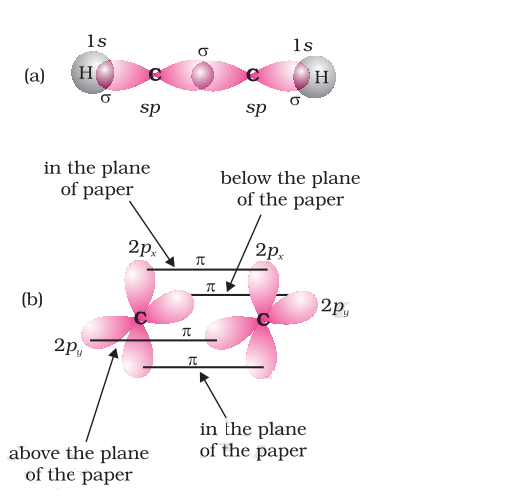
Structure of Triple Bond Ethyne is the simplest molecule of alkyne series. Structure of ethyne is shown in Figure. Each carbon atom of ethyne has two sp hybridised orbitals. Carbon-carbon sigma $(\sigma)$ bond is obtained by the head-on overlapping of the two sp hybridised orbitals of the two carbon atoms. The remaining sp hybridised orbital of each carbon atom undergoes overlapping along the internuclear axis with the 1s orbital of each of the two hydrogen atoms forming two C-H sigma bonds. H-C-C bond angle is of $180^\circ .$

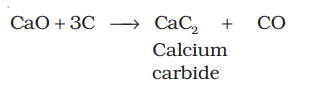
Each carbon has two unhybridised p orbitals which are perpendicular to each other as well as to the plane of the C C sigma bond. The $2 p$ orbitals of one carbon atom are parallel to the $2 p$ orbitals of the other carbon atom, which undergo lateral or sideways overlapping to form two pi ( $\pi$ ) bonds between two carbon atoms. Thus ethyne molecule consists of one $C - C \sigma$ bond, two $C - H \sigma$ bonds and two $C - C \pi$ bonds. The strength of $C \equiv C$ bond (bond enthalpy $823 kJ mol ^{-1}$ ) is more than those of $C = C$ bond (bond enthalpy $681 kJ mol ^{-1}$ ) and $C - C$ bond (bond enthalpy 348 kJ $mol ^{-1}$ ). The $C \equiv C$ bond length is shorter $(120 pm )$ than those of $C = C (133 pm )$ and $C - C (154 pm )$. Electron cloud between two carbon atoms is cylindrically symmetrical about the internuclear axis. Thus, ethyne is a linear molecule. Preparation - From calcium carbide: On industrial scale, ethyne is prepared by treating calcium carbide with water. Calcium carbide is prepared by heating quick lime with coke. Quick lime can be obtained by heating limestone as shown in the following reactions:

$\text{C}\text{aC}_2+2\text{H}_2\text{O}\rightarrow\text{Ca}(\text{OH})_2+\text{C}_2\text{H}_2$
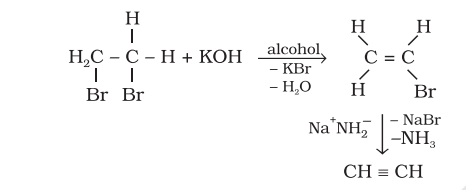
From vicinal dihalides: Vicinal dihalides on treatment with alcoholic potassium hydroxide undergo dehydrohalogenation. One molecule of hydrogen halide is eliminated to form alkenyl halide which on treatment with sodamide gives alkyne.


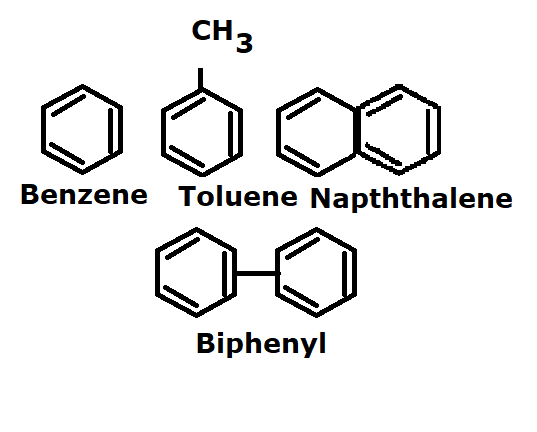
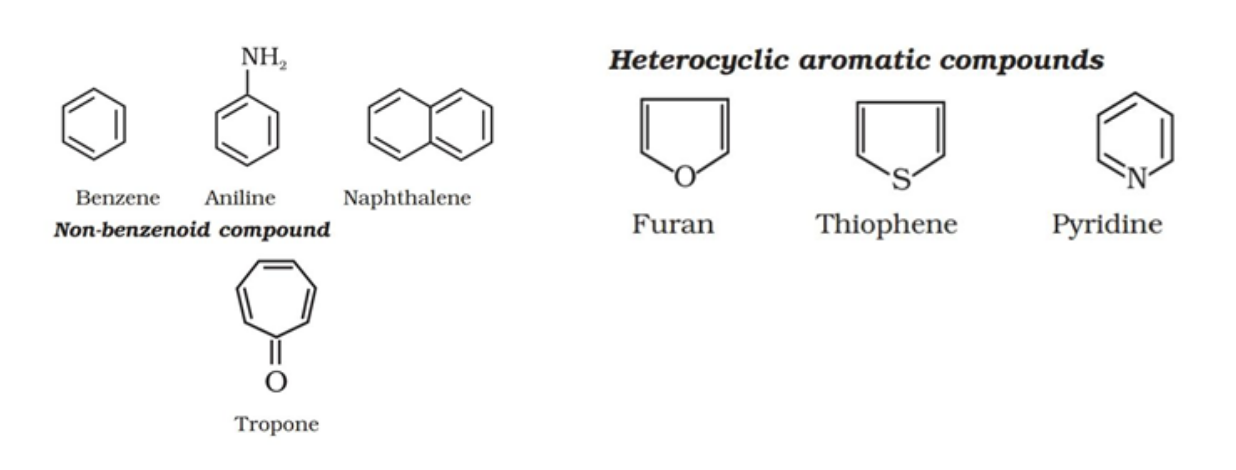
Aromatic hydrocarbon- These hydrocarbons are also known as ‘arenes’. Since most of them possess pleasant odour, the class of compounds was named as ‘aromatic compounds’. Most of such compounds were found to contain benzene ring. Benzene ring is highly unsaturated but in a majority of reactions of aromatic compounds, the unsaturation of benzene ring is retained. However, there are examples of aromatic hydrocarbons which do not contain a benzene ring but instead contain other highly unsaturated ring. Aromatic compounds containing benzene ring are known as benzenoids and those not containing a benzene ring are known as non-benzenoids. Some examples of arenes are given below:

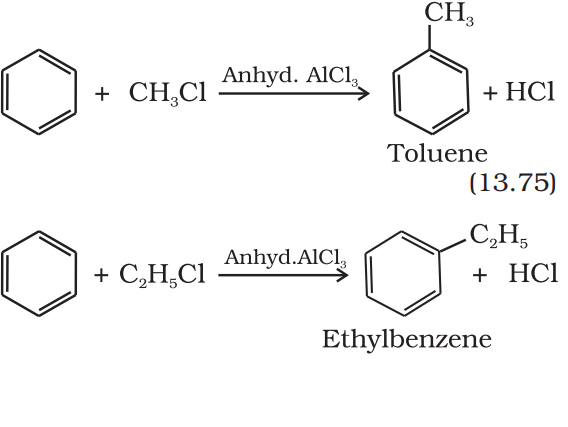
Friedel-Crafts alkylation reaction: When benzene is treated with an alkyl halide in the presence of anhydrous aluminium chloride, alkylbenene is formed.
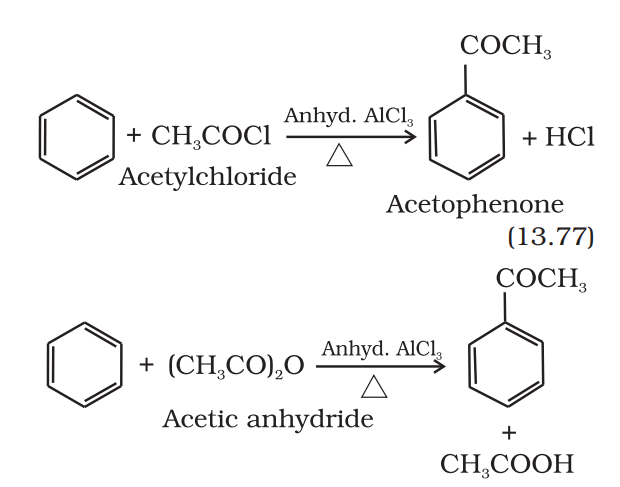
Friedel-Crafts acylation reaction: The reaction of benzene with an acyl halide or acid anhydride in the presence of Lewis acids ($AlCl_3$) yields acyl benzene.

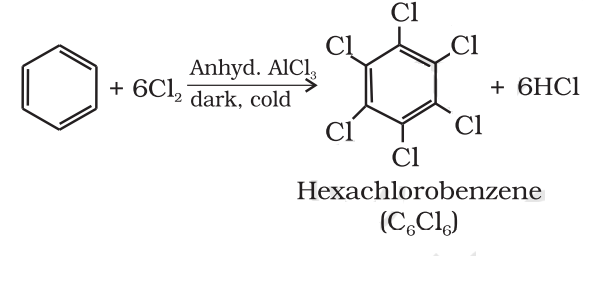
If excess of electrophilic reagent is used, further substitution reaction may take place in which other hydrogen atoms of benzene ring may also be successively replaced by the electrophile. For example, benzene on treatment with excess of chlorine in the presence of anhydrous $AlCl_3$​​​​​​​ can be chlorinated to hexachlorobenzene $(C_6Cl_6)​​​​​​​$​​​​​​​
  1. The general formula of Alkynes is …?
  1. $C_nH_{2n–2}$​​​​​​​
  2. $C_nH_{2n–2}$
  3. $C_nH_{2n–2}$
  4. $C_nH_{2n–2}$
  1. Calcium carbide is prepared by heating quick lime with …?
  1. Backing soda
  2. Coke
  3. Carbide
  4. Salt
  1. Vicinal dihalides on treatment with alcoholic potassium hydroxide undergo …?
  1. Dehydrogenation.
  2. Hydrohalogenation.
  3. Dehydrohalogenation
  4. Dehalogenation.
  1. The bond enthalpy of C ≡ C is …?
  1. 523 kJ mol
  2. 623 kJ mol
  3. 723 kJ mol
  4. 823 kJ mol
  1. The C ≡ C bond length is …?
  1. 1200 pm
  2. 620 pm
  3. 240 pm
  4. 120 pm
Read the passage given below and answer the following questions from 1 to 5 .
In p-block elements the last electron enters the outermost p orbital. As we know that the number of p orbitals is three and, therefore, the maximum number of electrons that can be accommodated in a set of p orbitals is six. Consequently there are six groups of p-block elements in the periodic table numbering from 13 to 18 . Boron, carbon, nitrogen, oxygen, fluorine and helium head the groups. Their valence shell electronic configuration is $ns ^2 np ^{1-}$ ${ }^6$ (except for He). The inner core of the electronic configuration may, however, differ. The difference in inner core of elements greatly influences their physical properties (such as atomic and ionic radii, ionisation enthalpy, etc.) as well as chemical properties. The occurrence of oxidation states two unit less than the group oxidation states are sometime attributed to the 'inert pair effect'.
Group 13 elements: the boron family This group elements show a wide variation in properties. Boron is a typical non-metal, aluminium is a metal but shows many chemical similarities to boron, and gallium, indium, thallium and nihonium are almost exclusively metallic in character. Boron is a fairly rare element, mainly occurs as orthoboric acid, $\left( H _3 BO _3\right)$, borax, $Na _2 B_4 O _7 \cdot 10 H _2 O$, and kernite, $Na _2 B_4 O _7 \cdot 4 H _2 O$. In India borax occurs in Puga Valley (Ladakh) and Sambhar Lake (Rajasthan). The abundance of boron in earth crust is less than $0.0001 \%$ by mass. There are two isotopic forms of boron $10 B(19 \%)$ and $11 B(81 \%)$. Aluminium is the most abundant metal and the third most abundant element in the earth's crust ( $8.3 \%$ by mass) after oxygen ( $45.5 \%$ ) and $Si (27.7 \%)$. Bauxite, $Al 2 O 3.2 H _2 O$ and cryolite, Na3AIF6 are the important minerals of aluminium. In India it is found as mica in Madhya Pradesh, Karnataka, Orissa and Jammu. Gallium, indium and thallium are less abundant elements in nature. Nihonium has symbol Nh, atomic number 113 , atomic mass $286 g mol ^{-1}$ and electronic configuration $[R n] 5 f^{14} 6 d^{10} 7 s^2 7 p ^2$. So far it has been prepared in small amount and half life of its most stable isotope is 20 seconds. Due to these reasons its chemistry has not been established. Nihonium is a synthetically prepared radioactive element. Here atomic, physical and chemical properties of elements of this group leaving nihonium are discussed below.
The outer electronic configuration of these elements is $n s 2 n{ }^1$. A close look at the electronic configuration suggests that while boron and aluminium have noble gas core, gallium and indium have noble gas plus 10 d electrons, and thallium has noble gas plus 14 f - electrons plus 10 d -electron cores. Thus, the electronic structures of these elements are more complex than for the first two groups of elements discussed in unit 10. This difference in electronic structures affects the other properties and consequently the chemistry of all the elements of this group. Atomic Radii On moving down the group, for each successive member one extra shell of electrons is added and, therefore, atomic radius is expected to increase. However, a deviation can be seen. Atomic radius of Ga is less than that of Al. This can be understood from the variation in the inner core of the electronic configuration. The presence of additional 10 d -electrons offer only poor screening effect (Unit 2) for the outer electrons from the increased nuclear charge in gallium. Consequently, the atomic radius of gallium ( 135 pm ) is less than that of aluminium (143 pm ).
Boron is non-metallic in nature. It is extremely hard and black coloured solid. It exists in many allotropic forms. Due to very strong crystalline lattice, boron has unusually high melting point. Rest of the members are soft metals with low melting point and high electrical conductivity. It is worthwhile to note that gallium with unusually low melting point ( 303 K ), could exist in liquid state during summer. Its high boiling point ( 2676 K ) makes it a useful material for measuring high temperatures. Density of the elements increases down the group from boron to thallium.
  1. There are … groups of p–block elements in the periodic table.
  1. six
  2. seven
  3. eight
  4. two
  1. Boron is … in nature.
  1. metallic
  2. non-metallic
  3. metalloid
  4. All the above
  1. Boiling point of gallium is …
  1. 303K
  2. 1345K
  3. 2676 K
  4. 1854K
  1. The occurrence of oxidation states two unit less than the group oxidation states are sometime attributed to the …
  1. loan pair effect
  2. middle pair effect
  3. outer pair effect
  4. inert pair effect
  1. Density of the elements … down the group from boron to thallium.
  1. increases
  2. decreases
  3. remains constant
  4. none of above
Read the passage given below and answer the following questions from 1 to 5.
Oxidation state and trends in chemical Reactivity Due to small size of boron, the sum of its first Three ionization enthalpies is very high. This Prevents it to form +3 ions and forces it to form Only covalent compounds. But as we move from B to Al, the sum of the first three ionisation Enthalpies of Al considerably decreases, and Is therefore able to form $Al^{3+}$ ions. In fact, Aluminium is a highly electropositive metal. However, down the group, due to poor Shielding effect of intervening d and f orbitals, The increased effective nuclear charge holds ns Electrons tightly (responsible for inert pair Effect) and thereby, restricting their Participation in bonding. As a result of this, Only p-orbital electron may be involved in Bonding. In fact in Ga, In and Tl, both +1 and +3 oxidation states are observed. The relative Stability of +1 oxidation state progressively Increases for heavier elements: A l< Ga < In< Tl. In Thallium +1 oxidation state is predominant whereas the +3 oxidation state is highly Oxidising in character. The compounds in +1 oxidation state, as expected from energy Considerations, are more ionic than those in +3 oxidation state.
Important trends and anomalous properties of boron – certain important trends can be observed in the chemical behaviour of group 13 elements. The tri-chlorides, bromides and iodides of all these elements being covalent in nature are hydrolysed in water. Species like tetrahedral $[M(OH)_4]^–$ and octahedral $[M(H_2O)6]^{3+}$, except in boron, exist in aqueous medium. The monomeric trihalides, being electron deficient, are strong Lewis acids. Boron trifluoride easily reacts with Lewis bases such as $NH_3$ to complete octet around boron. It is due to the absence of d orbitals that the maximum covalence of B is 4. Since the d orbitals are available with Al and other elements, the maximum covalence can be expected beyond 4. Most of the other metal halides (e.g., $AlCl_3$) are dimerised through halogen bridging (e.g., $Al2Cl_6$). The metal species completes its octet by accepting electrons from halogen in these halogen bridged molecules.
i) Reactivity towards air Boron is unreactive in crystalline form. Aluminium forms a very thin oxide layer on The surface which protects the metal from Further attack. Amorphous boron and Aluminium metal on heating in air form $B_2O_3$ And $Al_2O_3$ respectively. With dinitrogen at high Temperature they form nitrides. The nature of these oxides varies down the Group. Boron trioxide is acidic and reacts with Basic (metallic) oxides forming metal borates. Aluminium and gallium oxides are amphoteric And those of indium and thallium are basic in Their properties.
ii) Reactivity towards acids and alkalies Boron does not react with acids and alkalies Even at moderate temperature; but aluminium Dissolves in mineral acids and aqueous alkalies And thus shows amphoteric character. Aluminium dissolves in dilute HCl and Liberates dihydrogen.
$2Al(s) + 6HCl (aq) \rightarrow 2Al_3^+ (aq) + 6Cl^– (aq) + 3H_2 (g)$
However, concentrated nitric acid renders Aluminium passive by forming a protective Oxide layer on the surface. Aluminium also reacts with aqueous alkali And liberates dihydrogen.
$2Al (s) + 2NaOH(aq) + 6H_2O(l) \rightarrow 2 Na+ [Al(OH)_4]^– (aq) + 3H_2(g)$
Sodium Tetrahydroxoaluminate(III).
iii) Reactivity towards halogens These elements react with halogens to form Trihalides (except TlI3). $2E(s) + 3 X_2 (g) \rightarrow 2EX_3 (s) (X = F, Cl, Br, I)$
Borax- It is the most important compound of boron. It is a white crystalline solid of formula $Na_2B_4O_7⋅10H_2O$. In fact it contains the Tetranuclear units and correct Formula; therefore, is $Na2 [B4O5 (OH) 4].8H2O$. Borax dissolves in water to give an alkaline Solution.
$Na_2B_4O7 + 7H_2O \rightarrow 2NaOH + 4H_3BO_3$
On heating, borax first loses water Molecules and swells up. On further heating it Turns into a transparent liquid, which solidifies Into glass like material known as borax Bead. $Na_2B_4O_7.10H_2O \rightarrow Na^2B_4O_7\rightarrow 2NaBO_2+ B2O_3​​​​​​​$
Metaborate Boric Anhydride The metaborates of many transition metals Have characteristic colours and, therefore, Borax bead test can be used to identify them In the laboratory. For example, when borax is Heated in a Bunsen burner flame with CoO on A loop of platinum wire, a blue coloured Co(BO2) 2 bead is formed.
Orthoboric acid, $H_3BO_3$ is a white crystalline Solid, with soapy touch. It is sparingly soluble In water but highly soluble in hot water. It can Be prepared by acidifying an aqueous solution Of borax.
$Na_2B_4O_7 + 2HCl + 5H_2O \rightarrow 2NaCl + 4B(OH)_3​​​​​​​$
It is also formed by the hydrolysis (reaction With water or dilute acid) of most boron Compounds (halides, hydrides, etc.). It has a layer structure in which planar $BO_3$ units are Joined by hydrogen.
  1. Boron is … in crystalline form.
  1. unreactive
  2. highly reactive
  3. less reactive
  4. only (a) or (c)
  1. Orthoboric acid is …
  1. Amorphous
  2. Crystalline
  3. Polyamorphous
  4. None of above
  1. Aluminium and gallium oxides are … in their properties.
  1. acidic
  2. Basic
  3. amphoteric
  4. None of above
  1. Indium and thallium are … in their properties.
  1. acidic
  2. Alkali
  3. amphoteric
  4. basic
  1. Aluminium is a highly … metal.
  1. electronegative
  2. Neutral
  3. electropositive
  4. None of above
The ionic character of metallic halides tends toward covalent nature as per Fajan's rule. Such covalent halides behave as non-metal in their higher oxidation states. The property to hydrolyse to give oxy-acids of the element and corresponding hydro halogen acid for most non-metallic elements proceeds exceptionally in the way, keeping oxidation number of element and halide sam in oxo-acids.
Non-polar halides are immiscible in water, as they do not show hydrolysis, but halides of some elements with empty d-orbital undergo hydrolysis. Stability of halides of the higher state is governed by the inert-pair effect.

1. How does halide undergo hydrolysis to give oxy-acids of underlined element $PCl _3$ ?
2. Out of $NCl _3$ and $BCl _3$ undergoes hydrolysis to form oxy-acids? Write the chemical reaction for the correct answer.
3. Out of $PbCl _4, PbF _4, PbI _4$ and $PbBr _4$ which one doesn't exist?
OR
Non-Polar halides are immiscible in water. Why?
Read the passage given below and answer the following questions from 1 to 5.
F Wohler synthesised an organic compound, urea from an inorganic compound, ammonium cyanate.
The knowledge of fundamental concepts of molecular structure helps in understanding and predicting the properties of organic compounds. You have already learnt theories of valency and molecular structure. Also, you already know that tetravalence of carbon and the formation of covalent bonds by it are explained in terms of its electronic configuration and the hybridisation of s and p orbitals. It may be recalled that formation and the shapes of molecules like methane $(CH_4)$, ethene $(C_2H_4)$, ethyne $(C_2H_2)$ are explained in terms of the use of $sp^3, sp^2$ and sp hybrid orbitals by carbon atoms in the respective molecules. Hybridisation influences the bond length and bond enthalpy (strength) in compounds. The sp hybrid orbital contains more s character and hence it is closer to its nucleus and forms shorter and stronger bonds than the sp3 hybrid orbital.The sp2 hybrid orbital is intermediate in s character between sp and sp3 and, hence, the length and enthalpy of the bonds it forms, are also intermediate between them. The change in hybridisation affects the electronegativity of carbon. The greater the s character of the hybrid orbitals, the greater is the electronegativity. Thus, a carbon atom having an sp hybrid orbital with 50% s character is more electronegative than that possessing sp2 or sp3 hybridised orbitals. This relative electronegativity is reflected in several physical and chemical properties of the molecules concerned, about which you will learn in later units.
Characteristic Features of π Bonds In a π (pi) bond formation, parallel orientation of the two p orbitals on adjacent atoms is necessary for a proper sideways overlap. Thus, in $H_2C=CH_2$ molecule all the atoms must be in the same plane. The p orbitals are mutually parallel and both the p orbitals are perpendicular to the plane of the molecule. Rotation of one $CH_2$ fragment with respect to other interferes with maximum overlap of p orbitals and, therefore, such rotation about carbon-carbon double bond (C=C) is restricted. The electron charge cloud of the π bond is located above and below the plane of bonding atoms. This results in the electrons being easily available to the attacking reagents. In general, π bonds provide the most reactive centres in the molecules containing multiple bonds.

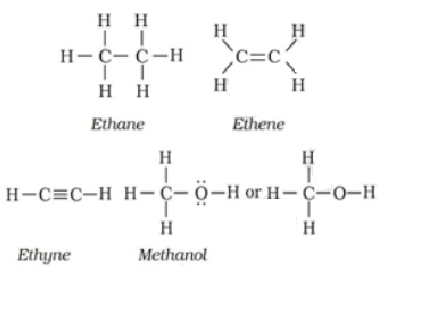
Structures of organic compounds are represented in several ways. The Lewis structure or dot structure, dash structure, condensed structure and bond line structural formulas are some of the specific types. The Lewis structures, however, can be simplified by representing the two-electron covalent bond by a dash (–). Such a structural formula focuses on the electrons involved in bond formation. A single dash represents a single bond, double dash is used for double bond and a triple dash represents triple bond. Lone- pairs of electrons on heteroatoms (e.g., oxygen, nitrogen, sulphur, halogens etc.) may or may not be shown. Thus, ethane $(C_2H_6)$, ethene $(C_2H_4)$, ethyne $(C_2H_2)$ and methanol $(CH_3OH)$ can be represented by the following structural formulas. Such structural representations are called complete structural formulas.
These structural formulas can be further abbreviated by omitting some or all of the dashes representing covalent bonds and by indicating the number of identical groups attached to an atom by a subscript. The resulting expression of the compound is called a condensed structural formula. Thus, ethane, ethene, ethyne and methanol can be written as:

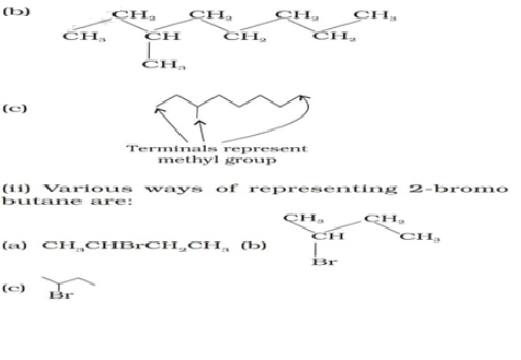
Similarly, $CH_3CH_2CH_2CH_2CH_2CH_2CH_2CH_3$ can be further condensed to $CH_3(CH_2)_6CH_3$. For further simplification, organic chemists use another way of representing the structures, in which only lines are used. In this bond-line structural representation of organic compounds, carbon and hydrogen atoms are not shown and the lines representing carbon-carbon bonds are drawn in a zig-zag fashion. The only atoms specifically written are oxygen, chlorine, nitrogen etc. The terminals denote methyl $(–CH_3)$ groups (unless indicated otherwise by a functional group), while the line junctions denote carbon atoms bonded to appropriate number of hydrogens required to satisfy the valency of the carbon atoms. Some of the examples are represented as follows: (i) 3-Methyloctane can be represented in various forms as:
  1. … synthesised an organic compound, urea from an inorganic compound, ammonium cyanate.
  1. Wohler
  2. Adams
  3. Roger
  4. William Evans
  1. Dot structure is also known as …
  1. Zig zag structure
  2. Lewis structure
  3. Line structure
  4. Bond line structure
  1. Terminals in zigzig structure denotes … Group.
  1. Bromyl
  2. Propyl
  3. Methyl
  4. Pentyl
  1. Triple dash represents …
  1. Single bond
  2. Double bond
  3. Triple bond
  4. Equivalent bond
  1. Lewis structures representing the two-electron covalent bond by …
  1. .
  2. :
  3. ?
The idea of oxidation number has been invariably applied to define oxidation, reduction, oxidising agent (oxidant), reducing agent (reductant) and the redox reaction. To summarise, we may say that:
Oxidation: An increase in the oxidation number of the element in the given substance.
Reduction: A decrease in the oxidation number of the element in the given substance.
Oxidising agent: A reagent which can increase the oxidation number of an element in a given substance. These reagents are called as oxidants also.
Reducing agent: A reagent which lowers the oxidation number of an element in a given substance. These reagents are also called as reductants.
Redox reactions: Reactions which involve change in oxidation number of the interacting species.
Types of Redox Reactions
1.) Combination reactions -A combination reaction may be denoted in the manner:
$A + B → C$
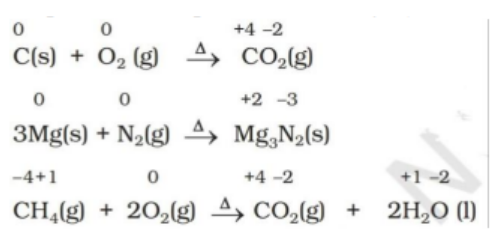
Either A and B or both A and B must be in the elemental form for such a reaction to be a redox reaction. All combustion reactions, which make use of elemental dioxygen, as well as other reactions involving elements other than dioxygen, are redox reactions. Some important examples of this category are:

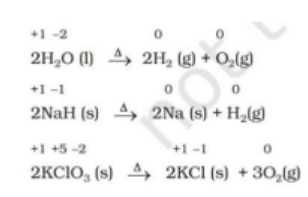
2.) Decomposition reactions- Decomposition reactions are the opposite of combination reactions. Precisely, a decomposition reaction leads to the breakdown of a compound into two or more components at least one of which must be in the elemental state.
Examples of this class of reactions are:

It may carefully be noted that there is no change in the oxidation number of hydrogen in methane under combination reactions and that of potassium in potassium chlorate in reaction. This may also be noted here that all decomposition reactions are not redox reactions. For example, decomposition of calcium carbonate is not a redox reaction.
3.) Displacement reactions- In a displacement reaction, an ion (or an atom) in a compound is replaced by an ion (or an atom) of another element. It may be denoted as:
$X + YZ → XZ + Y$
Displacement reactions fit into two categories: metal displacement and non-metal displacement.
(a) Metal displacement: A metal in a compound can be displaced by another metal in the uncombined state. Metal displacement reactions find many applications in metallurgical processes in which pure metals are obtained from their compounds in ores.
(b) Non-metal displacement: The non-metal displacement redox reactions include hydrogen displacement and a rarely occurring reaction involving oxygen displacement. All alkali metals and some alkaline earth metals (Ca, Sr, and Ba) which are very good reductants, will displace hydrogen from cold water. Many metals, including those which do not react with cold water, are capable of displacing hydrogen from acids. Dihydrogen from acids may even be produced by such metals which do not react with steam. Cadmium and tin are the examples of such metals.
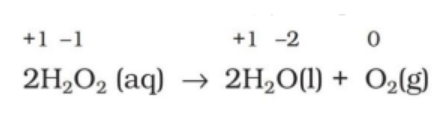
4.) Disproportionation reactions – Disproportionation reactions are a special type of redox reactions. In a disproportionation reaction an element in one oxidation state is simultaneously oxidised and reduced. One of the reacting substances in a disproportionation reaction always contains an element that can exist in at least three oxidation states. The element in the form of reacting substance is in the intermediate oxidation state; and both higher and lower oxidation states of that element are formed in the reaction. The decomposition of hydrogen peroxide is a familiar example of the reaction, where oxygen experiences disproportionation.

Here the oxygen of peroxide, which is present in –1 state, is converted to zero oxidation state in $O2$ and decreases to –2 oxidation state in $H_2O$.
  1. In … an ion (or an atom) in a compound is replaced by an ion (or an atom) of another element.
  1. displacement reaction
  2. decomposition reaction
  3. disproportionation reaction
  4. combination reaction
  1. leads to the breakdown of a compound into two or more components at least one of which must be in the elemental state.
  1. displacement reaction
  2. decomposition reaction
  3. disproportionation reaction
  4. combination reaction
  1. In …. an element in one oxidation state is simultaneously oxidised and reduced.
  1. displacement reaction
  2. decomposition reaction
  3. disproportionation reaction
  4. combination reaction
  1. Reactions which involve change in oxidation number of the interacting species…
  1. Exothermic reaction
  2. Endothermic reaction
  3. Neutralization reaction
  4. Redox reaction
  1. One of the reacting substances in a disproportionation reaction always contains an element that can exist in at least … oxidation states.
  1. 1
  2. 2
  3. 3
  4. 4
Read the passage given below and answer the following questions from 1 to 5.
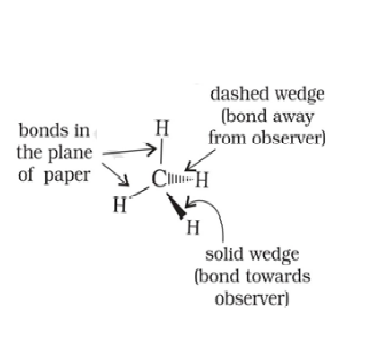
The three-dimensional (3-D) structure of organic molecules can be represented on paper by using certain conventions. For example, by using solid ( ) and dashed ( ) wedge formula, the 3-D image of a molecule from a two-dimensional picture can be perceived. In these formulas the solid-wedge is used to indicate a bond projecting out of the plane of paper, towards the observer. The dashed-wedge is used to depict the bond projecting out of the plane of the paper and away from the observer. Wedges are shown in such a way that the broad end of the wedge is towards the observer. The bonds lying in plane of the paper are depicted by using a normal line (—). 3-D representation of methane molecule on paper has been shown in Figure.

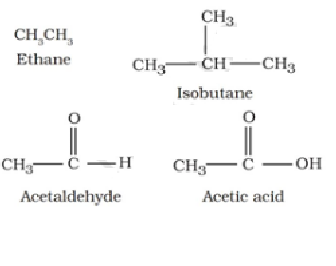
A cyclic or open chain componds these compounds are also called as aliphatic componds and consist of staright or branched chain componds for example:

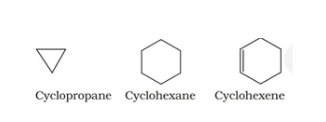
Cyclic or closed chain or ring compounds
a) Alicyclic compounds Alicyclic (aliphatic cyclic) compounds contain carbon atoms joined in the form of a ring (homocyclic).

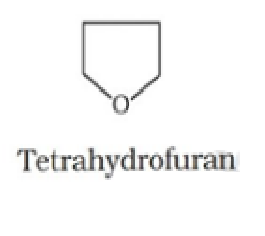
Someetimes atoms other than carbon are also present in the ring (heterocylic). Tetrahydrofuran given below is an example of this types of compound:

These exhibit some of the properties similar to those of aliphatic compounds.
b) Aromatic compounds Aromatic compounds are special types of compounds. These include benzene and other related ring compounds (benzenoid). Like alicyclic compounds, aromatic comounds may also have hetero atom in the ring. Such compounds are called hetrocyclic aromatic compounds. Some of the examples of various types of aromatic compounds are:
Benzenoid aromatic compounds .

Organic compounds can also be classified on the basis of functional groups, into families or homologous series.
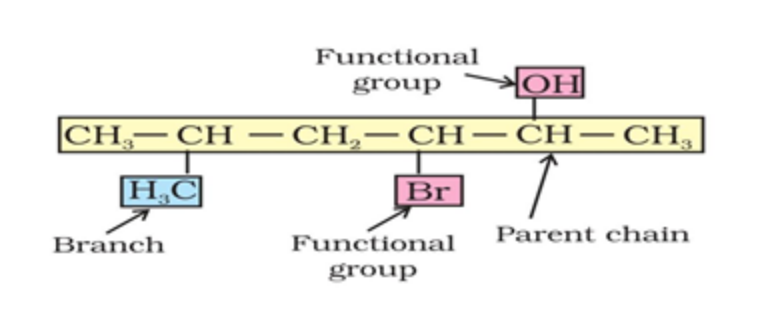
Functional Group The functional group is an atom or a group of atoms joined to the carbon chain which is responsible for the characteristic chemical properties of the organic compounds. The examples are hydroxyl group (–OH), aldehyde group (–CHO) and carboxylic acid group (–COOH) etc.
Homologous Series A group or a series of organic compounds each containing a characteristic functional group forms a homologous series and the members of the series are called homologues. The members of a homologous series can be represented by general molecular formula and the successive members differ from each other in molecular formula by a $–CH^2$ unit. There are a number of homologous series of organic compounds. Some of these are alkanes, alkenes, alkynes, haloalkanes, alkanols, alkanals, alkanones, alkanoic acids, amines etc. It is also possible that a compound contains two or more identical or different functional groups. This gives rise to polyfunctional compounds.
A systematic name of an organic compound is generally derived by identifying the parent hydrocarbon and the functional group(s) attached to it. See the example given below.

By further using prefixes and suffixes, the parent name can be modified to obtain the actual name. Compounds containing carbon and hydrogen only are called hydrocarbons. A hydrocarbon is termed saturated if it contains only carbon-carbon single bonds.
The IUPAC name for a homologous series of such compounds is alkane. Paraffin (Latin: little affinity) was the earlier name given to these compounds. Unsaturated hydrocarbons are those, which contain at least one carbon- carbon double or triple bond. IUPAC Nomenclature of Alkanes Straight chain hydrocarbons: The names of such compounds are based on their chain structure, and end with suffix ‘-ane’ and carry a prefix indicating the number of carbon atoms present in the chain (except from $CH_4$ to $C_4H_{10}$, where the prefixes are derived from trivial names). The IUPAC names of some straight chain saturated hydrocarbons are given in Table. The alkanes in table differ from each other by merely the number of $– CH_2$ groups in the chain. They are homologues of alkane series.
Name Molecular formula Name Molecular Formula
Methane $CH_4$ Heptane $C_7H_{16}$
Ethane $C_2H_6$ Octane $C_8H_{18}$
Propane $C_3H_8$ Nonane $C_9H_{20}$
Butane $C_4H_{10}$ Decane $C_{10}H_{22}$
Pentane $C_5H_{12}$ Icosane $C_{20}H_{42}$
Hexane $C_6H_{14}$ Triacontane $C_{30}H_{62}$
  1. IUPAC is an acronym for …
  1. International Union of Pure and Applied Chemistry
  2. International units of proteins and carbohydrates
  3. International understandings on physical aspects of chemistry
  4. Iodine under packings
  1. In homologous series, the successive members differ from each other in molecular formula by a … unit.
  1. $CH_3$
  2. $CH_2$
  3. $CH$
  4. $CH_4$
  1. A hydrocarbon is termed saturated if it contains only carbon-carbon … bonds.
  1. Triple
  2. Double
  3. Single
  4. Zero
  1. From ….., where the prefixes are derived from… trivial names.
  1. $CH_4$ to $C_2H_6$
  2. $CH_4$ to $C_3H_8$
  3. $CH_4$ to $C_6H_{14}$
  4. $CH_4$ to $C_4H_{10}$
  1. Molecular formula of octane is …
  1. $C_4H_{10}$
  2. $C_6H_{14}$
  3. $C_2H_6$
  4. $C_8H_{18}$
Read the passage given below and answer the following questions from (i) to (v).
Arrhenius Concept of Acids and Bases According to Arrhenius theory, acids are substances that dissociates in water to give hydrogen ions $H ^{+}{ }_{(a q)}$ and bases are substances that produce hydroxyl ions $OH ^{-}{ }_{( aq )}$. The ionization of an acid $HX { }_{\text {(aq) }}$ can be represented by the following equations:
$HX_{(aq)} \rightarrow H^{+}{ }_{(aq)}+X_{(aq)}^{-}$
or
$HX_{(aq)}+H_2 O(l) \rightarrow H_3 O^{+}{ }_{(aq)}+X_{(aq)}^{-}$
A bare proton, $H ^{+}$is very reactive and cannot exist freely in aqueous solutions. Thus, it bonds to the oxygen atom of a solvent water molecule to give trigonal pyramidal hydronium ion, $H _3 O ^{+}\left\{\left[ H \left( H _2 O \right)\right]^{+}\right\}$(see box). In this chapter we shall use $H ^{+}{ }_{( aq )}$ and $H _3 O ^{+}{ }_{( aq )}$ interchangeably to mean the same i.e., a hydrated proton. Similarly, a base molecule like MOH ionizes in aqueous solution according to the equation:
$MOH_{(aq)} \rightarrow M^{+}{ }_{(aq)}+OH^{-}(aq)$
The hydroxyl ion also exists in the hydrated form in the aqueous solution. Arrhenius concept of acid and base, however, suffers from the limitation of being applicable only to aqueous solutions and also, does not account for the basicity of substances like, ammonia which do not possess a hydroxyl group.
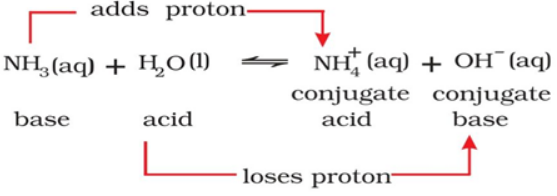
The Brönsted-Lowry Acids and Bases The Danish chemist, Johannes Brönsted and the English chemist, Thomas M. Lowry gave a more general definition of acids and bases. According to Brönsted-Lowry theory, acid is a substance that is capable of donating a hydrogen ion $H ^{+}$and bases are substances capable of accepting a hydrogen ion, $H ^{+}$. In short, acids are proton donors and bases are proton acceptors. Consider the example of dissolution of $NH _3$ in $H _2 O$ represented by the following equation:

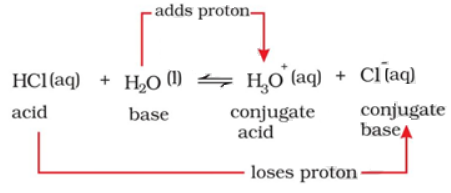
Hydronium and Hydroxyl lons Hydrogen ion by itself is a bare proton with very small size ( $\sim 10-15 m$ radius) and intense electric field, binds itself with the water molecule at one of the two available lone pairs on it giving $H _3 O ^{+}$. This species has been detected in many compounds (e.g., $H _3 O ^{+} Cl -$ ) in the solid state. In aqueous solution the hydronium ion is further hydrated to give species like $H _5 O _2^{+}, H7O3^{+}$and $H _9 4^{+}$. Similarly the hydroxyl ion is hydrated to give several ionic species like, $H _5 O 3$ - and H 7 O 4 - etc. The basic solution is formed due to the presence of hydroxyl ions. In this reaction, water molecule acts as proton donor and ammonia molecule acts as proton acceptor and are thus, called Lowry-Brönsted acid and base, respectively. In the reverse reaction, $H ^{+}$is transferred from $NH _4^{+}$to $OH ^{-}$. In this case, $NH _4^{+}$acts as a Bronsted acid while $OH ^{-}$acted as a Brönsted base. The acid-base pair that differs only by one proton is called a conjugate acid-base pair. Therefore, OH - is called the conjugate base of an acid $H _2 O$ and $NH _4{ }^{+}$is called conjugate acid of the base $NH _3$. f Brönsted acid is a strong acid then its conjugate base is a weak base and vice- versa. It may be noted that conjugate acid has one extra proton and each conjugate base has one less proton. Consider the example of ionization of hydrochloric acid in water. $HCl _{( aq )}$ acts as an acid by donating a proton to $H _2 O$ molecule which acts as a base.

It can be seen in the above equation, that water acts as a base because it accepts the proton. The species $H _3 O ^{+}$is produced when water accepts a proton from HCl . Therefore, Cl - is a conjugate base of HCl and HCl is the conjugate acid of base $Cl -$. Similarly, $H _2 O$ is a conjugate base of an acid $H _3 O ^{+}$and $H _3 O ^{+}$is a conjugate acid of base $H _2 O$. It is interesting to observe the dual role of water as an acid and a base. In case of reaction with HCl water acts as a base while in case of ammonia it acts as an acid by donating a proton.
Lewis Acids and Bases G.N. Lewis in 1923 defined an acid as a species which accepts electron pair and base which donates an electron pair. As far as bases are concerned, there is not much difference between Brönsted-Lowry and Lewis concepts, as the base provides a lone pair in both the cases. However, in Lewis concept many acids do not have proton. A typical example is reaction of electron deficient species $BF _3$ with $NH _3 . BF _3$ does not have a proton but still acts as an acid and reacts with $NH _3$ by accepting its lone pair of electrons. The reaction can be represented by, $BF _3+: NH _3 \rightarrow BF _3: NH _3$
Electron deficient species like $AlCl _3, Co ^{3+}, Mg ^{2+}$, etc. can act as Lewis acids while species like $H _2 O , NH _3, OH ^{-}$etc. which can donate a pair of electrons, can act as Lewis bases.
The pH Scale Hydronium ion concentration in molarity is more conveniently expressed on a logarithmic scale known as the pH scale. The pH of a solution is defined as the negative logarithm to base 10 of the activity ( $a _{ H }{ }^{+}$) of hydrogen ion. In dilute solutions ( $<0.01 M$ ), activity of hydrogen ion $\left( H ^{+}\right)$is equal in magnitude to molarity represented by $\left[ H ^{+}\right]$. It should be noted that activity has no units and is defined as:
$\text{a}=\frac{[\text{H}^+]}{\text{mol}\text{L}^{–1}}$
From the definition of pH, the following can be written,
$\text{pH}={–\log\text{a}_\text{H}^+=\frac{-\log[\text{H}^+]}{\text{mol}\text{L}^{–1}}}$
Thus, an acidic solution of HCl (10–2M) will have a pH = 2. Similarly, a basic solution of NaOH having $[OH^–] =10^{–4}​​​​​​​$​​​​​​​M and [ $H_3O^+] = 10^{–10}M$ will have a $pH = 10. At 25 ^\circ C$, pure water has a concentration of hydrogen ions,$ [H^+] = 10^{–7} M.$ Hence, the pH of pure water is given as:
$pH = –\log(10^{–7}) = 7$
Acidic solutions possess a concentration of hydrogen ions, $[H^+] > 10^{–7}​​​​​​​$​​​​​​​M, while basic solutions possess a concentration of hydrogen ions,$ [H^+] < 10^{–7}​​​​​​​$M. thus, we can summarise that
Acidic solution has pH < 7
Basic solution has pH > 7
Neutral solution has pH = 7
Now again, consider the equation at 298K
$Kw = [H_3O^+][OH^–] = 10^{–14}​​​​​​​$​​​​​​​
Taking negative logarithm on both sides of equation, we obtain
$–\log Kw = – \log{[ H_3O^+ ][OH– ]}$
$= – \log[H_3O^+] – \log[OH–]$
$= – log10^{–14}$
$pKw = pH + pOH = 14$
Note that although Kw may change with temperature the variations in pH with temperature are so small that we often ignore it. pKw is a very important quantity for aqueous solutions and controls the relative concentrations of hydrogen and hydroxyl ions as their product is a constant. It should be noted that as the pH scale is logarithmic, a change in pH by just one unit also means change in $\left[ H ^{+}\right]$by a factor of 10 . Similarly, when the hydrogen ion concentration, $\left[ H ^{+}\right]$changes by a factor of 100 , the value of pH changes by 2 units. Now you can realise why the change in pH with temperature is often ignored. Ionization Constants of Weak Acids Consider a weak acid HX that is partially ionized in the aqueous solution. The equilibrium can be expressed by::
$HX_{(aq)}+H_2O(l) \rightarrow H_3O^+_{(aq)} + X^–_{(aq)}​​​​​​​$
Initial concentration (M)
c 0 0
Let α be the extent of ionization Change (M) -cα +cα +cα Equilibrium concentration (M) c-cα cα cα Here, c = initial concentration of the undissociated acid, HX at time, t = 0. α = extent up to which HX is ionized into ions. Using these notations, we can derive the equilibrium constant for the above discussed acid- dissociation equilibrium:
$\text{Ka}=\frac{\text{c}^2\alpha^2}{\text{c}(1-\alpha)}=\frac{\text{c}\alpha^2}{1-\alpha}$
Ka is called the dissociation or ionization constant of acid HX. It can be represented alternatively in terms of molar concentration as follows,
$\text{Ka}=\frac{[\text{H}^+][\text{X}^–]}{[\text{HX}]}$
At a given temperature T, Ka is a measure of the strength of the acid HX i.e., larger the value of Ka, the stronger is the acid. Ka is a dimensionless quantity with the understanding that the standard state concentration of all species is 1M.
  1. … is a substance that is capable of donating a hydrogen ion $H^+.$
  1. Acid
  2. Base
  3. Neutral substances
  4. Alkaline
  1. … are proton acceptors.
  1. Acids
  2. Bases
  3. Neutral substances
  4. All the above
  1. According to …bases are substances that produce hydroxyl ions $OH^–.$
  1. Johannes Brönsted
  2. Thomas M. Lowry
  3. Arrhenius
  4. G. N. Lewis
  1. Brönsted acid is a strong acid then its conjugate base is a … base.
  1. Strong
  2. Medium
  3. Non
  4. Weak
  1. According to … an acid as a species which accepts electron pair.
  1. Johannes Brönsted
  2. Thomas M. Lowry
  3. Arrhenius
  4. G. N. Lewis
The ionic character of metallic halides tends toward covalent nature as per Fajan's rule. Such covalent halides behave as non-metal in their higher oxidation states. The property to hydrolyse to give oxy-acids of the element and corresponding hydro halogen acid for most non-metallic elements proceeds exceptionally in the way, keeping oxidation number of element and halide sam in oxo-acids.
Non-polar halides are immiscible in water, as they do not show hydrolysis, but halides of some elements with empty d-orbital undergo hydrolysis. Stability of halides of the higher state is governed by the inert-pair effect.

1. How does halide undergo hydrolysis to give oxy-acids of underlined element $PCl _3$ ? (1)
2. Out of $NCl _3$ and $BCl _3$ undergoes hydrolysis to form oxy-acids? Write the chemical reaction for the correct answer. (1)
3. Out of $PbCl _4, PbF _4, PbI _4$ and $PbBr _4$ which one doesn't exist? (2)
OR
Non-Polar halides are immiscible in water. Why? (2)