Question
Read the passage given below and answer the following questions from 1 to 5. Chemistry deals with varieties of matter and change of one kind of matter into the other. Transformation of matter from one kind into another occurs through the various types of reactions. One important category of such reactions is Redox Reactions. Originally, the term oxidation was used to describe the addition of oxygen to an element or a compound. Because of the presence of dioxygen in the atmosphere (~20%), many elements combine with it and this is the principal reason why they commonly occur on the earth in the form of their oxides. The following reactions represent oxidation processes: $2\text{Mg}(\text{s})\rightarrow2\text{MgO}\text{ (S)}$ $\text{S}(\text{s})+\text{O}_2(\text{g})\rightarrow\text{SO}_2\text{ g}$ the term “oxidation” is defined as the addition of oxygen/electronegative element to a substance or removal of hydrogen/ electropositive element from a substance. In the beginning, reduction was considered as removal of oxygen from a compound. However, the term reduction has been broadened these days to include removal of oxygen/electronegative element from a substance or addition of hydrogen/ electropositive element to a substance. According to the definition given above, the following are the examples of reduction processes: $2\text{HgO}\text{S}\xrightarrow{\triangle}2\text{ Hg}(1)+\text{O}_2(\text{g})$ $2\text{HgCl}_2(\text{aq})+\text{SnCl}_2(\text{aq})\rightarrow\text{Hg}_2\text{Cl}_2(\text{s})+\text{SnCl}_4(\text{aq})$ In reaction simultaneous oxidation of stannous chloride to stannic chloride is also occurring because of the addition of electronegative element chlorine to it. It was soon realised that oxidation and reduction always occur simultaneously (as will be apparent by re-examining all the equations given above), hence, the word “redox” was coined for this class of chemical reactions.The reactions:
$2\text{Na}(\text{s})+\text{Cl2}\text{g}\rightarrow2\text{NaCl}(\text{s})$ $4\text{Na}(\text{s})+\text{O}_2\text{g}\rightarrow2\text{Na}_2\text{o}(\text{s})$ $2\text{Na}(\text{s})+\text{S}\text{(s)}\rightarrow2\text{Na}_2\text{S}(\text{s})$ are redox reactions because in each of these reactions sodium is oxidised due to the addition of either oxygen or more electronegative element to sodium. Simultaneously, chlorine, oxygen and sulphur are reduced because to each of these, the electropositive element sodium has been added. From our knowledge of chemical bonding we also know that sodium chloride, sodium oxide and sodium sulphide are ionic compounds and perhaps better written as $\mathrm{Na}+\mathrm{Cl}-(\mathrm{s}),\left(\mathrm{Na}^{+}\right)_2 \mathrm{O}^2-(\mathrm{s})$, and $\left(\mathrm{Na}^{+}\right)_2 \mathrm{~S}^{2-}(\mathrm{s})$. Development of charges on the species produced suggests us to rewrite the reactions in the following manner: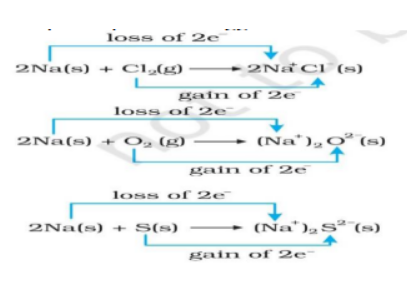 For convenience, each of the above processes can be considered as two separate steps, one involving the loss of electrons and the other the gain of electrons. As an illustration, we may further elaborate one of these, say, the formation of sodium chloride. $2\text{Na}(\text{s})\rightarrow2\text{Na}^+\text{g}+2\bar{\text{e}}$ $\text{Cl}_2\text{g}+2\bar{\text{e}}\rightarrow2\text{C}\bar{\text{I}}\text{ (g)}$ Each of the above steps is called a half reaction, which explicitly shows involvement of electrons. Sum of the half reactions gives the overall reaction $2\text{Na}(\text{s})+\text{Cl}_2\text{(g)}\rightarrow2\text{Na}^+\text{CI}(\text{s})\text{ or } 2\text{NaCI}(\text{s})$ Above Reactions suggest that half reactions that involve loss of electrons are called oxidation reactions. Similarly, the half reactions that involve gain of electrons are called reduction reactions. To summarise, we may mention that Oxidation: Loss of electron(s) by any species. Reduction: Gain of electron(s) by any species. Oxidising agent: Acceptor of electron(s). Reducing agent: Donor of electron(s).
$2\text{Na}(\text{s})+\text{Cl2}\text{g}\rightarrow2\text{NaCl}(\text{s})$ $4\text{Na}(\text{s})+\text{O}_2\text{g}\rightarrow2\text{Na}_2\text{o}(\text{s})$ $2\text{Na}(\text{s})+\text{S}\text{(s)}\rightarrow2\text{Na}_2\text{S}(\text{s})$ are redox reactions because in each of these reactions sodium is oxidised due to the addition of either oxygen or more electronegative element to sodium. Simultaneously, chlorine, oxygen and sulphur are reduced because to each of these, the electropositive element sodium has been added. From our knowledge of chemical bonding we also know that sodium chloride, sodium oxide and sodium sulphide are ionic compounds and perhaps better written as $\mathrm{Na}+\mathrm{Cl}-(\mathrm{s}),\left(\mathrm{Na}^{+}\right)_2 \mathrm{O}^2-(\mathrm{s})$, and $\left(\mathrm{Na}^{+}\right)_2 \mathrm{~S}^{2-}(\mathrm{s})$. Development of charges on the species produced suggests us to rewrite the reactions in the following manner:
For convenience, each of the above processes can be considered as two separate steps, one involving the loss of electrons and the other the gain of electrons. As an illustration, we may further elaborate one of these, say, the formation of sodium chloride. $2\text{Na}(\text{s})\rightarrow2\text{Na}^+\text{g}+2\bar{\text{e}}$ $\text{Cl}_2\text{g}+2\bar{\text{e}}\rightarrow2\text{C}\bar{\text{I}}\text{ (g)}$ Each of the above steps is called a half reaction, which explicitly shows involvement of electrons. Sum of the half reactions gives the overall reaction $2\text{Na}(\text{s})+\text{Cl}_2\text{(g)}\rightarrow2\text{Na}^+\text{CI}(\text{s})\text{ or } 2\text{NaCI}(\text{s})$ Above Reactions suggest that half reactions that involve loss of electrons are called oxidation reactions. Similarly, the half reactions that involve gain of electrons are called reduction reactions. To summarise, we may mention that Oxidation: Loss of electron(s) by any species. Reduction: Gain of electron(s) by any species. Oxidising agent: Acceptor of electron(s). Reducing agent: Donor of electron(s).
- Addition of electronegative element to a substance is known as..
- Oxidation
- Reduction
- Redox reaction
- All the above
- Removal of electronegative element to a substance is known as ..
- Oxidation
- Reduction
- Redox reaction
- All the above
- Acceptor of electrons is …
- Reducing Agent
- Catalytic Agent
- Oxidising Agent
- None of above
- Donor of electrons is…
- Organic Agent
- Catalytic Agent
- Oxidising Agent
- Reducing Agent
- Oxidation and Reduction occurs simultaneously is known as …
- Exothermic reaction
- Endothermic reaction
- Redox reaction
- Neutralization reaction