Question
Read the passage given below and answer the following questions from (i) to (v). A system is said to be isolated if no exchange or transfer of heat occurs between the system and its surroundings. When different parts of an isolated system are at different temperature a quantity of heat transfers from the part at higher temperature to the part at lower temperature. The heat lost by the part at higher temperature is equal to the heat gained by the part at lower temperature. Calorimetry means measurement of heat. When a body at higher temperature is brought in contact with another body at lower temperature, the heat lost by the hot body is equal to the heat gained by the colder body, provided no heat is allowed to escape to the surroundings. A device in which heat measurement can be done is called a calorimeter. It consists of a metallic vessel and stirrer of the same material, like copper or aluminium. The vessel is kept inside a wooden jacket, which contains heat insulating material. Matter normally exists in three states: solid, liquid and gas. A transition from one of these states to another is called a change of state. Two common changes of states are solid to liquid and liquid to gas (and, vice versa). These changes can occur when the exchange of heat takes place between the substance and its surroundings. The change of state from solid to liquid is called melting and from liquid to solid is called fusion. It is observed that the temperature remains constant until the entire amount of the solid substance melts. That is, both the solid and the liquid states of the substance coexist in thermal equilibrium during the change of states from solid to liquid. The temperature at which the solid and the liquid states of the substance is in thermal equilibrium with each other is called its melting point. The change of state from liquid to vapour (or gas) is called vaporisation. It is observed that the temperature remains constant until the entire amount of the liquid is converted into vapour. That is, both the liquid and vapour states of the substance coexist in thermal equilibrium, during the change of state from liquid to vapour. The temperature at which the liquid and the vapour states of the substance coexist is called its boiling point. The change from solid state to vapour state without passing through the liquid state is called sublimation, and the substance is said to sublime. Dry ice (solid $CO_2$) sublimes, so also iodine. During sublimation both the solid and vapour states of a substance coexist in thermal equilibrium.
  1. Device used for measurement of heat is:
  1. Calorimeter
  2. Thermometer
  3. Both a and b
  4. No one of these
  1. The change of state from solid to liquid is called:
  1. Melting
  2. Vaporization
  3. Sublimation
  4. None of these
  1. Define melting point and boiling point:
  2. What is sublimation?
  3. Define fusion process:

Answer

  1. (a) Calorimeter.
  2. (a) Melting.
  3. The change of state from solid to liquid is called melting process and temperature at which conversion of solid into liquid happens is called as melting point. The temperature at which the liquid and the vapour states of the substance coexist is called its boiling point.
  4. The change from solid state directly into vapour state without passing through the liquid state is called sublimation, and the substance is said to sublime.
  5. The change of state from liquid state to solid state is called as fusion process.

Need a full question paper?

Generate a complete, print-ready paper with questions like this in minutes — across 16+ boards, with answer keys.

Start Generating Free

Similar questions

Read the passage given below and answer the following questions from 1 to 5. The kinetic energy possessed by an object of mass, m and moving with a uniform velocity, v is $\text{K}=\frac{1}{2}\times\text{mv}^2=\frac{1}{2}\text{v}.\text{v}$ Kinetic energy is a scalar quantity. The kinetic energy of an object is a measure of the work and The energy possessed by an object is thus measured in terms of its capacity of doing work. The unit of energy is, therefore, the same as that of work, that is, joule (J). Work energy theorem: The change in kinetic energy of a particle is equal to the work done on it by the net force. Mathematically $K_f - K_i = W$ Where Ki and Kf are respectively the initial and final kinetic energies of the object. Work refers to the force and the displacement over which it acts. Work is done by a force on the body over a certain displacement.
  1. Kinetic energy is:
  1. Scalar quantity
  2. Vector quantity
  3. None of these
  1. Which of the following has same unit?
  1. Potential energy and work
  2. Kinetic energy and work
  3. Force and weight
  4. All of the above
  1. What is work energy theorem?
  1. Kinetic energy is scalar quantity. Justify the statement.
  1. Give formula for kinetic energy of body.
The amplification factor of a triode operating in the linear region depends strongly on:
  1. The temperature of the cathode.
  2. The plate potential.
  3. The grid potential.
  4. The separations of the grid from the cathode and the anode.
Read the passage given below and answer the following questions from 1 to 5.
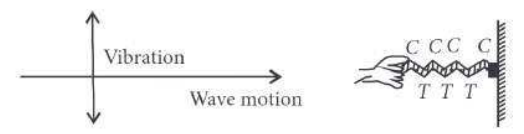
Transverse and Longitudinal Waves Transverse waves forms if the particles of the medium vibrate at right angle to the direction of wave motion energy propagation, the wave is called transverse wave. These are propagated as crests and troughs.

Longitudinal waves forms if the particles of the medium vibrate in the direction of wave motion, the wave is called longitudinal. These are propagated as compressions and rarefactions and wave is also known as pressure or compressional wave. Wave on spring or sound waves in air are examples of longitudinal waves.
  1. In a transverse wave, the particles of the medium:
  1. Vibrate in a direction perpendicular to the direction of the propagation.
  2. Vibrate in a direction parallel to the direction of the propagation.
  3. Move in circle.
  4. Move in ellipse.
  1. A transverse wave consists of:
  1. Only crests
  2. Only troughs
  3. Both crests and troughs
  4. Rarefactions and compressions
  1. Ultrasonic waves produced by a vibrating quartz crystal are:
  1. Only longitudinal.
  2. Only transverse.
  3. Both longitudinal and transverse.
  4. Neither longitudinal nor transverse.
  1. Sound waves travel fastest in:
  1. Solids
  2. Liquids
  3. Gases
  4. Vacuum
  1. Sound waves in air cannot be polarized because:
  1. Their speed is small
  2. They require medium
  3. They are longitudinal
  4. Their speed is temperature dependent
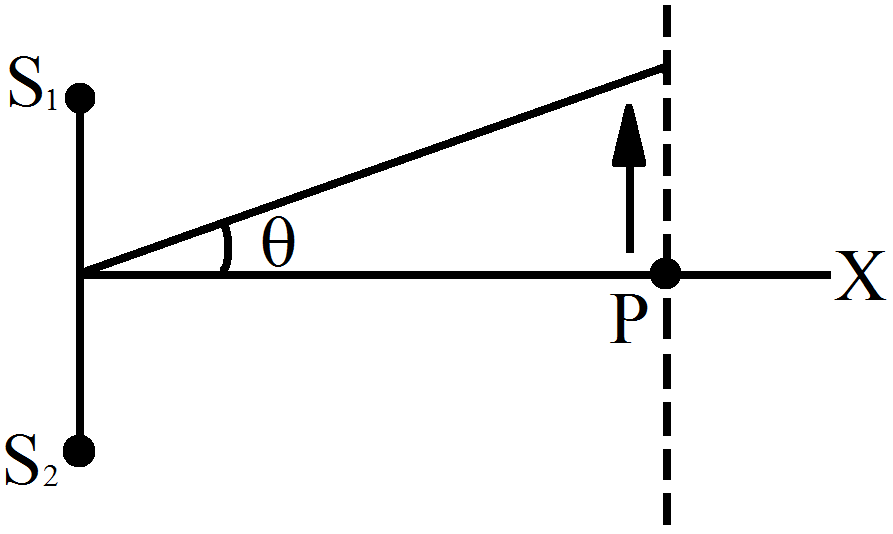
Two speakers $S_1$ and $S_2$, driven by the same amplifier, are placed at $y = 1.0m$ and $y = -1.0m$ figure, The speakers vibrate in phase at $600Hz$. A man stands at a point on the X-axis at a very large distance from the origin and starts moving parallel to the Y-axis. The speed of sound in air is $330m/s$.
  1. At what angle $\theta$ will the intensity of sound drop to a minimum for the first time?
  2. At what angle will he hear a maximum of sound intensity for the first time?
  3. If he continues to walk along the line, how many more maxima can he hear?
Read the passage given below and answer the following questions from $i$ to $v.$ When an object follows a circular path at a constant speed, the motion of the object is called uniform circular motion. The word “uniform” refers to the speed, which is uniform (constant) throughout the motion. Suppose an object is moving with uniform speed $v$ in a circle of radius $R$ Since the velocity of the object is changing continuously in direction, the object undergoes acceleration. Let us find the magnitude and the direction of this acceleration. Thus, the acceleration of an object moving with speed v in a circle of radius $R$ has a magnitude $V^2/R$ and is always directed towards the centre. This is why this acceleration is called centripetal acceleration (a term proposed by Newton). A thorough analysis of centripetal acceleration was first published in $1673$ by the Dutch scientist Christiaan Huygens $(1629-1695)$ but it was probably known to Newton also some years earlier. “Centripetal” comes from a Greek term which means ‘centre-seeking’. Since $v$ and $R$ are constant, the magnitude of the centripetal acceleration is also constant. However, the direction changes pointing always towards the centre. Therefore, a centripetal acceleration is not a constant vector. We can express centripetal acceleration ac in terms of angular speed as $\text{a}_\text{c}=\omega^2\text{R}$ The time taken by an object to make one revolution is known as its time period T and the number of revolution made in one second is called its frequency $v (=1/T).$ However, during this time the distance moved by the object is $\text{s}=2\pi\text{R}.$ Therefore, $\text{v}=2\pi\frac{\text{R}}{\text{T}}=2\pi\text{ Rv}$ In terms of frequency n, we have $\omega=2\pi\text{v}$
$\text{V}=2\pi\text{ RV}$
$\text{ac}=4\pi^2\text{v}^2\text{R}$
  1. SI unit of angular velocity is
  1. Rev/ sec
  2. $m/ s$
  3. $m/ s^2$ 
  4. None of these
  1. A centripetal acceleration is not a constant vector. True or false?
  1. True
  2. False
  1. Define Uniform circular motion
  2. What is meaning of word centripetal?
  3. What is centripetal acceleration? Give its relation with angular velocity
The reduction factor K of a tangent galvanometer is written on the instrument. The manual says that the current is obtained by multiplying this factor to tane. The procedure works well at Bhuwaneshwar. Will the procedure work if the instrument is taken to Nepal? If there is some error, can it be corrected by correcting the manual or the instrument will have to be taken back to the factory?
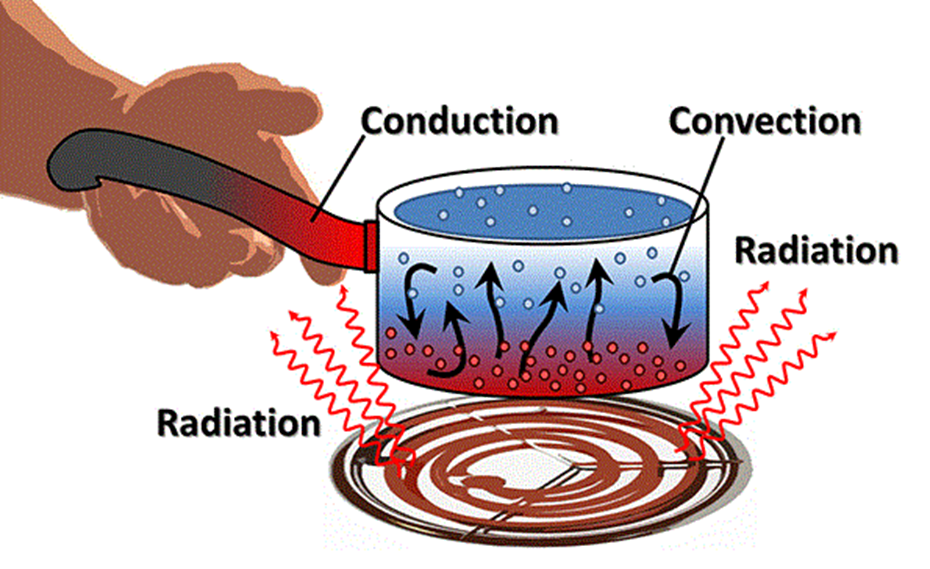
Read the passage given below and answer the following questions from (i) to (v). The figure shows the different modes of transfer of heat, heat transfer is defined as the movement of heat across the border of the system due to a difference in temperature between the system and its surroundings. The temperature difference exists between the two systems, heat will find a way to transfer from the higher to the lower system.
  1. The sea breeze is caused by:
    1. conduction
    2. convection
    3. radiation
    4. none of these
  2. At what factor heat absorbed on radiation by the body depends on?
    1. distance between body
    2. source of heat
    3. its color
    4. all of the above
  3. When heat is transferred by molecular collision, it is referred to as heat transfer by:
    1. convection
    2. conduction
    3. radiation
    4. convection and radiation
  4. Thermal conductivity of air with rise in temperature:
    1. increase
    2. decrease
    3. constant
    4. none of these
  5. Mass transfer does not take place in:
    1. conduction
    2. convection
    3. radiation
    4. none of these
At a prayer meeting, the disciples sing JAI-RAM JAI-RAM. The sound amplified by a loudspeaker comes back after reflection from a building at a distance of 80m from the meeting. What maximum time interval can be kept between one JAI-RAM and the next JAI-RAM so that the echo does not disturb a listener sitting in the meeting. Speed of sound in air is 320m/s.
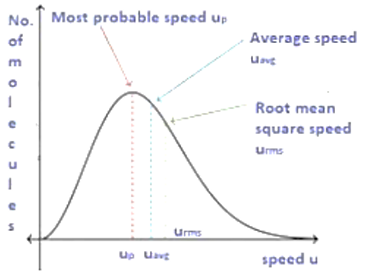
Root mean square velocity (RMS value)is the square root of the mean of squares of the velocity of individual gas molecules and the Average velocity is the arithmetic mean of the velocities of different molecules of a gas at a given temperature.
Image
1. Moon has no atmosphere because:
(a) the escape velocity of the moon’s surface is more than the r.m.s velocity of all molecules
(b) it is far away from the surface of the earth
(c) the r.m.s. velocity of all the gas molecules is more than the escape velocity of the moon’s surface
(d) its surface temperature is $10^{\circ} C$
2. For an ideal gas, $\frac{C_P}{C_V}$ is
(a) $\leq 1$    (b) none of these    (c) $>1$    (d) $<1$
3. The root means square velocity of hydrogen is $\sqrt{5}$ times that of nitrogen. If $T$ is the temperature of the gas then:
(a) $T\left(H_2\right)=T\left(N_2\right)$    (b) $T \left( H _2\right)< T \left( N _2\right)$
(c) $T \left( H _2\right) \neq T \left( N _2\right)$    (d) $T \left( H _2\right)> T \left( N _2\right)$
4. Suppose the temperature of the gas is tripled and $N _2$ molecules dissociate into an atom. Then what will be the rms speed of atom:
(a) $v_0 \sqrt{2}$    (b) $v_0 \sqrt{6}$    (c) $v_0 \sqrt{3}$    (d) $v_0$
OR
The velocities of the molecules are $v , 2 v , 3 v , 4 v \& 5 v$. The RMS speed will be:
(a) 11 v    (b) $v (12)^{11}$   (c) v    (d) $v (11)^{12}$
Read the passage given below and answer the following questions from (i) to (v). Maximum absolute error in the sum or difference of two quantities is equal to sum of the absolute error in the individual quantities, i.e. Z = A + B, then, $\pm\triangle\text{Z}=\pm\triangle\text{A}\pm\text{B}$ Maximum fractional error in a product or division of quantities is equal to the sum of fractional errors in the individual quantities i.e. AB or $\frac{\text{A}}{\text{B}},$ then, $\frac{\triangle\text{Z}}{\text{Z}}=\pm\frac{\triangle\text{A}}{\text{A}}+\frac{\triangle\text{B}}{\text{B}}$ Two resistors of resistances $\text{R}_1=100\pm3\Omega$ are connected (a) in series and (b) in parallel.
  1. The percentage error in the value of $R_1$ is:
  1. 3%
  2. 4%
  3. 6%
  4. 0.3%
  1. The fractional error in the value of $R_2$ is:
  1. $\frac{1}{40}$
  2. $\frac{1}{50}$
  3. $\frac{1}{100}$
  4. $\frac{1}{200}$
  1. Find the equivalent resistance of the series combination.
  1. $(250\pm7)\Omega$
  2. $(320\pm6)\Omega$
  3. $(300\pm7)\Omega$
  4. $(300\pm1)\Omega$
  1. The percentage error in equivalent resistance in series combination is:
  1. 2%
  2. 2.3%
  3. 2.5
  4. 3%
  1. Find the equivalent resistance of the parallel combination having error of $1.8\Omega.$
  1. $(66\pm1)\Omega$
  2. $(66.7\pm1.18)\Omega$
  3. $(66.3\pm2)\Omega$
  4. $(67\pm3)\Omega$