Question
Read the passage given below and answer the following questions from 1 to 5.
The dipositive oxidation state $(M^{2+})$ is the Predominant valence of Group 2 elements. The Alkaline earth metals form compounds which Are predominantly ionic but less ionic than the Corresponding compounds of alkali metals. This is due to increased nuclear charge and Smaller size. The oxides and other compounds Of beryllium and magnesium are more covalent Than those formed by the heavier and large Sized members (Ca, Sr, Ba). The general Characteristics of some of the compounds of Alkali earth metals are described below.
Oxides and Hydroxides: The alkaline Earth metals burn in oxygen to form the Monoxide, MO which, except for BeO, have Rock-salt structure. The BeO is essentially Covalent in nature. The enthalpies of formation Of these oxides are quite high and consequently They are very stable to heat. BeO is amphoteric While oxides of other elements are ionic in Nature. All these oxides except BeO are basic In nature and react with water to form sparingly Soluble hydroxides.
$MO + H2O \rightarrow M(OH)_2$
The solubility, thermal stability and the Basic character of these hydroxides increase With increasing atomic number from $Mg(OH)_2 To Ba(OH)_2$.The alkaline earth metal Hydroxides are, however, less basic and less Stable than alkali metal hydroxides. Beryllium Hydroxide is amphoteric in nature as it reacts With acid and alkali both.
$Be(OH)_2 + 2OH^– \rightarrow [Be(OH)4]^{2–}$
Beryllate ion
$Be(OH)_2 + 2HCl + 2H_2O \rightarrow [Be(OH)_4]Cl_2$
Halides: Except for beryllium halides, all Other halides of alkaline earth metals are ionic In nature. Beryllium halides are essentially Covalent and soluble in organic solvents. Beryllium chloride has a chain structure in the Solid state as shown below: In the vapour phase $BeCl_2$ tends to form a Chloro-bridged dimer which dissociates into the Linear monomer at high temperatures of the Order of 1200 K. The tendency to form halide Hydrates gradually decreases down the group. The dehydration Of hydrated chlorides, bromides and iodides Of Ca, Sr and Ba can be achieved on heating; However, the corresponding hydrated halides Of Be and Mg on heating suffer hydrolysis. The Fluorides are relatively less soluble than the Chlorides owing to their high lattice energies.
Salts of Oxoacids: The alkaline earth Metals also form salts of oxoacids. Some of These are :
Carbonates: Carbonates of alkaline earth Metals are insoluble in water and can be Precipitated by addition of a sodium or Ammonium carbonate solution to a solution Of a soluble salt of these metals. The solubility Of carbonates in water decreases as the atomic Number of the metal ion increases. All the Carbonates decompose on heating to give Carbon dioxide and the oxide. Beryllium Carbonate is unstable and can be kept only in The atmosphere of $CO_2$. The thermal stability Increases with increasing cationic size.
Sulphates: The sulphates of the alkaline earth Metals are all white solids and stable to heat. $BeSO_4,$ and $MgSO_4$ are readily soluble in water; The solubility decreases from $CaSO_4$ to $ BaSO_4$. The greater hydration enthalpies of $Be_2+$ and $Mg_2+$ ions overcome the lattice enthalpy factor And therefore their sulphates are soluble in Water.
Nitrates: The nitrates are made by dissolution Of the carbonates in dilute nitric acid. Magnesium nitrate crystallises with six Molecules of water, whereas barium nitrate Crystallises as the anhydrous salt. This again Shows a decreasing tendency to form hydrates With increasing size and decreasing hydration Enthalpy. All of them decompose on heating to Give the oxide like lithium nitrate.
$2\text{M}(\text{NO}_3)_2\rightarrow2\text{MO}+4\text{NO}_2+\text{O}_2$
(M = Be. Mg. Ca. Sr. Ba)
Beryllium, the first member of the Group 2 Metals, shows anomalous behaviour as Compared to magnesium and rest of the Members. Further, it shows diagonal Relationship to aluminium which is discussed Subsequently.
i) Beryllium has exceptionally small atomic And ionic sizes and thus does not compare Well with other members of the group. Because of high ionisation enthalpy and Small size it forms compounds which are Largely covalent and get easily hydrolysed.
ii) Beryllium does not exhibit coordination Number more than four as in its valence Shell there are only four orbitals. The Remaining members of the group can have A coordination number of six by making Use of d-orbitals.
iii) The oxide and hydroxide of beryllium, Unlike the hydroxides of other elements in The group, are amphoteric in nature.
Diagonal Relationship between Beryllium and Aluminium-The ionic radius of 4 is estimated to be 31 pm; the charge/radius ratio is nearly the Same as that of the $Al^{3+}$ ion. Hence beryllium Resembles aluminium in some ways. Some of The similarities are:
i) Like aluminium, beryllium is not readily Attacked by acids because of the presence Of an oxide film on the surface of the metal.
ii) Beryllium hydroxide dissolves in excess of Alkali to give a beryllate ion, $[Be(OH)_4]^{2–}$ just As aluminium hydroxide gives aluminate Ion, $[Al(OH)_4]^–.$
iii) The chlorides of both beryllium and Aluminium have $Cl^–$ Bridged chloride Structure in vapour phase. Both the Chlorides are soluble in organic solvents And are strong Lewis acids. They are used As Friedel Craft catalysts.
iv) Beryllium and aluminium ions have strong Tendency to form complexes, $BeF_4^{2–}, AlF_6^{3–}.$
The dipositive oxidation state $(M^{2+})$ is the Predominant valence of Group 2 elements. The Alkaline earth metals form compounds which Are predominantly ionic but less ionic than the Corresponding compounds of alkali metals. This is due to increased nuclear charge and Smaller size. The oxides and other compounds Of beryllium and magnesium are more covalent Than those formed by the heavier and large Sized members (Ca, Sr, Ba). The general Characteristics of some of the compounds of Alkali earth metals are described below.
Oxides and Hydroxides: The alkaline Earth metals burn in oxygen to form the Monoxide, MO which, except for BeO, have Rock-salt structure. The BeO is essentially Covalent in nature. The enthalpies of formation Of these oxides are quite high and consequently They are very stable to heat. BeO is amphoteric While oxides of other elements are ionic in Nature. All these oxides except BeO are basic In nature and react with water to form sparingly Soluble hydroxides.
$MO + H2O \rightarrow M(OH)_2$
The solubility, thermal stability and the Basic character of these hydroxides increase With increasing atomic number from $Mg(OH)_2 To Ba(OH)_2$.The alkaline earth metal Hydroxides are, however, less basic and less Stable than alkali metal hydroxides. Beryllium Hydroxide is amphoteric in nature as it reacts With acid and alkali both.
$Be(OH)_2 + 2OH^– \rightarrow [Be(OH)4]^{2–}$
Beryllate ion
$Be(OH)_2 + 2HCl + 2H_2O \rightarrow [Be(OH)_4]Cl_2$
Halides: Except for beryllium halides, all Other halides of alkaline earth metals are ionic In nature. Beryllium halides are essentially Covalent and soluble in organic solvents. Beryllium chloride has a chain structure in the Solid state as shown below: In the vapour phase $BeCl_2$ tends to form a Chloro-bridged dimer which dissociates into the Linear monomer at high temperatures of the Order of 1200 K. The tendency to form halide Hydrates gradually decreases down the group. The dehydration Of hydrated chlorides, bromides and iodides Of Ca, Sr and Ba can be achieved on heating; However, the corresponding hydrated halides Of Be and Mg on heating suffer hydrolysis. The Fluorides are relatively less soluble than the Chlorides owing to their high lattice energies.
Salts of Oxoacids: The alkaline earth Metals also form salts of oxoacids. Some of These are :
Carbonates: Carbonates of alkaline earth Metals are insoluble in water and can be Precipitated by addition of a sodium or Ammonium carbonate solution to a solution Of a soluble salt of these metals. The solubility Of carbonates in water decreases as the atomic Number of the metal ion increases. All the Carbonates decompose on heating to give Carbon dioxide and the oxide. Beryllium Carbonate is unstable and can be kept only in The atmosphere of $CO_2$. The thermal stability Increases with increasing cationic size.
Sulphates: The sulphates of the alkaline earth Metals are all white solids and stable to heat. $BeSO_4,$ and $MgSO_4$ are readily soluble in water; The solubility decreases from $CaSO_4$ to $ BaSO_4$. The greater hydration enthalpies of $Be_2+$ and $Mg_2+$ ions overcome the lattice enthalpy factor And therefore their sulphates are soluble in Water.
Nitrates: The nitrates are made by dissolution Of the carbonates in dilute nitric acid. Magnesium nitrate crystallises with six Molecules of water, whereas barium nitrate Crystallises as the anhydrous salt. This again Shows a decreasing tendency to form hydrates With increasing size and decreasing hydration Enthalpy. All of them decompose on heating to Give the oxide like lithium nitrate.
$2\text{M}(\text{NO}_3)_2\rightarrow2\text{MO}+4\text{NO}_2+\text{O}_2$
(M = Be. Mg. Ca. Sr. Ba)
Beryllium, the first member of the Group 2 Metals, shows anomalous behaviour as Compared to magnesium and rest of the Members. Further, it shows diagonal Relationship to aluminium which is discussed Subsequently.
i) Beryllium has exceptionally small atomic And ionic sizes and thus does not compare Well with other members of the group. Because of high ionisation enthalpy and Small size it forms compounds which are Largely covalent and get easily hydrolysed.
ii) Beryllium does not exhibit coordination Number more than four as in its valence Shell there are only four orbitals. The Remaining members of the group can have A coordination number of six by making Use of d-orbitals.
iii) The oxide and hydroxide of beryllium, Unlike the hydroxides of other elements in The group, are amphoteric in nature.
Diagonal Relationship between Beryllium and Aluminium-The ionic radius of 4 is estimated to be 31 pm; the charge/radius ratio is nearly the Same as that of the $Al^{3+}$ ion. Hence beryllium Resembles aluminium in some ways. Some of The similarities are:
i) Like aluminium, beryllium is not readily Attacked by acids because of the presence Of an oxide film on the surface of the metal.
ii) Beryllium hydroxide dissolves in excess of Alkali to give a beryllate ion, $[Be(OH)_4]^{2–}$ just As aluminium hydroxide gives aluminate Ion, $[Al(OH)_4]^–.$
iii) The chlorides of both beryllium and Aluminium have $Cl^–$ Bridged chloride Structure in vapour phase. Both the Chlorides are soluble in organic solvents And are strong Lewis acids. They are used As Friedel Craft catalysts.
iv) Beryllium and aluminium ions have strong Tendency to form complexes, $BeF_4^{2–}, AlF_6^{3–}.$
- The dipositive oxidation state $(M2^+)$ is the Predominant valence of … elements.
- Group 2
- Group 1
- Group 17
- Group 18
- … the first member of the Group 2 metals.
- Magnesium
- Beryllium
- Barium
- Radium
- Except for beryllium halides, all other halides of alkaline earth metals are ionic in nature.
- Magnesium halides
- beryllium halides
- Calcium halides
- Radium halides
- The ionic radius of $Be^{2+}$ is estimated to be … pm.
- 310
- 500
- 50
- 31
- Beryllium carbonate can be kept only in the atmosphere of …
- $N_2$
- $H_2$
- $CO_2$
- $O_2$
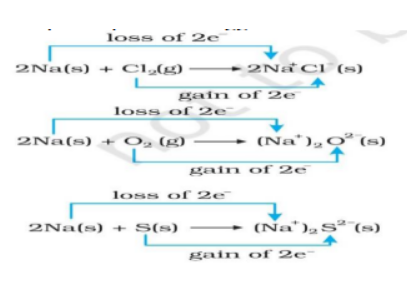 For convenience, each of the above processes can be considered as two separate steps, one involving the loss of electrons and the other the gain of electrons. As an illustration, we may further elaborate one of these, say, the formation of sodium chloride. $2\text{Na}(\text{s})\rightarrow2\text{Na}^+\text{g}+2\bar{\text{e}}$ $\text{Cl}_2\text{g}+2\bar{\text{e}}\rightarrow2\text{C}\bar{\text{I}}\text{ (g)}$ Each of the above steps is called a half reaction, which explicitly shows involvement of electrons. Sum of the half reactions gives the overall reaction $2\text{Na}(\text{s})+\text{Cl}_2\text{(g)}\rightarrow2\text{Na}^+\text{CI}(\text{s})\text{ or } 2\text{NaCI}(\text{s})$ Above Reactions suggest that half reactions that involve loss of electrons are called oxidation reactions. Similarly, the half reactions that involve gain of electrons are called reduction reactions. To summarise, we may mention that Oxidation: Loss of electron(s) by any species. Reduction: Gain of electron(s) by any species. Oxidising agent: Acceptor of electron(s). Reducing agent: Donor of electron(s).