Question
Read the passage given below and answer the following questions from 1 to 5.
A reagent that brings an electron pair to the reactive site is called a nucleophile (Nu:) i.e., nucleus seeking and the reaction is then called nucleophilic. A reagent that takes away an electron pair from reactive site is called electrophile (E+) i.e., electron seeking and the reaction is called electrophilic.
Electron Displacement Effects in Covalent Bonds The electron displacement in an organic molecule may take place either in the ground state under the influence of an atom or a substituent group or in the presence of an appropriate attacking reagent. The electron displacements due to the influence of an atom or a substituent group present in the molecule cause permanent polarlisation of the bond. Inductive effect and resonance effects are examples of this type of electron displacements. Temporary electron displacement effects are seen in a molecule when a reagent approaches to attack it. This type of electron displacement is called electrometric effect or polarisability effect.
Inductive Effect When a covalent bond is formed between atoms of different electronegativity, the electron density is more towards the more electronegative atom of the bond. Such a shift of electron density results in a polar covalent bond. Bond polarity leads to various electronic effects in organic compounds. Let us consider cholorethane $(CH_3CH_2Cl)$ in which the C–Cl bond is a polar covalent bond. It is polarised in such a way that the carbon-1 gains some positive charge $(\delta+)$ and the chlorine some negative charge $(\delta-)$ The fractional electronic charges on the two atoms in a polar covalent bond are denoted by symbol (delta) and the shift of electron density is shown by an arrow that points from$(\delta+)$ to $(\delta-)$ end of the polar bond.
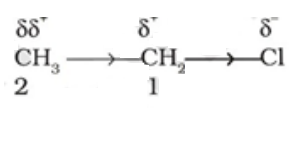
In turn carbon-1, which has developed partial positive charge $(\delta+)$draws some electron density towards it from the adjacent C-C bond. Consequently, some positive charge$(\delta\delta+)$develops on carbon-2 also, where $(\delta\delta+)$ symbolises relatively smaller positive charge as compared to that on carbon – 1. In other words, the polar C – Cl bond induces polarity in the adjacent bonds. Such polarisation of σ- bond caused by the polarisation of adjacent $σ-$bond is referred to as the inductive effect.
Resonance Structure There are many organic molecules whose behaviour cannot be explained by a single Lewis structure. An example is that of benzene. Its cyclic structure containing alternating C–C single and C=C double bonds shown is inadequate for explaining its characteristic properties.
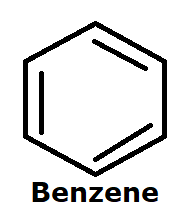
As per the above representation, benzene should exhibit two different bond lengths, due to C–C single and C=C double bonds. However, as determined experimentally benzene has a uniform C–C bond distances of 139 pm, a value intermediate between the C–C single(154 pm) and C=C double (134 pm) bonds. Thus, the structure of benzene cannot be represented adequately by the above structure. Further, benzene can be represented equally well by the energetically identical structures I and II.
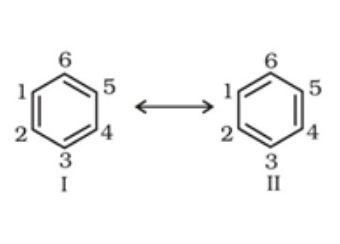
Therefore, according to the resonance theory the actual structure of benzene cannot be adequately represented by any of these structures, rather it is a hybrid of the two structures (I and II) called resonance structures. The resonance structures (canonical structures or contributing structures) are hypothetical and individually do not represent any real molecule. They contribute to the actual structure in proportion to their stability.
Resonance Effect The resonance effect is defined as ‘the polarity produced in the molecule by the interaction of two π-bonds or between a π-bond and lone pair of electrons present on an adjacent atom’. The effect is transmitted through the chain. There are two types of resonance or mesomeric effect designated as R or M effect. (i) Positive Resonance Effect (+R effect) In this effect, the transfer of electrons is away from an atom or substituent group attached to the conjugated system. This electron displacement makes certain positions in the molecule of high electron densities. This effect in aniline is shown as : (ii) Negative Resonance Effect (- R effect) This effect is observed when the transfer of Electrons is towards the atom or substituent Group attached to the conjugated system. For Example in nitrobenzene this electron Displacement can be depicted as : The atoms or substituent groups, which represent +R or –R electron displacement effects are as follows: +R effect: – halogen, –OH, –OR, –OCOR, –NH2, –NHR, –NR2, –NHCOR, – R effect: $– COOH, –CHO, > C = O, – CN, – NO_2$ The presence of alternate single and double bonds in an open chain or cyclic system is termed as a conjugated system. These systems often show abnormal behaviour. The examples are 1,3- butadiene, aniline and nitrobenzene etc. In such systems, the π-electrons are delocalised and the system develops polarity.
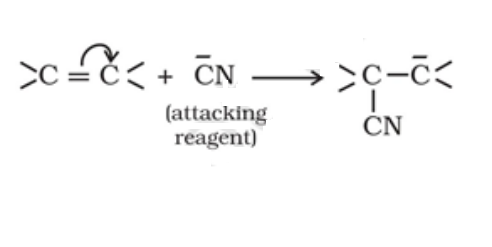
Electromeric Effect (E effect) It is a temporary effect. The organic compounds having a multiple bond (a double or triple bond) show this effect in the presence of an attacking reagent only. It is defined as the complete transfer of a shared pair of π-electrons to one of the atoms joined by a multiple bond on the demand of an attacking reagent. The effect is annulled as soon as the attacking reagent is removed from the domain of the reaction. It is represented by E and the shifting of the electrons is shown by a curved arrow ( ). There are two distinct types of electromeric effect.
a) Positive Electrometric Effect (+E effect)- In this effect the π−electrons of the multiple bond are transferred to that atom to which the reagent gets attached. For example
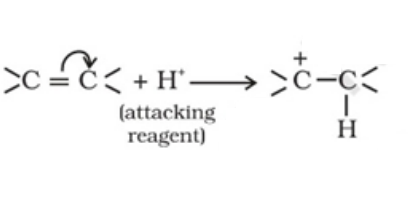
b) Negative Electromeric Effect (–E effect) -In this effect the $\pi-$ electrons of the multiple bond are transferred to that atom to which the attacking reagent does not get attached. For example: When inductive and electromeric effects operate in opposite directions, the electomeric effect predominates.
  1. A reagent that brings an electron pair to the reactive site is called a …
  1. nucleophile
  2. electrophile
  3. amphoteric
  4. amphophillic
  1. A reagent that takes away an electron pair from reactive site is called ..
  1. nucleophile
  2. electrophile
  3. amphoteric
  4. amphophillic
  1. The … effect is defined as the polarity produced in the molecule by the interaction of two π-bonds or between a π-bond and lone pair of electrons present on an adjacent atom.
  1. hindrance
  2. inductive
  3. resonance
  4. hyperconjunction
  1. –OH group, represent … electron displacement effect.
  1. M+
  2. M-
  3. R-
  4. R+
  1. – COOH group, represent … electron displacement effect.
  1. M+
  2. M-
  3. R-
  4. R+

Answer

  1. (a) nucleophile
  2. (b) electrophile
  3. (c) resonance
  4. (d) R+
  5. (c) R-

Need a full question paper?

Generate a complete, print-ready paper with questions like this in minutes — across 16+ boards, with answer keys.

Start Generating Free

Similar questions

Read the passage given below and answer the following questions from (i) to (v).
When covalent bond is formed betweentwo similar atoms, for example in $H _2, O _2, Cl _2, N_2 Or F _2$, the shared pair of electrons is equally Attracted by the two atoms. As a result electronPair is situated exactly between the twoldentical nuclei. The bond so formed is calledNonpolar covalent bond. As a result of polarisation, the moleculePossesses the dipole moment which can be defined as the productof the magnitude of the charge and theDistance between the centres of positive andNegative charge. It is usually designated by aGreek letter ' $\mu$ '. Mathematically, it is expressedAs follows :Dipole moment $(\mu)=$ charge $( Q ) \times$ distance ofSeparationDipole moment is usually expressed inDebye units (D). The conversion factor is $1 D =3.33564 \times 10^{-30} C$ mWhere C is coulomb and m is meter. Just as all the covalent bonds haveSome partial ionic character, the ionicBonds also have partial covalentCharacter. The partial covalent character of ionic bonds was discussed by Fajans in terms of the following rules:
- The smaller the size of the cation and theLarger the size of the anion, the greater theCovalent character of an ionic bond.
- The greater the charge on the cation, theGreater the covalent character of the ionic bond.
- For cations of the same size and charge, The one, with electronic configuration( $n -1) d ^0 n s ^0$, typical of transition metals, isMore polarising than the one with a nobleGas configuration, ns2 np6, typical of alkali and alkaline earth metal cations.

Sidgwick and Powell in 1940, proposed a simple theoryBased on the repulsive interactions of theElectron pairs in the valence shell of the atoms.It was further developed and redefined byNyholm and Gillespie (1957).The main postulates of VSEPR theory areAs follows:
- The shape of a molecule depends uponThe number of valence shell electron pairs(bonded or nonbonded) around the centralAtom.
- Pairs of electrons in the valence shell repelone another since their electron clouds arenegatively charged.
- These pairs of electrons tend to occupySuch positions in space that minimiseRepulsion and thus maximise distanceBetween them.
- The valence shell is taken as a sphere withThe electron pairs localising on theSpherical surface at maximum distanceFrom one another.
- A multiple bond is treated as if it is a singleElectron pair and the two or three electronPairs of a multiple bond are treated as aSingle super pair.
- Where two or more resonance structuresCan represent a molecule, the VSEPRModel is applicable to any such structure.
 The arrangement of electron pairs and the atoms around the central atom can be : linear,Trigonal planar, tetrahedral, trigonal-Bipyramidal and octahedral. Valence bond theory was introduced byHeitler and London (1927) and developedFurther by Pauling and others. A discussionOf the valence bond theory is based on the knowledge of atomic orbitals, electronicConfigurations of elements.partialmerging of atomic orbitals is called overlappingof atomic orbitals which results in the pairingof electrons. The extent of overlap decides thestrength of a covalent bond. according toorbital overlap concept, the formation of acovalent bond between two atoms results bypairing of electrons present in the valence shellhaving opposite spins. When orbitals of two atoms come close to formbond, their overlap may be positive, negativeor zero depending upon the sign anddirection of orientation of amplitude of orbitalwave function in space. Positive andnegative sign on boundary surface diagramsin the show the sign (phase) of orbitalwave function and are not related to charge.Orbitals forming bond should have same sign(phase) and orientation in space. This is calledpositive overlap. The criterion of overlap, as the main factorfor the formation of covalent bonds appliesuniformly to the homonuclear/heteronucleardiatomic molecules and polyatomic molecules.
  1. Dipole moment is usually expressed in….
  1. Debye
  2. Centimeter
  3. Columbs
  4. Ergs
  1. 1D = .....
  1. $33564\times 10^{–28}Cm$
  2. $3.3564\times 10^{–30}Cm$
  3. $33564\times 10^{–32}Cm$
  4. $33564\times 10^{–34}Cm$
  1. Valence bond theory was introduced by ….
  1. Pauling and lewis
  2. Nyholm and Gillespie
  3. Heitler and London
  4. Sidgwick and Powell
  1. Pair is situated exactly between the two Identical nuclei the bond so formed is called …. covalent bond.
  1. Unipolar
  2. Bipolar
  3. Polar
  4. Nonpolar
  1. Pairs of electrons in the valence shell … one another since their electron clouds are negatively charged.
  1. Attract
  2. Repel
  3. Both a) & b)
  4. None if above
The uncertainty in the experimental or the calculated values is indicated by mentioning the number of significant figures. Significant figures are meaningful digits which are known with certainty plus one which is estimated or uncertain. The uncertainty is indicated by writing the certain digits and the last uncertain digit. there are certain rules for determining the Number of significant figures. These are Stated below:
  • All non-zero digits are significant. For Example in 285cm, there are three Significant figures and in 0.25 mL, there are two significant figures.
  • Zeros preceding to first non-zero digit are not significant. such zero indicates the position of decimal point. thus, 0.03 has one significant figure and 0.0052 has two significant figures.
  • Zeros between two non-zero digits are significant. thus, 2.005 has four Significant figures.
  • Zeros at the end or right of a number are significant, provided they are on the right side of the decimal point. For example, 0.200 g has three significant figures. But, if otherwise, the terminal zeros are not significant if there is no decimal point.
Precision refers to the closeness of various measurements for the same quantity. However, accuracy is the agreement of a particular valueto the true value of the result.
LAWS OF CHEMICALCOMBINATIONS- The combination of elements to form compounds is governed by the following five basic laws.
  1. Law of Conservation of Mass-This law was put forth by Antoine Lavoisierin 1789. He performed careful experimental studies for combustion reactions and reached to the conclusion that in all physical andchemical changes, there is no net change inmassduring the process. Hence, he reachedto the conclusion that matter can neither becreated nor destroyed. This is called ‘Law ofConservation of Mass’.
  2. Law of Definite Proportions-This law was given by, a French chemist, Joseph Proust. He stated that a given compound always contains exactly the same proportion of elements by weight.
  3. Law of Multiple Proportions-This law was proposed by John Dalton. According to this law, if two elements can combine to form more than one compound, the masses of one element that combine with a fixed mass of the other element, are in the ratio of small whole numbers. For example, hydrogen combines with oxygen to form two compounds, namely, water and hydrogen peroxide.
Hydrogen + Oxygen→ Water

2g 16g 18g

Hydrogen + Oxygen → Hydrogen Peroxide

2g 32g 34g

Here, the masses of oxygen (i.e., 16 g and 32 g), which combine with a fixed mass of hydrogen (2g) bear a simple ratio, i.e., 16:32 or 1:2.
  1. Gay Lussac’s Law of Gaseous Volumes-This law was given by Gay Lussac in 1808. Heobserved that when gases combine or are produced in a chemicalreaction they do so in asimple ratio by volume,provided all gases are at the same temperature and pressure.
  2. Avogadro’s Law – In 1811, Avogadro proposed that equal volumes of all gases at the same temperature and pressure should contain equal number of molecules.
In 1808, Dalton published ‘A New System of Chemical Philosophy’, in which he proposed the following :
  1. Matter consists of indivisible atoms.
  2. All atoms of a given element have identical properties, including identical mass. Atoms of different elements differ in mass.
  3. Compounds are formed when atoms of different elements combine in a fixed ratio.
  4. Chemical reactions involve reorganisati on of atoms. These are neither created nor destroyed in a chemical reaction.
  1. … refers to the closeness of variousmeasurements for the same quantity.
  1. Accuracy
  2. Reliability
  3. Precision
  4. Uncertainty
  1. Law of Conservation of mass was put forth by ….in 1789.
  1. Joseph Proust
  2. Antoine Lavoisier
  3. Joseph Louis
  4. Gay Lussac
  1. Which of the following number has twosignificant figures.
  1. 0.0052
  2. 052
  3. 52
  4. 0052
  1. … is the agreement of a particular valueto the true value of the result.
  1. Accuracy
  2. Reliability
  3. Precision
  4. Uncertainty
  1. Law of Multiple Proportions proposed by....
  1. Joseph Proust
  2. Antoine Lavoisier
  3. Joseph Louis
  4. John Dalton
Read the passage given below and answer the following questions from 1 to 5.
Hydrogen Peroxide $(H_2O_2)$ Hydrogen peroxide is an important chemical used in pollution control treatment of domestic and industrial effluents.It can be prepared by the following methods.
i) Acidifying barium peroxide and removing excess water by evaporation under reduced pressure gives hydrogen.
$\text{BaO}_2.8\text{H}_2\text{O}(\text{s})+\text{H}_2\text{SO}_4\text{(aq)}\rightarrow\text{BaSO}_4\text{(s)}+\text{H}_2\text{O}_2\text{(aq)}+8\text{H}_2\text{O}\text{l}$
ii) Peroxodisulphate, obtained by electrolytic oxidation of acidified sulphate solutions at high current density, on hydrolysis yields hydrogen.
$2\text{HSO}_\bar{4}(\text{aq})\xrightarrow{\text{Electrolysis}}\text{HO}_3\text{SOOSO}_3\text{H}(\text{aq})\xrightarrow{\text{Hydrolysis}}2\text{HSO}_\bar{4}\text{(aq)}+2\text{H}^+\text{(aq)}+\text{H}_2\text{O}_2\text{aq}$
This method is now used for the laboratory preparation of $D_2O_{2.}$
_{$\text{K}_2\text{S}_2\text{O}_8(\text{s})+2\text{D}_2\text{O}\text{(l)}\rightarrow2\text{KDSO}_4(\text{aq})+\text{D}_2\text{O}_2\text{(l)}$}
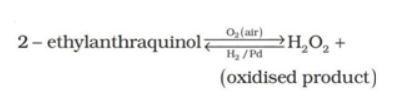
iii) Industrially it is prepared by the auto- oxidation of 2-alklylanthraquinols. 2 ethylanthraquinol H O oxidised product.

In this case 1% $H_2O_2$ is formed. It is extracted with water and concentrated to $\sim30\%$ (by mass) by distillation under reduced pressure. It can be further concentrated to $\sim85\%$ by careful distillation under low pressure. The remaining water can be frozen out to obtain pure $H_2O_2$. Physical Properties of the pure state $H_2O_2$ is an almost colourless (very pale blue) liquid. Its important physical properties. $H_2O_2$ is miscible with water in all proportions and forms a hydrate $H_2O_2.$ $H_2O$ (mp 221K). A 30% solution of $H_2O_2$ is marketed as ‘100 volume’ hydrogen peroxide. It means that one millilitre of 30% $H_2O_2$ solution will give 100 mL of oxygen at STP. Commercially marketed sample is 10 V, which means that the sample contains 3% $H_2O_2$ . Structure Hydrogen peroxide has a non-planar structure.
$H_2O_2$ decomposes slowly on exposure to light.
$2\text{H}_2\text{O}_2\text{(l)}\rightarrow2\text{H}_2\text{O}(\text{l})+\text{O}_2\text{(g)}$
In the presence of metal surfaces or traces of alkali (present in glass containers), the above reaction is catalysed. It is, therefore, stored in wax-lined glass or plastic vessels in dark. Urea can be added as a stabiliser. It is kept away from dust because dust can induce explosive decomposition of the compound.
Its wide scale use has led to tremendous increase in the industrial production of $H_2O_2$. Some of the uses are listed below:
i) In daily life it is used as a hair bleach and as a mild disinfectant. As an antiseptic it is sold in the market as
ii) It is used to manufacture chemicals like sodium perborate and per – carbonate, which are used in high quality detergents.
iii) It is used in the synthesis of hydroquinone, tartaric acid and certain food products and pharmaceuticals (cephalosporin)
iv) It is employed in the industries as a bleaching agent for textiles, paper pulp, leather, oils, fats,
v) Nowadays it is also used in Environmental (Green) Chemistry. For example, in pollution control treatment of domestic and industrial effluents, oxidation of cyanides, restoration of aerobic conditions to sewage wastes,
Heavy water, $D_2O$ It is extensively used as a moderator in nuclear reactors and in exchange reactions for the study of reaction mechanisms. It can be prepared by exhaustive electrolysis of water or as a by-product in some fertilizer industries. It is used for the preparation of other deuterium compounds, for example:
Dihydrogen can be used as a fuel .Dihydrogen releases large quantities of heat on combustion. The data on energy released by combustion of fuels like dihydrogen, methane, LPG etc. are compared in terms of the same amounts in mole, mass and volume Hydrogen Economy is an alternative. The basic principle of hydrogen economy is the transportation and storage of energy in the form of liquid or gaseous dihydrogen. Advantage of hydrogen economy is that energy is transmitted in the form of dihydrogen and not as electric power. It is for the first time in the history of India that a pilot project using dihydrogen as fuel was launched in October 2005 for running automobiles. Initially 5% dihydrogen has been mixed in CNG for use in four-wheeler vehicles. The percentage of dihydrogen would be gradually increased to reach the optimum level. Nowadays, it is also used in fuel cells for generation of electric power. It is expected that economically viable and safe sources of dihydrogen will be identified in the years to come, for its usage as a common source of energy.
  1. In India, a pilot project using dihydrogen as fuel was launched in… for running automobiles.
  1. October 2005
  2. May 2004
  3. August 2014
  4. February 2010
  1. Structure Hydrogen peroxide has a … structure.
  1. Bilateral
  2. Non-planar
  3. Planar
  4. Cubic
  1. One millilitre of 30% $H_2O_2$ solution will give … mL of oxygen at STP.
  1. 30
  2. 10
  3. 100
  4. 300
  1. …. is extensively used as a moderator in nuclear reactors and in exchange reactions for the study of reaction mechanisms.
  1. $H_2O_2$
  2. $T_2O$
  3. $H_2O$
  4. $D_2O$
  1. Colour of pure state $H_2O_2$ is ..
  1. Very Pale red
  2. Very Pale yellow
  3. Very Pale green
  4. Very Pale blue
In order to explain the characteristic geometrical shapes of polyatomic molecules, Pauling introduced the concept of hybridisation. The orbitals undergoing hybridisation should have nearly the same energy. There are various type of hybridisations involving s, p and d-type of orbitals. The type of hybridisation gives the characteristic shape of the molecule or ion.

1. Why all the orbitals in a set of hybridised orbitals have the same shape and energy?
2. Out of $XeF _2$ and $SF _2$ which molecule has the same shape as $NO _2^{+}$ion?
3. Out of $XeF _4$ and $XeF _2$ which molecule doesn't have the same type of hybridisation as P (Phosphorus) has in $PF _5$ ?
OR
Unsaturated compounds undergo additional reactions. Why?
Read the passage given below and answer the following questions from (i) to (vi).
The atomic theory of matter was first proposed on afirm scientific basis by JohnDalton, a British schoolteacher in 1808. His theory, called Dalton’s atomictheory, regarded the atom as the ultimate particle ofmatter Dalton’s atomic theory was able to explainthe law of conservation of mass, law of constantcomposition and law of multiple proportion verysuccessfully. However, it failed to explain the results ofmany experiments.In mid 1850s many scientists mainlyFaraday began to study electrical dischargein partially evacuated tubes, known ascathode ray discharge tubes.Electrical discharge carried out in the modifiedcathode ray tube led to the discovery of canalrays carrying positively charged particles. Thecharacteristics of these positively chargedparticles are listed below.
  1. Unlike cathode rays, mass of positivelycharged particles depends upon thenature of gas present in the cathode raytube. These are simply the positivelycharged gaseous ions.
  2. The charge to mass ratio of the particlesdepends on the gas from which theseoriginate.
  3. Some of the positively charged particlescarry a multiple of the fundamental unitof electrical charge.
  4. The behaviour of these particles in themagnetic or electrical field is opposite tothat observed for electron or cathoderays.
The smallest and lightest positive ion wasobtained from hydrogen and was called
proton. This positively charged particle wascharacterised in 1919. Later, a need was feltfor the presence of electrically neutral particleas one of the constituent of atom. Theseparticles were discovered by Chadwick (1932)by bombarding a thin sheet of beryllium byα-particles. When electrically neutral particleshaving a mass slightly greater than that ofprotons were emitted. He named theseparticles as neutrons.J. J. Thomson, in 1898, proposed that an atom possesses a spherical shape (radiusapproximately 10–10 m) in which the positivecharge is uniformly distributed. The electronsare embedded into it in such a manner as togive the most stable electrostatic arrangementMany different names are given tothis model, for example, plum pudding, raisinpudding or watermelon. This model can be visualised as a pudding or watermelon ofpositive charge with plums or seeds (electrons)embedded into it. An important feature of thismodel is that the mass of the atom is assumed to be uniformly distributed over theatom.Rutherford and his students (Hans Geiger andErnest Marsden) bombarded very thin gold foilwith α–particles. Rutherford’s famous α–particle scattering experiment.The observations of Scattering experiment are as follows-:
  1. most of the α–particles passed throughthe gold foil undeflected.
  2. a small fraction of the α–particles wasdeflected by small angles.
  3. a very few α–particles (∼1 in 20,000)bounced back, that is, were deflected bynearly 180°.
On the basis of observations andconclusions from this experiment, Rutherford proposed the nuclearmodel of atom. According to this model:
  1. The positive charge and most of the massof the atom was densely concentrated inextremely small region. This very smallportion of the atom was called nucleusby Rutherford.
  2. The nucleus is surrounded by electronsthat move around the nucleus with a veryhigh speed in circular paths called orbits.Thus, Rutherford’s model of atomresembles the solar system in which thenucleus plays the role of sun and theelectrons that of revolving planets.
  3. Electrons and the nucleus are held together by electrostatic forces of attraction.
  1. The atomic theory of matter was first proposed on afirm scientific basis by:
  1. John Dalton
  2. Ernest Rutherford
  3. J.Thomson
  4. Henry Moseley
  1. The cathode rays start from … and move towards the….
  1. Anode, Cathode
  2. Centre, Anode
  3. Cathod, Anode
  4. Cathod, Centre
  1. Negativelycharged particles in atoms, called…
  1. Protons
  2. Electrons
  3. Neutron
  4. Positron
  1. The smallest and lightest positive ion wasobtained from …. and was called proton.
  1. Oxygen
  2. Nitrogen
  3. Carbon
  4. Hydrogen
  1. Electrically neutral particles having a mass slightly greater than that of protons, these particles termed as:
  1. Protons
  2. Electrons
  3. Neutron
  4. Positron
  1. J.J. Thomson’s atomic model is also named as:
  1. Plum pudding
  2. Raisin pudding
  3. Watermelon
  4. All the above
Once an organic compound is extracted from a natural source or synthesised in the laboratory, it is essential to purify it. Various methods used for the purification of organic compounds are based on the nature of the compound and the impurity present in it. Finally, the purity of a compound is ascertained by determining its melting or boiling point. This is one of the most commonly used techniques for the purification of solid organic compounds. In crystallisation Impurities, which impart colour to the solution are removed by adsorbing over activated charcoal. In distillation Liquids having different boiling points vaporise at different temperatures. The vapours are cooled and the liquids so formed are collected separately. Steam Distillation is applied to separate substances which are steam volatile and are immiscible with water. Distillation under reduced pressure: This method is used to purify liquids having very high boiling points.

i. Which method can be used to separate two compounds with different solubilities in a solvent?
ii. Distillation method is used to separate which type of substance?
iii. Which technique is used to separate aniline from aniline water mixture?
OR
Why chloroform and aniline are easily separated by the technique of distillation?
Read the passage given below and answer the following questions from $(i)$ to $(v).$
Predicting the Direction of the Reaction- The equilibrium constant helps in predicting the direction in which a given reaction will proceed at any stage. For this purpose, we calculate the reaction quotient $Q$. The reaction quotient, $Q (Qc$ with molar concentrations and $QP$ with partial pressures$)$ is defined in the same way as the equilibrium constant Kc except that the concentrations in $Qc$ are not necessarily equilibrium values. For a general reaction:
$\text{a}\text{A}+\text{b}\text{B}\rightleftharpoons\text{c}\text{C}+\text{d}\text{D}$
$\text{Q}\text{c}=\frac{[\text{C}]^\text{c}[\text{D}]^\text{d}}{[\text{A}]^\text{a}[\text{B}]^\text{b}}$
Then,
If $Qc > Kc,$ the reaction will proceed in the direction of reactants (reverse reaction).
If $Qc < Kc,$ the reaction will proceed in the direction of the products (forward reaction).
If $Qc = Kc,$ the reaction mixture is already at equilibrium. Consider the gaseous reaction of $H_2$ with $I_2$ ,
$\text{H}_{2(\text{g})}+\text{l}_{2(\text{g})}\rightleftharpoons2\text{Hl}_{(\text{g})};\text{kc}=57.0\text{at}700\text{k}.$
Suppose we have molar concentrations $[H_2 ]t =0.10M, [I_2 ]t = 0.20 M$ and $[HI]t = 0.40 M.$ (the subscript t on the concentration symbols means that the concentrations were measured at some arbitrary time t, not necessarily at equilibrium). Thus, the reaction quotient, Qc at this stage of the reaction is given by,
$\text{Qc}=\frac{[\text{Hl}]\text{t}^2}{[\text{H}]^2]_\text{t}[\text{l}_2]_\text{t}}=\frac{(0.40)_2}{(0.10)\times(0.20)}=8.0$
Now, in this case, $Qc (8.0)$ does not equal Kc $(57.0)$, so the mixture of $H2 _{(g)}, I2 _{(g)} $ and $HI_{(g)} $ is not at equilibrium; that is, more $H2 _{(g)} $ and $I 2 _{(g)} $ will react to form more $HI_{(g)} $ and their concentrations will decrease till $Qc = Kc.$ The reaction quotient, Qc is useful in predicting the direction of reaction by comparing the values of Qc and Kc.Thus, we can make the following generalisations concerning the direction of the reaction
If $Qc < Kc,$ net reaction goes from left to right
If $Qc > Kc,$ net reaction goes from right to left.
If $Qc = Kc,$ no net reaction occurs.
Calculating Equilibrium Concentrations In case of a problem in which we know the initial concentrations but do not know any of the equilibrium concentrations, the following three steps shall be followed:
Step 1) Write the balanced equation for the reaction.
Step 2) Under the balanced equation, make a table that lists for each substance involved in the reaction: $(a)$ the initial concentration, $(b)$ the change in concentration on going to equilibrium, and $(c)$ the equilibrium concentration. In constructing the table, define $x$ as the concentration (mol/L) of one of the substances that reacts on going to equilibrium, then use the stoichiometry of the reaction to determine the concentrations of the other substances in terms of $x.$
Step 3) Substitute the equilibrium concentrations into the equilibrium equation for the reaction and solve for x. If you are to solve a quadratic equation choose the mathematical solution that makes chemical sense.
Step 4) Calculate the equilibrium concentrations from the calculated value of $x.$
Step 5) Check your results by substituting them into the equilibrium equation.
Relationship between equilibrium constant K, reaction quotient Q and gibbs energy G The value of Kc for a reaction does not depend on the rate of the reaction. However, it is directly related to the thermodynamics of the reaction and in particular, to the change in Gibbs energy, $\triangle\text{G}.$ If,
$\triangle\text{G}$ is negative, then the reaction is spontaneous and proceeds in the forward direction.
$\triangle\text{G}$ is positive, then reaction is considered non-spontaneous. Instead, as reverse reaction would have a negative $\triangle\text{G},$ the products of the forward reaction shall be converted to the reactants.
$\triangle\text{G}$ is 0, reaction has achieved equilibrium; at this point, there is no longer any free energy left to drive the reaction. A mathematical expression of this thermodynamic view of equilibrium can be described by the following equation:
$\triangle\text{G}=\triangle\text{G}^\phi+\text{RT}\text{lnQ}$
where, $\triangle\text{G}^\phi$ is standard Gibbs energy. At equilibrium, when $\triangle\text{G}=0$ and $Q = Kc,$ the equation becomes,
$\triangle\text{G}=\text{G}^\phi+\text{RT}\text{lnk}=0$
$\triangle\text{G}^\phi=-\text{RT}\text{lnk}$
$\text{Ink}=\frac{-\triangle\text{G}^\phi}{\text{RT}}$
Taking antilog of both sides, we get,
$\text{K}=\text{e}-\frac{\triangle\text{G}0}{\text{RT}}$
Hence, using the equation, the reaction spontaneity can be interpreted in terms of the value of $\triangle\text{G}^\phi.$
If $\triangle\text{G}^\phi>0$ then $\frac{-\triangle\text{G}^\phi}{\text{RT}}$ is positive, and $>1$, making $K > 1$, which implies a spontaneous reaction or the reaction which proceeds in the forward direction to such an extent that the products are present predominantly.
If $\triangle\text{G}^\phi>0,$ then $\frac{-\triangle\text{G}^\phi}{\text{RT}}$ is negative, and $< 1$, that is, $K < 1$, which implies a non-spontaneous reaction or a reaction which proceeds in the forward direction to such a small degree that only a very minute quantity of product is formed.
Factors affecting equilibria One of the principal goals of chemical synthesis is to maximise the conversion of the reactants to products while minimizing the expenditure of energy. This implies maximum yield of products at mild temperature and pressure conditions. If it does not happen, then the experimental conditions need to be adjusted. For example, in the Haber process for the synthesis of ammonia from $N_2$ and $H_2,$ the choice of experimental conditions is of real economic importance. Annual world production of ammonia is about hundred million tones, primarily for use as fertilizers. Equilibrium constant, Kc is independent of initial concentrations. But if a system at equilibrium is subjected to a change in the concentration of one or more of the reacting substances, then the system is no longer at equilibrium; and net reaction takes place in some direction until the system returns to equilibrium once again. Similarly, a change in temperature or pressure of the system may also alter the equilibrium. In order to decide what course the reaction adopts and make a qualitative prediction about the effect of a change in conditions on equilibrium we use Le Chatelier’s principle. It states that a change in any of the factors that determine the equilibrium conditions of a system will cause the system to change in such a manner so as to reduce or to counteract the effect of the change. This is applicable to all physical and chemical equilibria.
Effect of Concentration Change In general, when equilibrium is disturbed by the addition/removal of any reactant/ products, Le Chatelier’s principle predicts that:
The concentration stress of an added reactant/product is relieved by net reaction in the direction that consumes the added substance.
The concentration stress of a removed reactant/product is relieved by net reaction in the direction that replenishes the removed substance. or in other words, “When the concentration of any of the reactants or products in a reaction at equilibrium is changed, the composition of the equilibrium mixture changes so as to minimize the effect of concentration changes”. Let us take the reaction,
$\text{H}_{2(\text{g})}+\text{l}_{2(\text{g})}\rightleftharpoons2\text{Hl}_{(\text{g})}$
If $H_2$ is added to the reaction mixture at equilibrium, then the equilibrium of the reaction is disturbed. In order to restore it, the reaction proceeds in a direction wherein $H_2$ is consumed, i.e., more of $H_2$ and $I_2$ react to form HI and finally the equilibrium shifts in right (forward) direction. This is in accordance with the Le Chatelier’s principle which implies that in case of addition of a reactant/product, a new equilibrium will be set up in which the concentration of the reactant/product should be less than what it was after the addition but more than what it was in the original mixture. The same point can be explained in terms of the reaction quotient, $Qc,$​​​​​​​​​​​​​​
Case Study Questions Class 11 Chemistry – Equilibrium
$\text{Qc}=\frac{[\text{HI}]^2}{[\text{H}]_2[\text{I}]_2}$
Addition of hydrogen at equilibrium results in value of $Qc$ being less than $Kc$. Thus, in order to attain equilibrium again reaction moves in the forward direction. Similarly, we can say that removal of a product also boosts the forward reaction and increases the concentration of the products and this has great commercial application in cases of reactions, where the product is a gas or a volatile substance. In case of manufacture of ammonia, ammonia is liquified and removed from the reaction mixture so that reaction keeps moving in forward direction. Similarly, in the large scale production of $CaO$ (used as important building material) from $CaCO_3$, constant removal of $CO_2$ from the kiln drives the reaction to completion. It should be remembered that continuous removal of a product maintains Qc at a value less than Kc and reaction continues to move in the forward direction.
  1. If … the reaction will proceed in the direction of reactants (reverse reaction).
  1. $Qc > Kc$
  2. $Qc < Kc$
  3. $Qc = Kc$
  4. None of above
  1. If … the reaction will proceed in the direction of the products (forward reaction).
  1. $Qc > Kc$
  2. $Qc < Kc$
  3. $Qc = Kc$
  4. None of above
  1. If … the reaction mixture is already at equilibrium. Consider the gaseous reaction.
  1. $Qc > Kc$
  2. $Qc < Kc$
  3. $Qc = Kc$
  4. All of above
  1. If $\triangle\text{G}$ is …. then the reaction is spontaneous and proceeds in the forward direction.
  1. Zero
  2. Positive
  3. Negative
  4. None of above
  1. $\triangle\text{G}$ is … reaction has achieved equilibrium; at this point, there is no longer any free energy left to drive the reaction.
  1. Zero
  2. Positive
  3. Negative
  4. None of above
The phenomenon of the existence of two or more compounds possessing the same molecular formula but different properties is known as isomerism. Such compounds are called isomers. Compounds having the same molecular formula but different structures (manners in which atoms are linked) are classified as structural isomers. Structural isomers are classified as chain isomer, position isomer, functional group isomer. Meristematic arises due to different alkyl chains on either side of the functional group in the molecule and stereoisomerism and can be classified as geometrical and optical isomerism. Hyperconjugation is a general stabilising interaction. It involves delocalisation of $\sigma$ electrons of the C-H bond of an alkyl group directly attached to an atom of an unsaturated system or to an atom with an unshared p orbital. This type of overlap stabilises the carbocation because electron density from the adjacent $\sigma$ bond helps in dispersing the positive charge.

1. Why Isopentane, pentane and Neopentane are chain isomers?
OR
Why hyperconjugation is a permanent effect?
2. The molecular formula $C _3 H _8 O$ represents which isomer?
3. What type of isomerism is shown by Methoxypropane and ethoxyethane?
Read the passage given below and answer the following questions from 1 to 5.
Alkenes are unsaturated hydrocarbons containing at least one double bond. What should be the general formula of alkenes? If there is one double bond between two carbon atoms in alkenes, they must possess two hydrogen atoms less than alkanes. Hence, general formula for alkenes is $C_nH_{2n}$. Alkenes are also known as olefins (oil forming) since the first member, ethylene or ethene $(C_2H_4)$ was found to form an oily liquid on reaction with chlorine.
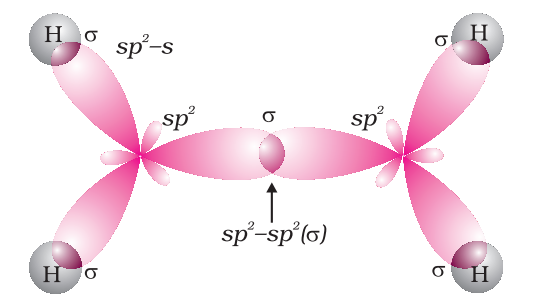
Structure of Double Bond Carbon-carbon double bond in alkenes consists of one strong sigma $(\sigma)$ bond (bond enthalpy about $397\ kJ\ mol^{–1)}$ due to head-on overlapping of $sp^2$ hybridised orbitals and one weak pi $\pi$ bond (bond enthalpy about $284\ kJ\ mol^{–1})$ obtained by lateral or sideways overlapping of the two 2p orbitals of the two carbon atoms. The double bond is shorter in bond length (134 pm) than the C–C single bond (154 pm). You have already read that the pi $(\pi)$ bond is a weaker bond due to poor sideways overlapping between the two 2p orbitals. Thus, the presence of the pi $(\pi)$bond makes alkenes behave as sources of loosely held mobile electrons. Therefore, alkenes are easily attacked by reagents or compounds which are in search of electrons. Such reagents are called electrophilic reagents. The presence of weaker$(\pi)$-bond makes alkenes unstable molecules in comparison to alkanes and thus, alkenes can be changed into single bond compounds by combining with the electrophilic reagents. Strength of the double bond (bond enthalpy, $681\ kJ\ mol^{–1}$) is greater than that of a carbon-carbon single bond in ethane (bond enthalpy, $348\ kJ\ mol^{–1}$). Orbital diagrams of ethene molecule are shown in Figure.

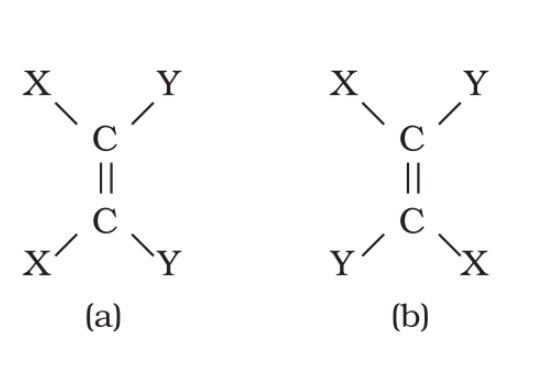
Geometrical isomerism: Doubly bonded Carbon atoms have to satisfy the remaining two Valences by joining with two atoms or groups. If the two atoms or groups attached to each Carbon atom are different, they can be Represented by YX C = C XY like structure. YX C = C XY can be represented in space in the Following two ways:

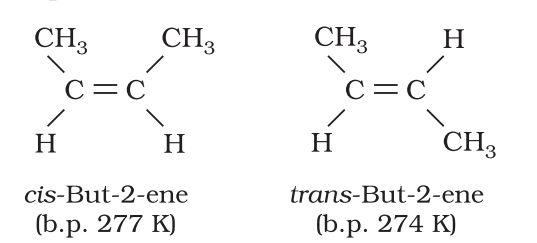
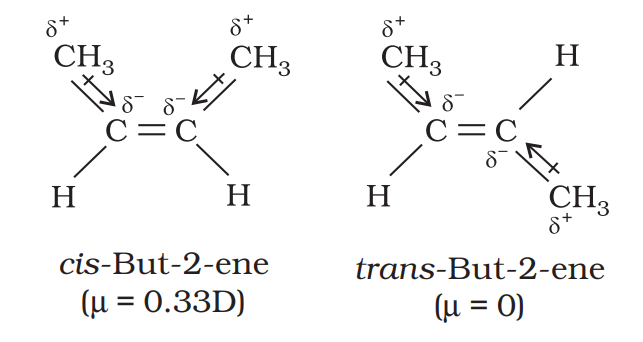
In (a), the two identical atoms i.e., both the X or both the Y lie on the same side of the Double bond but in (b) the two X or two Y lie Across the double bond or on the opposite Sides of the double bond. This results in Different geometry of (a) and (b) i.e. disposition Of atoms or groups in space in the two Arrangements is different. Therefore, they are Stereoisomers. They would have the same Geometry if atoms or groups around C = C bond Can be rotated but rotation around C = C bond Is not free. It is restricted. For understanding This concept, take two pieces of strong Cardboards and join them with the help of two Nails. Hold one cardboard in your one hand And try to rotate the other. Can you really rotate The other cardboard ? The answer is no. The Rotation is restricted. This illustrates that the Restricted rotation of atoms or groups around The doubly bonded carbon atoms gives rise to Different geometries of such compounds. The Stereoisomers of this type are called Geometrical isomers. The isomer of the type (a), in which two identical atoms or groups lie On the same side of the double bond is called Cis isomer and the other isomer of the type (b), in which identical atoms or groups lie on The opposite sides of the double bond is called Trans isomer. Thus cis and trans isomers Have the same structure but have different Configuration (arrangement of atoms or groups In space). Due to different arrangement of Atoms or groups in space, these isomers differ In their properties like melting point, boiling Point, dipole moment, solubility etc. Geometrical or cis-trans isomers of but-2-ene Are represented below:

Cis form of alkene is found to be more polar Than the trans form. For example, dipole Moment of cis - but - 2-ene is 0.33 Debye, Whereas, dipole moment of the trans form Is almost zero or it can be said that trans - but - 2 -ene is non-polar. This can be understood by drawing geometries of the two forms as given below from which it is clear that in the trans - but - 2 -ene, the two methyl groups are in opposite directions, Therefore, dipole moments of $C - CH_3$ bonds cancel, thus making the trans form non-polar.

In the case of solids, it is observed that the trans isomer has higher melting point than the cis form. Geometrical or cis-trans isomerism is also shown by alkenes of the types XYC = CXZ and XYC = CZW
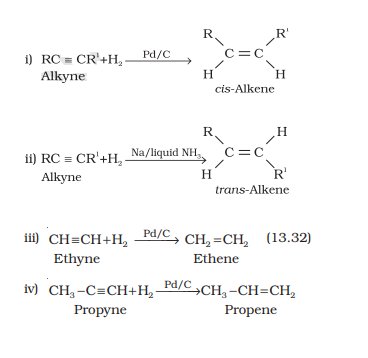
Preparation – From alkynes: Alkynes on partial reduction with calculated amount of dihydrogen in the presence of palladised charcoal partially deactivated with poisons like sulphur
compounds or quinoline give alkenes. Partially deactivated palladised charcoal is known as Lindlar’s catalyst. Alkenes thus obtained are having cis geometry. However, alkynes on reduction with sodium in liquid ammonia form trans alkenes.

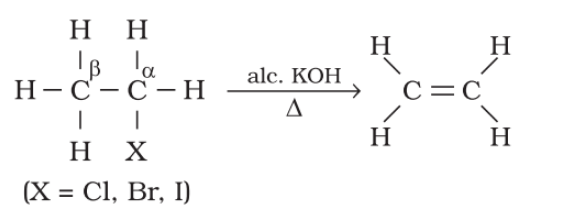
From alkyl halides: Alkyl halides (R-X) on heating with alcoholic potash (potassium hydroxide dissolved in alcohol, say, ethanol) eliminate one molecule of halogen acid to form alkenes. This reaction is known as dehydrohalogenation i.e., removal of halogen acid. This is example of $\beta-$elimination reaction, since hydrogen atom is eliminated from the $\beta$ carbon atom (carbon atom next to the carbon to which halogen is attached).

Nature of halogen atom and the alkyl group determine rate of the reaction. It is observed that for halogens, the rate is: iodine > bromine > chlorine, while for alkyl groups it is: tert > secondary > primary.
Physical properties Alkenes as a class resemble alkanes in physical properties, except in types of isomerism and difference in polar nature. The first three members are gases, the next fourteen are liquids and the higher ones are solids. Ethene is a colourless gas with a faint sweet smell. All other alkenes are colourless and odourless, insoluble in water but fairly soluble in non- polar solvents like benzene, petroleum ether. They show a regular increase in boiling point with increase in size i.e., every $–CH_2$ group added increases boiling point by 20–30 K. Like alkanes, straight chain alkenes have higher boiling point than isomeric branched chain compounds.
  1. The first three members of alkenes are …?
  1. Gases
  2. Liquids
  3. Solids
  4. None of above
  1. General formula for alkenes is ….?
  1. $C_nH_{2n+1}$
  2. $C_nH_{2n}$
  3. $C_nH_{2n-1}$
  4. $C_nH_{2n+2}$
  1. The colour of ethene gas is …?
  1. Red
  2. White
  3. Pale Green
  4. None of above
  1. The bond length of carbon carbon double bond is … pm ?
  1. 154
  2. 143
  3. 134
  4. 120
  1. Alkenes are also knows as …?
  1. Olefines
  2. Paraffines
  3. Oleofines
  4. Paracetofines
Read the passage given below and answer the following questions from (i) to (v).
First complete data on pressure-volume-Temperature relations of a substance in bothGaseous and liquid state was obtained byThomas Andrews on Carbon dioxide. He plottedlsotherms of carbon dioxide at variousTemperatures.
Later on it was found That real gases behave in the same manner asCarbon dioxide. Andrews noticed that at highTemperatures isotherms look like that of anldeal gas and the gas cannot be liquified even atVery high pressure. As the temperature isLowered, shape of the curve changes and dataShow considerable deviation from idealBehaviour. At $30.98^{\circ} C$ carbon dioxide remainsGas upto 73 atmospheric pressure. At 73 atmospheric pressure, liquidCarbon dioxide appears for the first time. TheTemperature $30.98^{\circ} C$ is called criticalTemperature (TC) of carbon dioxide. This is theHighest temperature at which liquid carbonDioxide is observed. Above this temperature itls gas. Volume of one mole of the gas at criticalTemperature is called critical volume $\left( V _{ c }\right)$ andPressure at this temperature is called criticalPressure (pc). The critical temperature, pressureand volume are called critical constants. A gasBelow the critical temperature can be liquifiedBy applying pressure, and is called vapour ofThe substance. Carbon dioxide gas below itsCritical temperature is called carbon dioxideVapour.
Intermolecular forces are stronger in liquidState than in gaseous state. Molecules in liquidsAre so close that there is very little empty space between them and under normal conditionsLiquids are denser than gases.Molecules of liquids are held together byAttractive intermolecular forces. Liquids haveDefinite volume because molecules do notSeparate from each other. However, moleculesOf liquids can move past one another freely, Therefore, liquids can flow, can be poured andCan assume the shape of the container in whichThese are stored. If an evacuated container is partially filled withA liquid, a portion of liquid evaporates to fillthe remaining volume of the container withVapour. Initially the liquid evaporates andPressure exerted by vapours on the walls of The container (vapour pressure) increases. AfterSome time it becomes constant, an equilibriumls established between liquid phase andVapour phase. Vapour pressure at this stagels known as equilibrium vapour pressure orSaturated vapour pressure.. Since process ofVapourisation is temperature dependent; the Temperature must be mentioned whilereporting the vapour pressure of a liquid.
When a liquid is heated in an open vessel,The liquid vapourises from the surface. At theTemperature at which vapour pressure of theLiquid becomes equal to the external pressure,Vapourisation can occur throughout the bulkOf the liquid and vapours expand freely intoThe surroundings. The condition of freeVapourisation throughout the liquid is calledBoiling. The temperature at which vapourPressure of liquid is equal to the externalPressure is called boiling temperature at thatPressure. At 1 atm pressure boilingTemperature is called normal boiling point.If pressure is 1 bar then the boiling point isCalled standard boiling point of the liquid. Standard boiling point of the liquid is slightlyLower than the normal boiling point because 1 bar pressure is slightly less than 1 atmPressure . The normal boiling point of water is $100^{\circ} C (373 K)$, its standard boiling point is $99.6^{\circ} C (372.6 K)$.At high altitudes atmospheric pressure isLow. Therefore liquids at high altitudes boil atLower temperatures in comparison to that atSea level. Since water boils at low temperatureOn hills, the pressure cooker is used forCooking food. In hospitals surgical instrumentsAre sterilized in autoclaves in which boilingPoint of water is increased by increasing thePressure above the atmospheric pressure byUsing a weight covering the vent.Boiling does not occur when liquid isHeated in a closed vessel. On heatingContinuously vapour pressure increases.
AtFirst a clear boundary is visible between liquidAnd vapour phase because liquid is more denseThan vapour. As the temperature increases more and more molecules go to vapour phaseAnd density of vapours rises. At the same timeLiquid becomes less dense. It expands becauseMolecules move apart. When density of liquidAnd vapours becomes the same; the clearBoundary between liquid and vapoursDisappears. This temperature is called critical Temperature.
  1. First complete data on Pressure-Volume-Temperature relations of a substance in both Gaseous and liquid state was obtained by:
  1. Thomas Andrews
  2. Fritz London
  3. Robert Boyle
  4. Joseph Lewis Gay Lussac
  1. Critical Temperature (TC) of carbon dioxide is.....
  1. $24^\circ C$
  2. $30.8^\circ C$
  3. $56^\circ C$
  4. $29^\circ C$
  1. The condition of free Vapourisation throughout the liquid is called …
  1. Evaporation
  2. Melting
  3. Boiling
  4. None of above
  1. Standard boiling point of Water is....
  1. $100^\circ C$
  2. $3^\circ C$
  3. $105^\circ C$
  4. $99.6^\circ C$
  1. Boundary between liquid and vapours Disappears,This temperature is called
  1. Critical temperature
  2. Absolute temperature
  3. Normal temperature
  4. Boiling temperature