Question

Read the passage given below and answer the following questions from 1 to 5.
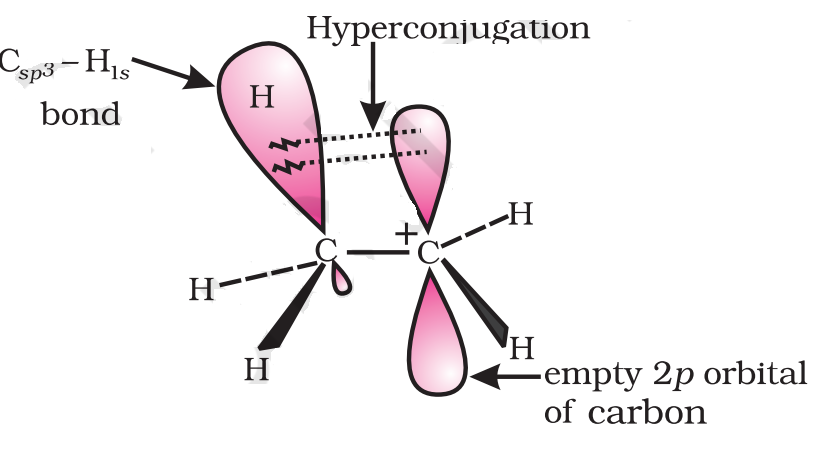
Hyperconjugation is a general stabilising interaction. It involves delocalisation of σ electrons of C—H bond of an alkyl group directly attached to an atom of unsaturated system or to an atom with an unshared p orbital. The σ electrons of C—H bond of the alkyl group enter into partial conjugation with the attached unsaturated system or with the unshared p orbital. Hyperconjugation is a permanent effect. To understand hyperconjugation effect, let us take an example of CH 32 + (ethyl cation) in which the positively charged carbon atom has an empty p orbital. One of the C-H bonds of the methyl group can align in the plane of this empty p orbital and the electrons constituting the C-H bond in plane with this p orbital can then be delocalised into the empty p orbital as depicted in Figure.
This type of overlap stabilises the carbocation because electron density from the adjacent σ bond helps in dispersing the positive charge.
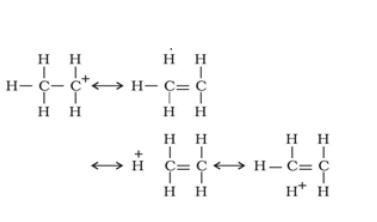
In general, greater the number of alkyl groups attached to a positively charged carbon atom, the greater is the hyperconjugation interaction and stabilisation of the cation. Thus, we have the following relative stability of carbocations:
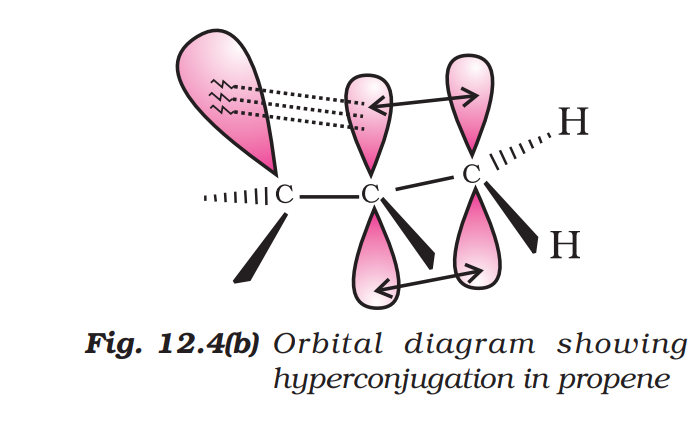
Hyperconjugation is also possible in alkenes and alkylarenes. Delocalisation of electrons by hyperconjugation in the case of alkene can be depicted as in Figure.
There are various ways of looking at the hyperconjugative effect. One of the way is to regard C—H bond as possessing partial ionic character due to resonance.
The hyperconjugation may also be regarded as no bond resonance.
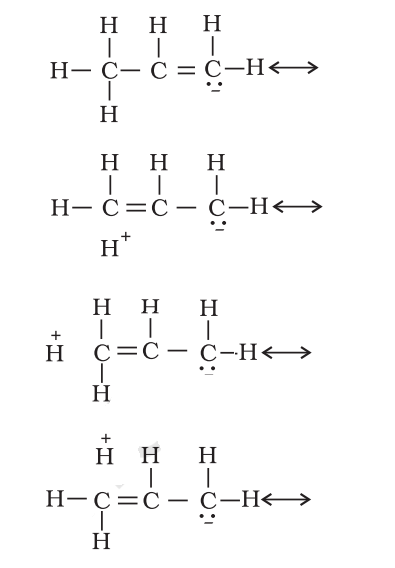
The hyperconjugation may also be regarded as no bond resonance.
Methods of purification of organic compounds Once an organic compound is extracted from a natural source or synthesised in the laboratory, it is essential to purify it. Various methods used for the purification of organic compounds are based on the nature of the compound and the impurity present in it. The common techniques used for purification are as follows :
i) Sublimation
ii) Crystallisation
iii) Distillation
iv) Differential extraction and
v) Chromatography
Finally, the purity of a compound is ascertained by determining its melting or boiling point. Most of the pure compounds have sharp melting points and boiling points. New methods of checking the purity of an organic compound are based on different types of chromatographic and spectroscopic techniques.
Sublimation On heating, some solid substances change from solid to vapour state without passing through liquid state. The purification technique based on the above principle is known as sublimation and is used to separate sublimable compounds from non- sublimable impurities.
Crystallisation This is one of the most commonly used techniques for the purification of solid organic compounds. It is based on the difference in the solubilities of the compound and the impurities in a suitable solvent. The impure compound is dissolved in a solvent in which it is sparingly soluble at room temperature but appreciably soluble at higher temperature. The solution is concentrated to get a nearly saturated solution. On cooling the solution, pure compound crystallises out and is removed by filtration. The filtrate (mother liquor) contains impurities and small quantity of the compound. If the compound is highly soluble in one solvent and very little soluble in another solvent, crystallisation can be satisfactorily carried out in a mixture of these solvents. Impurities, which impart colour to the solution are removed by adsorbing over activated charcoal. Repeated crystallisation becomes necessary for the purification of compounds containing impurities of comparable solubilities.
Distillation This important method is used to separate
i) volatile liquids from nonvolatile impurities and
ii) the liquids having sufficient difference in their boiling points.
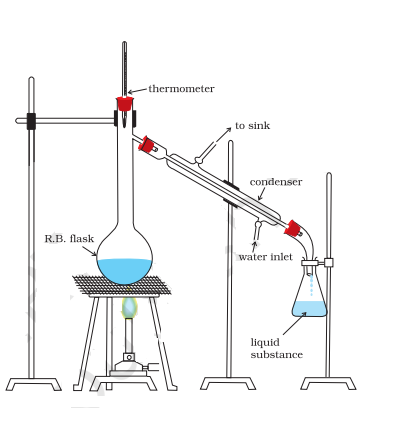
Liquids having different boiling points vaporise at different temperatures. The vapours are cooled and the liquids so formed are collected separately. Chloroform (b.p 334 K) and aniline (b.p. 457 K) are easily separated by the technique of distillation (Fig 12.5). The liquid mixture is taken in a round bottom flask and heated carefully. On boiling, the vapours of lower boiling component are formed first. The vapours are condensed by using a condenser and the liquid is collected in a receiver. The vapours of higher boiling component form later and the liquid can be collected separately.
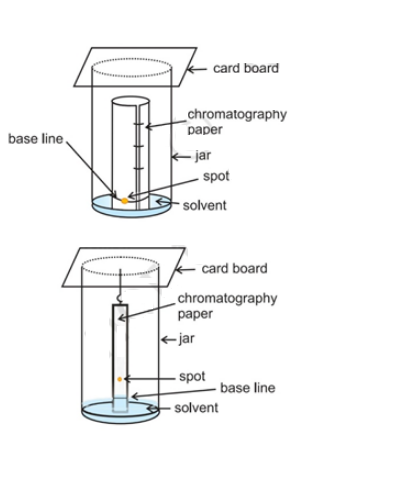
Partition Chromatography: Partition chromatography is based on continuous differential partitioning of components of a mixture between stationary and mobile phases. Paper chromatography is a type of partition chromatography. In paper chromatography, a special quality paper known as chromatography paper is used. Chromatography paper contains water trapped in it, which acts as the stationary phase. A strip of chromatography paper spotted at the base with the solution of the mixture is suspended in a suitable solvent or a mixture of solvents (Fig. 12.13). This solvent acts as the mobile phase. The solvent rises up the paper by capillary action and flows over the spot. The paper selectively retains different components according to their differing partition in the two phases. The paper strip so developed is known as a chromatogram. The spots of the separated coloured compounds are visible at different heights from the position of initial spot on the chromatogram. The spots of the separated colourless compounds may be observed either under ultraviolet light or by the use of an appropriate spray reagent as discussed under thin layer chromatography.
  1. Hyperconjunction involves delocalisation of … electrons of C—H bond of an alkyl group directly attached to an atom of unsaturated system or to an atom with an unshared p orbital.
  1. $\sigma$
  2. $\pi$
  3. $\delta$
  4. $\eta$
  1. Which of the is an example of technique used for purification.
  1. Distillation
  2. Differential extraction
  3. Chromatography
  4. All the above
  1. On heating, some solid substances change from solid to vapour state without passing through liquid state is known as …
  1. Melting
  2. Boiling
  3. Sublimation
  4. Condensation
  1. The hyperconjugation may also be regarded as ….
  1. bonding resonance
  2. no bond resonance
  3. no bond induction
  4. bonding induction
  1. Chromatography paper contains water trapped in it, which acts as the … phase.
  1. mobile
  2. stationery
  3. Secondary
  4. quaternary

Answer

  1. (a) $\sigma$
  2. (d) All the above
  3. (c) Sublimation
  4. b) no bond resonance
  5. b) stationery

Need a full question paper?

Generate a complete, print-ready paper with questions like this in minutes — across 16+ boards, with answer keys.

Start Generating Free

Similar questions

The ionic character of metallic halides tends toward covalent nature as per Fajan's rule. Such covalent halides behave as non-metal in their higher oxidation states. The property to hydrolyse to give oxy-acids of the element and corresponding hydro halogen acid for most non-metallic elements proceeds exceptionally in the way, keeping oxidation number of element and halide sam in oxo-acids.
Non-polar halides are immiscible in water, as they do not show hydrolysis, but halides of some elements with empty d-orbital undergo hydrolysis. Stability of halides of the higher state is governed by the inert-pair effect.

1. How does halide undergo hydrolysis to give oxy-acids of underlined element $PCl _3$ ?
2. Out of $NCl _3$ and $BCl _3$ undergoes hydrolysis to form oxy-acids? Write the chemical reaction for the correct answer.
3. Out of $PbCl _4, PbF _4, PbI _4$ and $PbBr _4$ which one doesn't exist?
OR
Non-Polar halides are immiscible in water. Why?
The French physicist, de Broglie, in 1924proposed that matter, like radiation, shouldalso exhibit dual behaviour i.e., both particleand wavelike properties. This means that justas the photon has momentum as well aswavelength, electrons should also havemomentum as well as wavelength, de Broglie,from this analogy, gave the following relationbetween wavelength $(\lambda)$ and momentum (p) ofa material particle
$\lambda=\frac{\text{h}}{\text{mv}}=\frac{\text{h}}{\text{p}}$
where m is the mass of the particle, v itsvelocity and p its momentum.
Werner Heisenberg a German physicist in1927, stated uncertainty principle which is theconsequence of dual behaviour of matter andradiation. It states that it is impossible todetermine simultaneously, the exact position and exact momentum (or velocity)of an electron.Mathematically, it can be given as inequation
$\triangle\text{x}\times\triangle\text{p}_{\text{x}}\geq\frac{\text{h}}{4\pi}$
or $\triangle\text{x}\times\triangle(\text{mv}_{\text{x}})\geq\frac{\text{h}}{4\pi}$
or $\triangle\text{x}\times\triangle(\text{v}_{\text{x}})\geq\frac{\text{h}}{4\pi\text{m}}$
where $\triangle\text{x}$ is the uncertainty in position and $\triangle\text{px}(\text{or}\triangle\text{vx})$ is the uncertainty in momentum (orvelocity) of the particle.
One of the important implications of theHeisenberg Uncertainty Principle is that itrules out existence of definite paths ortrajectories of electrons and other similarparticles. The effect of Heisenberg Uncertainty Principle is significant only for motion of microscopic objects and is negligible for that of macroscopic objects. It, therefore, means that theprecise statements of the position andmomentum of electrons have to bereplaced by the statements of probability,that the electron has at a given positionand momentum. This is what happens inthe quantum mechanical model of atom. In Bohr model, anelectron is regarded as a charged particlemovingin well defined circular orbits aboutthe nucleus. The wave character of the electronis not considered in Bohr model. Further, anorbit is a clearly defined path and this pathcan completely be defined only if both theposition and the velocity of the electron areknown exactly at the same time. This is notpossible according to the Heisenberguncertainty principle. Bohr model of thehydrogen atom, therefore, not only ignoresdual behaviour of matter but also contradictsHeisenberg uncertainty principle. The structure of the atom was needed which could account for wave-particle duality of matter and be consistent with Heisenberg uncertainty Principle. This came with the advent of Quantum mechanics. This is mainly becauseof the fact thatclassical mechanics ignores theconcept of dual behaviour of matter especiallyfor sub-atomic particles and the uncertaintyprinciple. The branch of science that takes intoaccount this dual behaviour of matter is calledquantum mechanics.Quantum mechanics is a theoreticalscience that deals with the study of the motionsof the microscopic objects that have bothobservable wave like and particle likeproperties.When Schrödinger equation is solved forhydrogen atom, the solution gives the possibleenergy levels the electron can occupy and thecorresponding wave function(s) $\psi$ of theelectron associated with each energy level. A large number of orbitals are possible in anatom. Qualitatively these orbitals can bedistinguished by their size, shape andorientation. An orbital of smaller size meansthere is more chance of finding the electron nearthe nucleus. Similarly shape and orientationmean that there is more probability of findingthe electron along certain directions thanalong others. Atomic orbitals are preciselydistinguished by what are known as quantumnumbers. Each orbital is designated by threequantum numbers labelled as n, l and $m_1$.
The principal quantum number ‘n’ isa positive integer with value of n = 1,2,3…….The principal quantum number determines thesize and to large extent the energy of theorbital. Azimuthal quantum number. ‘l’ is alsoknown as orbital angular momentum orsubsidiary quantum number. It defines thethree-dimensional shape of the orbital.. For agiven value of n, l can have n values rangingfrom 0 to n – 1, that is, for a given value of n,the possible value of l are : l = 0, 1, 2, ……….(n–1)
Magnetic orbital quantum number. ‘mlgives information about the spatialorientation of the orbital with respect tostandard set of co-ordinate axis. For anysub-shell (defined by ‘l’ value) 2l+1 valuesof ml are possible and these values are givenbuy :ml = – l, – (l –1), – (l–2)… 0,1… (l –2), (l–1)..
In 1925, George Uhlenbeck and SamuelGoudsmit proposed the presence of the fourthquantum number known as the electronspin quantum number (ms). electron has, besides charge and mass,intrinsic spin angular quantum number. Spinangular momentum of the electron — a vectorquantity, can have two orientations relative tothe chosen axis. These two orientations aredistinguished by the spin quantum numbersms which can take the values of $+½ or –½$.These are called the two spin states of theelectron and are normally represented by twoarrows, ↑ (spin up) and ↓ (spin down).the four quantum numbersprovide the following information :
  1. n defines the shell, determines the size ofthe orbital and also to a large extent theenergy of the orbital.
  2. There are n subshells in the n the shell. Lidentifies the subshell and determines the shape of the orbital (see section 2.6.2).There are (2l+1) orbitals of each type in asubshell, that is, one s orbital (l = 0), threep orbitals (l = 1) and five d orbitals (l = 2)per subshell. To some extent l alsodetermines the energy of the orbital in amulti-electron atom.
  3. ml designates the orientation of the orbital.For a given value of l, mlhas (2l+1) values,the same as the number of orbitals persubshell. It means that the number oforbitals is equal to the number of ways inwhich they are oriented.
  4. ms refers to orientation of the spin of the electron.
  1. Uncertainty principle was given by:
  1. Werner Heisenberg
  2. George Uhlenbeck
  3. Samuel Goudsmit
  4. De Broglie
  1. Quantum mechanics is a theoretical science that deals with the study of the motions of the ….. objects.
  1. Macroscopic
  2. Microscopic
  3. Laparoscopic
  4. All the above
  1. The principal quantum number …
  1. l
  2. m
  3. n
  4. p
  1. …is also known as orbital angular momentum or subsidiary quantum number.
  1. Principal quantum number
  2. Electron spin quantum number
  3. Magnetic orbital quantum number.
  4. Azimuthal quantum number
  1. George Uhlenbeck and Samuel Goudsmit proposed the presence of the fourth quantum number known as the …
  1. Principal quantum number
  2. Electron spin quantum number
  3. Magnetic orbital quantum number.
  4. Azimuthal quantum number
Read the passage given below and answer the following questions from 1 to 5.
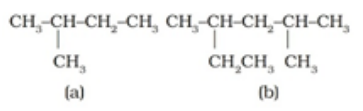
Branched chain hydrocarbons: In a branched chain compound small chains of carbon atoms are attached at one or more carbon atoms of the parent chain. The small carbon chains (branches) are called alkyl groups. For example:

In order to name such compounds, the names of alkyl groups are prefixed to the name of parent alkane. An alkyl group is derived from a saturated hydrocarbon by removing a hydrogen atom from carbon. Thus, $CH_4$becomes$ – CH_3 $and is called methyl group. An alkyl group is named by substituting ‘yl’ for ‘ane’ in the corresponding alkane. Some alkyl groups are listed in Table
Alkane Alkyl Group
Molecular formula Name of alkane Structural formula Name of alkyl group
$CH_4$ Methane $-CH_3$ Methyl
$C_2H_6$ Ethane $-CH_2CH_3​​​​​​​$ Ethyl
$C_3H_8​​​​​​​$ Propane $-CH_2CH_2CH_3$ Propyl
$C_4H_{10}​​​​​​​$ Butane $-CH_2CH_2CH_2CH_3​​​​​​​$ Butyl
$C_{10}H_{22}​​​​​​​$ Decane $-CH_2(CH_2)_8CH_3​​​​​​​$​​​​​​​ Decyl
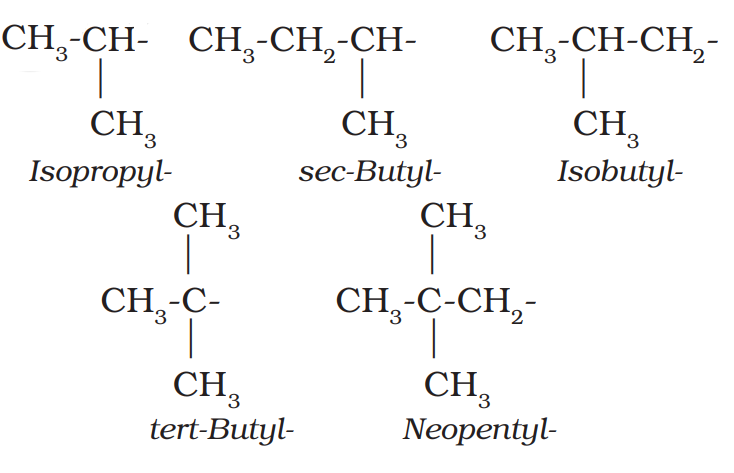
Abbreviations are used for some alkyl groups. For example, methyl is abbreviated as Me, ethyl as Et, propyl as Pr and butyl as Bu. The alkyl groups can be branched also. Thus, propyl and butyl groups can have branched structures as shown below .
Common branched groups have specific trivial names. For example, the propyl groups can either be n-propyl group or isopropyl group. The branched butyl groups are called sec- butyl, isobutyl and tert-butyl group. We also encounter the structural unit, – $CH_2C(CH_3)_3​​​​​​​$​​​​​​​, which is called neopentyl group.
For Nomenclature of branched chain alkanes ,longest carbon chain in the molecule is identified. The numbering is done in such a way that the branched carbon atoms get the lowest possible numbers. lower number is given to the one coming first in the alphabetical listing. Carbon atom of the branch that attaches to the root alkane. in alphabetical order, the prefixes iso- and neo- are considered to be the part of the fundamental name of alkyl group. The prefixes sec- and tert- are not considered to be the part of the fundamental name.
Cyclic Compounds: A saturated monocyclic compound is named by prefixing ‘cyclo’ to the corresponding straight chain alkane. If side chains are present, then the rules given above are applied. Names of some cyclic compounds are given below.

The phenomenon of existence of two or more compounds possessing the same molecular formula but different properties is known as isomerism. Such compounds are called as isomers. The following flow chart shows different types of isomerism.
Structural Isomerism Compounds having the same molecular formula but different structures (manners in which atoms are linked) are classified as structural isomers. Some typical examples of different types of structural isomerism are given below:

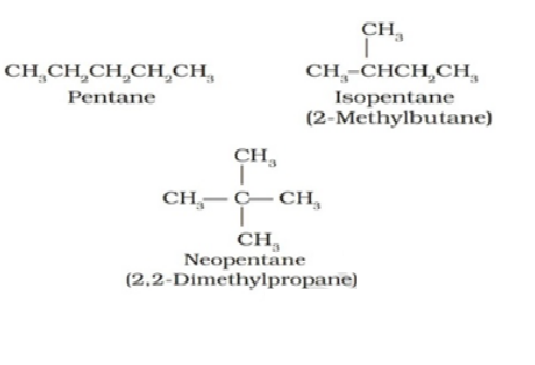
(i) Chain isomerism: When two or more compounds have similar molecular formula but different carbon skeletons, these are referred to as chain isomers and the phenomenon is termed as chain isomerism. For example, $C_5H_{12}​​​​​​​$​​​​​​​ represents three compounds:
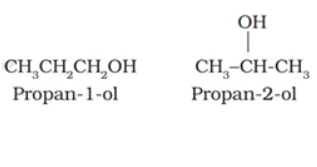
(ii) Position isomerism: When two or more compounds differ in the position of substituent atom or functional group on the carbon skeleton, they are called position isomers and this phenomenon is termed as position isomerism. For example, the molecular formula $C_3H_8O$ represents two alcohols:

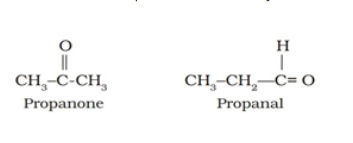
(iii) Functional group isomerism: Two or more compounds having the same molecular formula but different functional groups are called functional isomers and this phenomenon is termed as functional group isomerism. For example, the molecular formula $C_3H_6O$ represents an aldehyde and a ketone:

(iv) Metamerism: It arises due to different alkyl chains on either side of the functional group in the molecule. For example, $C_4H_{10}O$ represents methoxy propane $(CH_3OC_3H_7)$ and ethoxyethane $(C_2H_5OC_2H_5).$
Stereoisomerism The compounds that have the same constitution and sequence of covalent bonds but differ in relative positions of their atoms or groups in space are called stereoisomers. This special type of isomerism is called as stereoisomerism and can be classified as geometrical and optical isomerism.
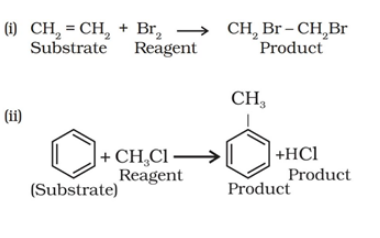
Substrate and Reagent Ions are generally not formed in the reactions of organic compounds. Molecules as such participate in the reaction. It is convenient to name one reagent as substrate and other as reagent. In general, a molecule whose carbon is involved in new bond formation is called substrate and the other one is called reagent. When carbon-carbon bond is formed, the choice of naming the reactants as substrate and reagent is arbitrary and depends on molecule under observation. Example:
  1. $CH_4​​​​​​​$​​​​​​​ becomes –$ CH_3​​​​​​​$​​​​​​​, is called … group.
  1. methyl
  2. ethyl
  3. propyl
  4. butyl
  1. For the Nomenclature of branched chain alkanes …. carbon chain in the molecule is identified.
  1. shortest
  2. longest
  3. smallest
  4. none of above
  1. when two or more compounds possessing the same molecular formula but different properties is known as ….
  1. Allotrops
  2. Isotops
  3. Isomers
  4. Isobars
  1. For the Nomenclature of branched chain alkanes, the numbering is done in such a way that the branched carbon atoms get the … possible numbers.
  1. biggest
  2. Lower
  3. Highest
  4. lowest
  1. Which of the following is not an example of isomerisim?
  1. Functional
  2. Positional
  3. Chain
  4. Preconditional
Read the passage given below and answer the following questions from 1 to 5. Uses of Dihydrogen:
  • The largest single use of dihydrogen is in the synthesis of ammonia which is used in the manufacture of nitric acid and nitrogenous
  • Dihydrogen is used in the manufacture of vanaspati fat by the hydrogenation of polyunsaturated vegetable oils like soyabean, cotton seeds
  • It is used in the manufacture of bulk organic chemicals, particularly
  • It is widely used for the manufacture of metal
  • It is used for the preparation of hydrogen chloride, a highly useful
  • In metallurgical processes, it is used to reduce heavy metal oxides to
  • Atomic hydrogen and oxy-hydrogen torches find use for cutting and welding purposes. Atomic hydrogen atoms (produced by dissociation of dihydrogen with the help of an electric arc) are allowed to recombine on the surface to be welded to generate the temperature of 4000
  • It is used as a rocket fuel in space
  • Dihydrogen is used in fuel cells for generating electrical energy. It has many advantages over the conventional fossil fuels and electric It does not produce any pollution and releases greater energy per unit mass of fuel in comparison to gasoline and other fuels.
Dihydrogen, under certain reaction conditions, combines with almost all elements, except noble gases, to form binary compounds, called hydrides. If ‘E’ is the symbol of an element then hydride can be expressed as EHx $($e.g., Mg $H_2)$ or EmHn $($e.g.,$B_2H_6)$. The hydrides are classified into three categories:
  • Ionic or saline or saltlike hydrides
  • Covalent or molecular hydrides
  • Metallic or non-stoichiometric hydrides
Ionic or Saline Hydrides are stoichiometric compounds of dihydrogen formed with most of the s-block elements which are highly electropositive in character. However, significant covalent character is found in the lighter metal hydrides such as LiH, $BeH_2$ and $MgH_2$. In fact Be $H_2$ and Mg $H_2$ are polymeric in structure. The ionic hydrides are crystalline, non-volatile and non- conducting in solid state. However, their melts conduct electricity and on electrolysis liberate dihydrogen gas at anode, which confirms the existence of $H^{–} ion$. Covalent or Molecular Hydride Dihydrogen forms molecular compounds with most of the p-block elements. Most familiar examples are $CH_4, NH_3, H_2O$ and $HF.$ For convenience hydrogen compounds of non- metals have also been considered as hydrides. Being covalent, they are volatile compounds. Molecular hydrides are further classified according to the relative numbers of electrons and bonds in their Lewis structure into:
  • electron-deficient,
  • electron-precise, and
  • electron-rich
An electron-deficient hydride, as the name suggests, has too few electrons for writing its conventional Lewis structure. Diborane $(B_2H_6)$ is an example. In fact all elements of group 13 will form electron-deficient compounds. They act as Lewis acids i.e., electron acceptors. Electron-precise compounds have the required number of electrons to write their conventional Lewis structures. All elements of group 14 form such compounds (e.g., $CH_4$) which are tetrahedral in geometry. Electron-rich hydrides have excess electrons which are present as lone pairs. Elements of group 15-17 form such compounds. (NH3 has 1 - lone pair, $H_2O – 2$ and $HF –3$ lone pairs). What do you expect from the behaviour of such compounds ? They will behave as Lewis bases i.e., electron donors. The presence of lone pairs on highly electronegative atoms like N, O and F in hydrides results in hydrogen bond formation between the molecules. This leads to the association of molecules. Metallic or Non-stoichiometric (or Interstitial ) Hydrides are formed by many d- block and f-block elements. However, the metals of group 7, 8 and 9 do not form hydride. Even from group 6, only chromium forms CrH. These hydrides conduct heat and electricity though not as efficiently as their parent metals do. Unlike saline hydrides, they are almost always non- stoichiometric, being deficient in hydrogen. For example, $La H_{2.87}, Yb H_{2.55}, TiH1_{.5–1.8}, ZrH_{1.3–1.75}$, etc. In such hydrides, the law of constant composition does not hold good. Earlier it was thought that in these hydrides, hydrogen occupies interstices in the metal lattice producing distortion without any change in its type. Consequently, they were termed as interstitial hydrides. However, recent studies have shown that except for hydrides of Ni, Pd, Ce and Ac, other hydrides of this class have lattice different from that of the parent metal. The property of absorption of hydrogen on transition metals is widely used in catalytic reduction / hydrogenation reactions for the preparation of large number of compounds. Some of the metals (e.g., Pd, Pt) can accommodate a very large volume of hydrogen and, therefore, can be used as its storage media. This property has high potential for hydrogen storage and as a source of energy. A major part of all living organisms is made up of water. Human body has about 65% and some plants have as much as 95% water. It is a crucial compound for the survival of all life forms. It is a solvent of great importance. The distribution of water over the earth’s surface is not uniform.​​​​​​​
  1. Dihydrogen, under certain reaction conditions, combines with almost all elements, except …
  1. Noble gases
  2. Halogens
  3. Alkali metals
  4. Alkaline earth metal
  1. Covalent or Molecular Hydride Dihydrogen forms molecular compounds with most of the p-block elements. Most familiar example is:
  1. $CH_4$
  2. $NH_3$
  3. $H_2O$
  4. All the above
  1. All elements of group 14 form such compounds have … geometry.
  1. pyramidal
  2. tetrahedral
  3. bilateral
  4. spherical
  1. From group 6, only … forms hydride.
  1. molybdenum
  2. tungsten
  3. chromium
  4. seaborgium
  1. Which of the following hydride is/ are deficient in hydrogen.
  1. $La H_2._{87}$
  2. $Yb H_2._{55}$
  3. TiH5–1.8
  4. All of above
Read the passage given below and answer the following questions from (i) to (v).
A system in thermodynamics refers to that part of universe in which observations are made and remaining universe constitutes the surroundings. The surroundings include everything other than the system. System and the surroundings together constitute the universe. The universe = The system + The surroundings However, the entire universe other than the system is not affected by the changes taking place in the system. Therefore, for all practical purposes, the surroundings are that portion of the remaining universe which can interact with the system. Usually, the region of space in the neighbourhood of the system constitutes its surroundings.
The wall that separates the system from the surroundings is called boundary.
Types of the System We, further classify the systems according to the movements of matter and energy in or out of the system.
  1. Open System In an open system, there is exchange of energy and matter between system and surroundings. The presence of reactants in an open beaker is an example of an open system. Here the boundary is an imaginary surface enclosing the beaker and reactants.
  2. Closed System In a closed system, there is no exchange of matter, but exchange of energy is possible between system and the surroundings. The presence of reactants in a closed vessel made of conducting material e.g., copper or steel is an example of a closed system.
  3. Isolated System In an isolated system, there is no exchange of energy or matter between the system and the surroundings. The presence of reactants in a thermos flask or any other closed insulated vessel is an example of an isolated system.
The State of the System The system must be described in order to make any useful calculations by specifying quantitatively each of the properties such as its pressure (p), volume (V), and temperature (T) as well as the composition of the system. We need to describe the system by specifying it before and after the change. You would recall from your Physics course that the state of a system in mechanics is completely specified at a given instant of time, by the position and velocity of each mass point of the system. In thermodynamics, a different and much simpler concept of the state of a system is introduced. It does not need detailed knowledge of motion of each particle because, we deal with average measurable properties of the system. We specify the state of the system by state functions or state variables. The state of a thermodynamic system is described by its measurable or macroscopic (bulk) properties. We can describe the state of a gas by quoting its pressure (p), volume (V), temperature (T), amount (n) etc. Variables like p, V, T are called state variables or state functions because their values depend only on the state of the system and not on how it is reached. In order to completely define the state of a system it is not necessary to define all the properties of the system; as only a certain number of properties can be varied independently. This number depends on the nature of the system. Once these minimum number of macroscopic properties are fixed, others automatically have definite values. The state of the surroundings can never be completely specified; fortunately it is not necessary to do so.
By conventions of IUPAC in chemical thermodynamics. The q is positive, when heat is transferred from the surroundings to the system and the internal energy of the system increases and q is negative when heat is transferred from system to the surroundings resulting in decrease of the internal energy of the system.
Let us consider the general case in which a change of state is brought about both by doing work and by transfer of heat. We write change in internal energy for this case as: $ \triangle{\text{U}}=\text{q}+\text{w}$
For a given change in state, q and w can vary depending on how the change is carried out. However, $\text{q}+\text{w}=\triangle{\text{U}}$ will depend only on initial and final state. It will be independent of the way the change is carried out. If there is no transfer of energy as heat or as work (isolated system) i.e., if w = 0 and q = 0, then $ \triangle{\text{U}}=0.$ The equation i.e., $ \triangle{\text{U}}=\text{q}+\text{w}$ is mathematical statement of the first law of thermodynamics, which states that The energy of an isolated system is constant. It is commonly stated as the law of conservation of energy i.e., energy can neither be created nor be destroyed.
  1. $\triangle\text{U}=\ ....$
  1. q + w
  2. q + v
  3. q + m
  4. q + z
  1. Which of the following is not an example of state variable?
  1. Pressure
  2. Ionic radius
  3. Volume
  4. Amount
  1. $\triangle\text{U}=\text{q}+\text{w}$ is termed as …
  1. Third law of thermodynamics
  2. Second law of thermodynamics
  3. First law of thermodynamics
  4. None of above
  1. A … in thermodynamics refers to that part of universe in which observations are made.
  1. Universe
  2. System
  3. Surrounding
  4. Boundary
  1. Which of the following is a type if system ?
  1. Open system
  2. Closed system
  3. Lsolated system
  4. All the above
The idea of oxidation number has been invariably applied to define oxidation, reduction, oxidising agent (oxidant), reducing agent (reductant) and the redox reaction. To summarise, we may say that:
Oxidation: An increase in the oxidation number of the element in the given substance.
Reduction: A decrease in the oxidation number of the element in the given substance.
Oxidising agent: A reagent which can increase the oxidation number of an element in a given substance. These reagents are called as oxidants also.
Reducing agent: A reagent which lowers the oxidation number of an element in a given substance. These reagents are also called as reductants.
Redox reactions: Reactions which involve change in oxidation number of the interacting species.
Types of Redox Reactions
1.) Combination reactions -A combination reaction may be denoted in the manner:
$A + B → C$
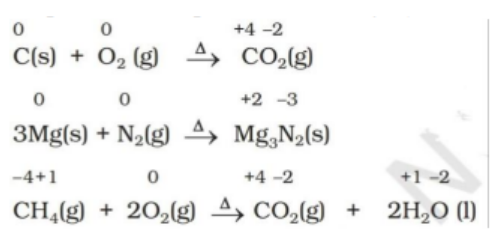
Either A and B or both A and B must be in the elemental form for such a reaction to be a redox reaction. All combustion reactions, which make use of elemental dioxygen, as well as other reactions involving elements other than dioxygen, are redox reactions. Some important examples of this category are:

2.) Decomposition reactions- Decomposition reactions are the opposite of combination reactions. Precisely, a decomposition reaction leads to the breakdown of a compound into two or more components at least one of which must be in the elemental state.
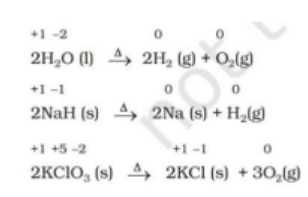
Examples of this class of reactions are:

It may carefully be noted that there is no change in the oxidation number of hydrogen in methane under combination reactions and that of potassium in potassium chlorate in reaction. This may also be noted here that all decomposition reactions are not redox reactions. For example, decomposition of calcium carbonate is not a redox reaction.
3.) Displacement reactions- In a displacement reaction, an ion (or an atom) in a compound is replaced by an ion (or an atom) of another element. It may be denoted as:
$X + YZ → XZ + Y$
Displacement reactions fit into two categories: metal displacement and non-metal displacement.
(a) Metal displacement: A metal in a compound can be displaced by another metal in the uncombined state. Metal displacement reactions find many applications in metallurgical processes in which pure metals are obtained from their compounds in ores.
(b) Non-metal displacement: The non-metal displacement redox reactions include hydrogen displacement and a rarely occurring reaction involving oxygen displacement. All alkali metals and some alkaline earth metals (Ca, Sr, and Ba) which are very good reductants, will displace hydrogen from cold water. Many metals, including those which do not react with cold water, are capable of displacing hydrogen from acids. Dihydrogen from acids may even be produced by such metals which do not react with steam. Cadmium and tin are the examples of such metals.
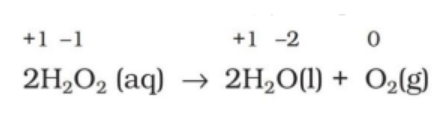
4.) Disproportionation reactions – Disproportionation reactions are a special type of redox reactions. In a disproportionation reaction an element in one oxidation state is simultaneously oxidised and reduced. One of the reacting substances in a disproportionation reaction always contains an element that can exist in at least three oxidation states. The element in the form of reacting substance is in the intermediate oxidation state; and both higher and lower oxidation states of that element are formed in the reaction. The decomposition of hydrogen peroxide is a familiar example of the reaction, where oxygen experiences disproportionation.

Here the oxygen of peroxide, which is present in –1 state, is converted to zero oxidation state in $O2$ and decreases to –2 oxidation state in $H_2O$.
  1. In … an ion (or an atom) in a compound is replaced by an ion (or an atom) of another element.
  1. displacement reaction
  2. decomposition reaction
  3. disproportionation reaction
  4. combination reaction
  1. leads to the breakdown of a compound into two or more components at least one of which must be in the elemental state.
  1. displacement reaction
  2. decomposition reaction
  3. disproportionation reaction
  4. combination reaction
  1. In …. an element in one oxidation state is simultaneously oxidised and reduced.
  1. displacement reaction
  2. decomposition reaction
  3. disproportionation reaction
  4. combination reaction
  1. Reactions which involve change in oxidation number of the interacting species…
  1. Exothermic reaction
  2. Endothermic reaction
  3. Neutralization reaction
  4. Redox reaction
  1. One of the reacting substances in a disproportionation reaction always contains an element that can exist in at least … oxidation states.
  1. 1
  2. 2
  3. 3
  4. 4
When anions and cations approach each other, the valence shell of anions are pulled towards the cation nucleus and thus, the shape of the anion is deformed. The phenomenon of deformation of anion by a cation is known as polarization and the ability of the cation to polarize the anion is called as polarizing power of cation. Due to polarization, sharing of electrons occurs between two ions to some extent and the bond shows some covalent character.
The magnitude of polarization depends upon a number of factors.

1. Out of $AlCl _3$ and $AlI _3$ which halides show maximum polarization? (1)
2. Out of $AlCl _3$ and $CaCl _2$ which one is more covalent in nature? (1)
3. The non-aqueous solvent like ether is added to the mixture of $LiCl , NaCl$ and KCl . Which will be extracted into the ether? (2)
OR
Out of $CaF _2$ and $CaI _2$ which one has a minimum melting point? (2)
Read the passage given below and answer the following questions from (i) to (v).
It is well known fact that liquids assume theshape of the container. Why is it then smalldrops of mercury form spherical bead insteadof spreading on the surface. Why do particlesof soil at the bottom of river remain separatedbut they stick together when taken out? Whydoes a liquid rise (or fall) in a thin capillary assoon as the capillary touches the surface ofthe liquid? All these phenomena are causeddue to the characteristic property of liquids,called surface tension. A molecule in the bulkof liquid experiences equal intermolecularforces from all sides. The molecule, thereforedoes not experience any net force. But for themolecule on the surface of liquid, net attractiveforce is towards the interior of the liquid, due to the molecules below it. Since thereare no molecules above it.Liquids tend to minimize their surface area.The molecules on the surface experience a netdownward force and have more energy than the molecules in the bulk, which do notexperience any net force. Therefore, liquids tendto have minimum number of molecules at theirsurface. If surface of the liquid is increased bypulling a molecule from the bulk, attractiveforces will have to be overcome. This willrequire expenditure of energy. The energyrequired to increase the surface area of theliquid by one unit is defined as surface energy.Its dimensions are Jm. Surface tension isdefined as the force acting per unit lengthperpendicular to the line drawn on the surfaceof liquid. It is denoted by Greek letter γ(Gamma). It has dimensions of kg $s^{–2}$ and in SIunit it is expressed as $Nm^{–1}.$
The lowest energystate of the liquid will be when surface area isminimum. Liquid tends to rise (or fall) in the capillarybecause of surface tension. Liquids wet thethings because they spread across their surfacesas thin film. Moist soil grains are pulled togetherbecause surface area of thin film of water isreduced. It is surface tension which givesstretching property to the surface of a liquid.On flat surface, droplets are slightly flattenedby the effect of gravity; but in the gravity freeenvironments drops are perfectly spherical. Viscosity is a measure of resistance toflow which arises due to the internal frictionbetween layers of fluid as they slip past oneanother while liquid flows. Strongintermolecular forces between molecules holdthem together and resist movement of layerspast one another.
When a liquid flows over a fixed surface,the layer of molecules in the immediate contactof surface is stationary. The velocity of upperlayers increases as the distance of layers fromthe fixed layer increases. This type of flow inwhich there is a regular gradation of velocityin passing from one layer to the next is calledlaminar flow.‘$ η’$ is proportionality constant and is calledcoefficient of viscosity. Viscosity coefficientis the force when velocity gradient is unity andthe area of contact is unit area. Thus ‘$ η’$ ismeasure of viscosity. SI unit of viscositycoefficient is $1$ newton second per square metre $\left( N s m ^{-2}\right)=$ pascal second (Pa s $\left.=1 g cm ^{-1} s^{-1}\right)$. Incgs system the unit of coefficient of viscosity ispoise (named after great scientist Jean LouisePoiseuille). 1 poise $=1 g cm ^{-1} S^{-1}=10^{-1} kg m ^{-1} S^{-1}$ Greater the viscosity, the more slowly theliquid flows. Hydrogen bonding and van derWaals forces are strong enough to cause highviscosity. Glass is an extremely viscous liquid.It is so viscous that many of its propertiesresemble solids.Viscosity of liquids decreases as thetemperature rises because at high temperaturemolecules have high kinetic energy and canovercome the intermolecular forces to slip pastone another between the layers.
  1. The dimension of surface energy is:
  1. $Jm^{–2}$
  2. $Jm^2$
  3. $Kjm^{–2}$
  4. $Kjm^2$
  1. 1 poise =
  1. $1cmskg^{-1}$
  2. $1gcm^{–1}s^{–1}$
  3. $1gcms^–1$
  4. $1gcm^{–1}s$
  1. Which of the following is most viscous liquid?
  1. Glass
  2. Water
  3. Mercury
  4. Kerosene
  1. Surface Tension denoteed by greek letter...
  1. $\in$
  2. $\zeta$
  3. $\delta$
  4. $\gamma$
  1. Flow in which there is a regular gradation of velocity in passing from one layer to the next is called:
  1. Turbulent flow
  2. Shear flow
  3. Streamline flow
  4. laminar flow.
Read the passage given below and answer the following questions from $1$ to $5.$
Quantitative measurement of properties isreaquired for scientific investigation. Earlier, two different systems of measurement, i.e., the English System and the Metric System were being used indifferent parts of the world. The metric system, which originated in France in late eighteenth century. The SI system has seven base units. these are listed as follow.
 
Base Physical Quantities
Unit
1
Length
Metre – m
2
Mass
Kilogram – kg
3
Time
Second – s
4
Electric current
Ampere- A
5
Thermodynamic Temperature
Kelvin – K
6
Amount of substance
Mole – mol
7
Luminous intensity
Candela- cd
Here, Mass of a substance is the amount of matter present in it, while weight is the force exerted by gravity on an object. Density of a substance is its amount of mass per unit volume. The mole, symbol mol, is the SI unit of amount of substance. One mole contains exactly $6.02214076 \times 10^{23}$ elementary entities. This number is the fixed numerical value of the Avogadro constant, NA, when expressed in the unit per moland is called the Avogadro number. The amount of substance, symbol $n$, of a system is a measure of the number of specified elementary entities. An elementary entity may be an atom, a molecule, an ion, an electron, any other particle or specified group of particles.There are three common scales to measure temperature - ${ }^{\circ} C$ (degree celsius), ${ }^{\circ} F$ (degree fahrenheit) and K (kelvin). Here, K is the Slunit. Generally, the thermometer with celsius scale are calibrated from $0^{\circ}$ to $100^{\circ}$, where these two temperatures are the freezing point and the boiling point of water, respectively. The fahrenheit scale is represented between $32^{\circ}$ to $212^{\circ}$.
The temperatures on two scales are related to each other by the following relationship:
$^\circ{F} = 9 (^\circ{C}) + 32$
$5$
The kelvin scale is related to celsius scaleas follows:
$K = ^\circ{C} + 273.15$
  1. The metric system,which originated in … in late eighteenthcentury.
  1. Ukraine
  2. German
  3. Russia
  4. France
  1. The SI system has …. base units.
  1. $7$
  2. $3$
  3. $9$
  4. $1$
  1. The symbol for SI unit of thermodynamic temperature is …
  1. Kelvin
  2. $K$
  3. Degree Celsius
  4. ${}^\circ C$
  1. A prefix giga equivalents to:
  1. $10^9$
  2. $10^{10}$
  3. $10^{11}$
  4. $10^{12}$
  1. The fahrenheit scale is represented between..
  1. $0^\circ F \ to\ 100^\circ F$
  2. $32^\circ F \ to\ 212^\circ .F$
  3. $15^\circ F \ to\ 373^\circ F$
Read the passage given below and answer the following questions from 1 to 5 .
After having some idea about the terms atomsand molecules, it is appropriate here tounderstand what do we mean by atomic andmolecular masses. One atomicmass unit is defined as a mass exactly equal to one-twelfth of the mass of one carbon -12 atom.Molecular mass is the sum of atomic masses of the elements present in a molecule. It is obtained by multiplying the atomic mass of each element by the number of its atoms and adding them together. Some substances, such as sodium chloride, do not contain discrete molecules as their constituent units. In such compounds, positive (sodium ion) and negative (chloride ion) entities are arranged in a three dimensional structure. The mole, symbol mol, is the SI unit of amount of substance. One mole contains exactly $6.02214076 \times 10^{23}$ elementary entities. This number is the fixed numerical value of the Avogadro constant, $N _{ A }$, when expressed in the unit mol-1 and is called the Avogadro number. The amount of substance, symbol $n$, of a system is a measure of the number of specified elementary entities. An elementary entity may be an atom, a molecule, an ion, an electron, any other particle or specified group of particles. It may be emphasised that the mole of a substance always contains the same number of entities, no matter what the substance may be. In order to determine this number precisely, the mass of a carbon-12 atom was determined by a mass spectrometer and found to be equal to $1.992648 \times 10^{-23} g$. Knowing that one mole of carbon weighs 12 g , the number of atoms in it is equal to: $12 g / mol C -12$.
$1.992648 \times 10^{23} g / C -12$ atom. $=6.0221367 \times 10^{23}$ atoms $/ mol$.
The mass of one mole of a substance in grams is called its molar mass. the molar mass in grams is numerically equal to atomic molecular/formula mass in u.An empirical formula represents the simplestwhole number ratio of various atoms present ina compound, whereas, the molecular formulashows the exact number of different types ofatoms present in a molecule of a compound. If the mass per cent of variouselements present in a compound is known, its empiricalformula can be determined. Molecular formulacan further be obtained if the molar mass isknown.Many a time, reactions are carried out with the Amounts of reactants that are different than The amounts as required by a balanced chemical reaction. In such situations, one Reactant is in more amount than the amount required by balanced chemical reaction. The reactant which is present in the least amount Many a time, reactions are carried out with the amounts of reactants that are different than the amounts as required by a balanced chemical reaction. In such situations, one reactant is in more amount than the amount required by balanced chemical reaction. The reactant which is present in the least amount gets consumed after sometime and after that further reaction does not take place whatever be the amount of the other reactant. Hence, the reactant, which gets consumed first, limits the amount of product formed and is, therefore, called the limiting reagent.
i. One atomic mass unit (amu) is defined as a mass exactly equal to one-twelfth of the mass of one ...atom.
  1. One atomic mass unit (amu) is defined as a mass exactly equal to one-twelfth of the mass of one …atom.
  1. Hydrogen $– 1$
  2. Carbon $– 12$
  3. Oxygen $-12$
  4. Chlorine $– 35$
  1. The mass of one mole of a substance in grams is called its..
  1. Atomic mass
  2. Molecular Weight
  3. Molecular mass
  4. Molar mass.
  1. … is the sum of atomic massesof the elements present in a molecule.
  1. Atomic mass
  2. Molecular Weight
  3. Molecular mass
  4. Molar mass.
  1. One mole contains exactly …elementary entities.
  1. $02214076 \times 10^{21}$
  2. $02214076 \times 10^{22}$
  3. $6.02214076 \times 10^{23}$
  4. $02214076 \times 10^{24}$
  1. For which of the following compound , formula mass is preferred instead of molecular mass?
  1. $NaCl$
  2. $C2H6$
  3. $N2$
  4. $H2O​$