Question
Read the passage given below and answer the following questions from $1$ to $5.$
Quantitative measurement of properties isreaquired for scientific investigation. Earlier, two different systems of measurement, i.e., the English System and the Metric System were being used indifferent parts of the world. The metric system, which originated in France in late eighteenth century. The SI system has seven base units. these are listed as follow.
 
Base Physical Quantities
Unit
1
Length
Metre – m
2
Mass
Kilogram – kg
3
Time
Second – s
4
Electric current
Ampere- A
5
Thermodynamic Temperature
Kelvin – K
6
Amount of substance
Mole – mol
7
Luminous intensity
Candela- cd
Here, Mass of a substance is the amount of matter present in it, while weight is the force exerted by gravity on an object. Density of a substance is its amount of mass per unit volume. The mole, symbol mol, is the SI unit of amount of substance. One mole contains exactly $6.02214076 \times 10^{23}$ elementary entities. This number is the fixed numerical value of the Avogadro constant, NA, when expressed in the unit per moland is called the Avogadro number. The amount of substance, symbol $n$, of a system is a measure of the number of specified elementary entities. An elementary entity may be an atom, a molecule, an ion, an electron, any other particle or specified group of particles.There are three common scales to measure temperature - ${ }^{\circ} C$ (degree celsius), ${ }^{\circ} F$ (degree fahrenheit) and K (kelvin). Here, K is the Slunit. Generally, the thermometer with celsius scale are calibrated from $0^{\circ}$ to $100^{\circ}$, where these two temperatures are the freezing point and the boiling point of water, respectively. The fahrenheit scale is represented between $32^{\circ}$ to $212^{\circ}$.
The temperatures on two scales are related to each other by the following relationship:
$^\circ{F} = 9 (^\circ{C}) + 32$
$5$
The kelvin scale is related to celsius scaleas follows:
$K = ^\circ{C} + 273.15$
  1. The metric system,which originated in … in late eighteenthcentury.
  1. Ukraine
  2. German
  3. Russia
  4. France
  1. The SI system has …. base units.
  1. $7$
  2. $3$
  3. $9$
  4. $1$
  1. The symbol for SI unit of thermodynamic temperature is …
  1. Kelvin
  2. $K$
  3. Degree Celsius
  4. ${}^\circ C$
  1. A prefix giga equivalents to:
  1. $10^9$
  2. $10^{10}$
  3. $10^{11}$
  4. $10^{12}$
  1. The fahrenheit scale is represented between..
  1. $0^\circ F \ to\ 100^\circ F$
  2. $32^\circ F \ to\ 212^\circ .F$
  3. $15^\circ F \ to\ 373^\circ F$

Answer

  1. (d) France
  1. (a) 7
  1. (a) Kelvin
  1. (a) $10^9$
  1. (b) $32^\circ F to 212^\circ .F$

Need a full question paper?

Generate a complete, print-ready paper with questions like this in minutes — across 16+ boards, with answer keys.

Start Generating Free

Similar questions

Read the passage given below and answer the following questions from $1$ to $5$.
It is prepared by complete combustion of Carbon and carbon containing fuels in excess Of air.
$\text{C(s)}+\text{O}_2\text{(g)}\xrightarrow{\triangle}\text{CO}_2\text{(g)}$
$\text{CH}_4\text{(g)}+2\text{O}_2\text{(g)}\rightarrow\text{CO}_2\text{(g)}+2\text{H}_2\text{O}\text{(g)}$
In the laboratory it is conveniently Prepared by the action of dilute HCl on calcium Carbonate.
$CaCO_3 (s) + 2HCl (aq) \rightarrow CaCl_2 (aq) + CO_2(g) + H_2O(l)$
$\text{H}_2\text{CO}_3(\text{aq})+\text{H}_2\text{O}\text{(l)}\rightleftharpoons\text{HCO}_3^-\text{(aq)}+\text{H}_3\text{O}^+\text{(aq)}$
$\text{H}\text{CO}_3^-(\text{aq})+\text{H}_2\text{O}\text{(l)}\rightleftharpoons\text{CO}_3^{2-}\text{(aq)}+\text{H}_3\text{O}^+\text{(aq)}$
Buffer system helps to Maintain pH of blood between $7.26$ to $7.42$. Being acidic in nature, it combines with alkalies To form metal carbonates. Carbon dioxide, which is normally present To the extent of $\sim0.03 %$ by volume in the Atmosphere, is removed from it by the process Known as photosynthesis. It is the process By which green plants convert atmospheric $CO_2$ into carbohydrates such as glucose. The Overall chemical change can be expressed as:
$6\text{CO}_2+12\text{H}_2\text{O}\xrightarrow[\text{Chlorophyll}]{\text{hv}}\text{C}_6\text{H}_{12}\text{O}_6+6\text{O}_2$
By this process plants make food for Themselves as well as for animals and human Beings. Unlike $CO$, it is not poisonous. But the Increase in combustion of fossil fuels and Decomposition of limestone for cement Manufacture in recent years seem to increase The $CO_2$ content of the atmosphere. This may Lead to increase in green house effect and Thus, raise the temperature of the atmosphere Which might have serious consequences. Carbon dioxide can be obtained as a solid In the form of dry ice by allowing the liquified $CO_2$ to expand rapidly. Dry ice is used as a Refrigerant for ice-cream and frozen food. Gaseous $CO_2$ is extensively used to carbonate Soft drinks. Being heavy and non-supporter Of combustion it is used as fire extinguisher. A Substantial amount of $CO_2$ is used to Manufacture urea. In $CO_2$ molecule carbon atom undergoes Sp hybridisation. Two sp hybridised orbitals Of carbon atom overlap with two p orbitals of Oxygen atoms to make two sigma bonds while Other two electrons of carbon atom are involved.

In $\text{p}\pi-\text{p}\pi$ bonding with oxyglargeen atom. This Results in its linear shape $[$with both $C–O$ bonds Of equal length $(115 pm)]$ with no dipole Moment. The resonance structures are shown Below: Resonance structures of carbon dioxide.
Silicon Dioxide, $SiO_2 95 \%$ of the earth’s crust is made up of silica And silicates. Silicon dioxide, commonly known As silica, occurs in several crystallographic Forms. Quartz, cristobalite and tridymite are Some of the crystalline forms of silica, and they Are interconvertable at suitable temperature. Silicon dioxide is a covalent, three-dimensional network solid in which each silicon atom is Covalently bonded in a tetrahedral manner to Four oxygen atoms. Each oxygen atom in turn Covalently bonded to another silicon atoms as Shown in diagram. Each corner is Shared with another tetrahedron. The entire Crystal may be considered as giant molecule In which eight membered rings are formed with Alternate silicon and oxygen atoms. Silica in its normal form is almost non- Reactive because of very high $Si—O$ bond Enthalpy. It resists the attack by halogens, Dihydrogen and most of the acids and metals Even at elevated temperatures. However, it is Attacked by HF and NaOH.
$SiO_2 + 2NaOH \rightarrow Na2SiO_3 + H_2O SiO_2 + 4HF \rightarrow SiF_4 + 2H_2O$
Quartz is extensively used as a piezoelectric Material; it has made possible to develop extremely Accurate clocks, modern radio and television Broadcasting and mobile radio communications. Silica gel is used as a drying agent and as a support For chromatographic materials and catalysts. Kieselghur, an amorphous form of silica is used In filtration plants.
Silicones are a group of organosilicon polymers, Which have $(R_2SiO)$ as a repeating unit. The Starting materials for the manufacture of Silicones are alkyl or aryl substituted silicon Chlorides, RnSiCl(4–n), where R is alkyl or aryl Group. When methyl chloride reacts with Silicon in the presence of copper as a catalyst At a temperature $573K$ various types of methyl substituted chlorosilane of formula $MeSiCl_3, Me_2SiCl_2, Me3SiCl$ with small amount of $Me4Si$ Are formed. Hydrolysis of dimethyl- Dichlorosilane, $(CH_3) 2SiCl_2$ followed by Condensation polymerisation yields straight Chain polymers.
A large number of silicates minerals exist in Nature. Some of the examples are feldspar, Zeolites, mica and asbestos. The basic structural unit of silicates is $SiO_4^{4–}$ In which silicon atom is bonded to four Oxygen atoms in tetrahedron fashion. In Silicates either the discrete unit is present or A number of such units are joined together Via corners by sharing $1, 2, 3$ or $4$ oxygen Atoms per silicate units. When silicate units Are linked together, they form chain, ring, Sheet or three-dimensional structures. Negative charge on silicate structure is Neutralised by positively charged metal ions. If all the four corners are shared with other Tetrahedral units, three-dimensional network Is formed. Two important man-made silicates are Glass and cement. Zeolites If aluminium atoms replace few silicon atoms In three-dimensional network of silicon dioxide, Overall structure known as aluminosilicate, Acquires a negative charge. Cations such as $Na+, K+$ Or $Ca_2+$ balance the negative charge. Examples are feldspar and zeolites.
Zeolites are Widely used as a catalyst in petrochemical Industries for cracking of hydrocarbons and Isomerisation, e.g., $ZSM-5$ (A type of zeolite) Used to convert alcohols directly into gasoline. Hydrated zeolites are used as ion exchangers In softening of “hard” water.
  1. … is used as a Refrigerant for ice-cream and frozen food.
  1. Dry ice
  2. Wet ice
  3. Crescent Ice
  4. Nugget Ice
  1. $H_2CO_3$ is a …
  1. strong dibasic acid
  2. weak dibasic acid
  3. weak diacidic base
  4. Strong diacidic base
  1. … is extensively used as a piezoelectric Material.
  1. Glass
  2. Ferrite
  3. Quartz
  4. Saphire
  1. … an amorphous form of silica is used In filtration plants.
  1. Ferrite
  2. Quartz
  3. Saphire
  4. Kieselghur
  1. Which of the following is not an example of silicate mineral ?
  1. feldspar
  2. mica
  3. asbestos
  4. hematite
The molecular orbital theory is based on the principle of a linear combination of atomic orbitals. According to this approach when atomic orbitals of the atoms come closer, they undergo constructive interference as well as destructive interference giving molecular orbitals, i.e., two atomic orbitals overlap to form two molecular orbitals, one of which lies at a lower energy level (bonding molecular orbital). Each molecular orbital can hold one or two electrons in accordance with Pauli's exclusion principle and Hund's rule of maximum multiplicity.
For molecules up to $N _2$, the order of filling of orbitals is:
Image
Bond order $=\frac{1}{2}$ [bonding electrons - antibonding electrons]
Bond order gives the following information:
I. If bond order is greater than zero, the molecule/ion exists otherwise not.
II. Higher the bond order, higher is the bond dissociation energy.
III. Higher the bond order, greater is the bond stability.
IV. Higher the bond order, shorter is the bond length.

1. Arrange the following negative stabilities of $CN , CN ^{+}$and $CN ^{-}$in increasing order of bond. (1)
2. The molecular orbital theory is preferred over valence bond theory. Why? (1)
3. Ethyne is acidic in nature in comparison to ethene and ethane. Why is it so? (2)
OR
Bonding molecular orbital is lowered by a greater amount of energy than the amount by which antibonding molecular orbital is raised. Is this statement correct? (2)
Read the passage given below and answer the following questions from (i) to (v).
It is well known fact that liquids assume theshape of the container. Why is it then smalldrops of mercury form spherical bead insteadof spreading on the surface. Why do particlesof soil at the bottom of river remain separatedbut they stick together when taken out? Whydoes a liquid rise (or fall) in a thin capillary assoon as the capillary touches the surface ofthe liquid? All these phenomena are causeddue to the characteristic property of liquids,called surface tension. A molecule in the bulkof liquid experiences equal intermolecularforces from all sides. The molecule, thereforedoes not experience any net force. But for themolecule on the surface of liquid, net attractiveforce is towards the interior of the liquid, due to the molecules below it. Since thereare no molecules above it.Liquids tend to minimize their surface area.The molecules on the surface experience a netdownward force and have more energy than the molecules in the bulk, which do notexperience any net force. Therefore, liquids tendto have minimum number of molecules at theirsurface. If surface of the liquid is increased bypulling a molecule from the bulk, attractiveforces will have to be overcome. This willrequire expenditure of energy. The energyrequired to increase the surface area of theliquid by one unit is defined as surface energy.Its dimensions are Jm. Surface tension isdefined as the force acting per unit lengthperpendicular to the line drawn on the surfaceof liquid. It is denoted by Greek letter γ(Gamma). It has dimensions of kg $s^{–2}$ and in SIunit it is expressed as $Nm^{–1}.$
The lowest energystate of the liquid will be when surface area isminimum. Liquid tends to rise (or fall) in the capillarybecause of surface tension. Liquids wet thethings because they spread across their surfacesas thin film. Moist soil grains are pulled togetherbecause surface area of thin film of water isreduced. It is surface tension which givesstretching property to the surface of a liquid.On flat surface, droplets are slightly flattenedby the effect of gravity; but in the gravity freeenvironments drops are perfectly spherical. Viscosity is a measure of resistance toflow which arises due to the internal frictionbetween layers of fluid as they slip past oneanother while liquid flows. Strongintermolecular forces between molecules holdthem together and resist movement of layerspast one another.
When a liquid flows over a fixed surface,the layer of molecules in the immediate contactof surface is stationary. The velocity of upperlayers increases as the distance of layers fromthe fixed layer increases. This type of flow inwhich there is a regular gradation of velocityin passing from one layer to the next is calledlaminar flow.‘$ η’$ is proportionality constant and is calledcoefficient of viscosity. Viscosity coefficientis the force when velocity gradient is unity andthe area of contact is unit area. Thus ‘$ η’$ ismeasure of viscosity. SI unit of viscositycoefficient is $1$ newton second per square metre $\left( N s m ^{-2}\right)=$ pascal second (Pa s $\left.=1 g cm ^{-1} s^{-1}\right)$. Incgs system the unit of coefficient of viscosity ispoise (named after great scientist Jean LouisePoiseuille). 1 poise $=1 g cm ^{-1} S^{-1}=10^{-1} kg m ^{-1} S^{-1}$ Greater the viscosity, the more slowly theliquid flows. Hydrogen bonding and van derWaals forces are strong enough to cause highviscosity. Glass is an extremely viscous liquid.It is so viscous that many of its propertiesresemble solids.Viscosity of liquids decreases as thetemperature rises because at high temperaturemolecules have high kinetic energy and canovercome the intermolecular forces to slip pastone another between the layers.
  1. The dimension of surface energy is:
  1. $Jm^{–2}$
  2. $Jm^2$
  3. $Kjm^{–2}$
  4. $Kjm^2$
  1. 1 poise =
  1. $1cmskg^{-1}$
  2. $1gcm^{–1}s^{–1}$
  3. $1gcms^–1$
  4. $1gcm^{–1}s$
  1. Which of the following is most viscous liquid?
  1. Glass
  2. Water
  3. Mercury
  4. Kerosene
  1. Surface Tension denoteed by greek letter...
  1. $\in$
  2. $\zeta$
  3. $\delta$
  4. $\gamma$
  1. Flow in which there is a regular gradation of velocity in passing from one layer to the next is called:
  1. Turbulent flow
  2. Shear flow
  3. Streamline flow
  4. laminar flow.
Once an organic compound is extracted from a natural source or synthesised in the laboratory, it is essential to purify it. Various methods used for the purification of organic compounds are based on the nature of the compound and the impurity present in it. Finally, the purity of a compound is ascertained by determining its melting or boiling point. This is one of the most commonly used techniques for the purification of solid organic compounds. In crystallisation Impurities, which impart colour to the solution are removed by adsorbing over activated charcoal. In distillation Liquids having different boiling points vaporise at different temperatures. The vapours are cooled and the liquids so formed are collected separately. Steam Distillation is applied to separate substances which are steam volatile and are immiscible with water. Distillation under reduced pressure: This method is used to purify liquids having very high boiling points.

1. Which method can be used to separate two compounds with different solubilities in a solvent?
OR
Why chloroform and aniline are easily separated by the technique of distillation?
2. Distillation method is used to separate which type of substance?
3. Which technique is used to separate aniline from aniline water mixture?
Read the passage given below and answer the following questions from 1 to 5. Chemistry deals with varieties of matter and change of one kind of matter into the other. Transformation of matter from one kind into another occurs through the various types of reactions. One important category of such reactions is Redox Reactions. Originally, the term oxidation was used to describe the addition of oxygen to an element or a compound. Because of the presence of dioxygen in the atmosphere (~20%), many elements combine with it and this is the principal reason why they commonly occur on the earth in the form of their oxides. The following reactions represent oxidation processes: $2\text{Mg}(\text{s})\rightarrow2\text{MgO}\text{ (S)}$ $\text{S}(\text{s})+\text{O}_2(\text{g})\rightarrow\text{SO}_2\text{ g}$ the term “oxidation” is defined as the addition of oxygen/electronegative element to a substance or removal of hydrogen/ electropositive element from a substance. In the beginning, reduction was considered as removal of oxygen from a compound. However, the term reduction has been broadened these days to include removal of oxygen/electronegative element from a substance or addition of hydrogen/ electropositive element to a substance. According to the definition given above, the following are the examples of reduction processes: $2\text{HgO}\text{S}\xrightarrow{\triangle}2\text{ Hg}(1)+\text{O}_2(\text{g})$ $2\text{HgCl}_2(\text{aq})+\text{SnCl}_2(\text{aq})\rightarrow\text{Hg}_2\text{Cl}_2(\text{s})+\text{SnCl}_4(\text{aq})$ In reaction simultaneous oxidation of stannous chloride to stannic chloride is also occurring because of the addition of electronegative element chlorine to it. It was soon realised that oxidation and reduction always occur simultaneously (as will be apparent by re-examining all the equations given above), hence, the word “redox” was coined for this class of chemical reactions.The reactions:
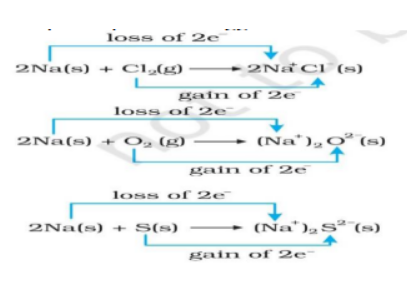
$2\text{Na}(\text{s})+\text{Cl2}\text{g}\rightarrow2\text{NaCl}(\text{s})$ $4\text{Na}(\text{s})+\text{O}_2\text{g}\rightarrow2\text{Na}_2\text{o}(\text{s})$ $2\text{Na}(\text{s})+\text{S}\text{(s)}\rightarrow2\text{Na}_2\text{S}(\text{s})$ are redox reactions because in each of these reactions sodium is oxidised due to the addition of either oxygen or more electronegative element to sodium. Simultaneously, chlorine, oxygen and sulphur are reduced because to each of these, the electropositive element sodium has been added. From our knowledge of chemical bonding we also know that sodium chloride, sodium oxide and sodium sulphide are ionic compounds and perhaps better written as $\mathrm{Na}+\mathrm{Cl}-(\mathrm{s}),\left(\mathrm{Na}^{+}\right)_2 \mathrm{O}^2-(\mathrm{s})$, and $\left(\mathrm{Na}^{+}\right)_2 \mathrm{~S}^{2-}(\mathrm{s})$. Development of charges on the species produced suggests us to rewrite the reactions in the following manner: For convenience, each of the above processes can be considered as two separate steps, one involving the loss of electrons and the other the gain of electrons. As an illustration, we may further elaborate one of these, say, the formation of sodium chloride. $2\text{Na}(\text{s})\rightarrow2\text{Na}^+\text{g}+2\bar{\text{e}}$ $\text{Cl}_2\text{g}+2\bar{\text{e}}\rightarrow2\text{C}\bar{\text{I}}\text{ (g)}$ Each of the above steps is called a half reaction, which explicitly shows involvement of electrons. Sum of the half reactions gives the overall reaction $2\text{Na}(\text{s})+\text{Cl}_2\text{(g)}\rightarrow2\text{Na}^+\text{CI}(\text{s})\text{ or } 2\text{NaCI}(\text{s})$ Above Reactions suggest that half reactions that involve loss of electrons are called oxidation reactions. Similarly, the half reactions that involve gain of electrons are called reduction reactions. To summarise, we may mention that Oxidation: Loss of electron(s) by any species. Reduction: Gain of electron(s) by any species. Oxidising agent: Acceptor of electron(s). Reducing agent: Donor of electron(s).
  1. Addition of electronegative element to a substance is known as..
  1. Oxidation
  2. Reduction
  3. Redox reaction
  4. All the above
  1. Removal of electronegative element to a substance is known as ..
  1. Oxidation
  2. Reduction
  3. Redox reaction
  4. All the above
  1. Acceptor of electrons is …
  1. Reducing Agent
  2. Catalytic Agent
  3. Oxidising Agent
  4. None of above
  1. Donor of electrons is…
  1. Organic Agent
  2. Catalytic Agent
  3. Oxidising Agent
  4. Reducing Agent
  1. Oxidation and Reduction occurs simultaneously is known as …
  1. Exothermic reaction
  2. Endothermic reaction
  3. Redox reaction
  4. Neutralization reaction
There are many observable patterns in thephysical and chemical properties of elementsas we descend in a group or move across aperiod in the Periodic Table.Atomic Radius the determination of the atomic sizecannot be precise. In other words, there is no practical way by which the size of an individualatom can be measured. However, an estimateof the atomic size can be made by knowing thedistance between the atoms in the combinedstate. One practical approach to estimate thesize of an atom of a non-metallic element is tomeasure the distance between two atoms whenthey are bound together by a single bond in acovalent molecule and from this value, the“Covalent Radius” For metals, we define theterm “Metallic Radius” which is taken as halfthe internuclear distance separating the metalcores in the metallic crystal. Atomic Radius to refer to both covalent ormetallic radius depending on whether theelement is a non-metal or a metal. Atomic radiican be measured by X-ray or otherspectroscopic methods. The atomic size generallydecreases across a period. It is because within the period the outerelectrons are in the same valence shell and theeffective nuclear charge increases as the atomicnumber increases resulting in the increasedattraction of electrons to the nucleus.Note that the atomic radii of noble gasesAre not considered here. Being monoatomic,Their (non-bonded radii) values are very large.In fact radii of noble gases should be comparednot with the covalent radii but with the van derWaals radii of other elements. The removal of an electron from an atom resultsin the formation of a cation, whereas gain ofan electron leads to an anion. The ionic radiican be estimated by measuring the distancesbetween cations and anions in ionic crystals.In general, the ionic radii of elements exhibitthe same trend as the atomic radii. A cation issmaller than its parent atom because it hasfewer electrons while its nuclear charge remainsthe same. The size of an anion will be largerthan that of the parent atom because theaddition of one or more electrons would resultin increased repulsion among the electronsand a decrease in effective nuclear charge. When we find some atoms and ions whichcontain the same number of electrons, we callthem isoelectronic species. For example,$O2–, F–, Na+$ and $Mg2+$ have the same number ofelectrons (10). Their radii would be differentbecause of their different nuclear charges.A quantitative measure of the tendency of anelement to lose electron is given by itsIonization Enthalpy. It represents the energyrequired to remove an electron from an isolatedgaseous atom (X) in its ground state. The ionization enthalpy is expressed inunits of kJ mol–1. We can define the secondionization enthalpy as the energy required toremove the second most loosely boundelectron The first ionization enthalpies of elementshaving atomic numbers up to 60 are plotted then The periodicity of the graph is quitestriking. You will find maxima at the noble gaseswhich have closed electron shells and verystable electron configurations. On the otherhand, minima occur at the alkali metals andtheir low ionization enthalpies can be correlated with their high reactivity. In addition, you willnotice two trends the first ionization enthalpygenerally increases as we go across a periodand decreases as we descend in a group. Electron Gain Enthalpy. when an electron is added to a neutral gaseousatom (x) to convert it into a negative ion, theenthalpy change accompanying the process isdefined as the electron gain enthalpy (∆egh).Electron gain enthalpy provides a measure ofthe ease with which an atom adds an electronto form anion. electron gain enthalpies have largenegative values toward the upper right of theperiodic table preceding the noble gases.The variation in electron gain enthalpies ofelements is less systematic than for ionizationenthalpies. As a general rule, electron gainenthalpy becomes more negative with increasein the atomic number across a period. Theeffective nuclear charge increases from left toright across a period and consequently it willbe easier to add an electron to a smaller atomsince the added electron on an average wouldbe closer to the positively charged nucleus. ElectronegativityA qualitative measure of the ability of an atomin a chemical compound to attract sharedelectrons to itself is called electronegativity.Unlike ionization enthalpy and electron gainenthalpy, it is not a measureable quantity.However, a number of numerical scales ofelectronegativity of elements viz., Pauling scale,Mulliken-Jaffe scale, Allred-Rochow scale havebeen developed. The one which is the most widely used is the Pauling scale. Electronegativity generallyincreases across a period from leftto right (say from lithium tofluorine) and decrease down a group(say from fluorine to astatine) inthe periodic table. Non-metallic elements have strong tendencyto gain electrons. Therefore, electronegativityis directly related to that non-metallicproperties of elements. It can be furtherextended to say that the electronegativity isinversely related to the metallic properties of elements. Thus, the increase inelectronegativities across a period isaccompanied by an increase in non-metallicproperties (or decrease in metallic properties)of elements. Similarly, the decrease inelectronegativity down a group is accompanied by a decrease in non-metallic properties (orincrease in metallic properties) of elements.
  1. The atomic size generally … across a period.
  1. Increases
  2. Decreases
  3. Remains Constant
  4. None of above
  1. The ionization enthalpy is expressed in units of ….
  1. $kJ mol^{–1}$
  2. $mole kJ^{-1}$
  3. $mole kJ$
  4. $-kJ mol^{-1}$
  1. Which of the following is/are numerical scales of electronegativity of elements.
  1. Pauling scale
  2. Mulliken-Jaffe scale
  3. Allred-Rochow scale
  4. All the above
  1. The … in electronegativity down a group is accompanied by a … in non-metallic properties.
  1. Increase, Decrease
  2. Decrease, Increase
  3. Decrease, Decrease
  4. Increase , Increase
  1. Electronegativity generally … across a period from left to right and … down a group in the periodic table.
  1. Increase, Decrease
  2. Decrease, Increase
  3. Decrease, Decrease
  4. Increase, Increase
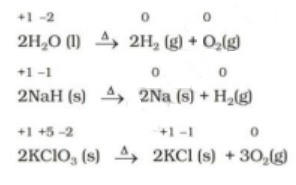
A less obvious example of electron transfer is realised when hydrogen combines with oxygen to form water by the reaction: $2\text{H}_2(\text{g}) + \text{O}_2 (\text{g}) → 2\text{H}_2\text{O} (\text{l})$ Though not simple in its approach, yet we can visualise the H atom as going from a Neutral (zero) state in H2 to a positive state in H2O, the O atom goes from a zero state in O2 To a dinegative state in H2O. It is assumed that There is an electron transfer from H to O and Consequently H2 is oxidised and O2 is reduced. However, as we shall see later, the charge Transfer is only partial and is perhaps better Described as an electron shift rather than a Complete loss of electron by H and gain by O. Two examples of this class Of the reactions are: $\text{H}_2 (\text{s}) + \text{Cl}_2(\text{g}) → 2\text{HCl} (\text{g})$ And, $\text{CH}_4 (\text{g}) + 4\text{Cl}_2 (\text{g}) → \text{CCl}_4(\text{l}) + 4\text{HCl (g)}$ In order to keep track of electron shifts in Chemical reactions involving formation of Covalent compounds, a more practical method Of using oxidation number has been Developed. In this method, it is always Assumed that there is a complete transfer of Electron from a less electronegative atom to a More electonegative atom. For example, we Rewrite equations to show Charge on each of the atoms forming part of The reaction:

It may be emphasised that the assumption Of electron transfer is made for book-keeping Purpose only and it will become obvious at a Later stage in this unit that it leads to the simple Description of redox reactions. Oxidation number denotes the Oxidation state of an element in a Compound ascertained according to a set Of rules formulated on the basis that electron pair in a covalent bond belongs Entirely to more electronegative element. It is not always possible to remember or Make out easily in a compound/ ion, which Element is more electronegative than the other. Therefore, a set of rules has been formulated To determine the oxidation number of an Element in a compound/ion. We may at this stage, state the rules for the Calculation of oxidation number. These rules are: 1.) In elements, in the free or the uncombined State, each atom bears an oxidation Number of zero. Evidently each atom in $H _2, O _2, C _{12}, O _3, P _4, S_8, Na , Mg$, Al has the Oxidation number zero. 2.) For ions composed of only one atom, the Oxidation number is equal to the charge On the ion. Thus $Na +$ lon has an oxidation Number of $+1, Mg _2+$ ion +2 , $Fe _3+$ ion, $+3, Cl -$ Ion, $-1, O _2-$ ion, -2 ; and so on. In their Compounds all alkali metals have Oxidation number of +1 , and all alkaline Earth metals have an oxidation number of +2 . Aluminium is regarded to have an Oxidation number of +3 in all its Compounds. 3.) The oxidation number of oxygen in most Compounds is -2 . However, we come across Two kinds of exceptions here. One arises In the case of peroxides and superoxides, The compounds of oxygen in which oxygen Atoms are directly linked to each other. While in peroxides (e.g., $H _2 O _2, Na _2 O _2$ ), each Oxygen atom is assigned an oxidation Number of -1 , in superoxides (e.g., $K O _2, Rb O _2$ ) each oxygen atom is assigned an Oxidation number of $-(1 / 2)$. The second Exception appears rarely, i.e. when oxygen Is bonded to fluorine. In such compounds e.g., oxygen difluoride $\left( OF _2\right)$ and dioxygen difluoride $\left( O _2 F_2\right)$, the oxygen is assigned an oxidation number of +2 and +1 , respectively. The number assigned to oxygen will depend upon the bonding state of oxygen but this number would now be a positive figure only. 4.)The oxidation number of hydrogen is +1, Except when it is bonded to metals in binary Compounds (that is compounds containing Two elements). For example, in LiH, NaH, And $Ca H_2,$ its oxidation number is –1. 5.) In all its compounds, fluorine has an Oxidation number of –1. Other halogens (Cl, Br, and I) also have an oxidation number Of –1, when they occur as halide ions in Their compounds. Chlorine, bromine and Iodine when combined with oxygen, for Example in oxoacids and oxoanions, have Positive oxidation numbers. 6.) The algebraic sum of the oxidation number Of all the atoms in a compound must be Zero. In polyatomic ion, the algebraic sum Of all the oxidation numbers of atoms of The ion must equal the charge on the ion. Thus, the sum of oxidation number of three Oxygen atoms and one carbon atom in the Carbonate ion, $(CO_3) 2$– must equal –2. A term that is often used interchangeably With the oxidation number is the oxidation State. Thus in $CO_2,$the oxidation state of Carbon is +4 , that is also its oxidation number And similarly the oxidation state as well as Oxidation number of oxygen is -2 . This implies That the oxidation number denotes the Oxidation state of an element in a compound. The oxidation number/state of a metal in a Compound is sometimes presented according To the notation given by German chemist, Alfred Stock. It is popularly known as Stock Notation. According to this, the oxidation Number is expressed by putting a Roman Numeral representing the oxidation number In parenthesis after the symbol of the metal in The molecular formula. Thus aurous chloride And auric chloride are written as $Au ( I ) Cl$ and $Au ( III ) Cl _3$. Similarly, stannous chloride and Stannic chloride are written as $Sn ( II ) Cl _2$ and $Sn ( IV ) Cl _4$. This change in oxidation number Implies change in oxidation state, which in Turn helps to identify whether the species is Present in oxidised form or reduced form. Thus, $Hg _2( I ) Cl _2$ is the reduced form of $Hg ( II ) Cl _2$.
  1. H atom goes from a … state in $H_2$ to a positive state in $H_2O$ in water formation.
  1. Neutral
  2. Positive
  3. Negative
  4. All the above
  1. In oxidation number method, there is a complete transfer of electron from a …. electronegative atom to a … electonegative atom.
  1. more, less
  2. less, more
  3. non, more
  4. non, less
  1. Oxidation number of $Mg_2$ + ion is:
  1. -2
  2. -1
  3. +2
  4. +1
  1. In $Na2O_2$ each oxygen atom is assigned an oxidation number of …
  1. +1
  2. -2
  3. +2
  4. -1
  1. The algebraic sum of the oxidation number of all the atoms in a compound must be…
  1. 0
  2. 1
  3. 2
  4. -2
Read the passage given below and answer the following questions from 1 to 5.
Alkenes are unsaturated hydrocarbons containing at least one double bond. What should be the general formula of alkenes? If there is one double bond between two carbon atoms in alkenes, they must possess two hydrogen atoms less than alkanes. Hence, general formula for alkenes is $C_nH_{2n}$. Alkenes are also known as olefins (oil forming) since the first member, ethylene or ethene $(C_2H_4)$ was found to form an oily liquid on reaction with chlorine.
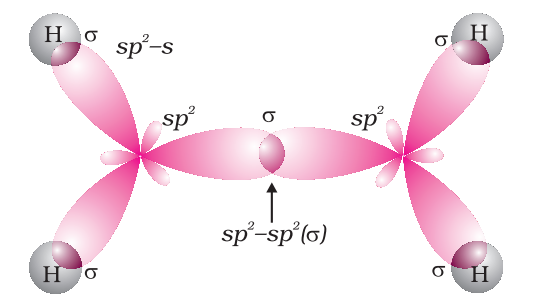
Structure of Double Bond Carbon-carbon double bond in alkenes consists of one strong sigma $(\sigma)$ bond (bond enthalpy about $397\ kJ\ mol^{–1)}$ due to head-on overlapping of $sp^2$ hybridised orbitals and one weak pi $\pi$ bond (bond enthalpy about $284\ kJ\ mol^{–1})$ obtained by lateral or sideways overlapping of the two 2p orbitals of the two carbon atoms. The double bond is shorter in bond length (134 pm) than the C–C single bond (154 pm). You have already read that the pi $(\pi)$ bond is a weaker bond due to poor sideways overlapping between the two 2p orbitals. Thus, the presence of the pi $(\pi)$bond makes alkenes behave as sources of loosely held mobile electrons. Therefore, alkenes are easily attacked by reagents or compounds which are in search of electrons. Such reagents are called electrophilic reagents. The presence of weaker$(\pi)$-bond makes alkenes unstable molecules in comparison to alkanes and thus, alkenes can be changed into single bond compounds by combining with the electrophilic reagents. Strength of the double bond (bond enthalpy, $681\ kJ\ mol^{–1}$) is greater than that of a carbon-carbon single bond in ethane (bond enthalpy, $348\ kJ\ mol^{–1}$). Orbital diagrams of ethene molecule are shown in Figure.

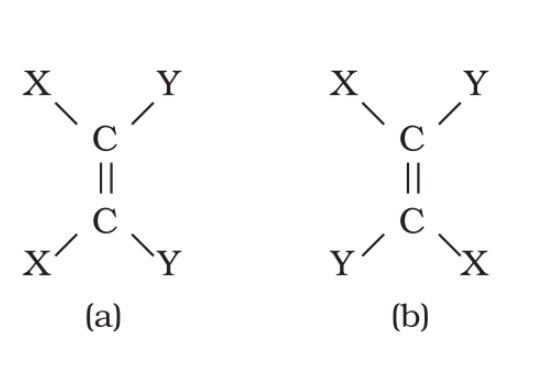
Geometrical isomerism: Doubly bonded Carbon atoms have to satisfy the remaining two Valences by joining with two atoms or groups. If the two atoms or groups attached to each Carbon atom are different, they can be Represented by YX C = C XY like structure. YX C = C XY can be represented in space in the Following two ways:

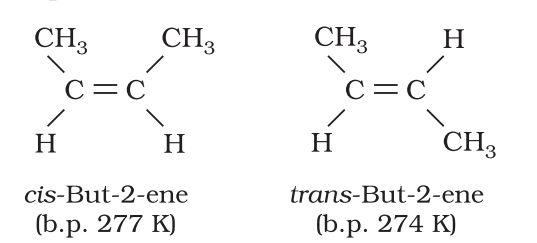
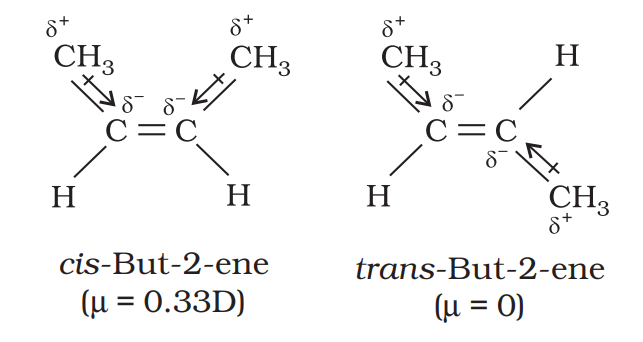
In (a), the two identical atoms i.e., both the X or both the Y lie on the same side of the Double bond but in (b) the two X or two Y lie Across the double bond or on the opposite Sides of the double bond. This results in Different geometry of (a) and (b) i.e. disposition Of atoms or groups in space in the two Arrangements is different. Therefore, they are Stereoisomers. They would have the same Geometry if atoms or groups around C = C bond Can be rotated but rotation around C = C bond Is not free. It is restricted. For understanding This concept, take two pieces of strong Cardboards and join them with the help of two Nails. Hold one cardboard in your one hand And try to rotate the other. Can you really rotate The other cardboard ? The answer is no. The Rotation is restricted. This illustrates that the Restricted rotation of atoms or groups around The doubly bonded carbon atoms gives rise to Different geometries of such compounds. The Stereoisomers of this type are called Geometrical isomers. The isomer of the type (a), in which two identical atoms or groups lie On the same side of the double bond is called Cis isomer and the other isomer of the type (b), in which identical atoms or groups lie on The opposite sides of the double bond is called Trans isomer. Thus cis and trans isomers Have the same structure but have different Configuration (arrangement of atoms or groups In space). Due to different arrangement of Atoms or groups in space, these isomers differ In their properties like melting point, boiling Point, dipole moment, solubility etc. Geometrical or cis-trans isomers of but-2-ene Are represented below:

Cis form of alkene is found to be more polar Than the trans form. For example, dipole Moment of cis - but - 2-ene is 0.33 Debye, Whereas, dipole moment of the trans form Is almost zero or it can be said that trans - but - 2 -ene is non-polar. This can be understood by drawing geometries of the two forms as given below from which it is clear that in the trans - but - 2 -ene, the two methyl groups are in opposite directions, Therefore, dipole moments of $C - CH_3$ bonds cancel, thus making the trans form non-polar.

In the case of solids, it is observed that the trans isomer has higher melting point than the cis form. Geometrical or cis-trans isomerism is also shown by alkenes of the types XYC = CXZ and XYC = CZW
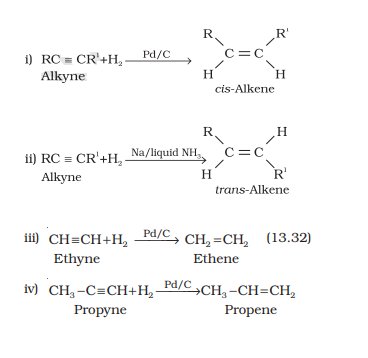
Preparation – From alkynes: Alkynes on partial reduction with calculated amount of dihydrogen in the presence of palladised charcoal partially deactivated with poisons like sulphur
compounds or quinoline give alkenes. Partially deactivated palladised charcoal is known as Lindlar’s catalyst. Alkenes thus obtained are having cis geometry. However, alkynes on reduction with sodium in liquid ammonia form trans alkenes.

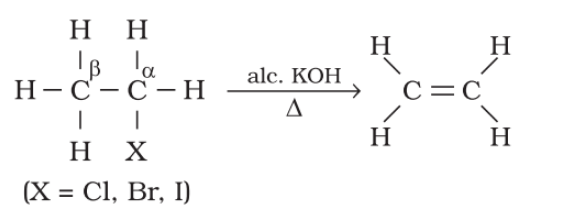
From alkyl halides: Alkyl halides (R-X) on heating with alcoholic potash (potassium hydroxide dissolved in alcohol, say, ethanol) eliminate one molecule of halogen acid to form alkenes. This reaction is known as dehydrohalogenation i.e., removal of halogen acid. This is example of $\beta-$elimination reaction, since hydrogen atom is eliminated from the $\beta$ carbon atom (carbon atom next to the carbon to which halogen is attached).

Nature of halogen atom and the alkyl group determine rate of the reaction. It is observed that for halogens, the rate is: iodine > bromine > chlorine, while for alkyl groups it is: tert > secondary > primary.
Physical properties Alkenes as a class resemble alkanes in physical properties, except in types of isomerism and difference in polar nature. The first three members are gases, the next fourteen are liquids and the higher ones are solids. Ethene is a colourless gas with a faint sweet smell. All other alkenes are colourless and odourless, insoluble in water but fairly soluble in non- polar solvents like benzene, petroleum ether. They show a regular increase in boiling point with increase in size i.e., every $–CH_2$ group added increases boiling point by 20–30 K. Like alkanes, straight chain alkenes have higher boiling point than isomeric branched chain compounds.
  1. The first three members of alkenes are …?
  1. Gases
  2. Liquids
  3. Solids
  4. None of above
  1. General formula for alkenes is ….?
  1. $C_nH_{2n+1}$
  2. $C_nH_{2n}$
  3. $C_nH_{2n-1}$
  4. $C_nH_{2n+2}$
  1. The colour of ethene gas is …?
  1. Red
  2. White
  3. Pale Green
  4. None of above
  1. The bond length of carbon carbon double bond is … pm ?
  1. 154
  2. 143
  3. 134
  4. 120
  1. Alkenes are also knows as …?
  1. Olefines
  2. Paraffines
  3. Oleofines
  4. Paracetofines
The ionic character of metallic halides tends toward covalent nature as per Fajan's rule. Such covalent halides behave as non-metal in their higher oxidation states. The property to hydrolyse to give oxy-acids of the element and corresponding hydro halogen acid for most non-metallic elements proceeds exceptionally in the way, keeping oxidation number of element and halide sam in oxo-acids.
Non-polar halides are immiscible in water, as they do not show hydrolysis, but halides of some elements with empty d-orbital undergo hydrolysis. Stability of halides of the higher state is governed by the inert-pair effect.

1. How does halide undergo hydrolysis to give oxy-acids of underlined element $PCl _3$ ? (1)
2. Out of $NCl _3$ and $BCl _3$ undergoes hydrolysis to form oxy-acids? Write the chemical reaction for the correct answer. (1)
3. Out of $PbCl _4, PbF _4, PbI _4$ and $PbBr _4$ which one doesn't exist? (2)
OR
Non-Polar halides are immiscible in water. Why? (2)
The phenomenon of the existence of two or more compounds possessing the same molecular formula but different properties is known as isomerism. Such compounds are called isomers. Compounds having the same molecular formula but different structures (manners in which atoms are linked) are classified as structural isomers. Structural isomers are classified as chain isomer, position isomer, functional group isomer. Meristematic arises due to different alkyl chains on either side of the functional group in the molecule and stereoisomerism and can be classified as geometrical and optical isomerism. Hyperconjugation is a general stabilising interaction. It involves delocalisation of $\sigma$ electrons of the C-H bond of an alkyl group directly attached to an atom of an unsaturated system or to an atom with an unshared p orbital. This type of overlap stabilises the carbocation because electron density from the adjacent $\sigma$ bond helps in dispersing the positive charge.

1. Why Isopentane, pentane and Neopentane are chain isomers?
2. The molecular formula $C _3 H _8 O$ represents which isomer?
3. What type of isomerism is shown by Methoxypropane and ethoxyethane?
OR
Why hyperconjugation is a permanent effect?