Question
Read the passage given below and answer the following questions from 1 to 5. Uses of Dihydrogen:
  • The largest single use of dihydrogen is in the synthesis of ammonia which is used in the manufacture of nitric acid and nitrogenous
  • Dihydrogen is used in the manufacture of vanaspati fat by the hydrogenation of polyunsaturated vegetable oils like soyabean, cotton seeds
  • It is used in the manufacture of bulk organic chemicals, particularly
  • It is widely used for the manufacture of metal
  • It is used for the preparation of hydrogen chloride, a highly useful
  • In metallurgical processes, it is used to reduce heavy metal oxides to
  • Atomic hydrogen and oxy-hydrogen torches find use for cutting and welding purposes. Atomic hydrogen atoms (produced by dissociation of dihydrogen with the help of an electric arc) are allowed to recombine on the surface to be welded to generate the temperature of 4000
  • It is used as a rocket fuel in space
  • Dihydrogen is used in fuel cells for generating electrical energy. It has many advantages over the conventional fossil fuels and electric It does not produce any pollution and releases greater energy per unit mass of fuel in comparison to gasoline and other fuels.
Dihydrogen, under certain reaction conditions, combines with almost all elements, except noble gases, to form binary compounds, called hydrides. If ‘E’ is the symbol of an element then hydride can be expressed as EHx $($e.g., Mg $H_2)$ or EmHn $($e.g.,$B_2H_6)$. The hydrides are classified into three categories:
  • Ionic or saline or saltlike hydrides
  • Covalent or molecular hydrides
  • Metallic or non-stoichiometric hydrides
Ionic or Saline Hydrides are stoichiometric compounds of dihydrogen formed with most of the s-block elements which are highly electropositive in character. However, significant covalent character is found in the lighter metal hydrides such as LiH, $BeH_2$ and $MgH_2$. In fact Be $H_2$ and Mg $H_2$ are polymeric in structure. The ionic hydrides are crystalline, non-volatile and non- conducting in solid state. However, their melts conduct electricity and on electrolysis liberate dihydrogen gas at anode, which confirms the existence of $H^{–} ion$. Covalent or Molecular Hydride Dihydrogen forms molecular compounds with most of the p-block elements. Most familiar examples are $CH_4, NH_3, H_2O$ and $HF.$ For convenience hydrogen compounds of non- metals have also been considered as hydrides. Being covalent, they are volatile compounds. Molecular hydrides are further classified according to the relative numbers of electrons and bonds in their Lewis structure into:
  • electron-deficient,
  • electron-precise, and
  • electron-rich
An electron-deficient hydride, as the name suggests, has too few electrons for writing its conventional Lewis structure. Diborane $(B_2H_6)$ is an example. In fact all elements of group 13 will form electron-deficient compounds. They act as Lewis acids i.e., electron acceptors. Electron-precise compounds have the required number of electrons to write their conventional Lewis structures. All elements of group 14 form such compounds (e.g., $CH_4$) which are tetrahedral in geometry. Electron-rich hydrides have excess electrons which are present as lone pairs. Elements of group 15-17 form such compounds. (NH3 has 1 - lone pair, $H_2O – 2$ and $HF –3$ lone pairs). What do you expect from the behaviour of such compounds ? They will behave as Lewis bases i.e., electron donors. The presence of lone pairs on highly electronegative atoms like N, O and F in hydrides results in hydrogen bond formation between the molecules. This leads to the association of molecules. Metallic or Non-stoichiometric (or Interstitial ) Hydrides are formed by many d- block and f-block elements. However, the metals of group 7, 8 and 9 do not form hydride. Even from group 6, only chromium forms CrH. These hydrides conduct heat and electricity though not as efficiently as their parent metals do. Unlike saline hydrides, they are almost always non- stoichiometric, being deficient in hydrogen. For example, $La H_{2.87}, Yb H_{2.55}, TiH1_{.5–1.8}, ZrH_{1.3–1.75}$, etc. In such hydrides, the law of constant composition does not hold good. Earlier it was thought that in these hydrides, hydrogen occupies interstices in the metal lattice producing distortion without any change in its type. Consequently, they were termed as interstitial hydrides. However, recent studies have shown that except for hydrides of Ni, Pd, Ce and Ac, other hydrides of this class have lattice different from that of the parent metal. The property of absorption of hydrogen on transition metals is widely used in catalytic reduction / hydrogenation reactions for the preparation of large number of compounds. Some of the metals (e.g., Pd, Pt) can accommodate a very large volume of hydrogen and, therefore, can be used as its storage media. This property has high potential for hydrogen storage and as a source of energy. A major part of all living organisms is made up of water. Human body has about 65% and some plants have as much as 95% water. It is a crucial compound for the survival of all life forms. It is a solvent of great importance. The distribution of water over the earth’s surface is not uniform.​​​​​​​
  1. Dihydrogen, under certain reaction conditions, combines with almost all elements, except …
  1. Noble gases
  2. Halogens
  3. Alkali metals
  4. Alkaline earth metal
  1. Covalent or Molecular Hydride Dihydrogen forms molecular compounds with most of the p-block elements. Most familiar example is:
  1. $CH_4$
  2. $NH_3$
  3. $H_2O$
  4. All the above
  1. All elements of group 14 form such compounds have … geometry.
  1. pyramidal
  2. tetrahedral
  3. bilateral
  4. spherical
  1. From group 6, only … forms hydride.
  1. molybdenum
  2. tungsten
  3. chromium
  4. seaborgium
  1. Which of the following hydride is/ are deficient in hydrogen.
  1. $La H_2._{87}$
  2. $Yb H_2._{55}$
  3. TiH5–1.8
  4. All of above

Answer

  1. (a) noble gases
  2. (d) All the above
  3. (b) tetrahedral
  4. (c) chromium
  5. (d) All the above

Need a full question paper?

Generate a complete, print-ready paper with questions like this in minutes — across 16+ boards, with answer keys.

Start Generating Free

Similar questions

Once an organic compound is extracted from a natural source or synthesised in the laboratory, it is essential to purify it. Various methods used for the purification of organic compounds are based on the nature of the compound and the impurity present in it. Finally, the purity of a compound is ascertained by determining its melting or boiling point. This is one of the most commonly used techniques for the purification of solid organic compounds. In crystallisation Impurities, which impart colour to the solution are removed by adsorbing over activated charcoal. In distillation Liquids having different boiling points vaporise at different temperatures. The vapours are cooled and the liquids so formed are collected separately. Steam Distillation is applied to separate substances which are steam volatile and are immiscible with water. Distillation under reduced pressure: This method is used to purify liquids having very high boiling points.

i. Which method can be used to separate two compounds with different solubilities in a solvent?
ii. Distillation method is used to separate which type of substance?
iii. Which technique is used to separate aniline from aniline water mixture?
OR
Why chloroform and aniline are easily separated by the technique of distillation?
Read the passage given below and answer the following questions from 1 to 5.
The dipositive oxidation state $(M^{2+})$ is the Predominant valence of Group 2 elements. The Alkaline earth metals form compounds which Are predominantly ionic but less ionic than the Corresponding compounds of alkali metals. This is due to increased nuclear charge and Smaller size. The oxides and other compounds Of beryllium and magnesium are more covalent Than those formed by the heavier and large Sized members (Ca, Sr, Ba). The general Characteristics of some of the compounds of Alkali earth metals are described below.
Oxides and Hydroxides: The alkaline Earth metals burn in oxygen to form the Monoxide, MO which, except for BeO, have Rock-salt structure. The BeO is essentially Covalent in nature. The enthalpies of formation Of these oxides are quite high and consequently They are very stable to heat. BeO is amphoteric While oxides of other elements are ionic in Nature. All these oxides except BeO are basic In nature and react with water to form sparingly Soluble hydroxides.
$MO + H2O \rightarrow M(OH)_2$
The solubility, thermal stability and the Basic character of these hydroxides increase With increasing atomic number from $Mg(OH)_2 To Ba(OH)_2$.The alkaline earth metal Hydroxides are, however, less basic and less Stable than alkali metal hydroxides. Beryllium Hydroxide is amphoteric in nature as it reacts With acid and alkali both.
$Be(OH)_2 + 2OH^– \rightarrow [Be(OH)4]^{2–}$
Beryllate ion
$Be(OH)_2 + 2HCl + 2H_2O \rightarrow [Be(OH)_4]Cl_2$​​​​​​​
Halides: Except for beryllium halides, all Other halides of alkaline earth metals are ionic In nature. Beryllium halides are essentially Covalent and soluble in organic solvents. Beryllium chloride has a chain structure in the Solid state as shown below: In the vapour phase $BeCl_2$ tends to form a Chloro-bridged dimer which dissociates into the Linear monomer at high temperatures of the Order of 1200 K. The tendency to form halide Hydrates gradually decreases down the group. The dehydration Of hydrated chlorides, bromides and iodides Of Ca, Sr and Ba can be achieved on heating; However, the corresponding hydrated halides Of Be and Mg on heating suffer hydrolysis. The Fluorides are relatively less soluble than the Chlorides owing to their high lattice energies.
Salts of Oxoacids: The alkaline earth Metals also form salts of oxoacids. Some of These are :
Carbonates: Carbonates of alkaline earth Metals are insoluble in water and can be Precipitated by addition of a sodium or Ammonium carbonate solution to a solution Of a soluble salt of these metals. The solubility Of carbonates in water decreases as the atomic Number of the metal ion increases. All the Carbonates decompose on heating to give Carbon dioxide and the oxide. Beryllium Carbonate is unstable and can be kept only in The atmosphere of $CO_2$. The thermal stability Increases with increasing cationic size.
Sulphates: The sulphates of the alkaline earth Metals are all white solids and stable to heat. $BeSO_4,$ and $MgSO_4$ are readily soluble in water; The solubility decreases from $CaSO_4$ to $ BaSO_4$. The greater hydration enthalpies of $Be_2+$ and $Mg_2+$ ions overcome the lattice enthalpy factor And therefore their sulphates are soluble in Water.​​​​​​​
Nitrates: The nitrates are made by dissolution Of the carbonates in dilute nitric acid. Magnesium nitrate crystallises with six Molecules of water, whereas barium nitrate Crystallises as the anhydrous salt. This again Shows a decreasing tendency to form hydrates With increasing size and decreasing hydration Enthalpy. All of them decompose on heating to Give the oxide like lithium nitrate.
$2\text{M}(\text{NO}_3)_2\rightarrow2\text{MO}+4\text{NO}_2+\text{O}_2$
(M = Be. Mg. Ca. Sr. Ba)
Beryllium, the first member of the Group 2 Metals, shows anomalous behaviour as Compared to magnesium and rest of the Members. Further, it shows diagonal Relationship to aluminium which is discussed Subsequently.
i) Beryllium has exceptionally small atomic And ionic sizes and thus does not compare Well with other members of the group. Because of high ionisation enthalpy and Small size it forms compounds which are Largely covalent and get easily hydrolysed.
ii) Beryllium does not exhibit coordination Number more than four as in its valence Shell there are only four orbitals. The Remaining members of the group can have A coordination number of six by making Use of d-orbitals.
iii) The oxide and hydroxide of beryllium, Unlike the hydroxides of other elements in The group, are amphoteric in nature.
Diagonal Relationship between Beryllium and Aluminium-The ionic radius of 4 is estimated to be 31 pm; the charge/radius ratio is nearly the Same as that of the $Al^{3+}$ ion. Hence beryllium Resembles aluminium in some ways. Some of The similarities are:
i) Like aluminium, beryllium is not readily Attacked by acids because of the presence Of an oxide film on the surface of the metal.
ii) Beryllium hydroxide dissolves in excess of Alkali to give a beryllate ion, $[Be(OH)_4]^{2–}$ just As aluminium hydroxide gives aluminate Ion, $[Al(OH)_4]^–.$
iii) The chlorides of both beryllium and Aluminium have $Cl^–$ Bridged chloride Structure in vapour phase. Both the Chlorides are soluble in organic solvents And are strong Lewis acids. They are used As Friedel Craft catalysts.
iv) Beryllium and aluminium ions have strong Tendency to form complexes, $BeF_4^{2–}, AlF_6^{3–}.$​​​​​​​
  1. The dipositive oxidation state $(M2^+)$ is the Predominant valence of … elements.
  1. Group 2
  2. Group 1
  3. Group 17
  4. Group 18
  1. … the first member of the Group 2 metals.
  1. Magnesium
  2. Beryllium
  3. Barium
  4. Radium
  1. Except for beryllium halides, all other halides of alkaline earth metals are ionic in nature.
  1. Magnesium halides
  2. beryllium halides
  3. Calcium halides
  4. Radium halides
  1. The ionic radius of $Be^{2+}$ is estimated to be … pm.
  1. 310
  2. 500
  3. 50
  4. 31
  1. Beryllium carbonate can be kept only in the atmosphere of …
  1. $N_2$
  2. $H_2$
  3. $CO_2$
  4. $O_2$
The idea of oxidation number has been invariably applied to define oxidation, reduction, oxidising agent (oxidant), reducing agent (reductant) and the redox reaction. To summarise, we may say that:
Oxidation: An increase in the oxidation number of the element in the given substance.
Reduction: A decrease in the oxidation number of the element in the given substance.
Oxidising agent: A reagent which can increase the oxidation number of an element in a given substance. These reagents are called as oxidants also.
Reducing agent: A reagent which lowers the oxidation number of an element in a given substance. These reagents are also called as reductants.
Redox reactions: Reactions which involve change in oxidation number of the interacting species.
Types of Redox Reactions
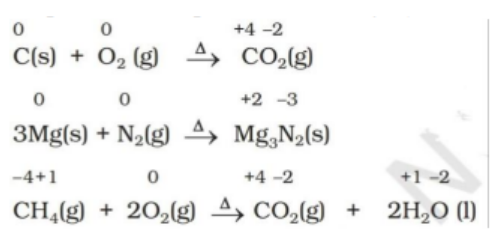
1.) Combination reactions -A combination reaction may be denoted in the manner:
$A + B → C$
Either A and B or both A and B must be in the elemental form for such a reaction to be a redox reaction. All combustion reactions, which make use of elemental dioxygen, as well as other reactions involving elements other than dioxygen, are redox reactions. Some important examples of this category are:

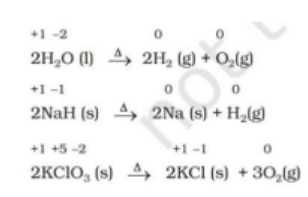
2.) Decomposition reactions- Decomposition reactions are the opposite of combination reactions. Precisely, a decomposition reaction leads to the breakdown of a compound into two or more components at least one of which must be in the elemental state.
Examples of this class of reactions are:

It may carefully be noted that there is no change in the oxidation number of hydrogen in methane under combination reactions and that of potassium in potassium chlorate in reaction. This may also be noted here that all decomposition reactions are not redox reactions. For example, decomposition of calcium carbonate is not a redox reaction.
3.) Displacement reactions- In a displacement reaction, an ion (or an atom) in a compound is replaced by an ion (or an atom) of another element. It may be denoted as:
$X + YZ → XZ + Y$
Displacement reactions fit into two categories: metal displacement and non-metal displacement.
(a) Metal displacement: A metal in a compound can be displaced by another metal in the uncombined state. Metal displacement reactions find many applications in metallurgical processes in which pure metals are obtained from their compounds in ores.
(b) Non-metal displacement: The non-metal displacement redox reactions include hydrogen displacement and a rarely occurring reaction involving oxygen displacement. All alkali metals and some alkaline earth metals (Ca, Sr, and Ba) which are very good reductants, will displace hydrogen from cold water. Many metals, including those which do not react with cold water, are capable of displacing hydrogen from acids. Dihydrogen from acids may even be produced by such metals which do not react with steam. Cadmium and tin are the examples of such metals.
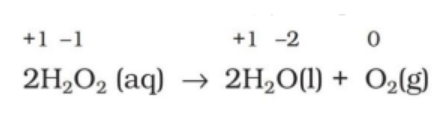
4.) Disproportionation reactions – Disproportionation reactions are a special type of redox reactions. In a disproportionation reaction an element in one oxidation state is simultaneously oxidised and reduced. One of the reacting substances in a disproportionation reaction always contains an element that can exist in at least three oxidation states. The element in the form of reacting substance is in the intermediate oxidation state; and both higher and lower oxidation states of that element are formed in the reaction. The decomposition of hydrogen peroxide is a familiar example of the reaction, where oxygen experiences disproportionation.

Here the oxygen of peroxide, which is present in –1 state, is converted to zero oxidation state in $O2$ and decreases to –2 oxidation state in $H_2O$.
  1. In … an ion (or an atom) in a compound is replaced by an ion (or an atom) of another element.
  1. displacement reaction
  2. decomposition reaction
  3. disproportionation reaction
  4. combination reaction
  1. leads to the breakdown of a compound into two or more components at least one of which must be in the elemental state.
  1. displacement reaction
  2. decomposition reaction
  3. disproportionation reaction
  4. combination reaction
  1. In …. an element in one oxidation state is simultaneously oxidised and reduced.
  1. displacement reaction
  2. decomposition reaction
  3. disproportionation reaction
  4. combination reaction
  1. Reactions which involve change in oxidation number of the interacting species…
  1. Exothermic reaction
  2. Endothermic reaction
  3. Neutralization reaction
  4. Redox reaction
  1. One of the reacting substances in a disproportionation reaction always contains an element that can exist in at least … oxidation states.
  1. 1
  2. 2
  3. 3
  4. 4
The phenomenon of the existence of two or more compounds possessing the same molecular formula but different properties is known as isomerism. Such compounds are called isomers. Compounds having the same molecular formula but different structures (manners in which atoms are linked) are classified as structural isomers. Structural isomers are classified as chain isomer, position isomer, functional group isomer. Meristematic arises due to different alkyl chains on either side of the functional group in the molecule and stereoisomerism and can be classified as geometrical and optical isomerism. Hyperconjugation is a general stabilising interaction. It involves delocalisation of $\sigma$ electrons of the C-H bond of an alkyl group directly attached to an atom of an unsaturated system or to an atom with an unshared p orbital. This type of overlap stabilises the carbocation because electron density from the adjacent $\sigma$ bond helps in dispersing the positive charge.

1. Why Isopentane, pentane and Neopentane are chain isomers?
2. The molecular formula $C _3 H _8 O$ represents which isomer?
3. What type of isomerism is shown by Methoxypropane and ethoxyethane?
OR
Why hyperconjugation is a permanent effect?
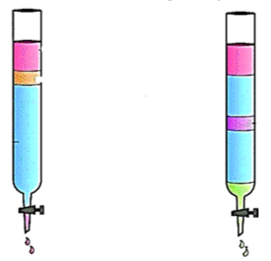
Chromatography is an important technique extensively used to separate mixtures into their components, purify compounds and also test the purity of compounds. Based on the principle involved, chromatography is classified into different categories. Two of these are Adsorption chromatography and Partition chromatography. Two main types of chromatographic techniques are based on the principle of differential adsorption column chromatography, and thin-layer chromatography. Adsorption chromatography is based on the fact that different compounds are adsorbed on an adsorbent to different degrees. Column chromatography involves the separation of a mixture over a column of adsorbent (stationary phase) packed in a glass tube. Thin-layer chromatography (TLC) is another type of adsorption chromatography, which involves the separation of substances of a mixture over a thin layer of an adsorbent coated on a glass plate. Partition chromatography is based on the continuous differential partitioning of components of a mixture between stationary and mobile phases.

1. Which adsorbent is used in adsorption chromatography?
2. How do you visualize colourless compounds after separation in Paper Chromatography?
3. Why paper chromatography is a type of partition chromatography?
OR
Which chromatography is shown in following image?
Image
Once an organic compound is extracted from a natural source or synthesised in the laboratory, it is essential to purify it. Various methods used for the purification of organic compounds are based on the nature of the compound and the impurity present in it. Finally, the purity of a compound is ascertained by determining its melting or boiling point. This is one of the most commonly used techniques for the purification of solid organic compounds. In crystallisation Impurities, which impart colour to the solution are removed by adsorbing over activated charcoal. In distillation Liquids having different boiling points vaporise at different temperatures. The vapours are cooled and the liquids so formed are collected separately. Steam Distillation is applied to separate substances which are steam volatile and are immiscible with water. Distillation under reduced pressure: This method is used to purify liquids having very high boiling points.

1. Which method can be used to separate two compounds with different solubilities in a solvent?
OR
Why chloroform and aniline are easily separated by the technique of distillation?
2. Distillation method is used to separate which type of substance?
3. Which technique is used to separate aniline from aniline water mixture?
Read the passage given below and answer the following questions from (i) to (v).
Chemical properties of a substance do not change withthe change of its physical state; but rate of chemicalreactions do depend upon the physical state. Many timesin calculations while dealing with data of experiments werequire knowledge of the state of matter. Therefore, itbecomes necessary for a chemist to know the physical laws which govern the behaviour of matter indifferent states. Intermolecular forces are the forces ofattraction and repulsion between interactingparticles (atoms and molecules). This termdoes not include the electrostatic forces thatexist between the two oppositely charged ionsand the forces that hold atoms of a moleculetogether i.e., covalent bonds.Attractive intermolecular forces are knownas van der Waals forces, in honour of Dutchscientist Johannes van der Waals (1837-1923) . van der Waals forces vary considerablyin magnitude and include dispersion forcesor London forces, dipole-dipole forces, anddipole-induced dipole forces. A particularlystrong type of dipole-dipole interaction ishydrogen bonding. Only a few elements canparticipate in hydrogen bond formation, therefore it is treated as a separatecategory.
Atoms and nonpolar molecules are electricallysymmetrical and have no dipole momentbecause their electronic charge cloud issymmetrically distributed. But a dipole maydevelop momentarily even in such atoms andmolecules. The temporary dipoles of two different atomattract each other. Similarly temporary dipolesare induced in molecules also. This force ofattraction was first proposed by the Germanphysicist Fritz London, and for this reasonforce of attraction between two temporary dipoles is known as London force. dispersion force forces are always attractive and interactionenergy is inversely proportional to the sixthpower of the distance between two interactingparticles (i.e.,$1/r ^6$ where r is the distancebetween two particles). These forces areimportant only at short distances (~500 pm)and their magnitude depends on thepolarisability of the particle.
Dipole-dipole forces act between the moleculespossessing permanent dipole. Ends of thedipoles possess “partial charges” and thesecharges are shown by Greek letter delta (δ).Partial charges are always less than the unitelectronic charge $(1.6\times 10^{–19} C)$. The polarmolecules interact with neighbouringmolecules. This interactionis stronger than the London forces but isweaker than ion-ion interaction because onlypartial charges are involved. The attractiveforce decreases with the increase of distancebetween the dipoles. As in the above case herealso, the interaction energy is inverselyproportional to distance between polarmolecules. Dipole-dipole interaction energybetween stationary polar molecules is proportional to $1/r^3$ and thatbetween rotating polar molecules is proportional to $1/r ^6$​​​​​​​, where r is the distancebetween polar molecules.
Dipole–Induced Dipole Forcesare type of attractive forces operate betweenthe polar molecules having permanent dipoleand the molecules lacking permanent dipole.Permanent dipole of the polar moleculeinduces dipole on the electrically neutralmolecule by deforming its electronic cloud. Thus an induced dipole is developedin the other molecule. In this case alsointeraction energy is proportional to $1/r ^6$​​​​​​​​​​​​​​ where r is the distance between twomolecules. Induced dipole moment dependsupon the dipole moment present in thepermanent dipole and the polarisability of theelectrically neutral molecule.
  1. Partial charges are always less than the unit electronic charge:
  1. $(1.6\times 10^{–19} C)$
  2. $(1.6\times 10^{–18} C)$
  3. $(1.6\times 10^{–17}C)$
  4. $(1.6\times 10^{–16} C)$
  1. Temporary dipoles are induced in molecules also. ,this force of attraction was first proposed by:
  1. Johannes van der Waals
  2. Fritz London
  3. Robert Boyle
  4. Joseph Lewis Gay Lussac
  1. Atoms and nonpolar molecules are electrically:
  1. Compositional
  2. Unsymmetrical
  3. Symmetrical
  4. All the above
  1. Partial Charges denoted by greek letter ….
  1. $\in$
  2. $\zeta$
  3. $\delta$
  4. $\eta$
  1. The attractive force … with the … of distance between the dipoles.
  1. Increase, increase
  2. Decrease, decrease
  3. Increase, decrease
  4. Decreases, increase
The s-Block Elements The elements of Group 1 (alkali metals) and Group 2 (alkaline earth metals) which have ns1and ns2 outermost electronic configuration belong to the s-Block Elements. They are all reactive metals with low ionization enthalpies. They lose the outermost electron(s) readily to form 1+ ion (in the case of alkali metals) or 2+ ion (in the case of alkaline earth metals). The metallic character and the reactivity increase as we go down the group. Because of high reactivity they are never found pure in nature. The compounds of the s-block elements, with the exception of those of lithium and beryllium are predominantly ionic. The p-Block Elements comprise those belonging to Group 13 to 18 and these together with the s-Block Elements are called the Representative Elements or Main Group Elements. The outermost electronic configuration varies from ns2np1 to ns2np6 in each period. At the end of each period is a noble gas element with a closed valence shell ns2np6 configuration. All the orbitals in the valence shell of the noble gases are completely filled by electrons and it is very difficult to alter this stable arrangement by the addition or removal of electrons. The noble gases thus exhibit very low chemical reactivity. Preceding the noble gas family are two chemically important groups of non-metals. They are the halogens (Group 17) and the chalcogens (Group 16).The non-metallic character increases as we move from left to right across a period and metallic character increases as we go down the group. These are the elements of Group 3 to 12 in the centre of the Periodic Table. These are characterised by the filling of inner d orbitals by electrons and are therefore referred to as d-Block Elements. These elements have the general outer electronic configuration (n-1)d1-10ns0-2 . They are all metals. They mostly form coloured ions, exhibit variable valence (oxidation states), paramagnetism and oftenly used as catalysts. However, Zn, Cd and Hg which have the electronic configuration, (n-1) d10ns2 do not show most of the properties of transition elements. In a way, transition metals form a bridge between the chemically active metals of s-block elements and the less active elements of Groups 13 and 14 and thus take their familiar name “Transition Elements”.The two rows of elements at the bottom of the Periodic Table, called the Lanthanoids, Ce(Z = 58) – Lu(Z = 71) and Actinoids, Th(Z = 90) – Lr (Z = 103) are characterised by the outer electronic configuration (n-2)f 1-14 (n-1)d 0–1ns2 . The last electron added to each element is filled in f- orbital. These two series of elements are hence called the Inner- Transition Elements (f-Block Elements). They are all metals. Within each series, the properties of the elements are quite similar. The chemistry of the early actinoids is more complicated than the corresponding lanthanoids, due to the large number of oxidation states possible for these actinoid elements. Actinoid elements are radioactive. Many of the actinoid elements have been made only in nanogram quantities or even less by nuclear reactions and their chemistry is not fully studied. The elements after uranium are called Transuranium Elements. The elements can be divided into Metals and Non-Metals. In contrast, non-metals are located at the top right hand side of the Periodic Table. The elements become more metallic as we go down a group; the non- metallic character increases as one goes from left to right across the Periodic Table. Periodic Table show properties that are characteristic of both metals and non- metals. These elements are called Semi-metals or Metalloids.
  1. Alkali metal and alkaline earth metal belongs to ..
  1. S – block
  2. P – block
  3. D – block
  4. F – block
  1. The metallic character and the reactivity … as we go down the group.
  1. Decreases
  2. Increases
  3. Remains Constant
  4. None of Above
  1. Group … Elements known as chalcogens.
  1. 12
  2. 14
  3. 16
  4. 18
  1. Elements Ce(Z = 58) to Lu(Z = 71) are known as:
  1. Halogens
  2. Chalcogens
  3. Actinoids
  4. Lanthenoids
  1. The elements after uranium are called … Elements.
  1. Halogens
  2. Chalcogens
  3. Actinoids
  4. Transuranium
The French physicist, de Broglie, in 1924proposed that matter, like radiation, shouldalso exhibit dual behaviour i.e., both particleand wavelike properties. This means that justas the photon has momentum as well aswavelength, electrons should also havemomentum as well as wavelength, de Broglie,from this analogy, gave the following relationbetween wavelength $(\lambda)$ and momentum (p) ofa material particle
$\lambda=\frac{\text{h}}{\text{mv}}=\frac{\text{h}}{\text{p}}$
where m is the mass of the particle, v itsvelocity and p its momentum.
Werner Heisenberg a German physicist in1927, stated uncertainty principle which is theconsequence of dual behaviour of matter andradiation. It states that it is impossible todetermine simultaneously, the exact position and exact momentum (or velocity)of an electron.Mathematically, it can be given as inequation
$\triangle\text{x}\times\triangle\text{p}_{\text{x}}\geq\frac{\text{h}}{4\pi}$
or $\triangle\text{x}\times\triangle(\text{mv}_{\text{x}})\geq\frac{\text{h}}{4\pi}$
or $\triangle\text{x}\times\triangle(\text{v}_{\text{x}})\geq\frac{\text{h}}{4\pi\text{m}}$
where $\triangle\text{x}$ is the uncertainty in position and $\triangle\text{px}(\text{or}\triangle\text{vx})$ is the uncertainty in momentum (orvelocity) of the particle.
One of the important implications of theHeisenberg Uncertainty Principle is that itrules out existence of definite paths ortrajectories of electrons and other similarparticles. The effect of Heisenberg Uncertainty Principle is significant only for motion of microscopic objects and is negligible for that of macroscopic objects. It, therefore, means that theprecise statements of the position andmomentum of electrons have to bereplaced by the statements of probability,that the electron has at a given positionand momentum. This is what happens inthe quantum mechanical model of atom. In Bohr model, anelectron is regarded as a charged particlemovingin well defined circular orbits aboutthe nucleus. The wave character of the electronis not considered in Bohr model. Further, anorbit is a clearly defined path and this pathcan completely be defined only if both theposition and the velocity of the electron areknown exactly at the same time. This is notpossible according to the Heisenberguncertainty principle. Bohr model of thehydrogen atom, therefore, not only ignoresdual behaviour of matter but also contradictsHeisenberg uncertainty principle. The structure of the atom was needed which could account for wave-particle duality of matter and be consistent with Heisenberg uncertainty Principle. This came with the advent of Quantum mechanics. This is mainly becauseof the fact thatclassical mechanics ignores theconcept of dual behaviour of matter especiallyfor sub-atomic particles and the uncertaintyprinciple. The branch of science that takes intoaccount this dual behaviour of matter is calledquantum mechanics.Quantum mechanics is a theoreticalscience that deals with the study of the motionsof the microscopic objects that have bothobservable wave like and particle likeproperties.When Schrödinger equation is solved forhydrogen atom, the solution gives the possibleenergy levels the electron can occupy and thecorresponding wave function(s) $\psi$ of theelectron associated with each energy level. A large number of orbitals are possible in anatom. Qualitatively these orbitals can bedistinguished by their size, shape andorientation. An orbital of smaller size meansthere is more chance of finding the electron nearthe nucleus. Similarly shape and orientationmean that there is more probability of findingthe electron along certain directions thanalong others. Atomic orbitals are preciselydistinguished by what are known as quantumnumbers. Each orbital is designated by threequantum numbers labelled as n, l and $m_1$.
The principal quantum number ‘n’ isa positive integer with value of n = 1,2,3…….The principal quantum number determines thesize and to large extent the energy of theorbital. Azimuthal quantum number. ‘l’ is alsoknown as orbital angular momentum orsubsidiary quantum number. It defines thethree-dimensional shape of the orbital.. For agiven value of n, l can have n values rangingfrom 0 to n – 1, that is, for a given value of n,the possible value of l are : l = 0, 1, 2, ……….(n–1)
Magnetic orbital quantum number. ‘mlgives information about the spatialorientation of the orbital with respect tostandard set of co-ordinate axis. For anysub-shell (defined by ‘l’ value) 2l+1 valuesof ml are possible and these values are givenbuy :ml = – l, – (l –1), – (l–2)… 0,1… (l –2), (l–1)..
In 1925, George Uhlenbeck and SamuelGoudsmit proposed the presence of the fourthquantum number known as the electronspin quantum number (ms). electron has, besides charge and mass,intrinsic spin angular quantum number. Spinangular momentum of the electron — a vectorquantity, can have two orientations relative tothe chosen axis. These two orientations aredistinguished by the spin quantum numbersms which can take the values of $+½ or –½$.These are called the two spin states of theelectron and are normally represented by twoarrows, ↑ (spin up) and ↓ (spin down).the four quantum numbersprovide the following information :
  1. n defines the shell, determines the size ofthe orbital and also to a large extent theenergy of the orbital.
  2. There are n subshells in the n the shell. Lidentifies the subshell and determines the shape of the orbital (see section 2.6.2).There are (2l+1) orbitals of each type in asubshell, that is, one s orbital (l = 0), threep orbitals (l = 1) and five d orbitals (l = 2)per subshell. To some extent l alsodetermines the energy of the orbital in amulti-electron atom.
  3. ml designates the orientation of the orbital.For a given value of l, mlhas (2l+1) values,the same as the number of orbitals persubshell. It means that the number oforbitals is equal to the number of ways inwhich they are oriented.
  4. ms refers to orientation of the spin of the electron.
  1. Uncertainty principle was given by:
  1. Werner Heisenberg
  2. George Uhlenbeck
  3. Samuel Goudsmit
  4. De Broglie
  1. Quantum mechanics is a theoretical science that deals with the study of the motions of the ….. objects.
  1. Macroscopic
  2. Microscopic
  3. Laparoscopic
  4. All the above
  1. The principal quantum number …
  1. l
  2. m
  3. n
  4. p
  1. …is also known as orbital angular momentum or subsidiary quantum number.
  1. Principal quantum number
  2. Electron spin quantum number
  3. Magnetic orbital quantum number.
  4. Azimuthal quantum number
  1. George Uhlenbeck and Samuel Goudsmit proposed the presence of the fourth quantum number known as the …
  1. Principal quantum number
  2. Electron spin quantum number
  3. Magnetic orbital quantum number.
  4. Azimuthal quantum number

The orbital wave function or $\psi$ for an electronin an atom has no physical meaning. It issimply a mathematical function of thecoordinates of the electron. However, fordifferent orbitals the plots of correspondingwave functions as a function of r (the distancefrom the nucleus) are different. According to the German physicist, MaxBorn, the square of the wave function(i.e.,$\psi^2$) at a point gives the probability densityof the electron at that point. Boundary surface diagrams of constantprobability density for different orbitals give afairly good representation of the shapes of theorbitals. In this representation, a boundarysurface or contour surface is drawn in spacefor an orbital on which the value of probabilitydensity $\mid\psi\mid2$ is constant. In principle manysuch boundary surfaces may be possible.However, for a given orbital, only thatboundary surface diagram of constantprobability density* is taken to be goodrepresentation of the shape of the orbital whichencloses a region or volume in which theprobability of finding the electron is very high,say, 90%.
In hydrogen atom, electron has the same energy when it is in the2s orbital as when it is present in 2p orbital.The orbitals having the same energy are calleddegenerate. The 1s orbital in a hydrogenatom, as said earlier, corresponds to the moststable condition and is called the ground stateand an electron residing in this orbital is moststrongly held by the nucleus.
An electron inthe 2s, 2p or higher orbitals in a hydrogen atomis in excited state.The filling of electrons into the orbitals ofdifferent atoms takes place according to theaufbau principle which is based on the Pauli’sexclusion principle, the Hund’s rule ofmaximum multiplicity and the relativeenergies of the orbitals. Theaufbausprinciple states : In the ground state of theatoms, the orbitals are filled in order oftheir increasing energies. In other words,electrons first occupy the lowest energy orbitalavailable to them and enter into higher energyorbitals only after the lower energy orbitals arefilled.The number of electrons to be filled in variousorbitals is restricted by the exclusion principle,given by the Austrian scientist Wolfgang Pauli(1926). According to this principle : No twoelectrons in an atom can have the sameset of four quantum numbers. Pauliexclusion principle can also be stated as : “Onlytwo electrons may exist in the same orbitaland these electrons must have oppositespin.” This means that the two electrons canhave the same value of three quantum numbersn, l and $m_l$, but must have the opposite spinquantum number.Hund’s Rule of Maximum Multiplicity rule deals with the filling of electrons into the orbitals belonging to the same subshell. It states : pairing ofelectrons in the orbitals belonging to thesame subshell (p, d or f) does not take placeuntil each orbital belonging to thatsubshell has got one electron each i.e., itis singly occupied.
The distribution of electrons into orbitals of anatom is called its electronic configuration.If one keeps in mind the basic rules whichgovern the filling of different atomic orbitals,the electronic configurations of different atomscan be written very easily.The electronic configuration of differentatoms can be represented in two ways. Forexample :
  1. $s^a p^bd^c$​​​​​​​…… notation
  2. Orbital diagram
  1. …at a point gives the probability density of the electron at that point.
  1. $\psi\times2$
  2. $-\psi^2$
  3. $\psi$
  4. $\psi^2$
  1. Only …. electrons may exist in the same orbital and these electrons must have opposite spin.
  1. One
  2. Two
  3. Three
  4. Four
  1. …deals with the filling of electrons into the orbitals belonging to the same subshell.
  1. Hund’s Rule of Maximum Multiplicity rule
  2. Pauli’s exclusion principle
  3. Aufbau principle
  4. Werner Heisenberg
  1. Electrons first occupy the …. energy orbital available to them and enter into … energy orbitals.
  1. Lowest, Higher
  2. Higher, Lowest
  3. Middle, Higher
  4. Higher, Middle