Question
Read the passage given below and answer the following questions from (i) to (v).
The presence of positive charge on thenucleus is due to the protons in the nucleus.As established earlier, the charge on the proton is equal but opposite to that of electron.Atomic number $(Z)=$ number of protons inthe nucleus of an atom = number of electrons in a nuetral atom. protons and neutrons present in thenucleus are collectively known as nucleons. The total number of nucleons is termed asmass number $(A)$ of the atom.
mass number $(A)=$ number of protons $(Z)+$ number of neutrons $( n )$.
Isobars are the atoms with same massnumber but different atomic number forexample, ${ }_6^4 C$ and ${ }_7^{14} N$. On the other hand, atomswith identical atomic number but differentatomic mass number are known as Isotopes. For example, considering of hydrogen atom again, $99.985 \%$ of hydrogen atoms contain only one proton.This isotope is called protium $\left(1^1 H \right)$. Rest of thepercentage of hydrogen atom contains two otherisotopes, the one containing 1 proton and 1 neutron is called deuterium ( ${ }^2{ }_1 D , 0.015 \%$ )and the other one possessing 1 proton and 2 neutrons is called tritium ( ${ }^3 T$ )..the studies of interactions of radiations with matter haveprovided immense information regarding thestructure of atoms and molecules. Neils Bohrutilised these results to improve upon themodel proposed by Rutherford. Twodevelopments played a major role in theformulation of Bohr's model of atom. Thesewere:
1. Dual character of the electromagneticradiation which means that radiations possess both wave like and particle likeproperties, and
2. Experimental results regarding atomicspectra.

James Maxwell (1870) was the first to givea comprehensive explanation about theinteraction between the charged bodies andthe behaviour of electrical and magnetic fieldson macroscopic level. He suggested that whenelectrically charged particle moves underaccelaration, alternating electrical and magnetic fields are produced and transmitted.These fields are transmitted in the forms ofwaves called electromagnetic waves orelectromagnetic radiation.radiations are characterised by theproperties, namely, frequency $(v)$ and wavelength $(\lambda)$.The SI unit for frequency $(v)$ is hertz $\left( Hz , s ^{-1}\right)$, after Heinrich Hertz. It is defined asthe number of waves that pass a given pointin one second. Wavelength should have the units of lengthand as you know that the SI units of length ismeter ( m ). Since electromagnetic radiationconsists of different kinds of waves of muchsmaller wavelengths, smaller units are used.In vaccum all types of electromagneticradiations, regardless of wavelength, travel atthe same speed, i.e., $3.0 \times 10^8 m s ^{-1}$ ( $2.997925 \times 10^8 ms^{-1}$, to be precise). This is called speedof light and is given the symbol ' c '. Thefrequency $( V )$, wavelength $(\lambda)$ and velocity of light(c) are related by the following equation.
$c=v \lambda$
The other commonly used quantityspecially in spectroscopy, is the wavenumber.It is defined as the number of wavelengthsper unit length. Its units are reciprocal ofwavelength unit, i.e., $m^{–1}$​​​​​​​. However commonlyused unit is $cm^{–1}​​​​​​​$​​​​​​​
  1. The presence of positive charge on the nucleus is due to the …. in the nucleus.
  1. Protons
  2. Neutrons
  3. Electron
  4. Nucleons
  1. Atomic Number is denoted by:
  1. $A$
  2. $Z$
  3. $N$
  4. $M$
  1. Atomic Mass number is denoted by:
  1. $M$
  2. $Z$
  3. $N$
  4. $A$
  1. … are the atoms with same mass number but different atomic number.
  1. Isotopes
  2. Allotropes
  3. Isobars
  4. None of above
  1. Atoms with identical atomic number but different atomic mass number are known as ..
  1. Isotopes
  2. Allotropes
  3. Isobars
  4. None of above

Answer

  1. (a) Protons
  1. (b) Z
  1. (b) Z
  1. (c) Isobars
  1. (a) Isotopes

Need a full question paper?

Generate a complete, print-ready paper with questions like this in minutes — across 16+ boards, with answer keys.

Start Generating Free

Similar questions

Read the passage given below and answer the following questions from 1 to 5.
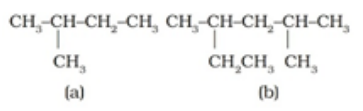
Branched chain hydrocarbons: In a branched chain compound small chains of carbon atoms are attached at one or more carbon atoms of the parent chain. The small carbon chains (branches) are called alkyl groups. For example:

In order to name such compounds, the names of alkyl groups are prefixed to the name of parent alkane. An alkyl group is derived from a saturated hydrocarbon by removing a hydrogen atom from carbon. Thus, $CH_4$becomes$ – CH_3 $and is called methyl group. An alkyl group is named by substituting ‘yl’ for ‘ane’ in the corresponding alkane. Some alkyl groups are listed in Table
Alkane Alkyl Group
Molecular formula Name of alkane Structural formula Name of alkyl group
$CH_4$ Methane $-CH_3$ Methyl
$C_2H_6$ Ethane $-CH_2CH_3​​​​​​​$ Ethyl
$C_3H_8​​​​​​​$ Propane $-CH_2CH_2CH_3$ Propyl
$C_4H_{10}​​​​​​​$ Butane $-CH_2CH_2CH_2CH_3​​​​​​​$ Butyl
$C_{10}H_{22}​​​​​​​$ Decane $-CH_2(CH_2)_8CH_3​​​​​​​$​​​​​​​ Decyl
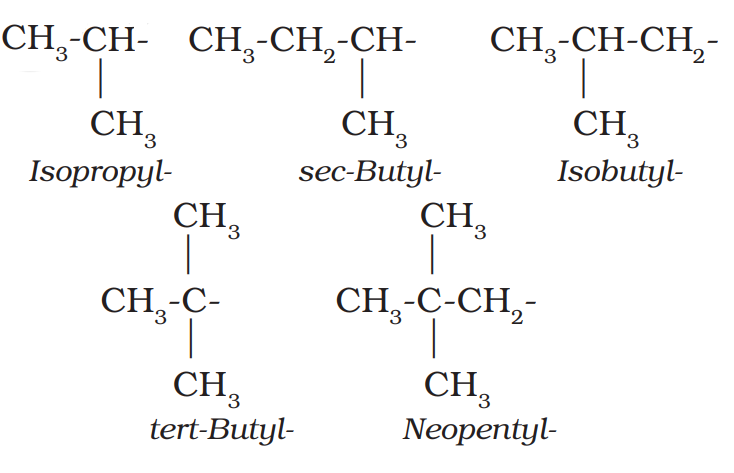
Abbreviations are used for some alkyl groups. For example, methyl is abbreviated as Me, ethyl as Et, propyl as Pr and butyl as Bu. The alkyl groups can be branched also. Thus, propyl and butyl groups can have branched structures as shown below .
Common branched groups have specific trivial names. For example, the propyl groups can either be n-propyl group or isopropyl group. The branched butyl groups are called sec- butyl, isobutyl and tert-butyl group. We also encounter the structural unit, – $CH_2C(CH_3)_3​​​​​​​$​​​​​​​, which is called neopentyl group.
For Nomenclature of branched chain alkanes ,longest carbon chain in the molecule is identified. The numbering is done in such a way that the branched carbon atoms get the lowest possible numbers. lower number is given to the one coming first in the alphabetical listing. Carbon atom of the branch that attaches to the root alkane. in alphabetical order, the prefixes iso- and neo- are considered to be the part of the fundamental name of alkyl group. The prefixes sec- and tert- are not considered to be the part of the fundamental name.
Cyclic Compounds: A saturated monocyclic compound is named by prefixing ‘cyclo’ to the corresponding straight chain alkane. If side chains are present, then the rules given above are applied. Names of some cyclic compounds are given below.

The phenomenon of existence of two or more compounds possessing the same molecular formula but different properties is known as isomerism. Such compounds are called as isomers. The following flow chart shows different types of isomerism.
Structural Isomerism Compounds having the same molecular formula but different structures (manners in which atoms are linked) are classified as structural isomers. Some typical examples of different types of structural isomerism are given below:

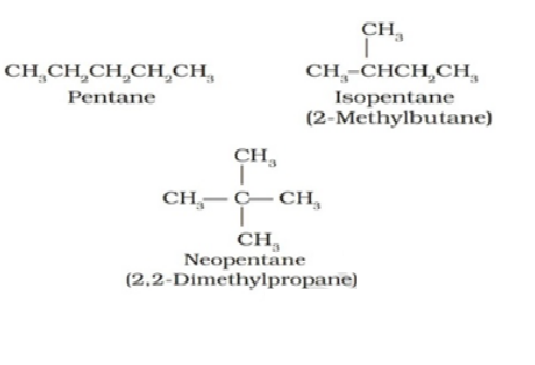
(i) Chain isomerism: When two or more compounds have similar molecular formula but different carbon skeletons, these are referred to as chain isomers and the phenomenon is termed as chain isomerism. For example, $C_5H_{12}​​​​​​​$​​​​​​​ represents three compounds:
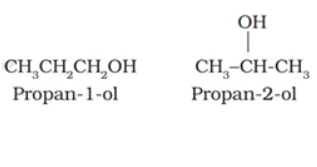
(ii) Position isomerism: When two or more compounds differ in the position of substituent atom or functional group on the carbon skeleton, they are called position isomers and this phenomenon is termed as position isomerism. For example, the molecular formula $C_3H_8O$ represents two alcohols:

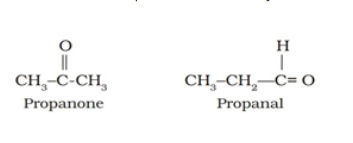
(iii) Functional group isomerism: Two or more compounds having the same molecular formula but different functional groups are called functional isomers and this phenomenon is termed as functional group isomerism. For example, the molecular formula $C_3H_6O$ represents an aldehyde and a ketone:

(iv) Metamerism: It arises due to different alkyl chains on either side of the functional group in the molecule. For example, $C_4H_{10}O$ represents methoxy propane $(CH_3OC_3H_7)$ and ethoxyethane $(C_2H_5OC_2H_5).$
Stereoisomerism The compounds that have the same constitution and sequence of covalent bonds but differ in relative positions of their atoms or groups in space are called stereoisomers. This special type of isomerism is called as stereoisomerism and can be classified as geometrical and optical isomerism.
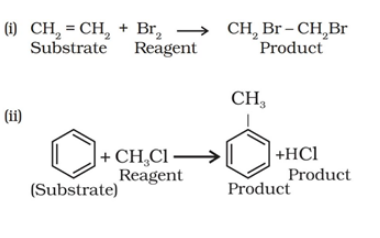
Substrate and Reagent Ions are generally not formed in the reactions of organic compounds. Molecules as such participate in the reaction. It is convenient to name one reagent as substrate and other as reagent. In general, a molecule whose carbon is involved in new bond formation is called substrate and the other one is called reagent. When carbon-carbon bond is formed, the choice of naming the reactants as substrate and reagent is arbitrary and depends on molecule under observation. Example:
  1. $CH_4​​​​​​​$​​​​​​​ becomes –$ CH_3​​​​​​​$​​​​​​​, is called … group.
  1. methyl
  2. ethyl
  3. propyl
  4. butyl
  1. For the Nomenclature of branched chain alkanes …. carbon chain in the molecule is identified.
  1. shortest
  2. longest
  3. smallest
  4. none of above
  1. when two or more compounds possessing the same molecular formula but different properties is known as ….
  1. Allotrops
  2. Isotops
  3. Isomers
  4. Isobars
  1. For the Nomenclature of branched chain alkanes, the numbering is done in such a way that the branched carbon atoms get the … possible numbers.
  1. biggest
  2. Lower
  3. Highest
  4. lowest
  1. Which of the following is not an example of isomerisim?
  1. Functional
  2. Positional
  3. Chain
  4. Preconditional
Read the passage given below and answer the following questions from (i) to (v).
The first concreteexplanation for the phenomenon of the blackbody radiation was given byMax Planck in 1900.An ideal body, which emits and absorbs radiations of allfrequencies uniformly, is called a black bodyand the radiation emitted by such a body is called black body radiation. Max Planck arrived at a satisfactory relationshipbymaking an assumption that absorption andemmission of radiation arises from oscillatori.e., atoms in the wall of black body.He suggested that atoms andmolecules could emit or absorb energy onlyin discrete quantities and not in a continuousmanner. He gave the name quantum to thesmallest quantity of energy that can be emitted or absorbed in the form of electromagnetic radiation. The energy (E) of aquantum of radiation is proportionalto its frequency (ν) and is expressed byequation .
$E = hυ.$
The proportionality constant, ‘h’ is knownas Planck’s constant and has the value6.$626\times 10^{–34}$ Js.In 1887, H. Hertz performed a very interestingexperiment in which electrons (or electriccurrent) were ejected when certain metals (forexample potassium, rubidium, caesium etc.)were exposed to a beam of light. The phenomenon is calledPhotoelectric effect. The results observed inthis experiment were:
  1. The electrons are ejected from the metalsurface as soon as the beam of light strikesthe surface, i.e., there is no time lagbetween the striking of light beam and theejection of electrons from the metal surface.
  2. The number of electrons ejected is proportional to the intensity or brightness of light.
  3. For each metal, there is a characteristicminimum frequency,ν0(also known asthreshold frequency) below which photoelectric effect is not observed. At afrequency $ν >ν_0$, the ejected electrons comeout with certain kinetic energy. The kineticenergies of these electrons increase withthe increase of frequency of the light used.
The particle nature of light posed a dilemmafor scientists. Theonly way to resolve the dilemma was to acceptthe idea that light possesses both particle andwave-like properties, i.e., light has dualbehaviour. Depending on the experiment, wefind that light behaves either as a wave or as astream of particles. Whenever radiationinteracts with matter, it displays particle likeproperties in contrast to the wavelike properties (interference and diffraction), whichit exhibits when it propagates. This conceptwas totally alien to the way the scientiststhought about matter and radiation and it tookthem a long time to become convincedof itsvalidity.
The study of emission or absorption spectra is referred to as spectroscopy.The emission spectra of atoms inthe gas phase, on the other hand, do not showa continuous spread of wavelength from redto violet, rather they emit light only at specificwavelengths with dark spaces between them.Such spectra are called line spectra or atomicspectra.The Swedishspectroscopist, Johannes Rydberg, noted that
all series of lines in the hydrogen spectrumcould be described by the following expression:
$\bar{\text{v}}=109,677\big(\frac{1}{\text{n}^2_1}-\frac{1}{\text{n}^2_2}\big)\text{cm}^{-1}$
The value $109,677 cm^{–1}$​​​​​​​ is called theRydberg constant for hydrogen. The first fiveseries of lines that correspond to $n_1= 1, 2, 3,4, 5$ are known as Lyman, Balmer, Paschen,Bracket and Pfund series, respectively.Neils Bohr (1913) was the first to explainquantitatively the general features of thestructure of hydrogen atom and its spectrum.He used Planck’s concept of quantisation ofenergy. Though the theory is not the modernquantum mechanics, it can still be used to rationalize many points in the atomic structureand spectra. Bohr’s model for hydrogen atomis based on the following postulates:
  1. The electron in the hydrogen atom canmove around the nucleus in a circular pathof fixed radius and energy. These paths arecalled orbits, stationary states or allowedenergy states. These orbits are arrangedconcentrically around the nucleus.
  2. The energy of an electron in the orbit doesnot change with time. However, theelectron will move from a lower stationarystate to a higher stationary state whenrequired amount of energy is absorbedby the electron or energy is emitted when electron moves from higher stationarystate to lower stationary state. The energychange does not takeplace in a continuous manner.
  3. The frequency of radiation absorbed oremitted when transition occurs between two stationary states that differ in energyby $\triangle\text{E},$ is given by:
$\text{v}=\frac{\triangle\text{E}}{\text{h}}=\frac{\text{E}_2-\text{E}_1}{\text{h}}$

Where E1 and E2 are the energies of the lower and higher allowed energy statesrespectively. This expression is commonly known as Bohr’s frequency rule.
  1. The angular momentum of an electron isquantised. In a given stationary state itcan be expressed as in equation
$\text{m}_{\text{e}}\text{vr}=\text{n}.\frac{\text{h}}{2\pi}\text{n}=1,2,3.....$
  1. The first concrete explanation for the phenomenon of the black body radiation was given by ….in 1900.
  1. Max Planck
  2. De Broglie
  3. Albert Einstein,
  4. Niels Bohr
  1. Which of the following equation is Planck’s equation?
  1. $E= mc^2​​​​​​​$
  2. $E = hυ$
  3. $E= hc^2​​​​​​​$
  4. $E= vc^2.$
  1. What is nature of light?
  1. Wave
  2. Particle
  3. Wave and Particle
  4. None of above
  1. The value …. is called theRydberg constant for hydrogen.
  1. $109,674cm^{–1}​​​​​​​$
  2. $109,675cm^{–1}​​​​​​​$
  3. $109,676cm^{–1}​​​​​​​$
  4. $109,677cm^{–1}$​​​​​​​
  1. …was the first to explain quantitatively the general features of the structure of hydrogen atom and its spectrum.
  1. Max Planck
  2. De Broglie
  3. Albert Einstein,
  4. Niels Bohr
Read the passage given below and answer the following questions from (i) to (v).
When a liquid evaporates in a closed container, molecules with relatively higher kinetic energy escape the liquid surface into the vapour phase and number of liquid molecules from the vapour phase strike the liquid surface and are retained in the liquid phase. It gives rise to a constant vapour pressure because of an equilibrium in which the number of molecules leaving the liquid equals the number returning to liquid from the vapour. We say that the system has reached equilibrium state at this stage. However, this is not static equilibrium and there is a lot of activity at the boundary between the liquid and the vapour. Thus, at equilibrium, the rate of evaporation is equal to the rate of condensation. It may be represented by
$\text{H}_2\text{O}_{(\text{l})}\rightleftharpoons\text{H}_2\text{O}_{(\text{vap})}$
The double half arrows indicate that the processes in both the directions are going on simultaneously. The mixture of reactants and products in the equilibrium state is called an equilibrium mixture.
Equilibrium can be established for both physical processes and chemical reactions. The reaction may be fast or slow depending on the experimental conditions and the nature of the reactants. When the reactants in a closed vessel at a particular temperature react to give products, the concentrations of the reactants keep on decreasing, while those of products keep on increasing for some time after which there is no change in the concentrations of either of the reactants or products. This stage of the system is the dynamic equilibrium
The chemical equilibrium may be classified in three groups.
  1. The reactions that proceed nearly to completion and only negligible concentrations of the reactants are left. In some cases, it may not be even possible to detect these experimentally.
  2. The reactions in which only small amounts of products are formed and most of the reactants remain unchanged at equilibrium stage.
  3. The reactions in which the concentrations of the reactants and products are comparable, when the system is in equilibrium.
The equilibrium involving ions in aqueous solutions which is called as ionic equilibrium.
Solid-Liquid Equilibrium Ice and water kept in a perfectly insulated thermos flask (no exchange of heat between its contents and the surroundings) at 273K and the atmospheric pressure are in equilibrium state and the system shows interesting characteristic features. We observe that the mass of ice and water do not change with time and the temperature remains constant. However, the equilibrium is not static. The intense activity can be noticed at the boundary between ice and water. Molecules from the liquid water collide against ice and adhere to it and some molecules of ice escape into liquid phase. There is no change of mass of ice and water, as the rates of transfer of molecules from ice into water and of reverse transfer from water into ice are equal at atmospheric pressure and 273 K. It is obvious that ice and water are in equilibrium only at particular temperature and pressure. For any pure substance at atmospheric pressure, the temperature at which the solid and liquid phases are at equilibrium is called the normal melting point or normal freezing point of the substance. The system here is in dynamic equilibrium and we can infer the following:
  1. Both the opposing processes occur simultaneously.
  2. Both the processes occur at the same rate so that the amount of ice and water remains constant.
Solid – Vapour Equilibrium Let us now consider the systems where solids sublime to vapour phase. If we place solid iodine in a closed vessel, after sometime the vessel gets filled up with violet vapour and the intensity of colour increases with time. After certain time the intensity of colour becomes constant and at this stage equilibrium is attained. Hence solid iodine sublimes to give iodine vapour and the iodine vapour condenses to give solid iodine. The equilibrium can be represented as,
$\text{l}_2(\text{solid})\rightleftharpoons\text{l}_2(\text{vapour})$
Other examples showing this kind of equilibrium are,
$\text{Camphor}_{(\text{solid})}\rightleftharpoons\text{Camphor}_{(\text{vapour})}$
$\text{NH}_4\text{CI}_{(\text{solid})}\rightleftharpoons\text{NH}_4\text{CI}_{(\text{vapour})}$
The equilibrium Involving Dissolution of Solid in Liquids Only a limited amount of salt or sugar can dissolves in a given amount of water at room temperature. If we make a thick sugar syrup solution by dissolving sugar at a higher temperature, sugar crystals separate out if we cool the syrup to the room temperature. We call it a saturated solution when no more of solute can be dissolved in it at a given temperature. The concentration of the solute in a saturated solution depends upon the temperature. In a saturated solution, a dynamic equilibrium exits between the solute molecules in the solid state and in the solution: Sugar (solution) Sugar (solid), and the rate of dissolution of sugar = rate of crystallisation of sugar. Equality of the two rates and dynamic nature of equilibrium has been confirmed with the help of radioactive sugar. If we drop some radioactive sugar into saturated solution of non-radioactive sugar, then after some time radioactivity is observed both in the solution and in the solid sugar. Initially there were no radioactive sugar molecules in the solution but due to dynamic nature of equilibrium, there is exchange between the radioactive and non-radioactive sugar molecules between the two phases. The ratio of the radioactive to non- radioactive molecules in the solution increases till it attains a constant value.
  1. Which of the following symbol represents equilibrium.
  1. $\rightleftharpoons$
  2. $\leftrightarrows$
  3. $\nLeftrightarrow$
  4. $\uparrow\downarrow$
  1. When there is no change in the concentrations of either of the reactants or products, this stage of the system is the …
  1. Static equilibrium
  2. Dynamic equilibrium
  3. Physical equilibrium
  4. Chemical equilibrium
  1. A … solution means no more of solute can be dissolved in it at a given temperature.
  1. Unsaturated
  2. Supersaturated
  3. Saturated
  4. None of these.
  1. The equilibrium involving ions in aqueous solutions which is called as …
  1. Static equilibrium
  2. Dynamic equilibrium
  3. Physical equilibrium
  4. Ionic equilibrium
  1. The concentration of the solute in a saturated solution depends upon the …
  1. Solvent
  2. Pressure
  3. Temperature
  4. System
There are many observable patterns in thephysical and chemical properties of elementsas we descend in a group or move across aperiod in the Periodic Table.Atomic Radius the determination of the atomic sizecannot be precise. In other words, there is no practical way by which the size of an individualatom can be measured. However, an estimateof the atomic size can be made by knowing thedistance between the atoms in the combinedstate. One practical approach to estimate thesize of an atom of a non-metallic element is tomeasure the distance between two atoms whenthey are bound together by a single bond in acovalent molecule and from this value, the“Covalent Radius” For metals, we define theterm “Metallic Radius” which is taken as halfthe internuclear distance separating the metalcores in the metallic crystal. Atomic Radius to refer to both covalent ormetallic radius depending on whether theelement is a non-metal or a metal. Atomic radiican be measured by X-ray or otherspectroscopic methods. The atomic size generallydecreases across a period. It is because within the period the outerelectrons are in the same valence shell and theeffective nuclear charge increases as the atomicnumber increases resulting in the increasedattraction of electrons to the nucleus.Note that the atomic radii of noble gasesAre not considered here. Being monoatomic,Their (non-bonded radii) values are very large.In fact radii of noble gases should be comparednot with the covalent radii but with the van derWaals radii of other elements. The removal of an electron from an atom resultsin the formation of a cation, whereas gain ofan electron leads to an anion. The ionic radiican be estimated by measuring the distancesbetween cations and anions in ionic crystals.In general, the ionic radii of elements exhibitthe same trend as the atomic radii. A cation issmaller than its parent atom because it hasfewer electrons while its nuclear charge remainsthe same. The size of an anion will be largerthan that of the parent atom because theaddition of one or more electrons would resultin increased repulsion among the electronsand a decrease in effective nuclear charge. When we find some atoms and ions whichcontain the same number of electrons, we callthem isoelectronic species. For example,$O2–, F–, Na+$ and $Mg2+$ have the same number ofelectrons (10). Their radii would be differentbecause of their different nuclear charges.A quantitative measure of the tendency of anelement to lose electron is given by itsIonization Enthalpy. It represents the energyrequired to remove an electron from an isolatedgaseous atom (X) in its ground state. The ionization enthalpy is expressed inunits of kJ mol–1. We can define the secondionization enthalpy as the energy required toremove the second most loosely boundelectron The first ionization enthalpies of elementshaving atomic numbers up to 60 are plotted then The periodicity of the graph is quitestriking. You will find maxima at the noble gaseswhich have closed electron shells and verystable electron configurations. On the otherhand, minima occur at the alkali metals andtheir low ionization enthalpies can be correlated with their high reactivity. In addition, you willnotice two trends the first ionization enthalpygenerally increases as we go across a periodand decreases as we descend in a group. Electron Gain Enthalpy. when an electron is added to a neutral gaseousatom (x) to convert it into a negative ion, theenthalpy change accompanying the process isdefined as the electron gain enthalpy (∆egh).Electron gain enthalpy provides a measure ofthe ease with which an atom adds an electronto form anion. electron gain enthalpies have largenegative values toward the upper right of theperiodic table preceding the noble gases.The variation in electron gain enthalpies ofelements is less systematic than for ionizationenthalpies. As a general rule, electron gainenthalpy becomes more negative with increasein the atomic number across a period. Theeffective nuclear charge increases from left toright across a period and consequently it willbe easier to add an electron to a smaller atomsince the added electron on an average wouldbe closer to the positively charged nucleus. ElectronegativityA qualitative measure of the ability of an atomin a chemical compound to attract sharedelectrons to itself is called electronegativity.Unlike ionization enthalpy and electron gainenthalpy, it is not a measureable quantity.However, a number of numerical scales ofelectronegativity of elements viz., Pauling scale,Mulliken-Jaffe scale, Allred-Rochow scale havebeen developed. The one which is the most widely used is the Pauling scale. Electronegativity generallyincreases across a period from leftto right (say from lithium tofluorine) and decrease down a group(say from fluorine to astatine) inthe periodic table. Non-metallic elements have strong tendencyto gain electrons. Therefore, electronegativityis directly related to that non-metallicproperties of elements. It can be furtherextended to say that the electronegativity isinversely related to the metallic properties of elements. Thus, the increase inelectronegativities across a period isaccompanied by an increase in non-metallicproperties (or decrease in metallic properties)of elements. Similarly, the decrease inelectronegativity down a group is accompanied by a decrease in non-metallic properties (orincrease in metallic properties) of elements.
  1. The atomic size generally … across a period.
  1. Increases
  2. Decreases
  3. Remains Constant
  4. None of above
  1. The ionization enthalpy is expressed in units of ….
  1. $kJ mol^{–1}$
  2. $mole kJ^{-1}$
  3. $mole kJ$
  4. $-kJ mol^{-1}$
  1. Which of the following is/are numerical scales of electronegativity of elements.
  1. Pauling scale
  2. Mulliken-Jaffe scale
  3. Allred-Rochow scale
  4. All the above
  1. The … in electronegativity down a group is accompanied by a … in non-metallic properties.
  1. Increase, Decrease
  2. Decrease, Increase
  3. Decrease, Decrease
  4. Increase , Increase
  1. Electronegativity generally … across a period from left to right and … down a group in the periodic table.
  1. Increase, Decrease
  2. Decrease, Increase
  3. Decrease, Decrease
  4. Increase, Increase
IUPAC (International Union of Pure and Applied Chemistry) system of nomenclature. Common names are useful and in many cases indispensable, particularly when the alternative systematic names are lengthy and complicated. A systematic name of an organic compound is generally derived by identifying the parent hydrocarbon and the functional group(s) attached to it. By using prefixes and suffixes, the parent name can be modified to obtain the actual name. In a branched-chain compound, small chains of carbon atoms are attached at one or more carbon atoms of the parent chain. The small carbon chains (branches) are called alkyl groups. An alkyl group is derived from a saturated hydrocarbon by removing a hydrogen atom from carbon. Abbreviations are used for some alkyl groups. For example, methyl is abbreviated as Me, ethyl as Et, propyl as Pr and butyl as Bu.

1. Draw the structure of 3-Ethyl-4,4-dimethylheptane. (1)
2. How is the numbering in branched chain hydrocarbon done?
3. Derive the structure of 2-Chlorohexane. (2)
OR
Why $CH _4$ after becoming- $CH _3$ called a methyl group? (2)
Read the passage given below and answer the following questions from 1 to 5.
The unusual properties of water in the Condensed phase (liquid and solid states) are Due to the presence of extensive hydrogen Bonding between water molecules. This leads To high freezing point, high boiling point, high Heat of vaporisation and high heat of fusion in Comparison to $H_2S$ and $H_2Se$. In comparison To other liquids, water has a higher specific Heat, thermal conductivity, surface tension, Dipole moment and dielectric constant, etc. these properties allow water to play a key role In the biosphere. In the gas phase water is a bent molecule with a bond angle of $104.5^\circ$ , and O–H bond length Of 95.7 pm
It is a highly polar molecule. Its orbital overlap. In the liquid Phase water molecules are associated together By hydrogen bonds. The crystalline form of water is ice. At Atmospheric pressure ice crystallises in the Hexagonal form, but at very low temperatures It condenses to cubic form.
Density of ice is Less than that of water. Therefore, an ice cube Floats on water. In winter season ice formed On the surface of a lake provides thermal Insulation which ensures the survival of the Aquatic life. This fact is of great ecological Significance. Structure of Ice Ice has a highly ordered three dimensional Hydrogen bonded structure. Examination of ice crystals with X-rays shows that each oxygen atom is Surrounded tetrahedrally by four other oxygen Atoms at a distance of 276 pm.
Hydrogen bonding gives ice a rather open Type structure with wide holes. These holes can Hold some other molecules of appropriate size Interstitially.
Water reacts with a large number of Substances. Some of the important reactions Are given below.
Amphoteric Nature: It has the ability to act as an acid as well as a base i.e., it behaves As an amphoteric substance. In the Brönsted Sense it acts as an acid with $NH_3$ and a base with $H_2S.$
$\text{H}_2\text{O}(\text{l})+\text{NH}_3(\text{aq})\rightleftharpoons\text{OH}^-(\text{aq})+\text{NH}^+_4\text{aq}$
$\text{H}_2\text{O}(\text{l})+\text{H}_2\text{S}(\text{aq})\rightleftharpoons\text{H}_3\text{O}^+(\text{aq})+\text{HS}^-\text{(aq)}$
The auto protolysis (self-ionzation) of water takes palace as follow:
$\text{H}_2\text{O}(\text{l})+\text{H}_2\text{O}(\text{l})\rightleftharpoons\text{H}_3\text{O}^+(\text{aq})+\text{OH}^-(\text{aq})$
$\text{acid-1 base-2 (acid-2) base-1}$
$\text{(acid) (base) (conjugate acid) (conjugate base)}$
Redox Reactions Involving Water: Water Can be easily reduced to dihydrogen by highly Electropositive metals.
$2\text{H}_2\text{O}(\text{l})+2\text{Na}\text{(s)}\rightarrow2\text{NaOH}\text{(aq)}+\text{H}_2\text{g}$
Thus. it is a great source of dihydrogen.
water is oxidished to $O_2$ during photosynthesis.
$6\text{CO}_2\text{g}+12\text{H}_2\text{O}(\text{l})\rightarrow\text{C}_6\text{H}_{12}\text{O}_6(\text{aq})+6\text{H}_2\text{O}{\text{l}}+6\text{O}_2\text{(g)}$
With fluorine also it is oxidised to $O_2.$
$2\text{F}_2\text{g}+2\text{H}_2\text{O}(\text{l})\rightarrow4\text{H}^+(\text{aq})+4\text{F}^-(\text{aq})+\text{O}_2\text{(G)}$
Hydrolysis Reaction: Due to high Dielectric constant, it has a very strong Hydrating tendency. It dissolves many ionic Compounds. However, certain covalent and Some ionic compounds are hydrolysed in water.
$\text{P}_4\text{O}_{10}(\text{s})+6\text{H}_2\text{O}(\text{l})\rightarrow4\text{H}_3\text{PO}_4\text{(aq)}$
$\text{SiCl}_4{\text{l}}+2\text{H}_2\text{O}(\text{l})\rightarrow\text{SiO}_2\text{(s)}+4\text{HCl}\text{(aq)}$
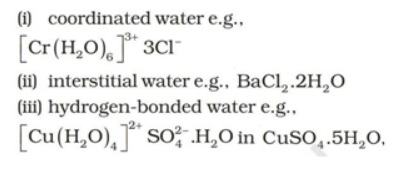
Hydrates Formation: From aqueous Solutions many salts can be crystallised as Hydrated salts. Such an association of water Is of different types viz., Coordinated water e.g.,

Hard and Soft Water- Rain water is almost pure (may contain some Dissolved gases from the atmosphere). Being a Good solvent, when it flows on the surface of The earth, it dissolves many salts. Presence of Calcium and magnesium salts in the form of Hydrogencarbonate, chloride and sulphate in Water makes water ‘hard’. Hard water does Not give lather with soap. Water free from Soluble salts of calcium and magnesium is Called Soft water. It gives lather with soap Easily. Temporary hardness is due to the presence of Magnesium and calcium hydrogen- Carbonates. It can be removed by:
Boiling: During boiling, the soluble $Mg(HCO_3)_2$ is converted into insoluble $Mg(OH)_2$ And $Ca(HCO_3)_2$ is changed to insoluble $CaCO_3$. It is because of high solubility product of $Mg(OH)_2$ as compared to that of $MgCO_3$, that $Mg(OH)_2$ is precipitated. These precipitates can Be removed by filtration. Filtrate thus obtained
Will be soft water.
$\text{Mg}(\text{HCO}_3)_2\xrightarrow{\text{Heating}}\text{Mg}(\text{OH})_2\downarrow+2\text{CO}_2\uparrow$
$\text{Ca}(\text{HCO}_3)_2\xrightarrow{\text{Heating}}\text{CaCO}_3\downarrow+\text{H}_2\text{O}+\text{CO}_2\uparrow$
Clark’s method: In this method calculated Amount of lime is added to hard water. It Precipitates out calcium carbonate and Magnesium hydroxide which can be filtered off.
Permanent Hardness is due to the presence of soluble salts of Magnesium and calcium in the form of Chlorides and sulphates in water. Permanent Hardness is not removed by boiling.
$\text{Ca}(\text{Hco}_3)_2+\text{Ca}(\text{OH)}_2\rightarrow2\text{CaCO}_3\downarrow2\text{H}_2\text{O}$
$\text{Mg}(\text{HCO)}_3+2\text{Ca}\text{(Oh)}_2\rightarrow2\text{CaCO}_3\downarrow+\text{Mg}(\text{OH)}_2\downarrow2\text{H}_2\text{O}$
Permanent Hardness is due to the presence of soluble salts of Magnesium and calcium in the form of Chlorides and sulphates in water. Permanent Hardness is not removed by boiling.
  1. In the gas phase water is a bent molecule with a bond angle of:
  1. $104.5^\circ$
  2. $94.5^\circ$
  3. $110.5^\circ$
  4. $95.5^\circ$
  1. At Atmospheric pressure ice crystallises in the … form.
  1. Cubic
  2. Hexagonal
  3. Octagonal
  4. Pentagonal
  1. Water free from Soluble salts of calcium and magnesium is called …
  1. hard water
  2. dry water
  3. soft water
  4. None of above
  1. Water has…. Nature.
  1. acidic
  2. basic
  3. neutral
  4. amphoteric
  1. Water is…. Molecule.
  1. Polar
  2. Non- Polar
  3. Ionic
  4. All the above
When anions and cations approach each other, the valence shell of anions are pulled towards the cation nucleus and thus, the shape of the anion is deformed. The phenomenon of deformation of anion by a cation is known as polarization and the ability of the cation to polarize the anion is called as polarizing power of cation. Due to polarization, sharing of electrons occurs between two ions to some extent and the bond shows some covalent character.
The magnitude of polarization depends upon a number of factors.

1. Out of $AlCl _3$ and $AlI _3$ which halides show maximum polarization? (1)
2. Out of $AlCl _3$ and $CaCl _2$ which one is more covalent in nature? (1)
3. The non-aqueous solvent like ether is added to the mixture of $LiCl , NaCl$ and KCl . Which will be extracted into the ether? (2)
OR
Out of $CaF _2$ and $CaI _2$ which one has a minimum melting point? (2)
Covalent molecules formed by heteroatoms bound to have some ionic character. The ionic character is due to shifting of the electron pair towards A or B in the molecule AB . Hence, atoms acquire small and equal charge but opposite in sign. Such a bond which has some ionic character is described as a polar covalent bond. Polar covalent molecules can exhibit a dipole moment. The dipole moment is equal to the product of charge separation, q and the bond length, d for the bond. The unit of dipole moment is Debye. One Debye is equal to $10^{-18}$ esu cm.
The dipole moment is a vector quantity. It has both magnitude and direction. Hence, the dipole moment of molecules depends upon the relative orientation of the bond dipole, but not the polarity of bonds alone. The symmetrical structure shows a zero dipole moment. Thus, a dipole moment help to predict the geometry of the molecules. Dipole moment values can be used to distinguish between cis- and trans-isomers; ortho-, meta- and para-forms of a substance, etc. The percentage of ionic character of a bond can be calculated by the application of the following formula:
$
\% \text { ionic character }=\frac{\text { Experimental value dipole moment }}{\text { Theoretical value of dipole moment }} \times 100
$
Image
ii. A diatomic molecule has a dipole moment of 1.2 D . If the bond length is $1.0 \times 10^{-8} cm$, what fraction of charge does exist on each atom? (1)
iii. The dipole moment of $NF _3$ is very much less that of $NH _3$. Why? (2)
OR
A covalent molecule, $x-y$, is found to have a dipole moment of $1.5 \times 10^{-29} cm$ and a bond length 150 pm . What will be the percentage of ionic character of the bond? (2)
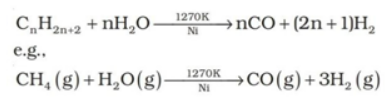
Read the passage given below and answer the following questions from 1 to 5. Since the isotopes have the same electronic Configuration, they have almost the same Chemical properties.The only difference is in Their rates of reactions, mainly due to their Different enthalpy of bond dissociation . However, in physical properties these Isotopes differ considerably due to their large Mass differences. There are a number of methods for preparing Dihydrogen from metals and metal hydrides. 1.) Laboratory Preparation of Dihydrogen – It is usually prepared by the reaction of Granulated zinc with dilute hydrochloric. $Zn + 2H + \rightarrow Zn_2+ + H_2$ It can also be prepared by the reaction of Zinc with aqueous alkali. $Zn + 2NaOH \rightarrow Na_2ZnO_2 + H_2$ Commercial Production of Dihydrogen – The commonly used processes are outlined Below: i) Electrolysis of acidified water using Platinum electrodes gives hydrogen. ii) High purity (> 99.95%) dihydrogen is Obtained by electrolysing warm aqueous Barium hydroxide solution between nickel iii) It is obtained as a by product in the Manufacture of sodium hydroxide and Chlorine by the electrolysis of brine Solution. During electrolysis, the reactions That take place are: at anode: $2\text{CI}(\text{aq})\rightarrow\text{CI}_2(\text{g})+2\bar{\text{e}}$ at cathode: $2\text{H}_2\text{O}(\text{l})+2\text{e}\rightarrow\text{H}_2(\text{g})+2\text{O}\bar{\text{H}}(\text{aq})$ The overall reaction is $2\text{Na }(\text {aq})+2\text{C}\bar{\text{I}}(\text{aq})+2\text{H}_2\text{O}(\text{l})$ $\text{CI}_2(\text{g})+\text{H}_2(\text{g})+2\text{Na}^+(\text{aq})+2\text{O}\bar{\text{H}}(\text{aq})$ That take place are: iv) Reaction of steam on hydrocarbons or coke At high temperatures in the presence of Catalyst yields hydrogen.

 The mixture of $CO$ and $H_2$ is called water Gas. As this mixture of $CO$ and $H_2$ is used for The synthesis of methanol and a number of Hydrocarbons, it is also called synthesis gas Or ‘syngas’. Nowadays ‘syngas’ is produced From sewage, saw-dust, scrap wood, Newspapers etc. The process of producing ‘syngas’ from coal is called ‘coal gasification’. The production of dihydrogen can be Increased by reacting carbon monoxide of Syngas mixtures with steam in the presence of Iron chromate as catalyst. This is called water-gas shift reaction. Carbon dioxide is removed by scrubbing with Sodium arsenite solution. Presently ~77% of the industrial Dihydrogen is produced from petro-chemicals, 18% from coal, 4% from electrolysis of aqueous Solutions and 1% from other sources. Physical Properties Dihydrogen is a colourless, odourless, Tasteless, combustible gas. It is lighter than Air and insoluble in water. Its other physical Properties are alongwith those of deuterium. The chemical behaviour of dihydrogen (and for That matter any molecule) is determined, to a Large extent, by bond dissociation enthalpy. The H–H bond dissociation enthalpy is the Highest for a single bond between two atoms Of any element. What inferences would you Draw from this fact ? It is because of this factor That the dissociation of dihydrogen into its Atoms is only~0.081% around 2000K which Increases to 95.5% at 5000K. Also, it is Relatively inert at room temperature due to the high H–H bond enthalpy. Thus, the atomic Hydrogen is produced at a high temperature In an electric arc or under ultraviolet Radiations. Since its orbital is incomplete with 1s1 Electronic configuration, it does combine With almost all the elements. It accomplishes Reactions by
i) loss of the only electron to Give H+, ii) gain of an electron to form H–, and iii) Sharing electrons to form a single covalent bond. The chemistry of dihydrogen can be Illustrated by the following reactions: Reaction with halogens: It reacts with Halogens, $X_2$ to give hydrogen halides, $\text{H}_2(\text{g})+\text{x}_2(\text{g})\rightarrow2\text{HX}(\text{g})(\text{x}=\text{F.CI.Br.I})$ While the reaction with fluorine occurs even in The dark, with iodine it requires a catalyst. Reaction with dioxygen: It reacts with Dioxygen to form water. The reaction is highly Exothermic. $2\text{H}_2(\text{g})+\text{O}_2(\text{g})\xrightarrow{\text{catalyst or beading}}2\text{H}_2\text{O}(\text{l}):$ $\triangle\text{H}^-=-285.9\text{kj}\text{mol}^-1$ This is the method for the manufacture of Ammonia by the Haber process. Reactions with metals: With many metals it Combines at a high temperature to yield the Corresponding hydrides $H_2$ (g) + 2M (g) → 2 MH (s); Where M is an alkali metal Reactions with metal ions and metal Oxides: It reduces some metal ions in aqueous Solution and oxides of metals (less active than Iron) into corresponding metals. $\text{H}_2(\text{g})+\text{Pd}^{2+}\text{(aq)}\rightarrow\text{Pd}(\text{s})+2\text{H}^+(\text{aq})$ $\text{y}\text{H}_2(\text{g})+\text{M}_\text{x}\text{O}_\text{y}(\text{S})\rightarrow\text{xM}(\text{s})+\text{y}\text{H}_2\text{O}\text{(l)}$ Reactions with organic compounds: It Reacts with many organic compounds in the Presence of catalysts to give useful Hydrogenated products of commercial Importance. For example: Hydrogenation of vegetable oils using Nickel as catalyst gives edible fats (margarine and vanaspati ghee) Hydroformylation of olefins yields Aldehydes which further undergo Reduction to give alcohols. $\text{H}_2+\text{CO}+\text{RCH}=\text{CH}_2\rightarrow\text{RCH}_2\text{CH}_2\text{CHO}$ $\text{H}_2+\text{RCH}_2\text{CH}_2\text{CHO}\rightarrow\text{RCH}_2\text{CH}_2\text{CH}_2\text{OH}$
  1. The mixture of CO and H2 is called …
  1. water Gas
  2. Dry ice
  3. Dry carbon
  4. Dry hydrogen
  1. Which of the following is not physical property of Dihydrogen.
  1. colourless
  2. Highest dissociation enthalpy
  3. odourless
  4. Tasteless
  1. Dihydrogen is reacts with dioxygen to get ….
  1. $H_2O_2$
  2. $2H_2O_2$
  3. $2H_2O$
  4. $H_2O$
  1. High purity dihydrogen is obtained by electrolysing warm aqueous barium hydroxide solution between… electrodes.
  1. Chromium
  2. Copper
  3. Platinum
  4. Nickel
The existing large number of organic compounds and their ever-increasing numbers has made it necessary to classify them on the basis of their structures. Organic compounds are broadly classified as open-chain compounds which are also called aliphatic compounds. Aliphatic compounds further classified as homocyclic and heterocyclic compounds. Aromatic compounds are special types of compounds. Alicyclic compounds, aromatic compounds may also have heteroatom in the ring. Such compounds are called heterocyclic aromatic compounds. Organic compounds can also be classified on the basis of functional groups, into families or homologous series. The members of a homologous series can be represented by general molecular formula and the successive members differ from each other in a molecular formula by a $- CH _2$ unit.

1. The successive members of a homologous series differ by which mass of amu? (1)
2. Does Pyridine, pyrrole, thiophene are all heteroaromatic compounds (1)
3. Difference between heterocyclic and homocyclic compound. (2)
OR
Is tetrahydrofuran is aromatic compounds? (2)