Question
Covalent molecules formed by heteroatoms bound to have some ionic character. The ionic character is due to shifting of the electron pair towards A or B in the molecule AB . Hence, atoms acquire small and equal charge but opposite in sign. Such a bond which has some ionic character is described as a polar covalent bond. Polar covalent molecules can exhibit a dipole moment. The dipole moment is equal to the product of charge separation, q and the bond length, d for the bond. The unit of dipole moment is Debye. One Debye is equal to $10^{-18}$ esu cm.
The dipole moment is a vector quantity. It has both magnitude and direction. Hence, the dipole moment of molecules depends upon the relative orientation of the bond dipole, but not the polarity of bonds alone. The symmetrical structure shows a zero dipole moment. Thus, a dipole moment help to predict the geometry of the molecules. Dipole moment values can be used to distinguish between cis- and trans-isomers; ortho-, meta- and para-forms of a substance, etc. The percentage of ionic character of a bond can be calculated by the application of the following formula:
$
\% \text { ionic character }=\frac{\text { Experimental value dipole moment }}{\text { Theoretical value of dipole moment }} \times 100
$

Image
ii. A diatomic molecule has a dipole moment of 1.2 D . If the bond length is $1.0 \times 10^{-8} cm$, what fraction of charge does exist on each atom? (1)
iii. The dipole moment of $NF _3$ is very much less that of $NH _3$. Why? (2)
OR
A covalent molecule, $x-y$, is found to have a dipole moment of $1.5 \times 10^{-29} cm$ and a bond length 150 pm . What will be the percentage of ionic character of the bond? (2)

Answer


Image
ii. Fraction of electronic charge $=\frac{1.2 \times 10^{-10}}{4.8 \times 10^{-10}}=0.25$
iii. Because of different direction of moment of N-H and N-F bonds.
OR
$
\% \text { ionic character }=\frac{1.5 \times 10^{-29}}{2.4 \times 10^{-29}} \times 100=62.5
$

Need a full question paper?

Generate a complete, print-ready paper with questions like this in minutes — across 16+ boards, with answer keys.

Start Generating Free

Similar questions

Read the passage given below and answer the following questions from 1 to 5.
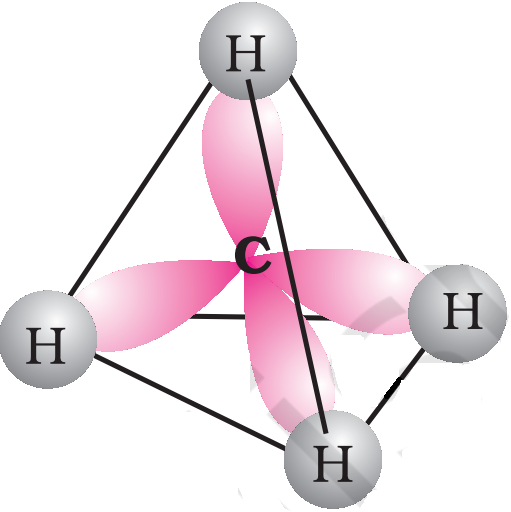
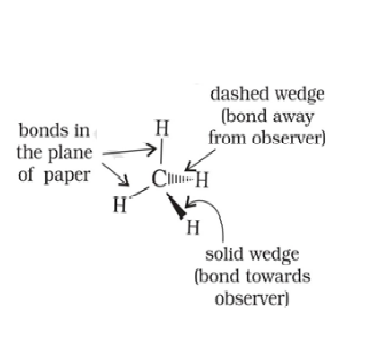
The three-dimensional (3-D) structure of organic molecules can be represented on paper by using certain conventions. For example, by using solid ( ) and dashed ( ) wedge formula, the 3-D image of a molecule from a two-dimensional picture can be perceived. In these formulas the solid-wedge is used to indicate a bond projecting out of the plane of paper, towards the observer. The dashed-wedge is used to depict the bond projecting out of the plane of the paper and away from the observer. Wedges are shown in such a way that the broad end of the wedge is towards the observer. The bonds lying in plane of the paper are depicted by using a normal line (—). 3-D representation of methane molecule on paper has been shown in Figure.

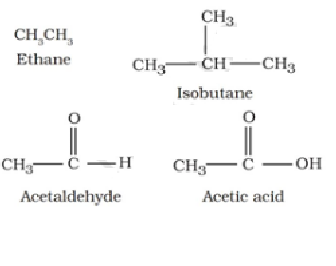
A cyclic or open chain componds these compounds are also called as aliphatic componds and consist of staright or branched chain componds for example:

Cyclic or closed chain or ring compounds
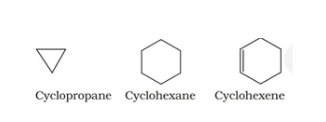
a) Alicyclic compounds Alicyclic (aliphatic cyclic) compounds contain carbon atoms joined in the form of a ring (homocyclic).

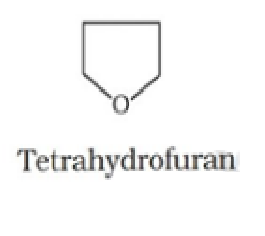
Someetimes atoms other than carbon are also present in the ring (heterocylic). Tetrahydrofuran given below is an example of this types of compound:

These exhibit some of the properties similar to those of aliphatic compounds.
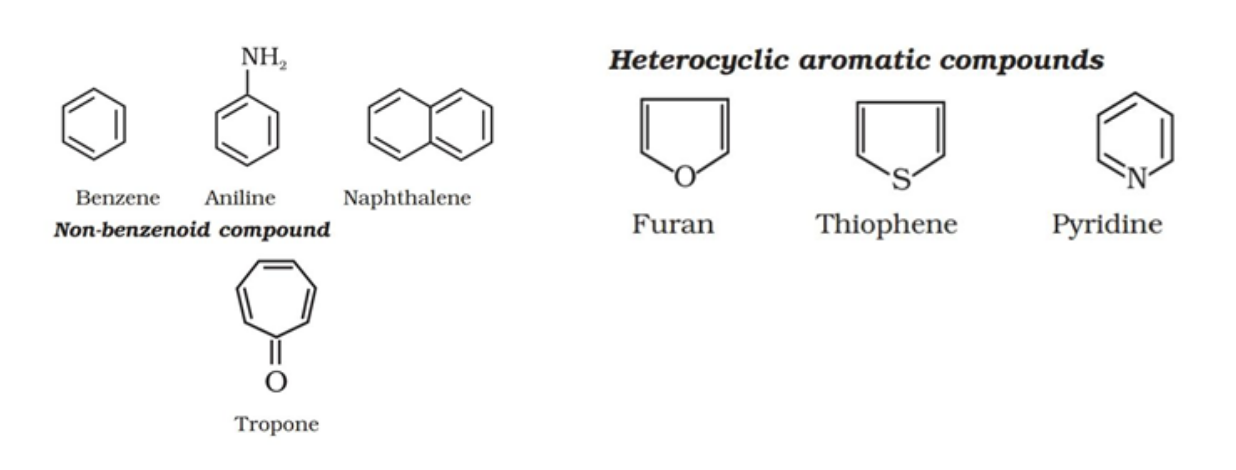
b) Aromatic compounds Aromatic compounds are special types of compounds. These include benzene and other related ring compounds (benzenoid). Like alicyclic compounds, aromatic comounds may also have hetero atom in the ring. Such compounds are called hetrocyclic aromatic compounds. Some of the examples of various types of aromatic compounds are:
Benzenoid aromatic compounds .

Organic compounds can also be classified on the basis of functional groups, into families or homologous series.
Functional Group The functional group is an atom or a group of atoms joined to the carbon chain which is responsible for the characteristic chemical properties of the organic compounds. The examples are hydroxyl group (–OH), aldehyde group (–CHO) and carboxylic acid group (–COOH) etc.
Homologous Series A group or a series of organic compounds each containing a characteristic functional group forms a homologous series and the members of the series are called homologues. The members of a homologous series can be represented by general molecular formula and the successive members differ from each other in molecular formula by a $–CH^2$ unit. There are a number of homologous series of organic compounds. Some of these are alkanes, alkenes, alkynes, haloalkanes, alkanols, alkanals, alkanones, alkanoic acids, amines etc. It is also possible that a compound contains two or more identical or different functional groups. This gives rise to polyfunctional compounds.
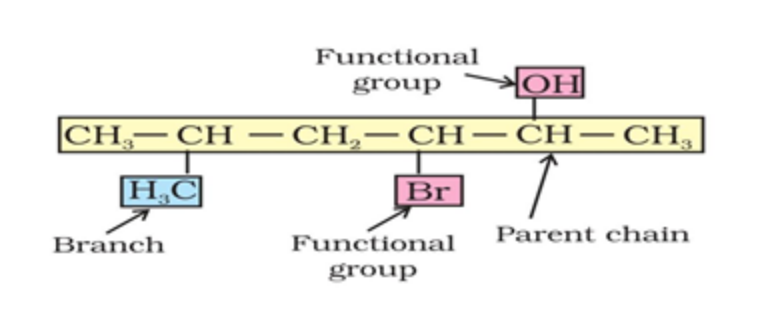
A systematic name of an organic compound is generally derived by identifying the parent hydrocarbon and the functional group(s) attached to it. See the example given below.

By further using prefixes and suffixes, the parent name can be modified to obtain the actual name. Compounds containing carbon and hydrogen only are called hydrocarbons. A hydrocarbon is termed saturated if it contains only carbon-carbon single bonds.
The IUPAC name for a homologous series of such compounds is alkane. Paraffin (Latin: little affinity) was the earlier name given to these compounds. Unsaturated hydrocarbons are those, which contain at least one carbon- carbon double or triple bond. IUPAC Nomenclature of Alkanes Straight chain hydrocarbons: The names of such compounds are based on their chain structure, and end with suffix ‘-ane’ and carry a prefix indicating the number of carbon atoms present in the chain (except from $CH_4$ to $C_4H_{10}$, where the prefixes are derived from trivial names). The IUPAC names of some straight chain saturated hydrocarbons are given in Table. The alkanes in table differ from each other by merely the number of $– CH_2$ groups in the chain. They are homologues of alkane series.
Name Molecular formula Name Molecular Formula
Methane $CH_4$ Heptane $C_7H_{16}$
Ethane $C_2H_6$ Octane $C_8H_{18}$
Propane $C_3H_8$ Nonane $C_9H_{20}$
Butane $C_4H_{10}$ Decane $C_{10}H_{22}$
Pentane $C_5H_{12}$ Icosane $C_{20}H_{42}$
Hexane $C_6H_{14}$ Triacontane $C_{30}H_{62}$
  1. IUPAC is an acronym for …
  1. International Union of Pure and Applied Chemistry
  2. International units of proteins and carbohydrates
  3. International understandings on physical aspects of chemistry
  4. Iodine under packings
  1. In homologous series, the successive members differ from each other in molecular formula by a … unit.
  1. $CH_3$
  2. $CH_2$
  3. $CH$
  4. $CH_4$
  1. A hydrocarbon is termed saturated if it contains only carbon-carbon … bonds.
  1. Triple
  2. Double
  3. Single
  4. Zero
  1. From ….., where the prefixes are derived from… trivial names.
  1. $CH_4$ to $C_2H_6$
  2. $CH_4$ to $C_3H_8$
  3. $CH_4$ to $C_6H_{14}$
  4. $CH_4$ to $C_4H_{10}$
  1. Molecular formula of octane is …
  1. $C_4H_{10}$
  2. $C_6H_{14}$
  3. $C_2H_6$
  4. $C_8H_{18}$
Read the passage given below and answer the following questions from $1$ to $5$.
It is prepared by complete combustion of Carbon and carbon containing fuels in excess Of air.
$\text{C(s)}+\text{O}_2\text{(g)}\xrightarrow{\triangle}\text{CO}_2\text{(g)}$
$\text{CH}_4\text{(g)}+2\text{O}_2\text{(g)}\rightarrow\text{CO}_2\text{(g)}+2\text{H}_2\text{O}\text{(g)}$
In the laboratory it is conveniently Prepared by the action of dilute HCl on calcium Carbonate.
$CaCO_3 (s) + 2HCl (aq) \rightarrow CaCl_2 (aq) + CO_2(g) + H_2O(l)$
$\text{H}_2\text{CO}_3(\text{aq})+\text{H}_2\text{O}\text{(l)}\rightleftharpoons\text{HCO}_3^-\text{(aq)}+\text{H}_3\text{O}^+\text{(aq)}$
$\text{H}\text{CO}_3^-(\text{aq})+\text{H}_2\text{O}\text{(l)}\rightleftharpoons\text{CO}_3^{2-}\text{(aq)}+\text{H}_3\text{O}^+\text{(aq)}$
Buffer system helps to Maintain pH of blood between $7.26$ to $7.42$. Being acidic in nature, it combines with alkalies To form metal carbonates. Carbon dioxide, which is normally present To the extent of $\sim0.03 %$ by volume in the Atmosphere, is removed from it by the process Known as photosynthesis. It is the process By which green plants convert atmospheric $CO_2$ into carbohydrates such as glucose. The Overall chemical change can be expressed as:
$6\text{CO}_2+12\text{H}_2\text{O}\xrightarrow[\text{Chlorophyll}]{\text{hv}}\text{C}_6\text{H}_{12}\text{O}_6+6\text{O}_2$
By this process plants make food for Themselves as well as for animals and human Beings. Unlike $CO$, it is not poisonous. But the Increase in combustion of fossil fuels and Decomposition of limestone for cement Manufacture in recent years seem to increase The $CO_2$ content of the atmosphere. This may Lead to increase in green house effect and Thus, raise the temperature of the atmosphere Which might have serious consequences. Carbon dioxide can be obtained as a solid In the form of dry ice by allowing the liquified $CO_2$ to expand rapidly. Dry ice is used as a Refrigerant for ice-cream and frozen food. Gaseous $CO_2$ is extensively used to carbonate Soft drinks. Being heavy and non-supporter Of combustion it is used as fire extinguisher. A Substantial amount of $CO_2$ is used to Manufacture urea. In $CO_2$ molecule carbon atom undergoes Sp hybridisation. Two sp hybridised orbitals Of carbon atom overlap with two p orbitals of Oxygen atoms to make two sigma bonds while Other two electrons of carbon atom are involved.

In $\text{p}\pi-\text{p}\pi$ bonding with oxyglargeen atom. This Results in its linear shape $[$with both $C–O$ bonds Of equal length $(115 pm)]$ with no dipole Moment. The resonance structures are shown Below: Resonance structures of carbon dioxide.
Silicon Dioxide, $SiO_2 95 \%$ of the earth’s crust is made up of silica And silicates. Silicon dioxide, commonly known As silica, occurs in several crystallographic Forms. Quartz, cristobalite and tridymite are Some of the crystalline forms of silica, and they Are interconvertable at suitable temperature. Silicon dioxide is a covalent, three-dimensional network solid in which each silicon atom is Covalently bonded in a tetrahedral manner to Four oxygen atoms. Each oxygen atom in turn Covalently bonded to another silicon atoms as Shown in diagram. Each corner is Shared with another tetrahedron. The entire Crystal may be considered as giant molecule In which eight membered rings are formed with Alternate silicon and oxygen atoms. Silica in its normal form is almost non- Reactive because of very high $Si—O$ bond Enthalpy. It resists the attack by halogens, Dihydrogen and most of the acids and metals Even at elevated temperatures. However, it is Attacked by HF and NaOH.
$SiO_2 + 2NaOH \rightarrow Na2SiO_3 + H_2O SiO_2 + 4HF \rightarrow SiF_4 + 2H_2O$
Quartz is extensively used as a piezoelectric Material; it has made possible to develop extremely Accurate clocks, modern radio and television Broadcasting and mobile radio communications. Silica gel is used as a drying agent and as a support For chromatographic materials and catalysts. Kieselghur, an amorphous form of silica is used In filtration plants.
Silicones are a group of organosilicon polymers, Which have $(R_2SiO)$ as a repeating unit. The Starting materials for the manufacture of Silicones are alkyl or aryl substituted silicon Chlorides, RnSiCl(4–n), where R is alkyl or aryl Group. When methyl chloride reacts with Silicon in the presence of copper as a catalyst At a temperature $573K$ various types of methyl substituted chlorosilane of formula $MeSiCl_3, Me_2SiCl_2, Me3SiCl$ with small amount of $Me4Si$ Are formed. Hydrolysis of dimethyl- Dichlorosilane, $(CH_3) 2SiCl_2$ followed by Condensation polymerisation yields straight Chain polymers.
A large number of silicates minerals exist in Nature. Some of the examples are feldspar, Zeolites, mica and asbestos. The basic structural unit of silicates is $SiO_4^{4–}$ In which silicon atom is bonded to four Oxygen atoms in tetrahedron fashion. In Silicates either the discrete unit is present or A number of such units are joined together Via corners by sharing $1, 2, 3$ or $4$ oxygen Atoms per silicate units. When silicate units Are linked together, they form chain, ring, Sheet or three-dimensional structures. Negative charge on silicate structure is Neutralised by positively charged metal ions. If all the four corners are shared with other Tetrahedral units, three-dimensional network Is formed. Two important man-made silicates are Glass and cement. Zeolites If aluminium atoms replace few silicon atoms In three-dimensional network of silicon dioxide, Overall structure known as aluminosilicate, Acquires a negative charge. Cations such as $Na+, K+$ Or $Ca_2+$ balance the negative charge. Examples are feldspar and zeolites.
Zeolites are Widely used as a catalyst in petrochemical Industries for cracking of hydrocarbons and Isomerisation, e.g., $ZSM-5$ (A type of zeolite) Used to convert alcohols directly into gasoline. Hydrated zeolites are used as ion exchangers In softening of “hard” water.
  1. … is used as a Refrigerant for ice-cream and frozen food.
  1. Dry ice
  2. Wet ice
  3. Crescent Ice
  4. Nugget Ice
  1. $H_2CO_3$ is a …
  1. strong dibasic acid
  2. weak dibasic acid
  3. weak diacidic base
  4. Strong diacidic base
  1. … is extensively used as a piezoelectric Material.
  1. Glass
  2. Ferrite
  3. Quartz
  4. Saphire
  1. … an amorphous form of silica is used In filtration plants.
  1. Ferrite
  2. Quartz
  3. Saphire
  4. Kieselghur
  1. Which of the following is not an example of silicate mineral ?
  1. feldspar
  2. mica
  3. asbestos
  4. hematite
Once an organic compound is extracted from a natural source or synthesised in the laboratory, it is essential to purify it. Various methods used for the purification of organic compounds are based on the nature of the compound and the impurity present in it. Finally, the purity of a compound is ascertained by determining its melting or boiling point. This is one of the most commonly used techniques for the purification of solid organic compounds. In crystallisation Impurities, which impart colour to the solution are removed by adsorbing over activated charcoal. In distillation Liquids having different boiling points vaporise at different temperatures. The vapours are cooled and the liquids so formed are collected separately. Steam Distillation is applied to separate substances which are steam volatile and are immiscible with water. Distillation under reduced pressure: This method is used to purify liquids having very high boiling points.

i. Which method can be used to separate two compounds with different solubilities in a solvent?
ii. Distillation method is used to separate which type of substance?
iii. Which technique is used to separate aniline from aniline water mixture?
OR
Why chloroform and aniline are easily separated by the technique of distillation?
Read the passage given below and answer the following questions from $1$ to $5$.
The term ‘hydrocarbon’ is self-explanatory which means compounds of carbon and hydrogen only. Hydrocarbons play a key role in our daily life. You must be familiar with the terms ‘LPG’ and ‘CNG’ used as fuels. LPG is the abbreviated form of liquified petroleum gas whereas CNG stands for compressed natural gas. Another term ‘LNG’ (liquified natural gas) is also in news these days. This is also a fuel and is obtained by liquifaction of natural gas. Petrol, diesel and kerosene oil are obtained by the fractional distillation of petroleum found under the earth’s crust. Coal gas is obtained by the destructive distillation of coal. Natural gas is found in upper strata during drilling of oil wells. The gas after compression is known as compressed natural gas. LPG is used as a domestic fuel with the least pollution. Kerosene oil is also used as a domestic fuel but it causes some pollution. Automobiles need fuels like petrol, diesel and CNG. Petrol and CNG operated automobiles cause less pollution. All these fuels contain mixture of hydrocarbons, which are sources of energy. Hydrocarbons are also used for the manufacture of polymers like polythene, polypropene, polystyrene etc. Higher hydrocarbons are used as solvents for paints. They are also used as the starting materials for manufacture of many dyes and drugs. Thus, you can well understand the importance of hydrocarbons in your daily life. In this unit, you will learn more about hydrocarbons.
Classification Hydrocarbons are of different types. Depending upon the types of carbon-carbon bonds present, they can be classified into three main categories – (i) saturated
(ii) unsaturated and
(iii) aromatic hydrocarbons. Saturated hydrocarbons contain carbon-carbon and carbon-hydrogen single bonds. If different carbon atoms are joined together to form open chain of carbon atoms with single bonds, they are termed as alkanes. On the other hand, if carbon atoms form a closed chain or a ring, they are termed as cycloalkanes. Unsaturated hydrocarbons contain carbon-carbon multiple bonds – double bonds, triple bonds or both. Aromatic hydrocarbons are a special type of cyclic compounds. You can construct a large number of models of such molecules of both types (open chain and close chain) keeping in mind that carbon is tetravalent and hydrogen is monovalent. For making models of alkanes, you can use toothpicks for bonds and plasticine balls for atoms. For alkenes, alkynes and aromatic hydrocarbons, spring models can be constructed.
Alkanes As already mentioned, alkanes are saturated open chain hydrocarbons containing carbon – carbon single bonds. Methane $(CH_4)$ is the first member of this family. Methane is a gas found in coal mines and marshy places. If replace one hydrogen atom of methane by carbon and join the required number of hydrogens to satisfy the tetravalence of the other carbon atom,it get $C_2H_6$. This hydrocarbon with molecular formula $C_2H_6$ is known as ethane. Thus it can consider $C_2H_6$ as derived from $CH_4$ by replacing one hydrogen atom by $-CH_3$ group. Go on constructing alkanes by doing this theoretical exercise i.e., replacing hydrogen atom by $–CH_3$ group. The next molecules will be $C_3H_8, C_4H_{10} …$

These hydrocarbons are inert under normal conditions as they do not react with acids, bases and other reagents. Hence, they were earlier known as paraffins (latin: parum, little; affinis, affinity). the general formula for alkanes is $C_nH_2n + 2$. It represents any particular homologue when n is given appropriate value. methane has a tetrahedral structure, in which carbon atom lies at the centre and the four hydrogen atoms lie at the four corners of a regular tetrahedron. All H-C-H bond angles are of $109.5^\circ$ .
In alkanes, tetrahedra are joined together in which C-C and C-H bond lengths are 154 pm and 112 pm respectively. We have already read that C–C and C–H $\sigma$ bonds are formed by head-on overlapping of sp 3 hybrid orbitals of carbon and 1s orbitals of hydrogen atoms.
Difference in properties is due to difference in their structures, they are known as structural isomers. structural isomers which differ in chain of carbon atoms are known as chain isomers.
Preparation- Petroleum and natural gas are the main sources of alkanes. However, alkanes can be prepared by following methods:

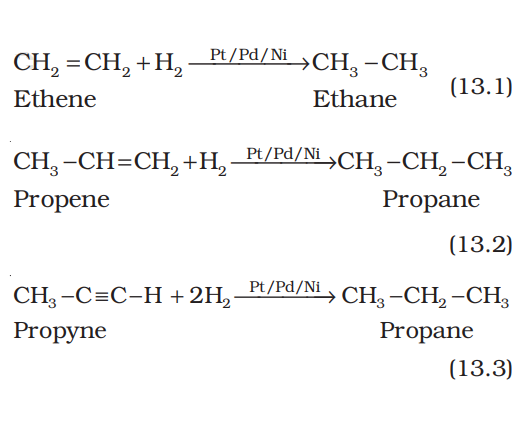
1) From unsaturated hydrocarbons Dihydrogen gas adds to alkenes and alkynes in the presence of finely divided catalysts like platinum, palladium or nickel to form alkanes. This process is called hydrogenation. These metals adsorb dihydrogen gas on their surfaces and activate the hydrogen – hydrogen bond. Platinum and palladium catalyse the reaction at room temperature but relatively higher temperature and pressure are required with nickel catalysts.
2) From alkyl halides
i) Alkyl halides (except fluorides) on reduction with zinc and dilute hydrochloric acid give alkanes.

ii) Alkyl halides on treatment with sodium metal in dry ethereal (free from moisture) solution give higher alkanes. This reaction is known as Wurtz reaction and is used for the preparation of higher alkanes containing even number of carbon atoms.
  1. Which of the following catalyst is used for hydrogenation…
  1. platinum
  2. palladium
  3. nickel
  4. All the above
  1. LPG stands for ….
  1. Liquid Pressure Gas
  2. Liquefied Petroleum Gas
  3. Liquid Platinum Gas
  4. Liquid Processed Gas
  1. Difference in properties is due to difference in their structures, they are known as …. isomers.
  1. Functional
  2. Positional
  3. Structural
  4. Chain
  1. Structural isomers which differ in chain of carbon atoms are known as… isomers.
  1. Functional
  2. Positional
  3. Structural
  4. Chain
  1. CNG Stands for ..
  1. Compressed Natural Gas
  2. Condensed Natural Gas
  3. Compressed Neutral Gas
  4. Compressed Neutral Gallium
The ionic character of metallic halides tends toward covalent nature as per Fajan's rule. Such covalent halides behave as non-metal in their higher oxidation states. The property to hydrolyse to give oxy-acids of the element and corresponding hydro halogen acid for most non-metallic elements proceeds exceptionally in the way, keeping oxidation number of element and halide sam in oxo-acids.
Non-polar halides are immiscible in water, as they do not show hydrolysis, but halides of some elements with empty d-orbital undergo hydrolysis. Stability of halides of the higher state is governed by the inert-pair effect.

1. How does halide undergo hydrolysis to give oxy-acids of underlined element $PCl _3$ ? (1)
2. Out of $NCl _3$ and $BCl _3$ undergoes hydrolysis to form oxy-acids? Write the chemical reaction for the correct answer. (1)
3. Out of $PbCl _4, PbF _4, PbI _4$ and $PbBr _4$ which one doesn't exist? (2)
OR
Non-Polar halides are immiscible in water. Why? (2)
Read the passage given below and answer the following questions from (i) to (v).
It is well known fact that liquids assume theshape of the container. Why is it then smalldrops of mercury form spherical bead insteadof spreading on the surface. Why do particlesof soil at the bottom of river remain separatedbut they stick together when taken out? Whydoes a liquid rise (or fall) in a thin capillary assoon as the capillary touches the surface ofthe liquid? All these phenomena are causeddue to the characteristic property of liquids,called surface tension. A molecule in the bulkof liquid experiences equal intermolecularforces from all sides. The molecule, thereforedoes not experience any net force. But for themolecule on the surface of liquid, net attractiveforce is towards the interior of the liquid, due to the molecules below it. Since thereare no molecules above it.Liquids tend to minimize their surface area.The molecules on the surface experience a netdownward force and have more energy than the molecules in the bulk, which do notexperience any net force. Therefore, liquids tendto have minimum number of molecules at theirsurface. If surface of the liquid is increased bypulling a molecule from the bulk, attractiveforces will have to be overcome. This willrequire expenditure of energy. The energyrequired to increase the surface area of theliquid by one unit is defined as surface energy.Its dimensions are Jm. Surface tension isdefined as the force acting per unit lengthperpendicular to the line drawn on the surfaceof liquid. It is denoted by Greek letter γ(Gamma). It has dimensions of kg $s^{–2}$ and in SIunit it is expressed as $Nm^{–1}.$
The lowest energystate of the liquid will be when surface area isminimum. Liquid tends to rise (or fall) in the capillarybecause of surface tension. Liquids wet thethings because they spread across their surfacesas thin film. Moist soil grains are pulled togetherbecause surface area of thin film of water isreduced. It is surface tension which givesstretching property to the surface of a liquid.On flat surface, droplets are slightly flattenedby the effect of gravity; but in the gravity freeenvironments drops are perfectly spherical. Viscosity is a measure of resistance toflow which arises due to the internal frictionbetween layers of fluid as they slip past oneanother while liquid flows. Strongintermolecular forces between molecules holdthem together and resist movement of layerspast one another.
When a liquid flows over a fixed surface,the layer of molecules in the immediate contactof surface is stationary. The velocity of upperlayers increases as the distance of layers fromthe fixed layer increases. This type of flow inwhich there is a regular gradation of velocityin passing from one layer to the next is calledlaminar flow.‘$ η’$ is proportionality constant and is calledcoefficient of viscosity. Viscosity coefficientis the force when velocity gradient is unity andthe area of contact is unit area. Thus ‘$ η’$ ismeasure of viscosity. SI unit of viscositycoefficient is $1$ newton second per square metre $\left( N s m ^{-2}\right)=$ pascal second (Pa s $\left.=1 g cm ^{-1} s^{-1}\right)$. Incgs system the unit of coefficient of viscosity ispoise (named after great scientist Jean LouisePoiseuille). 1 poise $=1 g cm ^{-1} S^{-1}=10^{-1} kg m ^{-1} S^{-1}$ Greater the viscosity, the more slowly theliquid flows. Hydrogen bonding and van derWaals forces are strong enough to cause highviscosity. Glass is an extremely viscous liquid.It is so viscous that many of its propertiesresemble solids.Viscosity of liquids decreases as thetemperature rises because at high temperaturemolecules have high kinetic energy and canovercome the intermolecular forces to slip pastone another between the layers.
  1. The dimension of surface energy is:
  1. $Jm^{–2}$
  2. $Jm^2$
  3. $Kjm^{–2}$
  4. $Kjm^2$
  1. 1 poise =
  1. $1cmskg^{-1}$
  2. $1gcm^{–1}s^{–1}$
  3. $1gcms^–1$
  4. $1gcm^{–1}s$
  1. Which of the following is most viscous liquid?
  1. Glass
  2. Water
  3. Mercury
  4. Kerosene
  1. Surface Tension denoteed by greek letter...
  1. $\in$
  2. $\zeta$
  3. $\delta$
  4. $\gamma$
  1. Flow in which there is a regular gradation of velocity in passing from one layer to the next is called:
  1. Turbulent flow
  2. Shear flow
  3. Streamline flow
  4. laminar flow.
Lewis dot structures, in general, do notrepresent the actual shapes of the molecules.In case of polyatomic ions, the net charge ispossessed by the ion as a whole and not by aparticular atom. It is, however, feasible toassign a formal charge on each atom. Theformal charge of an atom in a polyatomicmolecule or ion may be defined as thedifference between the number of valenceelectrons of that atom in an isolated or freestate and the number of electrons assignedto that atom in the Lewis structure. It isexpressed as :Generally the lowest energystructure is the one with the smallestformal charges on the atoms. The formalcharge is a factor based on a pure covalentview of bonding in which electron pairsare shared equally by neighbouring atoms. The octet rule, though useful, is not universal.It is quite useful for understanding thestructures of most of the organic compoundsand it applies mainly to the second periodelements of the periodic table. There are threetypes of exceptions to the octet rule.
  • The incomplete octet of the central atom
  • Odd-electron molecules
  • The expanded octetFrom the Kössel and Lewis treatment of theformation of an ionic bond, it follows that theformation of ionic compounds wouldprimarily depend upon:
  • The ease of formation of the positive andnegative ions from the respective neutralatoms;
  • The arrangement of the positive andnegative ions in the solid, that is, thelattice of the crystalline compound.
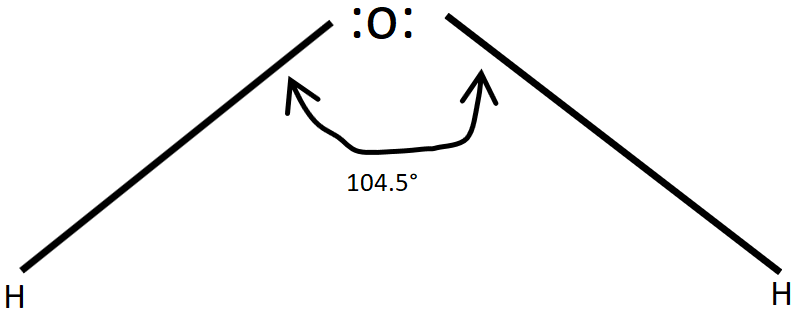
The Lattice Enthalpy of an ionic solid is defined as the energy required to completely separate one mole of a solid ionic compound into gaseous constituent ions. For example, the lattice enthalpy of NaCl is 788 kJ mol–1. This means that 788 kJ of energy is required to separate one mole of solid NaCl into one mole of Na+ (g) and one mole of Cl– (g) to an infinite distance.Bond length is defined as the equilibriumdistance between the nuclei of two bondedatoms in a molecule. Bond lengths aremeasured by spectroscopic, X-ray diffractionand electron-diffraction techniques . The covalent radius is measuredapproximately as the radius of an atom’score which is in contact with the core ofan adjacent atom in a bonded situation. The vander Waals radius represents the overall sizeof the atom which includes its valence shellin a nonbonded situation. Bond Angle is defined as the angle between the orbitalscontaining bonding electron pairs around thecentral atom in a molecule/complex ion. Bondangle is expressed in degree which can beexperimentally determined by spectroscopicmethods. It gives some idea regarding thedistribution of orbitals around the centralatom in a molecule/complex ion and hence ithelps us in determining its shape. Forexample H–O–H bond angle in water can berepresented as under:

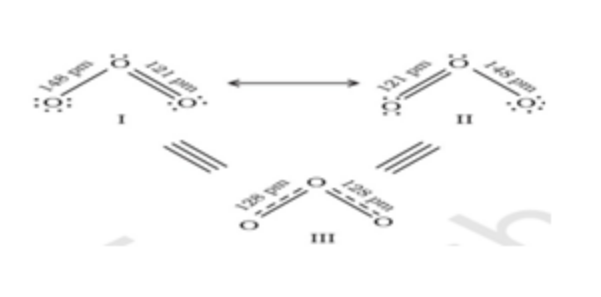
Bond Enthalpy It is defined as the amount of energy required to break one mole of bonds of a particular type between two atoms in a gaseous state. The unit of bond enthalpy is $kJ mol ^{-1}$. For example, the $H - H$ bond enthalpy in hydrogen molecule is $435.8 kJ mol ^{-1} \cdot H _2(g) \rightarrow H ( g )+ H ( g ) ; \Delta_{ a } H =435.8 kJ mol ^{-1}$. Bond Orderln the Lewis description of covalent bond, the Bond Order is given by the number ofbonds between the two atoms in amolecule. The bond order, for example in $H _2$ (with a single shared electron pair), in $O _2$ (with two shared electron pairs) and in $N _2$ (with three shared electron pairs) is 1,2,3respectively. A general correlation useful forunderstanding the stablities of moleculesis that: with increase in bond order, bondenthalpy increases and bond lengthdecreases. The concept of resonance was introducedto deal with the type of difficulty experiencedin the depiction of accurate structures ofmolecules like $O _3$. According to the conceptof resonance, whenever a single Lewis structure cannot describe a moleculeaccurately, a number of structures with similar energy, positions of nuclei, bonding and non-bonding pairs of electrons are taken as the canonical structures of the hybrid which describes the molecule accurately.

Thus for $O_3$, the two structures shown above constitute the canonical structures or resonance structures and their hybrid i.e., theIII structure represents the structure of $O_3$ more accurately. This is also called resonance hybrid. Resonance is represented by a double headed arrow. In general, it may be stated that
  • Resonance stabilizes the molecule as the energy of the resonance hybrid is lessthan the energy of any single cannonical structure; and,
  • Resonance averages the bond characteristics as a whole. Thus the energy of the$O_3$ . resonancehybrid is lower than either of the two cannonical froms I and II.
  1. Which of the following techniques used to measure bond length?
  1. Spectroscopic techniques
  2. X-ray diffraction
  3. Electron-diffraction techniques
  4. All the above
  1. The unit of bond enthalpy is …
  1. $kJ mol^{–1}$
  2. $Cal mol^{-1}$
  3. $Cal$ mol
  4. $kJ$ mol
  1. With increase in bond order, bond enthalpy… and bond length ….
  1. Decreases, decreases
  2. Increases, decreases
  3. Increases, increases
  4. Decreases, increases
  1. The …. is measured approximately as the radius of an atom’s core which is in contact with the core of an adjacent atom in a bonded situation.
  1. Ionic radius
  2. Metallic radius
  3. Covalent radius
  4. None of above
  1. … is given by the number of bonds between the two atoms in a molecule.
  1. Bond Order
  2. Bond size
  3. Bond enthalpy
  4. Bond angle
Read the passage given below and answer the following questions from 1 to 5.
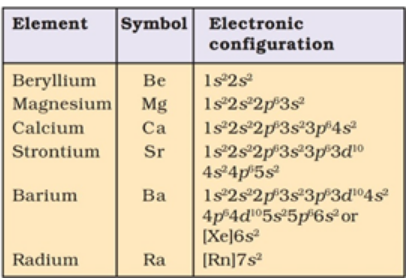
Alkaline earth elements have two electrons in the s - orbital of the valence shell. Their general electronic configuration may be represented as [noble gas] $ns^2$. Like alkali metals, the compounds of these elements are also predominantly ionic.

The atomic and ionic radii of the alkaline earth metals are smaller than those of the corresponding alkali metals in the same periods. This is due to the increased nuclear charge in these elements. Within the group, the atomic and ionic radii increase with increase in atomic number.
The alkaline earth metals have low ionization enthalpies due to fairly large size of the atoms. Since the atomic size increases down the group, their ionization enthalpy decreases. The first ionisation enthalpies of the alkaline earth metals are higher than those of the corresponding Group 1 metals. This is due to their small size as compared to the corresponding alkali metals. It is interesting to note that the second ionisation enthalpies of the alkaline earth metals are smaller than those of the corresponding alkali metals.
Like alkali metal ions, the hydration enthalpies of alkaline earth metal ions decrease with increase in ionic size down the group. $Be^{2+}> Mg^2+ > Ca^{2+} > Sr^{2+} > Ba^{2+}$ The hydration enthalpies of alkaline earth metal ions are larger than those of alkali metal ions. Thus, compounds of alkaline earth metals are more extensively hydrated than those of alkali metals, e.g., $MgCl_2$ and $CaCl_2$ exist as $MgCl_{2.}6H_2O$ and $CaCl_2· 6H_2O$ while NaCl and KCl do not form such hydrates.
The alkaline earth metals, in general, are silvery white, lustrous and relatively soft but harder than the alkali metals. Beryllium and magnesium appear to be somewhat greyish. The melting and boiling points of these metals are higher than the corresponding alkali metals due to smaller sizes. The trend is, however, not systematic. Because of the low ionisation enthalpies, they are strongly electropositive in nature. The electropositive character increases down the group from Be to Ba. Calcium, strontium and barium impart characteristic brick red, crimson and apple green colours respectively to the flame. In flame the electrons are excited to higher energy levels and when they drop back to the ground state, energy is emitted in the form of visible light. The electrons in beryllium and magnesium are too strongly bound to get excited by flame. Hence, these elements do not impart any colour to the flame. The flame test for Ca, Sr and Ba is helpful in their detection in qualitative analysis and estimation by flame photometry. The alkaline earth metals like those of alkali metals have high electrical and thermal conductivities which are typical characteristics of metals.
Chemical Properties- The alkaline earth metals are less reactive than the alkali metals. The reactivity of these elements increases on going down the group.
i) Reactivity towards air and water: Beryllium and magnesium are kinetically inert to oxygen and water because of the formation of an oxide film on their surface. Magnesium is more electropositive and burns with dazzling brilliance in air to give $MgO$ and $Mg_3N_2$​​​​​​​. Calcium, strontium and barium are readily attacked by air to form the oxide and nitride.
ii) Reactivity towards the halogens: All the alkaline earth metals combine with halogen at elevated temperatures forming their halides.
$M+X_2\rightarrow Mx_2(x=F, Cl, Br, l)$
iii) Reactivity towards hydrogen: All the elements except beryllium combine with hydrogen upon heating to form their hydrides, $MH_2. BeH_2​​​​​​​$, however, can be prepared by the reaction of $BeCl_2$ with $LiAlH_4$​​​​​​​
2 $BeCl_2+ LiAlH_4\rightarrow 2BeH_2+ LiCl+AlCl_3$​​​​​​​
iv) Reactivity towards acids: The alkaline earth metals readily react with acids liberating dihydrogen. $M + 2HCl \rightarrow MCl_2 + H_2$​​​​​​​
v) Reducing nature: Like alkali metals, the alkaline earth metals are strong reducing agents. This is indicated by large negative values of their reduction potentials. However their reducing power is less than those of their corresponding alkali metals. Beryllium has less negative value compared to other alkaline earth metals
vi) Solutions in liquid ammonia: Like alkali metals, the alkaline earth metals dissolve in liquid ammonia to give deep blue black solutions forming ammoniated ions.
$\text{M}+(\text{x+y})\text{NH}_3\rightarrow \big[\text{M}(\text{NH}_3)\text{X}\big]^{2+}+2\big[\text{e}(\text{NH}_3)\text{y}\big]^-$
From these solutions, the ammoniates, $\big[\text{M}(\text{NH}_3)6\big]^{2+}$can be recovered.
Beryllium is used in the manufacture of alloys. Copper - beryllium alloys are used in the preparation of high strength springs. Metallic beryllium is used for making windows of X-ray tubes. Magnesium forms alloys with aluminium, zinc, manganese and tin. Magnesium-aluminium alloys being light in mass are used in air-craft construction. Magnesium (powder and ribbon) is used in flash powders and bulbs, incendiary bombs and signals. A suspension of magnesium hydroxide in water (called milk of magnesia) is used as antacid in medicine. Magnesium carbonate is an ingredient of toothpaste. Calcium is used in the extraction of metals from oxides which are difficult to reduce with carbon. Calcium and barium metals, owing to their reactivity with oxygen and nitrogen at elevated temperatures, have often been used to remove air from vacuum tubes. Radium salts are used in radiotherapy, for example, in the treatment of cancer.
  1. The atomic and ionic radii of the alkaline earth metals are … than those of the corresponding alkali metals in the same periods.
  1. smaller
  2. bigger
  3. different
  4. None of above
  1. Within the group, the atomic and ionic radii of alkaline earth metals … with … in atomic number.
  1. increase, decrease
  2. increase, increase
  3. decrease, increase
  4. decrease, decrease
  1. Alkaline earth elements have … electrons in the s -orbital of the valence shell.
  1. Zero
  2. One
  3. Two
  4. Three
  1. Ionization enthalpy …. down the group of alkaline earth metals.
  1. first increases then decreases
  2. first decreases then increases
  3. increase
  4. decreases
  1. The hydration enthalpies of alkaline earth metal ions … with … in ionic size down the group.
  1. increase, decrease
  2. increase, increase
  3. decrease, increase
  4. decrease, decrease
Read the passage given below and answer the following questions from (i) to (v).
When covalent bond is formed betweentwo similar atoms, for example in $H _2, O _2, Cl _2, N_2 Or F _2$, the shared pair of electrons is equally Attracted by the two atoms. As a result electronPair is situated exactly between the twoldentical nuclei. The bond so formed is calledNonpolar covalent bond. As a result of polarisation, the moleculePossesses the dipole moment which can be defined as the productof the magnitude of the charge and theDistance between the centres of positive andNegative charge. It is usually designated by aGreek letter ' $\mu$ '. Mathematically, it is expressedAs follows :Dipole moment $(\mu)=$ charge $( Q ) \times$ distance ofSeparationDipole moment is usually expressed inDebye units (D). The conversion factor is $1 D =3.33564 \times 10^{-30} C$ mWhere C is coulomb and m is meter. Just as all the covalent bonds haveSome partial ionic character, the ionicBonds also have partial covalentCharacter. The partial covalent character of ionic bonds was discussed by Fajans in terms of the following rules:
- The smaller the size of the cation and theLarger the size of the anion, the greater theCovalent character of an ionic bond.
- The greater the charge on the cation, theGreater the covalent character of the ionic bond.
- For cations of the same size and charge, The one, with electronic configuration( $n -1) d ^0 n s ^0$, typical of transition metals, isMore polarising than the one with a nobleGas configuration, ns2 np6, typical of alkali and alkaline earth metal cations.

Sidgwick and Powell in 1940, proposed a simple theoryBased on the repulsive interactions of theElectron pairs in the valence shell of the atoms.It was further developed and redefined byNyholm and Gillespie (1957).The main postulates of VSEPR theory areAs follows:
- The shape of a molecule depends uponThe number of valence shell electron pairs(bonded or nonbonded) around the centralAtom.
- Pairs of electrons in the valence shell repelone another since their electron clouds arenegatively charged.
- These pairs of electrons tend to occupySuch positions in space that minimiseRepulsion and thus maximise distanceBetween them.
- The valence shell is taken as a sphere withThe electron pairs localising on theSpherical surface at maximum distanceFrom one another.
- A multiple bond is treated as if it is a singleElectron pair and the two or three electronPairs of a multiple bond are treated as aSingle super pair.
- Where two or more resonance structuresCan represent a molecule, the VSEPRModel is applicable to any such structure.
 The arrangement of electron pairs and the atoms around the central atom can be : linear,Trigonal planar, tetrahedral, trigonal-Bipyramidal and octahedral. Valence bond theory was introduced byHeitler and London (1927) and developedFurther by Pauling and others. A discussionOf the valence bond theory is based on the knowledge of atomic orbitals, electronicConfigurations of elements.partialmerging of atomic orbitals is called overlappingof atomic orbitals which results in the pairingof electrons. The extent of overlap decides thestrength of a covalent bond. according toorbital overlap concept, the formation of acovalent bond between two atoms results bypairing of electrons present in the valence shellhaving opposite spins. When orbitals of two atoms come close to formbond, their overlap may be positive, negativeor zero depending upon the sign anddirection of orientation of amplitude of orbitalwave function in space. Positive andnegative sign on boundary surface diagramsin the show the sign (phase) of orbitalwave function and are not related to charge.Orbitals forming bond should have same sign(phase) and orientation in space. This is calledpositive overlap. The criterion of overlap, as the main factorfor the formation of covalent bonds appliesuniformly to the homonuclear/heteronucleardiatomic molecules and polyatomic molecules.
  1. Dipole moment is usually expressed in….
  1. Debye
  2. Centimeter
  3. Columbs
  4. Ergs
  1. 1D = .....
  1. $33564\times 10^{–28}Cm$
  2. $3.3564\times 10^{–30}Cm$
  3. $33564\times 10^{–32}Cm$
  4. $33564\times 10^{–34}Cm$
  1. Valence bond theory was introduced by ….
  1. Pauling and lewis
  2. Nyholm and Gillespie
  3. Heitler and London
  4. Sidgwick and Powell
  1. Pair is situated exactly between the two Identical nuclei the bond so formed is called …. covalent bond.
  1. Unipolar
  2. Bipolar
  3. Polar
  4. Nonpolar
  1. Pairs of electrons in the valence shell … one another since their electron clouds are negatively charged.
  1. Attract
  2. Repel
  3. Both a) & b)
  4. None if above
Read the passage given below and answer the following questions from $(i)$ to $(v).$
Predicting the Direction of the Reaction- The equilibrium constant helps in predicting the direction in which a given reaction will proceed at any stage. For this purpose, we calculate the reaction quotient $Q$. The reaction quotient, $Q (Qc$ with molar concentrations and $QP$ with partial pressures$)$ is defined in the same way as the equilibrium constant Kc except that the concentrations in $Qc$ are not necessarily equilibrium values. For a general reaction:
$\text{a}\text{A}+\text{b}\text{B}\rightleftharpoons\text{c}\text{C}+\text{d}\text{D}$
$\text{Q}\text{c}=\frac{[\text{C}]^\text{c}[\text{D}]^\text{d}}{[\text{A}]^\text{a}[\text{B}]^\text{b}}$
Then,
If $Qc > Kc,$ the reaction will proceed in the direction of reactants (reverse reaction).
If $Qc < Kc,$ the reaction will proceed in the direction of the products (forward reaction).
If $Qc = Kc,$ the reaction mixture is already at equilibrium. Consider the gaseous reaction of $H_2$ with $I_2$ ,
$\text{H}_{2(\text{g})}+\text{l}_{2(\text{g})}\rightleftharpoons2\text{Hl}_{(\text{g})};\text{kc}=57.0\text{at}700\text{k}.$
Suppose we have molar concentrations $[H_2 ]t =0.10M, [I_2 ]t = 0.20 M$ and $[HI]t = 0.40 M.$ (the subscript t on the concentration symbols means that the concentrations were measured at some arbitrary time t, not necessarily at equilibrium). Thus, the reaction quotient, Qc at this stage of the reaction is given by,
$\text{Qc}=\frac{[\text{Hl}]\text{t}^2}{[\text{H}]^2]_\text{t}[\text{l}_2]_\text{t}}=\frac{(0.40)_2}{(0.10)\times(0.20)}=8.0$
Now, in this case, $Qc (8.0)$ does not equal Kc $(57.0)$, so the mixture of $H2 _{(g)}, I2 _{(g)} $ and $HI_{(g)} $ is not at equilibrium; that is, more $H2 _{(g)} $ and $I 2 _{(g)} $ will react to form more $HI_{(g)} $ and their concentrations will decrease till $Qc = Kc.$ The reaction quotient, Qc is useful in predicting the direction of reaction by comparing the values of Qc and Kc.Thus, we can make the following generalisations concerning the direction of the reaction
If $Qc < Kc,$ net reaction goes from left to right
If $Qc > Kc,$ net reaction goes from right to left.
If $Qc = Kc,$ no net reaction occurs.
Calculating Equilibrium Concentrations In case of a problem in which we know the initial concentrations but do not know any of the equilibrium concentrations, the following three steps shall be followed:
Step 1) Write the balanced equation for the reaction.
Step 2) Under the balanced equation, make a table that lists for each substance involved in the reaction: $(a)$ the initial concentration, $(b)$ the change in concentration on going to equilibrium, and $(c)$ the equilibrium concentration. In constructing the table, define $x$ as the concentration (mol/L) of one of the substances that reacts on going to equilibrium, then use the stoichiometry of the reaction to determine the concentrations of the other substances in terms of $x.$
Step 3) Substitute the equilibrium concentrations into the equilibrium equation for the reaction and solve for x. If you are to solve a quadratic equation choose the mathematical solution that makes chemical sense.
Step 4) Calculate the equilibrium concentrations from the calculated value of $x.$
Step 5) Check your results by substituting them into the equilibrium equation.
Relationship between equilibrium constant K, reaction quotient Q and gibbs energy G The value of Kc for a reaction does not depend on the rate of the reaction. However, it is directly related to the thermodynamics of the reaction and in particular, to the change in Gibbs energy, $\triangle\text{G}.$ If,
$\triangle\text{G}$ is negative, then the reaction is spontaneous and proceeds in the forward direction.
$\triangle\text{G}$ is positive, then reaction is considered non-spontaneous. Instead, as reverse reaction would have a negative $\triangle\text{G},$ the products of the forward reaction shall be converted to the reactants.
$\triangle\text{G}$ is 0, reaction has achieved equilibrium; at this point, there is no longer any free energy left to drive the reaction. A mathematical expression of this thermodynamic view of equilibrium can be described by the following equation:
$\triangle\text{G}=\triangle\text{G}^\phi+\text{RT}\text{lnQ}$
where, $\triangle\text{G}^\phi$ is standard Gibbs energy. At equilibrium, when $\triangle\text{G}=0$ and $Q = Kc,$ the equation becomes,
$\triangle\text{G}=\text{G}^\phi+\text{RT}\text{lnk}=0$
$\triangle\text{G}^\phi=-\text{RT}\text{lnk}$
$\text{Ink}=\frac{-\triangle\text{G}^\phi}{\text{RT}}$
Taking antilog of both sides, we get,
$\text{K}=\text{e}-\frac{\triangle\text{G}0}{\text{RT}}$
Hence, using the equation, the reaction spontaneity can be interpreted in terms of the value of $\triangle\text{G}^\phi.$
If $\triangle\text{G}^\phi>0$ then $\frac{-\triangle\text{G}^\phi}{\text{RT}}$ is positive, and $>1$, making $K > 1$, which implies a spontaneous reaction or the reaction which proceeds in the forward direction to such an extent that the products are present predominantly.
If $\triangle\text{G}^\phi>0,$ then $\frac{-\triangle\text{G}^\phi}{\text{RT}}$ is negative, and $< 1$, that is, $K < 1$, which implies a non-spontaneous reaction or a reaction which proceeds in the forward direction to such a small degree that only a very minute quantity of product is formed.
Factors affecting equilibria One of the principal goals of chemical synthesis is to maximise the conversion of the reactants to products while minimizing the expenditure of energy. This implies maximum yield of products at mild temperature and pressure conditions. If it does not happen, then the experimental conditions need to be adjusted. For example, in the Haber process for the synthesis of ammonia from $N_2$ and $H_2,$ the choice of experimental conditions is of real economic importance. Annual world production of ammonia is about hundred million tones, primarily for use as fertilizers. Equilibrium constant, Kc is independent of initial concentrations. But if a system at equilibrium is subjected to a change in the concentration of one or more of the reacting substances, then the system is no longer at equilibrium; and net reaction takes place in some direction until the system returns to equilibrium once again. Similarly, a change in temperature or pressure of the system may also alter the equilibrium. In order to decide what course the reaction adopts and make a qualitative prediction about the effect of a change in conditions on equilibrium we use Le Chatelier’s principle. It states that a change in any of the factors that determine the equilibrium conditions of a system will cause the system to change in such a manner so as to reduce or to counteract the effect of the change. This is applicable to all physical and chemical equilibria.
Effect of Concentration Change In general, when equilibrium is disturbed by the addition/removal of any reactant/ products, Le Chatelier’s principle predicts that:
The concentration stress of an added reactant/product is relieved by net reaction in the direction that consumes the added substance.
The concentration stress of a removed reactant/product is relieved by net reaction in the direction that replenishes the removed substance. or in other words, “When the concentration of any of the reactants or products in a reaction at equilibrium is changed, the composition of the equilibrium mixture changes so as to minimize the effect of concentration changes”. Let us take the reaction,
$\text{H}_{2(\text{g})}+\text{l}_{2(\text{g})}\rightleftharpoons2\text{Hl}_{(\text{g})}$
If $H_2$ is added to the reaction mixture at equilibrium, then the equilibrium of the reaction is disturbed. In order to restore it, the reaction proceeds in a direction wherein $H_2$ is consumed, i.e., more of $H_2$ and $I_2$ react to form HI and finally the equilibrium shifts in right (forward) direction. This is in accordance with the Le Chatelier’s principle which implies that in case of addition of a reactant/product, a new equilibrium will be set up in which the concentration of the reactant/product should be less than what it was after the addition but more than what it was in the original mixture. The same point can be explained in terms of the reaction quotient, $Qc,$​​​​​​​​​​​​​​
Case Study Questions Class 11 Chemistry – Equilibrium
$\text{Qc}=\frac{[\text{HI}]^2}{[\text{H}]_2[\text{I}]_2}$
Addition of hydrogen at equilibrium results in value of $Qc$ being less than $Kc$. Thus, in order to attain equilibrium again reaction moves in the forward direction. Similarly, we can say that removal of a product also boosts the forward reaction and increases the concentration of the products and this has great commercial application in cases of reactions, where the product is a gas or a volatile substance. In case of manufacture of ammonia, ammonia is liquified and removed from the reaction mixture so that reaction keeps moving in forward direction. Similarly, in the large scale production of $CaO$ (used as important building material) from $CaCO_3$, constant removal of $CO_2$ from the kiln drives the reaction to completion. It should be remembered that continuous removal of a product maintains Qc at a value less than Kc and reaction continues to move in the forward direction.
  1. If … the reaction will proceed in the direction of reactants (reverse reaction).
  1. $Qc > Kc$
  2. $Qc < Kc$
  3. $Qc = Kc$
  4. None of above
  1. If … the reaction will proceed in the direction of the products (forward reaction).
  1. $Qc > Kc$
  2. $Qc < Kc$
  3. $Qc = Kc$
  4. None of above
  1. If … the reaction mixture is already at equilibrium. Consider the gaseous reaction.
  1. $Qc > Kc$
  2. $Qc < Kc$
  3. $Qc = Kc$
  4. All of above
  1. If $\triangle\text{G}$ is …. then the reaction is spontaneous and proceeds in the forward direction.
  1. Zero
  2. Positive
  3. Negative
  4. None of above
  1. $\triangle\text{G}$ is … reaction has achieved equilibrium; at this point, there is no longer any free energy left to drive the reaction.
  1. Zero
  2. Positive
  3. Negative
  4. None of above