Question
There are many observable patterns in thephysical and chemical properties of elementsas we descend in a group or move across aperiod in the Periodic Table.Atomic Radius the determination of the atomic sizecannot be precise. In other words, there is no practical way by which the size of an individualatom can be measured. However, an estimateof the atomic size can be made by knowing thedistance between the atoms in the combinedstate. One practical approach to estimate thesize of an atom of a non-metallic element is tomeasure the distance between two atoms whenthey are bound together by a single bond in acovalent molecule and from this value, the“Covalent Radius” For metals, we define theterm “Metallic Radius” which is taken as halfthe internuclear distance separating the metalcores in the metallic crystal. Atomic Radius to refer to both covalent ormetallic radius depending on whether theelement is a non-metal or a metal. Atomic radiican be measured by X-ray or otherspectroscopic methods. The atomic size generallydecreases across a period. It is because within the period the outerelectrons are in the same valence shell and theeffective nuclear charge increases as the atomicnumber increases resulting in the increasedattraction of electrons to the nucleus.Note that the atomic radii of noble gasesAre not considered here. Being monoatomic,Their (non-bonded radii) values are very large.In fact radii of noble gases should be comparednot with the covalent radii but with the van derWaals radii of other elements. The removal of an electron from an atom resultsin the formation of a cation, whereas gain ofan electron leads to an anion. The ionic radiican be estimated by measuring the distancesbetween cations and anions in ionic crystals.In general, the ionic radii of elements exhibitthe same trend as the atomic radii. A cation issmaller than its parent atom because it hasfewer electrons while its nuclear charge remainsthe same. The size of an anion will be largerthan that of the parent atom because theaddition of one or more electrons would resultin increased repulsion among the electronsand a decrease in effective nuclear charge. When we find some atoms and ions whichcontain the same number of electrons, we callthem isoelectronic species. For example,$O2–, F–, Na+$ and $Mg2+$ have the same number ofelectrons (10). Their radii would be differentbecause of their different nuclear charges.A quantitative measure of the tendency of anelement to lose electron is given by itsIonization Enthalpy. It represents the energyrequired to remove an electron from an isolatedgaseous atom (X) in its ground state. The ionization enthalpy is expressed inunits of kJ mol–1. We can define the secondionization enthalpy as the energy required toremove the second most loosely boundelectron The first ionization enthalpies of elementshaving atomic numbers up to 60 are plotted then The periodicity of the graph is quitestriking. You will find maxima at the noble gaseswhich have closed electron shells and verystable electron configurations. On the otherhand, minima occur at the alkali metals andtheir low ionization enthalpies can be correlated with their high reactivity. In addition, you willnotice two trends the first ionization enthalpygenerally increases as we go across a periodand decreases as we descend in a group. Electron Gain Enthalpy. when an electron is added to a neutral gaseousatom (x) to convert it into a negative ion, theenthalpy change accompanying the process isdefined as the electron gain enthalpy (∆egh).Electron gain enthalpy provides a measure ofthe ease with which an atom adds an electronto form anion. electron gain enthalpies have largenegative values toward the upper right of theperiodic table preceding the noble gases.The variation in electron gain enthalpies ofelements is less systematic than for ionizationenthalpies. As a general rule, electron gainenthalpy becomes more negative with increasein the atomic number across a period. Theeffective nuclear charge increases from left toright across a period and consequently it willbe easier to add an electron to a smaller atomsince the added electron on an average wouldbe closer to the positively charged nucleus. ElectronegativityA qualitative measure of the ability of an atomin a chemical compound to attract sharedelectrons to itself is called electronegativity.Unlike ionization enthalpy and electron gainenthalpy, it is not a measureable quantity.However, a number of numerical scales ofelectronegativity of elements viz., Pauling scale,Mulliken-Jaffe scale, Allred-Rochow scale havebeen developed. The one which is the most widely used is the Pauling scale. Electronegativity generallyincreases across a period from leftto right (say from lithium tofluorine) and decrease down a group(say from fluorine to astatine) inthe periodic table. Non-metallic elements have strong tendencyto gain electrons. Therefore, electronegativityis directly related to that non-metallicproperties of elements. It can be furtherextended to say that the electronegativity isinversely related to the metallic properties of elements. Thus, the increase inelectronegativities across a period isaccompanied by an increase in non-metallicproperties (or decrease in metallic properties)of elements. Similarly, the decrease inelectronegativity down a group is accompanied by a decrease in non-metallic properties (orincrease in metallic properties) of elements.
  1. The atomic size generally … across a period.
  1. Increases
  2. Decreases
  3. Remains Constant
  4. None of above
  1. The ionization enthalpy is expressed in units of ….
  1. $kJ mol^{–1}$
  2. $mole kJ^{-1}$
  3. $mole kJ$
  4. $-kJ mol^{-1}$
  1. Which of the following is/are numerical scales of electronegativity of elements.
  1. Pauling scale
  2. Mulliken-Jaffe scale
  3. Allred-Rochow scale
  4. All the above
  1. The … in electronegativity down a group is accompanied by a … in non-metallic properties.
  1. Increase, Decrease
  2. Decrease, Increase
  3. Decrease, Decrease
  4. Increase , Increase
  1. Electronegativity generally … across a period from left to right and … down a group in the periodic table.
  1. Increase, Decrease
  2. Decrease, Increase
  3. Decrease, Decrease
  4. Increase, Increase

Answer

  1. (b) Decreases
  1. (a) $kJ mol^{–1}$​​​​​​​
  1. (d) All the above
  1. (c) Decrease, Decrease
  1. (a) Increase, Decrease

Need a full question paper?

Generate a complete, print-ready paper with questions like this in minutes — across 16+ boards, with answer keys.

Start Generating Free

Similar questions

Read the passage given below and answer the following questions from (i) to (v).
A system in thermodynamics refers to that part of universe in which observations are made and remaining universe constitutes the surroundings. The surroundings include everything other than the system. System and the surroundings together constitute the universe. The universe = The system + The surroundings However, the entire universe other than the system is not affected by the changes taking place in the system. Therefore, for all practical purposes, the surroundings are that portion of the remaining universe which can interact with the system. Usually, the region of space in the neighbourhood of the system constitutes its surroundings.
The wall that separates the system from the surroundings is called boundary.
Types of the System We, further classify the systems according to the movements of matter and energy in or out of the system.
  1. Open System In an open system, there is exchange of energy and matter between system and surroundings. The presence of reactants in an open beaker is an example of an open system. Here the boundary is an imaginary surface enclosing the beaker and reactants.
  2. Closed System In a closed system, there is no exchange of matter, but exchange of energy is possible between system and the surroundings. The presence of reactants in a closed vessel made of conducting material e.g., copper or steel is an example of a closed system.
  3. Isolated System In an isolated system, there is no exchange of energy or matter between the system and the surroundings. The presence of reactants in a thermos flask or any other closed insulated vessel is an example of an isolated system.
The State of the System The system must be described in order to make any useful calculations by specifying quantitatively each of the properties such as its pressure (p), volume (V), and temperature (T) as well as the composition of the system. We need to describe the system by specifying it before and after the change. You would recall from your Physics course that the state of a system in mechanics is completely specified at a given instant of time, by the position and velocity of each mass point of the system. In thermodynamics, a different and much simpler concept of the state of a system is introduced. It does not need detailed knowledge of motion of each particle because, we deal with average measurable properties of the system. We specify the state of the system by state functions or state variables. The state of a thermodynamic system is described by its measurable or macroscopic (bulk) properties. We can describe the state of a gas by quoting its pressure (p), volume (V), temperature (T), amount (n) etc. Variables like p, V, T are called state variables or state functions because their values depend only on the state of the system and not on how it is reached. In order to completely define the state of a system it is not necessary to define all the properties of the system; as only a certain number of properties can be varied independently. This number depends on the nature of the system. Once these minimum number of macroscopic properties are fixed, others automatically have definite values. The state of the surroundings can never be completely specified; fortunately it is not necessary to do so.
By conventions of IUPAC in chemical thermodynamics. The q is positive, when heat is transferred from the surroundings to the system and the internal energy of the system increases and q is negative when heat is transferred from system to the surroundings resulting in decrease of the internal energy of the system.
Let us consider the general case in which a change of state is brought about both by doing work and by transfer of heat. We write change in internal energy for this case as: $ \triangle{\text{U}}=\text{q}+\text{w}$
For a given change in state, q and w can vary depending on how the change is carried out. However, $\text{q}+\text{w}=\triangle{\text{U}}$ will depend only on initial and final state. It will be independent of the way the change is carried out. If there is no transfer of energy as heat or as work (isolated system) i.e., if w = 0 and q = 0, then $ \triangle{\text{U}}=0.$ The equation i.e., $ \triangle{\text{U}}=\text{q}+\text{w}$ is mathematical statement of the first law of thermodynamics, which states that The energy of an isolated system is constant. It is commonly stated as the law of conservation of energy i.e., energy can neither be created nor be destroyed.
  1. $\triangle\text{U}=\ ....$
  1. q + w
  2. q + v
  3. q + m
  4. q + z
  1. Which of the following is not an example of state variable?
  1. Pressure
  2. Ionic radius
  3. Volume
  4. Amount
  1. $\triangle\text{U}=\text{q}+\text{w}$ is termed as …
  1. Third law of thermodynamics
  2. Second law of thermodynamics
  3. First law of thermodynamics
  4. None of above
  1. A … in thermodynamics refers to that part of universe in which observations are made.
  1. Universe
  2. System
  3. Surrounding
  4. Boundary
  1. Which of the following is a type if system ?
  1. Open system
  2. Closed system
  3. Lsolated system
  4. All the above
Read the passage given below and answer the following questions from 1 to 5.
Alkynes– Like alkenes, alkynes are also unsaturated hydrocarbons. They contain at least one triple bond between two carbon atoms. The number of hydrogen atoms is still less in alkynes as compared to alkenes or alkanes. Their general formula is $C_nH_{2n–2}.$ The first stable member of alkyne series is ethyne which is popularly known as acetylene. Acetylene is used for arc welding purposes in the form of oxyacetylene flame obtained by mixing acetylene with oxygen gas. Alkynes are starting materials for a large number of organic compounds. Hence, it is interesting to study this class of organic compounds.
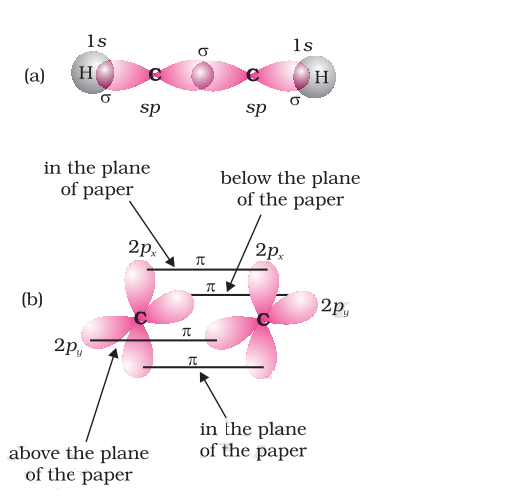
Structure of Triple Bond Ethyne is the simplest molecule of alkyne series. Structure of ethyne is shown in Figure. Each carbon atom of ethyne has two sp hybridised orbitals. Carbon-carbon sigma $(\sigma)$ bond is obtained by the head-on overlapping of the two sp hybridised orbitals of the two carbon atoms. The remaining sp hybridised orbital of each carbon atom undergoes overlapping along the internuclear axis with the 1s orbital of each of the two hydrogen atoms forming two C-H sigma bonds. H-C-C bond angle is of $180^\circ .$

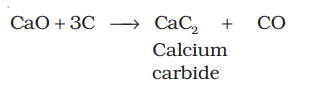
Each carbon has two unhybridised p orbitals which are perpendicular to each other as well as to the plane of the C C sigma bond. The $2 p$ orbitals of one carbon atom are parallel to the $2 p$ orbitals of the other carbon atom, which undergo lateral or sideways overlapping to form two pi ( $\pi$ ) bonds between two carbon atoms. Thus ethyne molecule consists of one $C - C \sigma$ bond, two $C - H \sigma$ bonds and two $C - C \pi$ bonds. The strength of $C \equiv C$ bond (bond enthalpy $823 kJ mol ^{-1}$ ) is more than those of $C = C$ bond (bond enthalpy $681 kJ mol ^{-1}$ ) and $C - C$ bond (bond enthalpy 348 kJ $mol ^{-1}$ ). The $C \equiv C$ bond length is shorter $(120 pm )$ than those of $C = C (133 pm )$ and $C - C (154 pm )$. Electron cloud between two carbon atoms is cylindrically symmetrical about the internuclear axis. Thus, ethyne is a linear molecule. Preparation - From calcium carbide: On industrial scale, ethyne is prepared by treating calcium carbide with water. Calcium carbide is prepared by heating quick lime with coke. Quick lime can be obtained by heating limestone as shown in the following reactions:

$\text{C}\text{aC}_2+2\text{H}_2\text{O}\rightarrow\text{Ca}(\text{OH})_2+\text{C}_2\text{H}_2$
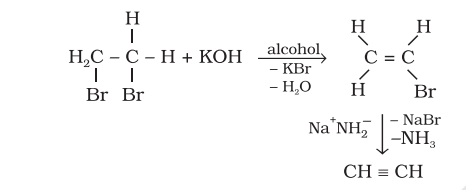
From vicinal dihalides: Vicinal dihalides on treatment with alcoholic potassium hydroxide undergo dehydrohalogenation. One molecule of hydrogen halide is eliminated to form alkenyl halide which on treatment with sodamide gives alkyne.


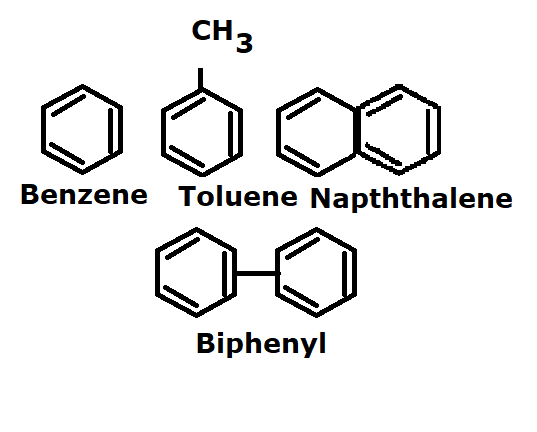
Aromatic hydrocarbon- These hydrocarbons are also known as ‘arenes’. Since most of them possess pleasant odour, the class of compounds was named as ‘aromatic compounds’. Most of such compounds were found to contain benzene ring. Benzene ring is highly unsaturated but in a majority of reactions of aromatic compounds, the unsaturation of benzene ring is retained. However, there are examples of aromatic hydrocarbons which do not contain a benzene ring but instead contain other highly unsaturated ring. Aromatic compounds containing benzene ring are known as benzenoids and those not containing a benzene ring are known as non-benzenoids. Some examples of arenes are given below:

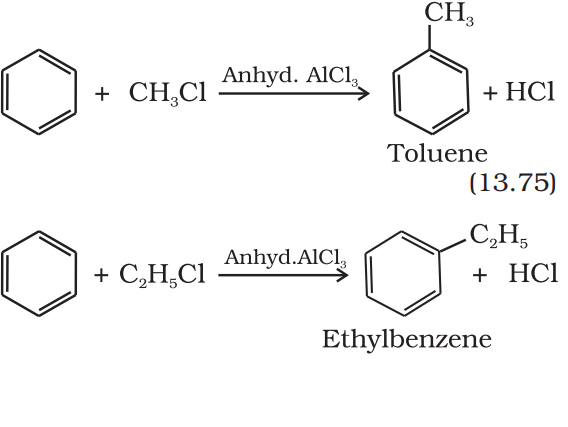
Friedel-Crafts alkylation reaction: When benzene is treated with an alkyl halide in the presence of anhydrous aluminium chloride, alkylbenene is formed.
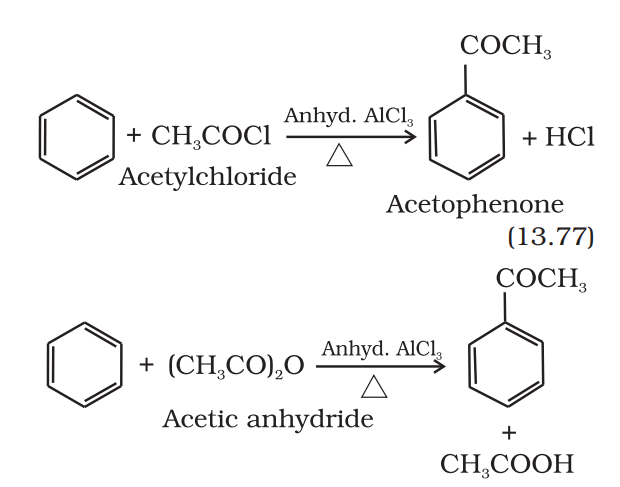
Friedel-Crafts acylation reaction: The reaction of benzene with an acyl halide or acid anhydride in the presence of Lewis acids ($AlCl_3$) yields acyl benzene.

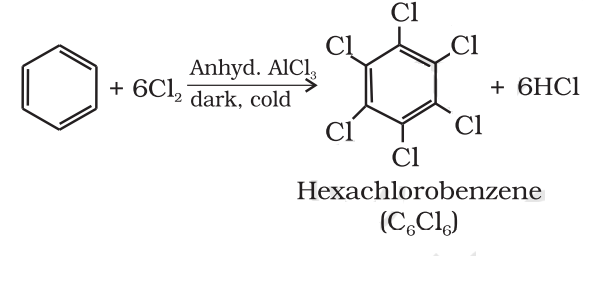
If excess of electrophilic reagent is used, further substitution reaction may take place in which other hydrogen atoms of benzene ring may also be successively replaced by the electrophile. For example, benzene on treatment with excess of chlorine in the presence of anhydrous $AlCl_3$​​​​​​​ can be chlorinated to hexachlorobenzene $(C_6Cl_6)​​​​​​​$​​​​​​​
  1. The general formula of Alkynes is …?
  1. $C_nH_{2n–2}$​​​​​​​
  2. $C_nH_{2n–2}$
  3. $C_nH_{2n–2}$
  4. $C_nH_{2n–2}$
  1. Calcium carbide is prepared by heating quick lime with …?
  1. Backing soda
  2. Coke
  3. Carbide
  4. Salt
  1. Vicinal dihalides on treatment with alcoholic potassium hydroxide undergo …?
  1. Dehydrogenation.
  2. Hydrohalogenation.
  3. Dehydrohalogenation
  4. Dehalogenation.
  1. The bond enthalpy of C ≡ C is …?
  1. 523 kJ mol
  2. 623 kJ mol
  3. 723 kJ mol
  4. 823 kJ mol
  1. The C ≡ C bond length is …?
  1. 1200 pm
  2. 620 pm
  3. 240 pm
  4. 120 pm
Read the passage given below and answer the following questions from 1 to 5.
Chemistry is the science of molecules and theirtransformations. It is the science not so much of the one hundred elements but of the infinite variety of molecules thatmay be built from them. Chemistry plays a central role in science andis often intertwined with other branches ofscience.to understand thebasic concepts of chemistry, which begin withthe concept of matter. Let us start with thenature of matter. matter can exist in threephysical states viz. solid, liquid and gas.Particles are held very close to each otherin solids in an orderly fashion and there is notmuch freedom of movement. In liquids, theparticles are close to each other but they canmove around. However, in gases, the particlesare far apart as compared to those present insolid or liquid states and their movement iseasy and fast. different states of matter exhibitthe following characteristics:
  1. Solids have definite volume and definiteshape.
  2. Liquids have definite volume but do nothave definite shape. They take the shapeof the container in which they are placed.
  3. Gases have neither definite volume nordefinite shape. They completely occupy thespace in the container in which they are placed.
Matter can be classified as mixture or pure substance. A mixture may be homogeneous or heterogeneous. Pure substances can further be classified into elements and compounds. Particles of an element consist of only one type of atoms. These particles may exist as atoms or molecules. When two or more atoms of different elements combine together in a definite ratio, the molecule of a compound is obtained.
Every substance has unique or characteristic properties. These properties can be classified into two categories — physical properties, such as colour, odour, melting point, boiling point, density, etc., and chemical properties, like composition, combustibility, ractivity with acids and bases, etc. Physical properties can be measured or observed without changing the identity or the composition of the substance. The measurement or observation of chemical properties requires a chemical change to occur. Measurement of physical properties does not require occurance of a chemical change.
  1. Which of the following state of matter have definite volume but do not have definite shape?
  1. Solid
  2. Liquid
  3. Gas
  4. Plasma
  1. Particles are held very close to each other in … in an orderly fashion and there is not much freedom of movement.
  1. Liquid
  2. Gas
  3. Solid
  4. Plasma
  1. Particles of …. consist of only one type of atom.
  1. Compound
  2. Mixture
  3. Element
  4. All the above
  1. Water molecule comprises …hydrogen atoms and … oxygen atom.
  1. One, two
  2. Three, one
  3. One, three
  4. Two, one
  1. Which of the following is not an example of Physical Properties of substance.?
  1. Odour
  2. Melting point
  3. Density
  4. Composition
The French physicist, de Broglie, in 1924proposed that matter, like radiation, shouldalso exhibit dual behaviour i.e., both particleand wavelike properties. This means that justas the photon has momentum as well aswavelength, electrons should also havemomentum as well as wavelength, de Broglie,from this analogy, gave the following relationbetween wavelength $(\lambda)$ and momentum (p) ofa material particle
$\lambda=\frac{\text{h}}{\text{mv}}=\frac{\text{h}}{\text{p}}$
where m is the mass of the particle, v itsvelocity and p its momentum.
Werner Heisenberg a German physicist in1927, stated uncertainty principle which is theconsequence of dual behaviour of matter andradiation. It states that it is impossible todetermine simultaneously, the exact position and exact momentum (or velocity)of an electron.Mathematically, it can be given as inequation
$\triangle\text{x}\times\triangle\text{p}_{\text{x}}\geq\frac{\text{h}}{4\pi}$
or $\triangle\text{x}\times\triangle(\text{mv}_{\text{x}})\geq\frac{\text{h}}{4\pi}$
or $\triangle\text{x}\times\triangle(\text{v}_{\text{x}})\geq\frac{\text{h}}{4\pi\text{m}}$
where $\triangle\text{x}$ is the uncertainty in position and $\triangle\text{px}(\text{or}\triangle\text{vx})$ is the uncertainty in momentum (orvelocity) of the particle.
One of the important implications of theHeisenberg Uncertainty Principle is that itrules out existence of definite paths ortrajectories of electrons and other similarparticles. The effect of Heisenberg Uncertainty Principle is significant only for motion of microscopic objects and is negligible for that of macroscopic objects. It, therefore, means that theprecise statements of the position andmomentum of electrons have to bereplaced by the statements of probability,that the electron has at a given positionand momentum. This is what happens inthe quantum mechanical model of atom. In Bohr model, anelectron is regarded as a charged particlemovingin well defined circular orbits aboutthe nucleus. The wave character of the electronis not considered in Bohr model. Further, anorbit is a clearly defined path and this pathcan completely be defined only if both theposition and the velocity of the electron areknown exactly at the same time. This is notpossible according to the Heisenberguncertainty principle. Bohr model of thehydrogen atom, therefore, not only ignoresdual behaviour of matter but also contradictsHeisenberg uncertainty principle. The structure of the atom was needed which could account for wave-particle duality of matter and be consistent with Heisenberg uncertainty Principle. This came with the advent of Quantum mechanics. This is mainly becauseof the fact thatclassical mechanics ignores theconcept of dual behaviour of matter especiallyfor sub-atomic particles and the uncertaintyprinciple. The branch of science that takes intoaccount this dual behaviour of matter is calledquantum mechanics.Quantum mechanics is a theoreticalscience that deals with the study of the motionsof the microscopic objects that have bothobservable wave like and particle likeproperties.When Schrödinger equation is solved forhydrogen atom, the solution gives the possibleenergy levels the electron can occupy and thecorresponding wave function(s) $\psi$ of theelectron associated with each energy level. A large number of orbitals are possible in anatom. Qualitatively these orbitals can bedistinguished by their size, shape andorientation. An orbital of smaller size meansthere is more chance of finding the electron nearthe nucleus. Similarly shape and orientationmean that there is more probability of findingthe electron along certain directions thanalong others. Atomic orbitals are preciselydistinguished by what are known as quantumnumbers. Each orbital is designated by threequantum numbers labelled as n, l and $m_1$.
The principal quantum number ‘n’ isa positive integer with value of n = 1,2,3…….The principal quantum number determines thesize and to large extent the energy of theorbital. Azimuthal quantum number. ‘l’ is alsoknown as orbital angular momentum orsubsidiary quantum number. It defines thethree-dimensional shape of the orbital.. For agiven value of n, l can have n values rangingfrom 0 to n – 1, that is, for a given value of n,the possible value of l are : l = 0, 1, 2, ……….(n–1)
Magnetic orbital quantum number. ‘mlgives information about the spatialorientation of the orbital with respect tostandard set of co-ordinate axis. For anysub-shell (defined by ‘l’ value) 2l+1 valuesof ml are possible and these values are givenbuy :ml = – l, – (l –1), – (l–2)… 0,1… (l –2), (l–1)..
In 1925, George Uhlenbeck and SamuelGoudsmit proposed the presence of the fourthquantum number known as the electronspin quantum number (ms). electron has, besides charge and mass,intrinsic spin angular quantum number. Spinangular momentum of the electron — a vectorquantity, can have two orientations relative tothe chosen axis. These two orientations aredistinguished by the spin quantum numbersms which can take the values of $+½ or –½$.These are called the two spin states of theelectron and are normally represented by twoarrows, ↑ (spin up) and ↓ (spin down).the four quantum numbersprovide the following information :
  1. n defines the shell, determines the size ofthe orbital and also to a large extent theenergy of the orbital.
  2. There are n subshells in the n the shell. Lidentifies the subshell and determines the shape of the orbital (see section 2.6.2).There are (2l+1) orbitals of each type in asubshell, that is, one s orbital (l = 0), threep orbitals (l = 1) and five d orbitals (l = 2)per subshell. To some extent l alsodetermines the energy of the orbital in amulti-electron atom.
  3. ml designates the orientation of the orbital.For a given value of l, mlhas (2l+1) values,the same as the number of orbitals persubshell. It means that the number oforbitals is equal to the number of ways inwhich they are oriented.
  4. ms refers to orientation of the spin of the electron.
  1. Uncertainty principle was given by:
  1. Werner Heisenberg
  2. George Uhlenbeck
  3. Samuel Goudsmit
  4. De Broglie
  1. Quantum mechanics is a theoretical science that deals with the study of the motions of the ….. objects.
  1. Macroscopic
  2. Microscopic
  3. Laparoscopic
  4. All the above
  1. The principal quantum number …
  1. l
  2. m
  3. n
  4. p
  1. …is also known as orbital angular momentum or subsidiary quantum number.
  1. Principal quantum number
  2. Electron spin quantum number
  3. Magnetic orbital quantum number.
  4. Azimuthal quantum number
  1. George Uhlenbeck and Samuel Goudsmit proposed the presence of the fourth quantum number known as the …
  1. Principal quantum number
  2. Electron spin quantum number
  3. Magnetic orbital quantum number.
  4. Azimuthal quantum number
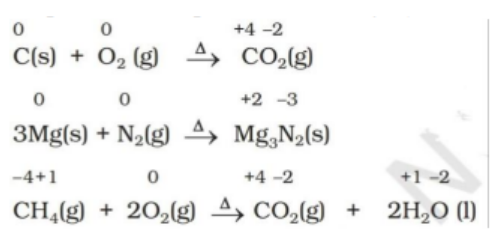
A less obvious example of electron transfer is realised when hydrogen combines with oxygen to form water by the reaction: $2\text{H}_2(\text{g}) + \text{O}_2 (\text{g}) → 2\text{H}_2\text{O} (\text{l})$ Though not simple in its approach, yet we can visualise the H atom as going from a Neutral (zero) state in H2 to a positive state in H2O, the O atom goes from a zero state in O2 To a dinegative state in H2O. It is assumed that There is an electron transfer from H to O and Consequently H2 is oxidised and O2 is reduced. However, as we shall see later, the charge Transfer is only partial and is perhaps better Described as an electron shift rather than a Complete loss of electron by H and gain by O. Two examples of this class Of the reactions are: $\text{H}_2 (\text{s}) + \text{Cl}_2(\text{g}) → 2\text{HCl} (\text{g})$ And, $\text{CH}_4 (\text{g}) + 4\text{Cl}_2 (\text{g}) → \text{CCl}_4(\text{l}) + 4\text{HCl (g)}$ In order to keep track of electron shifts in Chemical reactions involving formation of Covalent compounds, a more practical method Of using oxidation number has been Developed. In this method, it is always Assumed that there is a complete transfer of Electron from a less electronegative atom to a More electonegative atom. For example, we Rewrite equations to show Charge on each of the atoms forming part of The reaction:

It may be emphasised that the assumption Of electron transfer is made for book-keeping Purpose only and it will become obvious at a Later stage in this unit that it leads to the simple Description of redox reactions. Oxidation number denotes the Oxidation state of an element in a Compound ascertained according to a set Of rules formulated on the basis that electron pair in a covalent bond belongs Entirely to more electronegative element. It is not always possible to remember or Make out easily in a compound/ ion, which Element is more electronegative than the other. Therefore, a set of rules has been formulated To determine the oxidation number of an Element in a compound/ion. We may at this stage, state the rules for the Calculation of oxidation number. These rules are: 1.) In elements, in the free or the uncombined State, each atom bears an oxidation Number of zero. Evidently each atom in $H _2, O _2, C _{12}, O _3, P _4, S_8, Na , Mg$, Al has the Oxidation number zero. 2.) For ions composed of only one atom, the Oxidation number is equal to the charge On the ion. Thus $Na +$ lon has an oxidation Number of $+1, Mg _2+$ ion +2 , $Fe _3+$ ion, $+3, Cl -$ Ion, $-1, O _2-$ ion, -2 ; and so on. In their Compounds all alkali metals have Oxidation number of +1 , and all alkaline Earth metals have an oxidation number of +2 . Aluminium is regarded to have an Oxidation number of +3 in all its Compounds. 3.) The oxidation number of oxygen in most Compounds is -2 . However, we come across Two kinds of exceptions here. One arises In the case of peroxides and superoxides, The compounds of oxygen in which oxygen Atoms are directly linked to each other. While in peroxides (e.g., $H _2 O _2, Na _2 O _2$ ), each Oxygen atom is assigned an oxidation Number of -1 , in superoxides (e.g., $K O _2, Rb O _2$ ) each oxygen atom is assigned an Oxidation number of $-(1 / 2)$. The second Exception appears rarely, i.e. when oxygen Is bonded to fluorine. In such compounds e.g., oxygen difluoride $\left( OF _2\right)$ and dioxygen difluoride $\left( O _2 F_2\right)$, the oxygen is assigned an oxidation number of +2 and +1 , respectively. The number assigned to oxygen will depend upon the bonding state of oxygen but this number would now be a positive figure only. 4.)The oxidation number of hydrogen is +1, Except when it is bonded to metals in binary Compounds (that is compounds containing Two elements). For example, in LiH, NaH, And $Ca H_2,$ its oxidation number is –1. 5.) In all its compounds, fluorine has an Oxidation number of –1. Other halogens (Cl, Br, and I) also have an oxidation number Of –1, when they occur as halide ions in Their compounds. Chlorine, bromine and Iodine when combined with oxygen, for Example in oxoacids and oxoanions, have Positive oxidation numbers. 6.) The algebraic sum of the oxidation number Of all the atoms in a compound must be Zero. In polyatomic ion, the algebraic sum Of all the oxidation numbers of atoms of The ion must equal the charge on the ion. Thus, the sum of oxidation number of three Oxygen atoms and one carbon atom in the Carbonate ion, $(CO_3) 2$– must equal –2. A term that is often used interchangeably With the oxidation number is the oxidation State. Thus in $CO_2,$the oxidation state of Carbon is +4 , that is also its oxidation number And similarly the oxidation state as well as Oxidation number of oxygen is -2 . This implies That the oxidation number denotes the Oxidation state of an element in a compound. The oxidation number/state of a metal in a Compound is sometimes presented according To the notation given by German chemist, Alfred Stock. It is popularly known as Stock Notation. According to this, the oxidation Number is expressed by putting a Roman Numeral representing the oxidation number In parenthesis after the symbol of the metal in The molecular formula. Thus aurous chloride And auric chloride are written as $Au ( I ) Cl$ and $Au ( III ) Cl _3$. Similarly, stannous chloride and Stannic chloride are written as $Sn ( II ) Cl _2$ and $Sn ( IV ) Cl _4$. This change in oxidation number Implies change in oxidation state, which in Turn helps to identify whether the species is Present in oxidised form or reduced form. Thus, $Hg _2( I ) Cl _2$ is the reduced form of $Hg ( II ) Cl _2$.
  1. H atom goes from a … state in $H_2$ to a positive state in $H_2O$ in water formation.
  1. Neutral
  2. Positive
  3. Negative
  4. All the above
  1. In oxidation number method, there is a complete transfer of electron from a …. electronegative atom to a … electonegative atom.
  1. more, less
  2. less, more
  3. non, more
  4. non, less
  1. Oxidation number of $Mg_2$ + ion is:
  1. -2
  2. -1
  3. +2
  4. +1
  1. In $Na2O_2$ each oxygen atom is assigned an oxidation number of …
  1. +1
  2. -2
  3. +2
  4. -1
  1. The algebraic sum of the oxidation number of all the atoms in a compound must be…
  1. 0
  2. 1
  3. 2
  4. -2
The idea of oxidation number has been invariably applied to define oxidation, reduction, oxidising agent (oxidant), reducing agent (reductant) and the redox reaction. To summarise, we may say that:
Oxidation: An increase in the oxidation number of the element in the given substance.
Reduction: A decrease in the oxidation number of the element in the given substance.
Oxidising agent: A reagent which can increase the oxidation number of an element in a given substance. These reagents are called as oxidants also.
Reducing agent: A reagent which lowers the oxidation number of an element in a given substance. These reagents are also called as reductants.
Redox reactions: Reactions which involve change in oxidation number of the interacting species.
Types of Redox Reactions
1.) Combination reactions -A combination reaction may be denoted in the manner:
$A + B → C$
Either A and B or both A and B must be in the elemental form for such a reaction to be a redox reaction. All combustion reactions, which make use of elemental dioxygen, as well as other reactions involving elements other than dioxygen, are redox reactions. Some important examples of this category are:

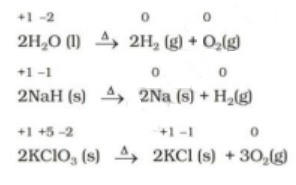
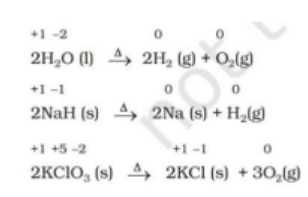
2.) Decomposition reactions- Decomposition reactions are the opposite of combination reactions. Precisely, a decomposition reaction leads to the breakdown of a compound into two or more components at least one of which must be in the elemental state.
Examples of this class of reactions are:

It may carefully be noted that there is no change in the oxidation number of hydrogen in methane under combination reactions and that of potassium in potassium chlorate in reaction. This may also be noted here that all decomposition reactions are not redox reactions. For example, decomposition of calcium carbonate is not a redox reaction.
3.) Displacement reactions- In a displacement reaction, an ion (or an atom) in a compound is replaced by an ion (or an atom) of another element. It may be denoted as:
$X + YZ → XZ + Y$
Displacement reactions fit into two categories: metal displacement and non-metal displacement.
(a) Metal displacement: A metal in a compound can be displaced by another metal in the uncombined state. Metal displacement reactions find many applications in metallurgical processes in which pure metals are obtained from their compounds in ores.
(b) Non-metal displacement: The non-metal displacement redox reactions include hydrogen displacement and a rarely occurring reaction involving oxygen displacement. All alkali metals and some alkaline earth metals (Ca, Sr, and Ba) which are very good reductants, will displace hydrogen from cold water. Many metals, including those which do not react with cold water, are capable of displacing hydrogen from acids. Dihydrogen from acids may even be produced by such metals which do not react with steam. Cadmium and tin are the examples of such metals.
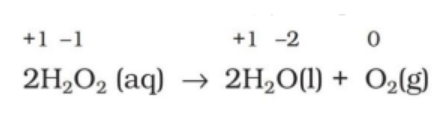
4.) Disproportionation reactions – Disproportionation reactions are a special type of redox reactions. In a disproportionation reaction an element in one oxidation state is simultaneously oxidised and reduced. One of the reacting substances in a disproportionation reaction always contains an element that can exist in at least three oxidation states. The element in the form of reacting substance is in the intermediate oxidation state; and both higher and lower oxidation states of that element are formed in the reaction. The decomposition of hydrogen peroxide is a familiar example of the reaction, where oxygen experiences disproportionation.

Here the oxygen of peroxide, which is present in –1 state, is converted to zero oxidation state in $O2$ and decreases to –2 oxidation state in $H_2O$.
  1. In … an ion (or an atom) in a compound is replaced by an ion (or an atom) of another element.
  1. displacement reaction
  2. decomposition reaction
  3. disproportionation reaction
  4. combination reaction
  1. leads to the breakdown of a compound into two or more components at least one of which must be in the elemental state.
  1. displacement reaction
  2. decomposition reaction
  3. disproportionation reaction
  4. combination reaction
  1. In …. an element in one oxidation state is simultaneously oxidised and reduced.
  1. displacement reaction
  2. decomposition reaction
  3. disproportionation reaction
  4. combination reaction
  1. Reactions which involve change in oxidation number of the interacting species…
  1. Exothermic reaction
  2. Endothermic reaction
  3. Neutralization reaction
  4. Redox reaction
  1. One of the reacting substances in a disproportionation reaction always contains an element that can exist in at least … oxidation states.
  1. 1
  2. 2
  3. 3
  4. 4
Read the passage given below and answer the following questions from 1 to 5 .
After having some idea about the terms atomsand molecules, it is appropriate here tounderstand what do we mean by atomic andmolecular masses. One atomicmass unit is defined as a mass exactly equal to one-twelfth of the mass of one carbon -12 atom.Molecular mass is the sum of atomic masses of the elements present in a molecule. It is obtained by multiplying the atomic mass of each element by the number of its atoms and adding them together. Some substances, such as sodium chloride, do not contain discrete molecules as their constituent units. In such compounds, positive (sodium ion) and negative (chloride ion) entities are arranged in a three dimensional structure. The mole, symbol mol, is the SI unit of amount of substance. One mole contains exactly $6.02214076 \times 10^{23}$ elementary entities. This number is the fixed numerical value of the Avogadro constant, $N _{ A }$, when expressed in the unit mol-1 and is called the Avogadro number. The amount of substance, symbol $n$, of a system is a measure of the number of specified elementary entities. An elementary entity may be an atom, a molecule, an ion, an electron, any other particle or specified group of particles. It may be emphasised that the mole of a substance always contains the same number of entities, no matter what the substance may be. In order to determine this number precisely, the mass of a carbon-12 atom was determined by a mass spectrometer and found to be equal to $1.992648 \times 10^{-23} g$. Knowing that one mole of carbon weighs 12 g , the number of atoms in it is equal to: $12 g / mol C -12$.
$1.992648 \times 10^{23} g / C -12$ atom. $=6.0221367 \times 10^{23}$ atoms $/ mol$.
The mass of one mole of a substance in grams is called its molar mass. the molar mass in grams is numerically equal to atomic molecular/formula mass in u.An empirical formula represents the simplestwhole number ratio of various atoms present ina compound, whereas, the molecular formulashows the exact number of different types ofatoms present in a molecule of a compound. If the mass per cent of variouselements present in a compound is known, its empiricalformula can be determined. Molecular formulacan further be obtained if the molar mass isknown.Many a time, reactions are carried out with the Amounts of reactants that are different than The amounts as required by a balanced chemical reaction. In such situations, one Reactant is in more amount than the amount required by balanced chemical reaction. The reactant which is present in the least amount Many a time, reactions are carried out with the amounts of reactants that are different than the amounts as required by a balanced chemical reaction. In such situations, one reactant is in more amount than the amount required by balanced chemical reaction. The reactant which is present in the least amount gets consumed after sometime and after that further reaction does not take place whatever be the amount of the other reactant. Hence, the reactant, which gets consumed first, limits the amount of product formed and is, therefore, called the limiting reagent.
i. One atomic mass unit (amu) is defined as a mass exactly equal to one-twelfth of the mass of one ...atom.
  1. One atomic mass unit (amu) is defined as a mass exactly equal to one-twelfth of the mass of one …atom.
  1. Hydrogen $– 1$
  2. Carbon $– 12$
  3. Oxygen $-12$
  4. Chlorine $– 35$
  1. The mass of one mole of a substance in grams is called its..
  1. Atomic mass
  2. Molecular Weight
  3. Molecular mass
  4. Molar mass.
  1. … is the sum of atomic massesof the elements present in a molecule.
  1. Atomic mass
  2. Molecular Weight
  3. Molecular mass
  4. Molar mass.
  1. One mole contains exactly …elementary entities.
  1. $02214076 \times 10^{21}$
  2. $02214076 \times 10^{22}$
  3. $6.02214076 \times 10^{23}$
  4. $02214076 \times 10^{24}$
  1. For which of the following compound , formula mass is preferred instead of molecular mass?
  1. $NaCl$
  2. $C2H6$
  3. $N2$
  4. $H2O​$
Read the passage given below and answer the following questions from 1 to 5.
F Wohler synthesised an organic compound, urea from an inorganic compound, ammonium cyanate.
The knowledge of fundamental concepts of molecular structure helps in understanding and predicting the properties of organic compounds. You have already learnt theories of valency and molecular structure. Also, you already know that tetravalence of carbon and the formation of covalent bonds by it are explained in terms of its electronic configuration and the hybridisation of s and p orbitals. It may be recalled that formation and the shapes of molecules like methane $(CH_4)$, ethene $(C_2H_4)$, ethyne $(C_2H_2)$ are explained in terms of the use of $sp^3, sp^2$ and sp hybrid orbitals by carbon atoms in the respective molecules. Hybridisation influences the bond length and bond enthalpy (strength) in compounds. The sp hybrid orbital contains more s character and hence it is closer to its nucleus and forms shorter and stronger bonds than the sp3 hybrid orbital.The sp2 hybrid orbital is intermediate in s character between sp and sp3 and, hence, the length and enthalpy of the bonds it forms, are also intermediate between them. The change in hybridisation affects the electronegativity of carbon. The greater the s character of the hybrid orbitals, the greater is the electronegativity. Thus, a carbon atom having an sp hybrid orbital with 50% s character is more electronegative than that possessing sp2 or sp3 hybridised orbitals. This relative electronegativity is reflected in several physical and chemical properties of the molecules concerned, about which you will learn in later units.
Characteristic Features of π Bonds In a π (pi) bond formation, parallel orientation of the two p orbitals on adjacent atoms is necessary for a proper sideways overlap. Thus, in $H_2C=CH_2$ molecule all the atoms must be in the same plane. The p orbitals are mutually parallel and both the p orbitals are perpendicular to the plane of the molecule. Rotation of one $CH_2$ fragment with respect to other interferes with maximum overlap of p orbitals and, therefore, such rotation about carbon-carbon double bond (C=C) is restricted. The electron charge cloud of the π bond is located above and below the plane of bonding atoms. This results in the electrons being easily available to the attacking reagents. In general, π bonds provide the most reactive centres in the molecules containing multiple bonds.

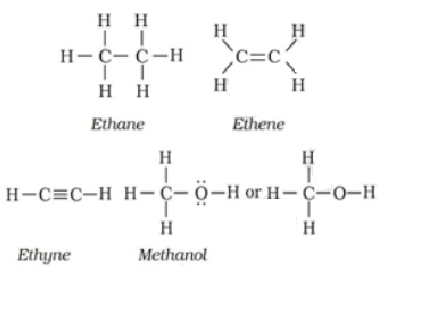
Structures of organic compounds are represented in several ways. The Lewis structure or dot structure, dash structure, condensed structure and bond line structural formulas are some of the specific types. The Lewis structures, however, can be simplified by representing the two-electron covalent bond by a dash (–). Such a structural formula focuses on the electrons involved in bond formation. A single dash represents a single bond, double dash is used for double bond and a triple dash represents triple bond. Lone- pairs of electrons on heteroatoms (e.g., oxygen, nitrogen, sulphur, halogens etc.) may or may not be shown. Thus, ethane $(C_2H_6)$, ethene $(C_2H_4)$, ethyne $(C_2H_2)$ and methanol $(CH_3OH)$ can be represented by the following structural formulas. Such structural representations are called complete structural formulas.
These structural formulas can be further abbreviated by omitting some or all of the dashes representing covalent bonds and by indicating the number of identical groups attached to an atom by a subscript. The resulting expression of the compound is called a condensed structural formula. Thus, ethane, ethene, ethyne and methanol can be written as:

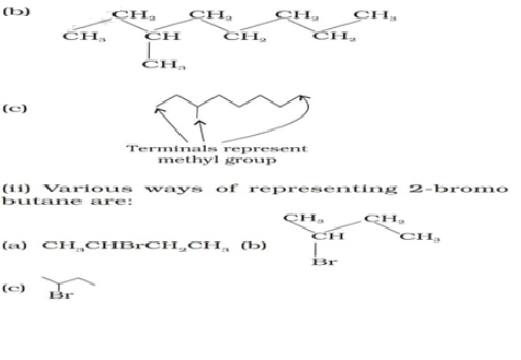
Similarly, $CH_3CH_2CH_2CH_2CH_2CH_2CH_2CH_3$ can be further condensed to $CH_3(CH_2)_6CH_3$. For further simplification, organic chemists use another way of representing the structures, in which only lines are used. In this bond-line structural representation of organic compounds, carbon and hydrogen atoms are not shown and the lines representing carbon-carbon bonds are drawn in a zig-zag fashion. The only atoms specifically written are oxygen, chlorine, nitrogen etc. The terminals denote methyl $(–CH_3)$ groups (unless indicated otherwise by a functional group), while the line junctions denote carbon atoms bonded to appropriate number of hydrogens required to satisfy the valency of the carbon atoms. Some of the examples are represented as follows: (i) 3-Methyloctane can be represented in various forms as:
  1. … synthesised an organic compound, urea from an inorganic compound, ammonium cyanate.
  1. Wohler
  2. Adams
  3. Roger
  4. William Evans
  1. Dot structure is also known as …
  1. Zig zag structure
  2. Lewis structure
  3. Line structure
  4. Bond line structure
  1. Terminals in zigzig structure denotes … Group.
  1. Bromyl
  2. Propyl
  3. Methyl
  4. Pentyl
  1. Triple dash represents …
  1. Single bond
  2. Double bond
  3. Triple bond
  4. Equivalent bond
  1. Lewis structures representing the two-electron covalent bond by …
  1. .
  2. :
  3. ?
Once an organic compound is extracted from a natural source or synthesised in the laboratory, it is essential to purify it. Various methods used for the purification of organic compounds are based on the nature of the compound and the impurity present in it. Finally, the purity of a compound is ascertained by determining its melting or boiling point. This is one of the most commonly used techniques for the purification of solid organic compounds. In crystallisation Impurities, which impart colour to the solution are removed by adsorbing over activated charcoal. In distillation Liquids having different boiling points vaporise at different temperatures. The vapours are cooled and the liquids so formed are collected separately. Steam Distillation is applied to separate substances which are steam volatile and are immiscible with water. Distillation under reduced pressure: This method is used to purify liquids having very high boiling points.

i. Which method can be used to separate two compounds with different solubilities in a solvent?
ii. Distillation method is used to separate which type of substance?
iii. Which technique is used to separate aniline from aniline water mixture?
OR
Why chloroform and aniline are easily separated by the technique of distillation?
IUPAC (International Union of Pure and Applied Chemistry) system of nomenclature. Common names are useful and in many cases indispensable, particularly when the alternative systematic names are lengthy and complicated. A systematic name of an organic compound is generally derived by identifying the parent hydrocarbon and the functional group(s) attached to it. By using prefixes and suffixes, the parent name can be modified to obtain the actual name. In a branched-chain compound, small chains of carbon atoms are attached at one or more carbon atoms of the parent chain. The small carbon chains (branches) are called alkyl groups. An alkyl group is derived from a saturated hydrocarbon by removing a hydrogen atom from carbon. Abbreviations are used for some alkyl groups. For example, methyl is abbreviated as Me, ethyl as Et, propyl as Pr and butyl as Bu.

1. Draw the structure of 3-Ethyl-4,4-dimethylheptane. (1)
2. How is the numbering in branched chain hydrocarbon done? (1)
3. Derive the structure of 2-Chlorohexane. (2)
OR
Why $CH _4$ after becoming- $CH _3$ called a methyl group? (2)