Following are properties of vectors
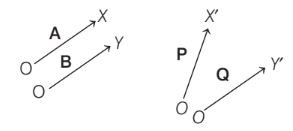
a) Two vectors A and B are said to be equal if, and only if, they have the same magnitude and the same direction.
b) Multiplying a vector A with a positive number λ gives a vector whose magnitude is changed by the factor λ but the direction is the same as that of A:
$|\ \lambda\text{ A }|=\lambda\text{ A }|$
c) The null vector also results when we multiply a vector A by the number zero. Properties of 0 are
A + 0 = A
λ 0 = 0
0 A = 0
d) Subtraction of vectors can be defined in terms of addition of vectors. We define the difference of two vectors A and B as the sum of two vectors A and –B :
A – B = A + (–B).
- Two vectors A and B are said to be equal if:
- they have the same magnitude
- they have the same direction
- they have the same magnitude and the same direction
- None of these
- Multiplying a vector A with a positive number will impact:
- Change in magnitude
- Change in direction
- Change in both magnitude and the same direction
- None of these
- What is null vector?
- How we can perform subtraction of two vectors?
- Enlist any 4 properties of vectors.
- (c) they have the same magnitude and the same direction
- (a) Change in magnitude
- Null vector is defined as the vector having zero magnitude and any direction. Consider two vectors A and –A. Their sum is A + (–A). Since the magnitudes of the two vectors are the same, but the directions are opposite, the resultant vector has zero magnitude and is represented by 0 called a null vector or a zero vector. . Properties of 0 are
A + 0 = A
λ 0 = 0
- Subtraction of vectors can be defined in terms of addition of vectors. We define the difference of two vectors A and B as the sum of two vectors A and –B:
A – B = A + (–B)
- Following are properties of vectors
a) Two vectors A and B are said to be equal if, and only if, they have the same magnitude and the same direction.
b) Multiplying a vector A with a positive number λ gives a vector whose magnitude is changed by the factor λ but the direction is the same as that of A :
$|\ \lambda\text{ A }|=\lambda\text{ A }|$
c) The null vector also results when we multiply a vector A by the number zero. Properties of 0 are
A + 0 = A
λ 0 = 0
0 A = 0
d) Subtraction of vectors can be defined in terms of addition of vectors. We define the difference of two vectors A and B as the sum of two vectors A and –B :
A – B = A + (–B)