Question
Read the passage given below and answer the following questions: Glucose is known as dextrose because it occurs in nature as the optically active dextrorotatory isomer. lt is essential constituent of human blood. The blood normally contains $65$ to $110mg$ of glucose per $100mL \ ($hence named Blood sugar$)$. The level may be much higher in diabetic persons. The urine of diabetic persons also contain considerable amount of glucose. ln combined form, it occurs in cane sugar and polysaccharides such as starch and cellulose. Glucose has an aldehyde group $(-\ce{CHO}),$ one primary alcoholic group $(-\ce{CH_2OH})$ and four secondary alcoholic groups $(-\ce{CHOH})$ in their structure. Due to the presence five hydroxyl groups $(-OH)$. glucose undergoes acetylation. Glucose also undergoes oxidation with mild oxidising agents like bromine water as well as with strong oxidising agents like nitric acid. Since glucose is readily oxidised, it acts as a strong reducing agent and reduces Tollen's reagent and Fehling solution. Glucose exists in two crystalline forms: $\alpha - D -$ glucose and $\beta - D - $ glucose. If either of the two forms is dissolved in water and allowed to stand, the specific rotation of the solution changes gradually, until a constant value is obtained. This change is called mutarotation. A statement of assertion followed by a statement of reason is given. Choose the correct answer out of the following choices.
  1. Assertion and reason both are correct statements and reason is correct explanation for assertion.
  2. Assertion and reason both are correct statements but reason is not correct explanation for assertion.
  3. Assertion is correct statement but reason is wrong statement.
  4. Assertion is wrong statement but reason is correct statement.
  1. Assertion : A diabetic person carries a packet of glucose with him always.
Reason : Glucose increases the blood sugar level almost instantaneously.
  1. Assertion : On oxidation with nitric acid, glucose as well as gluconic acid both yield saccharic acid.
Reason : The pentaacetate of glucose does not react with hydroxylamine indicating the absence of free $-\text{CHO}$ group.
  1. Assertion : Glucose reacts with acetyl chloride to form pentaacetyl glucose.
Reason : The formation of pentaacetyl derivative confirms the presence of five $-OH$ groups in glucose.
  1. Assertion : A certain compound gives negative test with ninhydrin and positive test with Benedict's solution, the compound is an amino acid.
Reason : Glucose is a monosaccharide.
  1. Assertion : The rapid interconversion of $\alpha - D - $ glucose and $\beta - D -$ glucose in solution is known as racemisation.
Reason : Hydrolysis reaction will take place when a mineral acid is treated with sugar.

Answer

  1.  $(a)$ Assertion and reason both are correct statements and reason is correct explanation for assertion.
  1. $(b)$ Assertion and reason both are correct statements but reason is not correct explanation for assertion.
$\ \text{CHO}\ \ \ \ \ \ \ \ \ \ \ \ \ \ \ \ \ \ \ \ \text{COOH}\ \ \ \ \ \ \ \ \ \ \ \ \ \ \ \ \ \text{COOH}\\\ \ |\ \ \ \ \ \ \ \ \ \ \ \ \ \ \ \ \ \ \ \ \ \ \ \ \ \ \ \ |\ \ \ \ \ \ \ \ \ \ \ \ \ \ \ \ \ \ \ \ \ \ \ \ \ \ \ \ |\$\text{CHOH})_4\xrightarrow[\text{HNO}_3]{[\text{O}]}(\text{COOH})_4\xleftarrow[\text{[O]}]{\text{HNO}_3}(\text{CHOH})_4\\\ \ |\ \ \ \ \ \ \ \ \ \ \ \ \ \ \ \ \ \ \ \ \ \ \ \ \ \ \ \ |\ \ \ \ \ \ \ \ \ \ \ \ \ \ \ \ \ \ \ \ \ \ \ \ \ \ \ \ |\\\ \text{CH}_2\text{OH}\ \ \ \ \ \ \ \ \ \ \ \ \ \ \ \text{COOH}\ \ \ \ \ \ \ \ \ \ \ \ \ \ \ \ \ \ \text{CH}_2\text{OH}\\\ \text{Glucose}\ \ \ \ \ \ \ \ \ \text{Saccharic acid}\ \ \ \ \ \ \ \text{Gluconic acid}$
Strong oxidising agents like nitric acid oxidises both the terminal $-\ce{CHO}$ and $-\ce{CH_2OH}$ groups of glucose to give the dibasic acid, saccharic acid.
  1. $(b)$ Assertion and reason both are correct statements but reason is not correct explanation for assertion.
  1. $(d)$ Assertion is wrong statement but reason is correct statement.
If a certain compound gives negative test with ninhydrin and positive test with Benedict's solution then the compound should be a monosaccharide.
  1.  $(d)$ Assertion is wrong statement but reason is correct statement.
The rapid interconversion of $\alpha -$ Dvgfucose and $\beta - D - $ glucose in solution is known as mutarotation.
​​​​​​​Sugar gets hydrolysed with mineral acids.
$\text{C}_{12}\text{H}-{22}+\text{H}_2\text{O}\xrightarrow{\text{H}^+}\text{C}_6\text{H}_{12}\text{O}_6+\text{C}_6\text{H}_{12}\text{O}_6\\\ \ \ \ \text{Sugar}\ \ \ \ \ \ \ \ \ \ \ \ \ \ \ \ \ \ \ \ \ \ \ \ \ \ \ \ \text{Glucose}\ \ \ \ \ \text{Fructose}$

Need a full question paper?

Generate a complete, print-ready paper with questions like this in minutes — across 16+ boards, with answer keys.

Start Generating Free

Similar questions

Read the passage given below and answer the following questions:
When a protein in its native form, is subjected to physical changes like change in temperature or chemical changes like change in pH, the hydrogen bonds are disturbed. Due to this, globules unfold and helix get uncoiled and protein loses its biological activity. This is called denaturation of protein.
The denaturation causes change in secondary and tertiary structures but primary structures remains intact. Examples of denaturation of protein are coagulation of egg white on boiling, curdling of milk, formation of cheese when an acid is added to milk.
The following questions are multiple choice questions. Choose the most appropriate answer:
  1. Mark the wrong statement about denaturation of proteins.
  1. The primary structure of the protein does not change.
  2. Globular proteins are converted into fibrous proteins.
  3. Fibrous proteins are converted into globular proteins.
  4. The biological activity of the protein is destroyed.
  1. Which structure(s) of proteins remains(s) intact during denaturation process?
  1. Both secondary and tertiary structures.
  2. Primary structure only.
  3. Secondary structure only.
  4. Tertiary structure only.
  1. $\alpha$-helix and $\beta$-pleated structures of proteins are classified as:
  1. Primary structure.
  2. Secondary structure.
  3. Tertiary structure.
  4. Quaternary structure.
  1. Cheese is a:
  1. Globular protein.
  2. Conjugated protein.
  3. Denatured protein.
  4. Derived protein.
  1. Secondary structure of protein refers to:
  1. Mainly denatured proteins and structure of prosthetic groups.
  2. Three-dimensional structure, especially the bond between amino acid residues that are distant from each other in the polypeptide chain.
  3. Linear sequence of amino acid residues in the polypeptide chain.
  4. Regular folding patterns of continuous portions of the polypeptide chain.
Read the passage given below and answer the following questions:
The aryl halides are relatively less reactive towards nucleophilic substitution reactions as compared to alkyl halides. This low reactivity can be attributed to the following factors:
  • The $C - X$ bond in halobenzene has a partial double bond character due to involvement of halogen electrons in resonance with benzene ring.
  • The $C - X$ bond in aryl halides is less polar as compared to that in alkyl halides as $sp^2$ hyridised carbon is more electronegative than $sp^3$ hybridised carbon.
In these questions $(Q. No. i-Iv),$ a statement of assertion followed by a statement of reason is given. Choose the correct answer out of the following choices.
  1. Assertion and reason both are correct statements and reason is correct explanation for assertion.
  2. Assertion and reason both are correct statements but reason is not correct explanation for assertion.
  3. Assertion is correct statement but reason is wrong statement.
  4. Assertion is wrong statement but reason is correct statement.
  1. Assertion: Primary benzylic halides are more reactive than primary alkyl halides towards $S_N1$ reactions.
Reason: Reactivity depends upon the nature of the nucleophile and the solvent.
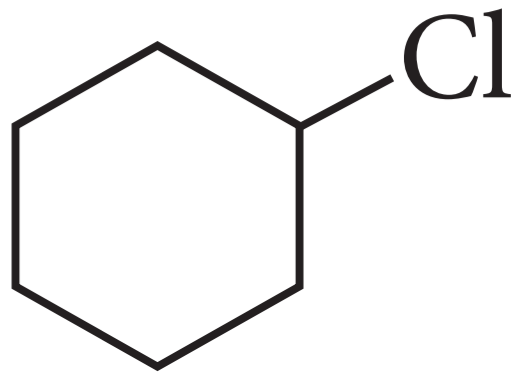
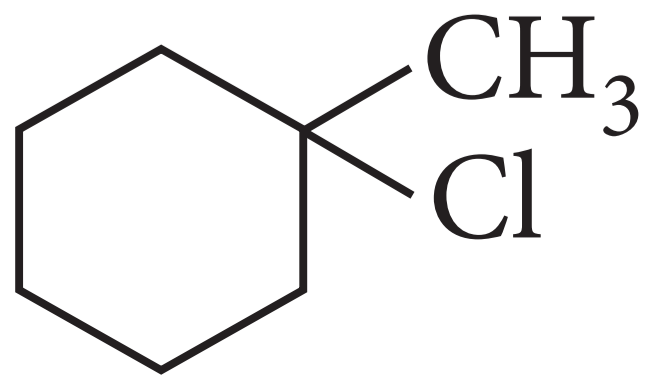
  1. Assertion: is more reactive than towards nucleophilic substitution reactions.
Reason: Tertiary alkyl halides react predominantly by $S_N1$ mechanism.
  1. Assertion: Chlorobenzene is more reactive than $p-$chloroanisole to nucleophilic substitution reactions.

Reason: Greater the stability of carbanion, greater is its ease of formation and hence, more reactive is the aryl halide.
  1. Assertion: $4-$Nitrochlorobenzene undergoes nucleophilic substitution more readily than chlorobenzene.
Reason: Chlorobenzene undergoes nucleophilic substitution by elimination-addition mechanism while $4-$nitrochlorobenzene undergoes nucleophilic substitution by addition$-$elimination mechanism.
  1. Assertion: Chlorobenzene is less reactive than benzene towards the electrophilic substitution reaction.
Reason: Resonance destabilises the carbocation.
Read the passage given below and answer the following questions:
$(A), (B)$ and $(C)$ are three non $-$ cyclic functional isomers of a carbonyl compound with molecular formula $\ce{C_4H_8O}$. Isomers $(A)$ and $(C)$ give positive Tollen's test whereas isomer $(B)$ does not give Tollen's test but gives positive iodoform test. Isomers $(A)$ and $(B)$ on reduction with $\frac{Zn}{(Hg)}$ conc.  $\text{HCl}$ give the same product $(D).$
The following questions are multiple choice questions. Choose the most appropriate answer:
  1. Compound $A$ is:
  1. $\text{CH}_3-\text{CH}-\text{CHO}\\\ \ \ \ \ \ \ \ \ \ \ \ \ |\\ \ \ \ \ \ \ \ \ \ \ \ \ \text{CH}_3$
  2. $\text{CH}_3\text{CH}_2\text{CH}_2\text{CHO}$
  3. $\ \ \ \ \ \ \ \ \ \ \ \ \text{O}\\\ \ \ \ \ \ \ \ \ \ \ \ \ ||\\\text{CH}_3-\text{C}-\text{CH}_2-\text{CH}_3$
  4. None of these.
  1. Compound $(C)$ is:
  1. Iso $-$ butyraldehyde
  2. Butyraldehyde
  3. Crotonaldehyde
  4. Acrolein
  1. Compound $(B)$ can be obtained by:
  1. $\text{CH}_3-\text{C}\equiv\text{C}-\text{CH}_2-\text{CH}_3\xrightarrow[333\text{K}]{\text{dil.H}_2\text{SO}_4+\text{HgSO}_4}$
  2. $(\text{CH}_3\text{CH}_2\text{COO})_2\text{Ca}\xrightarrow{\text{Dry distill}}$
  3. $\text{CH}_3-\text{C}\equiv\text{C}-\text{CH}_3\xrightarrow[\frac{\text{H}_2\text{O}_2}{\text{NaOH}}]{\frac{\text{B}_2\text{H}_6}{\text{THF}}}$
  4. $\text{CH}_3-\text{CH}=\text{CH}-\text{CH}_3\xrightarrow[\frac{\text{ZN}}{\text{H}_2\text{O}}]{\text{O}_3}$
  1. Out of $(A), (B)$ and $(C)$ isomers, which one is least reactive towards addition of $\text{HCN}$ ?
  1. $A$
  2. $B$
  3. $C$
  4. All are equally reactive.
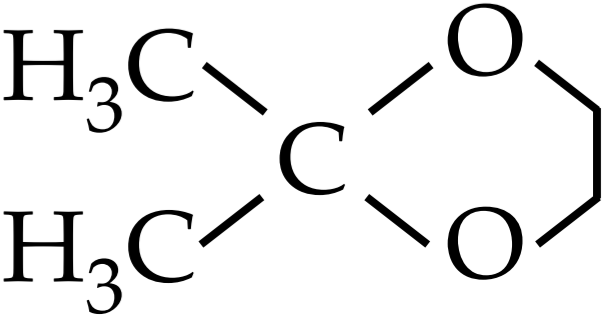
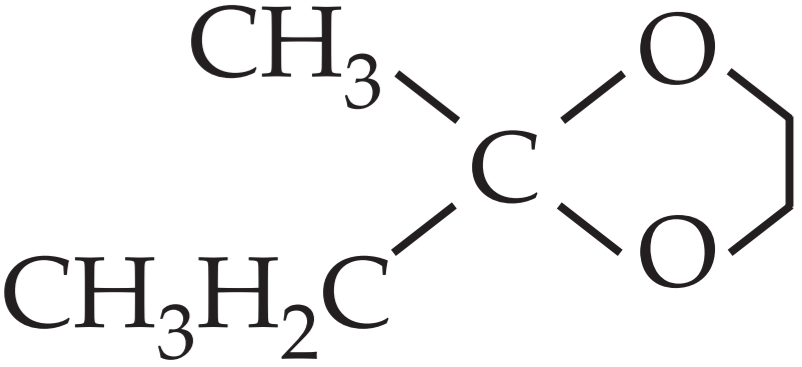
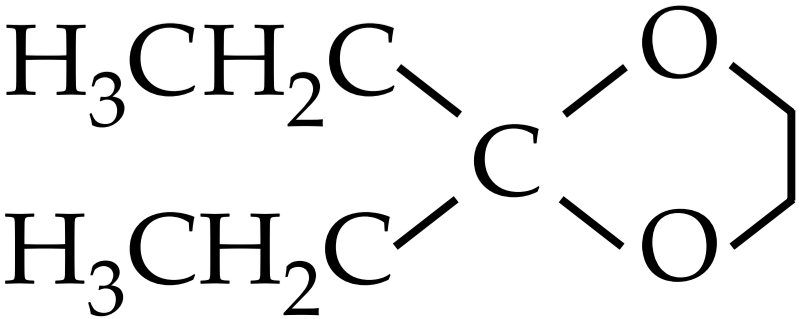
  1. What will be the product when $(B)$ reacts with ethylene glycol in presence of $\text{HCl}$ gas?
  1.  
  1.  
  1.  
  1. None of these.
Dependence of the rate of reaction on the concentration of reactants, temperature, and other factors is the most general method for weeding out unsuitable reaction mechanisms. The term mechanism means all the individual collisional or elementary processes involving molecules $($atoms, radicals, and ions included$)$ that take place simultaneously or consecutively to produce the observed overall reaction. For example, when hydrogen gas reacts with bromine, the rate of the reaction was found to be proportional to the concentration of $H_2$ and to the square root of the concentration of $Br_2.$ Furthermore, the rate was inhibited by increasing the concentration of $HBr$ as the reaction proceeded. These observations are not consistent with a mechanism involving bimolecular collisions of a single molecule of each kind. The currently accepted mechanism is considerably more complicated, involving the dissociation of bromine molecules into atoms followed by reactions between atoms and molecules:
It is clear from this example that the mechanism cannot be predicted from the overall stoichiometry.
$($source: Moore, J. W., Pearson, $R. G. (1981).$ Kinetics and mechanism. John Wiley Sons.$)$
$(a).$ Predict the expression for the rate of reaction and order for the following:
$H_2 + Br_2 \rightarrow 2 HBr$
What are the units of rate constant for the above reaction?
$(b).$ How will the rate of reaction be affected if the concentration of $Br_2$ is tripled?
For the reaction : $2\text{NO}_\text{(g)}+\text{Cl}_{2\text{(g)}}\rightarrow2\text{NOCl}_\text{(g)},$ the following data were collected. All the measurements were taken at $263K.$
Experiment No.
Initial $\ce{[NO] (M)}$
Initial $\ce{[Cl_2] (M)}$
Initial rate of disapp. of $\ce{Cl_2 (M/ min)}$
$1.$ $0.15$ $0.15$ $0.60$
$2.$ $0.15$ $0.30$ $1.20$
$3.$ $0.30$ $0.15$ $2.40$
$4.$ $0.25$ $0.25$ $?$
The following questions are multiple choice questions. Choose the most appropriate answer:
  1. The molecularity of the reaction is:
  1. $1$
  2. $2$
  3. $3$
  4. $4$
  1. The expression for rate law is:
  1. $\text{r}=\text{k}[\text{NO}][\text{Cl}_2]$
  2. $\text{r}=\text{k}[\text{NO}]^2[\text{Cl}_2]$
  3. $\text{r}=\text{k}[\text{NO}][\text{Cl}_2]^2$
  4. $\text{r}=\text{k}[\text{NO}]^2[\text{Cl}_2]^2$
  1. The overall order of the reaction is:
  1. $2$
  2. $0$
  3. $1$
  4. $3$
  1. The value of rate constant is:
  1. $150.32\ M^{-2}\ min^{-1}$
  2. $200.08\ M^{-1}\ min^{-1}$
  3. $177.77\ M^{-2}\ min^{-1}$
  4. $155.75\ M^{-1}\ min^{-1}$
  1. The initial rate of disappearance of $Cl_2$ in experiment $4$ is:
  1. $1.75\ M\ min^{-1}$
  2. $3.23\ M\ min^{-1}$
  3. $2.25\ M\ min^{-1}$
  4. $2.77\ M\ min^{-1}$
Read the passage given below and answer the following questions: At the freezing point of a solvent, the solid and the liquid are in equilibrium. Therefore, a solution will freeze when its vapour pressure becomes equal to the vapour pressure of the pure solid solvent. It has been observed that when a non-volatile solute is added to a solvent, the freezing point of the solution is always lower than that of the pure solvent. Depression in freezing point can be given as, $\Delta\text{T}_\text{f}=\text{K}_\text{f}\text{m}$ Where $, K_f =$ Molal freezing point depression constant or we can write, $\Delta\text{T}_\text{f}=\frac{\text{K}_\text{f}\times\text{W}_\text{B}\times1000}{\text{W}_A\times\text{M}_\text{B}}$ a statement of assertion followed by a statement of reason is given. Choose the correct answer out of the following choices.
  1. Assertion and reason both are correct statements and reason is correct explanation for assertion.
  2. Assertion and reason both are correct statements but reason is not correct explanation for assertion.
  3. Assertion is correct statement but reason is wrong statement.
  4. Assertion is wrong statement but reason is correct statement.
  1. Assertion : $0.1M$ solution of glucose has same depression in the freezing point as $0.1M$ solution of urea.
Reason : $K_f$ for both has same value.
  1. Assertion : Increasing pressure on pure water decreases its freezing point.
Reason : Density of water is maximum at $273K$.
  1. Assertion : Larger the value of cryoscopic constant of the solvent, lesser will be the freezing point of the solution.
Reason : Extent of depression in the freezing point depends on the nature of the solvent.
  1. Assertion : The water pouch of instant cold pack for treating athletic injuries breaks when squeezed and $\text{NH4N03}$ dissolves thus lowering the temperature.
Reason : Addition of non $-$ volatile solute into solvent results into depression of freezing point of solvent.
  1. Assertion : If a non $-$ volatile solute is mixed in a solution then elevation in boiling point and depression in freezing point both wiII be same.
Reason : Elevation in boiling point and depression in freezing point both depend on number of particles of solute.
Read the passage given below and answer the following questions:
At $298 K,$ the vapour pressure of pure benzene $, C_6, H_6$ is $0.256$ bar and the vapour pressure of pure toluene $\ce{C_6 H_5 CH_3}$ is $0.0925$ bar. Two mixtures were prepared as follows:
  1. $7.8g$ of $\ce{C_6 H_6 + 9.2g}$ of toluene
  2. $3.9g$ of $\ce{C_6 H_6 + 13.8g}$ of toluene
The following questions are multiple choice questions. Choose the most appropriate answer:
  1. The total vapour pressure $($bar$)$ of solution I is.
  1. $0.128$
  2. $0.174$
  3. $0.198$
  4. $0.258$
  1. Which of the given solutions have higher vapour pressure?
  1. $I$
  2. $II$
  3. Both have equal vapour pressure
  4. Cannot be predicted
  1. Mole fraction of benzene in vapour phase in solution I is.
  1. $0.128$
  2. $0.174$
  3. $0.734$
  4. $0.266$
  1. Which of the following statements is/are correct?
  1. Mole fraction of toluene in vapour phase is more in solution $ I$.
  2. Mole fraction of toluene in vapour phase is less in solution $I.$
  3. Mole fraction of benzene in vapour phase is less in solution $I.$
  1. Only $II$
  2. Only $I$
  3. $I$ and $III$
  4. $II$ and $III$
  1. Solution I is an example of a/an.
  1. Ideal solution.
  2. Non $-$ ideal solution with positive deviation.
  3. Non $-$ ideal solution with negative deviation.
  4. Can't be predicted.
Read the passage given below and answer the following questions:
Consider the given sequence of reactions:

The following questions are multiple choice questions. Choose the most appropriate answer:
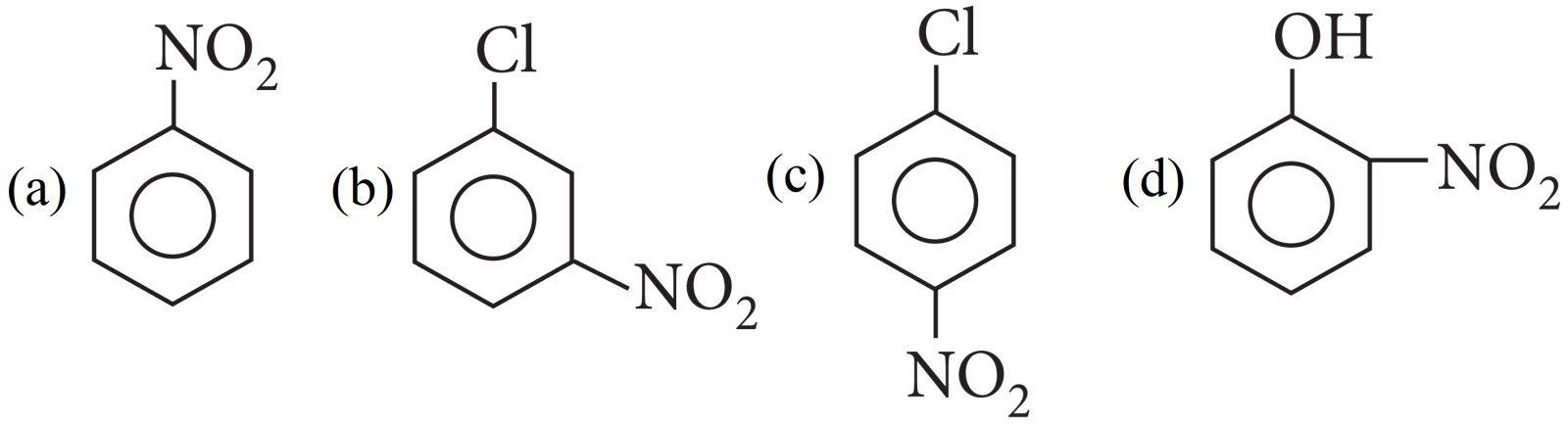
  1. Identify $W.$
  1. Compound $Y$ is:
  1. When $X$ reacts with $CH_3COCl$ in presence of anhy. $AlCl_3$, the reaction is known as:
  1. Benzene.
  2. Phenol.
  3. P-chlorophenol.
  4. Triphenyl.
  5. When $X$ is treated $Ni-Al/ \text{NaOH}$ the product obtained is:
  6. Fittig reaction.
  7. Ullmann reaction.
  8. Wurtz$-$Fittig reaction.
  9. Friedel$-$Crafts acylation reaction.
  1. Compound $Z$ is:
  1. Phenol.
  2. $P-$chlorophenol.
  3. $P-$nitrophenol.
  4. Nitrobenzene.
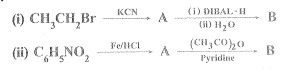
Give the structures of A and B in the following reactions
Image
Read the passage given below and answer the following questions:
The amines are basic in nature due to the presence of a lone pair of electron on $N-$atom of the $-NH_2$ group, which it can donate to electron deficient compounds. Aliphatic amines are stronger bases than $NH_3$ because of the $+I$ effect of the alkyl groups. Greater the number of alkyl groups attached to $N-$atom, higher is the electron density on it and more will be the basicity. Thus, the order of basic nature of amines is expected to be $3^\circ > 2^\circ > 1^\circ ,$ however the observed order is $2^\circ > 1^\circ > 3^\circ .$ This is explained on the basis of crowding on $N-$atom of the amine by alkyl groups which hinders the approach and bonding by a proton, consequently, the electron pair which is present on $N$ is unavailable for donation and hence $3^\circ$ amines are the weakest bases.
Aromatic amines are weaker bases than ammonia and aliphatic amines. Electron-donating groups such as $-\ce{CH_3, -OCH_3,}$ etc. increase the basicity while electron-withdrawing substitutes such as $\ce{-NO_2, -CN,}$ halogens, etc. decrease the basicity of amines. The effect of these substituents is more at $p$ than at $m-$positions.
The following questions are multiple choice questions. Choose the most appropriate answer:
  1. Which one of the following is the strongest base in aqueous solution?
  1. Methyl amine.
  2. Tri methyl amine.
  3. Aniline.
  4. Dimethyl amine.
  1. Which order ofbasicity is correct?
  1. Aniline $>$ $m-$toluidine $> o-$toluidine
  2. Aniline $> o-$toluidine $> m-$toluidine
  3. $o-$toluidine $>$ aniline $> m-$toluidine
  4. $o-$toluidine $<$ aniline $< m-$toluidine
  1. What is the decreasing order of basicity of primary, secondary and tertiary ethylamines and $NH_3$?
  1. $\ce{NH_3 > C_2H_5NH_2 > (C_2H_5)_2NH > (C_2H_5)_3N}$
  2. $\ce{(C_2H_5)_3N > (C_2H_5)_2NH_{ }> C_2H_5NH_2 > NH_3}$
  3. $\ce{(C_2H_5)_2NH > C_2H_5NH_2> (C_2H_5)_3N > NH_3}$
  4. $\ce{(C_2H_5)_2NH > (C_2H_5)_3N > C_2H_5NH_2 > NH_3​​​​​​​}$
  1. The order of basic strength among the following amines in benzene solution is:
  1. $\ce{CH_3NH_2 > (CH_3)_3N > (CH_3)_2NH}$
  2. $\ce{(CH_3)_3N > (CH_3)_2NH > CH_3NH_2​​​​​​​}$
  3. $\ce {CH_3NH_2 > (CH_3)_2NH > (CH_3)_3N}$
  4. $\ce{(CH_3)_3N > CH_3NH_2 > (CH_3)_2NH}$
  1. Choose the correct statement.
  1. Methylamine is slightly acidic.
  2. Methylamine is less basic than ammonia.
  3. Methylamine is a stronger base than ammonia.
  4. Methylamine forms salts with alkalies.