Question
Read the passage given below and answer the following questions:
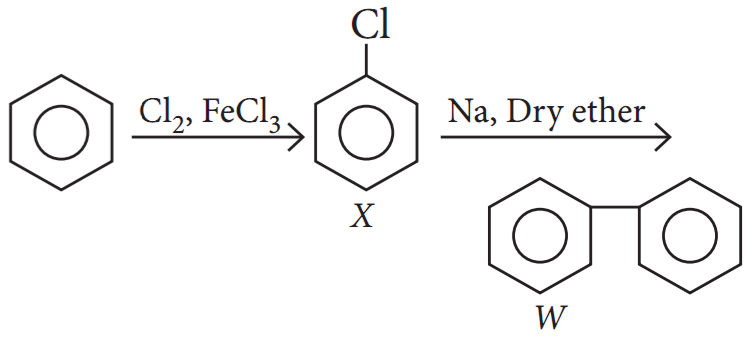
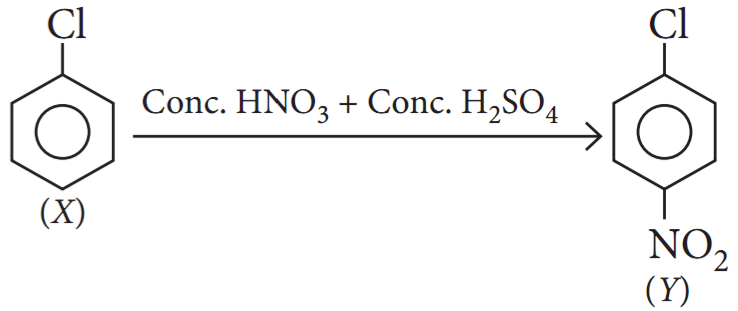
Consider the given sequence of reactions:

The following questions are multiple choice questions. Choose the most appropriate answer:

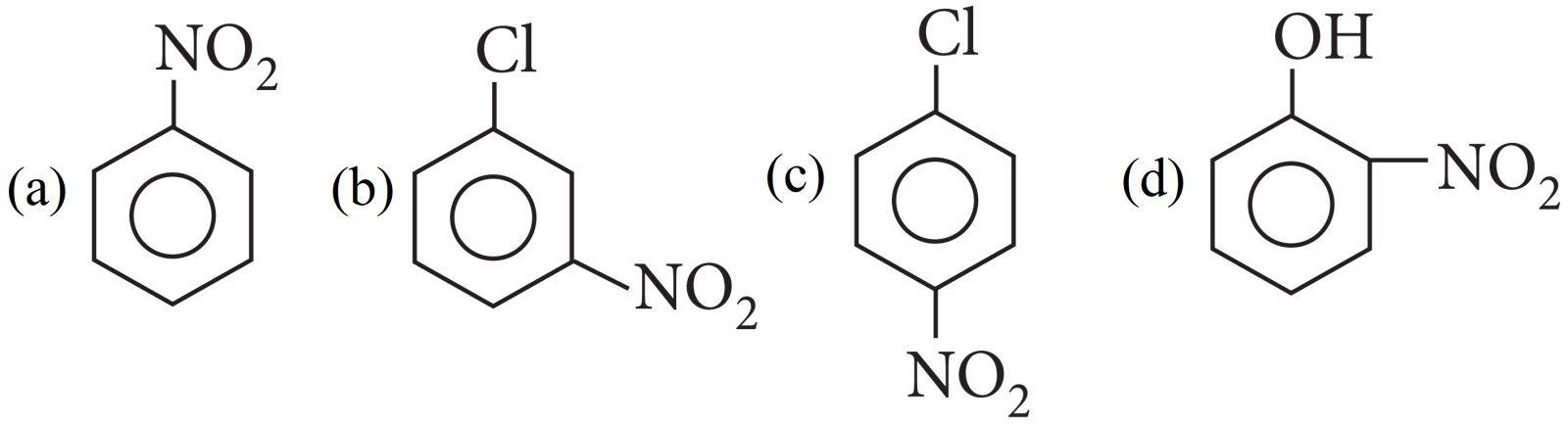
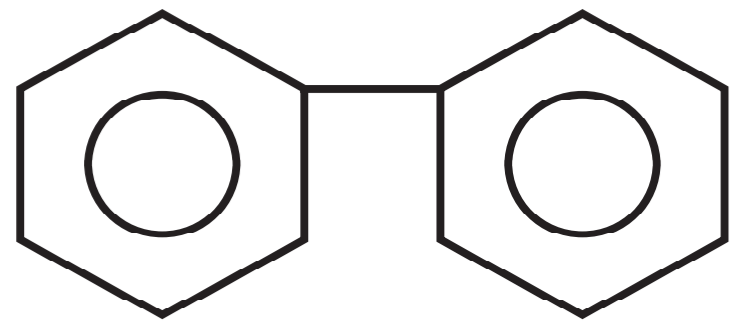
  1. Identify $W.$
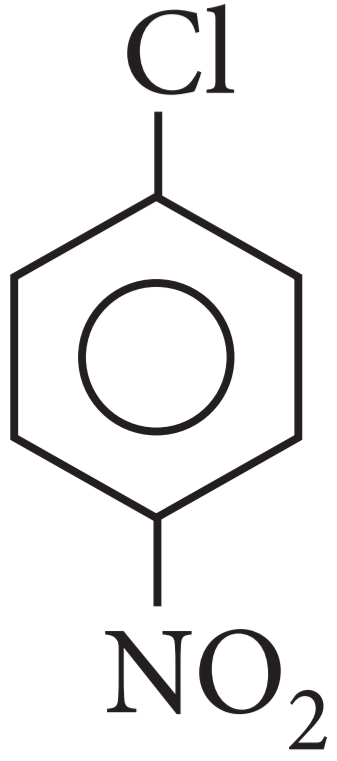
  1. Compound $Y$ is:
  1. When $X$ reacts with $CH_3COCl$ in presence of anhy. $AlCl_3$, the reaction is known as:
  1. Benzene.
  2. Phenol.
  3. P-chlorophenol.
  4. Triphenyl.
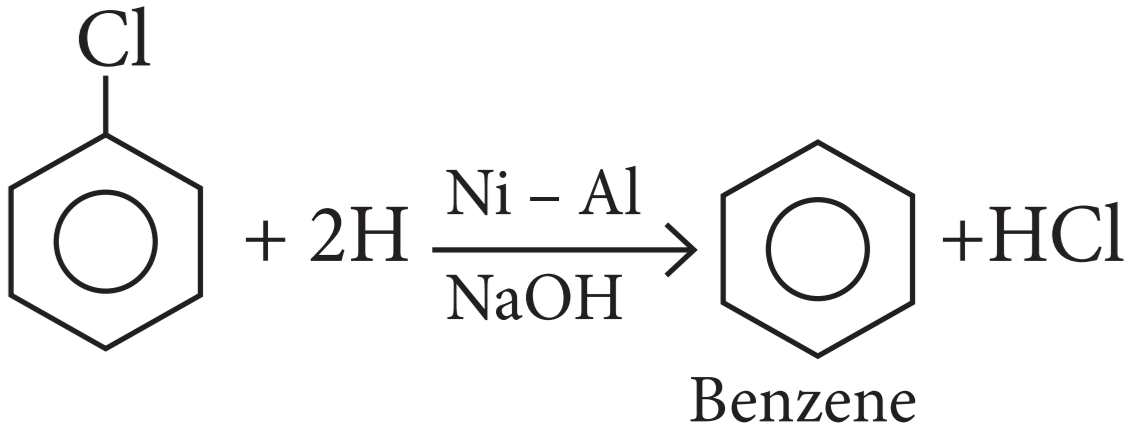
  5. When $X$ is treated $Ni-Al/ \text{NaOH}$ the product obtained is:
  6. Fittig reaction.
  7. Ullmann reaction.
  8. Wurtz$-$Fittig reaction.
  9. Friedel$-$Crafts acylation reaction.
  1. Compound $Z$ is:
  1. Phenol.
  2. $P-$chlorophenol.
  3. $P-$nitrophenol.
  4. Nitrobenzene.

Answer

  1. $(c)$

  1. $(c)$

  1. $(d)$ Friedel$-$Crafts acylation reaction.
  2. $(a)$ Benzene.
  1. $(c)\ P-$nitrophenol.

Need a full question paper?

Generate a complete, print-ready paper with questions like this in minutes — across 16+ boards, with answer keys.

Start Generating Free

Similar questions

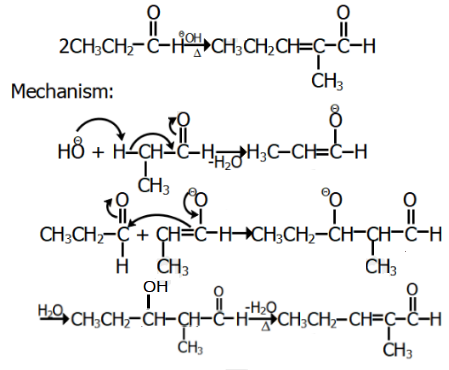
Read the passage given below and answer the following questions: The addition reaction of enol or enolate to the carbonyl functional group of aldehyde or ketone is known as aldol addition. The $\beta-$ hydroxyaldehyde or $\beta\beta-$ hydroxyketone so obtained undergo dehydration in second step to produce a conjugated enone. The first part of reaction is an addition reaction and the second part is an elimination reaction. Carbonyl compound having $\alpha \alpha -$ hydrogen undergoes aldol condensation reaction.
  1. Condensation reaction is the reverse of which of the following reaction?
  1. Lock and key hypothesis
  2. Oxidation
  3. Hydrolysis
  4. Glycogen formation
  1. Which of the following compounds would be the main product of an aldol condensation of acetaldehyde and acetone?
  1. $\ce{CH_3CH=CHCHO}$
  2. $\ce{CH_3CH=CHCOCH_3}$
  3. $\ce{(CH_3)_2C=CHCHO}$
  4. $\ce{(CH_3)_2C=CHCOCH_3}$
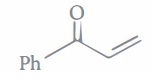
  1. Which combination of carbonyl compounds gives phenyl vinyl ketone by an aldol condensation?
  1.  Acetophenone and Formaldehyde
  2. Acetophenone and acetaldehyde
  3. Benzaldehyde and acetaldehyde
  4. Benzaldehyde and acetone
  5. Which of the following will undergo aldol condensation?
  1. $\ce{HCHO}$
  2. $\ce{CH_3CH_2OH}$
  3. $\ce{C_6H_5CHO}$
  4. $\ce{CH_3CH_2CHO}$
Read the passage given below and answer the following questions:
A compound $(X)$ containing $C, H$ and $O$ is unreactive towards sodium. It also does not react with Schiff s reagent. On refluxing with an excess of hydroiodic acid, $(X)$ yields only one organic product $( Y).$ On hydrolysis, $(Y)$ yields a new compound $(Z)$ which can be converted into $(Y)$ by reaction with red phosphorus and iodine. The compound $(Z)$ on oxidation with potassium permanganate gives a carboxylic acid. The equivalent weight of this acid is $60.$
The following questions are multiple choice questions. Choose the most appropriate answer:
  1. The compound $(X)$ is an:
  1. Acid.
  2. Aldehyde.
  3. Alcohol.
  4. Ether.
  1. The $\text{IUPAC}$ name of the acid formed is:
  1. Methanoic acid.
  2. Ethanoic acid.
  3. Propanoic acid.
  4. Butanoic acid.
  1. Compound $(Y)$ is:
  1. Ethyl iodide.
  2. Methyl iodide.
  3. Propyl iodide.
  4. Mixture of $(a)$ and $(b).$
  1. Compound $(Z)$ is:
  1. Methanol.
  2. Ethanol.
  3. Propanol.
  4. Butanol.
  1. Compound $(X)$ on treatment with excess of $Cl_2$ in presence of tight gives:
  1. $\propto-$ Chlorodiethyl ether.
  2. $\propto,\propto\ '-$ Dichlorodiethyl ether.
  3. Perchlorodiethyl ether.
  4. None of these.
Read the passage given below and answer the following questions:
Haloarenes are less reactive than haloalkanes. The low reactivity of haloarenes can be attributed to:
  • Resonance effect.
  • $sp^2$ hybridisation of $C - X$ bond.
  • Polarity of $C - X$ bond
  • Instability of phenyl cation $($formed by self$-$ionisation of haloarene$).$
  • Repulsion between the electron rich attacking nucleophiles and electron rich arenes.
Reactivity of haloarenes can be increased or decreased by the presence of certain groups at certain positions for example, nitro $(-NO_{^2})$ group at o/ p positions increases the reactivity of haloarenes towards nucleophilc substitution reactions.
The following questions are multiple choice questions Choose the most appropriate answer:
  1. Aryl halides are less reactive towards nucleophilic substitution reaction as compared to alkyl halides due to
  1. The formation of less stable carbonium ion.
  2. Resonance stabilisation.
  3. Larger carbon$-$halogen bond.
  4. Inductive effect.
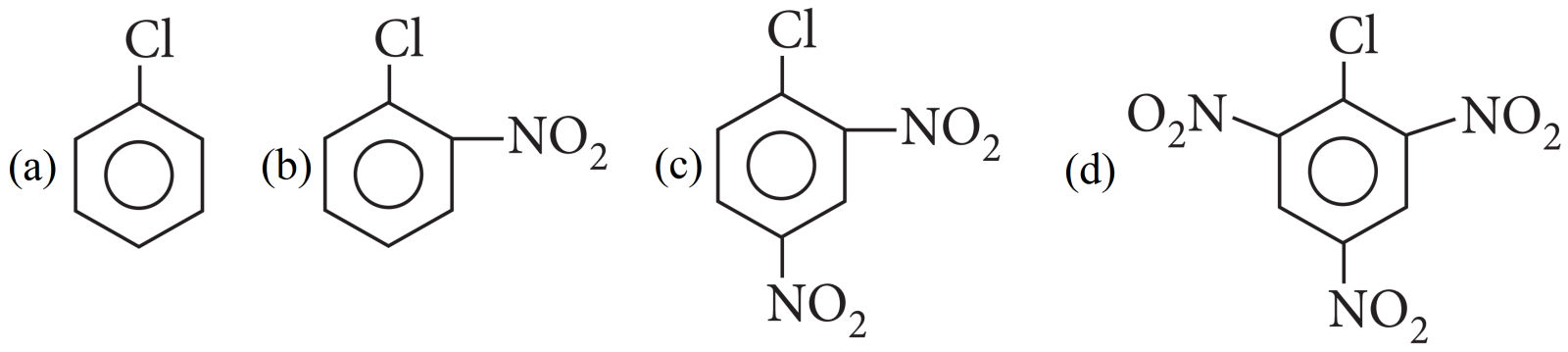
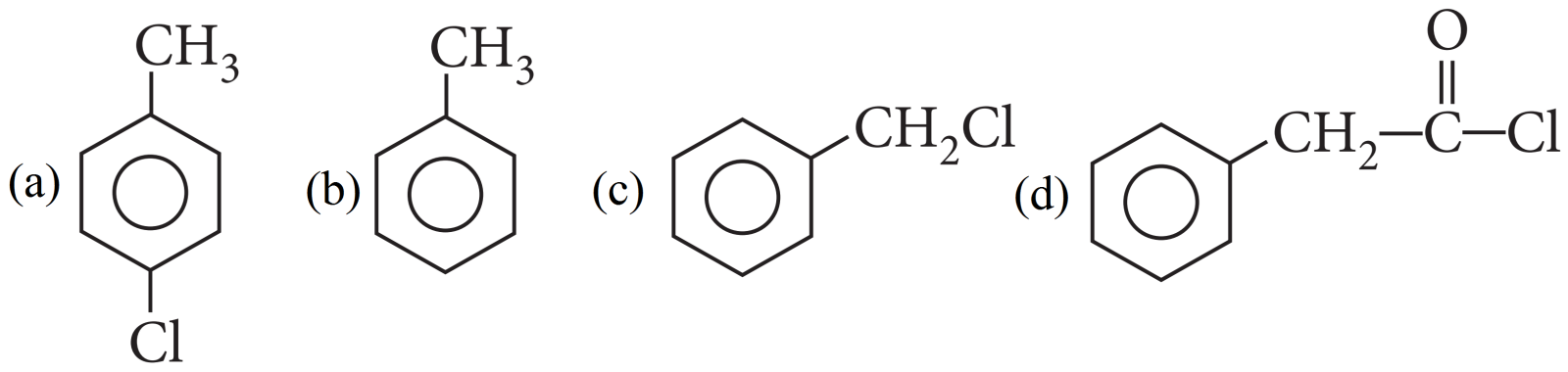
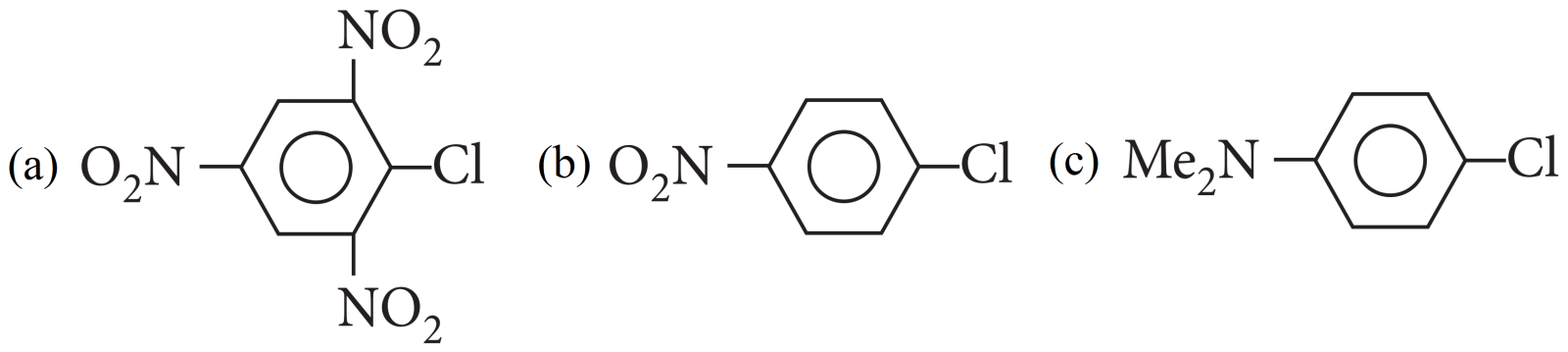
  1. Which of the following aryl halides is the most reactive towards nucleophilic substitution?
  1. Which one of the following will react fastest with aqueous $\text{NaOH}$?
  1. Which chloro derivative of benzene among the followings would undergo hydrolysis most readily with aqueous sodium hydroxide to furnish the corresponding hydroxy derivative?
  1. $\ce{C_6H_5Cl}$
  1. The reactivity of the compounds $\ce{(i)\ MeBr, (ii)\ PhCH_2Br, (iii)\ MeCI, (iv)\ p-MeOC_6H_4Br}$ decreases as:
  1. $\ce{(i) > (ii) > (iii) > (iv)}$
  2. $\ce{(iv) > (ii) > (i) > (iii)}$
  3. $\ce{(iv) > (iii) > (i) > (ii)}$
  4. $\ce{(ii) > (i) > (iii) > (iv)}$
Electrical work done in unit time is equal to electrical potential multiplied by total charge passed. ln order to obtain maximum work from a cell, the charge has to be passed reversibly. The reversible work done by a cell is equal to decrease in its Gibb's energy. Hence, Gibb's energy of reaction is given by $\Delta\text{G}=\text{nFE}_\text{cell}$ Hence, Eis the emfof the cell and $nF$ is the amount of energy. In these questions $(Q$. No. $i-Iv),$ a statement of assertion followed by a statement ofreason is given. Choose the correct answer out of the following choices.
  1. Assertion and reason both are correct statements and reason is correct explanation for assertion.
  2. Assertion and reason both are correct statements but reason is not correct explanation for assertion.
  3. Assertion is correct statement but reason is wrong statement.
  4. Assertion is wrong statement but reason is correct statement.
  1. Assertion : $\Delta\text{G}^\circ=-\text{nFE}^\circ$
Reason : $E^\circ$ ​​​​​​​ should be positive for a spontaneous reaction.
  1. Assertion : An electrochemical cell can be set up only if the red ox reaction is spontaneous.
Reason : A reaction is spontaneous if free energy change is negative.
  1. Assertion : For an electrochemical cell, $\Delta\text{G}<0$ and $\text{E}_\text{cell}>0.$
Reason : The given cell is non $-$ spontaneous.
  1. Assertion : Current stops flowing when $E_\text{cell} = 0$.
Reason : Equilibrium of the cell reaction is attained.
  1. Assertion :$ E_\text{cell}$ should have a positive value for the cell to function.
Reason : $E_\text{cell} = E_\text{cathode} - E_\text{anode}$
Read the passage given below and answer the following questions: Due to intermolecular hydrogen bonding, the boiling points of alcohols and phenols are much higher than those of corresponding haloalkanes, haloarenes, aliphatic and aromatic hydrocarbons. Among isomeric alcohols, the boiling points follow the order: primary > secondary > tertiary. Boiling points of ethers are much lower than those of isomeric alcohols. The solubility of alcohols in water decreases as the molecular mass of alcohols increases. Amongst isomeric alcohols solubility increases with branching. The solubility of phenols in water is much lower than that of alcohols. Lower ethers such as dimethyl ether and ethyl methyl ether are soluble in water, but the solubility decreases as the molecular mass increases. In these questions (Q. No. i-iv), a statement of assertion followed by a statement of reason is given. Choose the correct answer out of the following choices.
  1. Assertion and reason both are correct statements and reason is correct explanation for assertion.
  2. Assertion and reason both are correct statements but reason is not correct explanation for assertion.
  3. Assertion is correct statement but reason is wrong statement.
  4. Assertion is wrong statement but reason is correct statement.
  1. Assertion: Alcohols have higher boiling points than ethers of comparable molecular masses.
Reason: Alcohols and ethers are isomeric in nature.
  1. Assertion: The solubility of phenols in water is much lower than that of alcohols.
Reason: Phenols do not form H-bonds with water.
  1. Assertion: Among n-butane, ethoxyethane, 1-propanol and 2-propanol, the increasing order of boiling points is, 1-butanol < 1-propanol < ethoxyethane < n-butane.
Reason: Boiling point increases with increase in molecular mass.
  1. Assertion: Dimethyl ether and diethylether are soluble in water.
Reason: As the molecular mass increases, solubility of ethers in water decreases.
  1. Assertion: Butan-2-ol has higher boiling point than 2-methylpropan-2-ol.
Reason: Amongst isomeric alcohols, the boiling points decreases with branching.
Read the passage given below and answer the following questions: According to Raoult's law, the partial pressure of two components of the solution maybe given as: $\text{P}_\text{A}=\stackrel{{0}}{\hbox{PA }}\text{x}_\text{A}$ and $\text{P}_\text{B}=\stackrel{{0}}{\hbox{PB }}\text{x}_\text{B}$ For an ideal solution (obeys Raoult's law always) $\Delta\text{H}_\text{mix}=0,\Delta\text{mix}=0$ All solutions do not obey Raoults law over entire range of concentration. These are known as non-ideal solutions. For non-ideal solutions, $\text{P}_\text{A}\not=\stackrel{{0}}{\hbox{PA }}\text{x}_\text{A}$ or $\text{P}_\text{B}\not=\stackrel{{0}}{\hbox{PB }}\text{x}_\text{B}$ Positive deviation $\Rightarrow\text{P}_\text{A}>\stackrel{{0}}{\hbox{PA }}\text{x}_\text{A}$ and $\text{P}_\text{B}>\stackrel{{0}}{\hbox{PB }}\text{x}_\text{B}$ Negative deviation $\text{P}_\text{A}<\stackrel{{0}}{\hbox{PA }}\text{x}_\text{A}$ and $\text{P}_\text{B}\stackrel{{0}}{\hbox{PB }}\text{x}_\text{B}$ A statement of assertion followed by a statement ofreason is given. Choose the correct answer out of the following choices.
  1. Assertion and reason both are correct statements and reason is correct explanation for assertion.
  2. Assertion and reason both are correct statements but reason is not correct explanation for assertion.
  3. Assertion is correct statement but reason is wrong statement.
  4. Assertion is wrong statement but reason is correct statement.
  1. Assertion: An ideal solution obeys Raoult's law.
Reason: In an ideal solution, solute-solute as well as solvent-solvent interactions are similar to solute-solvent interactions.
  1. Assertion: Acetone and aniline show negative deviations.
Reason: H-bonding between acetone and aniline is stronger than that between acetone-acetone and aniline-aniline.
  1. Assertion: Azeotropic mixtures are formed only by non-ideal solutions and they may have boiling points either greater than both the components or lesser than both the components.
Reason: The composition of the vapour phase is same as that of the liquid phase of an azeotropic mixture.
  1. Assertion: The solutions which show negative deviations from Raoult's law are called maximum boiling azeotropes.
Reason: 68% nitric acid and 32% water by mass fonn maximum boiling azeotrope.
  1. Assertion: $\Delta\text{H}_{\text{mix}}$ mix and $\Delta\text{V}_{\text{mix}}$ are positive for an ideal solution.
Reason: The interactions between the particles of the components of an ideal solution are almost identical as between particles in the liquids.
Read the passage given below and answer the following questions:
When a solution of an et$-$amino acid is placed in an electric field depending on the $pH$ of the medium, following three cases may happen.
  1. In alkaline solution, $CL-$amino acids exist as anion $II,$ and there is a net migration of amino acid towards the anode.
  2. In acidic solution, a$-$amino acids exist as cation $III,$ and there is a net migration of amino acid towards the cathode.
  3. If $II$ and $III$ are exactly balanced there is no net migration; under such conditions any one molecule exists as a positive ion and as a negative ion for exactly the same amount of time, and any small movement in the direction of one electrode is subsequently cancelled by an equal movement back toward the other electrode. The $pH$ of the solution in which a particular amino acid does not migrate under the influence of an electric field is called the is oelectric point of that amino acid.
The following questions are multiple choice questions. Choose the most appropriate answer:
  1.  

Arrange in order of increasing acid strengths. 
  1. $\ce{X > Z > Y}$
  2. $\ce{Z < X < Y}$
  3. $\ce{X > Y > Z}$
  4. $\ce{Z > X > Y}$
  1. In aqueous solutions, amino acids mostly exist as:
  1. $\ce{NH_2 - CHR - COOH}$
  2. $\ce{NH_2 - CHR - COO^-}$
  3. $\stackrel{+}{\hbox{ N}}\text{H}_3\text{CHRCOOH}$
  4. $\text{H}_3\stackrel{{+}}{\hbox{N}}\text{CHRCOO}^-$
  1. Amino acids are least soluble:
  1. at $\ce{pH 1}$
  2. at $\ce{pH 7}$
  3. At their isoelectric points.
  4. None of these.
  1. The $\text{pK}_{\text{a}_1}$ and $\text{pK}_{\text{a}_2}$ of an amino acid are $2.3$ and $9.7$ respectively. The is oelectric point of the amino acid is:
  1. $12.0$
  2. $7.4$
  3. $6.0$
  4. $3.7$
  1. A tripeptide $(X)$ on partial hydrolysis gave two dipeptides $\ce{Cys-Gly}$ and $\ce{Glu-Cys.}$ Identify the tripeptide.
  1. $\ce{Glu-Cys-Gly}$
  2. $\ce{Gly-Glu-Cys}$
  3. $\ce{Cys-Gly-Glu}$
  4. $\ce{Cys-Glu-Gly}$
Read the passage given below and answer the following questions:
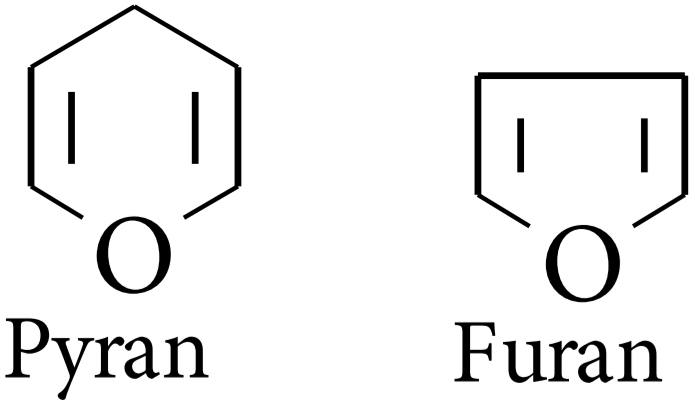
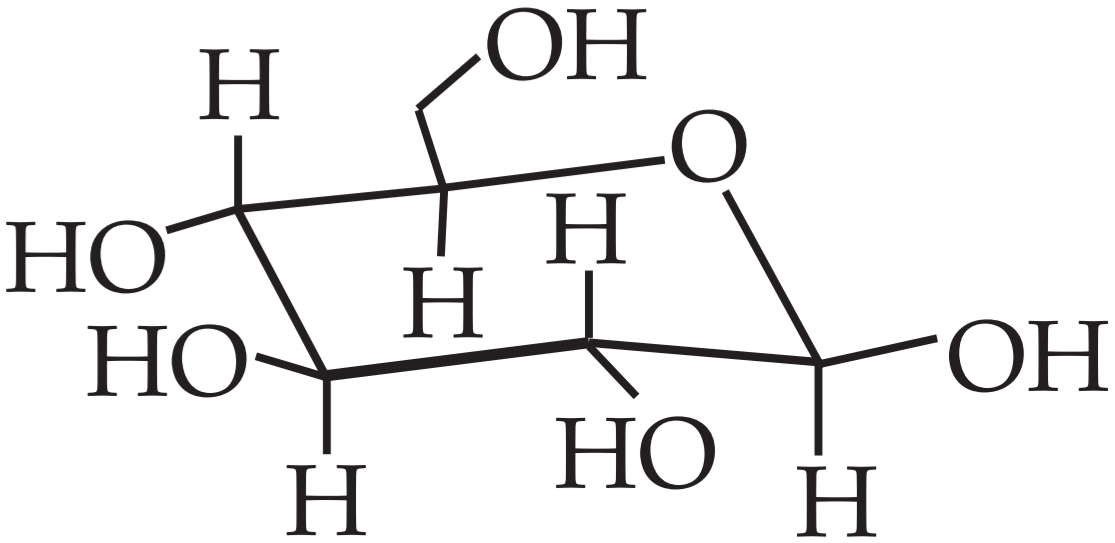
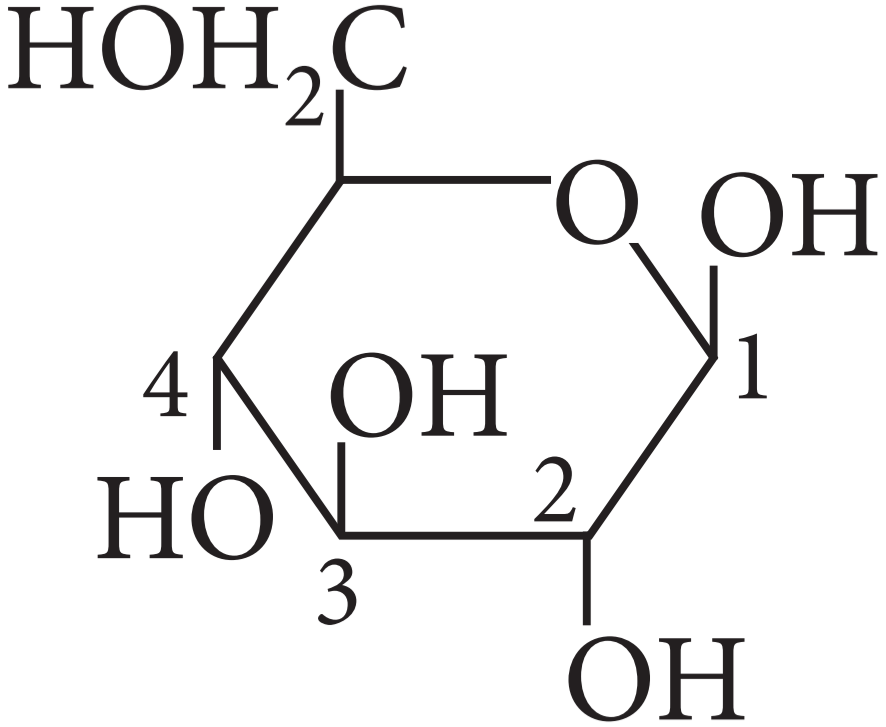
Pentose and hexose undergo intramolecular hemiacetal or hemiketal formation due to combination of the $–\ce{OH}$ group with the carbonyl group. The actual structure is either of five or six membered ring containing an oxygen atom. In the free state all pentoses and hexoses exist in pyranose form $($resembling pyran$).$ However,inthe combined state some of them exist as five membered cyclic structures, called furanose $($resembling furan$).$

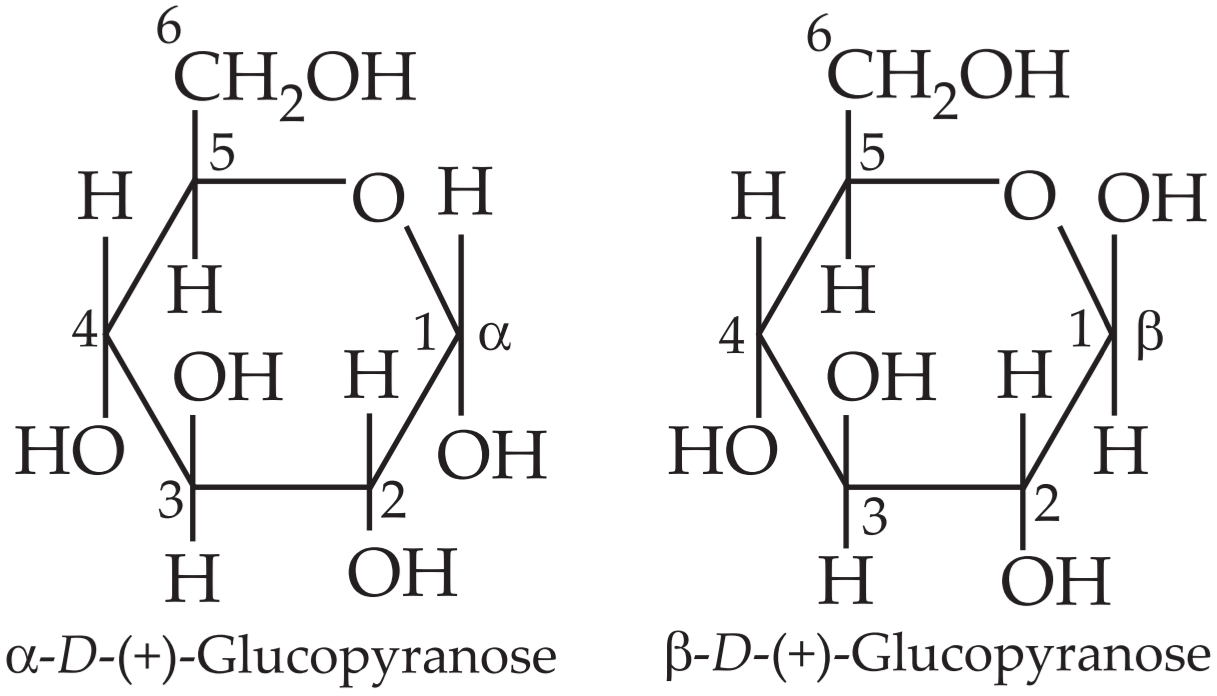
The cyclic structure of glucose is represented by Haworth structure:

$\alpha$ and $\beta D-$glucose have different configuration at anomeric $(C-1)$ carbon atom, hence are called anomers and the $C-1$ carbon atom is called anomeric carbon $($glycosidic carbon$).$
The six membered cyclic structure of glucose is called pyranose structure.
The following questionsare multiple choice questions. Choose the most appropriate answer:
  1. $\alpha D(+)-$glucose and $\beta D(+)$ glucose are:
  1. Enantiomers.
  2. Conformers.
  3. Epimers.
  4. Anomers.
  1. The following carbohydrate is:
 
  1. A ketohexose.
  2. An aldohexose.
  3. An $n-$furanose.
  4. An $\alpha-$pyranose.
  1. In the following structure, anomeric carbon is:
  1. $C-1$
  2. $C-2$
  3. $C-3$
  4. $C-4$
  1. The term anomers of glucose refers to:
  1. Isomers of glucose that differ in configurations at carbons one and four $(C-1$ and $C-4).$
  2. A mixture of $(D)-$glucose and $(L)-$glucose.
  3. Enantiomers of glucose.
  4. Isomers of glucose that differ in configuration at carbon one $(C-1).$
  1. What percentage of $\beta-D-(+)$ glucopyranose is found at equilibrium in the aqueous solution?
  1. $50\%$
  2. $\approx100%$
  3. $36\%$
  4. $64\%$
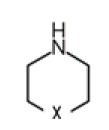
Amines are basic in nature. The $pK_b$ value is a measure of the basic strength of an amine. Lower the value of $pK_b$ more basic is the amine. The effect of substituent on the basic strength of amines in aqueous solution was determined using titrations. The substituent $''X\ ''$ replaced $''-CH_2\ ''$ group in piperidine $($ compound $1)$ and propylamine $\ce{CH_3CH_2CH_2NH_2}, ($compound $2).$
Compound $1:$ Image
Compound $2: \ce{HXCH_2CH_2NH_2}$
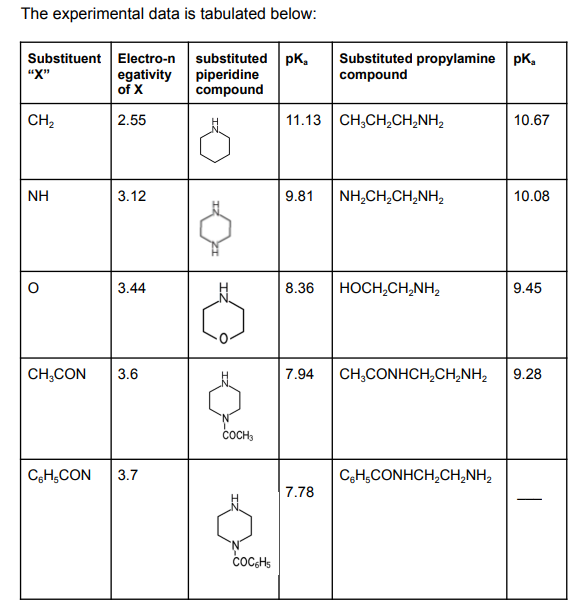
Image
$($source: Hall $\text{Jr, H. K.} (1956).$ Field and inductive effects on the base strengths of amines. Journal of the American Chemical Society, $78(11), 2570-2572.)$
Study the above data and answer the following questions:
$a.$ Plot a graph between the electronegativity of the substituent vs $pK_b$ value of the corresponding substituted propyl amine $($given that $pK_a + pK_b =14).$ Is there any relation between the electronegativity of the substituent and its basic strength?
$b.$ The electronegativity of the substituent $''C_6H_5CON\ ''$ is $3.7,$ what is the expected $pKa$ value of compound $\ce{C_6H_5CONHCH_2CH_2NH_2}$?
$(i)\ 9.9\ (ii)\ 9.5\ (iii)\ 9.3\ (iv)\ 9.1$
$c.$ The pKa value of the substituted piperidine formed with substituent $''X\ ''$ is found to be $8.28.$ What is the expected electronegativity of $''X\ ''$
$(i)\ 3.5\ (ii)\ 3.4\ (iii)\ 3.8\ (iv)\ 3.1$
Read the passage given below and answer the following questions: Fehling's reagent: Fehling's reagent is a mixture of two solutions. Fehllng's solution $A$ is aqueous copper sulphate solution. Fehling's solution Bis alkaline sodium potassium tartarate $($Rochelle salt$). \ \ \ \ \ \ \ \ \ \ \ \ \ \ \ \ \ \ \ \ \text{CH(OH)COONa}\\\text{CuSo}_{4\text{(aq)}}+|\\\ \ \ \ \ \ \ \ \ \ \ \ \ \ \ \ \ \ \ \ \text{CH(OH)COOK}$ It is a mild oxidising agent. It is weaker than Tollens' reagent. It oxidises only aliphatic aldehydes to carboxylate ions and itself gets reduced to reddish brown precipitate of cuprous oxide. Aromatic aldehydes do not respond to Fehling's test. This reaction is used for the test of aliphatic aldehydes known as Fehling's reagent test. In these questions $(Q$. No. $l-iv),$ a statement of assertion followed by a statement ofreason is given. Choose the correct answer out of the following choices.
  1. Assertion and reason both are correct statements and reason is correct explanation for assertion.
  2. Assertion and reason both are correct statements but reason is not correct explanation for assertion.
  3. Assertion is correct statement but reason is wrong statement.
  4. Assertion is wrong statement but reason is correct statement.
  1. Assertion : Fehling's solution can be used to distinguish between acetaldehyde and acetone.
Reason : Fehling's reagent is a mixture of two solutions.
  1. Assertion : Aromatic aldehydes can be distinguished from aliphatic aldehydes by Fehling's solution.
Reason : Aromatic aldehydes reduce Fehling's solution, but aliphatic aldehydes do not.
  1. Assertion : Fehling's solution oxidises acetaldehyde to acetic acid but not benzaldehyde to benzoic acid.
Reason : The $C-H$ bond of $-\text{CHO}$ group in benzaldehyde is stronger than in acetaldehyde.
  1. Assertion : $\ce{CH_3CHO}$ and $\ce{C_6H_5CH_2CHO}$ cannot be distinguished chemically by Fehling's solution.
Reason : $\ce{CH_3CHO}$ and $\ce{C_6H_5CH_2CHO}$ cannot be distinguished chemically by Fehling's solution.
  1. Assertion : Formaldehyde, when heated with Fehling's reagent produces a reddish brown ppt, of $\ce{Cu}$.
Reason : Fehling's reagent oxidises fonnaldehyde to formate ion.