Question
Read the passage given below and answer the following questions:
The amines are basic in nature due to the presence of a lone pair of electron on $N-$atom of the $-NH_2$ group, which it can donate to electron deficient compounds. Aliphatic amines are stronger bases than $NH_3$ because of the $+I$ effect of the alkyl groups. Greater the number of alkyl groups attached to $N-$atom, higher is the electron density on it and more will be the basicity. Thus, the order of basic nature of amines is expected to be $3^\circ > 2^\circ > 1^\circ ,$ however the observed order is $2^\circ > 1^\circ > 3^\circ .$ This is explained on the basis of crowding on $N-$atom of the amine by alkyl groups which hinders the approach and bonding by a proton, consequently, the electron pair which is present on $N$ is unavailable for donation and hence $3^\circ$ amines are the weakest bases.
Aromatic amines are weaker bases than ammonia and aliphatic amines. Electron-donating groups such as $-\ce{CH_3, -OCH_3,}$ etc. increase the basicity while electron-withdrawing substitutes such as $\ce{-NO_2, -CN,}$ halogens, etc. decrease the basicity of amines. The effect of these substituents is more at $p$ than at $m-$positions.
The following questions are multiple choice questions. Choose the most appropriate answer:
  1. Which one of the following is the strongest base in aqueous solution?
  1. Methyl amine.
  2. Tri methyl amine.
  3. Aniline.
  4. Dimethyl amine.
  1. Which order ofbasicity is correct?
  1. Aniline $>$ $m-$toluidine $> o-$toluidine
  2. Aniline $> o-$toluidine $> m-$toluidine
  3. $o-$toluidine $>$ aniline $> m-$toluidine
  4. $o-$toluidine $<$ aniline $< m-$toluidine
  1. What is the decreasing order of basicity of primary, secondary and tertiary ethylamines and $NH_3$?
  1. $\ce{NH_3 > C_2H_5NH_2 > (C_2H_5)_2NH > (C_2H_5)_3N}$
  2. $\ce{(C_2H_5)_3N > (C_2H_5)_2NH_{ }> C_2H_5NH_2 > NH_3}$
  3. $\ce{(C_2H_5)_2NH > C_2H_5NH_2> (C_2H_5)_3N > NH_3}$
  4. $\ce{(C_2H_5)_2NH > (C_2H_5)_3N > C_2H_5NH_2 > NH_3​​​​​​​}$
  1. The order of basic strength among the following amines in benzene solution is:
  1. $\ce{CH_3NH_2 > (CH_3)_3N > (CH_3)_2NH}$
  2. $\ce{(CH_3)_3N > (CH_3)_2NH > CH_3NH_2​​​​​​​}$
  3. $\ce {CH_3NH_2 > (CH_3)_2NH > (CH_3)_3N}$
  4. $\ce{(CH_3)_3N > CH_3NH_2 > (CH_3)_2NH}$
  1. Choose the correct statement.
  1. Methylamine is slightly acidic.
  2. Methylamine is less basic than ammonia.
  3. Methylamine is a stronger base than ammonia.
  4. Methylamine forms salts with alkalies.
Answer

  1. $(d)$ Dimethyl amine.
The increasing order of basicity of the given compounds is $\ce{(CH_3)_2NH > CH_3NH_2 > (CH_3)_3N > C_6H_5NH_2.}$ Due to the $+I$ effect of alkyl groups, the electron density on nitrogen increases and thus, the availability of the lone pair of electrons to proton increases and hence, the basicity of amines also increases. So, aliphatic amines are more basic than aniline. ln case of tertiary amine $(CH_3)_3N,$ the covering of alkyl groups over nitrogen atom from all sides makes the approach and bonding by a proton relatively difficult, hence the basicity decreases. Electron withdrawing groups decrease electron density on nitrogen atom and thereby decreasing basicity.
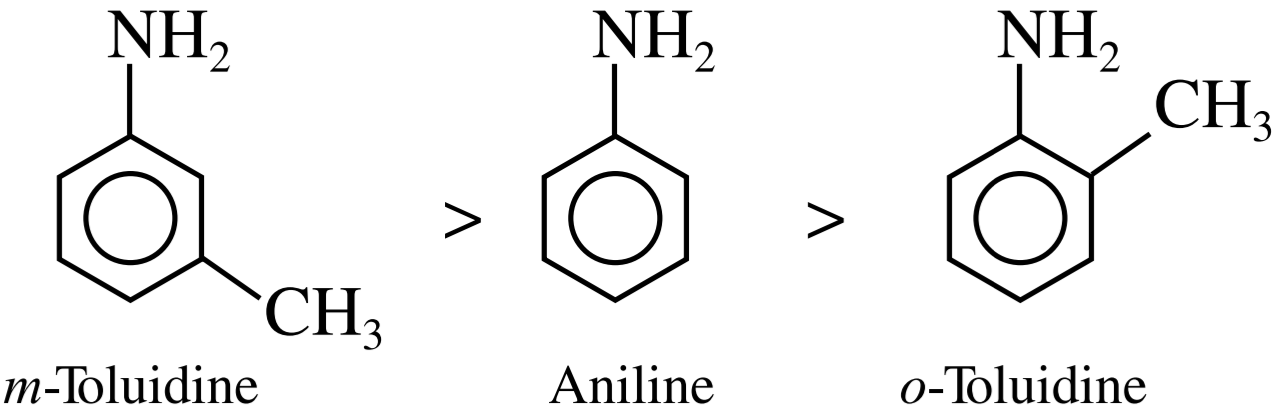
  1. $(d)\ o-$toluidine $<$ aniline $< m-$toluidine
In general, electron donating $( +R)$ group which when present on benzene ring $\ce{(-NH_2, -OR, -R,}$ etc$.)$ at the para position increases the basicity of aniline.
Ortho substituted anilines are weaker bases than aniline due to ortho effect.
  1. $(d)\  \ce{(C_2H_5)_2NH > (C_2H_5)_3N > C_2H_5NH_2 > NH_3}$
In case of ethylamines, the combined effect of $(c)$ inductive effect, steric effect and salvation effect gives the order of basic strength as
$(\text{C}_2\text{H}_5)_2\text{NH}>(\text{C}_2\text{H}_5)_3\text{N}>\text{C}_2\text{H}_5\text{NH}_2>\text{NH}_3\\\ \ \ \ \ \ \ \ (2^\circ)\ \ \ \ \ \ \ \ \ \ \ \ \ \ \ \ \ \ (3^\circ)\ \ \ \ \ \ \ \ \ \ \ \ \ (1^\circ)$
  1. $(b)\ \ce{(CH_3)_3N > (CH_3)_2NH > CH_3NH_2​​​​​​​}$
In non$-$aqueous solvents the basic strength of alkyl amines follows the order:
tertiary amines $>$ secondary amines $>$ primary amines.
  1. $(c)$ Methylamine is a stronger base than ammonia.
Methyl amine is stronger base than ammonia due to electron releasing inductive effect of methyl group.

Need a full question paper?

Generate a complete, print-ready paper with questions like this in minutes — across 16+ boards, with answer keys.

Start Generating Free

Similar questions

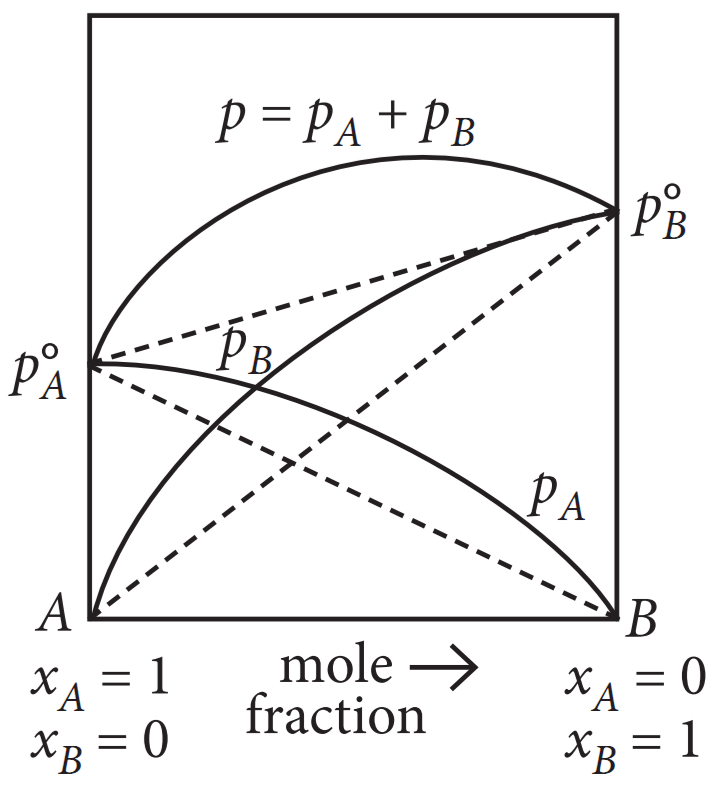
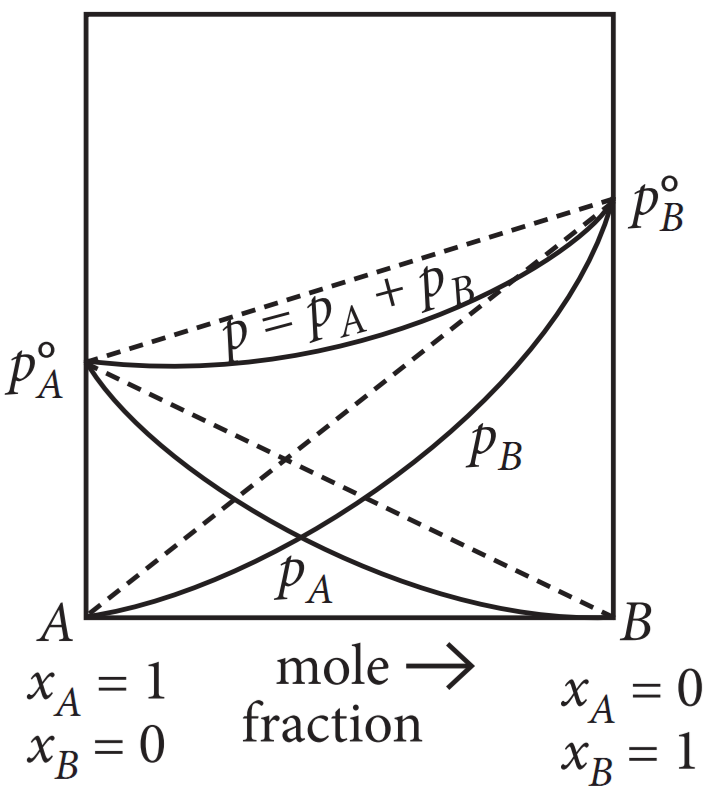
Read the passage given below and answer the following questions: An ideal solution may be defined as the solution which obeys Raoult's law exactly over the entire range of concentration. The solutions for which vapour pressure is either higher or lower than that predicted by Raoult's law are called non-ideal solutions.Non-ideal solutions can show either positive or negative deviations from Raoult's law depending on whether the A-B interactions in solution are stronger or weaker than A - A and B - B interactions. The following questions are multiple choice questions. Choose the most appropriate answer:
  1. Which of the following solutions is/are ideal solution(s)?
  1. Bromoethane and iodoethane.
  2. Acetone and chloroform
  3. Benzene and acetone
  4. n-heptane and n-hexane
  1. Only I
  2. I and II
  3. II and III
  4. I and Iv
  1. For which of the following solutions $\Delta\text{H}_{\text{mix}}$ and $\Delta\text{V}_{\text{mix}}$ is negative?
  1. Acetone and aniline
  2. Ethyl alcohol and cyclohexane
  3. Acetone and CS2
  4. Benzene and toluene
  1. Which of the following is not true for positive deviations?
  1. The A-B interactions in solution are weaker than the A - A and B - B interactions.
  2. $\text{P}_\text{A}<\text{P}\mathring{\text{A}}\ \text{x}_\text{A}$ and $\text{P}_\text{B}<\text{P}\mathring{\text{B}}\ \text{x}_\text{B}$
  3. Carbon tetrachloride and chloroform mixture is an example of positive deviations.
  4. All of these.
  1. For water and nitric acid mixture, which of the given graph is correct?
 
  1.  
 
  1.  
  1. Both of these
  2. None of these
  1. Water-HCI mixture.
  1. Shows positive deviations.
  2. Forms minimum boiling azeotrope.
  3. Shows negative deviations.
  4. Forms maximum boiling azeotrope.
  1. I and II
  2. I and III
  3. I and IV
  4. III and IV
Read the passage given below and answer the following questions :
Valence bond theory considers the bonding between the metal ion and the ligands as purely covalent. On the other hand, crystal field theory considers the metal$-$ligand bond to be ionic arising from electrostatic interaction between the metal ion and the ligands. In coordination compounds, the interaction between the ligand and the metal ion causes the five $d-$orbitals to split$-$up. This is called crystal field splitting and the energy difference between the two sets of energy level is called crystal field splitting energy. The crystal field splitting energy $(\Delta_0)$ depends upon the nature of the ligand. The actual configuration of complexes is divided by the relative values of $\Delta_0$ and $P\ ($pairing energy$)$.
If $\Delta_0<\text{P},$ then complex will be high spin.
If $\Delta_0>\text{P},$ then complex will be low spin
The following questions are multiple choice questions. Choose the most appropriate answer :
  1. Which of the following ligand has lowest $\Delta_0$ value?
  1. $CN^-$
  2. $CO$
  3. $F^-$
  4. $NH_3$
  1. The crystal field splitting energy for octahedral $(\Delta_0)$ and tetrahedral $(\Delta_t)$ complex is related as :
  1. $\Delta_\text{t}=\frac{1}{2}\Delta_0$
  2. $\Delta_\text{t}=\frac{4}{9}\Delta_0$
  3. $\Delta_\text{t}=\frac{3}{5}\Delta_0$
  4. $\Delta_\text{t}=\frac{2}{5}\Delta_0$
  1. On the basis of crystal field theory, the electronic configuration of $d_4$ in two situations : $(i)\ t.0 > P$ and $(ii)\ t.0$
  $(i)$ $(ii)$
$(a)$ $\text{t}^4_{2\text{g}}\text{e}^0_\text{g}$ $\text{t}^3_{2\text{g}}\text{e}^1_\text{g}$
$(b)$ $\text{t}^3_{2\text{g}}\text{e}^1_\text{g}$ $\text{t}^4_{2\text{g}}\text{e}^0_\text{g}$
$(c)$ $\text{t}^3_{2\text{g}}\text{e}^1_\text{g}$ $\text{t}^3_{2\text{g}}\text{e}^1_\text{g}$
$(d)$ $\text{t}^4_{2\text{g}}\text{e}^0_\text{g}$ $\text{t}^4_{2\text{g}}\text{e}^0_\text{g}$
  1. Using crystal field theory, calculate magnetic moment of central metal ion of $[FeF_6]^{4-}.$
  1. $1.79B.M.$
  2. $2.83B.M.$
  3. $3.85B.M.$
  4. $4.9B.M.$
  1. Electronic configuration of $d-$orbitals in $[Ti(H_2O)_6]^{3+}$ ion in an octahedral crystal field is:
  1. $\text{t}^1_{2\text{g}}\text{e}^0_\text{g}$
  2. $\text{t}^2_{2\text{g}}\text{e}^0_\text{g}$
  3. $\text{t}^0_{2\text{g}}\text{e}^1_\text{g}$
  4. $\text{t}^1_{2\text{g}}\text{e}^1_\text{g}$
Read the passage given below and answer the following questions:
An organic compound $(A)$ having molecular formula $C_6H_6O$ gives a characteristic colour with aqueous $FeCl_3$ solution. $(A)$ on treatment with $CO_2$ and $\text{NaOH}$ at $400K$ under pressure gives $(B),$ which on acidification gives a compound $(C).$ The compound $(C)$ reacts with acetyl chloride to give $(D)$ which is a popular pain killer.
The following questions are multiple choice questions. Choose the most appropriate answer:
  1. Compound $(A)$ is:
  1. $2-$Hexanol.
  2. Dimethyl ether.
  3. Phenol.
  4. $2-$Methyl pentanol.
  1. Compound $(C)$ is:
  1. Salicylic acid.
  2. Salicyladehyde.
  3. Benzoic acid.
  4. Benzaldehyde.
  1. Number of carbon atoms in compound $(D)$ is:
  1. $7$
  2. $6$
  3. $8$
  4. $9$
  1. The conversion of compound $(A)$ to $(C)$ is known as:
  1. Reimer$-$Tiemann reaction.
  2. Kolbe's reaction.
  3. Schimdt reaction.
  4. Swarts reaction.
  1. Compound $(A)$ on heating with compound $(C)$ in presence of $POCl_3$ gives a compound $(D)$ which is used:
  1. In perfumery as a ftavouring agent
  2. As an antipyretic
  3. As an analgesic
  4. As an intestinal antiseptic.
Read the passage given below and answer the following questions:
The properties of the solutions which depend only on the number of solute particles but not on the nature of the solute are called colligative properties. Relative lowering in vapour pressure is also an example of colligative properties. For an experiment, sugar solution is prepared, for which lowering in vapour pressure was found to be 0.061 mm of Hg. (Vapour pressure of water at 20° C is 17.5 mm of Hg)
The following questions are multiple choice questions. Choose the most appropriate answer:
  1. Relative lowering of vapour pressure for the given solution is.
  1. 0.00348
  2. 0.061
  3. 0.122
  4. 1.75
  1. The vapour pressure (mm of Hg) of solution will be.
  1. 17.5
  2. 0.61
  3. 17.439
  4. 0.00348
  1. Mole fraction of sugar in the solution is.
  1. 0.00348
  2. 0.9965
  3. 0.061
  4. 1.75
  1. If weight of sugar taken is 5g in 108g of water, then molar mass of sugar will be.
  1. 358
  2. 120
  3. 240
  4. 400
  1. The vapour pressure (mm of Hg) of water at 293K when 25g of glucose is dissolved in 450g of water is.
  1. 17.2
  2. 17.4
  3. 17.120
  4. 17.02
Read the passage given below and answer the following questions: Lucas test is a test to differentiate between primary, secondary and tertiary alcohols. This test consists of treating an alcohol with Lucas' reagent, and turbidity, due to the formation of insoluble alkyl chloride, is observed. Lucas test is based on the difference in reacting of three classes of alcohols with hydrogen chloride via $S_N1$ reaction. The different reactivity reflects the differing ease of formation of the corresponding carbocations. In these questions $($Q. No. $i-iv),$ a statement of assertion followed by a statement ofreason is given. Choose the correct answer out of the following choices.
  1. Assertion and reason both are correct statements and reason is correct explanation for assertion.
  2. Assertion and reason both are correct statements but reason is not correct explanation for assertion.
  3. Assertion is correct statement but reason is wrong statement.
  4. Assertion is wrong statement but reason is correct statement.
  1. Assertion: Equimolar mixture of cone. $\ce{HCI}$ and anhydrous $\ce{ZnCl_2}$ is called Lucas' reagent.
Reason: Lucas' reagent can be used to distinguish between methanol and ethanol.
  1. Assertion: $2-$Methyl$-2-$butanol gives no turbidity with Lucas' reagent at room temperature.
Reason: It is a $3^\circ$ alcohol.
  1. Assertion: Tertiary alcohols react fastest with Lucas' reagent by $S_N1$ mechanism.
Reason: $3^\circ$ carbocation is most stable.
  1. Assertion: Amongst the compounds, $\ce{H2C = CHCH_2OH (I), C_6H_5OH (II), CH_3CH_2CH_2OH (III)}$ and $\ce{(CH_3)_3COH (IV),}$ only $\ce{(IV)}$ reacts with Lucas' reagent at room temperature.
Reason: Tertiary alcohol gives turbidity immediately with Lucas' reagent.
  1. Assertion: Lucas test can be used to distinguish between $1-$propanol and $2-$propanol.
Reason: Lucas test is based upon the difference in reactivity of primary, secondary and tertiary alcohols with cone. $\ce{HCI}$ and anhyd. $\ce{ZnCl_2.}$
Read the passage given below and answer the following questions:
Haloarenes are less reactive than haloalkanes. The low reactivity of haloarenes can be attributed to:
  • Resonance effect.
  • $sp^2$ hybridisation of $C - X$ bond.
  • Polarity of $C - X$ bond
  • Instability of phenyl cation $($formed by self$-$ionisation of haloarene$).$
  • Repulsion between the electron rich attacking nucleophiles and electron rich arenes.
Reactivity of haloarenes can be increased or decreased by the presence of certain groups at certain positions for example, nitro $(-NO_{^2})$ group at o/ p positions increases the reactivity of haloarenes towards nucleophilc substitution reactions.
The following questions are multiple choice questions Choose the most appropriate answer:
  1. Aryl halides are less reactive towards nucleophilic substitution reaction as compared to alkyl halides due to
  1. The formation of less stable carbonium ion.
  2. Resonance stabilisation.
  3. Larger carbon$-$halogen bond.
  4. Inductive effect.
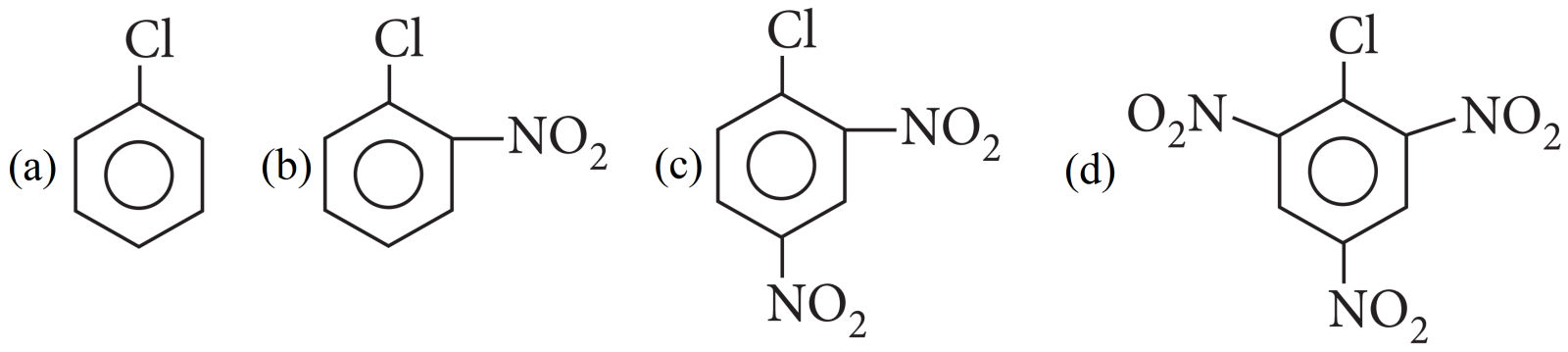
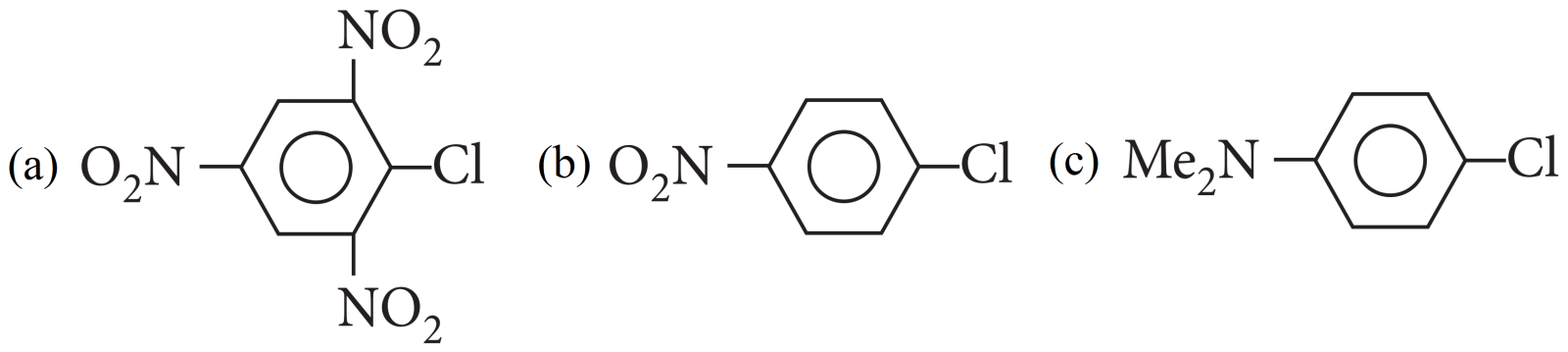
  1. Which of the following aryl halides is the most reactive towards nucleophilic substitution?
  1. Which one of the following will react fastest with aqueous $\text{NaOH}$?
  1. Which chloro derivative of benzene among the followings would undergo hydrolysis most readily with aqueous sodium hydroxide to furnish the corresponding hydroxy derivative?
  1. $\ce{C_6H_5Cl}$
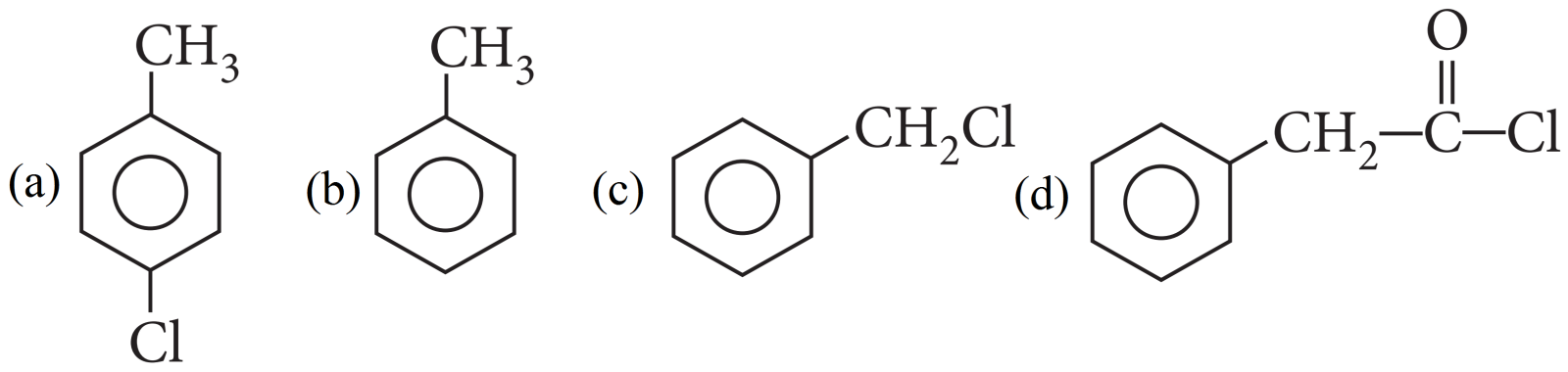
  1. The reactivity of the compounds $\ce{(i)\ MeBr, (ii)\ PhCH_2Br, (iii)\ MeCI, (iv)\ p-MeOC_6H_4Br}$ decreases as:
  1. $\ce{(i) > (ii) > (iii) > (iv)}$
  2. $\ce{(iv) > (ii) > (i) > (iii)}$
  3. $\ce{(iv) > (iii) > (i) > (ii)}$
  4. $\ce{(ii) > (i) > (iii) > (iv)}$
Read the passage given below and answer the following questions: Fehling's reagent: Fehling's reagent is a mixture of two solutions. Fehllng's solution $A$ is aqueous copper sulphate solution. Fehling's solution Bis alkaline sodium potassium tartarate $($Rochelle salt$). \ \ \ \ \ \ \ \ \ \ \ \ \ \ \ \ \ \ \ \ \text{CH(OH)COONa}\\\text{CuSo}_{4\text{(aq)}}+|\\\ \ \ \ \ \ \ \ \ \ \ \ \ \ \ \ \ \ \ \ \text{CH(OH)COOK}$ It is a mild oxidising agent. It is weaker than Tollens' reagent. It oxidises only aliphatic aldehydes to carboxylate ions and itself gets reduced to reddish brown precipitate of cuprous oxide. Aromatic aldehydes do not respond to Fehling's test. This reaction is used for the test of aliphatic aldehydes known as Fehling's reagent test. In these questions $(Q$. No. $l-iv),$ a statement of assertion followed by a statement ofreason is given. Choose the correct answer out of the following choices.
  1. Assertion and reason both are correct statements and reason is correct explanation for assertion.
  2. Assertion and reason both are correct statements but reason is not correct explanation for assertion.
  3. Assertion is correct statement but reason is wrong statement.
  4. Assertion is wrong statement but reason is correct statement.
  1. Assertion : Fehling's solution can be used to distinguish between acetaldehyde and acetone.
Reason : Fehling's reagent is a mixture of two solutions.
  1. Assertion : Aromatic aldehydes can be distinguished from aliphatic aldehydes by Fehling's solution.
Reason : Aromatic aldehydes reduce Fehling's solution, but aliphatic aldehydes do not.
  1. Assertion : Fehling's solution oxidises acetaldehyde to acetic acid but not benzaldehyde to benzoic acid.
Reason : The $C-H$ bond of $-\text{CHO}$ group in benzaldehyde is stronger than in acetaldehyde.
  1. Assertion : $\ce{CH_3CHO}$ and $\ce{C_6H_5CH_2CHO}$ cannot be distinguished chemically by Fehling's solution.
Reason : $\ce{CH_3CHO}$ and $\ce{C_6H_5CH_2CHO}$ cannot be distinguished chemically by Fehling's solution.
  1. Assertion : Formaldehyde, when heated with Fehling's reagent produces a reddish brown ppt, of $\ce{Cu}$.
Reason : Fehling's reagent oxidises fonnaldehyde to formate ion.
Read the passage given below and answer the following questions :
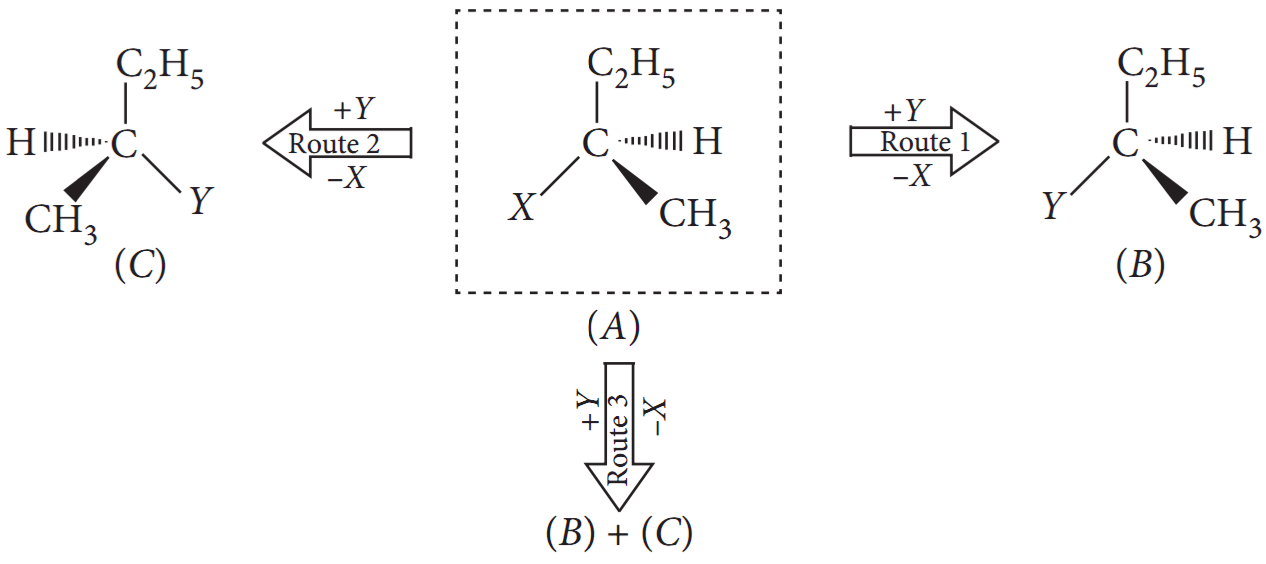
When a chemical reaction involves bond cleavage or bond formation at an asymmetric carbon atom, three different products may be formed.
For example, during the substitution of a group $X$ by $Y$ in the following reaction, the three possible products may be shown below:
  1. If Bis the only product, the process is called retention of configuration because $B$ has the same configuration as the starting reactant $(A).$
  2. If $C$ is the only product, the process is called inversion of configuration because $C$ has the configuration opposite to the starting reactant $(A).$
  3. If an equimolar mixture of Band $C\ ($r.e., a $50 : 50$ mixture$)$ is fanned, then the process is called racemisation and the product is optically inactive because one isomer will rotate the light in the direction opposite to another.
In these questions $(Q$. No. $i-iv),$ a statement of assertion followed by a statement of reason is given.
Choose the correct answer out of the following choices.
  1. Assertion and reason both are correct statements and reason is correct explanation for assertion.
  2. Assertion and reason both are correct statements but reason is not correct explanation for assertion.
  3. Assertion is correct statement but reason is wrong statement.
  4. Assertion is wrong statement but reason is correct statement.
  1. Assertion : A reaction is said to be stereospecific if a particular stereoisomer of the reactant produces a specific stereoisomer of the product.
Reason : Bromination of cis$-2-$butene gives meso$-2, 3-$dibromobutane which is stereospecific.
  1. Assertion: Addition of $Br_2$ to cis$-$but$-2-$ene is stereoselective.
Reason : $S_N2$ reactions are stereospecific as well as stereoselective.
  1. Assertion: Optically active $2-$iodobutane on treatment with Nal in acetone undergoes recemization.
Reason : Repeated Walden inversions on the reactant and its product eventually gives a racemic mixture.
  1. Assertion : $S_N2$ reaction of an optically active alkyl halide with an aqueous solution of $\text{KOH}$ always gives an alcohol with opposite sign of rotation.
Reason : $S_N2$ reactions always proceed with inversion of configuration.
  1. Assertion : Nudeophilic substitution reaction of an optically active alkyl halide gives a mixture of en an ti om ers.
Reason : The reaction occurs by $S_N2$ mechanism.
 
Read the passage given below and answer the following questions:
At $298 K,$ the vapour pressure of pure benzene $, C_6, H_6$ is $0.256$ bar and the vapour pressure of pure toluene $\ce{C_6 H_5 CH_3}$ is $0.0925$ bar. Two mixtures were prepared as follows:
  1. $7.8g$ of $\ce{C_6 H_6 + 9.2g}$ of toluene
  2. $3.9g$ of $\ce{C_6 H_6 + 13.8g}$ of toluene
The following questions are multiple choice questions. Choose the most appropriate answer:
  1. The total vapour pressure $($bar$)$ of solution I is.
  1. $0.128$
  2. $0.174$
  3. $0.198$
  4. $0.258$
  1. Which of the given solutions have higher vapour pressure?
  1. $I$
  2. $II$
  3. Both have equal vapour pressure
  4. Cannot be predicted
  1. Mole fraction of benzene in vapour phase in solution I is.
  1. $0.128$
  2. $0.174$
  3. $0.734$
  4. $0.266$
  1. Which of the following statements is/are correct?
  1. Mole fraction of toluene in vapour phase is more in solution $ I$.
  2. Mole fraction of toluene in vapour phase is less in solution $I.$
  3. Mole fraction of benzene in vapour phase is less in solution $I.$
  1. Only $II$
  2. Only $I$
  3. $I$ and $III$
  4. $II$ and $III$
  1. Solution I is an example of a/an.
  1. Ideal solution.
  2. Non $-$ ideal solution with positive deviation.
  3. Non $-$ ideal solution with negative deviation.
  4. Can't be predicted.
Dependence of the rate of reaction on the concentration of reactants, temperature, and other factors is the most general method for weeding out unsuitable reaction mechanisms. The term mechanism means all the individual collisional or elementary processes involving molecules $($atoms, radicals, and ions included$)$ that take place simultaneously or consecutively to produce the observed overall reaction. For example, when hydrogen gas reacts with bromine, the rate of the reaction was found to be proportional to the concentration of $H_2$ and to the square root of the concentration of $Br_2.$ Furthermore, the rate was inhibited by increasing the concentration of $HBr$ as the reaction proceeded. These observations are not consistent with a mechanism involving bimolecular collisions of a single molecule of each kind. The currently accepted mechanism is considerably more complicated, involving the dissociation of bromine molecules into atoms followed by reactions between atoms and molecules:
It is clear from this example that the mechanism cannot be predicted from the overall stoichiometry.
$($source: Moore, J. W., Pearson, $R. G. (1981).$ Kinetics and mechanism. John Wiley Sons.$)$
$(a).$ Predict the expression for the rate of reaction and order for the following:
$H_2 + Br_2 \rightarrow 2 HBr$
What are the units of rate constant for the above reaction?
$(b).$ How will the rate of reaction be affected if the concentration of $Br_2$ is tripled?