Question
Read the passage given below and answer the following questions:
In ideally ionic structures, the coordination numbers of the ions are determined by electrostatic considerations. Cations surround themselves with as many anions as possible, and vice versa. This maximizes the attractions between neighbouring ions of opposite charge and hence maximizes the lattice energy of the crystal. This requirement led to the formulation of the radius ratio rule for ionic structures, in which the ions and the structure adopted for a particular compound depend on the relative sizes of the ions. Thus, for the stable ionic crystalline structures, there is definite radius ratio limit for a cation to fit perfectly in the lattice of anions, called radius ratio rule. This depends upon the ratio of radii of two types of ions $\frac{\text{r}_+}{r}$This ratio for coordination numbers $3, 4, 6$ and $8$ are respectively $0.155 - 0.225, 0.225 - 0.414, 0.414 - 0.732$ and $0.732 - 1.000$. The coordination number of ionic solids also depends upon temperature and pressure. On applying high pressure, coordination number increases. On the other hand, on applying high temperature, it decreases.
The following questions are multiple choice questions. Choose the most appropriate answer:
  1. The ionic radii of $K^+,Rb^+$ and $Br-$ are $137, 148$ and $195$pm. The coordination number of cation in RbBr and KBr structures are respectively.
  1. $8, 6$
  2. $6, 4$
  3. $6, 8$
  4. $4, 6$
  1. For a coordination number $4,$ the maximum limiting radius ratio is.
  1. $0.414$
  2. $0.732$
  3. $0.225$
  4. $0.155$
  1. If the radius of $Na^+$ ion is 95 pm and that of $Cl^-$ ion is $181$  pm, the coordination number of $Na^+$ ion is.
  1. $6$
  2. $4$
  3. $8$
  4. $12$
  1. Which is not the correct statement for ionic solids, in which positive and negative ions are held by strong electrostatic attractive forces?
  1. The radius ratio $\frac{\text{r}_+}{r}$ increases as coordination number increases.
  2. As the difference in size of ions increases, coordination number increases.
  3. When coordination number is eight, $\frac{\text{r}_+}{r}$ ratio lies between $0.225$ to $0.414.$
  4. In ionic solid of the type AX (ZnS, wurtzite), the coordination number of $Zn^2$ and $S^2$- respectively are $4 $and $4.$
  1. If the pressure of CsCl is increased, then its coordination number will.
  1. Increase
  2. Remain the same
  3. Decrease
  4. None of these.

Answer

  1. (a) $8, 6$
Explanation:
$\frac{\text{r}(\text{Rb}^+)}{\text{r}(\text{Rb}^-)}=\frac{148}{195}=0.76$ (C.N. $8$ above $0. 732$)
$\frac{\text{r}(\text{k}^+)}{\text{r}(\text{br}^-)}=\frac{137}{195}=0.702$ (C.N. $6$ between $0.414 - 0.732$)
  1. (a) $0.414$
  2. (a)$ 6$
Explanation:
$\frac{\text{r_+}}{\text{r_}}=\frac{\text{r}(\text{Na}^+)}{\text{r}(\text{CI}^-)}=\frac{95}{181}=0.524$
The radius ratio lies between $0.414 - 0.732.$
Hence, $Na^+$ ions prefer to occupy octahedral holes having coordination number $6.$
  1. (c) When coordination number is eight, $\frac{\text{r}_+}{\text{r}_-}$ ratio lies between $0.225$ to $0.414.$
Explanation:
When coordination number is $8 \frac{\text{r}_+}{\text{r}}$ratio lies between $0.732 - 1$
  1. (a) Increase
Explanation:
If the pressure of CsCl is increased, then its coordination number will increase.
 

Need a full question paper?

Generate a complete, print-ready paper with questions like this in minutes — across 16+ boards, with answer keys.

Start Generating Free

Similar questions

Read the passage given below and answer the following questions:
A mixture of two aromatic compounds $(A)$ and $(B)$ was separated by dissolving in chloroform followed by extraction with aqueous $KOH$ solution. The organic layer containing compound $(A)$, when heated with alcoholic solution of KOH produce $C_7H_5N (C)$ associated with unpleasant odour.
The following questions are multiple choice questions. Choose the most appropriate answer:
  1. What is A?
  1. $C_6H_5NH_2$
  2. $C_6H_5CH_3$
  3. $C_6H_5CH_3$
  4. None of these.
  1. The reaction of $(A)$ with alcoholic solution of $KOH$ to produce $(C)$ of unpleasant odour is called:
  1. Sandmeyer reaction.
  2. Carbylamine reaction.
  3. Ullmann reaction.
  4. Reimer-Tiemann reaction..
  1. The alkaline aqueous layer $(B)$ when heated with chloroform and then acidified give a mixture of isomeric compounds of molecular formula $C_7H_6O_2. (B)$ is:
  1. $C_6H_5CHO$
  2. $C_6H_5COOH$
  3. $C_6H_5CH_3$
  4. $C_6H_5OH$
  1. In the chemical reaction, $CH_3CH_2NH_2 + CHCl_3 + 3KOH \rightarrow (A)+ (B) + 3H_2O,$
  1. $C_2H_5NC$ and $KCl$
  2. $C_2H_5CN$ and $KCl$
  3. $CH_3CH_2CONH_2$ and $KCl$
  4. $C_2H_5NC$ and $K_2CO_3$
  1. Direct nitration of an aromatic compound (A) is not feasible because:
  1. The reaction cannot be stopped at the mononitration stage.
  2. A mixture of o, m and p-nitroaniline is always obtained.
  3. Nitric acid oxidises most of the aromatic compound to give oxidation products along with only a small amount of nitrated products.
  4. All of the above.
Read the passage given below and answer the following questions:
The properties of the solutions which depend only on the number of solute particles but not on the nature of the solute are called colligative properties. Relative lowering in vapour pressure is also an example of colligative properties. For an experiment, sugar solution is prepared, for which lowering in vapour pressure was found to be 0.061 mm of Hg. (Vapour pressure of water at 20° C is 17.5 mm of Hg)
The following questions are multiple choice questions. Choose the most appropriate answer:
  1. Relative lowering of vapour pressure for the given solution is.
  1. 0.00348
  2. 0.061
  3. 0.122
  4. 1.75
  1. The vapour pressure (mm of Hg) of solution will be.
  1. 17.5
  2. 0.61
  3. 17.439
  4. 0.00348
  1. Mole fraction of sugar in the solution is.
  1. 0.00348
  2. 0.9965
  3. 0.061
  4. 1.75
  1. If weight of sugar taken is 5g in 108g of water, then molar mass of sugar will be.
  1. 358
  2. 120
  3. 240
  4. 400
  1. The vapour pressure (mm of Hg) of water at 293K when 25g of glucose is dissolved in 450g of water is.
  1. 17.2
  2. 17.4
  3. 17.120
  4. 17.02
Number of molecules which must collide simultaneously to give product is called molecularity. It is equal to sum of coefficients of reactants present in stoichiometric chemical equation.
For reaction, $m_1A + m_2B \rightarrow$ Product
Molecularity $= [m_1 + m_2]$
ln complex reaction each step has its own molecularity which is equal to the sum of coefficients of reactants present in a particular step. Molecularity is a theoretical property. Its value is any whole number. Number of concentration terms on which rate of reaction depends is called order of reaction or sum of powers of concentration terms present in the rate equation is called order of reaction.
If rate equation ofreaction is: Rate $=\text{k}\cdot\text{C}^{\text{m}_1}_\text{A}\cdot\text{C}^{\text{m}_2}_\text{B}$
Then order of reaction $= m_1 + m_2.$
ln simple reaction, order and molecularity are same.
ln complex reaction, order of slowest step is the order ofover all reaction. This step is known as rate determining step. Order is an experimental property. Its value may be zero, fractional or negative.
The following questions are multiple choice questions. Choose the most appropriate answer:
  1. Higher order$(> 3)$ reactions are rare due to:
  1. Shifting of equilibrium towards reactants due to elastic collisions.
  2. Loss of active species on collision.
  3. Low probability of simultaneous collision of all the reacting species.
  4. Increase in entropy and activation energy as more molecules are involved.
  1. The molecularity of the reaction:
$6\text{FeSO}_4+3\text{H}_2\text{SO}_4+\text{KClO}_3\rightarrow\text{KCl}+3\text{Fe}_2(\text{SO}_4)_3+3\text{H}_2\text{O}$ is:
  1. $6$
  2. $10$
  3. $3$
  4. $7$
  1. Which of the following statements is false in the following?
  1. Order of a reaction may be even zero.
  2. Molecularity of a reaction is always a whole number.
  3. Molecularity and order always have same values for a reaction.
  4. Order of a reaction depends upon the mechanism of the reaction.
  1. The rate of reaction, $A + 2B →$ products, is given by the following equation:
$-\frac{\text{d}[\text{A}]}{\text{dt}}=\text{k}[\text{A}][\text{B}]^2$

If $B$ is present in large excess, the order of the reaction is:
  1. Zero
  2. First
  3. Second
  4. Third
  1. The rate of the reaction, $A + B + C →$ products, is given by $\text{r}=\frac{\text{d}[\text{A}]}{\text{dt}}=\text{k}[\text{A}]^\frac{1}{2}[\text{B}]^\frac{1}{3}[\text{C}]^\frac{1}{4}.$ The order of the reaction is:
  1. $\frac{1}{3}$
  2. $\frac{1}{4}$
  3. $\frac{1}{2}$
  4. $\frac{13}{12}$
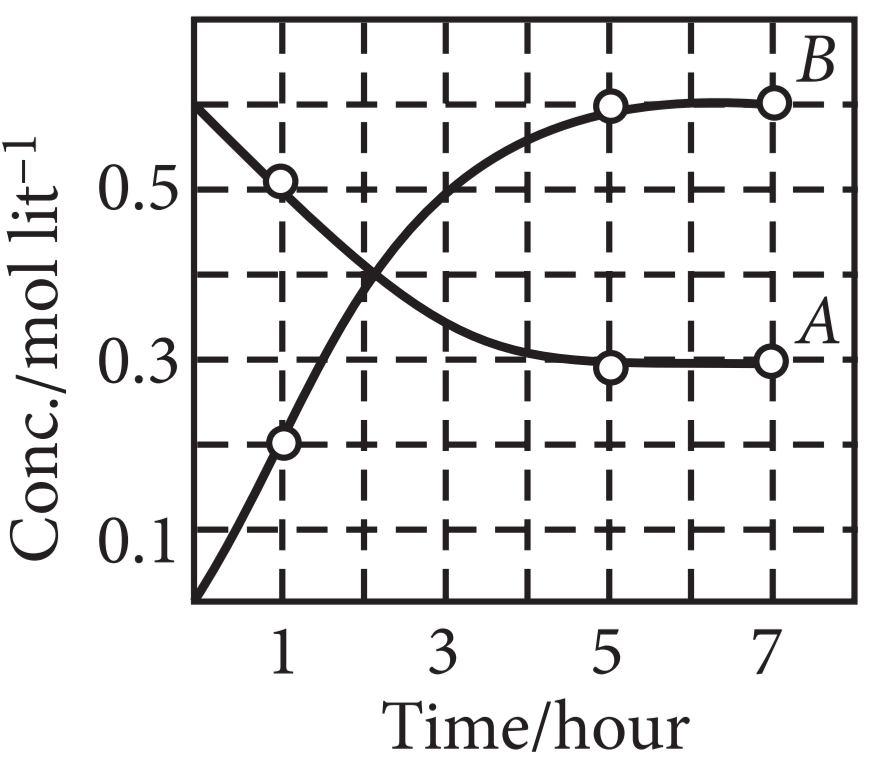
The progress of the reaction, $\text{A}\rightleftharpoons\text{nB}$ with time is represented in the following figure:

The following questions are multiple choice questions. Choose the most appropriate answer:
  1. What is the value of n?
  1. 1
  2. 2
  3. 3
  4. 4
  1. Find the value of the equilibrium constant.
  1. 0.6M
  2. 1.2M
  3. 0.3M
  4. 2.4M
  1. The initial rate of conversion of A will be:
  1. $0.1 mol ~L^{-1}hr^{-1}$
  2. $0.2 mol ~L^{-1}hr^{-1}$
  3. $0.4 mol ~L^{-1}hr^{-1}$
  4. $0.8 mol ~L^{-1}hr^{-1}$
  1. For the reaction, if $\frac{\text{d}[\text{B}]}{\text{dt}}=2\times10^{-4},$ value of $-\frac{\text{d}[\text{A}]}{\text{dt}}$ will be:
  1. $2 \times 10^{-4}$
  2. $10^{-4}$
  3. $4 \times 10^{-4}$
  4. $0.5 \times 10^{-4}$
  1. Which factor has no effect on rate of reaction?
  1. Temperature.
  2. Nature of reactant.
  3. Concentration of reactant.
  4. Molecularity.
In these questions, a statement of assertion followed by a statement of reason is given. Choose the correct answer out of the following choices.
Assertion: Porous or finely divided fonns of adsorbents adsorb larger quantities of adsorbate.
Reason: The greater the specific area of the solid, the greater would be its adsorbing capacity.
Read the passage given below and answer the following questions:
If some solute is added to a solvent, the boiling point of solution increases. This is known as elevation in baiting point.
$\Delta\text{T}_\text{b}=\text{K}_\text{b}\text{m}$ where, $K_b =$ Molal elevation constant,
$\Delta\text{T}_\text{b}\propto\text{m}$
Hence, it is a colligative property,
Also, $\text{K}_\text{b}=\frac{\text{MRT}^2_\text{b}}{\Delta\text{Vap}\text{H}\times1000}$
where, $M =$ Molar mass of solvent,
$\Delta\text{vap}$ $H = $Enthalpy of vaporisation,
Molar mass can also be calculated using elevation in boiling point.
$\text{M}_\text{B}=\frac{\text{K}_\text{B}\times\text{W}_\text{B}\times1000}{\Delta\text{T}_\text{b}\times\text{W}_\text{A}}$
A statement of assertion followed by a statement of reason is given. Choose the correct answer out of the following choices.
  1. Assertion and reason both are correct statements and reason is correct explanation for assertion.
  2. Assertion and reason both are correct statements but reason is not correct explanation for assertion.
  3. Assertion is correct statement but reason is wrong statement.
  4. Assertion is wrong statement but reason is correct statement.
  1. Assertion: In a pressure cooker, the water is brought to boil. The cooker is then removed from the stove. Now on removing the lid of pressure cooker, the water starts boiling again.
Reason: The impurities in water bring down its boiling point.
  1. Assertion: On dissolving $3.24g$ of sulphur in $40g$ of benzene, boiling point of solution get higher than that of benzene by $0.081K$, then the formula of sulphur is $S_8. (K_b$ for benzene $= 2.53K\ kg\ mol^{-1})$
Reason: Molecular mass of sulphur comes out to be $253.$
  1. Assertion: When sugar is added to water, boiling point of water increases.
Reason: When a non-volatile solute is added to a solvent, elevation in boiling point is observed.
  1. Assertion: Cooking time in pressure cookers is reduced.
Reason: Boiling point inside the pressure cooker in raised.
  1. Assertion: Elevation in boiling point of two isotonic solutions is same.
Reason: Boiling point depends upon the concentration of the solute.
Read the passage given below and answer the following questions:
The f-block elements are those in which the differentiating electron enters the $(n -2)f$ orbital. There are two series of F-block elements corresponding to filling of $4f $ and $5f-$orbitals. The series of $4f-$orbitals is called lanthanides. Lanthanides show different oxidation states depending upon stability of $f^0, f^7$ and $F^{14}$ configurations, though the most conunon oxidation states is $+3$. There is a regular decrease in size oflanthanides ions with increase in atomic number which is known as lanthanide contraction.
The following questions are multiple choice questions. Choose the most appropriate answer:
  1. The atomic numbers of three lanthanide elements $X, Y$ and $Z$ are $65, 68$ and $70$ respectively, their $Ln^{3+}$ electronic configuration is:
  1. $4f^8, 4f^{11}, 4f^{13}$
  2. $4f^{11}, 4f^8, 4f^{13}$
  3. $4f^0, 4f^2, 4f^{11}$
  4. $4f^3, 4f^7, 4f^9$
  1. Lanthanide contraction is observed in:
  1. $Gd$
  2. $At$
  3. $Xe$
  4. $Te$
  1. Which of the following is not the configuration oflanthanoid?
  1. $[Xe]4f^{10}6s^2$
  2. $[Xe]4f^15d^16s^2$
  3. $[Xe]4d^{14}5d^{10}6s^2$
  4. $[Xe]4f^75d^16s^2$
  1. Name a member of the lanthanoid series which is well known to exhibit +4 oxidation state.
  1. Cerium $(Z = 58)$
  2. Europium $(Z = 63)$
  3. Lanthanum $(Z = 57)$
  4. Gadolinium $(Z = 64)$
  1. Identify the incorrect statement among the following.
  1. Lanthanoid contraction is the accumulation of successive shrinkages.
  2. The different radii of $Zr$ and $Hf$ due to consequence of the lanthanoid contraction.
  3. Shielding power of $4f$ electrons is quite weak.
  4. There is a decrease in the radii of the atoms or ions as one proceeds from La to Lu.
Read the passage given below and answer the following questions:
Transition elements are elements that have partially filled d-orbitals. The configuration of these elements corresponds to $(n - 1)d^{1-10}ns^{1-2}.$ It is important to note that the elements mercury, cadmium and zinc are not considered transition elements because of their electronic configurations, which corresponds to $(n - 1)d^{10}ns^2.$ Some general properties of transition elements are:
These elements can fonn coloured compounds and ions due to $d-d$ transition;
These elements exhibit many oxidation states;
A large variety of ligands can bind themselves to these elements, due to this, a wide variety of stable complexes formed by these ions. The boiling and melting point of these elements are high. These elements have a large ratio of charge to the radius.
In these questions $(Q. No. i-iv),$ a statement of assertion followed by a statement ofreason is given. Choose the correct answer out of the following choices.
  1. Assertion and reason both are correct statements and reason is correct explanation for assertion.
  2. Assertion and reason both are correct statements but reason is not correct explanation for assertion.
  3. Assertion is correct statement but reason is wrong statement.
  4. Assertion is wrong statement but reason is correct statement.
  1. Assertion: Tungsten has very high melting point.
Reason: Tungsten is a covalent compound.
  1. Assertion: $Zn, Cd$ and $Hg$ are normally not considered transition metals.
Reason: d-Orbitals in $Zn, Cd$ and $Hg$ elements are completely filled, hence these metals do not show the general characteristics properties of the transition elements.
  1. Assertion: Copper metal gets readily corroded in acidic aqueous solution such as $HCl$ and dil. $H_2SO_4.$
Reason: Free energy change for this process is positive.
  1. Assertion: Tailing of mercury occurs on passing ozone through it.
Reason: Due to oxidation of mercury.
  1. Assertion: Transition metals are poor reducing agents.
Reason: Transition metals fonn numerous alloys with other metals.
Read the passage given below and answer the following questions:
Consider the given sequence of reactions:

The following questions are multiple choice questions. Choose the most appropriate answer:
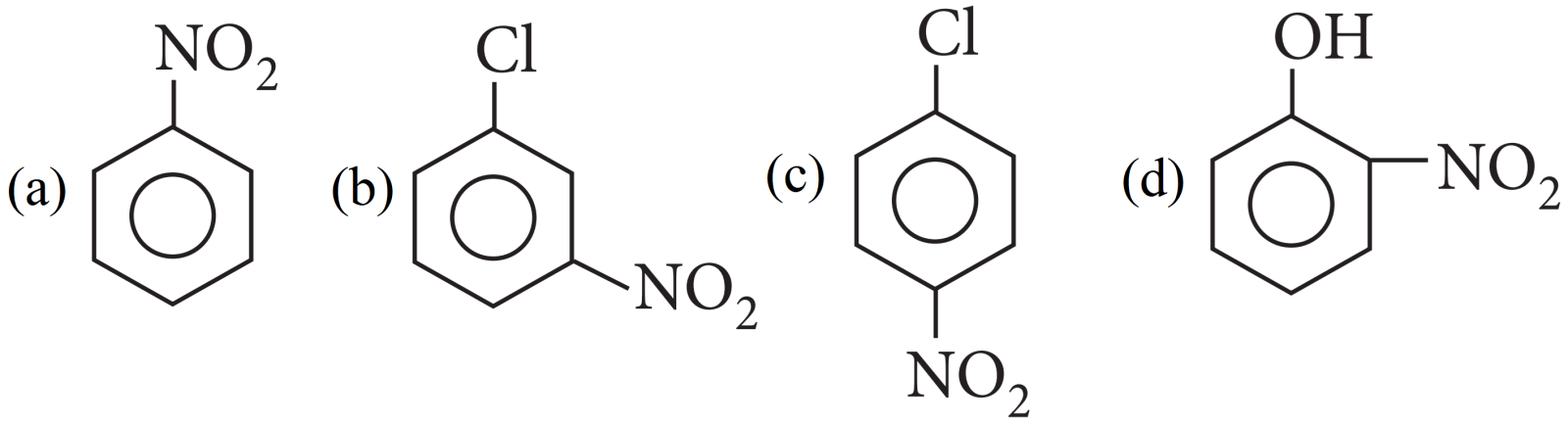
  1. Identify W.
  1. Compound Y is:
  1. When X reacts with $CH_3COCl$ in presence of anhy. $AlCl_3$, the reaction is known as:
  1. Fittig reaction.
  2. Ullmann reaction.
  3. Wurtz-Fittig reaction.
  4. Friedel-Crafts acylation reaction.
  1. When X is treated Ni-Al/ NaOH the product obtained is:
  1. Benzene.
  2. Phenol.
  3. P-chlorophenol.
  4. Triphenyl.
  1. Compound Z is:
  1. Phenol.
  2. P-chlorophenol.
  3. P-nitrophenol.
  4. Nitrobenzene.
Read the passage given below and answer the following questions:
The transition elements have incompletely filled d-subshells in their ground state or in any of their oxidation states. The transition elements occupy position in betweens- and p-blocks in groups $3-12$ of the Periodic table. Starting from fourth period, transition elements consists of four complete series : Sc to $Zn, Y$ to Cd and La, $Hf$ to $Hg$ and $Ac, Rf$ to $Cn$. In general, the electronic configuration of outer orbitals of these elements is $(n - 1)d^{1-10} n^{1-2}$. The electronic configurations of outer orbitals of $Zn, Cd, Hg$ and $Cn$ are represented by the general formula $(n - 1)d^{10}ns^2$. All the transition elements have typical metallic properties such as high tensile strength, ductility, malleability. Except mercury, which is liquid at room temperature, other transition elements have typical metallic structures. The transition metals and their compounds also exhibit catalytic property and paramagnetic behaviour. Transition metal also forms alloys. An alloy is a blend of metals prepared by mixing the components. Alloys may be homogeneous solid solutions in which the atoms of one metal are distributed randomly among the atoms of the other.
The following questions are multiple choice questions. Choose the most appropriate answer:
  1. Which of the following characteristics of transition metals is associated with higher catalytic activity?
  1. High enthalpy of atomisation.
  2. Variable oxidation states.
  3. Paramagnetic behaviour.
  4. Colour of hydrated ions.
  1. Transition elements form alloys easily because they have.
  1. Same atomic number.
  2. Same electronic configuration.
  3. Nearly same atomic size.
  4. Same oxidation states.
  1. The electronic configuration of tantalum $(Ta)$ is:
  1. $[Xe]4f^05d^16s^2$
  2. $[Xe]4f^{14}5d^26s^2$
  3. $[Xe]4f^{14}5d^36s^2$
  4. $[Xe]4f^{14}5d^46s^2$
  1. Which one of the following outer orbital configurations may exhibit the largest number of oxidation states?
  1. $3d^54s^1$
  2. $3d^54s^2$
  3. $3d^24s^2$
  4. $3d^34s^2$
  1. The correct statement(s) among the following is/ are:
  1. All d and f-block elements are metals.
  2. All d and f-block elements form coloured ions.
  3. All d and f-block elements are paramagnetic.
  1. $(I)$ only
  2. $(I)$ and $(II)$ only
  3. $(II)$ and $(III)$ only
  4. $(I), (II)$ and $(III)$