Question
Read the passage given below and answer the following questions:
The f-block elements are those in which the differentiating electron enters the $(n -2)f$ orbital. There are two series of F-block elements corresponding to filling of $4f $ and $5f-$orbitals. The series of $4f-$orbitals is called lanthanides. Lanthanides show different oxidation states depending upon stability of $f^0, f^7$ and $F^{14}$ configurations, though the most conunon oxidation states is $+3$. There is a regular decrease in size oflanthanides ions with increase in atomic number which is known as lanthanide contraction.
The following questions are multiple choice questions. Choose the most appropriate answer:
  1. The atomic numbers of three lanthanide elements $X, Y$ and $Z$ are $65, 68$ and $70$ respectively, their $Ln^{3+}$ electronic configuration is:
  1. $4f^8, 4f^{11}, 4f^{13}$
  2. $4f^{11}, 4f^8, 4f^{13}$
  3. $4f^0, 4f^2, 4f^{11}$
  4. $4f^3, 4f^7, 4f^9$
  1. Lanthanide contraction is observed in:
  1. $Gd$
  2. $At$
  3. $Xe$
  4. $Te$
  1. Which of the following is not the configuration oflanthanoid?
  1. $[Xe]4f^{10}6s^2$
  2. $[Xe]4f^15d^16s^2$
  3. $[Xe]4d^{14}5d^{10}6s^2$
  4. $[Xe]4f^75d^16s^2$
  1. Name a member of the lanthanoid series which is well known to exhibit +4 oxidation state.
  1. Cerium $(Z = 58)$
  2. Europium $(Z = 63)$
  3. Lanthanum $(Z = 57)$
  4. Gadolinium $(Z = 64)$
  1. Identify the incorrect statement among the following.
  1. Lanthanoid contraction is the accumulation of successive shrinkages.
  2. The different radii of $Zr$ and $Hf$ due to consequence of the lanthanoid contraction.
  3. Shielding power of $4f$ electrons is quite weak.
  4. There is a decrease in the radii of the atoms or ions as one proceeds from La to Lu.
Answer

  1. (a) $4f^8, 4f^{11}, 4f^{13}$
Explanation:
Terbium $(65), 4f^8;$ Dysprosium $(Dy), 4f^9;$ Ytterbium $(Yb), 4f^{13}.$
  1. (a) $Gd$
  2. (c) $[Xe]4d^{14}5d^{10}6s^2$
  3. (a) Cerium $(Z = 58)$
  4. (b) The different radii of Zr and Hf due to consequence of the lanthanoid contraction.
Explanation:
The almost identical radii of $Zr (160pm)$ and $Hf (159pm)$, a consequence of lanthanoid contraction.

Need a full question paper?

Generate a complete, print-ready paper with questions like this in minutes — across 16+ boards, with answer keys.

Start Generating Free

Similar questions

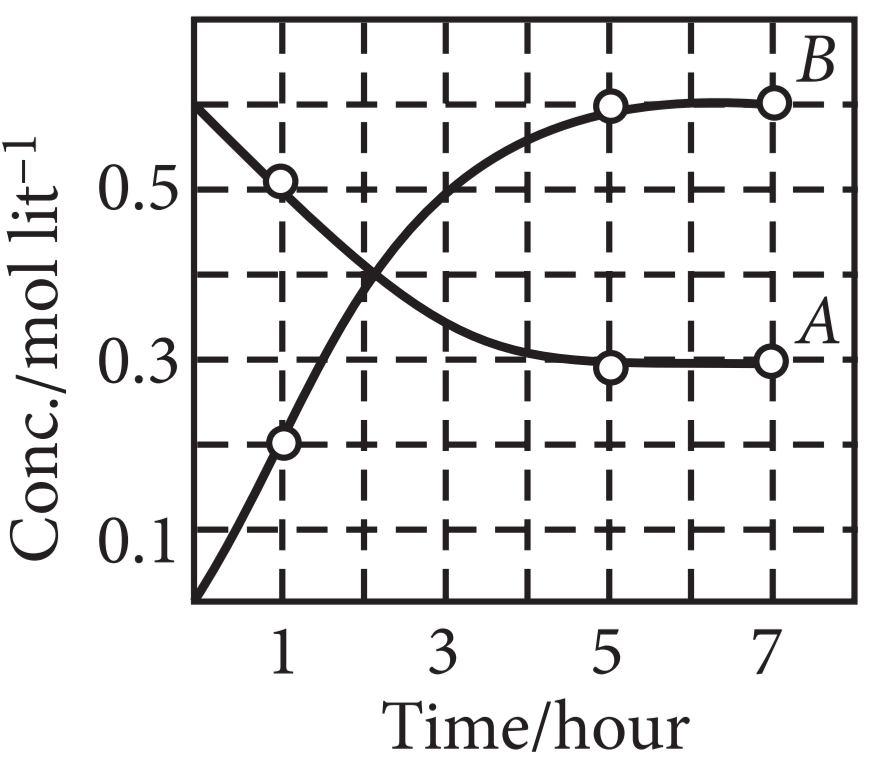
The progress of the reaction, $\text{A}\rightleftharpoons\text{nB}$ with time is represented in the following figure:

The following questions are multiple choice questions. Choose the most appropriate answer:
  1. What is the value of n?
  1. 1
  2. 2
  3. 3
  4. 4
  1. Find the value of the equilibrium constant.
  1. 0.6M
  2. 1.2M
  3. 0.3M
  4. 2.4M
  1. The initial rate of conversion of A will be:
  1. $0.1 mol ~L^{-1}hr^{-1}$
  2. $0.2 mol ~L^{-1}hr^{-1}$
  3. $0.4 mol ~L^{-1}hr^{-1}$
  4. $0.8 mol ~L^{-1}hr^{-1}$
  1. For the reaction, if $\frac{\text{d}[\text{B}]}{\text{dt}}=2\times10^{-4},$ value of $-\frac{\text{d}[\text{A}]}{\text{dt}}$ will be:
  1. $2 \times 10^{-4}$
  2. $10^{-4}$
  3. $4 \times 10^{-4}$
  4. $0.5 \times 10^{-4}$
  1. Which factor has no effect on rate of reaction?
  1. Temperature.
  2. Nature of reactant.
  3. Concentration of reactant.
  4. Molecularity.

Read the passage given below and answer the following questions:
When a solution of an et-amino acid is placed in an electric field depending on the pH of the medium, following three cases may happen.
  1. In alkaline solution, CL-amino acids exist as anion II, and there is a net migration of amino acid towards the anode.
  2. In acidic solution, a-amino acids exist as cation III, and there is a net migration of amino acid towards the cathode.
  3. If II and III are exactly balanced there is no net migration; under such conditions any one molecule exists as a positive ion and as a negative ion for exactly the same amount of time, and any small movement in the direction of one electrode is subsequently cancelled by an equal movement back toward the other electrode. The pH of the solution in which a particular amino acid does not migrate under the influence of an electric field is called the is oelectric point of that amino acid.
The following questions are multiple choice questions. Choose the most appropriate answer:
  1.  

Arrange in order of increasing acid strengths.
  1. X > Z > Y
  2. Z < X < Y
  3. X > Y > Z
  4. Z > X > Y
  1. In aqueous solutions, amino acids mostly exist as:
  1. $NH_2 - CHR - COOH$
  2. $NH_2 - CHR - COO^-$
  3. $\stackrel{+}{\hbox{ N}}\text{H}_3\text{CHRCOOH}$
  4. $\text{H}_3\stackrel{{+}}{\hbox{N}}\text{CHRCOO}^-$
  1. Amino acids are least soluble:
  1. at pH 1
  2. at pH 7
  3. At their isoelectric points.
  4. None of these.
  1. The $\text{pK}_{\text{a}_1}$ and $\text{pK}_{\text{a}_2}$ of an amino acid are 2.3 and 9.7 respectively. The is oelectric point of the amino acid is:
  1. 12.0
  2. 7.4
  3. 6.0
  4. 3.7
  1. A tripeptide (X) on partial hydrolysis gave two dipeptides Cys-Gly and Glu-Cys. Identify the tripeptide.
  1. Glu-Cys-Gly
  2. Gly-Glu-Cys
  3. Cys-Gly-Glu
  4. Cys-Glu-Gly
Read the passage given below and answer the following questions: An organic compound (A) having molecular formula $C_6H_6O$ gives a characteristic colour with aqueous $FeCl_3$ solution. (A) on treatment with $CO_2$ and $NaOH$ at $400K$ under pressure gives (B), which on acidification gives a compound (C). The compound (C) reacts with acetyl chloride to give (D) which is a popular pain killer. The following questions are multiple choice questions. Choose the most appropriate answer:
  1. Compound (A) is:
  1. 2-Hexanol.
  2. Dimethyl ether.
  3. Phenol.
  4. 2-Methyl pentanol.
  1. Compound (C) is:
  1. Salicylic acid.
  2. Salicyladehyde.
  3. Benzoic acid.
  4. Benzaldehyde.
  1. Number of carbon atoms in compound (D) is:
  1. 7
  2. 6
  3. 8
  4. 9
  1. The conversion of compound (A) to (C) is known as:
  1. Reimer-Tiemann reaction.
  2. Kolbe's reaction.
  3. Schimdt reaction.
  4. Swarts reaction.
  1. Compound (A) on heating with compound (C) in presence of $POCl_3$​​​​​​​ gives a compound (D) which is used:
  1. In perfumery as a ftavouring agent
  2. As an antipyretic
  3. As an analgesic
  4. As an intestinal antiseptic.
For a reaction, A + B → Products, the rate law is – Rate = $k[A][B]^{3/2}$ Can the reaction be an elementary reaction? Explain.
Read the passage given below and answer the following questions:
Noble gases are inert gases with general electronic configuration of $ns^2np^6$. These are monoatomic, colourless, odourless and tasteless gases. The first compound of noble gases was obtained by the reaction of Xe with $PtF_6.$ A large number of compounds of Xe and fluorine have been prepared till now. The structure of these compounds can be explained on the basis of VSEPR theory as well as concept of hybridisation. The compounds of krypton are fewer. Only the diftuoride of krypton $(KrF_2)$ has been studied in detail. Compounds of radon have not isolated but only identified by radio tracer technique. However, no true compounds of helium, neon or argon are yet known.
The following questions are multiple choice questions. Choose the most appropriate answer:
  1. The formula of the compound when $Xe$ and $PtF_6$ are mixed, is:
  1. $XeF_6$
  2. $XeF_4$
  3. $Xe_2PtF_6$
  4. $Xe^+[PtF_6]^-$
  1. The shape and hybridisation of some xenon oxy-fluoride and fluoride compounds are given below. Find the incorrect one.
  1. $XeOF_2 - T-$shape $- sy^3d$
  2. $XeOF_4 -$ square pyramidal $- sp^3d^2$
  3. $XeF_2 -$ linear $- sp^3d$
  4. $XeF_6 -$ square planar $- dsp^2$
  1. Which of the following is not formed by $Xe?$
  1. $XeF_5$
  2. $XeF$
  3. $XeF_3$
  4. All of these.
  1. The number oflone pairs and bond pairs of electrons around $Xe$ in $XeOF_4$ respectively are,
  1. $0$ and $5$
  2. $1$ and $5$
  3. $1$ and $4$
  4. $2$ and $3$
  1. Which of the following compounds has more than one lone pair of electrons around central atom?
  1. $XeO_3$
  2. $XeF_2$
  3. $XeOF_4$
  4. $XeO_2F_2$
Read the passage given below and answer the following questions:
Ozone is an unstable, dark blue diamagnetic gas. It absorbs the UV radiation strongly, thus protecting the people on earth from the harmful UV-radiation from the sun. The use of chlorofluorocarbon (CFC) in aerosol and refrigerators and their subsequent escape into the atmosphere, is blamed for making holes in the ozone layer over the Antarctica. Ozone acts as a strong oxidising agent in acidic and alkaline medium. for this property, ozone is used as a germicide and disinfectant for sterilizing water. It is also used in laboratory for the ozonolysis of organic compounds and in industry for the manufacture of potassium permanganate, artificial silk, etc.
The following questions are multiple choice questions. Choose the most appropriate answer:
  1. Which of the following statements is not correct for ozone?
  1. lt oxidises lead sulphide.
  2. It oxidises potassium iodide.
  3. It oxidises mercury.
  4. It cannot act as bleaching agent in dry state.
  1. Ozone gives carbonyl compounds with.
  1. Alkyl chloride
  2. Alkanes
  3. Alkenes followed by decomposition with $\frac{\text{Zn}}{\text{H}_2\text{O}}.$
  4. Alcohols followed by decomposition with $\frac{\text{Zn}}{\text{H}_2\text{O}}.$
  1. Ozone reacts with moist iodine gives.
  1. $HI$
  2. $HIO_3$
  3. $I_2O_5$
  4. $I_2O_4$
  1. Ozone acts as an oxidising agent due to.
  1. Iiberation of nascent oxygen.
  2. Iiberation of nascent oxygen.
  3. Both $(a)$ and $(b).$
  4. Both $(a)$ and $(b).$
  1. The colour of ozone molecule is:
  1. White.
  2. Blue.
  3. Pale green.
  4. Pale yellow.
Read the passage given below and answer the following questions: The order of reactivity towards $S_N1$ reaction depends upon the stability of carbocation in the first step. Greater the stability of the carbocation, greater will be its ease of formation from alkyl halide and hence faster will be the rate of the reaction. As we know, $3^\circ$ carbocation is most stable, therefore, the tert-alkyl that halides will undergo $S_N1$ reaction very fast. For example, it has been observed that the reaction $(CH_3)_3CBr$ with $OH^-$ ion to give 2-methyl-2-propanol is about I million times as fast as the corresponding reaction of the methyl bromide to give methanol. The primary alkyl halides always react predominantly by $S_N2$ mechanism. On the other hand, the tertiary alkyl halides react predominantly by $S_N1$ mechanism. Secondary alkyl halides may react by either mechanism or by both the mechanisms without much preference depending upon the nature of the nucleophile and solvent. In these questions (Q. No. i-tv), a statement of assertion followed by a statement of reason is given. Choose tile correct answer out of tile following choices.
  1. Assertion and reason both are correct statements and reason is correct explanation for assertion.
  2. Assertion and reason both are correct statements but reason is not correct explanation for assertion.
  3. Assertion is correct statement but reason is wrong statement.
  4. Assertion is wrong statement but reason is correct statement.
  1. Assertion: Low concentration of nudeophile favours $S_N1$ mechanism.
Reason: $2^\circ$ alkyl halides are less reactive than $1^\circ$ towards $S_N1$ reactions.
  1. Assertion: Polar solvent slows down $S_N2$ reactions.
Reason: $CH_3-Br$ is less reactive than $CH_3Cl.$
  1. Assertion: Benzyl bromide when kept in acetone- water it produces benzyl alcohol.
Reason: The reaction follows $S_N2$ mechanism.
  1. Assertion: Rate of hydrolysis of methyl chloride to methanol is higher in DMF than in water.
Reason: Hydrolysis of methyl chloride follows second order kinetics.
  1. Assertion: $S_N1$ reaction is carried out in the presence of a polar protic solvent.
Reason: A polar protic solvent increases the stability of carbocation due to solvation.
Read the passage given below and answer the following questions:
Under the normal conditions, noble gases are monoatomic and have closed shell electronic configuration. Lighter noble gases have low boiling points due to weak dispersion forces between the atoms and the absence of other interatomic interactions. Xenon, one of the important noble gas, forms a series of compounds with fluorine with oxidation number $+2, +4$ and $+6.$ All xenon fluorides are strong oxidising agents. $XeF_4$ reacts violently with water to give $XeO_3.$ The geometry of xenon compounds can be deduced by considering the total number of electron pairs in their valence shell.
The following questions are multiple choice questions. Choose the most appropriate answer:
  1. Among noble gases (from He to Xe) only xenon reacts with fluorine to form stable xenon fluorides because xenon.
  1. Has the largest size.
  2. Has the lowest ionisation enthalpy.
  3. Has the highest heat ofvapourisation.
  4. Is the most readily available noble gas.
  1. The structure of $XeO_3$ is:
  1. Square planar.
  2. Pyramidal.
  3. Linear.
  4. T-shaped.
  1. $XeF_6$ is expected to be.
  1. Oxidising agent.
  2. Reducing agent.
  3. Unreactive.
  4. Strongly basic.
  1. In the preparation of compound of xenon, Bartlett had taken $\text{O}_2^+\text{PtF}_6^-$ as a base compound. This is because,
  1. Both $O_2$ and $Xe$ have same size.
  2. Both $Xe$ and $O_2$ have same electron gain enthalpy.
  3. Both have almost same ionisation enthalpy.
  4. Both $Xe$ and $O_2$ are gases.
  1. The oxidation state of xenon in $XeO_3$ is:
  1. $+4$
  2. $+2$
  3. $+8$
  4. $+6$
Read the passage given below and answer the following questions:
Although chlorobenzene is inert to nucleophilic substitution, however it gives quantitative yield of phenol when heated with aq. $Na OH$ at high temperature and under high pressure. As far as electrophilic substitution in phenol is concemed the — OH group is an activating group, hence, its presence enhances the electrophilic substitution at o - and p - positions.
The following questions are multiple choice questions. Choose the most appropriate answer:
  1. Conversion of chlorobenzene into phenol involves:
  1. Modified $S_N1$ mechanism.
  2. Modified $S_N2$ mechanism.
  3. Both (a) and (b).
  4. Elimination-addition mechanism.
  1. Phenol undergoes electrophilic substitution more readily than benzene because:
  1. The intermediate carbocation is a resonance hybrid of more resonating structures than that from benzene.
  2. The intermediate is more stable as it has positive charge on oxygen, which can be better accommodated than on carbon.
  3. In one of the canonical structures, every atom (except hydrogen) has complete octet.
  4. The — OH group is o, p-directing which like all other o, p - directing group, is activating.
  1. Phenol on treatment with excess of cone. $HNO_3$ gives:
  1. O - nitrophenol.
  2. P - nitrophenol.
  3. O - and p - nitrophenol.
  4. 2, 4, 6 - trinitrophenol.
  1. Phenol is heated with a solution of mixture of $KBr$ and $KBrO_3$. The major product obtained in the above reaction is:
  1. 2 - bromophenol.
  2. 3 - bromophenol.
  3. 4 - bromophenol.
  4. 2, 4, 6 - tribromophenol.
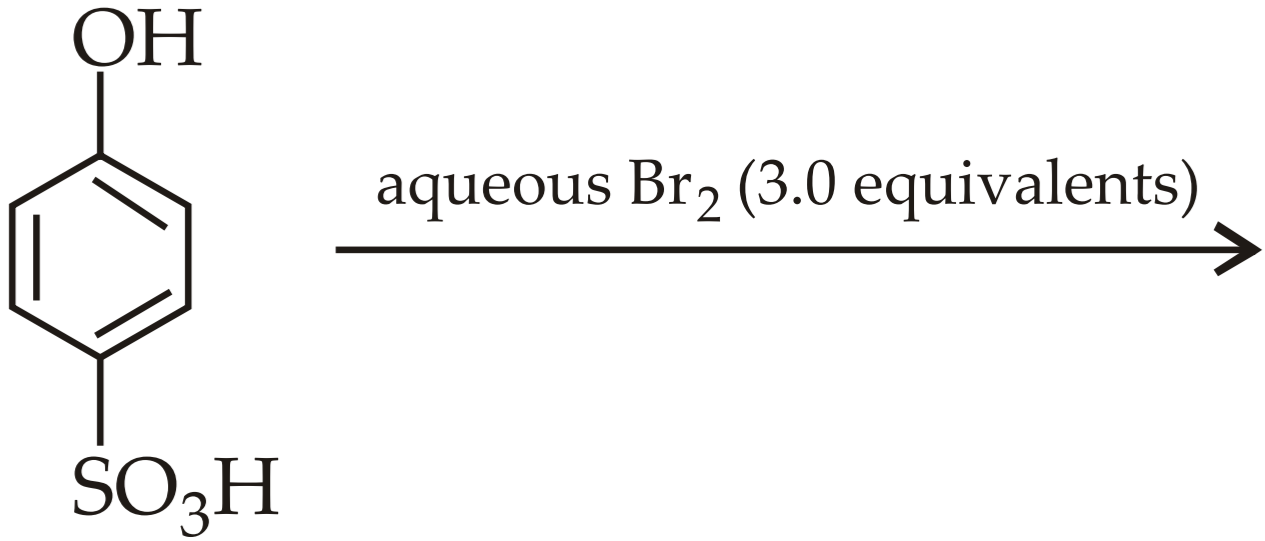
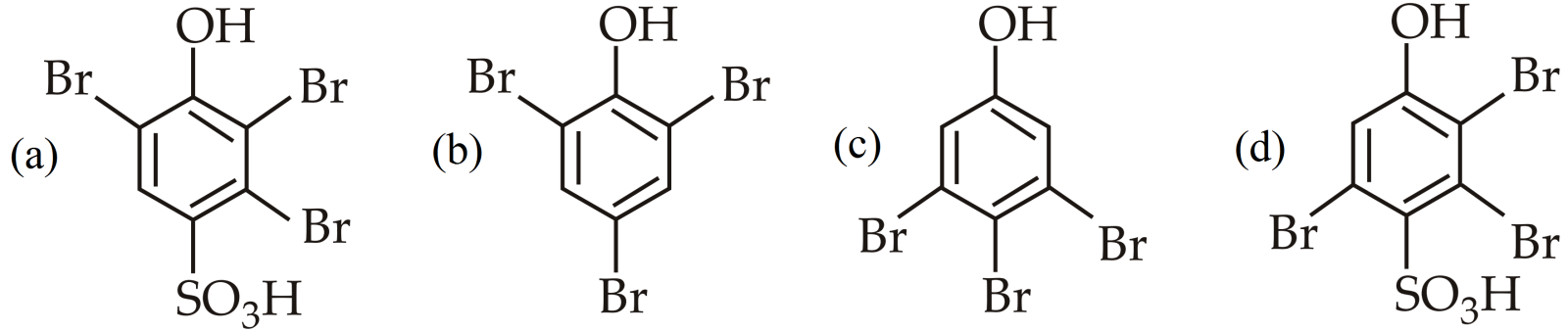
  1. The major product of the following reaction is:

What is the most suitable pKa value of the substituted propylamine formed with substituent "X" with electronegativity 3.0
(i)10.67 (ii)10.08 (iii) 10.15 (iv)11.10