Question
Read the passage given below and answer the following questions:
To explain bonding in coordination compounds various theories were proposed. One of the important theory was valence bond theory. According to that, the central metal ion in the complex makes available a number of empty orbitals for the formation of coordination bonds with suitable ligands. The appropriate atomic orbitals of the metal hybridise to give a set of equivalent orbitals of definite geometry.
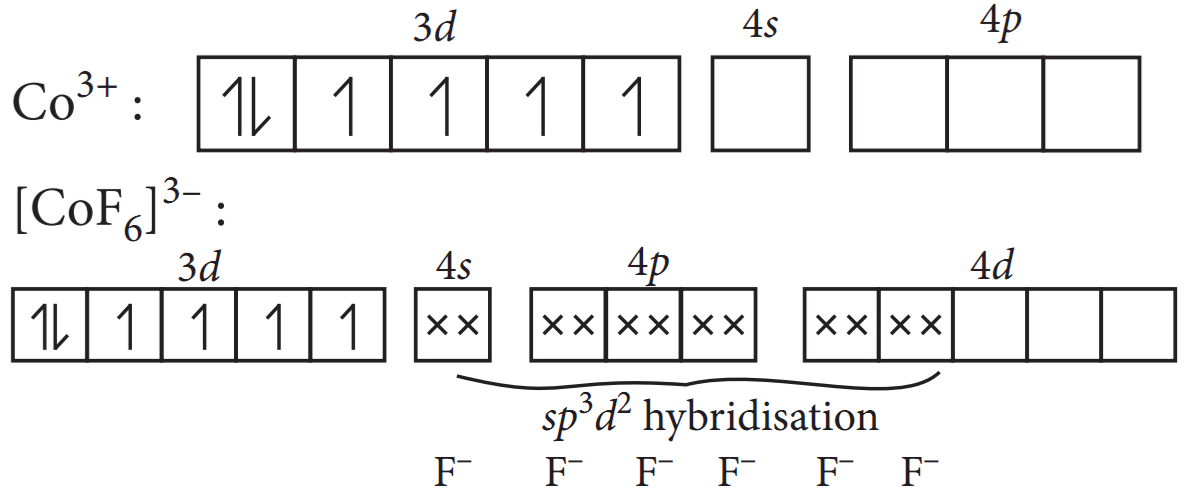
The d-orbitals involved in the hybridisation may be either inner d-orbitals i.e., $(n - 1)d$ or outer d-orbitals i.e., nd. For example, $Co^{3+}$ forms both inner orbital and outer orbital complexes, with ammonia it forms $[Co(NH_3)_6]^{3+}$ and with fluorine it forms $[CoF_6]^{3-}$ complex ion.
The following questions are multiple choice questions. Choose the most appropriate answer:
  1. Which of the following is not true for $[CoF_6]^{3-}?$
  1. It is paramagnetic.
  2. It has coordination number of $6.$
  3. It is outer orbital complex.
  4. It involves $d^2sp^3$ hybridisation.
  1. $[Cr(H_2O)_6]Cl_3 ($at. no. of $Cr = 24)$ has a magnetic moment of $3.83B.M.$ The correct distribution of $3d-$electrons in the central metal of the complex is:
  1. $3\text{d}^1_\text{xy},3\text{d}^1_{\text{x}^2-\text{y}^2},3\text{d}^1_\text{yz}$
  2. $3\text{d}^1_\text{xy},3\text{d}^1_{\text{yz}},3\text{d}^1_\text{zx}$
  3. $3\text{d}^1_\text{xy},3\text{d}^1_{\text{zy}},3\text{d}^1_{\text{z}^2}$
  4. $3\text{d}^1_{\text{x}^2-\text{y}^2},3\text{d}^1_{\text{z}^2},3\text{d}^1_\text{xz}$
  1. Which of the following is true for $[Co(NH_3)_6]^{3+}?$
  1. It is an octahedral, di magnetic and outer orbital complex.
  2. It is an octahedral, paramagnetic and outer orbital complex.
  3. It is an octahedral, paramagnetic and inner orbital complex.
  4. It is an octahedral, di magnetic and inner orbital complex.
  1. The paramagnetism of $[CoF_6]^{3-}$ is due to.
  1. $3$ electrons.
  2. $4$ electrons.
  3. $2$ electrons.
  4. $1$ electron.
  1. Which of the following is an inner orbital or low spin complex?
  1. $[Ni(H_2O)_6]^{3+}$
  2. $[FeF_6]^{3-}$
  3. $[Co(CN)_6]^{3-}$
  4. $[NiCl_4]^{2-}$

Answer

  1. (d) It involves $d^2sp^3$ hybridisation.
Explanation:

lt involves $sp^3d^2$ hybridisation and not $d^2sp^3.$​​​​​​​
  1. (b) $3\text{d}^1_\text{xy},3\text{d}^1_{\text{yz}},3\text{d}^1_\text{zx}$
Explanation:

Magnetic moment of $3.83B.M.$ suggests that it has $3$ unpaired electrons,

$\therefore n = 3$ i.e., $Cr^{3+}: 3d^3$​​​​​​​

It involves $d^2sp^3$ hybridisation so correct distribution of electrons is $3\text{d}^1_\text{xy},3\text{d}^1_{\text{yz}},3\text{d}^1_\text{zx}.$
  1. (d) It is an octahedral, di magnetic and inner orbital complex.
Explanation:

$[Co(NH_3)_6]^{3+}$ is $d^2sp^3$ hybridised with all electrons paired hence, it is diamagnetic and inner orbital complex.
  1. (b) $4$ electrons.
Explanation:

  1. (c) $[Co(CN)_6]^{3-}$​​​​​​​
Explanation:

Inner orbital complexes are formed with strong ligands as they force electrons to pair up and hence the complex will be either diamagnetic or will have less number of unpaired electrons.

Need a full question paper?

Generate a complete, print-ready paper with questions like this in minutes — across 16+ boards, with answer keys.

Start Generating Free

Similar questions

In these questions, a statement of assertion followed by a statement of reason is given. Choose the correct answer out of the following choices.
Assertion: Porous or finely divided fonns of adsorbents adsorb larger quantities of adsorbate.
Reason: The greater the specific area of the solid, the greater would be its adsorbing capacity.
Read the passage given below and answer the following questions:
Although chlorobenzene is inert to nucleophilic substitution, however it gives quantitative yield of phenol when heated with aq. $Na OH$ at high temperature and under high pressure. As far as electrophilic substitution in phenol is concemed the — OH group is an activating group, hence, its presence enhances the electrophilic substitution at o - and p - positions.
The following questions are multiple choice questions. Choose the most appropriate answer:
  1. Conversion of chlorobenzene into phenol involves:
  1. Modified $S_N1$ mechanism.
  2. Modified $S_N2$ mechanism.
  3. Both (a) and (b).
  4. Elimination-addition mechanism.
  1. Phenol undergoes electrophilic substitution more readily than benzene because:
  1. The intermediate carbocation is a resonance hybrid of more resonating structures than that from benzene.
  2. The intermediate is more stable as it has positive charge on oxygen, which can be better accommodated than on carbon.
  3. In one of the canonical structures, every atom (except hydrogen) has complete octet.
  4. The — OH group is o, p-directing which like all other o, p - directing group, is activating.
  1. Phenol on treatment with excess of cone. $HNO_3$ gives:
  1. O - nitrophenol.
  2. P - nitrophenol.
  3. O - and p - nitrophenol.
  4. 2, 4, 6 - trinitrophenol.
  1. Phenol is heated with a solution of mixture of $KBr$ and $KBrO_3$. The major product obtained in the above reaction is:
  1. 2 - bromophenol.
  2. 3 - bromophenol.
  3. 4 - bromophenol.
  4. 2, 4, 6 - tribromophenol.
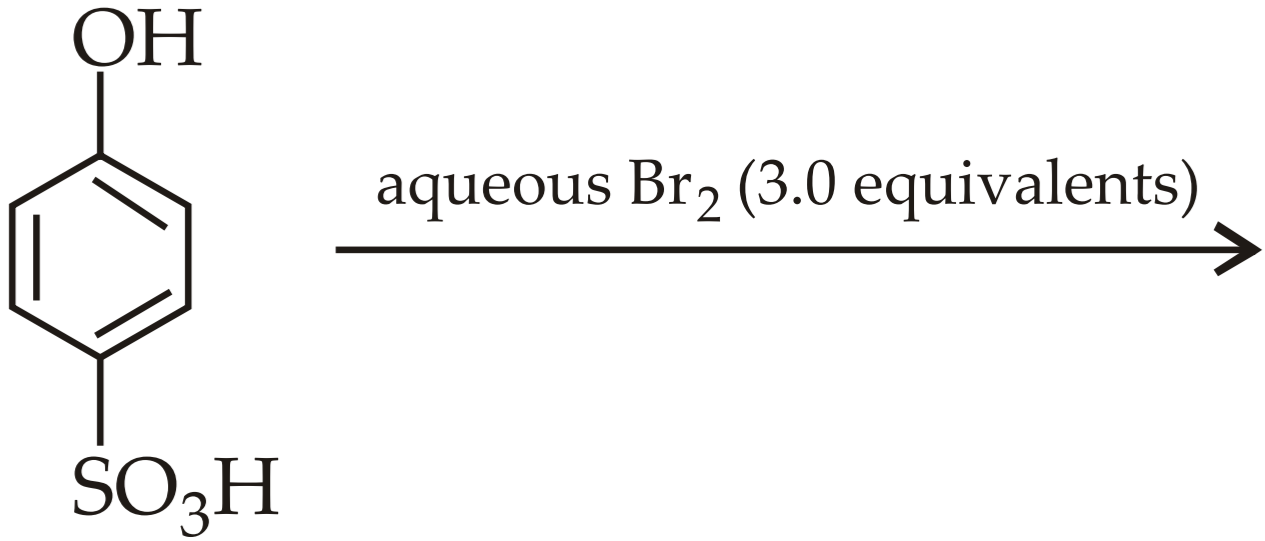
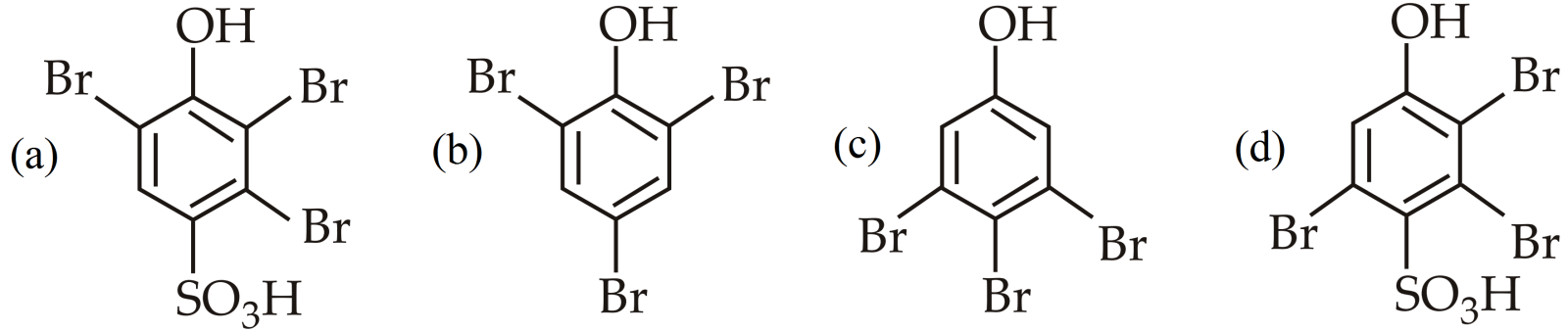
  1. The major product of the following reaction is:

In these questions, a statement of assertion followed by a statement of reason is given. Choose the correct answer out of the following choices.
Assertion: Gases are easily adsorbed on the surface of metals especially transition metals.
Reason: Transition metals have free valencies.
Read the passage given below and answer the following questions:In contrast to the disorders of gases and liquids, there is translational order in crystals. However, disordered or amorphous solids also exist which lack such order, they are really highly viscous liquids. In translational order entire structure or lattice, can be generated by repeated replication of a small regular figure, termed as unit cell. The planes of any crystalline structure can be specified using Miller indices, which is also serve to identify single crystal faces.The ordered structure, or lattice, of a solid can be determined by X-ray or neutron diffraction studies, in which a beam of X-rays of neutrons is scattered from the sample to produce a diffraction pattern which can be analyzed to reveal the crystal structure of the sample. All crystal lattices can be classified into 14 Bravais lattices belonging to 7 systems. For example, the simple cubic, face-centred cubic and body-centred cubic lattices are the 3 lattices of the cubic system. Cubic and hexagonal close-packed structures have the structure of tightly packed spheres, where each sphere touches 12 neighbours, 6 in the same plane and 3 above and 3 below. These two dose-packed structures differ in the placement of successive planes or layers. For the hexagonal close packing, a third layer is laid down to reproduce the first layer, so that the structure could be represented by ABABAB …. For cubic close packing, third layer is again displaced, corresponding to ABCABC.
The following questions are multiple choice questions. Choose the most appropriate answer:
  1. In hexagonal close packing, a sphere has coordination number of.
  1. 4
  2. 6
  3. 8
  4. 12
  1. Which of the following arrangements correctly represents hexagonal and cubic close packed structure respectively?
  1. ABCABC...and ABAB...
  2. ABAB...and ABCABC...
  3. Both have ABAB ... arrangement.
  4. Both have ABCABC... Arrangement.
  1. The arrangement of the first two layers, one above the other, in hep and ccp arrangements is.
  1. Exactly same in both cases
  2. Partly same and partly different
  3. Different from each other
  4. Nothing definite.
  1. Which of the following statements is not correct?
  1. The amorphous solids have a random, disordered arrangement of constituents.
  2. The simple cubic, face-centred and body-centred are the three lattices of the cubic system.
  3. The number of Bravais lattice in which a crystal can be categorized is 7.
  4. A metal that crystallizes in hep structure has coordination number 12.
  1. Which of the following statements about amorphous solids is incorrect?
  1. They melt over a range of temperature.
  2. There is no orderly arrangement of particles.
  3. They are anisotropic.
  4. They are rigid and incompressible.
Read the passage given below and answer the following questions: A compound (X) containing C, H and O is unreactive towards sodium. It also does not react with Schiff s reagent. On refluxing with an excess of hydroiodic acid, (X) yields only one organic product ( Y). On hydrolysis, (Y) yields a new compound (Z) which can be converted into (Y) by reaction with red phosphorus and iodine. The compound (Z) on oxidation with potassium permanganate gives a carboxylic acid. The equivalent weight of this acid is 60. The following questions are multiple choice questions. Choose the most appropriate answer:
  1. The compound (X) is an:
  1. Acid.
  2. Aldehyde.
  3. Alcohol.
  4. Ether.
  1. The IUPAC name of the acid formed is:
  1. Methanoic acid.
  2. Ethanoic acid.
  3. Propanoic acid.
  4. Butanoic acid.
  1. Compound (Y) is:
  1. Ethyl iodide.
  2. Methyl iodide.
  3. Propyl iodide.
  4. Mixture of (a) and (b).
  1. Compound (Z) is:
  1. Methanol.
  2. Ethanol.
  3. Propanol.
  4. Butanol.
  1. Compound (X) on treatment with excess of $Cl_2$ in presence of tight gives:
  1. $\propto-$ Chlorodiethyl ether.
  2. $\propto,\propto'-$ Dichlorodiethyl ether.
  3. Perchlorodiethyl ether.
  4. None of these.
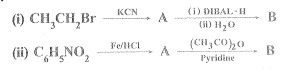
Give the structures of A and B in the following reactions
Image
Read the passage given below and answer the following questions:
Amines are produced when an alcoholic solution of ammonia and an alkyl or a benzyl halide is heated in a sealed tube at 373K. This reaction is called ammonolysis and usually gives a mixture of primary, secondary and tertiary amines along with some quarternary ammonium salts. This reaction is an example of nucleophilic substitution reaction in which ammonia acts as a nucleophile due to the presence of a lone pair of electrons on the nitrogen atom. However this method cannot be used for the preparation of aryl amines. One of the most convenient methods for the preparation of aryl amines is reduction of nitro compounds. Aryl amines can also be prepared by reduction of nitrites or Gabriel phthalimide synthesis.
A statement of assertion followed by a statement of reason is given. Choose the correct answer out of the following choices.
  1. Assertion and reason both are correct statements and reason is correct explanation for assertion.
  2. Assertion and reason both are correct statements but reason is not correct explanation for assertion.
  3. Assertion is correct statement but reason is wrong statement.
  4. Assertion is wrong statement but reason is correct statement.
  1. Assertion: Ammonolysis of alkyl halides only produces 2° amines.
Reason: Ammonolysis of alkyl halides involves the reaction between alkyl halides and alcoholic ammonia.
  1. Assertion: Gabriel-phthalimide reaction can be used to prepare both aryl and alkyl primary amines.
Reason: Aryl halides are more reactive alkyl halides towards nucleophilic substitution reactions.
  1. Assertion: Anunonolysis method cannot be used for the preparation of aryl amines.
Reason: Aryl halides are much less reactive than alkyl halides towards nucleophilic substitution reaction.
  1. Assertion: Ammonolysis can be used to prepare pure primary amines.
Reason: Ammonolysis of haloalkanes lead to multiple ammonium salts.
  1. Assertion: Aromatic 1º amines can not be prepared by Gabriel phthalimide synthesis.
Reason: Aryl halides do not undergo nucleophilic substitution with anion formed by phthalimide.
Read the passage given below and answer the following questions:
Transition elements are elements that have partially filled d-orbitals. The configuration of these elements corresponds to $(n - 1)d^{1-10}ns^{1-2}.$ It is important to note that the elements mercury, cadmium and zinc are not considered transition elements because of their electronic configurations, which corresponds to $(n - 1)d^{10}ns^2.$ Some general properties of transition elements are:
These elements can fonn coloured compounds and ions due to $d-d$ transition;
These elements exhibit many oxidation states;
A large variety of ligands can bind themselves to these elements, due to this, a wide variety of stable complexes formed by these ions. The boiling and melting point of these elements are high. These elements have a large ratio of charge to the radius.
In these questions $(Q. No. i-iv),$ a statement of assertion followed by a statement ofreason is given. Choose the correct answer out of the following choices.
  1. Assertion and reason both are correct statements and reason is correct explanation for assertion.
  2. Assertion and reason both are correct statements but reason is not correct explanation for assertion.
  3. Assertion is correct statement but reason is wrong statement.
  4. Assertion is wrong statement but reason is correct statement.
  1. Assertion: Tungsten has very high melting point.
Reason: Tungsten is a covalent compound.
  1. Assertion: $Zn, Cd$ and $Hg$ are normally not considered transition metals.
Reason: d-Orbitals in $Zn, Cd$ and $Hg$ elements are completely filled, hence these metals do not show the general characteristics properties of the transition elements.
  1. Assertion: Copper metal gets readily corroded in acidic aqueous solution such as $HCl$ and dil. $H_2SO_4.$
Reason: Free energy change for this process is positive.
  1. Assertion: Tailing of mercury occurs on passing ozone through it.
Reason: Due to oxidation of mercury.
  1. Assertion: Transition metals are poor reducing agents.
Reason: Transition metals fonn numerous alloys with other metals.
Read the passage given below and answer the following questions:
At the freezing point of a solvent, the solid and the liquid are in equilibrium. Therefore, a solution will freeze when its vapour pressure becomes equal to the vapour pressure of the pure solid solvent. It has been observed that when a non-volatile solute is added to a solvent, the freezing point of the solution is always lower than that of the pure solvent. Depression in freezing point can be given as, $\Delta\text{T}_\text{f}=\text{K}_\text{f}\text{m}$ Where, $K_f =$ Molal freezing point depression constant or we can write, $\Delta\text{T}_\text{f}=\frac{\text{K}_\text{f}\times\text{W}_\text{B}\times1000}{\text{W}_A\times\text{M}_\text{B}}$
a statement of assertion followed by a statement of reason is given. Choose the correct answer out of the following choices.
  1. Assertion and reason both are correct statements and reason is correct explanation for assertion.
  2. Assertion and reason both are correct statements but reason is not correct explanation for assertion.
  3. Assertion is correct statement but reason is wrong statement.
  4. Assertion is wrong statement but reason is correct statement.
  1. Assertion: $0.1M$ solution of glucose has same depression in the freezing point as $0.1M$ solution of urea.
Reason: $K_f $ for both has same value.
  1. Assertion: Increasing pressure on pure water decreases its freezing point.
Reason: Density of water is maximum at $273K.$
  1. Assertion: Larger the value of cryoscopic constant of the solvent, lesser will be the freezing point of the solution.
Reason: Extent of depression in the freezing point depends on the nature of the solvent.
  1. Assertion: The water pouch of instant cold pack for treating athletic injuries breaks when squeezed and NH4N03 dissolves thus lowering the temperature.
Reason: Addition of non-volatile solute into solvent results into depression of freezing point of solvent.
  1. Assertion: If a non-volatile solute is mixed in a solution then elevation in boiling point and depression in freezing point both wiII be same.
Reason: Elevation in boiling point and depression in freezing point both depend on number of particles of solute.
Read the passage given below and answer the following questions: Aldehydes and ketones undergo nucleophilic addition reactions.

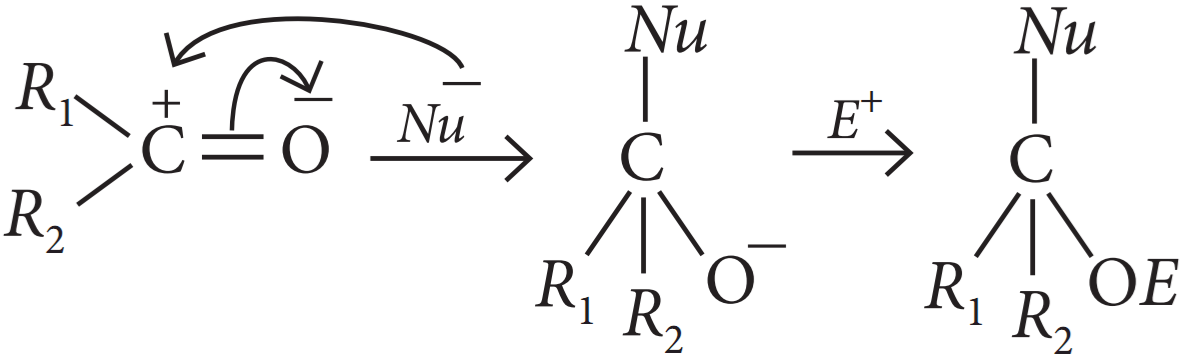
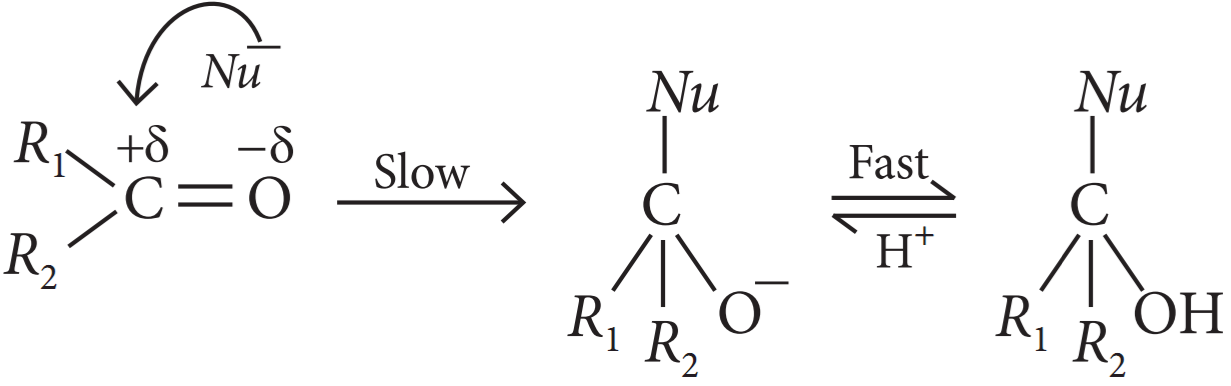
Carbonyl carbon is electron deficient hence acts as an electrophi le. Nucleophile attacks on the electrophili c carbon atom of the carbonyl group from a direction perpendicular to the plane of the molecule.

 ln this process, hybridisation of carbon atom changes from $sp^2$ to $sp^3$ and a tetrahedral alkoxide ion is formed as intermediate. This intermediate captures proton from the reaction medium to give the neutral product. Aldehydes are generally more reactive than ketones in nucleophilic addition reactions. In these questions $(Q. No. l-iv),$ a statement of assertion followed by a statement ofreason is given. Choose the correct answer out of the following choices.
  1. Assertion and reason both are correct statements and reason is correct explanation for assertion.
  2. Assertion and reason both are correct statements but reason is not correct explanation for assertion.
  3. Assertion is correct statement but reason is wrong statement.
  4. Assertion is wrong statement but reason is correct statement.
  1. Assertion: Benzaldehyde is more reactive than ethanal towards nucleophitic attack.
Reason: The overall effect of $-I$ and $+R$ effect of phenyl group decreases the electron density on the carbon atom of $>c=o$ group in benzaldehyde.
  1. Assertion: $(CH_3)_3CCOC(CH_3)_3$ and acetone can be distinguished by the reaction with $NaHSO_3.$
Reason: $HSO_3$ is the nucleophile in bisulphite addition.
  1. Assertion: Ease of nucleophilic addition of the compounds  $(I). CH_3CHO$ $(II)$ and $CH_3COCH_3(III)$ is$ I > II > III.$
Reason: Aldehydes and ketones undergo nucleophilic addition reactions.
  1. Assertion: The formation of cyanohydrin from an aldehyde or ketone occurs very slowly with pure $HCN$. The is reaction is catalysed by a base.
Reason: Base generates $CN^-$ ion which is a stronger nucleophile.
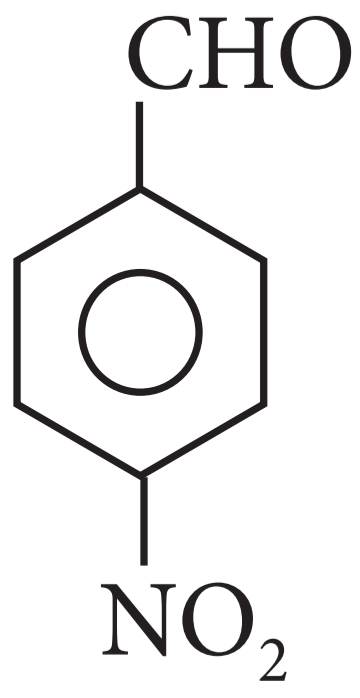
  1. Assertion: is more reactive towards nucleophilic addition reaction than .
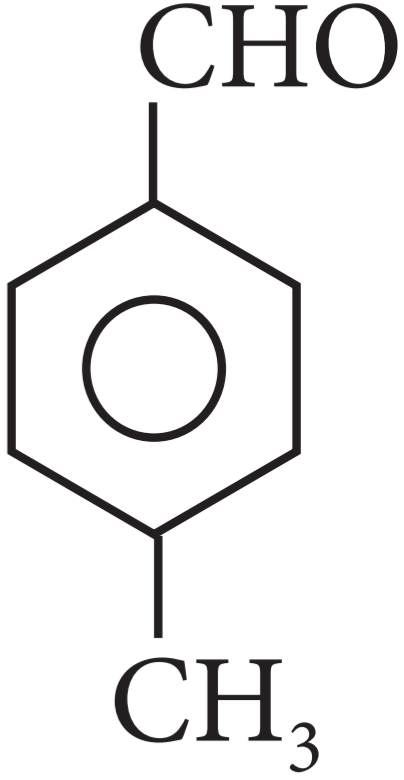
Reason: Reactivity of carbonyl group is due to electrophilic nature of carbonyl carbon.